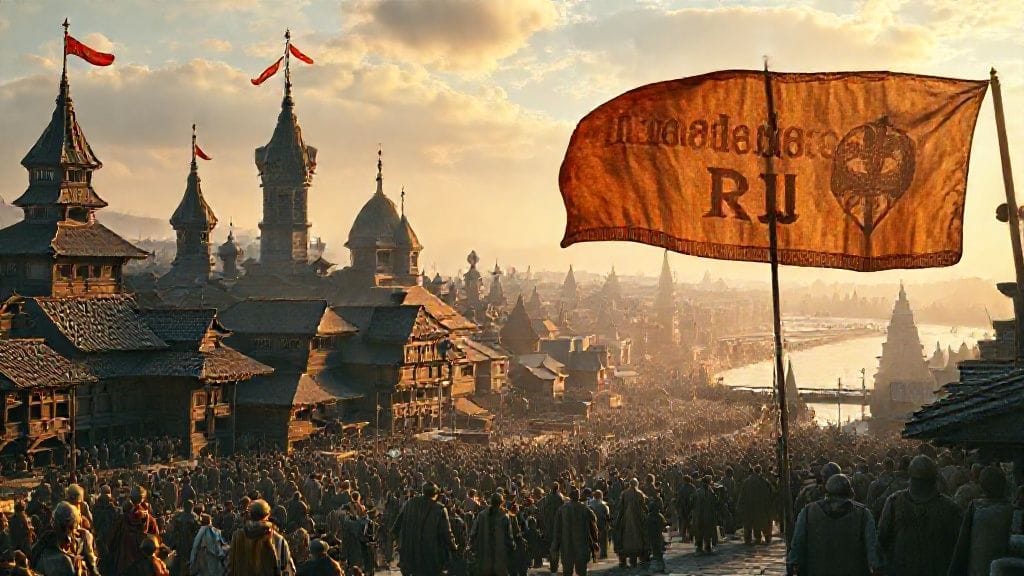
Table of Contents
- The Dawn of a New Era: Kiev’s Pulse in the Late 10th Century
- The Fragmented Lands of Kievan Rus’: A Mosaic of Power and Conflict
- Vladimir the Great: The Reluctant Heir in a Violent Realm
- The Struggle for Kiev: Brotherhood and Betrayal
- The Consolidation of Power: Reuniting the Rus’ Principalities
- The Quest for Spiritual Unity: From Paganism to Christianity
- The Baptism of the Rus’: A Turning Point in Eastern Europe
- Political Reforms and Governance: Crafting a Centralized State
- Military Campaigns and Defenses: Expanding Borders and Fending Off Invaders
- Diplomacy and Alliances: Ties That Shaped the Medieval World
- The Cultural Renaissance: Literacy, Architecture, and Law
- Vladimir’s Legacy: The Foundations of a Rus’ Identity
- The Economic Vibrancy of Kiev: Trade Routes and Urban Growth
- The Role of the Church in State and Society
- The Aftermath of Vladimir’s Reign: Seeds for Future Kingdoms
- The Symbolism of Saint Vladimir: Myth, Memory, and Nationhood
- Reflections from the Primary Chronicles and Norse Sagas
- The Global Significance: Eastern Europe at the Crossroads
- Conclusion
- FAQs
- External Resource
- Internal Link
1. The Dawn of a New Era: Kiev’s Pulse in the Late 10th Century
The year 980 dawned over the sprawling, river-laced landscape of Eastern Europe like a restless breath before a storm. Along the bustling banks of the Dnieper River, Kiev arose—not just as a trading hub, but as the throbbing heart of Kievan Rus’, a tapestry of Slavic principalities stitched together amid conflict and fragile alliances. The air was thick with whispers of change. Forests stood vast and wild, unyielding to the ambitions of men, but Kiev—this burgeoning city of wooden fortifications, bustling marketplaces, and Orthodox chapels yet to come—was pulsing with latent potential. Amidst the clamor of merchants, warriors, and envoys, one man’s name stirred anxiety and hope alike: Vladimir.
From the frozen steppes of the north to the fertile valleys below the Black Sea, the Kievan Rus’ lay divided, a realm as much defined by clan loyalties, Norse warrior princes, and pagan cults as by nascent statecraft. Yet, from this chaotic weave, Vladimir the Great was about to weave a new order that would echo through centuries. The story of his consolidation, his difficult choices, and his lasting reforms is not just a chronicle of power but a human saga of ambition, faith, and transformation.
2. The Fragmented Lands of Kievan Rus’: A Mosaic of Power and Conflict
To understand the full magnitude of Vladimir’s achievement, one must first peer into the fractured reality he inherited. Kievan Rus’, forged through a blend of Slavic tribes, Varangian marauders, and trading cultures, was a patchwork of shifting loyalties. Different principalities often warred with kin, while myriad pagan beliefs and Norse traditions competed for reverence. Kiev, the jewel of the realm, was surrounded by provincial centers such as Novgorod, Chernigov, and Polotsk—each ruled by princes vying for autonomy or dominance.
Trade thrived along key routes connecting the Baltic to Byzantium, with Kiev at the crossroads. Yet, political fragmentation bred internal strife; often, brother fought brother with ruthlessness fueled by ambition and vengeance. In this turbulent soil grew the seeds of Vladimir’s eventual ascent.
3. Vladimir the Great: The Reluctant Heir in a Violent Realm
Vladimir was not born a triumphant ruler but rather a son shaped by exile and hardship. The son of Prince Sviatoslav I, he initially found refuge in Novgorod during power struggles with his father’s other sons. Contemporary chronicles paint him as ruthless yet pragmatic, a leader marked by calculating resolve as much as by military prowess. His youth was steeped in the traditions of the Varangians—Norse warriors who had integrated deeply into Slavic lands—even as he governed over a predominantly Slavic, largely pagan population.
Such tensions between cultural heritages and religious worldviews underscored Vladimir’s early years. His consolidation of power would not just redefine borders but reshape the very identity of his people.
4. The Struggle for Kiev: Brotherhood and Betrayal
Perhaps the most gripping chapter before Vladimir’s dawn as Grand Prince was the bloody tussle for Kiev itself—a city whose control meant supremacy over Rus’. Following Sviatoslav’s death, sons battled for inheritance. Vladimir had to challenge his own brothers, employing both battlefield strategy and political cunning.
His victory was neither swift nor total, but it was decisive. The historical narrative reveals moments where kinship and treachery intertwined, illuminating the brutal nature of medieval princely rivalry. Vladimir’s seizure of Kiev in 980 was as much a testament to his military might as to his strategic patience.
5. The Consolidation of Power: Reuniting the Rus’ Principalities
With Kiev under his control, Vladimir faced the formidable task of bringing the fractious principalities into a cohesive realm. His rule signaled a transition from warring fiefdoms to an embryonic state, where allegiance was reluctantly centralized but gradually accepted. He imposed order through redistribution of lands to loyalists and strategic marriages, cultivating a network of alliances holding the Rus’ lands together.
His administrative reforms laid groundwork for governance structures that mixed traditional tribal councils with expanding princely authority. This delicate balancing act forged a new political reality, stabilizing the region and enhancing Kiev’s prominence.
6. The Quest for Spiritual Unity: From Paganism to Christianity
Central to Vladimir’s consolidation was a profound religious transformation, a pivot with political, social, and cultural implications. The polytheistic pagan beliefs, the veneration of Slavic gods like Perun and Mokosh, underpinned the old order but lacked unifying cohesion. Vladimir understood that to unify his people, he needed more than military power; he needed a shared faith.
His legendary conversion to Christianity was both spiritual awakening and masterstroke of statecraft. According to the Primary Chronicle, Vladimir dispatched emissaries to learn about Judaism, Islam, and Christianity before choosing the Byzantine Orthodox faith—a decision that would realign Kievan Rus’ with the Christian world. His baptism and that of his court in 988 marked the beginning of the Christianization of Rus’, a process that infused the political with the sacred.
7. The Baptism of the Rus’: A Turning Point in Eastern Europe
The ceremonial baptism in the Dnieper River was no mere religious rite; it was the consecration of the Rus’ as a player in the Christian arena. This event rippled far beyond Kiev’s wooden walls. Byzantium embraced the Rus’, creating diplomatic bonds that brought cultural, artistic, and intellectual currents. Churches sprang up, literacy began to blossom with the introduction of the Cyrillic script, and Christian law codes blended with native traditions.
Yet, this watershed moment came with tensions; pagan resistance simmered underground for decades, and the conversion exposed Rus’ to new enemies and allies alike. But undeniably, it marked the birth of a new identity.
8. Political Reforms and Governance: Crafting a Centralized State
Vladimir’s reign was notable for more than warfare and religion. His administrative reorganization enhanced the role of Kiev as a centralized authority that could project power effectively. Districts were governed by trusted princes or appointed governors; taxation systems were codified; and legal codes began to reflect Christian ethics.
This emerging bureaucratic anatomy did not erase the influence of tribal customs but reinterpreted them in the light of new governance needs. Vladimir’s synthesis of old and new resolved persistent issues of local autonomy versus princely authority, embedding mechanisms of justice, loyalty, and control.
9. Military Campaigns and Defenses: Expanding Borders and Fending Off Invaders
An astute commander, Vladimir expanded Rus’ borders through campaigns against neighboring tribes such as the Volga Bulgars and Polanians. His forces laid the foundations for a multi-ethnic state, integrating diverse peoples under Rus’ suzerainty.
Defensively, Vladimir fortified strategic points along key river routes. Fortifications around Kiev, Novgorod, and other centers not only deterred raiders but symbolized the maturing state’s resilience. His military ventures underscored that consolidation was not just diplomatic, but fought for on the battlefield.
10. Diplomacy and Alliances: Ties That Shaped the Medieval World
Vladimir’s rule was as much about alliances as arms. His marriage to the Byzantine princess Anna was a political masterstroke, linking Rus’ to one of the era’s greatest empires. This bond elevated Kiev’s status and opened avenues for cultural exchange and influence.
Moreover, Vladimir negotiated marriages and treaties across the Baltic and Slavic worlds, building a network that sustained peace and expanded Rus’ influence. These diplomatic moves exemplified medieval statecraft’s reliance on kinship and faith as much as on swords.
11. The Cultural Renaissance: Literacy, Architecture, and Law
With conversion came literacy. Byzantine monks brought the Cyrillic alphabet, enabling the transcription of religious texts and chronicles. This fostered an intellectual flowering; architecture thrived with the construction of stone churches like the Saint Sophia Cathedral of Kiev, combining Byzantine and local styles.
Legal codification blended Christian norms with customary law, producing the earliest versions of Kievan law codes. This cultural renaissance seeded a distinct Slavic identity, blending Eastern Christian spirituality with native traditions.
12. Vladimir’s Legacy: The Foundations of a Rus’ Identity
By the time of his death in 1015, Vladimir had transformed a fractious collection of principalities into a coherent, if still evolving, polity. His decisions etched deep into the Rus’ psyche: Christian faith, centralized rulership, and openness to Byzantine culture defined the region for centuries.
Historians regard Vladimir as the architect of the Kievan Rus’ state and the spiritual father of Eastern Slavic civilization. His name and deeds became mythologized, a symbol of unity and piety invoked through ages of upheaval.
13. The Economic Vibrancy of Kiev: Trade Routes and Urban Growth
The consolidation under Vladimir catalyzed a commercial boom. Kiev sat astride the great "from the Varangians to the Greeks" trade route, channeling furs, honey, wax, and slaves from the north to Constantinople and beyond.
Urban population swelled with merchants, craftsmen, and clerics, transforming Kiev into a cosmopolitan center. Markets thrived, currencies circulated, and the city’s economic infrastructure laid the groundwork for Rus’ prosperity—and its attraction to foreign powers.
14. The Role of the Church in State and Society
The newly established Orthodox Church became a pillar of Vladimir’s statehood. Clergy administered spiritual matters, educated the populace, and took part in governance. Bishops gained political influence while promoting monastic life and charity.
The church justified princely authority by divine right, intertwined religious ritual with state ceremonies, and gradually shaped social norms. It was both a conservator of tradition and a vehicle for cultural transformation.
15. The Aftermath of Vladimir’s Reign: Seeds for Future Kingdoms
Vladimir’s successors inherited a kingdom both enhanced and challenged. Though internal rivalries re-emerged, the Christian identity and centralized structures persisted. Kievan Rus’ became a model for emerging states like Muscovy, Ukraine, and Belarus centuries later.
His reign set patterns of governance, faith, and culture echoed through medieval and modern Eastern Europe, helping to define national narratives and geopolitical realities.
16. The Symbolism of Saint Vladimir: Myth, Memory, and Nationhood
Vladimir’s sainthood in the Orthodox Church immortalized him as a paragon of Christian kingship. Through centuries of folklore and historiography, he evolved into an emblem of piety, sovereignty, and the “baptizer” of his people.
In modern times, his figure has been invoked to underscore cultural identity and statehood, reflecting the enduring power of historical memory. The layered ways Vladimir is remembered illuminate the complex dialogue between past and present.
17. Reflections from the Primary Chronicles and Norse Sagas
The Primary Chronicle, compiled in the 12th century by monks, offers the most detailed contemporary glimpse of Vladimir’s life and times—but it is as much literary and theological as factual. Norse sagas introduce contrasting, sometimes conflicting perspectives, emphasizing his Varangian roots.
Together, these sources enrich our understanding, revealing not only political events but mentalities, biases, and cultural intersections shaping Kievan Rus’.
18. The Global Significance: Eastern Europe at the Crossroads
Vladimir’s consolidation of Rus’ resonates far beyond his own borders or era. His embrace of Orthodox Christianity realigned Eastern Europe geopolitically, culturally, and religiously.
In the flow of medieval civilizations—between Byzantium, nomadic steppe peoples, and Western Christendom—Kievan Rus’ became a decisive crossroads. Vladimir’s state-building efforts sowed seeds for later empires, influencing the trajectory of European and Eurasian history.
Conclusion
Vladimir the Great’s consolidation of Kievan Rus’ in the 980s was a masterstroke of leadership that melded brute force, vision, and faith into a transformative epoch. Against the backdrop of internecine war and fragmented tribal allegiances, Vladimir emerged as the architect of a state capable of enduring internal pressures and external threats.
His conversion to Christianity was more than spiritual; it was a political revolution that shaped the cultural DNA of Eastern Slavs. Under his reign, commerce flourished, fortresses rose, laws were crafted, and a shared identity began to crystallize. Yet Vladimir was not a mythic figure born perfect—he was a man of complexity, ambition, and contradictions whose story is suffused with both violence and grace.
Today, his legacy remains etched in the cities, churches, and chronicles of Eastern Europe, resonating through centuries as a symbol—of unity, transformation, and the power of leadership. The tale of Vladimir and his Rus’ is a reminder that history is not just about dates and battles but about the enduring human quest to forge meaning and community out of chaos.
FAQs
Q1: What circumstances led Vladimir the Great to consolidate power in Kievan Rus’?
A1: After the death of his father, Prince Sviatoslav, Rus’ descended into fraternal conflict. Vladimir, initially exiled, seized Kiev through military and political means, aiming to restore order among competing principalities fractured by kinship rivalries and clan politics.
Q2: Why was Vladimir’s conversion to Christianity so significant politically?
A2: Christianity offered Vladimir a unifying and legitimizing ideology that transcended tribal paganism. Adopting Byzantine Orthodox Christianity aligned Rus’ with a powerful empire, expanded diplomatic ties, and instilled a shared spiritual identity crucial for centralizing authority.
Q3: How did Vladimir’s governance reforms impact the structure of Kievan Rus’?
A3: Vladimir introduced administrative centralization by appointing loyal governors, redistributing lands, and codifying laws melding tribal customs with Christian ethics. This stabilized the realm and allowed Kiev to exercise stronger control over outlying regions.
Q4: What role did Vladimir’s marriage alliances play in his consolidation of power?
A4: Strategic marriages, most famously with Byzantine Princess Anna, bolstered diplomatic legitimacy and cultural exchange. These alliances facilitated peace with neighboring states and elevated Kiev’s status in the medieval world.
Q5: How did the Christianization of Rus’ affect its cultural development?
A5: It spurred literacy through the introduction of the Cyrillic script, led to the construction of monumental churches, and inspired codified legal systems—all of which fostered a cohesive cultural identity blending Slavic traditions with Byzantine Christian influence.
Q6: In what ways does Vladimir remain a symbol in modern Eastern European history?
A6: Vladimir is revered as the "baptizer" of the East Slavs and a foundational national figure in Ukraine, Russia, and Belarus. His legacy is evoked in religious and political narratives underscoring unity, sovereignty, and Christian heritage.
Q7: Were there any significant oppositions to Vladimir’s rule and reforms?
A7: Yes, pagan resistance persisted, and several of Vladimir’s sons contended for power after his death, causing instability. Nonetheless, Christianization and state centralization endured as enduring legacies.
Q8: What sources inform historians about Vladimir and Kievan Rus’?
A8: The Primary Chronicle, Norse sagas, Byzantine records, and archaeological evidence collectively illuminate Vladimir’s era, though each source comes with its own perspectives and biases.

