Table of Contents
- The Final Breath of a Renaissance Monarch
- The Shifting Power of Central Europe in 1490
- Matthias Corvinus: The Black King’s Rise to Glory
- Vienna: A City at the Crossroads of Empires
- The Weight of the Crown: Matthias’s Reforms and Ambitions
- The Campaigns Beyond Borders: Hungary’s Military Might
- The Deathbed in Vienna: April 6, 1490
- Reactions Across the Kingdom and Empire
- The Succession Crisis and Its Aftermath
- Matthias’s Legacy in Hungary and Beyond
- The Fate of Vienna After the King’s Death
- Dynastic Struggles and the Habsburg Ascendancy
- Cultural Flourishment Under Matthias’s Patronage
- The End of an Era: Hungary’s Political Fragmentation
- Europe at the Dawn of the 16th Century
- The Memory and Myth of King Matthias Corvinus
The Final Breath of a Renaissance Monarch
On a cold spring day in the heart of Vienna, the air hung heavy with anticipation and sorrow. April 6, 1490—this was the day King Matthias Corvinus exhaled his last, closing a chapter of Central European history marked by brilliance, ambition, and turbulence. The very halls of the Hofburg Palace, where the king had sought refuge and commanded his campaigns, seemed to hold their breath in silent witness to the passing of a ruler who had carved out an empire through intellect and iron will.
The death of Matthias was not just the fall of a man but the eclipse of a transformative age. From the fleeting flicker on his deathbed, the future of Hungary, Vienna, and indeed the greater European stage stood at a precarious crossroads. Yet, beneath the veils of mourning, the ripples of his demise spread powerful undercurrents of political intrigue, dynastic contention, and war. It was a moment pregnant with both loss and new beginnings.
The Shifting Power of Central Europe in 1490
The late 15th century was a tumultuous epoch for Central Europe. The great kingdoms and principalities were locked in an uneasy dance, balancing alliances, conquests, and tradition. Matthias Corvinus, King of Hungary and Croatia, was a towering figure in this grand chessboard. His reign had challenged the supremacy of the Habsburgs and repositioned Hungary as a military and cultural powerhouse.
Vienna, the imperial seat of the Habsburg dynasty, held profound symbolic and strategic weight. The city’s capture by Matthias in 1485 was a landmark that underscored the shifting tides. Yet, despite this triumph, the political landscape was fragile. Behind closed doors and within shadowed chambers, leaders pondered the implications of Matthias’s fate, knowing that the king’s death could unravel hard-won gains or ignite renewed conflicts.
Matthias Corvinus: The Black King’s Rise to Glory
Born in 1443 to a non-dynastic family, Matthias Hunyadi rose against the entrenched nobility through unmatched intellect, fierce resolve, and military genius. Nicknamed "Corvinus" after the black raven emblem he bore, he was celebrated as a Renaissance ruler who modernized his kingdom like no other. His court attracted humanists, scholars, and artists, while his army, the famed Black Army, was a force feared across Europe.
From his early years, Matthias embodied contrasts—a warrior prince fluent in Latin and the humanist ideals, wielding a sword with the same confidence as a quill. His reforms reorganized Hungary’s administration, judiciary, and military, and his campaigns expanded his influence into Austria, Moravia, and into the heart of the Holy Roman Empire itself.
Vienna: A City at the Crossroads of Empires
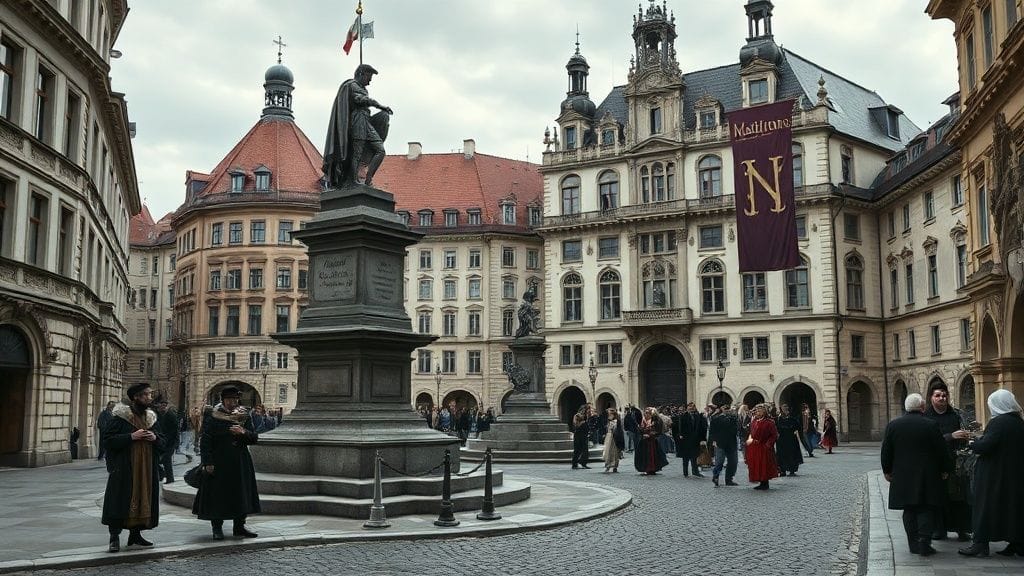
Vienna was no ordinary city—its cobbled streets and soaring spires bore witness to centuries of imperial ambitions and dynastic struggle. By the time Matthias besieged and seized it in 1485, Vienna was a symbol of power and privilege, the jewel of Habsburg dominion. For Matthias, occupying Vienna was both a military triumph and a statement: Hungary was an equal, if not superior, player in the concert of European powers.
Yet, the city's nobles and citizens were divided, many uneasy under a foreign king who represented Hungarian authority. The castle walls and city gates echoed with intrigue and cautious optimism. The presence of Matthias in Vienna was a precarious balance of diplomacy, suppression, and cultural exchange.
The Weight of the Crown: Matthias’s Reforms and Ambitions
Matthias Corvinus was no mere conqueror; he was a visionary statesman. He tirelessly worked to centralize royal power, curtail the influence of the magnates, and enforce justice through a streamlined legal system. His famed “Consilium Aulicum,” an inner council of trusted advisors, was an early model of governance that combined merit and loyalty.
His ambition extended beyond borders. As protector of the Church and champion of the Renaissance, Matthias sought to position his kingdom as a beacon of strength and culture at a time when Europe grappled with the waning Middle Ages and dawning modernity.
The Campaigns Beyond Borders: Hungary’s Military Might
The Black Army, Matthias's elite mercenary force, was revolutionary—a standing professional army at a time when feudal levies dominated Europe. Their campaigns not only expanded Hungary’s territory but also challenged the Ottoman Turks pressing from the southeast and posed a direct threat to the Habsburgs.
Matthias masterfully combined diplomatic cunning with battlefield prowess, mastering sieges and open warfare alike. His capture of Vienna was the crowning jewel in this military saga and symbolized the apex of Hungarian regional dominance.
The Deathbed in Vienna: April 6, 1490
But the unstoppable king was mortal. In early 1490, weakened by old wounds and the toll of constant war, Matthias fell gravely ill in Vienna. Attended by physicians whose art was more alchemy than science, the king lingered in states of pain and lucidity. His court held its breath, aware that the end of this legendary figure would open a void.
His death on April 6 was quiet, a stark contrast to the thunderous campaigns of his life. Yet, as the ink dried on this final act, the corridors buzzing with courtiers and generals knew that this was the death not just of a monarch but of an entire political order.
Reactions Across the Kingdom and Empire
News of Matthias’s death swept across Hungary, Austria, Bohemia, and beyond like wildfire. For many Hungarians, it was the loss of a father figure—the “Black King” who had elevated their nation’s status and pride. In Vienna, uncertainty spread; the locals feared Habsburg retaliation, while foreign courts balanced opportunism with diplomacy.
Political factions jockeyed for control. Matthias had died without a legitimate heir, setting off a fierce contest that would pit nobles and claimants against one another. At the same time, neighboring powers, especially the Habsburgs and the Ottomans, watched keenly, calculating their next moves.
The Succession Crisis and Its Aftermath
Without a crowned successor, Matthias’s death triggered a crisis. The Hungarian throne became a prize contested between rival nobles and foreign princes. Despite his efforts to strengthen royal authority, Andreas Corvinus, Matthias’s illegitimate son, was bypassed by the nobility, fearful of centralized power.
Eventually, Vladislaus II of Bohemia, from the Jagiellonian dynasty, was elected king but lacked the formidable strength and political acumen of Matthias. This period of instability weakened Hungary significantly and opened the door to increased Ottoman incursions and Habsburg influence.
Matthias’s Legacy in Hungary and Beyond
Despite the swift unraveling after his death, Matthias Corvinus left an indelible imprint. His reforms planted seeds for modern governance, his patronage fueled a Renaissance cultural blossoming in Central Europe, and his military strategies influenced European warfare for decades.
In the memories of his people, Matthias was more than a king—he was a symbol of national pride, justice, and enlightened rule. His reign was often idealized as a golden age, bittersweet in hindsight for what it revealed about the fragility of power.
The Fate of Vienna After the King’s Death
Vienna, liberated from Matthias’s control, returned to Habsburg hands but bore the scars of foreign occupation. The city focused inward, rebuilding and fortifying itself against future threats. The legacy of Matthias’s occupation lingered in the city’s cultural and architectural fabric, a reminder of the fluidity of borders and rulers.
Vienna would continue to be a fulcrum for imperial ambition, navigating the chaotic waters stirred by Matthias’s passing and the rising tides of the Reformation and Ottoman pressure.
Dynastic Struggles and the Habsburg Ascendancy
Matthias’s death marked the beginning of the Habsburgs’ steady ascent in Central Europe. The political vacuum allowed them to consolidate their hold, ultimately paving the way for the empire that shaped European history for centuries.
Yet, this rise was neither swift nor uncontested. The dynastic struggles that followed were violent and divisive, fundamentally transforming the political map of the region.
Cultural Flourishment Under Matthias’s Patronage
One of Matthias’s most lasting contributions was his patronage of the arts and scholarship. His royal library, the Bibliotheca Corviniana, was among the largest of its time, housing rare manuscripts and humanist works. He drew painters, poets, and thinkers to his court, fostering a vibrant Renaissance culture in Hungary.
This flowering of art and learning was remarkable for Central Europe, a bridge between East and West, mediating the currents emerging from Italy and the German lands.
The End of an Era: Hungary’s Political Fragmentation
The death of Matthias presaged a decline in Hungary’s political cohesion. The kingdom fragmented under pressures both internal—noble rebellions, weak monarchy—and external—Ottoman advances, Habsburg encroachment.
The unity forged by Matthias’s iron will unraveled, echoing wider European trends of fragmented sovereignties and contested borders, setting the stage for the dramatic conflicts of the 16th century.
Europe at the Dawn of the 16th Century
Matthias’s passing coincided with Europe’s fragile step into modernity. The Renaissance was dawning; new scientific ideas and exploration beckoned. But at the same time, religious tensions, emerging nation-state rivalries, and Ottoman threats foreshadowed centuries of upheaval.
His death symbolized the close of a chapter where kings could both be patrons of culture and masters of war—a fading model in an age on the verge of transformation.
The Memory and Myth of King Matthias Corvinus
Centuries later, Matthias Corvinus remains a fixture in Hungarian national identity, a symbol invoked in literature, folklore, and political discourse. The “Black King” embodies ideals of justice, wisdom, and strength—a mythic figure whose reality was deeply human.
This lasting legacy testifies not only to the man himself but to the yearning for strong, enlightened leadership in turbulent times.
Conclusion
King Matthias Corvinus’s death on April 6, 1490, was a moment that echoed far beyond the chambers of Vienna’s Hofburg Palace. It marked the end of a dynamic reign characterized by visionary reforms, military exploits, and cultural refinement. Yet, it also unraveled an era of relative stability in Central Europe, plunging Hungary into political turmoil and opening pathways for rivalry and conquest.
More than a king, Matthias was a symbol of Renaissance ideals adapted to the harsh realities of medieval power struggles. His legacy lives on—not only in history books and monuments but in the cultural consciousness of a region shaped by his dreams and dilemmas.
The story of his final days in Vienna is a poignant reminder of the fragility of human endeavor and the tides of history that no monarch can fully command.
FAQs
Q1: Who was Matthias Corvinus and why was he called the Black King?
A1: Matthias Corvinus was King of Hungary and Croatia from 1458 until his death in 1490. He was nicknamed the “Black King” after the raven (corvus in Latin) that appeared on his coat of arms. His reign was noted for strong leadership, military success, and patronage of arts and education.
Q2: What was the significance of Vienna during Matthias’s reign?
A2: Vienna was the ancestral seat of the Habsburgs and a strategic hub in Central Europe. Matthias captured Vienna in 1485, extending his influence into Austria and challenging Habsburg dominance, though he held it for only a few years.
Q3: How did Matthias Corvinus modernize Hungary?
A3: Matthias introduced judicial reforms, centralized administration, and created a professional standing army known as the Black Army. He fostered Renaissance humanism through his court and amassed a vast royal library.
Q4: What were the immediate effects of Matthias’s death on Hungary and Central Europe?
A4: His death triggered a succession crisis since he had no legitimate heir accepted by the nobility. This led to political instability, weakened royal authority, renewed noble factionalism, and a decline in Hungary’s power relative to the Ottomans and Habsburgs.
Q5: Why is Matthias Corvinus still remembered today?
A5: He is regarded as one of Hungary’s greatest kings, a Renaissance prince who combined military might with cultural patronage. His myth endures as a symbol of national pride and enlightened rule.
Q6: How did Matthias’s reign impact the balance of power in Central Europe?
A6: Matthias’s campaigns and reforms challenged the dominance of the Habsburgs and delayed Ottoman advances temporarily. His rule shifted power dynamics through territorial expansion and cultural achievements.
Q7: What happened to Vienna after Matthias’s death?
A7: Vienna was retaken by the Habsburgs and resumed its role as the imperial capital, reinforcing its defenses and gradually recovering from the disruptions of Hungarian occupation.
Q8: Did Matthias Corvinus leave an heir to continue his dynasty?
A8: Matthias had an illegitimate son, John Corvinus, but he was never accepted as king. The nobility elected Vladislaus II from the Jagiellonian dynasty, marking the end of the Hunyadi family’s reign.

