Table of Contents
- A Gift of Earth in a Restless Age: Setting the Scene in 764
- The Rise of Mercia and the Making of a King
- Offa Before the Crown: Bloodlines, Exile, and Ambition
- What It Meant to Grant Land in Early Medieval England
- The Stoke Charter of 764: Reimagining a Day of Gift
- Witnesses Around the Parchment: Bishops, Thegns, and Royal Kin
- Power, Piety, and Strategy: Why King Offa Granted Stoke
- Stoke and the Landscape of Mercia: Fields, Forests, and Frontiers
- The People of Stoke: Farmers, Slaves, Monks, and Warriors
- Ink, Formula, and Oath: Inside an Anglo-Saxon Royal Charter
- Church and Crown: Offa’s Long Game with the Bishops
- From Stoke to Offa’s Dyke: Building a Mercian Empire
- Shadow and Light: Violence Behind the Gifts
- Remembering and Forgetting: How Offa Shaped His Own Legacy
- The Fate of Stoke After Offa: Continuity, Ruin, and Reinvention
- Reading Between the Lines: What the Stoke Grant Reveals About Power
- Conclusion
- FAQs
- External Resource
- Internal Link
Article Summary: In the year 764, in the heart of what is now England, king offa of mercia set his name to a grant of land at a place called Stoke, transforming a patch of earth into a tool of power and piety. This article follows that single act and stretches it across the wide canvas of the eighth century, tracing how a king’s signature could alter lives, landscapes, and loyalties. We explore the rise of Mercia, the personal struggles and ambitions of king offa of mercia, and the subtle politics hidden in royal charters. Through narrative reconstruction and historical analysis, the grant at Stoke becomes a window into the lives of peasants, monks, and nobles who moved in the king’s shadow. We look at why land grants mattered, how they were written, blessed, and witnessed, and how they bound church and crown together in a fragile alliance. Along the way, we follow king offa of mercia from this early gift to his immense frontier work at Offa’s Dyke and his complex dealings with the Church of Rome. By the end, the episode at Stoke in 764 emerges not as an isolated event, but as a decisive step in the making of a Mercian empire under king offa of mercia. It is a story of parchment and plough, of oaths and fears, of one man’s attempt to anchor his rule in the soil of Mercia itself.
A Gift of Earth in a Restless Age: Setting the Scene in 764
In the damp chill of an English spring, sometime in the year 764, a small group gathered around a table that was barely more than a plank resting on trestles. Outside, the low sky pressed over the fields, and smoke coiled up from scattered timber halls. Inside, where rushlights bled a wavering yellow onto rough-hewn beams, a royal scribe bent over a sheet of scraped animal skin. A king had come to give away land.
The king was Offa, ruler of the Mercians, and the land lay at a place called Stoke—one of those English names that spoke simply of stakes and stockades, of a rough enclosure in a rough age. For the men and women who lived in its shadow, this might have seemed like an ordinary day, another turn in the ancient rhythm of sowing and reaping. Yet within the hushed murmurs of that chamber, lines of ink were about to redefine who owned the soil beneath their feet, who owed whom their labor, and under whose protection they would live and die.
Charters like this—dry lists of bounds and witnesses to the modern eye—were, in their time, instruments of drama. They spoke in the solemn, padded phrases of Latin diplomacy, but they could ignite resentments, forge alliances, and reshape futures. And this grant at Stoke, sealed with the authority of king offa of mercia, took place in an England that did not yet know itself as a kingdom, where power drifted like smoke, following the fortunes of warlords and the blessings of bishops.
In 764, Mercia was rising but not yet unchallenged. The Roman legions had been gone for more than three centuries, their roads still scarred into the earth, their stones scavenged for new churches. The older native kingdoms—Northumbria in the north, Wessex in the south—watched one another with hard eyes. Between them, the valley of the River Trent, the forests, marshes, and riverlands of the Midlands, formed the heart of Mercia, “the land of the border people.” It was here that Offa ruled, and from here that he extended his influence outward like the spreading rings in a pond.
To rule such a land meant more than clashing swords on the battlefield. It meant securing loyalties that could endure beyond the moment of victory. And in the eighth century, the surest way to bind men and communities was through land—the promise of fields to farm, rents to collect, souls to shepherd, and, above all, protection. The grant at Stoke, recorded under the year 764, was one such tie. It was not the grandest of Offa’s acts, nor the bloodiest. But it was one of the thousands of quiet, legal rituals through which he slowly turned Mercia from a shifting patchwork of competing warlords into something tighter, harder, and more enduring.
Years later, chroniclers would remember him mostly as a great builder and a fearsome ruler, the man who carved a monumental earthwork between England and Wales and who dared to negotiate with Frankish emperors. But in 764, king offa of mercia was still fashioning his authority, one stroke of the pen at a time. This is the story of that moment—of a king, a charter, and a place called Stoke—and of how a gift of earth became a building block in the cruel and brilliant architecture of Mercian power.
The Rise of Mercia and the Making of a King
Long before Offa’s name was ever inked onto parchment, Mercia itself had risen from obscurity, its people carved out between older powers like rough-hewn timber wedged between stone blocks. In the fifth and sixth centuries, when Roman order collapsed and groups of Anglo-Saxons crossed the North Sea, settling in waves along river valleys and coasts, Mercia was not yet a kingdom. It was a region of marshlands, forest clearings, and violent opportunism.
The very name “Mercia” echoed frontier. Deriving from an Old English word meaning “border,” it spoke of edge-lands, of people who lived where lines were uncertain and disputes common. These were communities that saw danger in every direction: British kingdoms to the west in what is now Wales, other Anglo-Saxon polities to the east and south, and raiding parties slipping through rivers and woods. First came war-bands, then chieftains, and eventually kings who claimed the right to speak for all those dwelling along the borders.
By the seventh century, the outlines of Mercia’s royal house had hardened. Penda, a fierce pagan king, battled his Christian neighbors and bloodied the growing power of Northumbria. When he died in 655 at the Battle of Winwaed, his sons and successors began the slow process of turning the old border-kingdom into a dominant force. Conversion to Christianity tied Mercia into the broader networks of the Church; monasteries and minsters appeared like lanterns across the dark countryside, points of prayer but also administration.
By the time king offa of mercia came to power, his predecessors had already laid down a foundation of conquest and statecraft. King Æthelbald (r. 716–757) ruled Mercia with such authority that the Anglo-Saxon Chronicle later called him “overlord of all the English south of the Humber.” Yet his reign ended in blood—he was killed, perhaps by his own men, at a place evocatively named Seckington.
In the wake of Æthelbald’s death, Mercia threatened to fracture. Nobles sniffed opportunity; neighboring kings watched for weakness. It was into this whirlpool that Offa stepped, initially as a relatively minor figure from a side-branch of the royal family. His ascent would not be straightforward. It would require the careful cultivation of alliances, the swift elimination of rivals, and the patient accumulation of legitimacy—much of it recorded, in the end, on parchment.
The rise of Mercia mattered for everyone beneath its expanding umbrella. It meant greater demands for military service, stricter systems of tribute, the arrival of royal officials overseeing justice and tax. But it also brought a kind of order. Mercian kingship grew increasingly institutionalized, connecting distant villages and estates through a web of obligations and privileges. It is within that web that the grant of Stoke in 764 must be understood. A king strong enough to give away land was a king whose authority over that land was no longer in serious question.
Offa Before the Crown: Bloodlines, Exile, and Ambition
To understand why king offa of mercia stood over a royal charter at Stoke in 764, one must follow him back into the shadows of his youth. The sources are sparse, their details blurred, but from them we can piece together a story threaded with danger. Offa was born into the Mercian royal line, a descendant of Eowa, who was himself related to the formidable Penda. This bloodline gave Offa a claim, but not an unchallenged one. In eighth-century Mercia, royal kinship was less a guarantee of safety than an invitation to conspiracy.
Upon Æthelbald’s violent death, the throne did not automatically pass to Offa. Instead, a noble named Beornred seems to have seized power. Chroniclers, with the blunt hindsight of those who backed the eventual victor, later said that Beornred “ruled badly.” What exactly this meant we do not know; early medieval chroniclers were economical with their insults. But it appears that his rule alienated powerful men, perhaps by neglecting the delicate process of gift-giving and alliance-building that legitimized any king.
Offa’s opportunity lay in these fractures. We are told that war broke out—a civil struggle for control of Mercia. Offa emerged as the successful challenger, forcing Beornred to flee or die. Yet every sword raised in his name, every battle fought on churned-up fields and river crossings, created new expectations. Men did not fight for free. Warriors demanded land, offices, and gold; churchmen, whose spiritual endorsement could steady a throne, expected privileges and estates for their monasteries.
In those early years of his reign, Offa’s position was precarious. He needed to show himself not only a warlord but a lawful king, capable of ruling by more than fear. That meant coronations, assemblies, and, crucially, charters—formal, written acts that portrayed his will as part of a divine and legal order. A king who issued grants rooted his rule not only in victory but in law.
The grant at Stoke, dated 764, falls within this phase of consolidation. Offa had not yet reached the towering prestige he would enjoy in later decades, but he was no longer a mere claimant. He was learning to wield power with both sword and pen. In the world around him, most people would never see his face, never hear his voice. They would know him instead through rumor, tax demands, and the visible presence of his agents. The charter at Stoke became one small but vital way in which a distant figure named Offa reached into the daily lives of the people who ploughed its earth.
We can imagine the double edge here. For those favored by the king—perhaps a monastery, a bishop, a trusted thegn—this grant was a blessing, a reward for loyalty or a down payment on future support. For others, it might be a quiet displacement. A family that had farmed a plot for generations might find that, on parchment and in law, their land was now part of a church estate, their obligations re-ordered. It was in such tensions that Offa’s ambition lived: a determination to stamp his rule onto the land so thoroughly that no rival could easily pull it free.
What It Meant to Grant Land in Early Medieval England
To modern eyes, a royal land grant can seem like an abstract legal gesture, a technical rearrangement of ownership. In Offa’s England, it was nothing of the sort. Land was the currency of power, the basis of wealth, the foundation of status. A grant like the one at Stoke in 764 was at once economic transaction, political maneuver, and religious act.
First, the economic dimension: land meant food. A fertile estate could feed dozens or hundreds of people: the lord’s household, the resident peasants, possibly even itinerant travelers and the poor if the new owner was a religious house. With fields, meadows, pasture, and woodland came rents in grain and livestock, labor obligations from tenants, and rights to timber, honey, and game. To receive land at Stoke was to secure an ongoing stream of resources, not just a patch of earth.
Second, land was political. A king’s grip on the countryside depended on the loyalty of those who held key estates. By taking land into his hands and then bestowing it, a king like Offa could reshape the social geography of power. A monastery favored with Stoke might become a royal ally in the region, a place where the king’s envoys were welcomed and fed, where news could be spread or gathered. A secular noble receiving the estate might be anchored more firmly to the royal cause, indebted to the hand that granted this new wealth.
Third, and crucially in the eighth century, land grants carried a religious charge. Many such charters explicitly framed the gift as an offering for the salvation of the king’s soul, or as penance for sins known or unnamed. In the language of the time, kings and nobles sought “remission of sins” and a share in the eternal prayers of the church. Land at Stoke given to a monastery or church brought not only earthly benefits but an ongoing spiritual service: the chanting of psalms, the celebration of masses, intercessions in the dead of night for the soul of king offa of mercia and his kin.
In the formal language of charters—which scholars like Susan Kelly and Nicholas Brooks have carefully dissected—these dimensions blended. A typical charter of Offa’s time would begin with an invocation of God’s mercy, proceed to describe the king’s decision, specify the land (sometimes in great detail), and end with curses upon anyone who dared to infringe the grant. The Stoke grant likely followed such a pattern, embedding itself in a sacred-legal frame that made resistance not merely treasonous but sinful.
To grant land was also, in a sense, to create a story. The charter recorded the king’s generosity, the circumstances of the gift, the witnesses who stood by. It told future generations: on this day, King Offa acted as rightful lord. Long after his bones were dust, the charter would speak for him, asserting his authority each time it was read aloud in a dispute or copied by a scribe. At Stoke, the people might not have known all the Latin phrases, but they understood what it meant when the king’s will was set down in writing: the land beneath their feet now belonged, in an official and enduring way, to someone new.
The Stoke Charter of 764: Reimagining a Day of Gift
We do not possess the original parchment of Offa’s 764 grant at Stoke, but the formulae and surviving charters from nearby years allow us to reconstruct its likely shape. So let us step into that day, into the fleeting drama of a royal grant turned into ink.
Picture a royal estate somewhere in Mercia, perhaps not far from the land in question. A gathering has been called: bishops have traveled with small retinues, thegns—local nobles—have arrived with their armed companions, and royal agents move through the hall coordinating food, lodging, and protocol. Such assemblies served many purposes: disputes heard, alliances negotiated, marriages proposed. Among these business matters, the grant of Stoke is to be formalized.
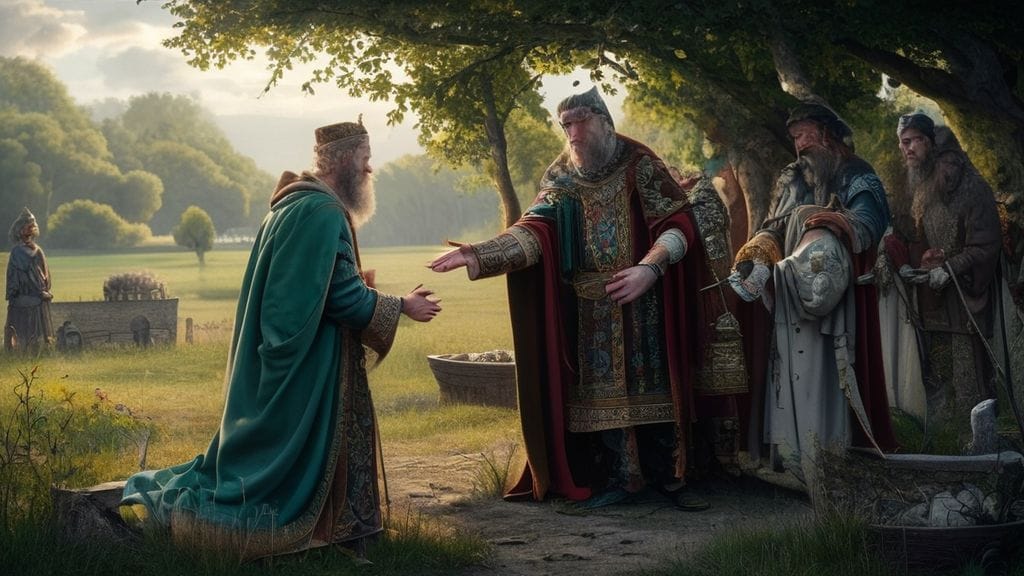
A wooden table is cleared. The royal scribe, perhaps a monk trained in one of Mercia’s monastic scriptoria, unrolls a sheet of parchment. A small horn of ink stands nearby, and a sharpened quill rests beside it. The hall quiets as king offa of mercia steps forward, flanked by men who know that what happens next will echo far beyond this room.
The scribe begins, chanting the words in Latin as he writes, so that those gathered can follow the rhythm if not every term: an invocation like In nomine Domini summi—“In the name of the highest Lord.” The first lines proclaim that Offa, by God’s grace king of the Mercians, has decided to grant a parcel of land at a place called Stoke. The purpose is explained: perhaps for the foundation or endowment of a church, perhaps as a reward to a loyal follower, perhaps for both, wrapped together.
The estate is then described. Boundaries are traced not with neat maps but with a litany of landmarks: “from the old oak by the marsh, along the stream to the stone cross, thence to the hill where the three paths meet.” Anyone familiar with the local terrain could have walked those bounds, seeing how the king’s words mapped onto reality. Farmers whose fields lay at the edges might have watched with mixed feelings. Inclusion meant new obligations; exclusion could mean marginalization.
Next, the conditions of the grant are laid down: freedom from certain royal taxes, perhaps, or from the obligation to provide food for the king’s traveling court—unless, of course, he chose to stay there. The beneficiaries are named directly. If Stoke was granted to a religious community, their role would be spelled out: prayers, hospitality to travelers, care for the poor. If to a lay noble, the language might emphasize service to the king, loyalty in war and peace.
Witnesses step forward as the scribe reaches the end of his text. Bishops raise their hands in blessing; nobles nod solemnly. Their names are entered in a witness list that might run to a dozen or more lines, now a roll call of those whose prestige fortified the act. Each name was another strand in the rope binding Stoke to the new lord, and the new lord to king offa of mercia.
Finally, the charter closes with a threat. This, too, was standard. Anyone who dared to seize the land, to diminish the rights granted today, to question the king’s decision, was placed under solemn curse. God’s judgment was invoked; sometimes hellfire was mentioned, or the fate of biblical villains. The hall might murmur at these words, sensing again that the document was more than law: it was a spiritual barrier raised around the estate.
Offa himself might not have written a word, but his presence, his nod of assent, his hand perhaps touching the parchment or a reliquary as an oath was sworn, made the grant live. In that moment at Stoke, the invisible lines of authority that crisscrossed Mercia tightened a little. Earth, ink, and soul-work wove together, fixing the king’s will into both land and memory.
Witnesses Around the Parchment: Bishops, Thegns, and Royal Kin
No royal charter existed in a vacuum. Its authority depended not only on the king who issued it but also on those who stood around him and lent their names to the act. The Stoke grant of 764 would have borne a witness list—a kind of snapshot of Mercia’s political and ecclesiastical leadership at that moment.
Foremost among the witnesses were bishops. Mercia in Offa’s time included important sees like Lichfield and Worcester, along with various monastic centers whose abbots wielded significant influence. Bishops were not passive men of prayer; they were administrators, diplomats, and, at times, royal critics. Offa needed them, and they needed him. To see “Headda, bishop of Lichfield,” or “Mildred, abbess of Minster-in-Thanet,” or other such figures listed beneath the Stoke grant would have signaled that the Church’s hierarchy not only approved but participated in this transfer of land.
Behind them stood secular nobles—thegns and ealdormen whose loyalty, though often loudly proclaimed, could never be taken for granted. For these men, adding their names to a charter was both an honor and a statement of alignment. They were publicly siding with king offa of mercia’s decision. Should disputes arise in future generations, these names would be read out, their authority invoked. A man who tried to undo the grant would not only be defying a dead king; he would be contradicting the recorded consent of a roster of powerful men long buried.
Royal kin, too, were essential. Mercian politics, like those of most early medieval kingdoms, was shot through with family tensions. By having close relatives witness important charters, Offa could signal unity, or at least the appearance of it. A brother or cousin who signed the Stoke document as witness was, in effect, asserting that Offa’s control over land and title was legitimate—that the hopes of other claimants should be deferred or abandoned.
Not everyone present would have understood the Latin phrases the scribe inscribed, but they understood the theater. To step forward as a witness was a public act. It was the difference between murmuring assent in a corner and proclaiming support under the gaze of peers and, in the logic of the time, under the eye of God. The more prestigious the assembly, the stronger the charter’s future standing. When later generations argued over whether Stoke had really been given in this or that way, they could be met with a recitation of witness names: “Do you also deny that these honored men stood by?”
In this sense, the Stoke grant was a kind of frozen assembly. On that day in 764, Offa’s England came briefly together in microcosm: church and nobility, family and followers, all orbiting around the king. When we read a charter like this centuries later, we are not just reading law. We are, as one historian has put it, “looking through a keyhole at a moment of consensus.” That consensus might, of course, be fragile or forced. But in the flicker of torchlight around the table where the scribe wrote, it felt solid, even sacred.
Power, Piety, and Strategy: Why King Offa Granted Stoke
Every royal grant carried at least two stories: the official one, set out in pious phrases, and the unofficial one, whispered in corridors or left unspoken but understood. The land at Stoke in 764 was no exception.
On the surface, the charter would likely have presented the grant as an act of Christian generosity. Language of humility was standard: Offa might be described as ruling “by divine favor,” conscious of his sins, eager to secure spiritual benefits for himself, his queen, and his ancestors. Granting Stoke to a religious community—if that was the case—would be framed as a step toward heaven, an investment in perpetual intercession.
Yet behind the celebrations, calculation ran deep. A king did not give away valuable land without expecting something in return. Strategically located estates anchored royal influence in contested areas. If Stoke lay near an old frontier or along a trade route, handing it to a loyal church or noble would secure that key point more firmly for Mercia. Likewise, a new church at Stoke could promote the king’s preferred brand of Christianity, aligning local practice with larger political aims.
One possibility is that Stoke was part of a wider pattern of concession to the church in exchange for its backing. Offa’s long reign saw intense negotiations with ecclesiastical authorities, culminating in his controversial attempt to elevate Lichfield to archiepiscopal status, effectively rivaling Canterbury. By showing himself, early on, as a pious donor of land—by letting priests and monks mark his charters with grateful prayers—king offa of mercia built credit in a spiritual economy that could later be cashed in for institutional support.
There were more immediate calculations, too. If Offa had come to power through civil conflict, as sources suggest, he might have used land grants like that at Stoke to reward those who had backed him during the struggle. Swords given, risks taken, blood shed in his name had to be acknowledged. Failing to compensate key supporters would invite discontent; generous grants, by contrast, turned wartime alliances into stable patron-client relationships.
At the same time, the act of formalizing the grant through a charter was itself a survival strategy. In an era when memory could be selective and oral agreements disputed, parchment had a long life. By inscribing his will in clear, authoritative language, witnessed by bishops and nobles, Offa was trying to prevent tomorrow’s quarrels. He wanted, in a sense, to rule the future, to ensure that long after he left this world, his decision over Stoke would still stand. Political power in the present was being projected forward through the fragile but potent medium of ink.
The pious language of the charter, then, was not hypocritical—but it was intertwined with realpolitik. Offa might genuinely have feared for his soul, believed in the necessity of almsgiving and endowment. But he was also a ruler in a competitive, dangerous landscape. For king offa of mercia, the path to both heaven and security ran through land like Stoke, carved off from the royal demesne and handed to carefully chosen hands.
Stoke and the Landscape of Mercia: Fields, Forests, and Frontiers
Step out of the assembly hall where the charter is signed, and you are in another world—the living reality that the parchment seeks to organize. Stoke, wherever precisely it lay within Mercia’s sprawl, would have been part of a dense, textured landscape. Understanding that landscape is crucial for grasping what it meant to grant it away.
Eighth-century Mercia was a mosaic of river valleys, dense woodlands, open pastures, and patches of cultivated field. Along riverbanks, heavier soils yielded good crops of barley, oats, and wheat. The uplands, by contrast, were rougher, suited more to grazing than ploughing. Forests—ancient, tangled, alive with game—covered large stretches, broken by clearings where communities like Stoke had hacked out space for themselves.
The very name “Stoke” suggests a stockaded place, perhaps an early enclosure built from pointed stakes driven into the earth. Such a site might have begun as a defensive outpost, a cluster of dwellings protected against raiders or wild animals, and then grown into a settled village ringed by communal fields. Its people would have known the land intimately: which hollow held water longest in summer, where the best hazelnuts could be gathered, which patch of woodland was dense enough to lose an enemy in.
To Offa and his circle, however, Stoke was more abstract—an estate that could be measured in “hides,” a notional unit of land deemed sufficient to support a household. A grant might speak of “ten hides at Stoke,” for instance, signaling not a precise acreage but an economic weight. This way of thinking about land reduced its complexity into a countable resource, something the king could transfer in blocks like coin.
Yet the frontier character of Mercia never entirely faded. If Stoke lay near contested zones—perhaps not far from the Welsh borderlands or the shifting edge of Mercian encroachment into neighboring territories—then its grant carried military significance. Estates in such areas served as staging points for campaigns, as buffers against incursion, as symbols planted in the earth: “here, Mercian law holds.”
The landscape also had a spiritual dimension. Shrines and holy wells, ancient barrows reused as Christian sites, churches planted atop older sacred places—all these knit the land into the mental map of the people. If the grant of Stoke included a church or the right to found one, it tied religious authority to a specific geography. Bells ringing at dawn and dusk would slowly inscribe the new order into the ears of everyone within hearing.
When king offa of mercia granted Stoke, then, he was not only reallocating income. He was redrawing part of Mercia’s living map—altering who decided when the fields were to be ploughed, who held court when disputes arose, who claimed the first part of the harvest. The charter was an attempt to catch the shifting reality of land and people and fix it into a stable pattern, one that suited both the king’s interests and, as the document declared, the will of God.
The People of Stoke: Farmers, Slaves, Monks, and Warriors
Charters rarely name them, but the true protagonists of the Stoke grant were the men and women whose lives unfolded on its soil. For them, the king’s decision in 764 was not a matter of abstract policy. It was a change in who could demand their labor, judge their disputes, and claim a share of their harvest.
Most inhabitants were peasants, bound in varying degrees to the land. Some were free, holding their plots from a lord in exchange for rents or limited labor. Others were semi-free or unfree—slaves captured in war or born into servitude, people whose lives could be bought and sold along with the estate itself. A grant like Offa’s at Stoke could literally move these people from one master to another without them ever leaving the village.
Their days were a cycle of exhausting work: ploughing with heavy wooden ploughs drawn by oxen, sowing seed by hand, tending to animals, repairing fences, cutting wood, spinning and weaving. The seasons dictated everything. A ruined harvest meant hunger; a mild year might allow a small surplus to be sold at a local market. Yet whatever the yield, a portion went upward—to the estate holder, and through him or her, indirectly, to the king whose authority underpinned the whole structure.
If Stoke’s new lord was a religious house, monks or nuns would become a regular presence in the area. A modest church or minster might grow on the estate, its stone or timber structure rising above simpler dwellings. Bells would call the faithful; processions, feast days, and funerals would weave the community into the church’s calendar. For the peasants, the change of lord might mean more emphasis on tithes and offerings, but also greater access to spiritual services and, sometimes, to sanctuary in times of trouble.
Warriors, too, hovered at the edges of this world. The noble who received Stoke—if the grant was secular—would owe military service to king offa of mercia. That meant maintaining a retinue of armed men, training them, equipping them, and answering the king’s summons when conflict flared. These warriors, when not on campaign, might oversee estate work, enforce the lord’s rights, or simply live off its yields. Their presence was a constant reminder that, in the end, behind every written charter stood the possibility of force.
For the people of Stoke, the day the charter was issued may have passed almost unnoticed. They still rose before dawn, still worried about the weather, still measured their lives in births, marriages, and deaths. But beneath that continuity, something fundamental had changed: the invisible lines of obligation binding them had been rerouted. A new name carried on the wind; a new set of expectations settled over the estate.
In the longer term, such changes could alter the community’s fate. A benevolent lord might invest in better mills or more secure storage, might shield his tenants during lean years. A harsh or ambitious one might squeeze the estate dry to fund his own ventures. A monastery might educate a few local boys, turning them into future priests or scribes. An indifferent one might be content to let Stoke drift, as long as rents arrived on time. The king’s pen, in 764, had opened all these possibilities, without consulting those who would bear their weight.
Ink, Formula, and Oath: Inside an Anglo-Saxon Royal Charter
Historian Patrick Wormald once described Anglo-Saxon charters as “the voice of royal government in its own age,” and nowhere is that more evident than in documents from Offa’s reign. The Stoke grant of 764 would have followed recognizable conventions, yet within those formulas lay subtle cues about power and intention.
Most charters began with an invocation to the divine, often in elaborate language: God was addressed as “King of kings,” the source of all earthly authority. This was not mere ornament. By anchoring the act in God’s will, the charter implied that the king’s decision was part of a cosmic order. To resist it was to resist not just Offa, but God’s arrangement of the world.
The preamble usually followed, a kind of moral reflection in which the king—or, more accurately, the scribe writing in the king’s name—acknowledged the frailty of life, the weight of sin, and the need to use temporal power wisely. It is here that we sometimes glimpse self-consciousness: an awareness that rulership was precarious, subject to divine judgment. For a king like Offa, who had won his throne in conflict, such language also served to soften his image, casting him not as a brutal warlord but as a Christian shepherd of his people.
Then came the dispositive clause: a precise statement of what was being granted. At Stoke, this would have named the estate, its size in hides, and the rights attached to it. The charter might specify, for instance, that the land was given “in perpetual freedom” from certain burdens: military levy, bridge repair, or the obligation to host the royal court. Each exemption was a tiny erosion of royal control in one place, balanced, Offa hoped, by gains in loyalty and prayer.
The boundary clause, often the most concrete part of the charter, followed. Written in Old English rather than Latin in many cases, it traced the estate’s limits in language that ordinary folk could understand. Reading these today, one hears the echoes of voices walking the land: “Then along the brook to the great thorn-tree, then up to the high ridge…” In this alternation between Latin and Old English—between universal claims and local realities—the Stoke grant, too, must have moved.
The sanction came next—a mixture of promise and threat. Blessings were invoked on those who honored the grant; curses on those who dared to violate it. Some were elaborately imaginative, calling down diseases, social disgrace, or the fate of biblical traitors. The aim was clear: to wrap the charter in a spiritual armor that would deter future aggressors.
Finally, the subscription: the list of witnesses. Here, Offa’s name would lead, often accompanied by a signum—a royal symbol, perhaps a cross he traced or touched. Beneath, bishops, abbots, royal kinsmen, and leading nobles added their own marks or allowed the scribe to write their names. The sequence of these names mattered. It silently expressed the hierarchy of the day, ranking status in ink.
By the time the scribe laid down his quill, the Stoke grant had been transformed from intention into record. Copies might be made and stored at the beneficiary’s church or hall, read aloud when disputes arose, recopied as the original parchment aged. Each reading reaffirmed the story: that in the year 764, in the presence of church and nobility, king offa of mercia had seen fit to remake the ownership of Stoke. The charter became a voice from the past, insisting on being heard in the courts of the future.
Church and Crown: Offa’s Long Game with the Bishops
The grant at Stoke did not stand alone. It formed part of a wider pattern in which Offa courted, confronted, and ultimately reshaped the church within his realm. His relationship with ecclesiastical authority was one of careful choreography—steps of deference, assertion, and occasional collision.
Early in his reign, Offa needed churchmen as legitimizers. Bishops crowned kings, preached obedience from pulpits, and framed royal acts in a scriptural light. By endowing churches and monasteries with land like Stoke, Offa signaled reverence. He knelt before altars, commissioned prayers, and wrapped his policies in pious language. For clerics anxious about war and instability, such gestures were both reassuring and practical: they brought real resources to religious communities.
But as his power grew, Offa began to test the limits of ecclesiastical autonomy. He demanded heavy contributions from monasteries, appropriated lands when it suited him, and was unafraid to manipulate church structures. His most famous ecclesiastical gamble came later, when he pushed for the creation of an archbishopric at Lichfield, carving it out of the jurisdiction of Canterbury. This move, which briefly succeeded with papal approval, was as much political as spiritual. It created a senior see more directly under Mercian influence, reducing the leverage of southern churchmen linked to rival kingdoms.
Land grants like the one at Stoke were the currency of this relationship. Each estate given to a church could be seen as an investment in clerical goodwill—but also, from another angle, as a way for the king to plant allies across his territories. Monasteries founded or refounded under royal patronage often owed as much to Offa as to any distant pope or saint. Their abbots might come from families already tied to the king, binding spiritual power to kinship networks.
Not all churchmen approved. Some resented royal intrusion into their internal affairs; others feared that dependence on royal largesse compromised their prophetic role. Yet outright resistance was difficult. A king who could raise armies and redistribute land was not easily opposed. In such a context, the grant at Stoke might have been received with a mixture of gratitude and caution. The beneficiaries would have seen it as both a blessing and a tether, tying their community’s fate to the favor of king offa of mercia.
This dance between church and crown played out against a wider European backdrop. Across the Channel, the Frankish king Charlemagne—Offa’s near-contemporary—was forging his own alliance with the church, culminating in imperial coronation. English churchmen traveled to and from the Continent, carrying news of how other rulers managed their clerical partners. Offa operated within this shared culture of sacral kingship, aware that piety could be wielded as effectively as force.
In the end, the land at Stoke was a small piece in a vast chessboard of ecclesiastical politics. But it was precisely through such small pieces that the overall pattern took shape. Every endowed estate strengthened the church materially while also drawing it more tightly into the orbit of Mercian royal power.
From Stoke to Offa’s Dyke: Building a Mercian Empire
To focus on a single charter like that of Stoke in 764 is to zoom in on one tile in a much larger mosaic. Step back, and another image emerges: that of a king relentlessly expanding and defending his realm. Over the course of his long reign (typically dated 757–796), Offa turned Mercia from a regional power into something approaching an early English empire.
His most famous monument still scars the landscape today: Offa’s Dyke, the great earthwork that snakes for roughly 150 miles along parts of the border between England and Wales. Composed of a deep ditch and a bank, it marked more than just a line. It was a statement in soil, an announcement of Mercian boundaries and ambition, visible to all who lived near or crossed it. While the exact date of its construction remains debated, many scholars situate it in the later part of Offa’s reign.
Between the modest fields of Stoke and the massive embankments of the Dyke lies a continuum of projects through which king offa of mercia hardened his control. He campaigned against neighboring kingdoms—against Kent in the southeast, Wessex in the south, and the Welsh to the west—sometimes annexing territories directly, sometimes imposing overlordship. Each victory brought new lands into his gift-giving arsenal, more Stokes to allocate to faithful followers or religious communities.
Charters record these expansions in a dry but telling way. Estates at river crossings, near fords, along roads, or in fertile valleys appear as the objects of grants. From them, we can trace the skeleton of Mercian strategy: a line of fortified sites here, a cluster of endowed monasteries there. Stoke may have been one such node, a link in a chain of properties designed to secure a particular corridor of influence.
Offa also engaged in far-reaching diplomacy. He corresponded with Charlemagne; according to one well-known episode reported by later writers, a proposed marriage alliance between their children soured, leading to a brief trade embargo. Such international entanglements were financed by the wealth of Mercian land. It is astonishing, isn’t it, to think that decisions taken in distant courts—in Aachen, in Rome—depended in part on the grain grown in places like Stoke, on the rents extracted from its peasants.
Even Offa’s interest in coinage—he introduced a high-quality silver penny that set a standard for later English currency—was rooted in his control over resources. Mints needed silver; silver came ultimately from the surplus wrested from the soil. Every penny stamped with Offa’s image or name symbolized, in metallic form, the same authority that his charters expressed in ink.
Thus, the grant of Stoke in 764 was both local and imperial. Locally, it altered the fate of a specific community. At the imperial scale, it was one adjustment among many in a complex machinery that transformed Mercia into the dominant power of its age. The same king who watched a scribe trace lines on parchment for Stoke would, in later years, survey vast border works, inspect fortified sites, and negotiate on near-equal terms with the greatest ruler in Western Europe.
In both cases—field and frontier bank, charter and coin—the underlying logic was consistent: control the land, control the people; control the people, control the future.
Shadow and Light: Violence Behind the Gifts
It would be comforting to see the Stoke grant as pure generosity, a moment of peaceful administration untainted by blood. But in the world of king offa of mercia, gifts and violence were intertwined. The land he gave away had been, in many cases, gained through conflict. The authority that allowed him to dispose of Stoke in 764 rested on earlier, sharper decisions: rivals defeated, dissidents cowed, rebellions preempted.
The sparse sources hint at Offa’s ruthlessness. Some rivals and even kin vanished from the record, perhaps “removed” in ways never formally recorded. Later tradition—in part shaped by Offa’s enemies—suggested that he could be as cruel as he was pious, capable of ordering executions and confiscations when his rule required it. Land seized from political opponents often found its way into royal hands, from which it could then be redistributed to loyalists or the church, cloaked in the language of devotion.
In this light, charters become double-edged instruments. On one side, they formalize and secure rightful ownership, protect communities, and support religious life. On the other, they can legitimize expropriation, papering over the harsher realities by which land changed hands. A monastery reading out the rights granted to it over Stoke might not dwell on how that estate first came under royal control—whether through conquest, confiscation, or more subtle pressures.
Violence also lurked in the charter’s sanctions. The curses called down on future violators were vividly punitive: blindness, madness, social disgrace, eternal damnation. Such language reflects not only spiritual fears but the reality that disputes over land could easily turn deadly. A contested boundary, a disputed right of pasture, a lord unwilling to respect another’s charter—all these could spark feuds. The charter tried to channel such conflicts into legal forms, but the threat of armed enforcement was never far away.
For ordinary people on the Stoke estate, the experience of royal power oscillated between protection and coercion. A strong king like Offa could deter opportunistic raids, ensure the relative safety of the region, and provide stable frameworks for justice. But he could also demand military service, levy heavy taxes, and sanction harsh punishments. The same hand that signed the Stoke grant might sign orders for execution or dispossession elsewhere.
Recognizing this duality does not empty Offa’s pious acts of meaning. It simply places them in their full context. In early medieval kingship, light and shadow were inseparable. The fields of Stoke might be blessed by priests, its boundaries walked in solemn ceremony—but the peace enjoyed there was, in part, the peace enforced by a man who understood that mercy and terror were both tools of rule.
Remembering and Forgetting: How Offa Shaped His Own Legacy
Offa did not live forever, but he thought hard about how he would be remembered. Charters like the Stoke grant were one means of leaving a trace: every time his name was read aloud in a monastery, often in the context of prayers for his soul, he lived again in the liturgy of the church. Yet he also pursued more deliberate strategies of commemoration.
Like other kings of his age, Offa patronized religious foundations that could become dynastic memorials. Monasteries and churches endowed with land—Stoke among them, perhaps—were expected not only to pray for generic Christian souls but to mention the king and his family by name. In an era when most people could not read and few written histories were produced, such liturgical remembrance was one of the most durable forms of memory.
At the same time, Offa’s monumental works and political achievements impressed themselves onto the mindscape of later generations. The massive Dyke, visible long after his charters turned brittle or were lost, spoke of a king who shaped the very earth. Coins bearing his name circulated widely, some even found by modern metal detectorists in fields far from ancient Mercia. These artifacts, more than any scroll, proclaimed: “Offa was here.”
Yet memory is fickle. Within a few decades of his death in 796, Mercia’s dominance waned. New powers rose; Viking raids disrupted old systems; West Saxon rulers like Alfred the Great recast the story of English unity with themselves at the center. Chroniclers, writing under later dynasties, gave only selective credit to earlier figures. Offa survived in some texts as a benchmark of greatness, but the full complexity of his rule, and of acts like the Stoke grant, faded.
Some charters attributed to Offa are, in fact, later forgeries—monasteries retroactively claiming his endorsement to bolster their rights. This phenomenon testifies to his enduring prestige: to invoke king offa of mercia’s name was to call upon an authority that even generations later could still sway judgments. Ironically, the very attempt to preserve or extend his influence through such documents has made the historian’s task harder, blurring the line between genuine memory and creative reconstruction.
Modern scholars piece together Offa’s legacy from scattered sources: charters, chronicles like Bede’s earlier Ecclesiastical History and the later Anglo-Saxon Chronicle, Continental letters, archaeological findings. Each adds a shard to the mosaic. In this reconstruction, the grant at Stoke becomes more than a footnote. It exemplifies the everyday mechanisms through which Offa ruled, the “small” acts that underpinned his “great” achievements.
In remembering Offa today—as builder of dykes, reformer of coinage, ally and adversary of Charlemagne—we would do well to remember also the quieter, local impacts of his rule. Somewhere beneath modern towns or fields lies the ghost of Stoke as he shaped it: a community whose fate was altered by a decision taken in 764 and recorded in lines of Latin and Old English. That, too, is part of his legacy.
The Fate of Stoke After Offa: Continuity, Ruin, and Reinvention
What became of Stoke after the ink dried in 764? The documentary trail grows thin, but we can infer much from the broader currents of English history. For several generations, the estate likely functioned as intended: a productive patch of land feeding its new lords, supporting a small church or noble household, and integrating itself into the local hierarchy.
Peasants continued to work the soil, now under the oversight of stewards or reeves acting on behalf of the new landlord. If the beneficiary was a monastery, Stoke’s produce might partially flow out to support monks elsewhere, linking the village to a wider spiritual and economic network. If secular, it served as one node in the landed portfolio of a noble family—dowry in marriages, collateral in political bargaining, inheritance for younger sons.
Then came the ninth century’s storms. Viking raiders struck the English coasts and riverlands repeatedly, burning churches, seizing movable wealth, and, in some cases, occupying territories. Mercia, already under pressure from rising Wessex, struggled to cope. Some estates were devastated; others adapted by strengthening local defenses, relocating treasure, or negotiating with invaders. Stoke’s exact fate is unknown, but its people would have felt the tremors: rumors of longships, news of nearby monasteries sacked, extra levies demanded for defense.
As power shifted toward Wessex and a more unified English kingdom emerged in the late ninth and tenth centuries, older charters like Offa’s at Stoke became tools in legal disputes. Descendants of the original beneficiaries—or those who claimed to be—might produce the 764 grant as proof of long-standing rights. Kings like Alfred and his successors often confirmed such ancient charters, weaving local traditions into the new royal order. In this way, Offa’s decision could echo, in courtrooms and councils, centuries after his death.
The Norman Conquest of 1066 brought another upheaval. William the Conqueror and his followers conducted a vast survey of landholding—the Domesday Book—listing estates, their holders, and their resources. If Stoke survived as a distinct unit, its name might appear there, attached now to Norman lords with French names. The people of Stoke would have experienced yet another layer of overlordship, hearing different accents in their lord’s hall, experiencing new demands in the form of castles, knights, and royal forest laws.
Over the centuries, the name “Stoke” multiplied across the English map. Many villages bear it now, often with qualifiers: Stoke-on-Trent, Stoke Golding, Stoke-by-Nayland, and more. The specific Stoke of Offa’s charter may be lost among them, its exact site debated in scholarly footnotes. Yet in each Stoke, there lingers a faint echo of that old word for enclosure, for a place taken hold of and held.
Thus, Stoke’s story is one of continuity and reinvention. Fields were reploughed under new regimes; boundaries shifted; lords came and went. But the land itself remained, its productivity the enduring prize that attracted king offa of mercia in 764 and so many others before and after him. The charter was a moment in the estate’s life—not its birth, and certainly not its end, but a pivot around which its history turned.
Reading Between the Lines: What the Stoke Grant Reveals About Power
Stand back from the detail, and the 764 grant of Stoke becomes a lens through which to reevaluate Offa’s rule and early medieval kingship more broadly. What does this single act tell us about how power worked in his world?
First, it underscores the centrality of land. Control of soil—not abstract sovereignty over people—was the primary concern. By owning estates directly and by determining who held others, Offa and his peers constructed political order from the ground up. Their authority was literally rooted in the earth, in fields that fed armies and halls that hosted councils.
Second, it reveals the intertwining of secular and sacred. The same document that conveyed property rights also invoked God’s judgment, saints’ protection, and the terrors of hell. For king offa of mercia, ruling was not simply a matter of force; it was framed as a sacred trust, one for which he would answer at the Last Judgment. Whether or not we take this piety at face value, its practical effect was to wrap political decisions like the Stoke grant in a moral aura that discouraged opposition.
Third, it highlights the importance of writing in a society still largely oral. The spoken word—oaths, public announcements, the chanting of boundary clauses—remained crucial. Yet increasingly, it was the written word that outlived individuals and anchored claims. The scribe at Stoke was as much a maker of power as the warriors who enforced Offa’s will. Without charters, land disputes would have been settled more often by memory and might; with them, there was at least a script to consult.
Fourth, the Stoke grant illustrates the networked nature of rule. Offa did not act alone. His decision was embedded in a web of relationships: with bishops who blessed him, nobles who fought for him, kin who contested or supported him, peasants who fed him. The witness list is the visible tip of this web; behind each name lay families, followers, and local influence. By granting Stoke, Offa tugged on multiple strands, reinforcing some, loosening others.
Finally, it reminds us that history is often made in quiet rooms, not only on battlefields. The year 764 might have seen no great battles recorded in the chronicles, no dramatic shifts in borders. Yet in a hall somewhere in Mercia, a king and his inner circle made a choice about who would control a place called Stoke. That choice set in motion a chain of consequences that would ripple through generations: who prospered, who prayed, who wielded local authority.
As modern readers, we meet king offa of mercia most vividly in such moments—in the surviving strokes of a quill, in the legalese that once carried emotional weight. The Stoke charter, even in its partial or reconstructed form, is an invitation to look past the grand narratives of empire and war and to see how, line by line, a kingdom was written into being.
Conclusion
In the low light of an eighth-century hall, a king’s will became words, and words became law. The grant of land at Stoke in 764 was, in one sense, a routine act of administration by king offa of mercia. Yet when we unpack it—its context, its language, its actors—it unfolds into a rich tapestry of early medieval life. Here are fields and forests, bishops and peasants, warriors and scribes; here is piety expressed in lavish phrases, and calculation encoded in the assignment of hides and exemptions.
Offa’s decision to grant Stoke reveals a ruler adept at using every tool available: force when necessary, but also gift, ritual, and writing. Through charters like this, he consolidated a fragile throne, bound powerful allies to his side, and wove the church more tightly into Mercia’s political fabric. For the people of Stoke, the charter was both distant and intimate—a transaction in far-off corridors that nonetheless reshaped their daily obligations and protections.
Across the centuries, the original parchment may have perished, its ink flaked away. Yet the act it recorded endures in the logic of English landholding, in the memory of Offa as a foundational figure, and in the very idea that authority can be fixed and transmitted through documents. The story of Stoke is thus more than a footnote; it is a microcosm of how power was claimed, justified, and remembered in the formative centuries of English history.
To follow that story is to stand closer to Offa himself—not the distant builder of dykes and maker of coins, but the king at a table, listening as a scribe intones the sacred and legal words that would carry his will beyond his own lifetime. In that moment, poised between earth and eternity, between ambition and anxiety, we meet him most fully: a man who believed that kingdoms could be written, one estate at a time.
FAQs
- Who was King Offa of Mercia?
King Offa of Mercia was an eighth-century ruler (c. 757–796) who transformed the central Anglo-Saxon kingdom of Mercia into the dominant power in much of what is now England. He is best known for his extensive coinage reforms, his diplomatic correspondence with Charlemagne, and the construction of Offa’s Dyke along the Welsh border, as well as for numerous land grants like the one at Stoke in 764. - Where was Stoke, the estate granted by Offa in 764, located?
The precise identification of the Stoke mentioned in the 764 grant is uncertain, as “Stoke” is a common English place-name meaning an enclosure or stockaded settlement. Scholars use boundary descriptions in surviving or related charters, along with later records such as Domesday Book, to propose locations, but no single site has been definitively proven. - Why were land grants so important in Offa’s time?
Land was the foundation of wealth and power in early medieval England. Through grants, kings rewarded followers, endowed churches and monasteries, secured strategic sites, and reshaped local hierarchies. A written charter turned a political decision into a lasting legal and spiritual claim, enforceable long after the original parties had died. - Did Offa’s grant at Stoke go to a church or a lay noble?
The surviving evidence for this specific charter is fragmentary, and modern historians debate the exact beneficiary. Many of Offa’s grants went to religious institutions, which he used as allies in consolidating his power, while others went to secular followers. The Stoke grant likely fit within one of these broader patterns of endowment and reward. - How reliable are charters from King Offa’s reign?
Many genuine charters from Offa’s reign survive, but some have been altered or forged in later centuries by institutions seeking to bolster their land claims. Scholars analyze handwriting, language, formulae, and historical context to distinguish authentic documents from later creations, often concluding that even forgeries can preserve elements of genuine earlier texts. - What was Offa’s Dyke, and how does it relate to the Stoke grant?
Offa’s Dyke is a massive earthwork running along parts of the England–Wales border, probably constructed in the later part of Offa’s reign to mark and defend Mercian territory. While not directly connected to the Stoke estate, both the Dyke and land grants like Stoke formed part of Offa’s broader strategy to control territory—one through monumental engineering, the other through legal and ecclesiastical structures. - How did the Church benefit from Offa’s land grants?
Churches and monasteries that received estates gained secure sources of income in the form of rents, produce, and labor. In return, they offered spiritual services—prayers, masses, and commemoration—for Offa and his family, and often provided political support, administrative expertise, and local influence that shored up royal authority. - What happened to Mercia after Offa’s death?
After Offa died in 796, Mercia entered a period of instability. His immediate successors struggled to maintain his level of control, and by the early ninth century, the kingdom’s dominance was challenged by Wessex and undermined by Viking incursions. Over time, Mercian territory was absorbed into a more unified English kingdom under West Saxon leadership.
External Resource
Internal Link
Other Resources
- Encyclopaedia Britannica – general search for the exact subject
- Google Scholar – academic search for the exact subject
- Internet Archive – digital library search for the exact subject

