Table of Contents
- The Dawn of a New Era: England United under a Single Crown
- The Fragmented Isles before Athelstan: A Land Divided
- The Legacy of Alfred the Great: Foundations of Unity
- Athelstan’s Rise: From Prince to Monarch
- The Seven Kingdoms: A Puzzle of Power and Rivalry
- The National Assembly of 927: The Moment of Reckoning
- Winchester: The Heartbeat of a New Kingdom
- Forging an Identity: Symbols and Ceremonies of Unity
- The Challenge of the Vikings: Invasions and Alliances
- Diplomacy in the Age of Kings: Athelstan’s Foreign Policy
- The Battle of Brunanburh: Securing the Realm
- Law and Order: Building a Kingdom through Justice
- The Church and the Crown: Religious Authority as a Unifier
- Economic Revival: Trade, Coinage, and Stability
- Culture and Court Life in Early Medieval England
- The Limits of Power: Rebellions and Resistance
- Athelstan’s Legacy: The First King of All England
- The Kingdom’s Influence on Later British History
- Remembrance and Myth: How Athelstan Lives On
- Conclusion: The Enduring Power of Unity
- FAQs: Exploring the Kingdom Reunified
- External Resource
- Internal Link
1. The Dawn of a New Era: England United under a Single Crown
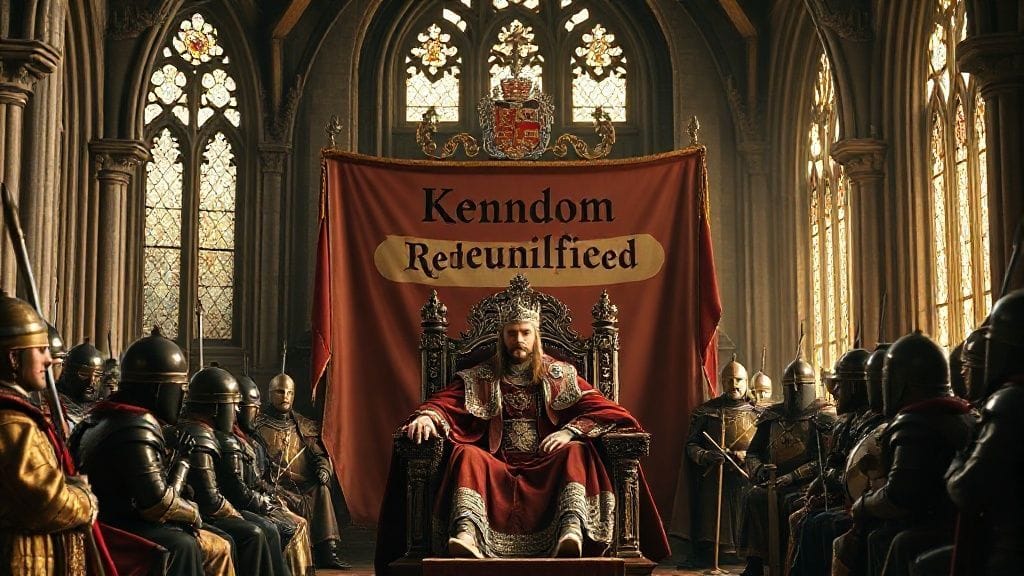
In the chilled dawn of 12 July 927, the city of Winchester shimmered under a low, pale sun, its walls holding breaths of expectancy and change. For the first time in generations, the torch of sovereignty passed not from one small, squabbling kingdom to another, but lit the entire land known as England. It was here that King Athelstan, a figure as complex as the patchwork of the island itself, was hailed as the ruler of all. This crowning moment was more than the conclusion of war or inheritance; it was the birth of a united England — a bold, unprecedented political realignment that would ripple through centuries.
Imagine that city, its streets thrumming with the footsteps of nobles, clergymen, and common folk alike, all turning their eyes to a future uncertain yet full of hope. The narrative of England, fractured for centuries into distinct and often hostile realms, was being rewritten. Athelstan’s kingdom was a promise: of peace stitched together by authority, of cultures intertwined beneath one crown, and of a fledgling nation daring to dream beyond survival towards greatness.
2. The Fragmented Isles before Athelstan: A Land Divided
England before 927 was far from a singular entity. The terrain stretched into what chroniclers called the Heptarchy — seven kingdoms each with its own laws, traditions, and kings. Northumbria, Mercia, Wessex, East Anglia, Essex, Kent, and Sussex existed not only in geographical boundaries but also in political fragmentation. This mosaic reflected stubborn regional identities, long histories of rivalry, and a climate of fragile alliances.
This period was also overshadowed by repeated incursions from Viking settlers and raiders, whose settlements and raids further complicated allegiances. The Danes controlled substantial territories, especially the Danelaw in eastern England, adding to the region’s volatility. The aspirations of conquest and preservation intertwined daily with diplomacy, subterfuge, and often brutal conflict. To imagine 927 without this lingering unrest would be to underestimate the delicate balance upon which Athelstan’s reign would be founded.
3. The Legacy of Alfred the Great: Foundations of Unity
Any story of Athelstan’s England begins with his grandfather, Alfred the Great — a figure who emerged from the thickets of Viking war to erect the first pillars supporting the unity of England. Alfred’s reign, from 871 to 899, was a watershed moment. Not only did he halt the southward Viking invasions, but he also undertook remarkable reforms in law, military organization, and education.
Alfred’s vision was that of a unified realm held together by shared laws and Christian values—a stark contrast to the fragmented chaos before him. His establishment of fortified burhs (towns) and encouragement of literacy sowed seeds of resilience and identity. Athelstan inherited this legacy, not merely as a family heir but as the beneficiary of a burgeoning national consciousness shaped by his grandfather’s ideals.
4. Athelstan’s Rise: From Prince to Monarch
Athelstan’s path to kingship was neither straightforward nor uncontested. Born around 895, he was the son of King Edward the Elder, himself Alfred’s son, but not of the oldest line in a complex medieval inheritance system. Nevertheless, Athelstan distinguished himself through strategic marriages, military prowess, and political acumen.
Ascension to the throne of Wessex and later Mercia was marked by power struggles and cunning alliances. His reputation extended beyond his immediate territories, earning respect and fear alike. It was not until 924 that Athelstan succeeded his father as king, but the true test would appear not in succession by birthright but in his ambition to control all English kingdoms and beyond.
5. The Seven Kingdoms: A Puzzle of Power and Rivalry
The political geography Athelstan inherited was remarkably complex. Wessex, positioned in the south and west, had long been the dominant power, but Mercia still held substantial influence in the midlands, and Northumbria to the north threatened with its own ambitions. East Anglia and the smaller southern kingdoms, although less powerful, had their own claims and shifting loyalties.
Each kingdom had unique customs and local nobility deeply entrenched in their own power structures. To unify these successfully required more than military might: it demanded subtle diplomacy, legal reforms, and a sense of legitimacy that could be accepted by the diverse peoples of the island.
6. The National Assembly of 927: The Moment of Reckoning
It was at this pivotal assembly in Winchester that the vision of unity crystallized. Kings from various regions, including those of Scotland and Strathclyde, were reportedly present, acknowledging Athelstan’s overlordship. This gathering was more than a ceremonial recognition; it was a practical repudiation of the fragmented autonomy of these realms in favor of a broader political order.
Contemporary chroniclers like William of Malmesbury spoke of the assembly as a symbolic submission to "the first king who reigned over all England." For many nobles, this was a high-stakes negotiation—accepting new hierarchies against deep tribal instincts and territorial pride.
7. Winchester: The Heartbeat of a New Kingdom
Winchester, the ancient capital of Wessex, was carefully chosen as the site for this defining moment. The city was not just geographically central but intellectually vibrant, home to religious institutions and royal administration. Athelstan’s court in Winchester became a microcosm of the new England, where Old English traditions mingled with Continental influences and Christian ceremony.
The city’s halls echoed with proclamations and oaths, while its streets buzzed with commoners sensing the changing tides of history. The royal palace, the cathedral, and the bustling marketplace together forged a new political center not just for a kingdom, but for a country.
8. Forging an Identity: Symbols and Ceremonies of Unity
To transform seven kingdoms into one nation required more than political unity; it invoked culture and symbolism. Athelstan invested in grand religious ceremonies, coinage bearing his likeness and titles, and established laws that extended uniformly across his realm.
Such symbols were crucial to creating a sense of shared identity that transcended local loyalties. The idea of "Englishness" began to solidify around the image of a single monarch preserving order, faith, and prosperity.
9. The Challenge of the Vikings: Invasions and Alliances
Even as Athelstan’s crown grew in stature, the Viking threat never fully disappeared. Norse kings still ruled parts of the Irish Sea and the north, making military confrontation likely. Yet Athelstan’s approach was often pragmatic—engaging in marriage alliances and tribute payments alongside military campaigns.
The complex dance with Scandinavian powers was one of survival and assertion; Athelstan sought not simply to repel but to integrate rival forces into his political vision where possible, setting a precedent for later English rulers.
10. Diplomacy in the Age of Kings: Athelstan’s Foreign Policy
Athelstan’s influence reached beyond the shores of England. His sister was married into continental nobility, and he maintained correspondence with European monarchs and the papacy itself. This era marked the first time the English king asserted himself on the international stage as a peer among rulers.
Diplomatic gifts, envoys, and alliances underscored a kingdom confident in its emerging power. Such international relations raised England’s profile and provided a measure of security through respectability and alliances, rather than by force alone.
11. The Battle of Brunanburh: Securing the Realm
Arguably the defining military moment of Athelstan’s reign was the Battle of Brunanburh in 937, fought against a coalition of Scots, Vikings, and others refusing to recognize his rule. This brutal conflict, terrible in scale by the standards of the age, was immortalized in an Old English poem commemorating the victory as securing the unity of England.
Brunanburh was not merely a defensive victory but a statement: Athelstan’s kingdom was to be respected and feared, its borders inviolate. The battle reinforced his political standing, consolidating the fractured regions into a more cohesive whole.
12. Law and Order: Building a Kingdom through Justice
Recognizing that power depends on legitimacy, Athelstan prioritized the rule of law. Inspired by Alfred’s codes and Byzantine influences, he promulgated laws that sought fairness but also reinforced royal authority.
These laws tackled issues from theft to church protection, integrating Christian moral teachings with pragmatic governance. By projecting the king as guardian of justice, Athelstan aimed to win hearts and minds across diverse peoples, making rebellion less attractive.
13. The Church and the Crown: Religious Authority as a Unifier
Church and state intertwined deeply during Athelstan’s reign. He was a devout Christian and understood the church’s role in legitimizing power and uniting people ideologically.
By promoting ecclesiastical reforms, supporting monasteries, and fostering the cult of saints, Athelstan strengthened the spiritual foundation of his kingdom. The church became a vital partner, disseminating the king’s authority and integrating his subjects through shared faith.
14. Economic Revival: Trade, Coinage, and Stability
Political stability under Athelstan stimulated economic growth. Minting coinage with consistent imagery and inscriptions standardized commerce and projected power, facilitating trade both internally and internationally.
Markets expanded, and craft production flourished. Trade routes linking England to the continent and Scandinavia were protected and encouraged. This economic vitality was both a product of and a contributor to the kingdom’s unity.
15. Culture and Court Life in Early Medieval England
The court of Athelstan was not only a political center but also a cultural hub. Poets, scholars, and clerics gathered under royal patronage. Manuscripts were copied, laws codified, and histories chronicled.
This intellectual flowering reflected the amalgamation of Anglo-Saxon traditions and Continental influences, marking a cultural awakening alongside the political unification.
16. The Limits of Power: Rebellions and Resistance
Forging a kingdom was never without resistance. Local lords, especially in Northumbria and the Danelaw areas, often chafed under centralized authority.
Rebellions and plots were frequent reminders that Athelstan’s rule was as much an ongoing negotiation as an accomplished fact. Yet even when crushed, these challenges shaped the evolving nature of kingship and governance in England.
17. Athelstan’s Legacy: The First King of All England
By the time of his death in 939, Athelstan was widely recognized as the first true king to rule all of England. Chroniclers celebrated his wisdom, courage, and piety.
His reign laid the groundwork for a unified state that would endure — despite future upheavals — far beyond his lifetime. He set standards for kingship, jurisprudence, and cultural patronage that inspired successors for centuries.
18. The Kingdom’s Influence on Later British History
Athelstan’s vision of England influenced later historical trajectories profoundly. His unification efforts prefigured the later evolution of a centralized English monarchy and the eventual emergence of the United Kingdom itself.
Many political traditions, administrative practices, and even symbolic rituals trace roots to his era, demonstrating an enduring legacy in British political culture.
19. Remembrance and Myth: How Athelstan Lives On
Over the centuries, Athelstan’s figure became surrounded with legend and folklore. Seen as a unifier and warrior king, his name conjured ideals of national unity and strength.
Monuments, literature, and historical memory celebrate him as an early architect of England, anchoring identity in the shared past — an icon of a kingdom once fragmented but brilliantly reassembled.
Conclusion
The story of Athelstan and the reunification of England in 927 is more than an episode of medieval history; it is a testament to human ambition, resilience, and the quest for unity amid fragmentation. Through shrewd diplomacy, military prowess, and cultural vision, Athelstan forged a kingdom that began the journey toward one nation from many competing tribes and rulers.
His reign teaches us that nation-building is never a simple path but a complex, multifaceted process requiring vision and pragmatism. More than bloodlines or borders, it is the weaving together of diverse peoples, faiths, and ideas that creates enduring identity.
Reading about that day in Winchester — the murmurs in the stone halls, the heavy silence before a declaration, the spark of hope in countless eyes — reveals how history is lived not as a series of dates, but as vibrant, human moments rippling through time. Athelstan’s England was born from such moments, a kingdom united not just on a map, but in the hearts of its people.
FAQs
Q1: Why was the reunification of England under Athelstan such a significant event?
The reunification marked the first time historically that the various Anglo-Saxon kingdoms accepted a single ruler, creating the foundation for the modern English state and ending centuries of fractious regional rule.
Q2: What role did the Vikings play in shaping Athelstan’s reign?
The Vikings were both adversaries and political actors. Their invasions and settlements fragmented England but also led Athelstan to engage in strategic military campaigns and diplomatic marriages that strengthened his rule.
Q3: How did religion influence Athelstan’s approach to kingship?
Christianity was central to legitimizing Athelstan's rule. He worked closely with the church to reinforce his authority and unify his subjects under a common faith, using religious ceremonies and institutions to solidify political unity.
Q4: What was the significance of the Battle of Brunanburh in 937?
This battle was crucial in solidifying Athelstan’s control over England by defeating a coalition of rival kings. It is often viewed as the climax of his military efforts to secure and unify the kingdom.
Q5: How did Athelstan’s legal reforms contribute to his kingdom’s stability?
By extending and codifying laws, Athelstan created a consistent legal framework that balanced royal authority with justice, which helped reduce internal conflicts and create a sense of order.
Q6: In what ways did Athelstan’s foreign diplomacy impact England?
His foreign policy elevated England’s status internationally, formalized alliances through marriage, and fostered relations with continental Europe and the church, offering security and prestige.
Q7: What challenges did Athelstan face in unifying such diverse kingdoms?
Political fragmentation, cultural differences, local loyalties, and ongoing Viking threats meant Athelstan had to constantly negotiate and sometimes use force to maintain unity.
Q8: How is Athelstan remembered in English history today?
He is revered as the first king of a united England, a military leader, and a lawgiver. Though less known popularly than later monarchs, historians recognize his reign as foundational to English national identity.

