Table of Contents
- The Dawn of a New Era: Proclamation Day in Turin, 1861
- Italy Divided: The Fragmented Peninsula before Unification
- The Risorgimento: Birth of an Italian National Consciousness
- The House of Savoy and Victor Emmanuel II: Architects of Unification
- Count Cavour’s Diplomatic Gambits: The Mastermind behind the Kingdom
- Garibaldi’s Red Shirts: The Sword of Italian Unity
- Foreign Powers and the Chessboard of Europe
- The Wars of Unification: Battles and Strategies that Forged Italy
- The Moment Arrives: March 17th, 1861, The Kingdom is Proclaimed
- Turin: The Historic Cradle of Italian Statehood
- The Crown and the Constitution: Defining a New Monarchy
- Reactions Across the Peninsula: Jubilation, Skepticism, and Conflict
- The Southern Question: Integrating the Mezzogiorno
- Rome and Venetia: The Unfinished Chapters of Italian Unity
- Cultural Renaissance: National Identity through Art and Literature
- Economic Challenges: From Feudalism to Industrialization
- Social Transformations: The People Behind the Kingdom
- The Kingdom’s Role on the European Stage
- Legacy of the 1861 Proclamation: Foundations for Modern Italy
- Remembering Unification: Memory, Myths, and National Holidays
The Dawn of a New Era: Proclamation Day in Turin, 1861
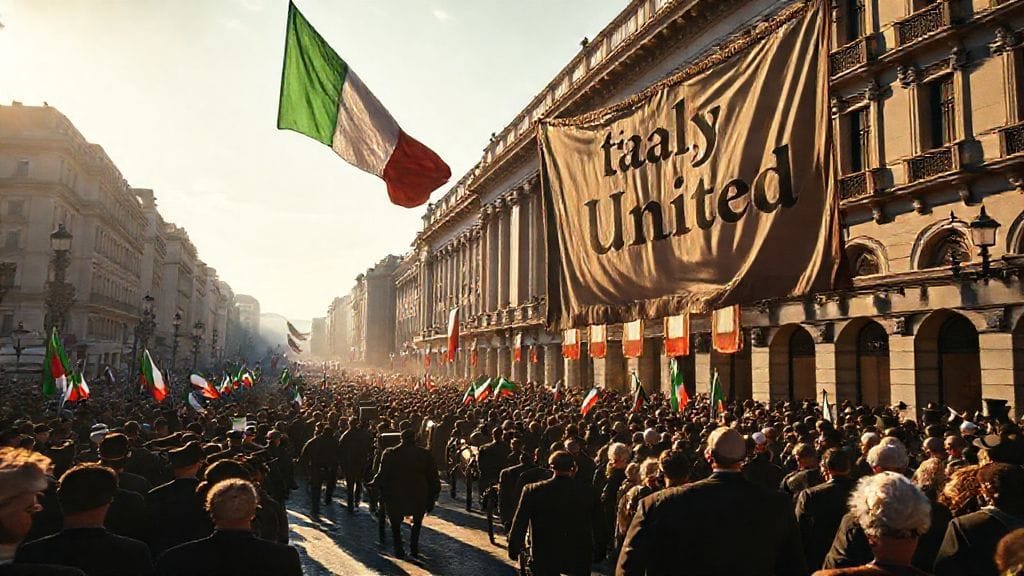
On a bright, hopeful day in March 1861, the air in Turin was thick with anticipation and triumph. Crowds gathered in the grand piazzas, banners fluttering as church bells rang out, echoing against the ancient stones of palaces and cathedrals alike. The city, capital of the Kingdom of Sardinia and the political heart of a burgeoning movement for Italian unification, radiated an energy that was electric and transcendent. The proclamation of the Kingdom of Italy was not just a formal act of state but the crescendo of decades of struggle, dreams, bloodshed, and diplomacy.
Victor Emmanuel II, clad in regal military attire, stood upon the balcony of the Palazzo Carignano. As the declaration was read aloud, his acceptance of the crown symbolized a profound transformation: a fractured peninsula, long divided by foreign powers and local rulers, was now—at last—conceived as a unified kingdom. Yet beneath the celebration, complexities loomed. Would this new kingdom endure the seismic social and political upheavals to come? Would it truly embody the spirit of a nation reborn?
This was the moment the Risorgimento promised — the “Resurgence” of Italy.
Italy Divided: The Fragmented Peninsula before Unification
To understand the triumph of 1861, one must first grasp the fragmented reality of Italy throughout the early 19th century. The Italian peninsula was a mosaic of kingdoms, duchies, papal territories, and foreign dominions. The Kingdom of Sardinia in the northwest, including Piedmont and Savoy, was one of the few relatively autonomous states. To the south sprawled the Kingdom of the Two Sicilies, ruled by the Bourbons. The Papal States controlled the center, wrapped tightly around Rome. Between these, smaller duchies like Parma, Modena, and Tuscany served as pawns in a patchwork often dictated by the ambitions of Austria and France.
This division was as much cultural as political: dialects, customs, and economies varied sharply. The legacy of the Napoleonic Wars had stirred national consciousness, but old feudal structures and local loyalties still held sway. Foreign powers dominated much of Italy’s destiny, especially Austria, whose military presence in Lombardy and Venetia was a constant reminder of the peninsula’s frailty.
The Risorgimento: Birth of an Italian National Consciousness
The 19th century saw the Risorgimento emerge as both a political movement and a cultural awakening. Intellectuals, writers, and revolutionaries began weaving the idea of an “Italian nation” — a concept previously more literary than real. Poets like Alessandro Manzoni celebrated the common language and history. Figures such as Giuseppe Mazzini championed republican ideals, dreaming of a free and equal Italy under a democratic government.
Societies like “Young Italy” spread the gospel of nationalism among students and the middle class, inspiring a wave of uprisings and conspiracies. Yet the vision of unification was far from unanimous; monarchists, republicans, liberals, and radicals often differed profoundly on what shape the new Italy should take. Still, the yearning for unity—“Una, Italiana e Libera”—echoed through the salons and taverns of the peninsula.
The House of Savoy and Victor Emmanuel II: Architects of Unification
At the center of this political whirlwind was Victor Emmanuel II and his House of Savoy. Unlike fiery ideologues, Victor Emmanuel was a pragmatic monarch, keen to meld power with the aspirations of his people. His hereditary kingdom of Sardinia played the role of the spearhead for unification. The king, alongside his prime minister, Camillo Benso, Count of Cavour, sought to position Piedmont-Sardinia as a constitutional monarchy capable of absorbing other Italian states.
Victor Emmanuel’s military leadership and personal charisma drew many advocates, who saw in the Savoyard crown a potential nucleus for the new Italian nation. The king's famous declaration—“Fate gli italiani”—implored his subjects to become true Italians, signaling his commitment to the Risorgimento ideals.
Count Cavour’s Diplomatic Gambits: The Mastermind behind the Kingdom
Arguably the greatest strategist of the era, Count Camillo Cavour elevated Piedmont-Sardinia from a provincial kingdom to a powerful player on the European stage. Cavour’s vision was clear: unify Italy under the monarchy of Victor Emmanuel using realpolitik—a careful combination of diplomacy, alliances, and warfare.
He diplomatically courted France and Britain, securing the support of Napoleon III while maneuvering around the constant threat posed by Austria. Cavour orchestrated alliances and engineered conflicts, including the Second Italian War of Independence in 1859, where French and Piedmontese forces battled Austrian domination. Behind the scenes, Cavour’s diplomatic finesse expanded Piedmontese influence over central Italian duchies, ultimately consolidating power for the unification cause.
Garibaldi’s Red Shirts: The Sword of Italian Unity
If Cavour was the architect, Giuseppe Garibaldi was the sword. The legendary general and populist hero had become the embodiment of popular revolutionary energy. Leading his volunteer “Red Shirts,” Garibaldi launched daring campaigns in southern Italy, notably the Expedition of the Thousand in 1860. With remarkable speed and ferocity, he toppled Bourbon rule in Sicily and Naples, handing these liberated territories over to Victor Emmanuel’s kingdom.
Garibaldi’s charisma, military prowess, and willingness to fight for the people made him a symbol of the unification movement’s more radical dimension. Despite occasional tensions with the Piedmontese government, his actions were crucial in extending the reach of the new Kingdom of Italy.
Foreign Powers and the Chessboard of Europe
Italy’s unification did not happen in a vacuum. The great powers—France, Austria, Britain, and Prussia—had vested interests in the Italian peninsula, turning it into a geopolitical chessboard. Austria’s grip over northern Italy was the biggest obstacle, while France walked a fine line: Napoleon III both supported and limited Italian ambitions to accommodate Catholic interests and French politics.
Prussia’s rise in the 1860s added a new dynamic, eventually leading to the Austro-Prussian War and influencing Italy’s own territorial designs. Britain largely adopted a policy of non-intervention but monitored developments carefully. Each foreign move echoed in Italian politics, shaping outcomes in subtle and profound ways.
The Wars of Unification: Battles and Strategies that Forged Italy
The path to Italy’s unification was paved with conflict. The small but decisive battles—Varese, Palestro, and Solferino—revealed the determination and growing capabilities of Italian troops. The Second Italian War of Independence (1859) was a turning point, delivered under the command of Victor Emmanuel and his generals, with French support.
Later, Garibaldi’s campaign in the south made headline news worldwide for its daring nature and almost romantic intensity. The wars were brutal and complex, but they captured the imagination of a new generation of Italians who saw in them the price of freedom and unity.
The Moment Arrives: March 17th, 1861, The Kingdom is Proclaimed
The atmosphere in Turin on March 17th, 1861, was electric. The Chamber of Deputies of the Kingdom of Sardinia declared Victor Emmanuel II King of Italy, officially proclaiming the Kingdom of Italy. This symbolic act was the culmination of years of struggle and negotiation.
The proclamation was met with wild enthusiasm in Piedmont and other northern regions, even as parts of Italy, especially in the south and Rome, remained outside the new kingdom’s control. The hardships and contradictions of unification did not diminish the emotional impact of this day, which Italians would remember for generations.
Turin: The Historic Cradle of Italian Statehood
Turin, ancient capital of the House of Savoy, became the first capital of the Kingdom of Italy. The city represented more than administrative convenience; it was symbolic of the new Italian state’s aspirations—modern, constitutional, and progressive.
In Turin’s palaces and streets, the machinery of the new monarchy was set into motion. Yet the city’s aristocratic calm contrasted with the revolutionary fervor that had churned across the peninsula, reflecting the new kingdom’s balance of tradition and change.
The Crown and the Constitution: Defining a New Monarchy
Victor Emmanuel II’s acceptance of the crown was inseparable from the Statuto Albertino—the 1848 constitution inherited from the Kingdom of Sardinia. This constitution laid down the framework for a constitutional monarchy, balancing royal authority with parliamentary governance.
This political structure was revolutionary in Italy at the time, introducing modern governance even as conflicts over suffrage, regional autonomy, and church-state relations simmered. The Statuto would serve as the basis for Italian political life for decades but also reveal the tensions that haunted unification.
Reactions Across the Peninsula: Jubilation, Skepticism, and Conflict
The joy of unification was unevenly spread. The north largely celebrated the new political entity, while the south experienced ambivalence, unrest, and sometimes violent resistance. Many southern Italians felt abandoned or betrayed by the new government, sparking the “Brigandage” rebellions that would trouble Italy for years.
In Rome, under papal rule and protected by French troops, the pope resisted unification, declaring himself a prisoner in the Vatican. The complex mosaic of reactions reflected the monumental challenges inherent in forging a nation from disparate parts.
The Southern Question: Integrating the Mezzogiorno
The incorporation of the south exposed deep economic, social, and cultural divides. The so-called “Southern Question” referred to the problems of integrating a largely rural and impoverished south with a more industrialized and politically different north.
The policies of the new government often failed to address southern grievances adequately, leading to long-lasting disparities and resentment. The tensions between north and south would shape Italian politics and identity well into the 20th century.
Rome and Venetia: The Unfinished Chapters of Italian Unity
While the Kingdom was proclaimed in 1861, the dream of a fully unified Italy remained incomplete. Rome, still under papal control, and Venetia, held by Austria, were the two missing puzzle pieces.
The question of Rome was particularly sensitive, intertwined with the Catholic Church and French protection. It would not be until 1870, with the withdrawal of French troops during the Franco-Prussian War, that Italian forces would enter Rome, completing the Risorgimento.
Venetia was annexed in 1866 after the Austro-Prussian War, marking another crucial step toward unity.
Cultural Renaissance: National Identity through Art and Literature
Unification awakened more than politics; it kindled a cultural renaissance. Writers, painters, and composers sought to celebrate and define what it meant to be Italian.
Artists like Giuseppe Verdi became national symbols, their works suffused with patriotic themes. Literature celebrated the diverse histories and dialects that constituted Italy’s soul. This cultural efflorescence helped forge a collective identity beyond mere institutional constructs.
Economic Challenges: From Feudalism to Industrialization
The Kingdom of Italy inherited an economic landscape marked by regional disparities. The north was beginning to industrialize, while the south remained largely agrarian with feudal legacies.
Bridging this divide demanded modernization, infrastructure development, and fiscal reform—daunting tasks for a nascent government. While progress was uneven, these challenges underscored the complexities beneath Italy’s nationalistic triumph.
Social Transformations: The People Behind the Kingdom
Beyond kings and generals, unification was about millions of ordinary Italians—peasants, artisans, intellectuals, migrants—whose lives were profoundly altered. The Risorgimento provided hope but also upheaval, prompting migrations, social conflict, and new political awareness.
Women played roles as supporters, nurses, and even combatants in the wars of unification, while new urban classes emerged in rapidly growing cities like Milan and Naples.
The Kingdom’s Role on the European Stage
With unification, Italy entered the concert of European powers, aspiring to assert itself diplomatically and militarily. The kingdom sought alliances and colonies, reflecting its modern ambitions.
Its participation in the Triple Alliance with Germany and Austria-Hungary, participation in colonial ventures in Africa, and involvement in continental politics marked Italy’s ambitions but also tested its cohesion.
Legacy of the 1861 Proclamation: Foundations for Modern Italy
The proclamation of the Kingdom of Italy in 1861 stands as a seminal moment in European history—a triumph of nationalism, diplomacy, and popular struggle. It marked the birth of a state that, despite imperfections and struggles, laid the groundwork for modern Italy.
The ideals sparked that day in Turin continue to shape Italian political culture, collective memory, and identity, even as the country navigates contemporary challenges.
Remembering Unification: Memory, Myths, and National Holidays
Today, March 17th is commemorated as Italy’s National Unity and Armed Forces Day, a reminder of the complex journey to nationhood. The Risorgimento’s heroes and myths are celebrated, questioned, and reinterpreted continuously.
Monuments, museums, and schools keep the memory alive, fostering reflection on what unification meant—and still means—to Italy and the world.
Conclusion
The proclamation of the Kingdom of Italy in 1861 was not merely a political act— it was the birth cry of a nation long dreamt of but hard won. It summoned together centuries of history, hope, and sacrifice into a fragile, luminous new reality. Victor Emmanuel II’s crown crowned more than a monarch; it symbolized the unity of a people, diverse yet bound by a common destiny.
Yet, this moment also uncovered the immense challenges ahead—the scars of division, the question of identity, and the effort required to transform a collection of regions into a living nation. The drama of unification is a story of resilience, vision, and humanity, still echoing in Italy’s soul today.
To walk the streets of Turin on that March day is to hear the voices of a new nation discovering itself, triumphant yet humble, radiant yet uncertain. It was a beginning—a foundation stone placed firmly on the eternal dream of “one, free, and united Italy.”
FAQs
Q1: What were the main obstacles to Italian unification before 1861?
A1: The peninsula’s political fragmentation, foreign domination (primarily Austrian), competing nationalisms, and regional cultural differences posed significant challenges. The Papal States and the Kingdom of the Two Sicilies also resisted unification efforts.
Q2: Who was Victor Emmanuel II and why was he important?
A2: Victor Emmanuel II was King of Sardinia and became the first King of a united Italy. His pragmatic leadership and the legacy of the House of Savoy provided a unifying monarchy for the new kingdom.
Q3: What role did Garibaldi play in the unification?
A3: Garibaldi was a revolutionary and military leader who led volunteer forces in the south, conquering the Kingdom of the Two Sicilies and handing territory over to the new Italian state, showcasing popular support for unification.
Q4: How did foreign powers influence the unification process?
A4: Austria was the main obstacle in northern Italy; France supported Piedmont-Sardinia selectively; Britain remained mostly neutral; Prussia’s rising power affected the balance of power. These dynamics shaped the wars and diplomacy that led to unification.
Q5: Why wasn’t Rome immediately part of the Kingdom of Italy in 1861?
A5: Rome was under Papal control, protected by French troops, and deeply symbolic for the Catholic Church. It was only annexed in 1870, after the withdrawal of French protection.
Q6: What was the “Southern Question”?
A6: It referred to the difficulties integrating the economically backward south with the industrializing north. It involved social unrest, economic disparity, and political alienation that persisted long after unification.
Q7: How did Italian culture reflect the unification?
A7: Art, music, and literature, notably the works of Verdi and Manzoni, contributed to a shared national identity, celebrating Italian language, history, and pride.
Q8: What is the historical significance of March 17th, 1861?
A8: It marks the official proclamation of the Kingdom of Italy, symbolizing the formal political unification of much of the peninsula under a constitutional monarchy.