Table of Contents
- The Dawn of a New Era: Jerusalem, July 15, 1099
- The Road to the Holy City: Origins of the First Crusade
- Call to Arms: Pope Urban II and Christendom’s Rallying Cry
- Pilgrimage or War? The Religious Zeal Behind the Crusade
- The Crusader Armies Assemble: Knights, Peasants, and Nobles United
- Through Flames and Blood: The Siege of Jerusalem Unfolds
- July 15, 1099: The Fall of Jerusalem – Glory and Carnage
- A Kingdom Born from Ashes: The Establishment of the Kingdom of Jerusalem
- Baldwin I: The First Crusader King and Architect of Stability
- Governing the Holy City: The Latin Patriarchate and Feudal Structures
- Between Faith and Pragmatism: Relationships with Muslim Neighbors
- Rival Claims and Internal Frictions: The Political Landscape of the Kingdom
- The Kingdom’s Cultural Mosaic: Latin Christians, Muslims, Jews, and Eastern Christians
- Economic Life in the Crusader State: Trade, Agriculture, and Military Financing
- The Military Orders: From Templars to Hospitallers – Guardians of the Kingdom
- The Kingdom of Jerusalem in the Larger Crusader Context
- Muslim Counterattacks: Beginning of Prolonged Conflict
- Legacy of the Kingdom of Jerusalem: Crusader Ideals and Medieval Memory
- Jerusalem’s Enduring Symbolism: From Medieval Crusade to Modern Imagination
- Conclusion: The Kingdom of Jerusalem as a Testament to Faith and Ambition
- FAQs on the Kingdom of Jerusalem and the First Crusade
- External Resource
- Internal Link
1. The Dawn of a New Era: Jerusalem, July 15, 1099
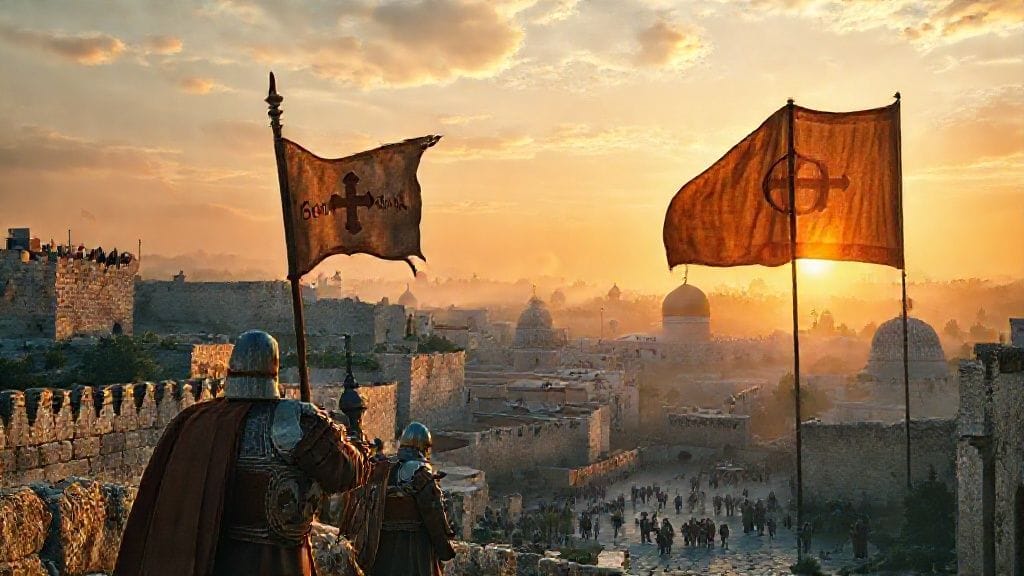
The sun rose on Jerusalem, casting its golden light upon the battered walls still blackened by battle. For weeks, the city had been under siege — a desperate, brutal contest of faith, will, and bloodshed. The air was thick with the stench of smoke, sweat, and fear. Yet as the gates fell open to the crusaders, the city erupted into a cacophony of clashing swords, triumphant shouts, and lamenting cries. The conquest of Jerusalem on July 15, 1099, marked not just a military victory, but the birth of something that would shape centuries: the Kingdom of Jerusalem, a feudal Christian state in the Levant.
This day was more than the capture of a city; it was the culmination of a pilgrimage transformed into warfare, a clash between civilizations, and a new chapter in medieval history. The Kingdom of Jerusalem’s foundation was steeped in both sanctity and violence, devotion and pragmatism.
2. The Road to the Holy City: Origins of the First Crusade
The story of Jerusalem’s conquest is inseparable from the broader momentum of the First Crusade. By the late 11th century, the Byzantine Empire in the East was weakened, facing incursions by Seljuk Turks who threatened Constantinople and Christian pilgrims traveling towards holy sites. Reports of persecution and restricted access to pilgrimage routes sparked outrage in Western Europe.
The political and religious divisions between Latin Christendom and the Muslim-controlled Levant had deep roots, but it was the Seljuk expansion that set the stage for Western intervention. The Byzantine Emperor Alexios I Komnenos appealed to Pope Urban II for military assistance — a request that resonated with many restless knights and nobles in the West.
3. Call to Arms: Pope Urban II and Christendom’s Rallying Cry
In November 1095, at the Council of Clermont, Pope Urban II made a dramatic appeal to the assembled clergy and nobility. His speech was fiery, invoking the idea of a holy war, a pilgrimage armed with faith, to reclaim Jerusalem and defend Eastern Christianity. “Deus vult!” (“God wills it!”) became the rallying cry that echoed across Europe.
Urban promised spiritual rewards — remission of sins and eternal salvation — to those who took up the cross and journeyed to the East. The call merged piety with political ambition, stirring the hearts and swords of thousands. This fusion of religious fervor and martial zeal would propel the First Crusade forward.
4. Pilgrimage or War? The Religious Zeal Behind the Crusade
For many participants, the Crusade was first and foremost a sacred journey. Medieval Christendom held Jerusalem as the spiritual core of the faith — the city where Christ had lived, died, and risen. Pilgrimage was an act of devotion, but the escalating conflicts and Muslim control complicated access. The Crusade promised a return to sacred sites under Christian authority, both to protect pilgrims and to expand Christendom’s earthly dominion.
Yet the reality of the Crusade was harsh: it was a war waged in God’s name, marked by violence and complex political rivalries. The tension between spirituality and bloodshed was palpable from the outset.
5. The Crusader Armies Assemble: Knights, Peasants, and Nobles United
The call to arms saw unprecedented mobilization. Knights of noble birth, peasants armed with farming tools, and wandering adventurers alike marched from France, Germany, Italy, and beyond. The army was fragmented — multiple leaders with divergent ambitions converged in a chaotic but determined expedition. Figures such as Godfrey of Bouillon, Raymond of Toulouse, and Bohemond of Taranto became names etched into the Crusade’s saga.
Despite logistical challenges, long and grueling marches, and battles along the way, this motley army was fueled by a shared purpose — to reach Jerusalem and reclaim it.
6. Through Flames and Blood: The Siege of Jerusalem Unfolds
By June 1099, the Crusaders reached Jerusalem, a city surrounded by formidable walls and defended by a determined Fatimid garrison. The siege was merciless. Crusaders constructed siege towers, dug tunnels, and launched assaults under an unforgiving sun. Disease, hunger, and exhaustion tested both sides.
The defenders were outnumbered but fought fiercely, knowing the city’s fall would mean catastrophe. Yet after weeks of relentless effort, the attackers breached the walls.
7. July 15, 1099: The Fall of Jerusalem – Glory and Carnage
When the walls finally fell on July 15, the Crusaders poured into the city in a frenzy of violence. Contemporary chroniclers describe a grim bloodbath: streets ran red with the blood of soldiers and civilians alike. The city was claimed in the name of Christendom, but at a terrible human cost.
Godfrey of Bouillon refused the title of king, instead choosing “Advocate of the Holy Sepulchre” — underscoring the city’s sacred status more than temporal power. The triumph was bittersweet, marked by both jubilation and mourning.
8. A Kingdom Born from Ashes: The Establishment of the Kingdom of Jerusalem
In the wake of conquest, the Crusaders began to organize their hold over the city and surrounding territories. The Kingdom of Jerusalem was declared, a new feudal monarchy fashioned according to Western norms but transplanted into an alien and volatile environment.
Jerusalem became the capital, a city sacred to Christians, Jews, and Muslims alike — now a fortress of Latin Christendom at the heart of the Levant.
9. Baldwin I: The First Crusader King and Architect of Stability
Godfrey’s death in 1100 led to his brother Baldwin I’s ascension as the first official King of Jerusalem. Baldwin proved a shrewd and energetic ruler, consolidating the kingdom’s defenses and expanding its borders through diplomacy and warfare.
His reign laid the administrative and military foundations necessary for the kingdom’s survival amid hostile surroundings. Baldwin’s leadership helped transform the fragile gains of the conquest into a functioning state.
10. Governing the Holy City: The Latin Patriarchate and Feudal Structures
The Kingdom was not only a political entity but also a religious project. The Latin Patriarch of Jerusalem replaced the Greek Orthodox hierarchy, seeking to assert ecclesiastical dominance. Feudalism imported from Europe underpinned governance — knights swore loyalty to the king, and lands were parceled out in fiefs.
This transplanted system created tensions with the indigenous populations and required adaptation to local realities.
11. Between Faith and Pragmatism: Relationships with Muslim Neighbors
Despite its devotees’ zeal, the Kingdom’s survival depended on pragmatic dealings with Muslim rulers nearby. Treaties, alliances, and occasional truces coexisted with ongoing skirmishes and wars. The Crusader states were far from isolated outposts; they were enmeshed in a complex diplomatic and military web.
The Kingdom’s leaders balanced devotion to their cause with the necessity of political realism.
12. Rival Claims and Internal Frictions: The Political Landscape of the Kingdom
From its inception, the Kingdom was a patchwork of competing claims and interests. Various noble families jostled for power, and disputes erupted over titles and territories. The need to unite against external threats often clashed with internal rivalries.
Power struggles shaped the Kingdom’s often unstable political dynamics, reflecting broader medieval patterns of governance.
13. The Kingdom’s Cultural Mosaic: Latin Christians, Muslims, Jews, and Eastern Christians
Jerusalem and its environs harbored a diverse population. Latin Christian settlers ruled over a mosaic of Muslims, Jews, Greek Orthodox Christians, Armenians, and others. This multicultural reality challenged the Crusaders to govern beyond their immediate community.
Religious coexistence was fragile, often punctuated by hostility but sometimes marked by commerce and coexistence. The Kingdom was at once a cultural frontier and a crucible of encounter.
14. Economic Life in the Crusader State: Trade, Agriculture, and Military Financing
The survival of the Kingdom depended not only on military might but also on economic stability. Trade routes connecting Europe, Egypt, and Asia passed through its lands, bringing merchants and wealth. Agriculture in the fertile Levant sustained local populations and armies.
Militarized orders collected revenues, and taxation supported the costly defense efforts. Economic life was dynamic yet precarious.
15. The Military Orders: From Templars to Hospitallers – Guardians of the Kingdom
One of the most enduring institutions born from the Crusades was the military orders. The Knights Templar and Knights Hospitaller emerged as key defenders, monastic yet martial, sworn to protect pilgrims and the Kingdom’s territory.
Their growing power influenced both the military fortunes and the political evolution of Jerusalem’s state.
16. The Kingdom of Jerusalem in the Larger Crusader Context
The Kingdom was the centerpiece of a constellation of Crusader states including Antioch, Tripoli, and Edessa. These states relied on one another for military support and ideological unity but often pursued their own interests.
Jerusalem’s capture inspired further crusading ventures but also intensified Muslim resistance.
17. Muslim Counterattacks: Beginning of Prolonged Conflict
The fall of Jerusalem sparked decades of counteroffensives by Muslim leaders intent on reclaiming the city and expelling the Crusaders. The Kingdom found itself in a constant state of siege, with battles that would culminate in figures like Saladin reconquering Jerusalem in 1187.
This prolonged conflict defined the region’s history for centuries.
18. Legacy of the Kingdom of Jerusalem: Crusader Ideals and Medieval Memory
Although the Kingdom lasted less than two centuries, its impact reverberated widely. It embodied a fusion of religious zealotry, martial valor, and medieval chivalry that shaped Western and Islamic perceptions alike.
The Crusader ideal remained a potent symbol, fueling later crusades and mystical imaginings of the Holy Land.
19. Jerusalem’s Enduring Symbolism: From Medieval Crusade to Modern Imagination
Jerusalem’s capture and the Kingdom’s story resonate beyond their time. The city remains a flashpoint of faith, conflict, and hope. The narrative of crusading permeates literature, art, and politics through the centuries, reflecting perennial human struggles with identity, belief, and power.
20. Conclusion: The Kingdom of Jerusalem as a Testament to Faith and Ambition
The establishment of the Kingdom of Jerusalem on July 15, 1099, invites reflection on the potency of faith mixed with ambition. It was a moment where spiritual aspiration met the brutal realities of conquest and governance. This Kingdom was a crucible of medieval ideals and hardships, a story of human hope, courage, and tragedy writ large on the tapestry of history.
Its legacy endures not only in chronicles and ruins but in the collective memory of a world still grappling with the meanings of sacred space and human destiny.
Conclusion
The Kingdom of Jerusalem’s foundation stands as one of history’s most compelling chapters—a vivid drama where religion, warfare, and culture collided. The conquest of Jerusalem was not merely a military triumph but the birth of a complex political entity engaged in a continuous struggle for identity, survival, and legitimacy.
Reflecting on this moment, we see humanity’s persistent yearning for meaning and power intertwined—how a city at the crossroads of faith could inspire both sublime devotion and unspeakable violence. The echoes of 1099 resonate still, reminding us of the cost and complexity behind the grand narratives we tell about civilization, belief, and conquest.
FAQs
1. What motivated the Crusaders to capture Jerusalem in 1099?
The Crusaders were driven by a mixture of religious devotion to reclaim the Holy City from Muslim control, political ambitions, and promises made by Pope Urban II for spiritual rewards, such as the remission of sins.
2. Who were the key leaders of the First Crusade and the Kingdom of Jerusalem?
Notable figures included Godfrey of Bouillon, who led much of the siege of Jerusalem; Raymond of Toulouse; Bohemond of Taranto; and Baldwin I, who became the first King of Jerusalem after Godfrey’s death.
3. How was the Kingdom of Jerusalem governed after its establishment?
It adopted a feudal system with a Latin Christian monarch at its head, supported by knights and vassals. The Latin Patriarch led the Church hierarchy, while military orders like the Templars defended the kingdom.
4. What was the relationship between the Kingdom and the native Muslim and Jewish populations?
The populations were diverse and complex. While conflict and religious tensions existed, pragmatic alliances, economic exchanges, and coexistence sometimes occurred amidst the cultural mosaic of the city and its territories.
5. How long did the Kingdom of Jerusalem last?
The Kingdom lasted from 1099 until 1187 when it lost Jerusalem to Saladin. Crusader control persisted in coastal cities until the late 13th century, with the fall of Acre in 1291.
6. What is the lasting significance of the Kingdom of Jerusalem?
It symbolizes the intense interplay of faith and power in medieval history, influenced Christian-Muslim relations for centuries, and inspired the enduring mythos of the Crusades in Western and Middle Eastern memory.
7. How did the military orders like the Templars influence the Kingdom of Jerusalem?
The military orders provided essential military defense, protected pilgrims, and accrued wealth and power that shaped both the security and politics of the Kingdom.
8. How did the fall of Jerusalem affect the broader Crusader efforts?
Jerusalem’s fall galvanized further Crusading expeditions but also intensified Muslim resistance, leading to a protracted conflict that would shape the geopolitics of the region for generations.

