Table of Contents
- The Dawn of a New Era: May 17, 1814, Eidsvoll
- Norway’s Long Road to Sovereignty
- The Napoleonic Storm and Scandinavian Geopolitics
- Danish Rule and Norwegian Discontent
- The Treaty of Kiel: A Betrayal and a Call to Arms
- The Norwegian National Assembly Convenes
- The Framers of the Constitution: Visionaries at Eidsvoll
- The Drafting Process: Ideals, Debates, and Dilemmas
- The Constitution Unveiled: Principles and Innovations
- The Role of Democracy and Separation of Powers
- Norway’s Monarchy Question: Balancing Tradition and Freedom
- The Declaration of Independence and Its Immediate Impact
- Sweden’s Response: Conflict and the Campaign of 1814
- The Convention of Moss: Compromise and Union
- The Legacy of Eidsvoll’s Constitution in Norwegian Identity
- The Constitution’s Influence Beyond Norway’s Borders
- Commemorations and National Celebrations: May 17 as Norway’s Day
- Constitutional Amendments and the Road to Modern Norway
- Reflections on Sovereignty in the Face of Power Dynamics
- The Eidsvoll Constitution Today: Symbol and Living Document
1. The Dawn of a New Era: May 17, 1814, Eidsvoll
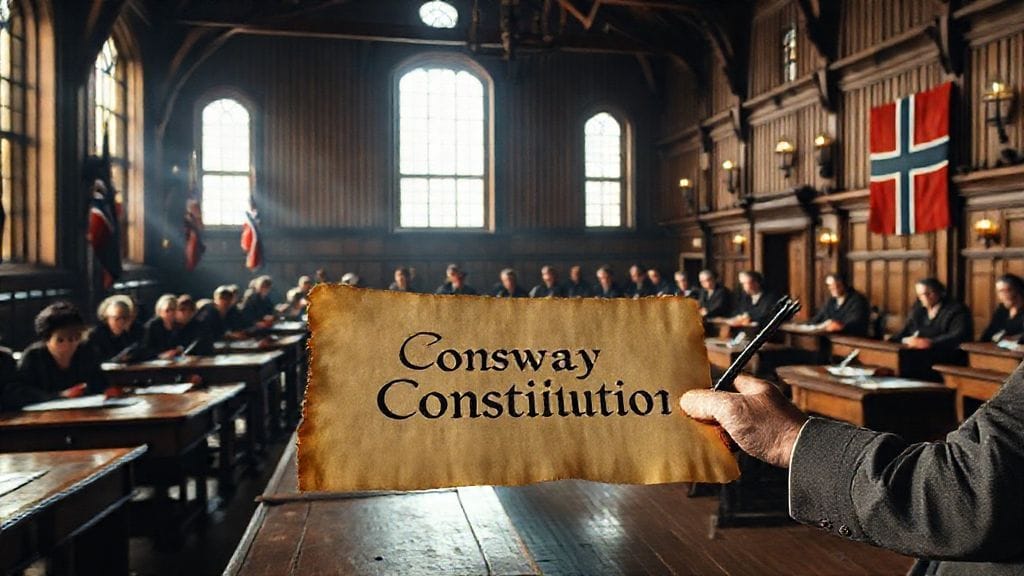
The chill of a late spring day in Eidsvoll did nothing to temper the warmth swelling in the hearts gathered at the grand hall of the manor house. It was May 17, 1814 — a date destined to be etched into the soul of a nation. Amid flurries of snow that still clung to the Norwegian countryside, 112 delegates assembled, representing a land caught in the shifting currents of European power struggles. They were about to break the chains that had long bound them and breathe life into one of the most progressive constitutions of its time. The room buzzed with the weight of responsibility, with hope, with the fervor of men who dared to dream of self-rule. As the final strokes of pen marked the document, Norway’s destiny veered from centuries of foreign dominion to the fragile yet fierce promise of independence.
2. Norway’s Long Road to Sovereignty
For centuries, Norway had occupied a complex place in Northern Europe’s political tapestry — a country rich in natural beauty but subjected to foreign crowns. Historically united with Denmark since the late Middle Ages under the Danish-Norwegian union, Norway found itself at the mercy of a foreign administration in Copenhagen, its political and economic will subsumed, often ignored. The 18th century exacerbated existing grievances: a lack of Norwegian representation in governance, economic restrictions, and cultural overshadowing fostered a growing desire for national recognition. Yet, the seeds of sovereignty remained dormant until the cataclysmic years of the Napoleonic Wars created the cracks necessary for change.
3. The Napoleonic Storm and Scandinavian Geopolitics
Europe in the early 19th century was a continent aflame. The Napoleonic Wars had drawn every power into their vortex, shifting alliances and upending centuries-old borders. Denmark-Norway, aligned with Napoleon following the British attack on Copenhagen in 1807, found itself isolated. The tides of war swept across the continent, with Sweden, allied to Britain and Russia, eyeing Norway as a prize for its loyalty to the anti-Napoleonic coalition. The Treaty of Kiel, signed in January 1814, harshly redrew the Scandinavian map, ceding Norway from Denmark to Sweden — a transaction forced on a Norwegian population that had no voice in the matter. But beneath this verdict simmered a restless spirit ready to stand firm.
4. Danish Rule and Norwegian Discontent
Under Danish rule, Norway’s governance had been largely peripheral. Copenhagen dictated policy, collected taxes, and appointed officials with little Norwegian input. Cultural suppression and economic neglect bred frustration across its fjords and forests. Norwegians saw themselves as distinct, bound by language, traditions, and geography to a future that no longer included submission. The Napoleonic Wars, while devastating, also awakened nationalist sentiments, with merchants, clergy, and farmers increasingly conscious of their identity and eager for a governance that respected their autonomy.
5. The Treaty of Kiel: A Betrayal and a Call to Arms
The Treaty of Kiel was the detonator. Signed against Norwegian wishes, it transferred sovereignty as a prize of war. The news rippled through Norway like a shockwave — no Norwegian had been consulted or consented. Yet, the great powers of Europe, exhausted by war and eager to stabilize the region, overlooked Norway’s claims. In response, Prince Christian Frederick, then viceroy in Norway and a Danish prince, seized the moment. Declaring himself regent, he vowed to secure Norwegian independence and called for a national assembly, setting into motion a process that would lead to a historic constitutional moment.
6. The Norwegian National Assembly Convenes
In April 1814, delegates from rural districts, cities, merchants, farmers, clergy, and civil servants gathered at the Eidsvoll manor. This grand convention embodied a rare moment of broad representation unprecedented in Norwegian history. The attendees brought diverse perspectives but shared a commitment: to craft a constitution that would underpin a free Norway. The assembly was charged with a monumental task — to define the political future of the nation, balancing ideals, pragmatism, and the realities of international politics.
7. The Framers of the Constitution: Visionaries at Eidsvoll
The men of Eidsvoll, often referred to as the “Eidsvollsmenn,” were pioneers not only in politics but in their vision of Norway’s future. Among them were jurists, merchants, farmers, and former soldiers — a microcosm of Norwegian society. Christian Magnus Falsen, often dubbed the “Father of the Constitution,” drew heavily upon Enlightenment ideals and foreign constitutions such as those of the United States and France. They debated fiercely but with mutual respect, weaving together principles of sovereignty, equality, and rights that challenged the monarchic absolutism that had ruled Norway for centuries.
8. The Drafting Process: Ideals, Debates, and Dilemmas
Over weeks of debates, the assembly confronted difficult questions. How to balance the power of the king with popular sovereignty? How to protect freedoms without descending into chaos? The process was both solemn and spirited, with compromises marking the margins of the document. Discussions around religion, suffrage, and executive power occupied long hours. Though not a perfect document by modern standards—some rights were limited to men, certain classes remained privileged—the constitution became a testament to democratic aspirations in a time of monarchy and empire.
9. The Constitution Unveiled: Principles and Innovations
Finally, on May 17, 1814, the Constitution of the Kingdom of Norway was adopted. It enshrined principles that were revolutionary for its time: popular sovereignty, with authority derived from the people; separation of powers among executive, legislative, and judicial branches; and protection of civil liberties like freedom of speech and protection from arbitrary arrest. It established Norway as a constitutional monarchy with a hereditary king — a nod towards continuity amid change. The constitution was one of the most liberal in Europe, a beacon that balanced tradition and progress.
10. The Role of Democracy and Separation of Powers
The Eidsvoll Constitution echoed the political philosophies of Montesquieu and Rousseau, emphasizing checks and balances. The Storting—the new Norwegian parliament—was given legislative authority, while the executive power was vested in the king, but under constitutional constraints. This was an alarming evolution from the centuries of royal absolutism, signaling a shift not just in power but in the notion of governance itself. The document envisioned a political system in which the people had a real voice, laying the groundwork for Norway’s gradual democratization.
11. Norway’s Monarchy Question: Balancing Tradition and Freedom
While democratic ideas flourished, the framers understood the symbolic power of monarchy in maintaining stability. They chose to retain a king, though under limited authority, hoping to avoid the chaos seen in France and elsewhere. Christian Frederick was elected king by the assembly but faced opposition from Sweden, whose own monarch claimed legitimate sovereignty over Norway per the Treaty of Kiel. This precarious balance between independence and monarchy would define the immediate political drama that followed.
12. The Declaration of Independence and Its Immediate Impact
Accompanying the constitution was a bold declaration of independence. Norway proclaimed itself a sovereign kingdom, seeking recognition from European powers and rejecting the terms imposed at Kiel. This act was as much a statement of intention as a gamble — the young nation stood defiant against the political realities surrounding it. The declaration galvanized national pride and hope but also drew the gaze of neighboring Sweden, unwilling to accept this challenge to the status quo.
13. Sweden’s Response: Conflict and the Campaign of 1814
Sweden responded swiftly, initiating a military campaign to enforce the Kiel treaty and bring Norway under its crown. The brief war of the summer of 1814 pitted a determined, if outnumbered, Norwegian force against Swedish troops. Despite fierce fighting and popular resistance, the military superiority of Sweden was overwhelming. Yet, the spirit of resistance and the legitimacy conferred by the Eidsvoll Constitution complicated Sweden’s efforts to claim absolute control. Diplomacy soon took precedence over open conflict.
14. The Convention of Moss: Compromise and Union
The conflict concluded with the Convention of Moss in August 1814. Norway agreed to enter a personal union with Sweden, accepting the Swedish king as monarch but crucially retaining its newly adopted constitution with only minor amendments. This compromise preserved much of Norway’s sovereignty and was a rare example of negotiated autonomy in an era dominated by imperial conquest and suppression. Though unionized, Norway’s distinct legal and political identity endured, a testament to the power of the Eidsvoll Constitution.
15. The Legacy of Eidsvoll’s Constitution in Norwegian Identity
The Constitution of 1814 swiftly became a cornerstone of Norwegian nationalism. It was more than a political text—it embodied the spirit of self-determination, justice, and modern governance. Celebrated annually on May 17, now Norway’s national day, it reminds citizens of their collective struggle and achievements. The document fostered a sense of unity and pride that helped sustain Norwegian cultural and political distinctiveness throughout the 19th and 20th centuries, ultimately contributing to full independence in 1905.
16. The Constitution’s Influence Beyond Norway’s Borders
Though crafted under exceptional circumstances, the Norwegian constitution was among the earliest in Europe to espouse democracy, human rights, and governance principles modeled on Enlightenment ideals. Its progressive features resonated beyond its borders, inspiring reformers elsewhere and carving a place for Norway in the broader dialogues about nationhood and constitutionalism in an era overshadowed by empire and monarchy. Its pragmatism—blending tradition with innovation—served as a model for emerging nations.
17. Commemorations and National Celebrations: May 17 as Norway’s Day
Today, May 17 is a vibrant celebration of Norwegian identity, democracy, and history. Known as “Syttende Mai,” this day is marked by parades, speeches, traditional dress, and communal gatherings. It recalls not just the adoption of a legal document, but the birth of a national spirit. The festivities echo the hopes and struggles of the Eidsvoll fathers and the people they represented. It is a reminder that constitutions live in the hearts of those governed as much as in ink on parchment.
18. Constitutional Amendments and the Road to Modern Norway
Over the past two centuries, Norway’s constitution has evolved, adapting to new challenges and realities. Amendments have expanded suffrage, enhanced civil rights, and refined the balance of powers. The document has remained sufficiently flexible to accommodate change while preserving its core ideals. This adaptability helped Norway transition peacefully from monarchical rule to a parliamentary democracy and a prosperous modern state.
19. Reflections on Sovereignty in the Face of Power Dynamics
The story of Norway’s constitution reveals timeless tensions—the aspiration for self-rule clashing against the ambitions of larger powers, the negotiation between tradition and reform, the delicate art of compromise. Norway’s experience underscores the fragility and strength of sovereignty; that it must be continually claimed, defended, and redefined. The Eidsvoll Constitution stands as a testament to this ongoing struggle, both unique and universal.
20. The Eidsvoll Constitution Today: Symbol and Living Document
More than two centuries later, the 1814 constitution remains a living document. It is enshrined in Norway’s laws, taught in its schools, and celebrated in its public life. It anchors the nation’s values and legal framework, inspiring generations to seek justice, equality, and democracy. The framers at Eidsvoll crafted more than governance; they shaped the soul of a nation — a soul that beats strongly on every May 17.
Conclusion
The adoption of the Kingdom of Norway’s Constitution on May 17, 1814, was a watershed moment — a bold assertion of identity, freedom, and political innovation amid a world dominated by empires. It marked not only a break from centuries of foreign domination but the birth of a democratic ethos that continues to define Norway. This remarkable document symbolized hope in a changing Europe and has endured as a beacon of democracy, sovereignty, and national pride. Its crafting was a human story of courage, debate, and compromise; a reminder that the foundations of freedom are laid by those willing to believe in a better future. Today, the spirit of Eidsvoll still inspires Norway and offers hope to any people yearning for self-determination and justice.
FAQs
1. Why was the Norwegian Constitution adopted in 1814?
The constitution was adopted to assert Norway’s independence following the Treaty of Kiel, which transferred Norway from Danish to Swedish rule without Norwegian consent. It was an effort to establish sovereignty and self-government.
2. Who were the main figures involved in drafting the constitution?
Key figures included Christian Magnus Falsen, often called the “Father of the Constitution,” along with other members of the Norwegian National Assembly representing various social groups.
3. How did the Treaty of Kiel influence Norway’s constitutional moment?
The Treaty ceded Norway to Sweden, spurring Norwegians to resist by drafting a constitution to declare independence and reject foreign imposition.
4. What are the most important principles of the 1814 Norwegian Constitution?
Popular sovereignty, separation of powers, protection of civil liberties, and the establishment of a constitutional monarchy.
5. Did Norway remain independent after adopting the constitution?
Norway declared independence but was forced into a union with Sweden following a brief conflict. However, it retained its constitution and a large degree of autonomy.
6. How is the Constitution of 1814 commemorated in Norway today?
May 17, Constitution Day or “Syttende Mai,” is a national holiday marked by celebrations of Norwegian identity including parades, speeches, and cultural events.
7. How has the Norwegian Constitution evolved since 1814?
It has been amended multiple times to expand suffrage, enhance rights, and adjust governance structures while maintaining its original democratic spirit.
8. What is the global significance of the Norwegian Constitution?
It was one of the early liberal constitutions in Europe, inspiring later democratic reforms and symbolizing the power of small nations to assert their sovereignty.