Krakatoa 1883: The Explosion That Echoed Across the Planet
Table of Contents
- Introduction
- Where is Krakatoa?
- Build-Up to the Cataclysm
- The Eruption: August 26–27, 1883
- The Mega-Tsunamis
- Death Toll and Destruction
- Atmospheric and Global Effects
- Scientific Reactions and Discoveries
- Legacy in Culture and History
- Conclusion
- External Resource
- Internal Link
1. Introduction
On August 27, 1883, the world witnessed one of the most violent volcanic eruptions in recorded history. The explosion of Krakatoa, a volcanic island in the Sunda Strait of Indonesia, not only decimated the island itself but also triggered deadly tsunamis and atmospheric changes felt across the globe.
Krakatoa’s eruption became a turning point in volcanology and global environmental awareness. From towns buried in waves to sunsets turned blood-red across continents, its reach extended far beyond Indonesia’s shores.
2. Where is Krakatoa?
Krakatoa, or Krakatau in Indonesian, was located between the islands of Java and Sumatra. Part of a volcanic island arc, it belonged to the Pacific Ring of Fire, an area infamous for its tectonic instability.
The island consisted of three main volcanic cones: Perboewatan, Danan, and Rakata. By 1883, increased volcanic activity in this region had drawn the attention of Dutch colonists and local populations.
3. Build-Up to the Cataclysm
Activity began in May 1883, with ash clouds rising 6 km high. Ships passing nearby reported falling pumice and loud explosions.
In June and July, eruptions became more frequent. Yet, many considered Krakatoa a curiosity rather than a serious threat. Tourists even took boats to watch the “spectacle.”
But on August 26, the tone shifted. Four gigantic explosions occurred in under 24 hours, culminating in the cataclysmic blast of August 27 at 10:02 AM.
4. The Eruption: August 26–27, 1883
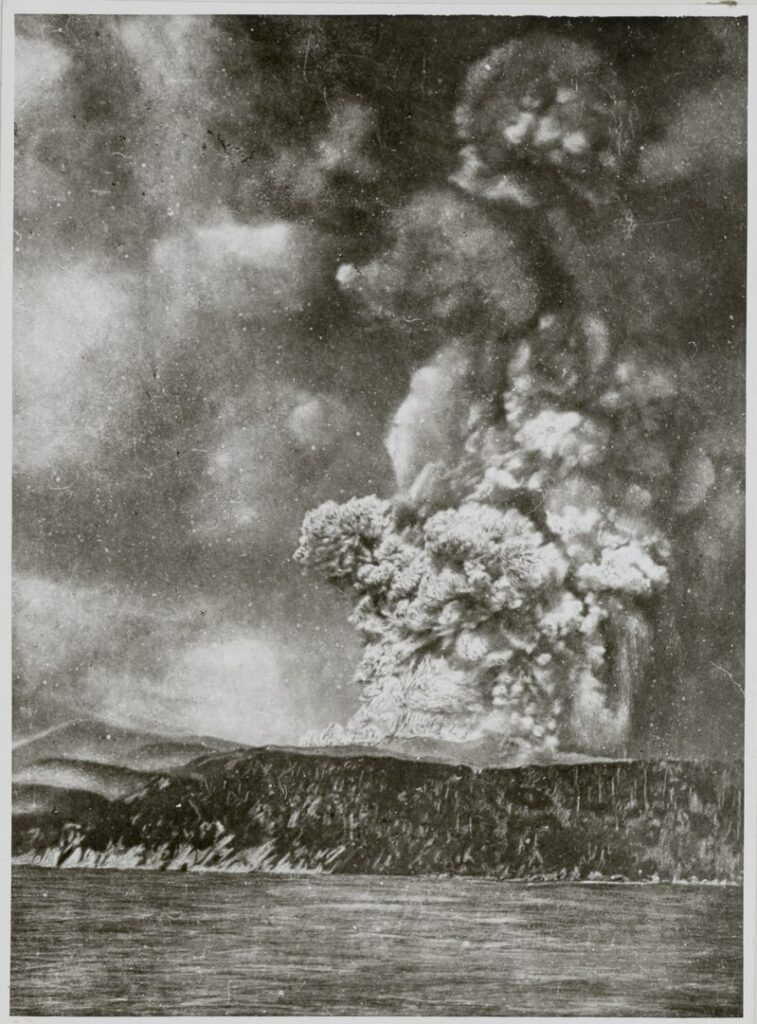
The final blast obliterated two-thirds of Krakatoa Island. It generated the loudest sound ever recorded in history—heard over 3,000 miles away in Australia and the island of Rodrigues near Mauritius.
🌋 A volcanic column of ash and debris soared 50 km into the sky.
🔥 The blast released energy equivalent to 200 megatons of TNT.
🌍 The shockwaves circled the Earth seven times.
5. The Mega-Tsunamis
The eruption triggered colossal tsunamis reaching up to 40 meters high.
Coastal towns across Java and Sumatra were wiped off the map.
✔️ Over 165 coastal villages were destroyed.
✔️ Tsunami waves traveled across the Indian Ocean and were recorded as far away as South Africa.
✔️ One wave reportedly reached New Zealand, over 7,000 km away.
6. Death Toll and Destruction
✔️ At least 36,000 people were killed, though some estimates go up to 120,000.
✔️ Most deaths were caused by the tsunamis, not the eruption itself.
✔️ Thousands more died from starvation, disease, and loss of habitat.
Entire communities vanished overnight. Survivors spoke of complete silence after the blast, followed by deadly walls of water.
7. Atmospheric and Global Effects
The Krakatoa eruption injected enormous amounts of sulfur dioxide into the upper atmosphere.
✔️ Global temperatures dropped by up to 1.2°C for over a year.
✔️ Spectacular sunsets were observed worldwide, inspiring paintings and literature.
✔️ Some reports mention “blue suns” visible through ash in the atmosphere.
These effects provided the first real understanding of volcanic climate forcing.
8. Scientific Reactions and Discoveries
Scientists worldwide rushed to understand the event.
Meteorological stations recorded air pressure waves multiple times over several days.
New studies in atmospheric science, oceanography, and volcanology were sparked.
Krakatoa marked the beginning of global scientific collaboration in studying natural disasters.
9. Legacy in Culture and History
✔️ Books, songs, and legends blossomed from the event.
✔️ The eruption was later linked to religious interpretations and end-time prophecies in different cultures.
✔️ In 1927, a new island called Anak Krakatau (Child of Krakatoa) began forming in the same location.
Krakatoa became a symbol of both destruction and rebirth.
10. Conclusion
The Krakatoa eruption of 1883 remains one of Earth’s greatest recorded natural disasters. It reshaped geography, shattered lives, and forced humanity to confront the raw power of geological forces. But it also expanded our scientific horizons and our understanding of how events in one place can ripple across the entire globe.
11. External Resource
🌐 Wikipedia: 1883 eruption of Krakatoa

