Table of Contents
- The Final Breath of an Empire: Kublai Khan’s Death in Khanbaliq
- The Last Winter of 1294: A World on the Cusp of Change
- The Rise of Kublai Khan: From Warrior to Emperor
- The Founding of Yuan China: A New Dynasty’s Dawn
- Khanbaliq: The Heartbeat of the Mongol Empire
- The Golden Palace: Life and Power in the Imperial Court
- The Weight of Leadership: Kublai Khan’s Later Years
- Shadows of Decline: The Challenges of Governing East Asia
- The Final Days: Illness and Uncertainty in the Imperial City
- The Passing of the Great Khan: February 18, 1294
- Mourning an Era: Reactions across the Empire
- The Succession Struggle: Power after Kublai Khan
- Yuan China’s Political Landscape Post-Kublai
- The Empire’s Splintering: Seeds of Fragmentation
- Cultural Legacy: Kublai’s Impact on China and Beyond
- Economic Policies and Trade Under Kublai Khan
- The Silk Road Reimagined: East Meets West
- Kublai Khan in Memory and Myth
- Lessons from the End of an Era
- Conclusion: The Sunset of a Mongol Vision
- FAQs: Unveiling the Legacy of Kublai Khan’s Death
- External Resource: Wikipedia Link
- Internal Link: Visit History Sphere
1. The Final Breath of an Empire: Kublai Khan’s Death in Khanbaliq
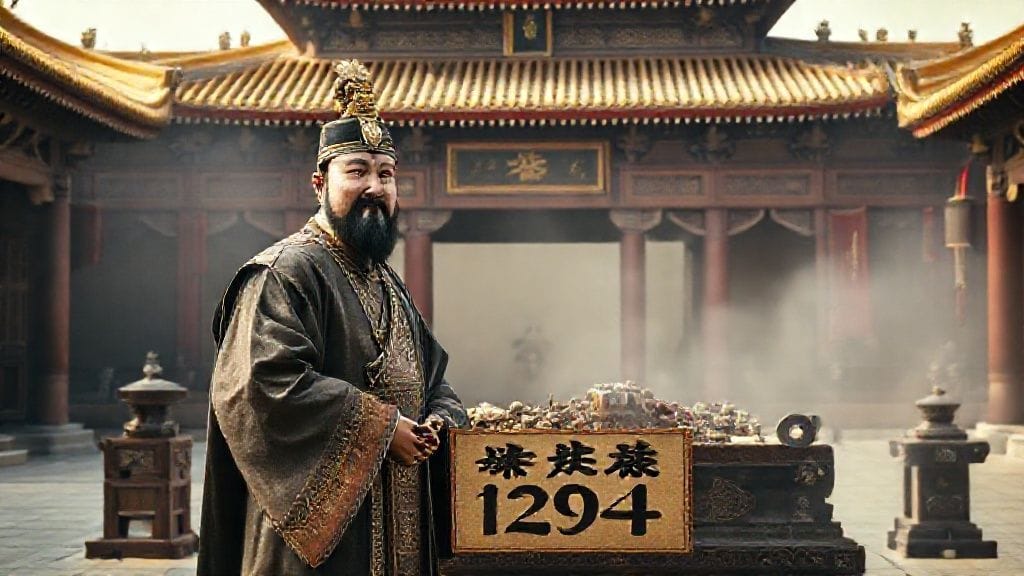
The cold winds swept through the winding streets of Khanbaliq, the imperial capital echoing with a quiet unrest. It was February 18, 1294, a day that carried an unbearable weight on the shoulders of every courtier, soldier, and commoner alike. The great Kublai Khan, the mighty architect of the Yuan dynasty and the first Mongol emperor of China, had drawn his last breath. In the sprawling palace complex, where every stone seemed to whisper tales of conquest and synthesis, silence fell like an ominous shroud.
This was not just the death of a man. It was the twilight of an epoch — a giant whose footsteps forever stamped the contours of Asia’s history. His passing ignited an uncertain future, foreshadowing the fragility of an empire that had stretched from the steppes of Mongolia to the lush plains of southern China.
2. The Last Winter of 1294: A World on the Cusp of Change
The world of 1294 was a mosaic of shifting powers. Europe was emerging from its medieval fog, the Islamic world pulsated with intellectual vigor, and East Asia stood under the watch of this Mongol empire forged by Kublai Khan. Yet, beneath the shimmering surface of Kublai’s court lay daunting pressures — territorial overreach, internal dissent, economic strains.
As winter deepened in Khanbaliq, so did the shadow of the emperor’s failing health. Rumblings of instability grew louder, and the mighty machinery of governance showed cracks that no force could easily repair.
3. The Rise of Kublai Khan: From Warrior to Emperor
To understand the weight of that final day, one must trace back to the man’s meteoric journey. Born in 1215, Kublai was a grandson of the legendary Genghis Khan, inheriting not just blood but a vision of universal empire. Unlike his predecessors, Kublai combined Mongol martial vigor with an appreciation for Chinese culture and administration, a synthesis that would define his reign.
By 1271, he had claimed the title of Emperor of China, establishing the Yuan dynasty and reorienting the Mongol empire’s center of gravity towards the established Chinese heartlands.
4. The Founding of Yuan China: A New Dynasty’s Dawn
Yuan China was revolutionary—an empire melding the nomadic legacy of the steppes with the deep-rooted Chinese civilization. Kublai’s court welcomed scholars, merchants, and monks from across the globe, transforming Khanbaliq into a cosmopolitan hub.
This fusion was fraught with challenges: balancing Mongol traditions with Chinese bureaucracy, integrating diverse peoples, and maintaining control over vast distances. But it created an emergent world power at the crossroads of culture and commerce.
5. Khanbaliq: The Heartbeat of the Mongol Empire
Khanbaliq, modern-day Beijing, was more than a capital city; it was a symbol of the Mongol conquest’s triumph but also its most complex experiment. The imperial city housed palaces of jade and gold, labyrinthine administrative offices, and bustling marketplaces where Persian merchants exchanged their silks for Chinese ceramics.
It was here that the pulse of the empire could be felt most vividly — in ceremonies that intertwined Mongol customs and Chinese rites, in the murmurs of intrigue within the palace walls.
6. The Golden Palace: Life and Power in the Imperial Court
Within the “White Stupa” and the Golden Palace, Kublai Khan presided over a court that was as dazzling as it was divided. His advisors included Confucian scholars, Mongol generals, Tibetan lamas, and foreign envoys, reflecting the empire’s sprawling reach.
Yet the glitter could not mask undercurrents of rivalry and tension. The administration grappled with corruption, cultural clashes, and the perennial challenge of imposing Mongol supremacy over a sedimented Chinese bureaucratic tradition.
7. The Weight of Leadership: Kublai Khan’s Later Years
As years turned to decades, Kublai’s robust energy faded. His ambitions grew grander but were increasingly undermined by crises: failed military expeditions into Japan and Southeast Asia, bureaucratic inertia, and factionalism.
Still, the emperor clung fiercely to his vision of a unified, stable empire. The burden of blending two worlds exacted a steep price on his health and mind — a toll borne with melancholy dignity.
8. Shadows of Decline: The Challenges of Governing East Asia
Kublai’s death did not come in isolation; it reflected systemic challenges. The Yuan dynasty struggled with administrative inefficiencies especially when distant provinces felt neglected. Economic troubles worsened as inflation rose and agricultural production faltered, partly due to natural calamities.
Moreover, the Mongol ruling class faced growing alienation from the Chinese populace, with resentment erupting in localized uprisings.
9. The Final Days: Illness and Uncertainty in the Imperial City
In the chill of February 1294, Kublai Khan’s health deteriorated rapidly. Despite the care of the empire’s best physicians and spiritual advisers, the great emperor’s body betrayed him. The once indomitable figure was bedridden, his breathing shallow.
Close confidants and family gathered, unsure whether the man who had shaped vast realms would endure to witness the dawning of another spring.
10. The Passing of the Great Khan: February 18, 1294
When the emperor died that bleak winter day, the news rippled through Khanbaliq and beyond with a stunned finality. The once unstoppable force of expansion, patronage, and governance had folded into history.
The chroniclers of the day capture the scene with poignant sobriety. Court officials observed rituals, chanting prayers into the cold night. A great mourning ceremony was held, yet beneath the public grief lay an undercurrent of anxiety.
11. Mourning an Era: Reactions across the Empire
From the steppes to the southern provinces, the death of Kublai Khan stirred diverse responses. Mongol warriors lamented their strong leader, Chinese scholars debated the fate of their homeland, and foreign dignitaries pondered the implications.
In several towns, spontaneous memorials arose, revealing the emperor’s complex legacy: both revered and resented, yet undeniably monumental.
12. The Succession Struggle: Power after Kublai Khan
Kublai left no peaceful handover. The question of the next Great Khan sparked intense rivalries, particularly among his sons and court factions. Temür Khan, Kublai’s grandson, eventually emerged as successor, but the process exposed fragilities in the Mongol dynastic structure.
This period was marked by political purges, shifting alliances, and an erosion of centralized power.
13. Yuan China’s Political Landscape Post-Kublai
Under Temür and successors, the Yuan dynasty’s grip loosened progressively. Bureaucratic corruption worsened, and the Mongol ruling elite grew increasingly estranged.
Chinese scholar-officials regained some influence, yet without the steady hand of Kublai, the empire’s cohesion unspooled inch by inch.
14. The Empire’s Splintering: Seeds of Fragmentation
Within decades, the sprawling Mongol Empire fractured into competing khanates. The Ilkhanate in Persia, the Golden Horde in the west, and the Chagatai Khanate in Central Asia drifted towards autonomy.
Yuan China became increasingly insular, grappling with internal rebellions and external threats, foreshadowing the dynastic collapse in the century that followed.
15. Cultural Legacy: Kublai’s Impact on China and Beyond
Kublai Khan’s reign was a crucible for cultural synthesis. He patronized Buddhism and Daoism, encouraged the arts, and fostered trade routes that carried knowledge across continents.
His embracing of foreign technologies and religions created ripples throughout Asia that would endure long past the Yuan dynasty’s fall.
16. Economic Policies and Trade Under Kublai Khan
Kublai’s economic vision blended Mongol mobility with China’s settled agriculture. He invested heavily in infrastructure — building roads, postal systems, and canals — to knit the empire’s vast expanse together.
The revitalization of the Silk Road under his rule not only enriched the empire but also connected the East to markets and ideas in the West.
17. The Silk Road Reimagined: East Meets West
Under Kublai’s aegis, the Silk Road enjoyed an unprecedented heyday. Traders, diplomats, and adventurers — most famously Marco Polo — journeyed through Khanbaliq, witnessing the empire’s grandeur.
This contact accelerated cultural exchange, technology transfer, and the spread of goods, shaping the trajectory of Eurasian history.
18. Kublai Khan in Memory and Myth
Long after his death, Kublai Khan assumed a near-mythic stature. Chinese, Mongol, and Western narratives painted him alternately as a conqueror, a wise ruler, or a tyrant.
Stories of his court, his dialogues with foreign visitors, and his ambitious projects feed both history and imagination to this day.
19. Lessons from the End of an Era
Kublai Khan’s death marks more than the demise of one man; it symbolizes the limits of conquest and the challenges of empire-building across cultures.
His story offers timeless insights into leadership, cultural integration, and the delicate balance between force and governance.
20. Conclusion: The Sunset of a Mongol Vision
Kublai Khan’s passing in Khanbaliq encapsulated the closing of a chapter as vast as the Eurasian landmass itself. His life embodied ambition and adaptation, vision and contradiction.
Though his empire would eventually fade, the echoes of his reign continue to resonate, reminding us of the extraordinary possibilities—and inevitable fragilities—of human empires.
Conclusion
The death of Kublai Khan on February 18, 1294, was a moment heavy with portent and melancholy. Here stood a man who had upended continents, sewn together disparate peoples, and rekindled ancient routes of commerce and culture. Yet, in his final breath lay the seeds of uncertainty, a reminder that even the mightiest rule over impermanence.
Kublai’s legacy is a mirror reflecting the triumphs and trials of empire: the exhilaration of expansion and the quiet erosion of power; the fusion of worlds and the fractures that follow. His story invites us not only to marvel at human achievement but to contemplate the complex dance between strength and vulnerability that defines history itself.
FAQs
1. Who was Kublai Khan and why was his death significant?
Kublai Khan was the founder of the Yuan dynasty and the first Mongol emperor to rule over China. His death in 1294 marked the beginning of political instability that would weaken the Yuan dynasty and eventually lead to its decline.
2. What challenges did Kublai Khan face during his reign?
He struggled with balancing Mongol nomadic traditions with Chinese bureaucratic governance, managing a vast and diverse empire, failed military campaigns, economic troubles, and growing alienation from his Chinese subjects.
3. How did Kublai Khan’s death affect the Mongol Empire?
It triggered a succession crisis and accelerated the fragmentation of the Mongol Empire, with various khanates becoming more independent and Yuan China entering a prolonged period of decline.
4. What was the significance of Khanbaliq (Beijing) during Kublai’s rule?
Khanbaliq served as the political and cultural capital of the Yuan dynasty, symbolizing the blend of Mongol power and Chinese civilization, and was a hub for international trade and diplomacy.
5. How did Kublai Khan influence trade routes like the Silk Road?
He revitalized the Silk Road, promoting safe passage for merchants and travelers, which facilitated cross-cultural exchanges and boosted economic prosperity across Eurasia.
6. How is Kublai Khan remembered in history and culture?
He is remembered both as a formidable conqueror and an innovative ruler who fostered cultural exchange, with his court inspiring countless myths, literary works, and historical studies.
7. What led to the decline of the Yuan dynasty after Kublai Khan’s death?
Post-Kublai, the Yuan dynasty suffered from factionalism, corruption, economic hardship, and rebellions, resulting in its eventual collapse in the 14th century.
8. Did Kublai Khan integrate Chinese culture into his administration?
Yes. Kublai actively incorporated Chinese customs, Confucian bureaucracy, and religious traditions into his rule to maintain legitimacy and stabilize his reign.