Table of Contents
- The Strategic Heart of Mesopotamia: Al-Hira in the 6th Century
- The Lakhmids: Guardians of the Arabian Frontier
- Sassanian Persia: The Eastern Empire on the Brink
- Origins of Cooperation: From Tension to Alliance
- Al-Hira: The Cultural and Political Capital of the Lakhmid Dynasty
- The Geo-Political Chessboard: Romans, Persians, and Arab Tribes
- The Catalyst for Alliance: Threats from Byzantium and Arab Rivals
- The Marriage of Politics and Power: The Diplomatic Ties Binding Lakhmids and Sassanians
- Military Symbiosis: How the Lakhmids Served the Sassanian Eastern Flank
- The Role of al-Nu’man III: Architect of the Tightening Alliance
- Religious Dimensions: Nestorian Christianity and Zoroastrian Persia
- Economic Flourishing: Trade Routes, Tribute, and Prosperity under the Alliance
- Cultural Exchanges and the Blending of Identities in Mesopotamia
- The Lakhmid–Sassanian Alliance Under Strain: Intrigues at the Court of Ctesiphon
- The Demise of the Alliance: Prelude to the Islamic Conquests
- Legacy and Long-Term Effects: The Collapse and Historical Memory
- Lessons from the Frontier: How Al-Hira Shaped Arab-Persian Relations
- Conclusion: A Tale of Alliance, Identity, and Empire on Mesopotamian Soil
- Frequently Asked Questions
- External Resource
- Internal Link
1. The Strategic Heart of Mesopotamia: Al-Hira in the 6th Century
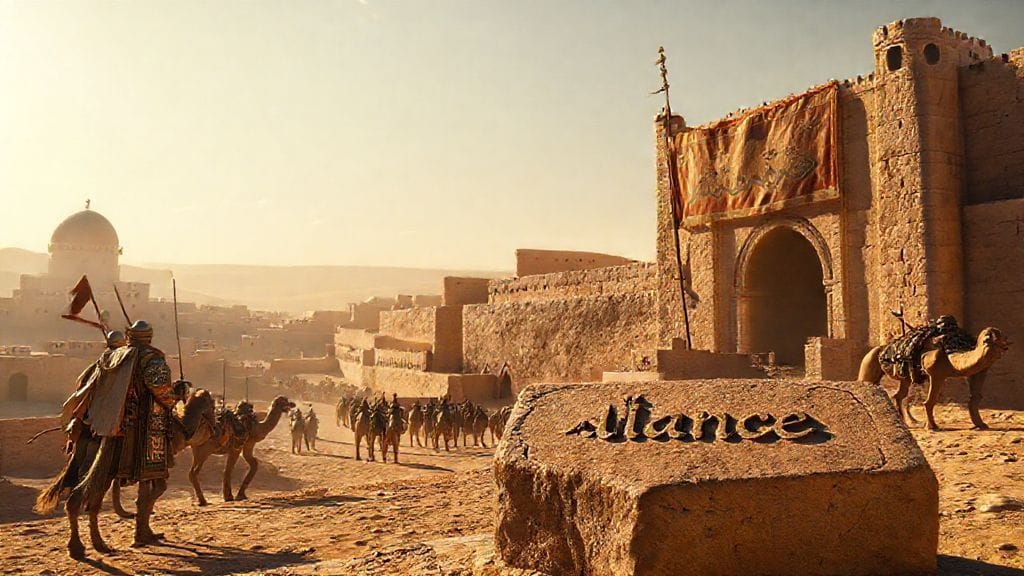
In the blistering sands and shimmering heat of 6th-century Mesopotamia, the city of al-Hira stood as an oasis of political intrigue, cultural synthesis, and strategic might. Nestled between the mighty Euphrates River and the expansive Arabian deserts, al-Hira was not merely a city but a pivotal fulcrum balancing the ambitions of empires and the fate of Arabian tribes. Amid this scorching crossroads, a unique alliance was tightening between the Lakhmid rulers—Arabian chieftains with influence that stretched deep into desert caravans—and the mighty Sassanian Empire, Persia’s last bulwark against Roman encroachment. One could almost hear the desert winds whispering secrets of dynastic marriages, military campaigns, and shifting loyalties that coerced together a fragile but vital bond.
Yet, this alliance was more than a mere pact of convenience—under its surface swirled a complex tapestry of cultural hybridity, political necessity, and religious negotiation. The story of the Lakhmid–Sassanian alliance is therefore not only about armies and empires but about identity forged in the crucible of shifting sands and imperial ambitions.
2. The Lakhmids: Guardians of the Arabian Frontier
The Lakhmid dynasty traced its origins to the ancient Arab tribes that had roamed and settled the fringes of the Arabian Peninsula. By the 6th century, the Lakhmids had established their power base at al-Hira, a city that had flourished as a center of commerce, poetry, and religious life. Known for their Arabian tribal roots, the Lakhmids had morphed into vassal kings under the protectorship of the Sassanians, serving as their frontier guardians against Byzantine incursions and hostile Arab confederations.
While nominally Arab, the Lakhmid elites showcased a remarkable ability to absorb Persian culture, adopting Zoroastrian customs, political structures, and military technologies from their suzerains. They acted as a buffer, a first line of defense, and an intelligence network stretching across deserts and oases. This unique position gave them a dual identity—Arab yet Persian, traditional yet cosmopolitan.
3. Sassanian Persia: The Eastern Empire on the Brink
Sassanian Persia, at this time, was a formidable imperial power whose rivalry with the Byzantine Empire defined the politics of the Near East. Under rulers like Khosrow I (Anushirwan), the empire was undergoing reforms to strengthen its military and administrative capabilities. The Sassanians viewed their western borders, including Mesopotamia and the Arabian fringes, as crucial theaters of conflict against Roman influence and nomadic Arab tribes.
However, the empire’s strength was continually tested by internal divisions, religious plurality, and external pressure. Binding powerful allies like the Lakhmids to the empire was not only a strategic move but a necessity that shaped Persian policy. This alliance served not just military ends but was also a vital thread weaving together the Sassanian hold over a volatile frontier region.
4. Origins of Cooperation: From Tension to Alliance
The road to alliance was as fraught as the desert pathways. The Lakhmids had fluctuated between independence and Persian vassalage, sometimes asserting autonomy, sometimes bending to imperial will. Their proximity to the Byzantine front and their role as Arab leaders placed them in a unique, often precarious, position. The early 6th century witnessed growing pressures: Arab tribal wars, Byzantine machinations, and internal Sassanian conflicts necessitated a formalizing of relationships.
By the mid-6th century, under al-Nu’man III, the Lakhmid king, the alliance grew stronger. Al-Nu’man’s diplomatic acumen and military support complemented the Sassanians’ imperial ambitions. The mutual benefits—security, trade regulation, and political stability—crafted a bond that was both pragmatic and symbolic.
5. Al-Hira: The Cultural and Political Capital of the Lakhmid Dynasty
Al-Hira itself was an emblem of the alliance’s vitality. The city was no mere military garrison but a thriving hub of culture, blending Arab poetry, Nestorian Christianity, and Persian influences. Majestic palaces stood next to churches; marketplaces buzzed with traders carrying silks and spices from distant lands.
The city was also famously the seat of Arabian poetry, fostering luminaries whose verses spoke of honor, love, and tribal valor—yet under the shadow of Persian suzerainty. Al-Hira’s inhabitants exemplified the complex multicultural identity emerging from this alliance: Arab, Persian, Christian, pagan, and Zoroastrian alike.
6. The Geo-Political Chessboard: Romans, Persians, and Arab Tribes
The 6th century Near East was a grand chessboard of imperial contest. The Byzantines sought to reclaim lost Mesopotamian territories, while local Arab tribes oscillated between alliances based on shifting fortunes. Against this backdrop, the Lakhmid–Sassanian alliance represented a strategic maneuver to dominate the Arabian desert fringes and protect the Sassanian western flank.
This alliance placed al-Hira at the center of a contested space between two great empires and a mosaic of Arab tribes with their own ambitions. Their role was as peacekeepers, spies, warriors, and negotiators—a complicated existence forged by turbulent geopolitics.
7. The Catalyst for Alliance: Threats from Byzantium and Arab Rivals
The immediate triggers tightening the alliance involved military pressure from Byzantium and unrest among rival Arab confederations. Byzantine support for Arab factions hostile to Lakhmid rule, combined with Persian military reform and frontier stabilization policies, pressured al-Nu’man and the Sassanian shahanshah to cement their cooperation.
This moment was an inflection point: to survive politically and militarily, the Lakhmid dynasty needed imperial backing; the Sassanians needed loyal Arabian allies to ward off Byzantine encroachments and desert raids.
8. The Marriage of Politics and Power: The Diplomatic Ties Binding Lakhmids and Sassanians
Diplomacy was sealed not just with words but with bonds of marriage and tribute. Historical chronicles speak of marriage alliances that wove the Lakhmids ever closer to the Persian court in Ctesiphon. Such unions symbolized trust and reciprocal obligation, serving as guarantees of loyalty in an era where personal ties could outweigh treaties.
The Lakhmid kings gained prestige and protection, while Persian rulers secured a dependable vassal state—anchoring an alliance that was simultaneously political, personal, and cultural.
9. Military Symbiosis: How the Lakhmids Served the Sassanian Eastern Flank
The military dimension of this alliance was paramount. The Lakhmids provided swift, cavalry-based forces adept at desert warfare, reconnaissance, and raids into Byzantine-held territory. Their intimate knowledge of terrain and tribal politics made them invaluable scouts and intermediaries.
For the Sassanians, who emphasized heavy cavalry and infantry, the light horsemen of the Lakhmids complemented their strategies perfectly. The alliance thus created a combined arms capability stretching across harsh deserts and fertile plains. This military symbiosis allowed Persia to hold formidable ground against Byzantine advances for decades.
10. The Role of al-Nu’man III: Architect of the Tightening Alliance
Al-Nu’man III emerged as the most pivotal Lakhmid ruler of the period, whose reign symbolized the apex and complexity of the alliance. His diplomatic skills, combined with military leadership and cultural patronage, reinforced the bond with Persia. Yet, his reign also lay at the crossroads of tension: Byzantine conspiracies, tribal dissent, and Persian suspicions.
His eventual downfall—captured and executed by Khosrow II—marked not just a personal tragedy but the beginning of the alliance’s unraveling. Al-Nu’man III’s life and death are emblematic of the delicate balance between vassalage and autonomy in this politically charged frontier.
11. Religious Dimensions: Nestorian Christianity and Zoroastrian Persia
Religion played a subtle but significant role in the alliance. The Lakhmids were predominantly followers of Nestorian Christianity, which contrasted with the Zoroastrian faith of their Persian overlords. Yet, rather than sowing discord, this religious plurality underpinned a pragmatic tolerance.
The Sassanians enforced Zoroastrianism as a state religion but allowed relative religious freedom to secure loyalty. Al-Hira emerged as a vibrant religious center, with churches and fire temples coexisting. This fragile religious balance reflects a broader theme of cultural negotiation embedded in imperial politics.
12. Economic Flourishing: Trade Routes, Tribute, and Prosperity under the Alliance
With security assured by the Sassanian–Lakhmid pact, trade along the Euphrates and Arabian caravan routes flourished. Al-Hira became a bustling entrepôt where goods from India, Arabia, Persia, and the Mediterranean converged. Tribute payments from Persian coffers brought wealth to Lakhmid rulers, enabling urban growth and cultural patronage.
This economic vitality was directly tied to the alliance’s stability: disruption meant not just political chaos but loss of prosperity for a region perched on ancient trade arteries stretching from the East to the West.
13. Cultural Exchanges and the Blending of Identities in Mesopotamia
The alliance catalyzed a fascinating cultural synthesis. Persian administrative practices, art, language, and courtly customs mingled with Arabian tribal traditions and Christian theology. Al-Hira’s poets wrote eloquently of Arab valor while adopting Persian motifs. Persian artisans influenced local crafts; Persian educational models reached eastern Arab elites.
This cultural blending was not always harmonious—frictions and tensions arose—but it shaped a distinct Mesopotamian identity, setting the stage for the region’s later transformations under Islamic rule.
14. The Lakhmid–Sassanian Alliance Under Strain: Intrigues at the Court of Ctesiphon
By the late 6th century, cracks appeared in the alliance’s edifice. Internal Persian court intrigues, growing distrust towards the Lakhmids, and Byzantine subterfuge tested the bond. Khosrow II’s reign witnessed increasing suspicion of Lakhmid ambitions and eventual harsh actions against al-Nu’man III.
These tensions underscored the fragile nature of the alliance: as Persia centralized power, reliance on Arab vassals became both a strength and a vulnerability. The delicate balance of influence shifted toward imperial consolidation, signaling difficulties ahead.
15. The Demise of the Alliance: Prelude to the Islamic Conquests
The execution of al-Nu’man III and the subsequent dissolution of the Lakhmid kingdom around 602 CE marked the terminal phase of the alliance. The Sassanians absorbed Lakhmid territories, but this move alienated Arab tribes and weakened frontier defenses.
Only a few decades later, these fractures facilitated the rapid spread of Islam and the collapse of Sassanian power in Mesopotamia. The alliance’s fall symbolized not just a political shift but a deeper transformation reshaping the Near East and heralding the rise of a new Arab empire.
16. Legacy and Long-Term Effects: The Collapse and Historical Memory
Though short-lived in a grand historical sense, the Lakhmid–Sassanian alliance left an indelible mark. It shaped Arab-Persian relations, influenced early Islamic political structures, and informed the cultural memory of the region. The alliance demonstrated the possibilities and limits of cross-cultural cooperation under imperial pressures.
In later Arab historiography, the Lakhmids were remembered as both loyal subjects and tragic victims, caught between empires yet essential to the shaping of Arabian identity and Mesopotamian history.
17. Lessons from the Frontier: How Al-Hira Shaped Arab-Persian Relations
What does the story of this alliance teach us? It reveals how frontier peoples negotiate power, how cultural identities evolve in contact zones, and how imperial strategies depend on local actors as much as central rulers. Al-Hira’s history shows the complexity of loyalty, blending cooperation with competition, faith with pragmatism, and war with culture.
This tale from the Mesopotamian desert remains a powerful metaphor for history itself—ever shifting, layered, and deeply human.
18. Conclusion: A Tale of Alliance, Identity, and Empire on Mesopotamian Soil
Looking back on the tightened Lakhmid–Sassanian alliance in 6th-century al-Hira, one sees a story far richer than a mere political pact. It is the saga of empires thrust together across cultural and religious divides, of a city pulsating with poetry and trade, and of human ambitions entangled in desert dust.
Though the alliance ultimately dissolved, its echoes shaped the Near East’s transition from late antiquity into a new Islamic age. It stands as a testament to the power and peril of frontier politics—a dance between autonomy and empire, culture and conquest.
Conclusion
The 6th century witnessed one of the most intricate and consequential alliances in Near Eastern history. The Lakhmid–Sassanian partnership forged in al-Hira was more than a military pact—it was a crucible of identity, culture, and imperial strategy. Through war, diplomacy, religion, and commerce, this alliance bridged two worlds, marking Mesopotamia as a place where Arab and Persian legacies intertwined.
Though time and conquest ultimately ended this partnership, the story of Al-Hira’s alliance continues to resonate, offering insights into the complexities of empire-building and cultural synthesis. It reminds us that history is not just the tale of kings and armies but of people navigating the fragile threads that bind societies together.
FAQs
Q1: Who were the Lakhmids and what was their role in Mesopotamia?
The Lakhmids were an Arab dynasty ruling from al-Hira, serving as vassal kings under the Sassanians to guard the empire’s Arabian frontier, acting as military allies and cultural intermediaries in Mesopotamia.
Q2: Why did the Sassanian Empire ally with the Lakhmids?
Sassanian Persia needed reliable Arab allies to secure its western borders against Byzantine incursions and control restless nomadic tribes, making the Lakhmids indispensable as a buffer state.
Q3: How did religion influence the Lakhmid–Sassanian alliance?
Despite the Lakhmids being primarily Nestorian Christians and the Sassanians Zoroastrians, both powers tolerated religious differences to maintain political and military cohesion.
Q4: What led to the breakdown of the alliance?
The alliance deteriorated due to Persian centralization, distrust of Lakhmid autonomy, Byzantine political intrigues, and the execution of al-Nu’man III, culminating in the Lakhmid kingdom's absorption by Persia.
Q5: What significance does al-Hira hold in Arabian and Persian history?
Al-Hira was a cultural, political, and economic hub that symbolized Arab-Persian cooperation, producing a unique blend of identities and serving as a gateway between empires.
Q6: How did the alliance impact the later Islamic conquests?
The weakening of the Lakhmid–Sassanian alliance destabilized frontier defenses, facilitating rapid Arab expansion and the ultimate decline of Sassanian control in the region.
Q7: Were there any notable leaders involved in the alliance?
Al-Nu’man III, the last Lakhmid king, was a pivotal figure who reinforced the alliance but whose execution marked its end. Sassanian kings like Khosrow I and II also shaped the alliance’s fate.
Q8: What can modern historians learn from this alliance?
It offers a lens into frontier diplomacy, cultural hybridity, and the complexities of imperial politics where local identities and global ambitions collide.

