Table of Contents
- The Awakening of Langila: A Volcano’s Fiery Resurgence in 2016
- Papua New Guinea: The Land of Fire and Shadows
- Langila Volcano: Geography, History, and Myth
- Early Signs: Quiet Tremors and Rising Fumes
- The First Explosions: Dawn of an Eruption
- The Sky on Fire: Spectacular Plumes and Lava Flows
- Lives on the Edge: Communities at the Foot of Langila
- The Response: Local and International Efforts to Monitor the Eruption
- Scientists in Action: Tracking Ash Clouds and Seismic Activity
- The Volcanic Fallout: Ash, Smoke, and Its Impact on Environment
- Displacement and Despair: Human Stories Behind the Disaster
- Cultural Interpretations: How Indigenous Beliefs Shaped Reactions
- The Economic Toll: Agriculture, Infrastructure, and Trade Disrupted
- Media Coverage: From Local News to Global Headlines
- Recovery and Renewal: Aftermath and Long-term Consequences
- Lessons Learned: Advances in Volcanology and Disaster Preparedness
- Langila’s Place in Volcanic History: Comparison with Past Eruptions
- The Global Significance: Understanding Volcanic Hazards in the 21st Century
- Local Heroes: Tales of Courage Amidst Crisis
- A Volcano’s Voice: Ecological Effects and Geological Insights
- The Lingering Shadows: Health Implications of Volcanic Ash
- The Future Watch: Ongoing Monitoring and Risk Mitigation
- Conclusion: Langila’s Fiery Message to the World
- FAQs: The Langila Eruption Explored
- External Resource
- Internal Link
The air was thick with sulfur, and the once serene slopes of Langila thickened with ominous clouds of ash and smoke. Dawn broke over New Britain, Papua New Guinea, revealing a landscape transformed overnight — where green hills met violent plumes of fire. In 2016, Langila, one of the Pacific’s most active yet least studied volcanoes, slumbered no longer. Its eruption was a vivid reminder of the Earth’s primal power — terrifying, mesmerizing, and humbling. The rumble beneath the soil was more than a geological tremor; it was a voice from deep within the planet, urgent and relentless. The eruption gripped locals, scientists, and observers worldwide, challenging their understanding and resilience.
Papua New Guinea: The Land of Fire and Shadows
Papua New Guinea (PNG) is a land woven with cultures as diverse as its terrain. Nestled within the Pacific “Ring of Fire,” this island nation rests on the restless edge of tectonic plates where seismic and volcanic activity are a given, shaping its environment and history. New Britain, the largest island of the Bismarck Archipelago, boasts a rugged topography peppered with steaming calderas and erupted cones. Langila, located in this volatile region, has an eruption record dating back centuries, though its activity often thrives far from international headlines.
The year 2016, however, was different. What began as faint sparks beneath the earth soon intensified into a spectacle of nature’s fury. But before Langila could roar, specific conditions converged—tectonic pressures, magmatic movements, and the complex interplay of geological forces long at work beneath the surface. The story is not one merely of flames and ash, but of an intricate dance between nature and humanity.
Langila Volcano: Geography, History, and Myth
Langila is more than a peak; it is a geological marvel comprised of three summits nested within its volcanic complex. Its flows have repeatedly reshaped the island’s contours over centuries. Historically, the volcano’s eruptions were regarded with a mix of reverence and dread by local communities. Oral traditions recount spirits and ancestral warnings, weaving volcanic activity into legends that persist alongside scientific narratives.
This volcano’s eruption history is marked by intermittent but often intense activity—eruptions in the 19th and 20th centuries brought ash clouds, lava fountains, and phreatic explosions. Yet, the 2016 event stands as a particularly significant episode, prompting detailed observation from volcanologists and emergency agencies alike.
Early Signs: Quiet Tremors and Rising Fumes
The months leading up to the eruption were marked by subtle shifts. Residents of nearby villages noticed unusual rumblings, faint enough to be dismissed initially, but growing in frequency and intensity. Local pilots flying over New Britain reported increasingly dramatic sulfurous plumes, and satellite imagery began to reveal thermal anomalies.
Scientists from the Rabaul Volcano Observatory, experts with years of experience studying East New Britain’s volatile landscape, raised alerts as seismic stations detected a steady increase in tremor activity beneath Langila’s crater. Gas emissions, particularly sulfur dioxide, began to spike — signals of magma nearing the surface. The tension building underground was palpable, mirrored by the heightened anxiety of communities living under Langila’s shadow.
The First Explosions: Dawn of an Eruption
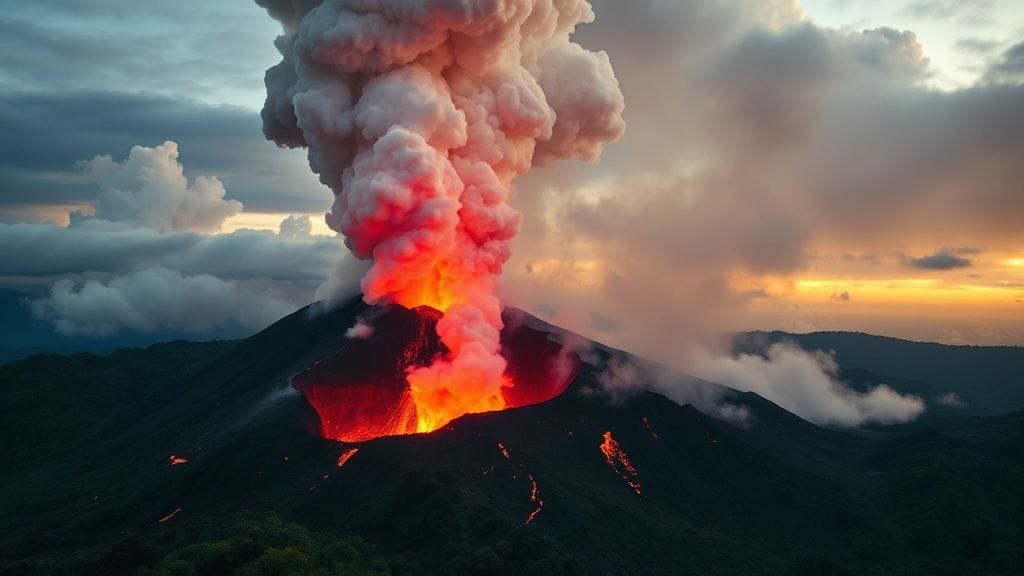
April 2016 marked the eruption’s onset. At first, it was subtle—a series of small explosive bursts that sent ash columns hundreds of meters skyward. At dawn, a thunderous roar shattered the usual island calm. Villagers described the first explosions as “the mountain speaking,” frightening yet awe-inspiring. Lava fountains illuminated the darkened sky, painting reddish streaks against the pre-dawn haze.
The initial phase was characterized by Strombolian activity — moderate explosions ejecting incandescent cinder and ash. The volcano’s activity increased over days, sparking renewed evacuations and reshaping local priorities. Emergency protocols were activated, but the remoteness of the area and the challenging terrain slowed rapid response.
The Sky on Fire: Spectacular Plumes and Lava Flows
Volcanic ash ascended kilometers into the stratosphere, visible from afar and disrupting air traffic. The searing glow of lava illuminated forest canopies at night, a deadly beauty contrasting with the fertile soil waiting to recover in the future. The eruption produced fresh lava flows that slowly advanced downslope, threatening plantations and infrastructure.
Satellite images captured the growing ash cloud’s extent, sparking concern beyond New Britain. Aviation authorities issued warnings for trans-Pacific routes. Local communities, while familiar with eruptions, felt the impact keenly as ashfall blanketed settlements.
Lives on the Edge: Communities at the Foot of Langila
For the island’s inhabitants, the eruption was not just a spectacle—it was a test of survival. Villagers relied heavily on subsistence farming, and the ash fall contaminated water sources and crops. Evacuations disrupted fragile livelihoods and forced families into makeshift shelters. Stories emerged of families fleeing under ash clouds, of children frightened by explosions, and elders recalling past eruptions with renewed fear.
Despite hardship, community bonds strengthened. Neighbors helped each other clear ash, share resources, and rebuild in the face of uncertainty. The eruption became a lived experience, etched into personal and collective memory.
The Response: Local and International Efforts to Monitor the Eruption
The Papua New Guinea government, together with international partners, mobilized scientific teams to assess the ongoing risk. The Rabaul Volcano Observatory increased its monitoring efforts, deploying additional seismic sensors and engaging in continuous gas sampling despite logistical difficulties.
Agencies collaborated to transmit warnings and coordinate evacuations. Papua New Guinea’s Department of Disaster Management worked to distribute aid and provide healthcare, while international organizations contributed technical support. The eruption underscored the need for robust disaster preparedness in a vulnerable region.
Scientists in Action: Tracking Ash Clouds and Seismic Activity
The eruption offered a wealth of scientific data. Researchers studied the chemistry of volcanic gases, revealing variations in magma composition and ascent rates. Infrared satellites tracked thermal anomalies, enabling predictions regarding lava flow trajectories.
Seismic records helped decipher the volcano’s plumbing system — magma chambers, conduits, and interaction with hydrothermal fluids. This information enriched understanding not only of Langila but also of volcanology in complex subduction zones.
The Volcanic Fallout: Ash, Smoke, and Its Impact on Environment
Ashfall blanketed forests and croplands, suffocating trees and contaminating soil. Rivers carried volcanic sediments into the ocean, affecting marine life. Wildlife conservationists expressed concern over habitat disruption, noting short-term mortality and long-term ecological changes.
The eruption’s atmospheric aerosols contributed to regional climate impacts, with ash particles affecting radiation balance and potentially influencing rainfall patterns. This event illustrated the broad environmental consequences beyond mere lava and explosions.
Displacement and Despair: Human Stories Behind the Disaster
Amid scientific fascination, at the human scale, the eruption meant loss and upheaval. Displacement caused by evacuations fractured social and economic routines. Health issues arose from ash inhalation and contaminated water, adding strain to local healthcare.
Yet stories of resilience abound—the teacher who continued lessons in a temporary shelter, the farmers who began soil rehabilitation immediately, the youth documenting the eruption on social media, giving voice to their experience in a modern language of communication.
Cultural Interpretations: How Indigenous Beliefs Shaped Reactions
For many in East New Britain, volcanic activity is entwined with culture and spirituality. Langila is considered an abode of ancestral spirits, and eruptions evoke traditional ceremonies and rituals aimed at appeasing these forces.
This cultural lens shaped responses—some weathered the eruption as a natural cycle in harmony with nature’s rhythms, while others found comfort in rituals. Anthropologists note that such beliefs have practical implications for communication and evacuation efforts, highlighting the need for culturally sensitive disaster management.
The Economic Toll: Agriculture, Infrastructure, and Trade Disrupted
Volcanic ash caused severe degradation of coffee and cocoa crops, staples of local agriculture. Blocked roads and damaged bridges isolated communities, impeding trade and access to necessities. The eruption’s timing, disrupting harvest seasons, intensified economic woes.
Estimates of damage ran into millions of dollars, a daunting figure for communities already grappling with poverty and limited infrastructure. International aid helped, but recovery demanded years, patience, and innovation.
Media Coverage: From Local News to Global Headlines
Surprisingly, Langila’s eruption captured international attention, featuring in global volcanic activity reports and news portals. Dramatic images of plumes and lava intrigued scientists and laypeople alike, drawing attention to the geopolitical and disaster vulnerability of Papua New Guinea.
Local media played a crucial role in broadcasting alerts and human stories, while social media amplified firsthand accounts. This broadened awareness, an unexpected boon for a region often overshadowed on the global stage.
Recovery and Renewal: Aftermath and Long-term Consequences
As the eruption waned, communities faced the hard task of rebuilding. Soil fertility slowly returned, enabling farmers to replant. Infrastructure repairs reopened critical pathways. Health programs addressed respiratory illnesses caused by ash exposure.
Langila’s eruption left scars, yet also renewed respect for the natural forces shaping New Britain. Efforts to integrate traditional knowledge with scientific insights aimed to better prepare for future events.
Lessons Learned: Advances in Volcanology and Disaster Preparedness
The 2016 Langila eruption contributed valuable lessons. Improved monitoring techniques unveiled magma dynamics in real time. Precautionary evacuations saved lives. Community engagement proved essential, highlighting that disaster preparedness must incorporate local voices.
The event spurred investment in early warning systems and capacity building within PNG’s disaster framework, offering a model for other vulnerable regions.
Langila’s Place in Volcanic History: Comparison with Past Eruptions
In the annals of Pacific volcanism, Langila’s 2016 eruption stands out for its intensity and duration. When compared to eruptions of neighboring Tavurvur or Ulawun, Langila shared similar explosive behaviors yet differed in geochemical signatures and impact patterns.
Historical records indicate this eruption was one of the most significant of the 21st century on New Britain, reaffirming Langila’s status as a volcano demanding vigilance.
The Global Significance: Understanding Volcanic Hazards in the 21st Century
Langila is a case study in the challenges faced by volcanic communities worldwide amid climate change, population pressures, and limited resources. Its eruption underscores the necessity to balance economic development with environmental stewardship and disaster risk reduction.
Moreover, understanding ash clouds’ influence on aviation and climate highlights how local events resonate globally. Langila reminds us that the earth’s geology, though ancient, continues to shape modern human experience.
Local Heroes: Tales of Courage Amidst Crisis
Among the many stories emerging from this eruption are those of local leaders, health workers, and scientists who stood firm amid adversity. From the disaster management officers coordinating evacuations to the villagers who helped neighbors breathe through ash storms, these heroes embody resilience and humanity.
Their stories deserve recognition, not just as anecdotes but as integral parts of the eruption’s legacy.
A Volcano’s Voice: Ecological Effects and Geological Insights
Langila’s eruption rejuvenated scientific understanding of volcanic gas emissions and their interactions with the troposphere. The eruption also forced renewed studies of ecosystem adaptation to volcanic disturbance, revealing nature’s remarkable ability to recover.
Geologically, the event offered insights into magma chamber replenishment and conduit dynamics beneath active volcanoes.
The Lingering Shadows: Health Implications of Volcanic Ash
Beyond immediate destruction, volcanic ash carries long-term health hazards. Respiratory diseases, eye irritation, and mental health challenges emerged post-eruption. Local health providers faced increased patient loads, revealing gaps in healthcare access and preparedness.
Longitudinal studies are ongoing to measure the full impact on community health and inform future interventions.
The Future Watch: Ongoing Monitoring and Risk Mitigation
Post-eruption, Langila remains under close surveillance. Investments in seismic equipment, satellite observations, and community education seek to mitigate future disasters. Partnerships between local authorities, NGOs, and scientific bodies represent a proactive approach, transforming past hardship into future preparedness.
In a world where the earth’s restlessness is a constant threat, this vigilance is a testament to human foresight and determination.
Conclusion
Langila’s 2016 eruption was not merely an event marked on scientific charts or news headlines. It was a devastating yet affirming encounter between humanity and the primal forces beneath their feet. The volcano’s awakening shifted landscapes, economies, and lives, yet also forged stories of courage, adaptation, and unity.
This fiery upheaval is a solemn reminder: nature’s power is immense and unpredictable, but so too is human resilience. As the ash settled and communities began to heal, Langila’s voice echoed a message — one of respect for the earth, interface between tradition and science, and unyielding hope for renewal amid destruction. In the relentless dance of fire and earth, the people of New Britain found both challenge and profound kinship.
FAQs
Q1: What caused the 2016 eruption of Langila volcano?
A1: The eruption was triggered by the movement of magma beneath the crust, driven by tectonic pressures within the Pacific Ring of Fire. Increasing magma accumulation, rising gas pressure, and seismic activity signaled the impending eruption.
Q2: How did local communities respond to the eruption?
A2: Communities undertook evacuations, relied on traditional knowledge for interpretation, and combined efforts to clear ash and support vulnerable neighbors. Despite disruption, resilience and cooperation were notable.
Q3: What environmental impacts did the eruption cause?
A3: The eruption affected terrestrial and marine ecosystems through ashfall, water contamination, and habitat disruption. It also influenced local climate conditions temporarily due to ash aerosols.
Q4: How did the 2016 eruption affect Papua New Guinea’s economy?
A4: Damage to agriculture, infrastructure disruption, and trade interruption led to economic setbacks estimated in millions, affecting largely subsistence farmers and local businesses.
Q5: What were the key challenges in monitoring Langila’s eruption?
A5: Langila’s remote location, rugged terrain, and limited infrastructure complicated real-time monitoring, requiring coordination among local observers and international scientific programs.
Q6: How has the eruption advanced scientific understanding?
A6: The eruption provided valuable data on magma dynamics, gas emissions, and volcanic behavior in subduction zones, enhancing predictive modeling and risk assessment capabilities.
Q7: What health issues arose due to the eruption?
A7: Respiratory problems from ash inhalation, eye irritation, and mental health stresses were prominent, highlighting the need for improved healthcare responses in volcanic crises.
Q8: What measures are in place to prevent future disasters at Langila?
A8: Enhanced seismic monitoring, community education, improved evacuation plans, and international cooperation are key components of ongoing preparedness and risk mitigation strategies.

