Table of Contents
- The Dawn of a New Era: Rome, February 11, 1929
- The Roman Question: A Half-Century of Uncertainty
- The Italian State and the Papacy: A Fractured Relationship
- The Rise of Benito Mussolini and the Fascist State
- Negotiations Behind Closed Doors: The Road to the Lateran Treaty
- Cardinal Pietro Gasparri: The Vatican’s Architect of Peace
- Mussolini’s Calculated Gambit: Power, Religion, and Politics
- The Contents of the Lateran Treaty: Boundaries, Sovereignty, and Compensation
- The Concordat: Church and State in Post-Treaty Italy
- The Creation of Vatican City: An Independent Sovereign Entity
- The Financial Settlement: Reparations and the Holy See’s Resources
- Religious Freedom, Catholicism as State Religion, and Italian Society
- Public Reactions: Jubilation, Skepticism, and Criticism
- International Responses: The Global Significance of the Treaty
- The Lateran Treaty’s Legacy in Church-State Relations
- Mussolini’s Political Gain and the Fascist Regime’s Image
- Long-term Implications for Italian Catholicism
- The Treaty and Its Impact on the Second World War Era
- Vatican City Today: A Testament to the Treaty’s Lasting Influence
- Reflections on Sovereignty, Identity, and Diplomacy
- Conclusion: A Moment Where Faith and Politics Converged
- FAQs: Exploring the Lateran Treaty’s Mysteries and Meanings
- External Resource
- Internal Link
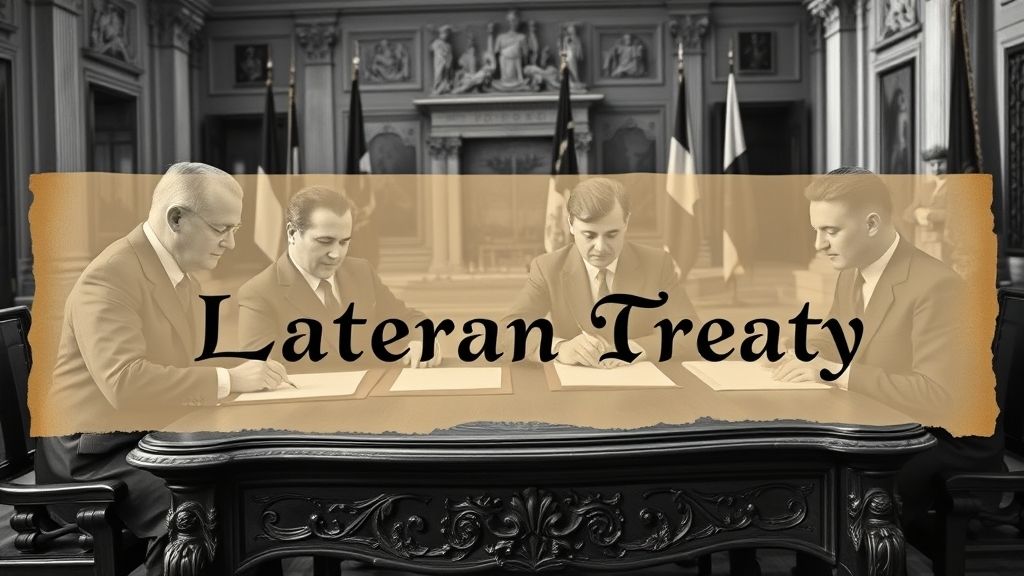
On a cold winter day in Rome, February 11, 1929, history was quietly being made in the austere halls of the Palazzo del Laterano. The air in the room was thick with anticipation, tension, and hope. After nearly six decades of bitter estrangement, two ancient rivals—the Italian state and the Holy See—were about to sign an agreement that would forever alter their relationship. This was no mere diplomatic formality; it was the resolution of the “Roman Question,” a wound festering since 1870, when the Kingdom of Italy had annexed Rome, ending the temporal power of the popes. For the first time, the papacy would receive recognition as a sovereign entity within the very heart of the city it once ruled. The Lateran Treaty, as it would be called, promised peace, sovereignty, and a pact that intertwined politics and faith in a uniquely modern context.
But this treaty was much more than ink on paper—it was an emblem of the fragile balance between spiritual authority and political reality, between a rising fascist regime and an ancient religious institution. To comprehend the profound significance of that day, we must delve into decades of conflict, ideological confrontations, and the striving for legitimacy that shaped the early 20th century in Italy and beyond.
The Roman Question: A Half-Century of Uncertainty
In 1870, the Italian army breached the Aurelian Walls at Porta Pia, signaling the end of the Papal States and the incorporation of Rome into the newly unified Kingdom of Italy. This conquest did not only change geography; it shattered centuries of papal temporal power. Pope Pius IX, sealing himself inside the Vatican, declared himself a “prisoner” and excommunicated the king. For decades, the Holy See refused to acknowledge the Italian state’s authority over Rome, casting a shadow of non-recognition that impacted diplomacy and internal governance.
The “Roman Question” was a thorny problem that paralyzed Italian politics. Catholics, a majority in Italy, were torn between loyalty to the Church and patriotism to their new nation. The Italian state’s anticlerical policies deepened the rift, and successive governments failed to settle the status of the papacy. The Vatican remained a spiritual giant robbed of its territorial foundation, while the Italian government struggled to assert control without the moral legitimacy that Catholic recognition could bestow.
The Italian State and the Papacy: A Fractured Relationship
The relationship between the Vatican and the Italian government from 1870 to the late 1920s was marked by distrust, hostility, and a lack of formal diplomatic ties. The popes themselves refused to leave Vatican grounds for fear of legitimizing Italian sovereignty over Rome. Catholic political parties were often excluded from power, discouraged by the pope’s non expedit—a directive forbidding Catholics from participating in the new Italian political system.
During this time, millions of Italian Catholics found themselves alienated politically and spiritually, caught between two forces they considered divine and national. The unresolved conflict was more than symbolic; it was foundational, touching on issues of identity, governance, and the role of religion in the modern state.
The Rise of Benito Mussolini and the Fascist State
Into this climate stepped Benito Mussolini, a former socialist turned fascist dictator. By creating a new authoritarian state that glorified the nation, Mussolini recognized the importance of reconciling with the Catholic Church to solidify his regime’s legitimacy. Unlike previous governments, Mussolini approached the Roman Question pragmatically, envisioning a partnership that would serve his political ambitions while restoring the Church’s dignity.
The fascist leader understood that Italy’s national unity could not be complete without the Catholic majority’s spiritual backing. Thus, from the mid-1920s onward, overtures began, carefully orchestrated behind closed doors.
Negotiations Behind Closed Doors: The Road to the Lateran Treaty
Negotiations between the Holy See and the Italian government were delicate and complex. They required compromise, subtle diplomacy, and the involvement of astute personalities who balanced religious zeal with political realism.
Italy’s Minister of Foreign Affairs, Dino Grandi, and the Vatican’s Cardinal Secretary of State, Pietro Gasparri, played pivotal roles. Gasparri was the mastermind who navigated centuries of Church doctrine and political sensitivities to bring the Holy See to a workable agreement. Though the Fascist regime was authoritarian, the Vatican treated the negotiations as between sovereign entities, emphasizing the Church’s status beyond mere religious hierarchy.
Cardinal Pietro Gasparri: The Vatican’s Architect of Peace
Cardinal Gasparri, a towering figure in Roman Catholic diplomacy, had been crafting the Concordat since shortly after World War I. His vision was to ensure the Church’s independence and moral influence while accepting pragmatic territorial and political realities. He believed that by recognizing Italian sovereignty, the Church could regain its spiritual primacy and secure its position in a world rapidly changing.
Often described as shrewd yet conciliatory, Gasparri’s work culminated in the historic treaty that balanced tradition and modern political demands.
Mussolini’s Calculated Gambit: Power, Religion, and Politics
For Mussolini, negotiating with the Church was both a strategy and a gamble. The Lateran Treaty offered him the chance to portray fascism as Italy’s defender of faith and tradition, countering accusations of tyranny with images of solemn respect for religion.
His regime promoted mass rallies that celebrated the concordat and the new Vatican City, linking Mussolini’s image with divine favor. The treaty was also a tool of internal control, helping to placate Catholic opposition and unite Italians under fascist symbolism intertwined with Catholic ritual.
The Contents of the Lateran Treaty: Boundaries, Sovereignty, and Compensation
The Lateran Treaty, signed on February 11, 1929, contained several key provisions:
- Recognition of Vatican City as an independent sovereign state, distinct and separate from Italy.
- The Italian State’s recognition of the sovereignty and independence of the Holy See.
- Financial compensation to the Holy See for losses incurred with the seizure of the Papal States.
- Recognition of Catholicism as the official state religion of Italy.
- Agreements regulating relations between Church and State, including religious education, marriage laws, and Church privileges.
These components ensured a lasting peace, codifying the new status quo with legal force.
The Concordat: Church and State in Post-Treaty Italy
Integral to the treaty was the Lateran Concordat, which defined the relations between the Italian State and the Roman Catholic Church. It included provisions for Catholic religious education in public schools, recognized Church marriage laws as valid civil law, and protected ecclesiastical property from state interference.
This concordat embedded Catholicism deeply into Italian public life, merging faith with law in unprecedented ways. It simultaneously reassured the Vatican of its central role in Italian society and offered Mussolini an aura of sanctity.
The Creation of Vatican City: An Independent Sovereign Entity
At the heart of the treaty was the establishment of Vatican City State, a 44-hectare enclave recognized under international law as a sovereign territory. This tiny yet symbolically immense state restored a territorial basis for the papacy’s sovereignty after decades of liminal status.
Vatican City became the seat of the pope’s government, the custodian of the “Holy See,” and a unique crossroads of religion and diplomacy. It allowed the Vatican to engage in foreign relations, enter treaties, and maintain independence without Italian interference.
The Financial Settlement: Reparations and the Holy See’s Resources
Compensation was a major hurdle in negotiations, with the Holy See demanding reparations for the loss of the vast Papal States. The Italian government ceded 750 million lire in cash and 1 billion lire in Italian government bonds, a substantial sum worth around 150 million dollars at the time.
This financial support ensured the Vatican’s economic autonomy, funding its operations and preserving its global mission. It was an essential component, reaffirming the Holy See’s sovereignty beyond mere symbolism.
Religious Freedom, Catholicism as State Religion, and Italian Society
The recognition of Catholicism as Italy’s state religion had profound social implications. Public life was now shaped by Catholic rituals, holidays, and education. While this pleased many citizens, it also sowed seeds of tension with non-Catholic minorities, secularists, and political opponents who feared the erosion of religious pluralism.
In many ways, the treaty redefined Italian national identity, intertwining it with Catholicism and creating a cultural unity that Mussolini sought to capitalize on politically.
Public Reactions: Jubilation, Skepticism, and Criticism
The signing of the Lateran Treaty was greeted with widespread jubilation among Catholics, who saw it as a triumph and vindication. Pope Pius XI celebrated the moment as a “peace which grants us sovereignty.”
Yet, not all Italians or observers were equally enthusiastic. Socialists, liberals, and secularists criticized the treaty as a church-state conspiracy, arguing it reinforced reactionary forces and curtailed freedoms. Some questioned Mussolini’s motives, wary of the intertwining of church and fascist power.
International Responses: The Global Significance of the Treaty
The treaty resonated far beyond Italy’s borders. For the global Catholic Church, it restored prestige and diplomatic recognition after years of marginalization. Other states acknowledged the new Vatican City and revised their relations with the Holy See accordingly.
It also signified the Church’s willingness to engage in modern diplomacy, paving the way for future concordats and concordance with secular governments worldwide.
The Lateran Treaty’s Legacy in Church-State Relations
Decades on, the Lateran Treaty remains a cornerstone of Italy’s political and religious landscape. It has been amended and renegotiated (notably in 1984), but its essence endures: a unique fusion of spiritual authority with temporal sovereignty.
It set a precedent for defining the role of the Catholic Church in a democratic yet secular world, balancing autonomy with cooperation.
Mussolini’s Political Gain and the Fascist Regime’s Image
Politically, the treaty was a masterstroke for Mussolini. By aligning fascism with the Church, he cemented popular support and framed his dictatorship as Italy’s moral and cultural renewal.
However, this alliance also linked the Church with fascism, a relationship that became a source of controversy during and after World War II.
Long-term Implications for Italian Catholicism
For Italian Catholics, the treaty was both blessing and burden. It restored dignity and influence but tied the Church to a regime whose brutal realities contradicted Christian ethics.
The Church navigated this tension through the 20th century, using its restored sovereignty to advocate for peace and humanitarian causes while confronting political challenges.
The Treaty and Its Impact on the Second World War Era
During World War II, the Lateran Treaty helped maintain the Vatican’s neutrality and protected Pope Pius XII’s position as a diplomatic mediator. The sovereign status of Vatican City allowed the Holy See to act as a haven and voice amid the conflict’s horrors.
Yet, the treaty also complicated relations with the fascist and Nazi powers, forcing the Church to balance diplomacy and morality.
Vatican City Today: A Testament to the Treaty’s Lasting Influence
Nearly a century later, Vatican City stands as a unique microstate, a beacon of Catholicism and a hub of global religious diplomacy.
The Lateran Treaty’s recognition of its sovereignty continues to define the Holy See’s international role, from peace negotiations to humanitarian efforts.
Reflections on Sovereignty, Identity, and Diplomacy
The Lateran Treaty remains a profound case study in the complexity of sovereignty—how spiritual and temporal powers negotiate identity, legitimacy, and authority.
It challenges us to consider the relationship between religion and state, the nature of sovereignty, and the enduring power of diplomacy grounded in mutual respect and pragmatic compromise.
Conclusion
The signing of the Lateran Treaty on February 11, 1929, was an extraordinary moment when faith and politics converged to reshape not only Italy but the global order of the 20th century. From the shadows of a bitter conflict that had lasted nearly sixty years emerged a fragile yet resilient peace, one that gave birth to the world’s smallest sovereign state and redefined the relationship between church and state in modern times. It was a treaty wrought by cautious diplomacy, political calculation, and spiritual yearning—testament to humanity’s relentless pursuit of reconciliation and legitimacy.
This agreement embodied the paradoxes of an era marked by authoritarian rule and religious revival, by state crafting and spiritual sovereignty. Its legacy is visible today not only in the city-state nestled within Rome’s ancient walls but also in the ongoing dialogue between religion and governance, nationalism and universalism, power and conscience. The Lateran Treaty was more than a political document; it was a human story of confrontation, negotiation, and, ultimately, understanding.
FAQs
1. What was the “Roman Question” and why was it so significant?
The Roman Question referred to the unresolved political and territorial dispute between the Italian state and the papacy after the Kingdom of Italy annexed Rome in 1870, ending the Pope’s temporal power. It was significant because it symbolized the struggle over sovereignty, identity, and the role of the Church in Italian society for nearly 60 years.
2. Why did Mussolini support and negotiate the Lateran Treaty?
Mussolini saw the treaty as a way to legitimize his regime by gaining the support of Italy’s Catholic majority, offsetting opposition, and presenting fascism as a protector of Italian traditions and faith. It was a calculated political move to strengthen his power.
3. What are the main components of the Lateran Treaty?
The treaty recognized Vatican City as an independent state, compensated the Holy See financially, established Catholicism as Italy’s state religion, and laid out terms for church-state relations, including religious education and marriage laws.
4. How did the creation of Vatican City change the papacy’s status?
It restored territorial sovereignty to the papacy after decades without it, allowing the Holy See to operate as a fully sovereign entity in international affairs, thus reinforcing its spiritual and political independence.
5. Did the treaty have any negative consequences?
While it resolved a longstanding conflict, the treaty aligned the Church with Mussolini’s fascist regime, which later led to criticism during and after World War II. It also reinforced Catholic dominance in Italy, marginalizing secular and minority voices.
6. How is the Lateran Treaty viewed today?
It is regarded as a landmark agreement that established Vatican City and church-state relations in Italy, serving as a model of compromise between religion and secular power, despite ongoing debates about its political and social implications.
7. Did the Lateran Treaty affect Italy’s foreign relations?
Yes, it facilitated better relations between Italy and Catholic countries, enhanced the Holy See’s diplomatic role worldwide, and highlighted the Church’s unique position as a religious and political sovereign.
8. How has the Lateran Treaty evolved since 1929?
The treaty was revised in 1984 to reflect changing church-state relations, including Italy’s recognition of religious freedom and ending Catholicism’s status as the state religion, signaling adaptation to modern secular values.