Table of Contents
- The First Dawn of June 6, 1982: Beirut on the Brink
- Lebanon at the Crossroads: A Nation Fractured by History
- The Geopolitical Chessboard: Cold War, Regional Rivalries, and Superpowers
- The Rise of the PLO in Lebanon: From Refugees to Militants
- Israeli Ambitions and Strategic Calculations in Lebanon
- The Spark Ignites: The Attempted Assassination of Shlomo Argov
- Operation Peace for Galilee: The Launch of the 1982 Lebanon War
- The Air Raids over Beirut: Thunder in the Sky
- The Ground Offensive: Israeli Forces Advance into Lebanon
- Beirut’s Civilian Population: Caught in the Crossfire
- The Siege of West Beirut: Urban Warfare and Human Suffering
- International Reactions: From Washington to Moscow
- The Entrance of Multinational Peacekeepers and Diplomatic Maneuvers
- The Evacuation of the PLO: A Forced Exodus
- The Aftermath: Political Shifts and New Middle Eastern Alignments
- The Sabra and Shatila Massacre: A Tragedy Reverberating Through History
- The Israeli Internal Divides: War Support and Criticism
- The Long Shadow: Lebanon War’s Impact on Regional Politics
- Cultural Reflections: Memory and Representation of the 1982 War
- Conclusion: Beirut's 1982 War – The End of Illusions and the Start of New Struggles
- FAQs: Understanding the Complexities of the 1982 Lebanon War
- External Resource
- Internal Link
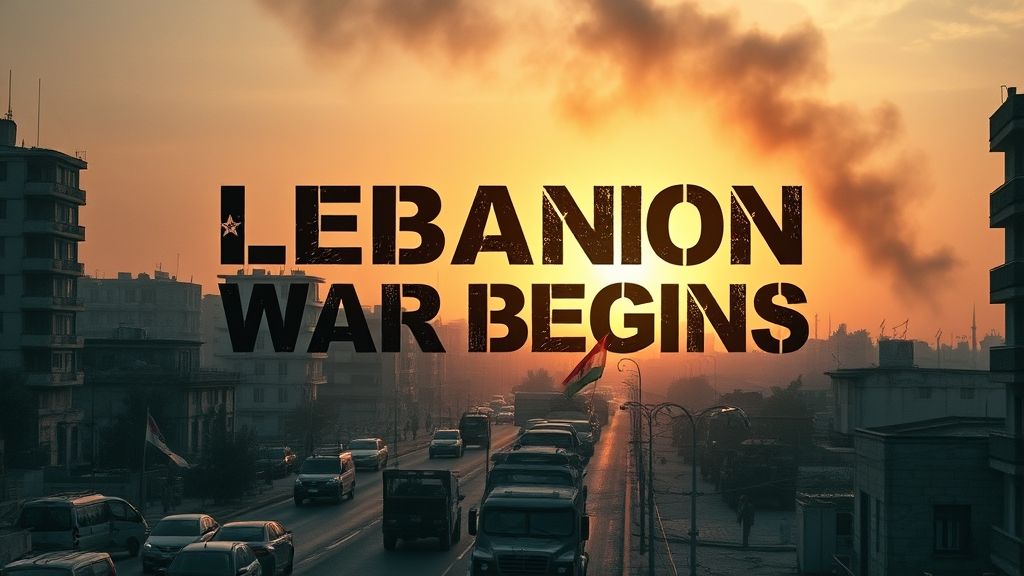
June 6, 1982, dawned unforgivingly hot over Beirut’s narrow streets and sprawling neighborhoods. The distant thrumming of fighter jets heralded a day destined to rupture the fragile calm of Lebanon’s capital and thrust the whole region into prolonged chaos. For decades, Beirut had lived as a mosaic of conflicting identities and simmering tensions—now it found itself the epicenter of an unprecedented confrontation. Invisible lines of fear and hope wove between crumbling stone walls, as mothers clutched their children, shopkeepers shuttered their doors, and young fighters checked their weapons, bracing for the storm soon to descend. This was not merely a war of armies, but a collision of histories, ambitions, and ideologies. In those hours before the sun rose fully, the stage was set for what would become one of the most tumultuous chapters in Middle Eastern history: the beginning of the 1982 Lebanon War.
Lebanon at the Crossroads: A Nation Fractured by History
To truly grasp the eruption of war on that summer day in Beirut, one must first journey back through Lebanon’s labyrinth of sectarian identities, colonial legacies, and fragile alliances. Lebanon, a tiny nation nestled between the Mediterranean Sea and the rugged mountains, was more than a geographic crossroad; it was a cultural and religious mosaic. Maronites, Sunnis, Shias, Druze, Armenians, Palestinians, and others cohabited in delicate balance, maintained by the National Pact of 1943, which apportioned power based on sectarian lines. But beneath this political architecture lurked fault lines that would soon fracture violently.
The Lebanese Civil War, which ignited in 1975, was the violent rupture of these sectarian and ideological tensions, pitting various militias—Christian Phalange, Shi’a Amal, Druze forces, and Palestinian factions—against each other and the Lebanese state. Civilians became pawns in these bloody power plays, where alliances shifted as rapidly as the gunfire. Lebanon was no stranger to violence, but the ever-growing Palestinian presence, especially that of the Palestine Liberation Organization (PLO), added a potent new element to the volatile mix.
The Geopolitical Chessboard: Cold War, Regional Rivalries, and Superpowers
The Lebanese conflict was not insulated from the broader chessboard of Cold War rivalries and Middle Eastern politics. The Soviet Union backed the PLO and various leftist militias, while Israel and Western powers aligned themselves against them. Syria, itself a major player with territorial ambitions and fears of Israeli dominance, wielded considerable influence in Lebanon, often supporting allied militias. Meanwhile, the United States and France watched with wary eyes, sometimes intervening diplomatically but largely hesitant to be drawn into the fray.
This regional and international backdrop was crucial. Lebanon was not just a battlefield for internal Lebanese factions—it was a proxy war spilling into every corridor of Middle Eastern politics. Every move in Beirut reverberated in capitals from Cairo to Washington D.C., and from Damascus to Moscow.
The Rise of the PLO in Lebanon: From Refugees to Militants
Following their expulsion from Jordan in 1970 during the “Black September” conflict, the PLO relocated much of its command and fighters to Lebanon. This relocation altered Lebanon’s balance of power drastically. What began as a massive influx of Palestinian refugees gradually morphed into a militarized presence that challenged not only Israel’s borders but Lebanon’s sovereignty.
The PLO’s activities—cross-border raids, rocket attacks, and urban guerrilla warfare—made southern Lebanon a battleground and a constant point of Israeli concern. This created simmering tensions that periodically erupted in violent confrontations, shaping Israel’s resolve to impose a decisive military solution.
Israeli Ambitions and Strategic Calculations in Lebanon
Israel’s government viewed the PLO’s Lebanese presence as an existential threat. The northern border was a constant source of attacks, with civilian populations within striking distance. But beyond immediate defense, Israel had broader strategic ambitions: reshaping Lebanon’s political landscape, installing a friendly Christian-led government, and diminishing Syrian and Palestinian influence.
Under Prime Minister Menachem Begin and Defense Minister Ariel Sharon, Israel began planning a pre-emptive operation intended not just to push the PLO away from borders but to decisively alter the Lebanese battlefield. Dubbed “Operation Peace for Galilee,” the plan envisaged a deep penetration into Lebanon to secure a “security zone” and forcibly eject the PLO.
The Spark Ignites: The Attempted Assassination of Shlomo Argov
Ironically, the trigger that pushed Israel from warning to war was not a direct attack by the PLO but the attempted assassination of Israel’s ambassador to the UK, Shlomo Argov, on June 3, 1982, by the Abu Nidal faction—a radical Palestinian splinter group condemned and opposed by the PLO leadership. This attack gave Israel the pretext it sought to launch Operation Peace for Galilee.
Though the Abu Nidal group’s actions were disconnected from Yasser Arafat’s PLO, Israel used the incident to declare war two days later. This episode illustrates how complex webs of alliances and rivalries could spur major conflicts even on tenuous grounds.
Operation Peace for Galilee: The Launch of the 1982 Lebanon War
On June 6, 1982, Israeli Defense Forces (IDF) began the largest military operation in the region since the 1967 Six-Day War. The initial phase was marked by intense airstrikes targeting paltry military installations, PLO bases, and suspected command centers scattered throughout southern Lebanon and the outskirts of Beirut.
Simultaneously, armored divisions crossed the border with overwhelming force, aiming to swiftly cut off PLO militants from their Lebanese allies and reach Beirut’s southern suburbs where PLO headquarters were fortified. The operation unfolded faster and deeper than many analysts had anticipated, quickly dispersing Lebanese militias caught unprepared.
The Air Raids over Beirut: Thunder in the Sky
The roar of Israeli jets filled the skies over Beirut as pillars of smoke and fire began to rise from the city’s outskirts. These air campaigns targeted weapons depots, infrastructure, and urban strongholds, sending waves of terror through civilian neighborhoods. Casualty reports grew, but the public was often shielded from the full horrors by censorship and fog of war.
The air raids signaled more than tactical strikes—they were psychological warfare aimed at sapping the will of the PLO and intimidating Lebanese urban populations.
The Ground Offensive: Israeli Forces Advance into Lebanon
As the armored columns surged forward, they met pockets of fierce resistance. Palestinian fighters, backed by leftist Lebanese militias, clung tenaciously to their positions, turning the hills and narrow city streets into battlefields. Hezbollah, still in embryonic stages, quietly observed but the conflict fueled their foundational narrative of resistance.
The slow advance into Beirut’s suburbs foreshadowed the protracted urban combat and humanitarian crisis to come, a stark contrast to Israel’s expectation of a swift, surgical campaign.
Beirut’s Civilian Population: Caught in the Crossfire
For Beirut’s residents, the war was a nightmare unfolding in their homes and schools. Neighborhoods turned into battlegrounds, hospitals overflowed, and electricity and water became scarce commodities. Civilians faced the impossible choice of fleeing, hiding, or enduring the brunt of artillery and sniper fire.
Stories emerged of extraordinary courage and despair: families sheltering under stairwells, doctors treating the wounded amid bombed-out hallways, children trying to play in ruins. Lebanese society was fraying at its seams, and Beirut itself was becoming a city suspended between life and destruction.
The Siege of West Beirut: Urban Warfare and Human Suffering
By mid-June, Israeli forces had surrounded West Beirut, the heartland of the PLO and Palestinian civilians. The siege lasted for weeks, marked by intermittent shelling, shell-shocked populations, and diplomatic pressure from around the world.
Negotiations for ceasefires and evacuations were interspersed with fresh outbreaks of violence. The images broadcast from West Beirut—bombed-out buildings, desperate civilians—galvanized global opinion but complicated Israel’s military objectives.
International Reactions: From Washington to Moscow
The war sent shockwaves far beyond the Levant. The United States, though allied with Israel, found itself diplomatically balancing support with calls for restraint. Secretary of State Alexander Haig flew repeatedly to the region attempting to negotiate ceasefires, while Moscow condemned Israel’s aggression, offering rhetorical support to Palestinian and Lebanese factions.
Arab states reacted with outrage, some mobilizing troops, others offering rhetorical condemnations. The war further polarized global politics and deepened Cold War rivalries.
The Entrance of Multinational Peacekeepers and Diplomatic Maneuvers
Under intense international pressure and following ceasefire agreements, a multinational force—comprising American, French, Italian, and British troops—was deployed to Lebanon to oversee the withdrawal of PLO fighters and stabilize Beirut.
This intervention created a brief lull in fighting but also introduced new complexities, as peacekeepers were targets of attacks and the peace they enforced proved fragile.
The Evacuation of the PLO: A Forced Exodus
One of the most dramatic moments of the war came in August 1982, when Yasser Arafat and thousands of PLO fighters finally evacuated Beirut under international auspices. This departure marked a military defeat but also a tactical retreat, dispersing the Palestinian leadership and fighters to Tunisia and elsewhere.
Yet the void left was soon filled by new actors and scarred memories—setting the stage for further conflicts to come.
The Aftermath: Political Shifts and New Middle Eastern Alignments
Israel’s invasion and occupation of southern Lebanon ushered in a new era of Lebanese politics. The alignment of Christian militias with Israel and the emergence of Hezbollah as a dominant Shia force altered Lebanon’s sectarian and political map profoundly.
Israeli hopes for a friendly Christian government were only partially realized, and an occupation that was meant to be short-lived turned into a costly quagmire lasting years.
The Sabra and Shatila Massacre: A Tragedy Reverberating Through History
Amid the chaos, one of the darkest episodes occurred: the massacre of Palestinian refugees in the Sabra and Shatila camps by Lebanese Christian militia allied with Israel, while Israeli forces controlled the area. Over several days, hundreds—possibly thousands—were killed in an atrocity that shocked the world.
This massacre stained Israel’s international reputation and prompted profound domestic debates about moral responsibility and military oversight.
The Israeli Internal Divides: War Support and Criticism
Back home, the Lebanon War fractured Israeli society. Many supported the operation as a necessary defense, but growing casualties, a drawn-out occupation, and revelations about Sabra and Shatila inflamed public dissent.
Mass protests, political inquiries, and cultural debates ensued—a nation wrestling with the costs of war and the limits of military power.
The Long Shadow: Lebanon War’s Impact on Regional Politics
The 1982 Lebanon War reshaped regional dynamics for decades. Syrian influence in Lebanon was challenged but not eliminated; Palestinian resistance was redirected; Hezbollah emerged as a formidable force enfolding Shia grievances.
Israel’s entanglement in Lebanon contributed to future conflicts, including the 2006 war with Hezbollah. The war served as a reminder that entrapment in Lebanon’s volatile web was neither swift nor painless.
Cultural Reflections: Memory and Representation of the 1982 War
Artists, writers, and filmmakers grappled with the war’s legacy. Beirut’s ruins became metaphors for lost innocence, trauma, and endurance. Lebanese literature reflects ambivalence—mourning while resisting erasure.
In Israel and Palestinian territories too, narratives of heroism and victimhood contend, underscoring the war’s enduring complexity in collective memory.
Conclusion: Beirut's 1982 War – The End of Illusions and the Start of New Struggles
The Lebanon War that began on June 6, 1982, stands as a tragic testament to the devastating interplay of nationalism, ideology, and geopolitics. It exposed the fragility of peace in a land scarred by history and unsettled identities. Beirut’s battered skyline became a silent witness to dreams shattered and realities transformed, forever changing the region’s trajectory.
Yet, amid rubble and sorrow, the conflict also revealed resilience and the urgent need for dialogue and understanding—lessons still relevant today, as Lebanon and the Middle East navigate cycles of conflict and hope. The war was not an end but a painful prelude, a reminder that history’s echoes shape the present, urging humanity toward peace that must be striven for relentlessly.
FAQs
1. What triggered the 1982 Lebanon War?
The immediate trigger was the attempted assassination of Israeli ambassador Shlomo Argov in London by a radical Palestinian faction, providing Israel the pretext to launch Operation Peace for Galilee aimed at expelling the PLO from southern Lebanon.
2. Why was Lebanon a focal point for conflict in the early 1980s?
Lebanon’s unique sectarian and political makeup, combined with the significant presence of the PLO and regional rivalries involving Israel, Syria, and other actors, made it a volatile tinderbox prone to explosive conflict.
3. What was Operation Peace for Galilee?
It was the codename for Israel’s 1982 military campaign into Lebanon, aiming to create a security buffer by expelling the PLO and reshaping Lebanese politics.
4. How did the Lebanon War affect Beirut’s civilian population?
The war brought immense suffering—civilian casualties, destruction of infrastructure, displacement, and psychological trauma—turning Beirut into a city marred by urban warfare and humanitarian collapse.
5. What was the significance of the Sabra and Shatila massacre?
This massacre, carried out by allied Lebanese Christian militias against Palestinian refugees under Israeli control, raised profound questions about complicity and war crimes, impacting Israel’s domestic and international reputation.
6. How did the international community respond to the Lebanon War?
There were condemnations, diplomatic efforts for ceasefire, and a deployment of a multinational peacekeeping force. However, geopolitical interests often complicated cohesive intervention.
7. What was the war’s long-term impact on Lebanon and the region?
The war reshaped Lebanese politics, boosted the rise of Hezbollah, strained Israeli society, and influenced subsequent Middle Eastern conflicts, embedding a complex legacy of division and resistance.
8. How is the 1982 Lebanon War remembered culturally?
Through literature, film, art, and public discourse, the war is commemorated as a profound trauma and a crucible for identity in Lebanon and beyond, reflecting contested memories and calls for peace.