Table of Contents
- The Final Journey Begins: Tolstoy’s Departure from Yasnaya Polyana
- Astapovo Station: A Quiet Hamlet Foretold by History
- The Arrival of a Titan: Tolstoy at the Railway Station
- The Unfolding Crisis: Symptoms and Fading Strength
- The Conflicting Loyalties of a Family in Turmoil
- The Role of the Peasant Class: Witnesses to the Last Days
- Physicians and Faith: Medicine Meets Mysticism
- The World Awaits News: Media and Rumors in 1910 Russia
- A Literary Giant's Silent Witnesses: Clergy, Servants, and Friends
- November 20th, 1910: The Passing of Tolstoy
- The Immediate Aftermath: Mourning Beyond Borders
- The Funeral Dilemma: Orthodox Church vs. Tolstoyan Ideals
- Yasnaya Polyana: Tolstoy’s Resting Place and Pilgrimage Site
- Political Reverberations: A Nation Reflects on Its Moral Conscience
- Tolstoy’s Legacy in the 20th Century: Literature, Philosophy, and Peace Movements
- The Death of a Prophet: Tolstoy’s End as a Narrative of Russian Soul
- Memory and Myth: How Astapovo Became a Symbol
- Lessons From Tolstoy’s Final Journey: Humanity, Suffering, and Redemption
- The Enduring Enigma: Reconciling the Man and the Legend
- The Last Letter: Voices From the Edge of an Era
The late autumn in 1910 carried with it a chill that bit into the bones of Russia’s vast expanse—a cold as relentless and raw as the great moral tempest that had stirred within one of its greatest sons. Leo Tolstoy, the literary colossus who had reshaped the world’s understanding of human nature and spiritual longing, was dying. Not in the calm sanctuary of his beloved Yasnaya Polyana, but in an obscure railway station called Astapovo, in the heart of the Russian steppes. It was here, on the night of November 20th, under flickering lamps and the watchful eyes of peasants and strangers alike, that a man who had inspired countless souls took his last breath, quietly altering the course of an empire’s cultural soul.
The Final Journey Begins: Tolstoy’s Departure from Yasnaya Polyana
It is almost poetic, the way great lives end far from where they began. Tolstoy’s decision to leave Yasnaya Polyana in late October 1910 was abrupt and shrouded in mystery. The 82-year-old writer, frail yet resolute, felt an unbearable weight pressing on his spirit—a tension between his radical spiritual beliefs and the rigid conventions of family and church. His departure was an act of defiance and exhaustion, a flight from the suffocating gaze of his kin and the societal structures he had spent decades questioning.
As his modest carriage rolled over the snowswept roads, few could have foreseen his route to the lonely Astapovo station—a place serving as a transient stop for common travelers and freight, yet destined to become hallowed ground by association.
Astapovo Station: A Quiet Hamlet Foretold by History
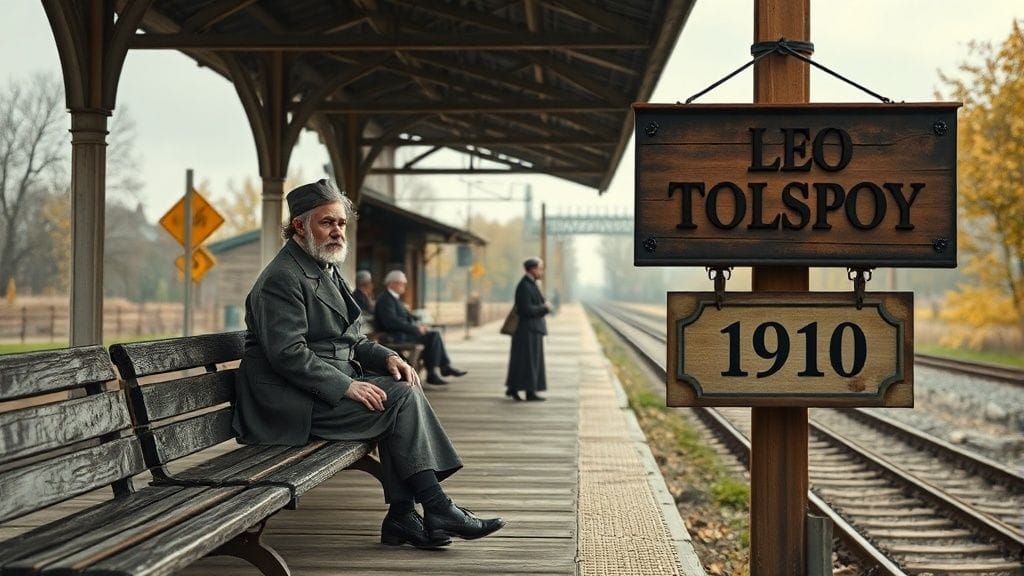
Astapovo was no grand city; it was a dusty, cold outpost nestled among the endless fields of Central Russia's steppes, its name largely unknown beyond local merchants and railway workers. Yet fate had chosen this place to witness the final chapter of a man who had spread intellectual and spiritual fires worldwide.
The station's plain wooden structures and rusting rails seemed inconsequential beside Tolstoy’s looming legacy. But in moments of history, even the humblest locale can become an epicenter of profound meaning. Astapovo, with its humble inn and curious onlookers, was about to bear witness to loss on an unprecedented scale.
The Arrival of a Titan: Tolstoy at the Railway Station
When Tolstoy arrived at Astapovo on November 7 according to the Julian calendar (November 20 Gregorian), he was barely coherent—his body ravaged by pneumonia and exhaustion. The stationmaster, a man accustomed to the mundane affairs of railway logistics, was confronted with a figure of tragic grandeur. Despite the disarray, Tolstoy’s presence summoned a hush, a gravity that transcended his physical frailty.
His travel companions—his doctor and a small retinue—were caught between urgency and helplessness. Tolstoy, once renowned for his towering intellect and boundless ideological energy, was reduced to whispers and pained moans. His face bore the marks of a pilgrim’s journey—not of places, but of faith and conscience.
The Unfolding Crisis: Symptoms and Fading Strength
The tenseness of that frosty November was punctuated by Tolstoy’s labored breathing and failing pulse. Pneumonia had taken hold quietly but mercilessly. His robust physicality had long yielded to years of ascetic discipline and spiritual fasting, and his body no longer possessed the strength to resist nature’s brutal assault.
Despite the medical care provided—rudimentary by today’s standards and hampered by the station’s isolation—his condition worsened daily. His mind, sharp until the end, drifted intermittently between lucidity and delirium, reciting passages from his own writings and murmuring prayers.
The Conflicting Loyalties of a Family in Turmoil
Tolstoy’s deathbed was as much a stage for private conflict as it was for public mourning. The writer’s family, fractured by ideological and personal schisms, converged on Astapovo with conflicting intentions. His wife, Sophia Tolstaya, was wracked by grief and guilt, her love for Leo shadowed by resentment born from years of tormenting debates about inheritance, lifestyle, and morality.
Meanwhile, his eldest sons wrestled between filial duty and their own ambitions, struggling to reconcile the mythic figure of the father with the frail man slipping away before them. The family drama, steeped in the nation’s class divisions and spiritual crises, mirrored the larger fractures within Russian society itself.
The Role of the Peasant Class: Witnesses to the Last Days
The peasants of Astapovo, simple folk who had encountered many travelers over the years, became silent observers of a spectacle beyond their usual comprehension. Many held profound respect for Tolstoy, whose Christian anarchist ideals had drawn inspiration from the humble peasantry.
These villagers provided what comfort they could, with folk remedies and quiet companionship, embodying the living human chain that connected the great writer’s philosophy with the grassroots realities of rural Russia. Their presence underscored the socio-political undercurrents shaping the twilight of an empire.
Physicians and Faith: Medicine Meets Mysticism
Medical treatment in 1910 Russia was confined by harsh realities—antibiotics did not yet exist, and pneumonia was frequently fatal. Tolstoy’s doctors endeavored to stabilize his respiration and reduce fever, yet their efforts were as much symbolic gestures as practical interventions.
Meanwhile, Tolstoy’s spiritual beliefs, which blended Christian pacifism with a deep disdain for institutionalized religion, complicated his care. Tolstoy had rejected the official Orthodox Church, yet his final moments dragged clergy into the drama—some to administer last rites, others to argue the theological implications of his beliefs and death.
The World Awaits News: Media and Rumors in 1910 Russia
News of Tolstoy’s illness spread quickly across Russia, carried by telegraphs, newspapers, and eager rumor mills. The tension was palpable in the public imagination; here was the man who had challenged the Tsarist establishment and inspired revolutionary thinkers, now helpless and vulnerable.
The press dispatched reporters to Astapovo, and trains disgorged curious journalists and admirers alike, eager to glimpse the man who had shaped the Russian soul. The atmosphere was electric, a mixture of reverence, curiosity, and sorrow.
A Literary Giant's Silent Witnesses: Clergy, Servants, and Friends
In the bleak station rooms, surrounded by dim lamplight and the murmur of the train yard, Tolstoy was attended by a disparate group—clergy denied full access by the family’s tensions, loyal servants used to the rhythms of Yasnaya Polyana, and friends traveling from afar to say farewell.
These quiet witnesses bore testimony to the contradictions embedded in Tolstoy’s life—a man revered and repudiated in equal measure, caught between old Russia and a new world dawning. Their accounts varied, from tearful recollections to stoic acceptance, each adding a thread to the tapestry of the final hours.
November 20th, 1910: The Passing of Tolstoy
As winter deepened, so did the stillness in the room where Tolstoy lay. On the night of November 20th (Gregorian), at approximately 11:30 p.m., the great writer’s battle came to its inevitable end. His last breath was as unassuming and serene as the man himself sought throughout his spiritual quest.
The announcement sent shockwaves through Astapovo and spilled over into a grieving nation. The poet and reformer was gone, leaving behind a legacy that was as complex as it was profound.
The Immediate Aftermath: Mourning Beyond Borders
Russia plunged into mourning, yet the grief extended far beyond its borders. Tolstoy’s works had touched hearts worldwide—from Europe’s literary salons to peasant huts in the Americas.
Messages poured in from figures as diverse as Mahatma Gandhi, who regarded Tolstoy as a spiritual mentor, and the emerging intellectual movements seeking to redefine modernity. The death occasioned not simply sorrow, but a reexamination of values, belief systems, and the possibility of human kindness.
The Funeral Dilemma: Orthodox Church vs. Tolstoyan Ideals
Tolstoy’s funeral reflected the contradictions of his life. The Russian Orthodox Church, wary of his heretical views, denied him a traditional burial rite. The family grappled with how to honor his wishes—simple, humble, and removed from pomp—and the societal expectations of a man of his stature.
The ceremony held at Yasnaya Polyana was austere yet deeply moving, attended by peasants, intellectuals, and friends. It symbolized a rupture not only within a family but across Russian society, split between old orthodoxy and burgeoning calls for reform.
Yasnaya Polyana: Tolstoy’s Resting Place and Pilgrimage Site
Though he died in Astapovo, Tolstoy’s body was transported back to his estate, symbolically returning to the soil that had nurtured his genius and convictions. Yasnaya Polyana became a site of pilgrimage, where admirers sought to reconnect with the spirit of the man who had lived in simple communion with nature and truth.
Over decades, the estate evolved into a museum and sanctuary of Russian cultural memory.
Political Reverberations: A Nation Reflects on Its Moral Conscience
Tolstoy’s death echoed amidst the turmoil brewing within the Russian Empire. His critiques of autocracy, militarism, and social injustice gained renewed attention as revolutionary fervor simmered beneath the surface.
For some, Tolstoy represented the conscience of Russia—a moral compass during times of uncertainty. For others, his radical pacifism seemed impractical in a world hurtling toward the cataclysm of the Great War.
Tolstoy’s Legacy in the 20th Century: Literature, Philosophy, and Peace Movements
The years following Tolstoy’s passing witnessed his ideas crossing continents and disciplines. His vision of nonviolence profoundly influenced figures like Martin Luther King Jr. and Gandhi, seeding the philosophy of civil disobedience.
His literary masterpieces, especially War and Peace and Anna Karenina, remained central texts for understanding the depths of human emotion and social complexity. His emphasis on simplicity, compassion, and self-examination challenged generations to rebalance life’s priorities.
The Death of a Prophet: Tolstoy’s End as a Narrative of Russian Soul
Tolstoy’s final journey and death became symbolic narratives that intertwined with Russia’s identity. The twilight of this giant—marked by internal conflict, spiritual searching, and mortal vulnerability—mirrored the twilight of the Russian Empire itself.
The powerful image of a "prophet on the edge" helped enshrine Tolstoy not only as a man but as a symbol of aspiration and tragedy.
Memory and Myth: How Astapovo Became a Symbol
Though just a small railway station, Astapovo was etched into history as the place where Tolstoy spent his last days. Over time, its legend grew—stories recounting the compassionate kindness of its inhabitants and the spiritual gravity of those final moments became part of cultural lore.
Astapovo transcended its geographical obscurity to become a symbol of humility amid greatness, a reminder of mortality’s equalizing hand.
Lessons From Tolstoy’s Final Journey: Humanity, Suffering, and Redemption
Reflecting on Tolstoy’s departure prompts timeless questions about the human condition—our relationship with family, faith, and society. His story from Yasnaya Polyana to Astapovo reveals suffering not as defeat, but as a crucible of moral and spiritual testing.
The tension between worldly attachment and spiritual aspiration that marked his final days resonates across cultures and eras, offering a mirror for our own trials.
The Enduring Enigma: Reconciling the Man and the Legend
Tolstoy remains a study in paradoxes—a man who embraced asceticism yet produced opulent novels; a spiritual seeker who condemned institutional religion but inspired religious movements; a patriarch cast into family conflicts while preaching universal love.
His death crystallized these contradictions, compelling historians, readers, and thinkers to grapple with the complexity of a life lived openly and fiercely.
The Last Letter: Voices From the Edge of an Era
Among the artifacts of Tolstoy’s final days is a poignant last letter penned shortly before his passing. It expressed hopes for forgiveness, reconciliation, and peace—a testament to the enduring spirit that had carried him through decades of philosophical and personal battles.
This letter, like his death itself, acts as a bridge between the man’s earthly trials and the immortal realm of ideas he inhabited.
Conclusion
Leo Tolstoy’s death at Astapovo was far more than the passing of a literary giant—it was the closing of a profound chapter in Russian and world history. His final journey encapsulated the struggles between tradition and reform, spirit and flesh, family and ideology. In the starkness of a lonely railway station, veiled in the cold haze of an approaching Russian winter, a man whose words reshaped humanity quietly slipped away.
Yet his legacy did not end with his breath. It flourished in the hearts of those who sought a kinder, more truthful world and echoed through movements for peace, justice, and spiritual renewal. Tolstoy’s death reminds us that great lives are often marked by unresolved tensions and that in embracing complexity, we find the full measure of human dignity.
His final moments at Astapovo are an invitation to confront our own contradictions, to seek compassion amid suffering, and to live truthfully in the face of mortality’s stark certainty.
FAQs
1. Why did Tolstoy leave his home at Yasnaya Polyana shortly before his death?
Tolstoy left Yasnaya Polyana due to deep personal and spiritual turmoil. He wished to escape family conflicts and impose his radical religious beliefs away from the pressures of his household and society’s judgment. His journey was an act of defiance and a quest for peace.
2. What made Astapovo station significant in Tolstoy’s death?
Astapovo, a modest railway station, was where Tolstoy was forced to stop due to his declining health. Though unremarkable, the station became historically significant as the literal place of his final days and death, embodying the contrast between Tolstoy’s global stature and the humble circumstances of his passing.
3. How did Tolstoy’s family react to his illness and death?
The family was deeply divided. His wife Sophia was torn between love, resentment, and exhaustion from years of ideological battles and personal sacrifices. His sons faced their own conflicts between honoring their father and managing his estate and legacy.
4. What was the Russian Orthodox Church’s stance on Tolstoy’s death and funeral?
The Orthodox Church was conflicted and generally disapproving. Tolstoy’s critiques of the Church and rejection of orthodox doctrines led to his denial of a formal church funeral, reflecting the broader tensions between traditional religion and Tolstoyan spirituality.
5. How did the public and the international community react to Tolstoy’s death?
The death was widely mourned in Russia and abroad. Intellectuals, political figures, and activists like Gandhi expressed respect and sorrow. Tolstoy’s ideas on nonviolence, social justice, and spiritual searching continued to inspire global movements.
6. In what ways did Tolstoy’s death highlight the social and political tensions of early 20th-century Russia?
His death underscored Russia’s struggles with modernity, revolution, and social hierarchy. Tolstoy’s life and death illuminated the contradictions between autocracy and reform, aristocracy and peasantry, faith and skepticism that were fracturing the empire.
7. Why is Tolstoy’s death often referred to as symbolic of the Russian soul?
Because Tolstoy embodied the nation’s spiritual yearnings, moral conflicts, and tragic grandeur, his final moments became a metaphor for Russia’s own search for identity amidst upheaval and uncertainty.
8. How is Tolstoy commemorated today at the site of his death?
Astapovo, now known as Lev Tolstoy, hosts a small museum and memorials. Yasnaya Polyana remains a major literary museum and pilgrimage site, preserving the memory of Tolstoy’s life, ideals, and ultimate departure.