Table of Contents
- Introduction
- Birth and Royal Education
- Early Role in the Belgian Monarchy
- Obsession with Empire
- The Creation of the Congo Free State
- Atrocities and Exploitation in the Congo
- Global Outcry and Scandal
- Forced Reforms and Transfer of Power
- Leopold II’s Legacy in Belgium
- Posthumous Judgment
- Monuments and Historical Debates
- Lesser-Known Facts about Leopold II
- External Resource
- Internal Link
Introduction
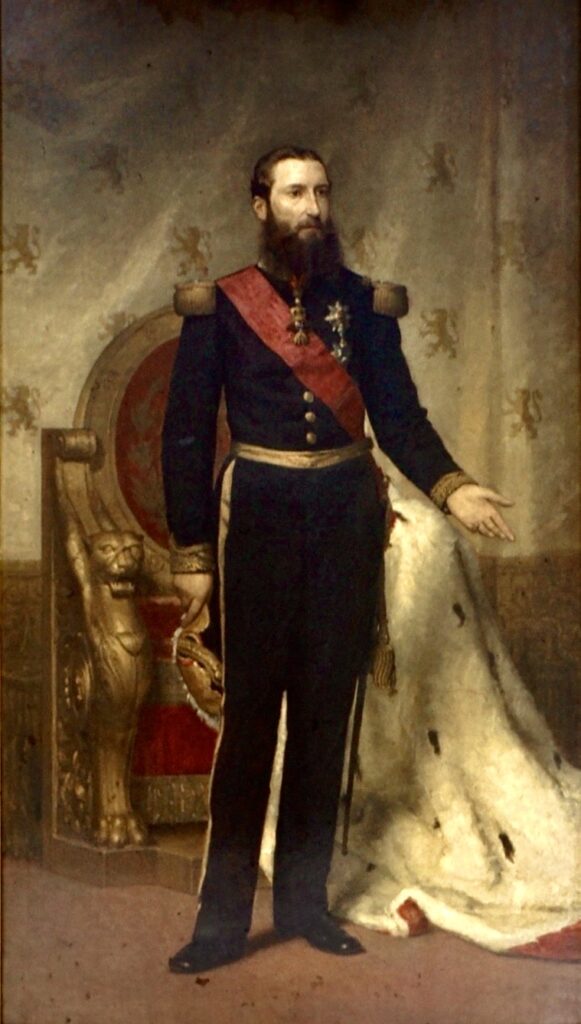
When speaking of European monarchs, few names spark as much discomfort and controversy as Leopold II. Born in Brussels in 1835, this king ruled Belgium from 1865 to 1909. But it’s not his reign over the tiny European kingdom that haunts history—it’s his brutal private rule over the Congo Free State, a territory 76 times the size of Belgium. There, in the name of profit and “civilization”, millions died, entire communities were shattered, and a legacy of trauma was born.
The tragedy? He never even set foot in the Congo.
Birth and Royal Education
Leopold Louis Philippe Marie Victor was born on April 9, 1835, at the Royal Palace of Brussels. He was the second son of King Leopold I and Queen Louise-Marie of Orléans. From early on, Leopold II was groomed for leadership. But while his older brother died young, making him heir to the throne, Leopold never truly saw Belgium as enough.
Raised in the strict etiquette of 19th-century royalty, his education emphasized diplomacy, military science, and languages—but also instilled in him a cold, calculating view of power. Even as a teenager, he was deeply interested in empire-building.
Early Role in the Belgian Monarchy
Before becoming king, Leopold II served in the Belgian Senate, where he openly pushed for colonial expansion. He viewed colonialism not as a moral mission but a business venture. His frustration was evident: Belgium had no empire, while Britain, France, and the Netherlands thrived on overseas colonies.
Leopold believed that to gain international prestige, Belgium needed territory abroad. But the Belgian government, small and cautious, refused to fund such ventures. So Leopold went private.
Obsession with Empire
When Leopold ascended the throne in 1865, he was determined to carve out a colonial empire—with or without Belgian support. He disguised his ambition under philanthropy and humanitarianism. He publicly decried the slave trade and promised to bring civilization and Christianity to the heart of Africa.
Behind closed doors, his motives were chillingly clear: resources, especially rubber and ivory. And he would stop at nothing.
The Creation of the Congo Free State
In 1885, through cunning diplomacy and manipulation at the Berlin Conference, Leopold II convinced European powers to recognize his personal control over a vast region in Central Africa. It became known as the Congo Free State, but it was anything but free.
Leopold never ruled it as king of Belgium. Instead, it was his private property—an unimaginable empire owned by one man.
He established a brutal system where local Congolese populations were forced to meet rubber and ivory quotas. Those who resisted faced mutilation, imprisonment, or death.
Atrocities and Exploitation in the Congo
The atrocities in the Congo Free State are among the darkest in colonial history. Villages were razed. Men were executed. Women were taken hostage. Children had their hands cut off as punishment—or proof of enforcement.
Estimates of the death toll vary, but historians generally agree that between 10 and 15 million Congolese died under Leopold’s regime from violence, famine, and disease caused by exploitation.
The rubber trade grew profitable, but at an unthinkable human cost.
Global Outcry and Scandal
Eventually, reports of the horrors began to reach Europe. Missionaries, former agents, and journalists exposed the reality. E.D. Morel, a shipping clerk turned activist, noticed that ships going to the Congo were full of guns—and returning full of rubber. Something didn’t add up.
With the help of African-American missionary George Washington Williams and British consul Roger Casement, a global movement erupted, denouncing Leopold’s crimes. Pictures of mutilated Congolese children shocked the world. Even Mark Twain and Arthur Conan Doyle joined the protest.
Leopold tried to suppress the truth—buying off journalists, burning official records—but it was too late.
Forced Reforms and Transfer of Power
Under immense pressure, including from the Belgian Parliament, Leopold II was forced to surrender control of the Congo Free State in 1908. It was transformed into a Belgian colony—the Belgian Congo—no longer his private fiefdom.
Though conditions slowly improved, the scars of Leopold’s rule remained. His regime had created a system of violence, racial hierarchy, and economic plunder that would echo for generations.
Leopold II’s Legacy in Belgium
In Belgium, Leopold II left behind grand boulevards, monuments, and parks. He invested the wealth extracted from the Congo into public buildings, royal estates, and museums. Brussels became a more majestic city, but its foundations were built on blood.
For decades, he was celebrated as a builder-king. Only recently has public sentiment shifted. Statues of Leopold have been defaced, removed, or recontextualized in cities across Belgium.
It’s a reckoning still underway.
Posthumous Judgment
Leopold II died on December 17, 1909, at the age of 74. His funeral was marked by public jeers—a rare sight for a monarch. Many Belgians saw through the façade of grandeur to the truth beneath.
Today, he is widely condemned as a mass murderer, even though he never personally killed—but because he orchestrated a system that did. His is a legacy of duplicity: civilization on the lips, cruelty in the hands.
Monuments and Historical Debates
- In 2020, during the global Black Lives Matter movement, Leopold II’s statues became flashpoints of protest.
- A petition to remove all his monuments gathered hundreds of thousands of signatures.
- Some argue for removal, others for contextualization—but almost none call for celebration.
Belgium, like many former colonial powers, is still grappling with how to teach and confront this painful past.
Lesser-Known Facts about Leopold II
- He never visited the Congo, despite ruling it for 23 years.
- He destroyed or concealed many official documents about the Congo before his death.
- He fathered multiple illegitimate children, including with a 16-year-old prostitute named Blanche Delacroix.
- He was obsessed with legacy, commissioning massive public works to immortalize his name.
- He was once nicknamed “the builder king”, before being remembered as one of history’s deadliest colonial rulers.
External Resource
🌐 Wikipedia – Leopold II of Belgium