Table of Contents
- A Crown Prince in the Making: Setting the Stage in Tang China
- The Glorious Yet Fragile Zenith of the Tang Dynasty
- The Early Life of Li Heng: A Prince in the Shadow of Power
- Emperor Xuanzong’s Golden Age and the Burden of Succession
- Intrigue in the Inner Court: Consorts, Princes, and Factions
- The Road to 742: How Li Heng Became the Favored Heir
- The Ceremony of 742: Proclaiming Li Heng Crown Prince
- Rituals, Symbols, and the Meaning of Crown Princeship
- A Prince Between Heaven and Earth: Duties After the Proclamation
- An Empire in the Balance: Military Governors and Hidden Fault Lines
- An Lushan and the Gathering Storm Around the Heir Apparent
- From Crown Prince to Exile: The Collapse of the Old Order
- Li Heng’s Flight, Survival, and Ascension as Emperor Suzong
- Restoring a Shattered Realm: Governance, War, and Compromise
- Human Cost and Cultural Memory of a Crown Prince’s Burden
- Legacy of Li Heng Crown Prince in Chinese Political Thought
- Historians, Chronicles, and the Battle Over Li Heng’s Image
- Echoes Through Time: Succession, Fragility, and Modern Parallels
- Conclusion
- FAQs
- External Resource
- Internal Link
Article Summary: In 742, at the glittering height of the Tang dynasty, Li Heng was proclaimed crown prince, an appointment that seemed to promise continuity and stability to one of the most resplendent empires in world history. Yet the story of Li Heng crown prince is less about serene succession and more about the shattering of illusions, as the empire that crowned him would soon be torn apart by rebellion. This article traces the arc from the prosperous reign of Emperor Xuanzong through the intricate court politics that elevated Li Heng, to the brutal upheaval of the An Lushan Rebellion that transformed the shy heir into the embattled Emperor Suzong. We move through palaces, temples, and war-torn cities to understand how an empire’s hopes were placed on one man raised to be both symbol and savior. The narrative follows the human drama of fear, duty, loss, and resilience that surrounded Li Heng crown prince as he navigated betrayal and civil war. Along the way, we explore how the concept of the heir apparent functioned in Tang political thought and how Li Heng’s brief tenure as crown prince altered the course of Chinese history. The image of Li Heng crown prince, standing in ceremonial robes beneath the ancestral tablets in 742, becomes a haunting contrast to the weary ruler directing desperate campaigns only a decade later. Through chronicles, poetry, and later historical reflection, the legacy of Li Heng crown prince offers a lens into the fragile balance between splendor and catastrophe at the heart of imperial rule.
A Crown Prince in the Making: Setting the Stage in Tang China
On a morning in the year 742, the sun rose over Chang’an, capital of the Tang dynasty, illuminating tiled roofs, bustling markets, and the vermilion gates of imperial power. Within the inner precincts of the palace—beyond walls guarded by elite troops and watched over by ancestral tablets—a decision was about to be confirmed that would shape the fate of millions. Li Heng, a quiet, dutiful middle-aged prince, long overshadowed by the dazzling brilliance of his father’s reign, was to be proclaimed heir apparent, the li heng crown prince whose name would be inscribed beside the Mandate of Heaven itself.
The city itself seemed to affirm the wisdom of the choice. Chang’an was perhaps the greatest metropolis on earth, its population swollen with merchants from Sogdia and Persia, Buddhist monks from India and Central Asia, Korean envoys, Japanese students, and Arab traders. The empire’s tax registers gleamed with promise; its granaries were full; its poetry flourished alongside silk and ritual. In such a world, choosing the crown prince looked like a matter of careful balance rather than urgent necessity. The empire appeared stable; the emperor, Xuanzong, still vigorous; the border armies strong. Yet beneath the gilded surface ran currents of anxiety that few, even among the elite, fully grasped.
Li Heng’s promotion to crown prince was not simply the story of one man raised above his brothers. It was the culmination of decades of courtly maneuvering, of factional rivalries, of shifting alliances between consorts, eunuchs, and ministers. It was also the product of a particular moment in world history, when China stood at the center of a vast network of exchanges and yet remained vulnerable to its own internal contradictions. The li heng crown prince whose name would soon be proclaimed in the ancestral hall carried on his shoulders more than the hopes of a single dynasty; he bore the weight of an entire political model built on ritual hierarchy, military might, and moral legitimacy.
But this was only the beginning. The proclamation of Li Heng as crown prince would, in retrospect, mark the turning of a great wheel—the pivot from unclouded splendor to an age of trauma. To understand why this moment was so charged, we must first step back into the larger world of Tang China at its apex, and then follow the child who would one day wear that heavy, glittering title.
The Glorious Yet Fragile Zenith of the Tang Dynasty
By the 740s, the Tang dynasty occupied an almost mythic place in East Asian imagination. Founded in 618 after the Sui collapse, the Tang had restored political unity to a fractured realm and then extended its influence deep into Central Asia. Embassies traveled from distant lands to pay respects at the Tang court; the Silk Roads pulsed with caravans carrying jade, horses, incense, and ideas. Within China, poetry reached heights that still define classical Chinese literature; painting and music flourished; the capital itself became a symbol of ordered abundance. When foreign rulers dreamed of what civilization might look like, they often imagined something like Tang China.
And at the apex of this flourishing stood Emperor Xuanzong, the sovereign under whom Li Heng would be named crown prince. Xuanzong (r. 712–756) inherited a troubled throne but soon ushered in what later historians would call the “Kaiyuan Golden Age.” Early in his reign, he reformed finances, pruned the bureaucracy, restrained the power of the palace women and eunuchs, and selected capable ministers. Under his guidance, state revenue increased significantly—some sources speak of tax income reaching nearly twice what it had been in the late 7th century, though precise figures vary. This fiscal health supported a standing army, elaborate court rituals, and major infrastructure projects.
Culturally, too, Xuanzong’s court was a magnet for talent. Poets like Li Bai and Du Fu moved in and out of the corridors of power; Buddhist monks debated Confucian scholars; Daoist priests gained imperial favor. Music and dance from Central Asia fascinated the elite; new instruments and rhythms transformed court performances. The Tang capital became a living map of the world, with foreign quarters, temples, and markets reflecting the empire’s openness and ambition.
Yet this very splendor masked structural weaknesses. To secure the borders, the Tang had increasingly devolved military authority to powerful frontier commanders, the jiedushi, who commanded semi-autonomous regional armies. These generals were often of mixed or non-Han origin, hardened by frontier warfare, loyal as much to their own retinues as to the distant court. Meanwhile, within the heartland, land concentration, tax inequities, and administrative corruption eroded the equal-field system that had once underpinned Tang prosperity. Rural discontent simmered quietly beneath the surface, unheeded by an urban elite enamored of refinement.
It’s astonishing, isn’t it? An empire that looked so strong on the outside contained within it all the elements of future catastrophe: over-mighty generals, fragile finances, an aging ruler, and a court increasingly consumed by pleasure and intrigue. It was into this bright yet brittle world that Li Heng was born, raised, and ultimately lifted up as the designated inheritor of the Mandate of Heaven.
The Early Life of Li Heng: A Prince in the Shadow of Power
Li Heng was born in 711, only a year before his father, the future Emperor Xuanzong, took the throne. From the outset, his life unfolded in a palace atmosphere thick with uncertainty and danger. The Tang succession in the early 8th century had been anything but smooth: coups, deposings, and assassinations haunted the corridors of power. To be a prince in such an environment was to learn very early that survival required silence, observation, and caution.
As one of Xuanzong’s sons by Consort Wu, Li Heng was neither the eldest nor the most dazzling. His early years left few vivid anecdotes in the official chronicles, a silence that itself is revealing. Unlike some princes who were famed for their literary brilliance or martial prowess, Li Heng appears as a figure of reserve—a man who studied, obeyed, and avoided conspicuous displays. The “Old Book of Tang,” compiled centuries later, describes him in terms that emphasize his seriousness and sense of duty, noting his “mild disposition” and “filial behavior,” labels that, while formulaic, suggest the type of heir a cautious emperor might prefer.
Growing up in the inner palace, Li Heng would have been immersed in a highly ritualized education. Tutors would instruct him in the Confucian classics, history, calligraphy, and the art of governing; military officers would introduce him to archery, horsemanship, and the basics of command. At formal banquets and court audiences, he would stand quietly behind his father, learning the choreography of imperial rule: who bowed first, who knelt longer, whose words carried weight, whose glances were to be feared. The omnipresent eunuchs, who controlled access to the emperor, would serve as both guardians and watchers, silently recording who associated with whom.
Li Heng’s mother’s position in the harem also shaped his prospects. Unlike the famous Consort Yang, who would later dominate Xuanzong’s affections, Consort Wu did not overshadow the political stage. This relative obscurity may ironically have served Li Heng well. In the lethal ecology of the palace, where a consort’s political ambition could doom her children, modesty was often a shield. The future li heng crown prince learned early to cultivate a low profile, to accept minor appointments, and to show scrupulous deference to his father’s will.
In his youth, Li Heng received posts appropriate for an imperial son—honorary titles, nominal governorships, ceremonial commands. These roles served as training rather than true power. They gave him a taste of administration without offering a separate power base. He observed the endless flow of memorials, the complaints from provinces, the petitions from scholars, and the subtle tug-of-war between central authority and local interests. While the chronicles rarely delve into his private thoughts, one can imagine the impression these documents left on a young man being groomed, if slowly, for greater responsibility.
The boy prince walked palace corridors lined with history—murals of earlier emperors, carved stones inscribed with precedents, tablets honoring virtuous ministers and loyal generals. Every inscription reminded him that the throne was not merely a seat of luxury but a position at the center of an intricate moral and cosmic order. Whether he would ever occupy that seat was uncertain. For much of his early life, the question of who would succeed Xuanzong remained open, suspended in a haze of protocol, affection, and politics.
Emperor Xuanzong’s Golden Age and the Burden of Succession
To a contemporary observer in the 730s, Emperor Xuanzong might have seemed almost immortal. Having steered the empire from turmoil to prosperity, he embodied the Mandate of Heaven in its most radiant form. His reign, especially in the Kaiyuan era (713–741), was celebrated in verse and prose; the roads to Chang’an were crowded with officials seeking advancement and poets hoping for recognition. Yet time moves even for golden-age monarchs, and by the early 740s, the question of age and succession could no longer be postponed.
In Confucian political culture, the heir apparent was essential to stability. A clear succession minimized the risk of factional conflict, rebellion, or foreign exploitation at the moment of transfer. However, designating a crown prince was never simply a legal or ritual act. It involved the emperor’s personal feelings, the influence of consorts and eunuchs, and the larger calculations of powerful ministers and generals. An emperor who hesitated or vacillated invited precisely the turmoil he hoped to avoid.
Xuanzong had once taken succession very seriously. In earlier years, he had appointed an heir, then deposed him, then considered others. Each appointment reshaped the map of court alliances. Ministers and relatives aligned themselves with whatever prince seemed likely to inherit; as favorites rose and fell, so did their followers’ fortunes. By the 740s, Xuanzong’s later-life passions—most famously his love for Consort Yang Guifei—complicated matters further. Here was an aging ruler deeply enamored of beauty and pleasure, whose judgment, according to some later chroniclers, began to soften under the charms of music, wine, and romance.
Yet the empire demanded clarity. Officials knew that, despite the bright pageantry, Xuanzong could not reign forever. Border provinces faced new threats; the power of frontier generals continued to grow. The long-term health of the dynasty required a crown prince who could not only inherit power but wield it wisely. Ministers debated among themselves in private, weighing the princes’ qualities. Some preferred more assertive, charismatic candidates who might dominate the court; others favored a quieter, more pliant figure who would allow the bureaucracy to function without interruption.
Li Heng, in this calculus, presented an appealing compromise. He was not too young—already in his thirties by 742—and had ample experience in minor posts. He had no notorious vices, no wild scandals attached to his name. His demeanor, as noted, was reserved, even self-effacing. He was the sort of man who could reassure conservative officials and perhaps calm rival factions. To an emperor half-exhausted by decades of rule, such an heir might seem like a safe harbor.
But behind the scenes, the decision was far from straightforward. Brothers of Li Heng, their mothers, and their supporters all had stakes in the outcome. The palace, that walled city within a city, hummed with whispered predictions, subtle tests of loyalty, and careful offerings of poetry and gifts. Every gesture could be read as a sign. The process of choosing the li heng crown prince thus became a mirror in which the empire’s deeper tensions reflected themselves.
Intrigue in the Inner Court: Consorts, Princes, and Factions
The Tang palace in the mid-8th century was both theater and battlefield. Its jade floors and silk curtains hid struggles that could determine the lives of millions. Within this closed world, women and eunuchs—often excluded from formal historical narratives—wielded immense influence. Their preferences and fears shaped the fortunes of princes, including Li Heng.
By 742, Consort Yang Guifei had become the emotional center of Xuanzong’s world. Their romance has been immortalized in poetry, especially Bai Juyi’s later masterpiece “Song of Everlasting Sorrow,” which portrays an emperor so entranced by beauty that he neglects affairs of state. While the poem is literary rather than strictly historical, it captures something real about the court’s mood: a growing sense that personal passions and public duty were coming into conflict.
Consort Yang herself did not have a son by Xuanzong, but her relatives gained enormous power. Her cousin Yang Guozhong, for example, would later become one of the most reviled figures in Tang political memory, blamed by many for mismanaging the crisis of the An Lushan Rebellion. At this earlier phase, however, the Yang clan’s influence was still consolidating. Their rise inevitably touched on questions of succession, as they weighed which prince might best safeguard their interests once Xuanzong was gone.
Other consorts and their sons, older and younger than Li Heng, cultivated their own allies. Some nurtured relationships with key ministers in the civil bureaucracy; others looked to powerful generals. Eunuchs, who controlled the emperor’s movements and the flow of information, became brokers between these factions. They could arrange or block audiences, deliver private messages, and quietly tarnish reputations in the emperor’s ear.
In this tense climate, Li Heng’s greatest asset may have been his caution. He did not raise a private retinue suggestive of military ambition. He did not surround himself with flamboyant literati known for satirical verse. Instead, he built a reputation for sober behavior, respect for ritual, and loyalty to his father. Such conduct limited the pretexts his rivals might use against him. It also presented him as a figure acceptable to a wide range of political actors who, while not necessarily enthusiastic, could at least agree on his reliability.
Still, the path to becoming li heng crown prince passed through whispered accusations, secret reports, and personal appeals. Some princes were quietly discredited; rumors of their intemperance, alleged conspiracies, or unsuitable associations reached the emperor. Talented but impetuous brothers might find themselves posted to distant provinces or stripped of influence. Courtiers watched these shifts closely. Each change in favor altered the invisible map of power that stretched from the throne room to the frontier camps.
We cannot fully reconstruct the emotional toll this environment took on Li Heng. Did he pace sleeplessly in his residence, wondering which gesture would be misread? Did he worry that too much modesty might be seen as weakness, and too much assertiveness as ambition? The chronicles remain quiet on his inner turmoil, but the very absence of scandal suggests a man walking a narrow, perilous path with extraordinary care.
The Road to 742: How Li Heng Became the Favored Heir
By the early 740s, a convergence of circumstances brought Li Heng closer to the center of imperial calculations. Certain princes fell from grace, some due to their conduct, others simply because their mothers lacked influence or had died. Ministers close to the emperor, concerned with preserving the stability of the dynasty and perhaps their own careers, began to speak more favorably of Li Heng’s virtues.
In memorials to the throne and private conversations, they stressed his “respect for the classics,” his “stability of temperament,” and his “uprightness.” Such phrases, repeated in the Jiu Tangshu (Old Book of Tang), may sound formulaic, but they carried significant political weight. An emperor bombarded with conflicting advice needed patterns, and Li Heng’s image as the steady, dutiful son provided exactly that.
At the same time, Xuanzong’s own perspective was shifting. After decades of rule, he had seen the dangers of impulsive heirs. He had faced conspiracies, suffered from poorly chosen favorites, and lived through the turbulence of earlier successions. As he aged, the idea of a calm, cautious heir may have felt like a refuge. Li Heng’s very lack of dazzling brilliance—so often a liability in court culture obsessed with poetry and performance—became a virtue in the eyes of an emperor weary of drama.
External factors also played a role. The frontiers were increasingly restless; the empire’s population had grown; governing had become more complex. A prince who would not rashly challenge powerful generals or alienate key ministers offered a measure of reassurance. The position of li heng crown prince was not about personal glory alone; it was about maintaining a delicate balance among elites, regions, and institutions.
Behind the scenes, there were almost certainly bargaining and compromises. Eunuchs gauged reactions in various palace quarters. Consorts considered what kind of future would best secure their own survival once Xuanzong died. Ministers tallied who could live with Li Heng’s ascent and who might resist it. The process culminated in the emperor’s decision: Li Heng would be formally raised to the status of crown prince in 742, with all the ritual and documentation that entailed.
Thus, the road to the proclamation was less a straight path than a hesitant spiral, circling around fears, hopes, and calculations. When the final decree was drafted and sealed, it embodied years of unspoken negotiations. It fixed in writing what had already become a tacit understanding among many at court: that Li Heng, if not beloved, was at least acceptable as the man who would someday become the Son of Heaven.
The Ceremony of 742: Proclaiming Li Heng Crown Prince
When the day of proclamation arrived in 742, Chang’an awakened to the muted drumbeats of ritual preparation. Inside the palace, servants unfurled banners dyed in imperial colors; incense coiled from bronze burners; officials donned formal robes according to rank. Though daily life in the capital went on—markets opened, artisans worked, children ran through courtyard alleys—the inner court entered a different tempo, that of ceremony.
At the heart of it stood Li Heng. Clad in robes appropriate for his station, he moved through the scripted sequence that had been refined over centuries. First, acts of reverence: offerings to the ancestors, bows to the emperor, gestures that signaled humility before Heaven and filial devotion to his father. Such scènes were not mere ornament; they were statements about continuity. The li heng crown prince was, in that moment, being woven into the fabric of the dynastic lineage, made visible not only to the living but to the dead.
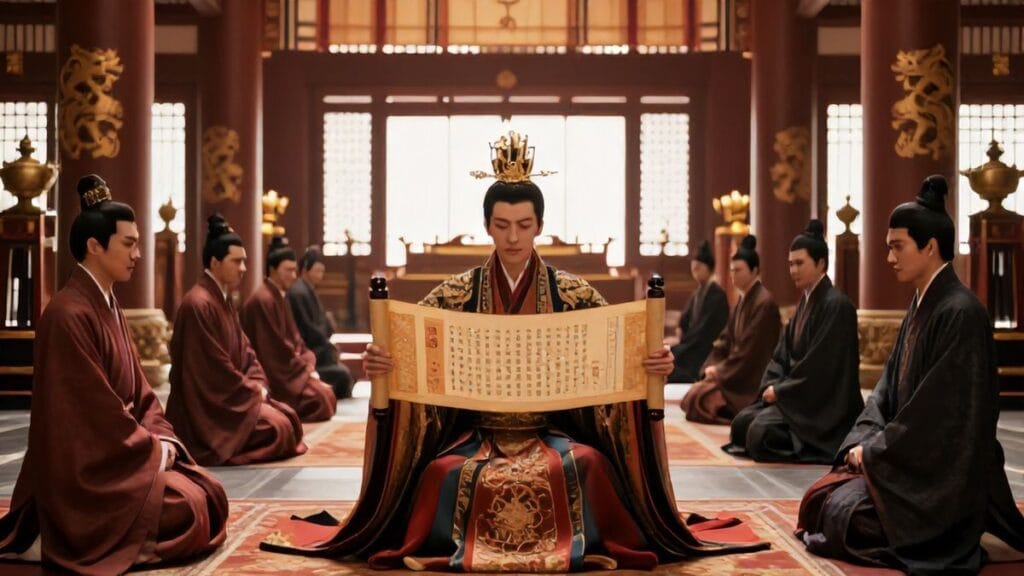
Officials arrayed themselves in strict order. Civilians stood on one side, military officers on the other, each group watching intently. A proclamation, drafted by the chancellery and approved by Xuanzong, was read aloud in a clear voice. It praised Li Heng’s virtues—his study, his restraint, his respect for ritual—and declared him the rightful heir who would “receive the inheritance of the Great Mandate and continue the sacrifices to the Ancestral Temple.” The language was ornate, yet its meaning was unmistakable: from this day forward, Li Heng was the axis around which the future of the dynasty turned.
The emperor himself played a crucial role. Whether Xuanzong’s face betrayed a father’s pride or an aging man’s apprehension, we cannot know. But his presence conferred legitimacy. In front of ministers, generals, and envoys from distant lands, he symbolically transferred part of his cosmic responsibility to his son. This was not abdication, but anticipation—an acknowledgment that the Mandate would someday need a new vessel.
After the reading, the assembled officials performed a series of bows, first to Xuanzong, then to Li Heng. Their gestures expressed loyalty to the existing order while pledging allegiance to the one to come. Some may have done so sincerely; others surely calculated the benefits of early displays of submission. Yet in that hall, under the lacquered beams, few would have openly questioned the propriety of the act. The ceremony worked precisely because it blended moral, religious, and political imperatives into a single performance.
Beyond the palace, proclamations would be sent to provincial administrations, frontier garrisons, and allied kingdoms. Edicts announcing the elevation of the li heng crown prince would be copied by scribes, carried by couriers along dusty roads, and read aloud in local yamen (offices) to officials and commoners alike. In distant counties, farmers pausing from their labor might hear that a new heir had been named in the capital, evidence that the dynasty continued unbroken and that Heaven’s order remained intact.
For Li Heng personally, the ceremony marked an irreversible transformation. He was no longer merely a prince among many; he was the focal point of expectation, envy, and scrutiny. From that day, every word he spoke, every alliance he formed, would be weighed against his role as the future emperor. Yet in that moment of elevation, surrounded by ritual splendor, he could not know how swiftly joy would give way to fear, nor how violently the empire that had crowned him would be torn apart.
Rituals, Symbols, and the Meaning of Crown Princeship
To modern eyes, the elaborate rituals surrounding Li Heng’s proclamation might seem excessive—mere theater masking political realities. But in Tang political philosophy, ritual was reality. The crown prince was not just a successor-in-waiting; he was a living bridge between the present reign and a future yet to be written, between the will of Heaven and the daily lives of subjects scattered across mountains and plains.
Confucian thinkers had long stressed the importance of the heir apparent. As the Book of Rites put it, “When the heir is established, the hearts of the people are at rest.” The presence of a designated successor reassured officials and commoners alike that the cosmic order would not shatter upon the emperor’s death. The crown prince embodied continuity of ritual sacrifices to ancestors, continuation of laws, and the preservation of moral norms. In a sense, the li heng crown prince became a “shadow emperor,” already partially invested with the Mandate.
Symbols reinforced this status. The crown prince’s residence, often called the Eastern Palace, functioned as a miniature court. He had his own staff of scholars, advisers, and attendants. His seal bore distinct characters; his robes differed subtly from those of other princes. He participated in certain ceremonies alongside the emperor, underscoring both his subordination and his centrality. To watch him move through these roles was to glimpse, in advance, how he might rule.
At the same time, the institution of the crown prince carried tensions. A too-powerful heir could overshadow the emperor, becoming a rallying point for opposition. A too-weak heir might fail to command respect. Li Heng’s careful cultivation of modest strength thus fit a delicate ideal. He needed to be visible, yet not ostentatious; firm, yet not threatening. The proclamation of 742 sought to fix this balance in place, even as shifting political winds would later test it to the breaking point.
Religious symbolism deepened the role. In state sacrifices to Heaven and Earth, the emperor performed as the chief mediator, but the crown prince often assisted. He learned the complex choreography of bowing, offering, and invocation that kept the cosmos in harmony, at least in theory. The li heng crown prince thus became an apprentice in cosmic stewardship, rehearsing acts that would one day be his alone to perform. In a world where droughts, floods, and famines were often interpreted as signs of Heaven’s disfavor, competence in ritual was no trivial matter.
Thus, Li Heng’s new status in 742 was not a mere title pinned to his name; it was an intricate package of expectations, symbols, and practices. To accept it was to place his life irrevocably at the center of forces far larger than any individual, however cautious or intelligent. The crown prince stood, by definition, at the fault line between glory and catastrophe.
A Prince Between Heaven and Earth: Duties After the Proclamation
Once proclaimed crown prince, Li Heng’s daily life changed in ways both visible and subtle. He now presided over his own court within the palace complex, receiving reports, hearing petitions, and consulting with advisers. The Eastern Palace, once a training ground, became a parallel center of activity where the rhythms of rule were rehearsed under the watchful gaze of the emperor and the expectations of the bureaucracy.
His duties expanded. He was expected to scrutinize memorials, discuss policy options, and occasionally represent the emperor in ceremonies or audiences with foreign envoys. These tasks allowed Xuanzong to ease some burdens of rule while testing his heir’s judgment. Ministers, in turn, began to cultivate relationships with the li heng crown prince, anticipating the day when their careers might depend on his favor. Every conversation, every suggestion, became imbued with double meaning—what did it reveal about how the future emperor might rule?
Li Heng also took on a more visible role in the ceremonial and religious life of the dynasty. He accompanied his father to important sacrifices, observed the protocols of court festivals, and sometimes issued edicts in his own name—with imperial approval. These acts were carefully recorded in official annals. The chronicles’ dry language—“The Crown Prince attended,” “The Crown Prince memorialized”—conceals a deeper significance: Li Heng was being woven into the tapestry of dynastic legitimacy, one ritual thread at a time.
Yet his power remained constrained. Ultimate authority still resided firmly with Xuanzong. If the emperor chose to ignore his heir’s advice, few would protest. Moreover, the empire’s real coercive strength lay increasingly in the hands of regional military governors and palace eunuchs, whose loyalty to the crown prince was uncertain. Li Heng’s new responsibilities therefore came with an awareness of his own limitations—an uncomfortable but instructive lesson for any future ruler.
We can imagine the inner conflict. On the one hand, the li heng crown prince carried the confidence of institutions, rituals, and texts that declared him the ordained successor. On the other, he saw the empire’s growing reliance on generals who commanded tens of thousands of troops, and on eunuchs who held keys to the emperor’s private world. He knew that if the day came when he had to assert his authority, these would be the very forces he must either win over or withstand.
For ordinary people, Li Heng’s activities remained distant abstractions. Farmers planted and harvested according to the seasons; traders bargained in noisy markets; monks and priests tended to their temples. Yet in official proclamations posted in county seats, the presence of a crown prince was cited as evidence of Heaven’s continued favor. “The state has an heir,” the logic went; therefore, the cosmic order endures. Little did they know how soon that order would convulse.
An Empire in the Balance: Military Governors and Hidden Fault Lines
While Li Heng adjusted to his role in the Eastern Palace, the structural tensions of the Tang state deepened beyond the palace walls. Chief among these were the powers of the regional military governors, or jiedushi. Originally designed to secure vulnerable frontiers and swiftly respond to external threats, these commanders gradually amassed quasi-independent authority, blending military, fiscal, and sometimes civil powers within their jurisdictions.
Among them, few loomed larger than An Lushan, the mixed Sogdian-Turk general who controlled a swath of the northeastern frontier. Stationed in areas like Fanyang (near modern Beijing), he commanded tens of thousands of troops and cultivated an image of fierce loyalty to the throne. He visited the capital frequently, charming the court with his rough humor and feigned simplicity. Emperor Xuanzong and Consort Yang reportedly treated him with especial favor; some anecdotes, preserved in the New Book of Tang, even describe him jesting in the inner palace, an intimacy unheard of for most generals.
This favoritism came at a cost. Court officials, including some of the more sober-minded ministers, worried about An Lushan’s burgeoning power. They recognized that his control over multiple circuits, combined with close ties to the emperor’s favorites, created a potential threat. However, their warnings were often drowned out by the chorus of flatterers and by Xuanzong’s desire for stability on the frontier with minimal interference from the central court.
Simultaneously, internal strains grew. Reforms that had once invigorated the Tang state had long since run their course. Landholding patterns shifted toward concentration in the hands of great families and religious estates; peasants found it harder to maintain their allotments under the equal-field system. Tax burdens, military conscription, and corvée labor contributed to quiet resentments. Regional disparities widened as wealth and influence clustered closer to the capital and certain prosperous corridors, leaving other areas more vulnerable when crisis would strike.
Li Heng, as crown prince, would have heard reports about these trends, though probably in sanitized form. Memorials from frontier commanders highlighted their own victories and grievances; civil officials decried abuses but often blamed local subordinates rather than structural defects. The li heng crown prince thus stood at an informational crossroads, receiving a torrent of documents whose contradictions revealed the empire’s fraying seams.
Yet, behind the celebrations of his proclamation, little was done to rebalance the system. The Tang state had grown so used to its own success that it failed to recognize how fragile that success had become. Instead, the court drifted toward complacency and distraction, its attention increasingly preoccupied by courtly pleasures and factional quarrels rather than far-off garrisons and overburdened peasants. When the storm finally broke, it would do so with a ferocity that stunned all who had believed in the permanence of the golden age.
An Lushan and the Gathering Storm Around the Heir Apparent
As the 740s slipped toward their end, the relationship between the palace and its frontier commanders grew more fraught. An Lushan, outwardly loyal and even endearingly buffoonish at court, was in fact building a formidable military machine. He recruited troops not only from regular conscripts but from disaffected populations, including non-Han peoples and those who found in his banner a path to wealth or survival. His armies trained, drilled, and prepared, even as the capital basked in cultural florescence.
From the standpoint of Li Heng, this posed an acute dilemma. The crown prince could not directly command frontier forces; to do so would risk being seen as overstepping his authority or challenging his father’s prerogatives. Yet he could hardly ignore the growing imbalance of power. Did he quietly advocate stricter supervision of regional generals? Did he voice concerns about An Lushan by way of cautious memorials? Some sources suggest that a few officials close to the heir expressed unease, but their warnings were lost in the broader cacophony of court politics.
Meanwhile, Consort Yang’s family, especially Yang Guozhong, became locked in a bitter rivalry with An Lushan. Their conflict interlaced personal animosity with structural tension: the court’s civilian favorites versus the empire’s most powerful general. For the li heng crown prince, this feud was doubly dangerous. To side too openly with either camp risked alienating the other. To remain neutral risked appearing weak or indecisive. The very elevation that had made him central to the empire now trapped him amid conflicting claims.
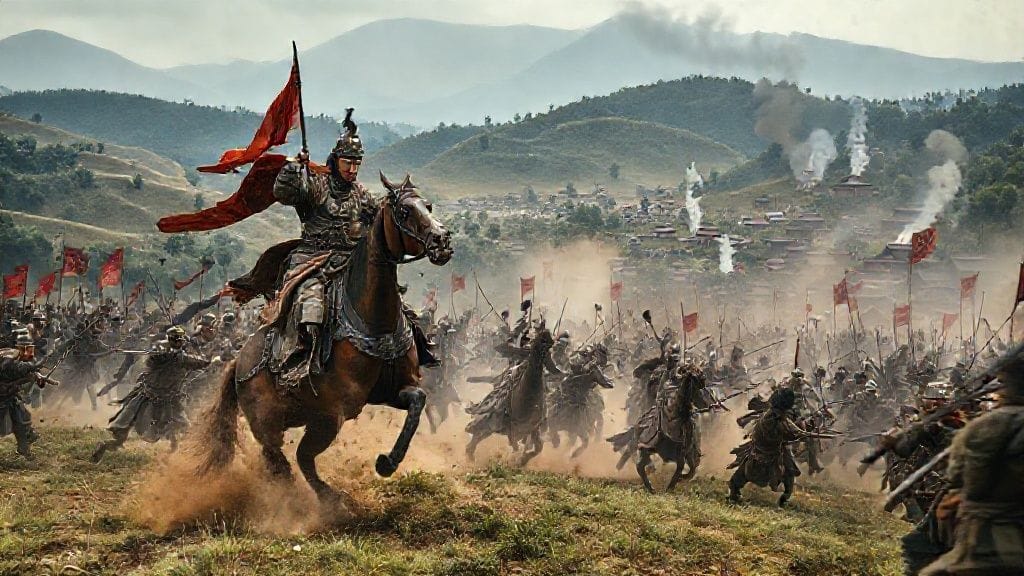
In 755, An Lushan finally rebelled, proclaiming the establishment of a new Yan dynasty and denouncing the corruption of the Yang family as a justification. His forces surged southward, capturing major cities with alarming speed. The shock to the Tang state was immediate and profound. Frontier defenses crumbled; local garrisons defected or fled; communications faltered. The path that had once carried solemn edicts announcing the li heng crown prince now echoed with the footfalls of rebel armies.
Xuanzong, distraught and ill-prepared, vacillated between countermeasures. Court debates turned frantic. In this chaos, the earlier proclamation of the crown prince took on a bitterly ironic tone. The ritual of 742 had promised continuity and calm succession; the reality of 755 delivered disintegration and panic. It was precisely at this moment, when the Mandate seemed in danger of being ripped away, that Li Heng’s role would take a dramatic and perilous turn.
From Crown Prince to Exile: The Collapse of the Old Order
The outbreak of the An Lushan Rebellion transformed the Tang court from a stage of elegant intrigues into a theater of existential crisis. Rebel forces captured Luoyang, the eastern capital, and drove inexorably toward Chang’an. Rumors of atrocities, defections, and collapsing defenses reached the imperial city. Panic spread through the population; some elites quietly prepared escape routes, while others clung to denial, insisting that the empire’s grandeur would somehow repel the invaders.
Li Heng, the li heng crown prince who had once embodied future stability, now found himself at the epicenter of an imploding world. His father’s court, shaken by military disasters, struggled to respond coherently. Debates raged over whether to negotiate, to flee, or to mount a desperate defense. The emperor’s trust in his officials frayed; suspicion and fear flourished where once poetry and music had held sway.
In 756, as rebel forces neared Chang’an, Xuanzong made the fateful decision to flee southward toward Sichuan. The imperial caravan, weighed down with treasures and attendants, moved through dust and confusion. In one of the most dramatic episodes of Tang history, mutinous troops accompanying the flight turned on Yang Guozhong, killing him and then demanding the death of Consort Yang herself, whom they blamed for the catastrophe. Under immense pressure, the emperor, weeping and devastated, consented to her execution. The golden age ended not in dignity, but in flight and blood.
In this chaos, Li Heng became separated from his father. Whether by design or circumstance, he did not accompany Xuanzong’s flight into the deep southwest. Instead, he turned northward and westward, heading for Lingwu (in modern Ningxia), a strategic point where loyalist forces were gathering. The crown prince’s journey was no ceremonial procession; it was an escape undertaken in fear and uncertainty. He traveled not as the serene heir of 742, but as a fugitive whose very survival was in question.
Yet this flight also opened a new possibility. As Tang authority crumbled, regional commanders and officials needed a figure around whom to rally. Xuanzong, broken by the collapse and the death of his beloved consort, seemed increasingly unable to act decisively. The li heng crown prince, on the other hand, was in a position to claim that, in such desperate times, the Mandate required a more active bearer. At Lingwu, surrounded by generals and officials who feared the dynasty’s extinction, Li Heng would take his fate—and that of the Tang—into his own hands.
Li Heng’s Flight, Survival, and Ascension as Emperor Suzong
Arriving at Lingwu in 756, Li Heng confronted a reality that must have felt worlds away from the measured rituals of his proclamation fourteen years earlier. The air was thick with dust and tension; camps of soldiers, some ragged and exhausted from retreat, dotted the landscape. Officers argued over strategy, supplies, and loyalty. Everyone looked to the crown prince, but not for ceremonial reassurance now—for leadership in war.
In a move that has provoked historical debate for centuries, Li Heng accepted the urging of his supporters and proclaimed himself emperor, taking the reign title Suzong. This act effectively divided the Tang court in two: the old emperor, Xuanzong, still alive in the southwest, and the new emperor Suzong at the front. To some, this looked like a usurpation; to others, a necessary assumption of responsibility in a moment when the empire needed someone to rally around. Later chroniclers, writing under the restored Tang legitimacy, carefully framed this transition as a kind of consensual transfer of the Mandate, emphasizing Xuanzong’s eventual recognition of his son’s new status.
For Li Heng personally, the transformation from li heng crown prince to Emperor Suzong was both liberation and burden. The constraints of heirship fell away, replaced by the crushing weight of ultimate responsibility. Decisions that once might have been cautiously suggested to his father were now his alone to make. Military strategy, diplomatic outreach to regional warlords, and negotiations with potential allies all demanded his attention. He faced the immediate question of how to halt the rebel momentum and reclaim the heartland.
Emperor Suzong’s early reign was marked by improvisation. Lacking direct control over large, disciplined central armies, he had to rely on alliances with semi-autonomous commanders. One of the most significant of these was the Uyghur Khaganate, whose cavalry would play a crucial role in recapturing Chang’an and Luoyang. Such alliances came at a price. Uyghur troops expected rich payment and plunder; their assistance deepened the Tang state’s dependence on foreign powers even as it helped save the dynasty.
Amid these military and diplomatic maneuvers, Suzong also had to navigate the emotionally fraught relationship with his father. Xuanzong, upon learning of his son’s enthronement, initially reacted with shock and sorrow. Over time, however, he accepted the new reality, formally recognizing Suzong as the legitimate emperor and himself assuming the honorary title of “Retired Emperor.” This compromise, though painful, helped heal the symbolic rift at the heart of the dynasty. It allowed the former li heng crown prince to fight in Heaven’s name, not merely as a rival claimant.
The recapture of Chang’an in 757, aided by Uyghur forces and loyalist armies, was a major victory—but not a return to the world of 742. The capital had been ravaged; population displaced; confidence shattered. Suzong entered a city haunted by ghosts, both literal and metaphorical. He had saved the dynasty in name, but the cost—to the state, to the people, and to his own spirit—was immense.
Restoring a Shattered Realm: Governance, War, and Compromise
Having reclaimed the capitals, Emperor Suzong faced a task that would have daunted even the most seasoned ruler: to govern an empire torn apart by civil war, famine, and betrayal. The challenges he confronted were the direct inheritance of his years as crown prince and the broader structural issues of the Tang state, now laid bare by the An Lushan Rebellion.
Politically, Suzong had to balance gratitude and caution. Generals who had supported his cause, like Guo Ziyi, emerged as towering figures in the postwar landscape. They commanded the loyalty of their troops and the admiration of the populace. Rewarding them was essential; restraining them was equally so. The old problem of over-mighty warlords, which had helped produce the rebellion, did not disappear with its suppression. If anything, it intensified: the very men who had saved the dynasty now constituted new centers of power.
Economically, vast regions lay devastated. Fields had gone untilled, irrigation works neglected, and transport routes disrupted. Refugees crowded into safer areas, straining local resources. Tax registers, once the pride of Xuanzong’s early reign, became unreliable. Suzong’s government had to find ways to reestablish basic order—reconfirm land rights, resettle populations, restore granaries—while lacking the administrative capacity fully to do so. Emergency measures, remissions, and ad hoc arrangements proliferated.
Socially, trauma ran deep. The rebellion and subsequent campaigns had killed hundreds of thousands, perhaps more; precise numbers elude us, but the scale of suffering was enormous. Families were separated; entire communities displaced. Stories circulated of massacres, rapes, and enslavements. Poets like Du Fu, who experienced the turmoil firsthand, bore witness in lines of harrowing beauty, describing hunger, loss, and the collapse of moral certainties. One of Du Fu’s poems mourns the fate of ordinary soldiers, “bones white in the wild,” a stark counterpoint to the official rhetoric of heroic restoration.
In this context, the earlier ceremony proclaiming Li Heng crown prince took on a tragic resonance. The rituals had promised that the Mandate’s passage from father to son would be smooth, almost seamless. Instead, succession had been accompanied by some of the worst suffering in Chinese imperial history to that point. Suzong’s reign thus became, in part, an attempt to make good on the earlier promise—to show that the man raised up in 742 could, even belatedly, fulfill the role of restorer and protector.
Yet his efforts were constrained by ill health, factional struggles at court, and the sheer magnitude of the problems he faced. Eunuchs reasserted their influence, controlling access and playing off ministers against one another. Rivalry among his own heirs began to echo the old succession tensions of Xuanzong’s court. Suzong, never a charismatic figure, found it hard to impose a unifying vision amid this turbulence. He presided more as a manager of crisis than as a grand architect of renewal.
Still, his achievements were not negligible. The Tang state survived; its cultural life, though scarred, continued to flourish; its institutions adapted, however imperfectly, to new realities. The empire that emerged from Suzong’s reign was smaller in confidence and more divided in power than the one that had proclaimed him li heng crown prince, but it endured, preserving enough strength and prestige to influence East Asia for another century and a half.
Human Cost and Cultural Memory of a Crown Prince’s Burden
Behind the grand narratives of rebellion and restoration lies the human story of Li Heng himself—the boy raised in ritual splendor, the cautious prince, the reluctant war emperor. His life encapsulates a paradox that haunts many rulers: he was chosen to guarantee stability, yet his very tenure as heir coincided with the greatest instability the dynasty had ever known.
We catch only fleeting glimpses of his inner world in the sources. Anecdotes depict him listening attentively to ministers, showing concern for the welfare of troops, and expressing sorrow at the empire’s sufferings. When he learned of Consort Yang’s death, for example, he reportedly wept deeply—not only for a woman whose presence had defined his father’s later years, but for what her demise symbolized: the total unraveling of the old courtly order.
The emotional burden of leading a traumatized realm weighed heavily on him. As Emperor Suzong, he had to sign death warrants, approve harsh measures against suspected collaborators, and tolerate the excesses of allies whose loyalty was essential but whose conduct was often brutal. Each decision meant balancing justice, expediency, and the desperate need to preserve what remained of the Tang state.
Cultural memory of his role evolved over time. Some later historians criticized his reliance on regional forces and foreign allies; others praised his perseverance under impossible conditions. In the official histories, he appears as a figure of somber resilience rather than glory—a man whose greatest achievement was not creating a new golden age, but preventing the collapse of everything. The Xin Tangshu (New Book of Tang), compiled in the 11th century, frames his reign as a “restoration under duress,” implicitly honoring the crown prince who became emperor only to find his inheritance shattered.
Poetry, too, preserves the echo of his age. Du Fu, who sought patronage under Suzong and his successors, addressed the emperor indirectly in many poems that lament the suffering of the people. In one, he speaks of “a throne won back, yet hearts unhealed,” a line that, while not a direct quotation from Suzong’s court, captures the emotional texture of the era. The juxtaposition of restored ceremonial order and lingering human pain became a defining motif in Tang cultural memory.
Thus, the story of the li heng crown prince is not merely that of one man’s rise to power. It is the story of how an entire society grappled with the dissonance between its ideals of orderly succession and the brutal contingencies of history. The crown prince, crowned in hope, ruled in mourning.
Legacy of Li Heng Crown Prince in Chinese Political Thought
The elevation of Li Heng to crown prince in 742 and his subsequent reign as Suzong left a complex legacy in Chinese political thought. For later generations of scholars and officials, his story served both as a cautionary tale and as an example of perseverance under duress.
On one level, his case reinforced the Confucian emphasis on clear succession. The turmoil that followed the An Lushan Rebellion could easily have been far worse if there had been no widely recognized heir apparent to step into leadership. The existence of the li heng crown prince, already legitimized in the eyes of the bureaucracy and the provinces, enabled relatively rapid rallying once the empire’s center collapsed. In this sense, the 742 proclamation did what it was supposed to do: it gave the state a focal point for continuity in crisis.
On another level, however, his experience highlighted the limits of ritual and designation. Simply naming a crown prince could not by itself solve structural issues: the rise of military governors, fiscal imbalances, court corruption, and the aging ruler’s indulgences. Later thinkers argued that the virtues of the heir—no matter how genuine—could not compensate for systemic rot. The Mandate of Heaven, they insisted, required more than orderly succession; it demanded ongoing attention to just governance at all levels.
Political theorists of the Song dynasty, reflecting on Tang history, sometimes pointed to the period around Li Heng’s elevation as the moment when the Tang state failed to address deepening problems in favor of surface splendor. The contrast between the serene proclamations of 742 and the chaos of 755 became a moral lesson: rulers must not mistake ceremony for substance. The crown prince’s education, they argued, should emphasize not only classics and ritual, but also the hard realities of administration and military affairs.
At the same time, Suzong’s partial success in restoring the dynasty bolstered a more hopeful reading. Even when an empire seemed fatally wounded, virtuous leadership—however constrained—could still make a difference. The figure of Li Heng, dutiful crown prince turned embattled restorer, entered the pantheon of historical exemplars invoked when later dynasties faced severe crises. His story suggested that the Mandate was not a brittle relic easily shattered, but a flexible principle that could, under the right leadership, bend without breaking.
Historians, Chronicles, and the Battle Over Li Heng’s Image
Our understanding of Li Heng crown prince and Emperor Suzong depends heavily on the perspectives of the historians who wrote about him. The primary dynastic histories—the Jiu Tangshu (Old Book of Tang) and the Xin Tangshu (New Book of Tang)—present him in condensed, formalized narratives that balance praise and criticism according to the moral frameworks of their compilers.
The Old Book of Tang, completed in the 10th century under the Later Jin dynasty, compiled earlier records into a relatively straightforward account. It emphasizes Suzong’s role in preserving the dynasty, highlighting key decisions such as his enthronement at Lingwu and his alliances with frontier powers. At the same time, it notes the continuing unrest during his reign and his inability fully to rein in militarized regionalism. Li Heng appears as a conscientious but somewhat constrained figure, more reactive than proactive.
The New Book of Tang, compiled later in the Song dynasty, offers a more interpretive lens. Influenced by Song-era concerns about civil versus military authority and the dangers of eunuch influence, its authors use Suzong’s reign to illustrate broader points about governance. The text is somewhat more critical of his reliance on generals and foreign troops, reading his choices as symptoms of the late Tang’s institutional weaknesses. Yet it also acknowledges the near-impossibility of his position, caught between the need for allies and the risk of empowering future challengers.
Modern historians add further layers. Some emphasize the structural causes of the An Lushan Rebellion—frontier militarization, fiscal pressures, ethnic complexities—and see Li Heng more as a victim of historical forces than as a decisive agent. Others focus on agency, arguing that his careful demeanor as crown prince and his willingness to assume the throne in crisis helped prevent a total dynastic rupture. Scholarly debates continue over the extent of his responsibility for postwar compromises that entrenched regional power at the expense of central authority.
One thing is clear: the image of the li heng crown prince is not fixed. It shifts depending on what questions we ask and which values we prioritize—stability versus reform, ritual versus practicality, individual virtue versus systemic design. By reading across different sources and eras, we can see not only the man himself, but also how successive generations have used his story to reflect on their own anxieties about power, succession, and survival.
Echoes Through Time: Succession, Fragility, and Modern Parallels
The proclamation of Li Heng as crown prince in 742 may seem, at first glance, a distant episode in an unfamiliar world of emperors, eunuchs, and ritual sacrifices. Yet its themes echo powerfully in later history and even into the present. The challenges it encapsulates—succession, the gap between appearances and realities, the fragility of seemingly stable systems—are not unique to Tang China.
Modern states, too, grapple with questions of political transition. Whether under monarchies, single-party regimes, or democracies, the issue of how leadership passes from one generation to the next remains a fault line of potential instability. The case of the li heng crown prince shows how even a carefully staged succession can be overwhelmed by underlying structural tensions if those tensions are not addressed. It reminds us that legitimacy is not a static possession but a constantly renegotiated relationship between rulers, elites, and the broader populace.
The story also speaks to the dangers of complacency at moments of apparent peak power. The Tang dynasty of 742, luxuriating in cultural brilliance and international prestige, failed to see—or at least to act decisively on—the warning signs at its frontiers and in its fiscal base. Many later societies, from European empires to modern superpowers, have repeated similar patterns: mistaking short-term prosperity for long-term security, trusting in rituals and symbols while neglecting institutional resilience.
On an individual level, Li Heng’s trajectory—from understated prince to symbol of continuity, from fugitive to embattled emperor—captures the unpredictable burdens that fall on leaders in crisis. His life invites reflection on what it means to inherit responsibility rather than seek it; on the ways in which quiet virtues like patience and caution can suddenly be tested by events of overwhelming force. He did not choose the An Lushan Rebellion, but he had to live, decide, and rule within its shadow.
In this sense, the tale of Li Heng crown prince is less a remote curiosity than a mirror held up to enduring human concerns. How do we prepare future leaders not only for symbolic roles but for genuine crises? How do societies ensure that mechanisms of succession are paired with continual attention to underlying justice and balance? And how do individuals bear the weight of expectations projected onto them long before they have any real power to shape events?
The answers to these questions will, of course, differ from era to era. But the questions themselves, first posed in the gleam of a Tang palace in 742, are still with us.
Conclusion
In the shimmering world of Tang China at its zenith, the proclamation of Li Heng as crown prince in 742 seemed an act of serene confidence. The empire was wealthy, cultured, and globally connected; its ruler, Emperor Xuanzong, stood as a paragon of civilized kingship; its institutions appeared solid. By elevating Li Heng—the quiet, dutiful son—to heir apparent, the court announced to itself and to the broader world that the Mandate of Heaven would pass smoothly from one generation to the next.
Yet behind the celebrations lay fault lines: over-mighty frontier generals, fiscal strain, social discontent, and a court increasingly distracted by pleasure and factionalism. The very years that crowned the li heng crown prince also saw the slow accumulation of conditions that would explode in the An Lushan Rebellion. When that storm broke, it hurled Li Heng from the ceremonial security of the Eastern Palace into the desperate uncertainties of flight, self-enthronement, and civil war.
As Emperor Suzong, Li Heng did not restore the Tang to its former golden glory, but he prevented its complete annihilation. He navigated impossible choices, forged uneasy alliances, and presided over a partial reconstruction of political order amid pervasive trauma. His story, preserved in chronicles and poetry, became a touchstone for later reflections on leadership under extreme pressure, on the limits of ritual and designation, and on the stubborn resilience of institutions even after catastrophe.
Ultimately, the life of Li Heng crown prince invites us to see imperial history not as a sequence of static portraits—wise fathers, dutiful sons—but as a dynamic interplay of ideals and realities. Succession rituals can embody genuine hopes, but they cannot, by themselves, correct deep structural imbalances. Leadership can matter profoundly, yet even conscientious rulers operate within constraints set by past choices and broader forces. The image of Li Heng kneeling in the ancestral hall in 742 and, years later, standing amid war councils at Lingwu condenses this tension into a single human life.
Seen from our own age, his story is a reminder that the moment of crowning—of naming any successor, in any system—is never the end of a process, only one fragile point within it. The true test comes later, in crises no one fully foresaw, when titles and rituals must either be translated into resilient action or revealed as hollow. In that gap between what was promised in the halls of Chang’an and what was demanded on the battlefields of a fractured realm, Li Heng lived, struggled, and left a legacy that still speaks to the precarious art of handing power from one generation to the next.
FAQs
- Who was Li Heng before he became Emperor Suzong?
Li Heng was a Tang prince, son of Emperor Xuanzong, known for his reserved demeanor and dutiful conduct. In 742 he was proclaimed crown prince, becoming the designated heir to the throne. Before his elevation, he held a series of minor posts that trained him in administration without giving him an independent power base. His early life unfolded within the intricate, often dangerous world of the Tang inner court. - Why was Li Heng chosen as crown prince in 742?
Li Heng was chosen partly because he embodied a compromise acceptable to many court factions. He was mature, experienced in lesser offices, and free of major scandals or flamboyant ambitions. Emperor Xuanzong, aging and wary of disruptive heirs, likely saw in him a safe, steady successor. The choice also reflected the bureaucracy’s desire for a crown prince who would respect established institutions rather than challenge them. - What was the political significance of being crown prince in Tang China?
In Tang political culture, the crown prince was the linchpin of continuity. His existence reassured officials and commoners that the Mandate of Heaven would pass in an orderly fashion, preserving rituals, laws, and social order. The crown prince managed his own quasi-court in the Eastern Palace, gained administrative experience, and participated in important ceremonies, effectively serving as an “emperor in waiting” whose legitimacy was publicly affirmed well before actual succession. - How did the An Lushan Rebellion affect Li Heng’s role?
The An Lushan Rebellion upended Li Heng’s life and transformed his position. Instead of a peaceful transition after Xuanzong’s death, he became a fugitive as the court fled the advancing rebels. Separated from his father, he eventually proclaimed himself emperor at Lingwu in 756, taking the title Suzong. The rebellion forced him to step from ritual heirship into immediate, crisis-driven rulership, making him the focal point of efforts to save the dynasty. - Did Li Heng succeed in restoring the Tang dynasty?
Li Heng, as Emperor Suzong, partially restored the Tang dynasty. With the help of loyalist generals and allied forces such as the Uyghurs, he recaptured Chang’an and Luoyang and reestablished imperial administration. However, the empire never fully regained the unity, wealth, and confidence of Xuanzong’s early reign. Regional military power remained strong, and social and economic damage was profound. Suzong’s achievement lay more in preserving the dynasty than in recreating its lost golden age. - How do historical sources judge Li Heng’s reign?
Official histories like the Old and New Books of Tang portray Suzong as conscientious and resilient but constrained by circumstances. They credit him with saving the dynasty while noting his dependence on powerful generals and foreign allies, and the persistence of unrest. Later scholars often use his reign to discuss structural problems in late Tang governance, seeing him as a ruler who did what he could within a deeply damaged system rather than as a transformative reformer. - What is the long-term legacy of Li Heng as crown prince and emperor?
Li Heng’s legacy lies in his role as a bridge between the Tang’s golden age and its era of fragmentation and adaptation. His proclamation as crown prince showed the importance of clear succession in maintaining legitimacy, while his later reign revealed the limits of ceremony when structural issues are ignored. For later dynasties and modern historians, his life serves as a case study in leadership under extreme pressure and in the complex interplay between personal virtue, institutional design, and historical contingency.
External Resource
Internal Link
Other Resources
- Encyclopaedia Britannica – general search for the exact subject
- Google Scholar – academic search for the exact subject
- Internet Archive – digital library search for the exact subject