Table of Contents
- An Unseen Fury: Introduction to the Long Valley Eruption
- The Land Before the Explosion: Geological and Cultural Context
- The Native Voices: Mono and Inyo Peoples Before the Cataclysm
- Tectonic Tensions Beneath the Surface
- A Landscape of Fire and Ice: The Eastern Sierra Nevada Region
- Triggers in the Deep: Magma Chamber and Volcanic Processes
- The Long Valley Caldera Formation: Birth of a Giant Depression
- The 1350s Eruption: A Cataclysmic Event Unfolds
- Explosions, Ash, and Pyroclastic Flows: Nature’s Wrath in Motion
- Immediate Aftermath: Altered Landscapes and Collapsed Ecosystems
- Human Responses: Survival and Adaptation of the Mono and Inyo Peoples
- Long-Term Geological Consequences: Shaping California’s Topography
- The Climate Effect: Volcanic Winter or Temporary Global Cooling?
- Tracking the Fallout: Ash Layers and Archaeological Records
- Interpreting the Past: Scientific Discoveries from the Long Valley Eruption
- Lessons from the Deep Earth: Understanding Volcanic Hazards Today
- The Long Valley Caldera in Modern Times: A Sleeping Giant?
- Cultural Memory and Mythology: Echoes of the Eruption in Oral Traditions
- Comparisons with Other Global Volcanic Events
- Implications for Contemporary Volcanology and Disaster Preparedness
- Conclusion: The Enduring Legacy of the Long Valley Eruption
- FAQs About the Long Valley (Mono–Inyo) Eruption
- External Resources
- Internal Link
1. An Unseen Fury: Introduction to the Long Valley Eruption
Imagine standing in a serene valley cloaked in forests and shimmering lakes, bordered by rugged mountain ranges—a landscape that to the untrained eye seems timeless and unchanging. Yet beneath its calm surface, the Earth’s pulse beats unpredictably. Nearly seven centuries ago, in the 1350s, this tranquillity was shattered. Without warning, the ground ruptured, spewing thick clouds of ash, molten rock, and toxic gases into the sky. The eruption that followed would reshape the terrain and forever mark the history of eastern California.
This was the Long Valley (Mono–Inyo) eruption, a cataclysmic event that reshaped the land and challenged the resilience of those who lived there. More than a geological footnote, it is a story of elemental forces at war — of fire and earth colliding — and of humans caught in nature’s relentless upheaval.
2. The Land Before the Explosion: Geological and Cultural Context
Long before the 1350s eruption, the region now known as California’s eastern Sierra Nevada was a land defined by deep geological processes and rich human cultures. Situated along the restless western edge of the North American tectonic plate, this area was marked by volcanic activity and seismic rumblings. Over millennia, shifting plates, volcanic cones, and molten chambers sculpted the environment.
Simultaneously, the Mono and Inyo peoples, indigenous tribes with deep spiritual ties to the land, called this place home. Their lives were intimately entwined with the forests, rivers, and mountains. They hunted game, gathered native plants, and observed the rhythms of nature, interpreting the world through stories and rituals. The region’s dramatic landscapes were more than mere backdrop—they were living, breathing entities imbued with meaning.
Yet beneath the ancient forest canopies lurked a tension—a subterranean restlessness that would soon manifest with world-shattering force.
3. The Native Voices: Mono and Inyo Peoples Before the Cataclysm
It is vital to see this eruption not just as a geological event but through the eyes of the Mono and Inyo peoples. At the time of the eruption, these Native American communities had thrived for generations amidst the rugged terrain. Their knowledge of nature was profound. Oral histories that survive hint at volcanic upheavals and tremors woven into their spiritual narratives.
The eruption was, no doubt, a moment of fear and uncertainty. The sky darkened with ash, rivers choked with sediment, and entire hunting grounds were swallowed by flowing lava and toxic pumice. Yet these indigenous communities were resilient, branded by endurance and adaptability. As much as the eruption fractured the earth, it also transformed their cultural landscape—shaping rituals, migration patterns, and survival strategies for decades to follow.
4. Tectonic Tensions Beneath the Surface
At the heart of this cataclysm lay relentless tectonic activity. The western edge of North America is a geological puzzle of shifting plates, fractures, and faults. Beneath eastern California, molten rock accumulated in vast chambers beneath the surface, pressured by the collision and sliding of crustal plates.
The Long Valley Caldera forms part of the Basin and Range Province—a region marked by extension, thinning crust, and volcanic activity. Magma’s slow rise into the magma chamber built pressure, venting gases eventually escaping through small fissures. However, in the 14th century, these subterranean dynamics intensified, culminating in what geologists now reconstruct as an explosive eruption—a blowout that emptied the magma chamber, causing the ground to collapse and form the caldera depression.
5. A Landscape of Fire and Ice: The Eastern Sierra Nevada Region
Stretching east of the towering Sierra Nevada, the Long Valley area contrasts snow-capped peaks with arid valleys. Volcanic plateaus interspersed with lakes create an otherworldly vista. The region’s unique climate alternates between heavy winter snow and dry summers, a fragile ecosystem balancing on forces both ancient and modern.
It was within this complex, diverse terrain that the eruption struck. The interplay of dry forests, alpine meadows, and steep slopes contributed to the severity of the event and shaped how it unfolded across the landscape.
6. Triggers in the Deep: Magma Chamber and Volcanic Processes
Volcanic eruptions of this magnitude do not begin with a bang but build gradually, often unseen. The magma chamber beneath Long Valley acted as a volatile cauldron. Over centuries, molten rock and dissolved gases accumulated in this vast underground reservoir.
Scientists believe the trigger came when the pressure exceeded the strength of the overlying crust. The crust cracked, unleashing a violent release in multiple phases. Each phase expelled ash, pumice, and lava flows, progressively emptying the chamber until its roof collapsed. This process created the defining caldera structure spanning almost 20 kilometers in diameter—an event that rivals some of the largest volcanic eruptions in North American history.
7. The Long Valley Caldera Formation: Birth of a Giant Depression
The caldera itself is a testament to the eruption’s staggering power. As magma erupted, the roof of the chamber—no longer supported—collapsed in on itself, leaving a deep, wide bowl-shaped depression. This caldera today measures roughly 17 by 32 kilometers, one of the largest volcanic depressions on the continent.
This geological scar is more than an empty void. It contains lakes, fumaroles, and hot springs—a reminder that the volcanic system is still alive below. The Long Valley Caldera is a silent witness to one of nature’s great upheavals, its formation marking the moment when the earth beneath California’s eastern flank cracked open.
8. The 1350s Eruption: A Cataclysmic Event Unfolds
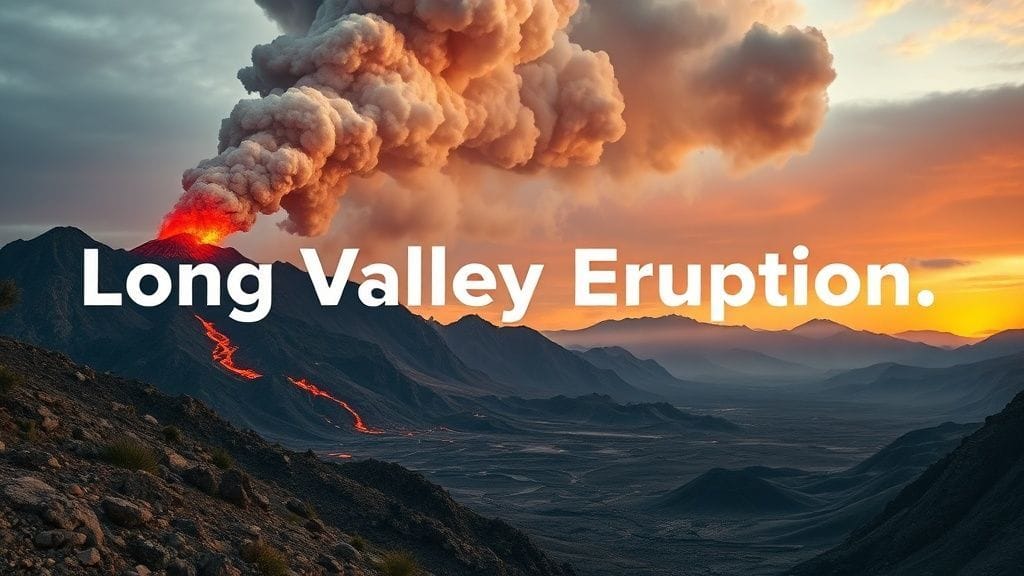
The eruption in the 1350s was not a single instant but a complex sequence. Over days or perhaps weeks, the volcano expelled an estimated 600 cubic kilometers of material—ash plumes that drifted hundreds of kilometers, blanketings of pumice, and pyroclastic flows that scoured the landscape with lethal speed.
Eyewitnesses—if any survived—or later storytellers likely described a sky turned dark as twilight even at midday, the earth trembling violently, and sounds of explosions echoing across the mountains. Trees were incinerated, wildlife scattered or perished, and rivers overwhelmed by sediment and heat.
The eruption transformed the local ecosystem, destroyed food sources, and left a hazardous terrain.
9. Explosions, Ash, and Pyroclastic Flows: Nature’s Wrath in Motion
The eruption’s most destructive force came from pyroclastic flows—fast-moving currents of hot gas and volcanic matter racing down valleys at hundreds of kilometers per hour. These flows obliterated everything in their path, stripping soil from bedrock and carbonizing forests. Ashfall blanketed areas miles away, choking the air and soil alike.
Ash layers discovered in sediment cores provide a tangible record, revealing the extent and volume of the fallout. The eruption rivaled others known from historical records in its intensity, vividly illustrating volcanic power at a time when no human could predict or control it.
10. Immediate Aftermath: Altered Landscapes and Collapsed Ecosystems
In the days and months after the eruption, the landscape was a shattered mosaic of new topography. The caldera’s depression filled partially with ash and debris, rivers were diverted by sediment dams, and vegetation lay smothered beneath thick layers of volcanic fallout.
Terrestrial wildlife populations plunged or moved elsewhere. Stagnant pools and altered drainage affected aquatic life. Recovery would be slow, spanning generations.
Amid this devastation, those human inhabitants faced immense challenges to survival, resource scarcity, and forced displacement—a testament to resilience in the face of nature’s overwhelming force.
11. Human Responses: Survival and Adaptation of the Mono and Inyo Peoples
How did the indigenous peoples respond? While no direct written records exist, anthropological studies and oral histories suggest a narrative of adaptation and spiritual reckoning.
Faced with barren hunting grounds, the Mono and Inyo peoples may have migrated temporarily or altered their subsistence methods. Rituals to appease the spirits and make sense of the cataclysm likely grew in prominence. This eruption was not just a physical disaster but an event with deep cultural resonance, influencing mythologies and community structures for centuries.
Their survival underscored deep knowledge of the land and remarkable human adaptability.
12. Long-Term Geological Consequences: Shaping California’s Topography
The eruption left a permanent imprint on California’s geological landscape. The Long Valley Caldera became an active volcanic hotspot contributing to ongoing geothermal activity, sustaining hot springs and fumaroles visible today.
Over time, the terrain’s reconfiguration affected water courses and soil composition, influencing ecosystems and human settlement patterns. The 1350s event was, in a sense, a geological reset—a transformative moment in the long history of California’s formation.
13. The Climate Effect: Volcanic Winter or Temporary Global Cooling?
Large volcanic eruptions are known to inject aerosols into the stratosphere, reflecting sunlight and triggering temporary climate cooling. Though data is sparse for the 1350s eruption, some scholars suggest the Long Valley event may have contributed to cooler summers or regional climatic anomalies.
Tree ring analyses show signs of environmental stress during this period. Though more research is needed, this eruption fits within a pattern of volcanic events influencing Earth’s climate cycles—reminding us of nature’s interconnectedness.
14. Tracking the Fallout: Ash Layers and Archaeological Records
Geologists examining layers of volcanic ash (tephra) across California and neighboring states have matched signatures to the Long Valley eruption, helping date and map its magnitude. These tephra layers serve as time stamps and markers for understanding human occupation.
Archaeological sites buried beneath ash reveal a snapshot of pre-eruption life, while others hint at disruption—abandoned villages or shifts in material culture. This interplay between geology and archaeology provides a vivid lens on the past.
15. Interpreting the Past: Scientific Discoveries from the Long Valley Eruption
Modern volcanology owes much to studying events like the Long Valley eruption. Detailed geological mapping, radiometric dating, and remote sensing uncover its phases and magnitude.
This eruption ranks among the largest in the last 10,000 years in North America and provides valuable insights into caldera formation processes, magma dynamics, and hazard forecasting. Efforts to model magma chamber behavior have improved eruption prediction methods worldwide.
16. Lessons from the Deep Earth: Understanding Volcanic Hazards Today
The shadow cast by the 1350s eruption extends into contemporary disaster preparedness. Long Valley remains a monitored volcanic region—geologists watch for signs of unrest: seismic tremors, ground deformation, gas emissions.
Understanding past eruptions teaches us caution. Cities and communities now strive to manage risks from potential future activity. It’s a constant reminder that beneath calm landscapes, Earth’s inner fires still pulse.
17. The Long Valley Caldera in Modern Times: A Sleeping Giant?
Today, the Long Valley Caldera appears peaceful, even idyllic—a place for hiking, skiing, and geothermal energy exploration. Yet beneath lies a restless heart.
Scientists classify it as an active volcanic system, with minor eruptions and geothermal activity in recent millennia. Its potential to awaken lingers, underscoring the importance of monitoring and awareness for populations living nearby.
18. Cultural Memory and Mythology: Echoes of the Eruption in Oral Traditions
Though the 1350s eruption predates modern documentation, elements of Native oral traditions may encode memories of this event. Stories of fire from the mountains, skies darkened by ash, and earth shaking suggest collective remembrance.
These narratives are woven deeply into cultural identity—reminders of nature’s power and humanity’s place within it. Recognizing indigenous knowledge alongside scientific discoveries enriches our understanding of history.
19. Comparisons with Other Global Volcanic Events
The Long Valley eruption invites comparison with other major volcanic events such as the 1815 Tambora eruption or the Yellowstone Caldera’s past supereruptions.
While smaller than some supervolcanoes, Long Valley’s eruption was among the largest in recent human history in North America. Its effects were regional but profound, highlighting how volcanic activity shapes environments and civilizations worldwide.
20. Implications for Contemporary Volcanology and Disaster Preparedness
Long Valley’s history informs modern volcano monitoring and hazard management strategies. Its eruption underscores the need for cross-disciplinary research combining geology, archaeology, climatology, and anthropology.
Preparedness plans near volcanic regions increasingly include evacuation routes, public education, and technological advances. The lessons of the 1350s eruption resonate as a call for respect toward nature’s unpredictable power.
21. Conclusion: The Enduring Legacy of the Long Valley Eruption
Seven centuries ago, Long Valley was transformed in moments of terrifying grandeur, reshaping earth and life alike. This eruption is not only a tale of geological might but a chronicle of survival, adaption, and enduring mystery.
It reminds us that the world beneath our feet is alive, and that humanity’s story is inseparable from Earth’s restless nature. As we look to the future, the Long Valley eruption stands as a profound testament to resilience—both natural and human—and the ever-present dialogue between civilization and the fiery heart of the planet.
FAQs About the Long Valley (Mono–Inyo) Eruption
Q1: What caused the Long Valley eruption in the 1350s?
The eruption was caused by the buildup of magma pressure beneath the earth’s crust, leading to a volcanic blowout and collapse of the magma chamber’s roof, forming the caldera.
Q2: How large was the eruption compared to other volcanic events?
The Long Valley eruption expelled approximately 600 cubic kilometers of volcanic material, making it one of the largest eruptions in North American history, though smaller than some supervolcanic eruptions like Yellowstone.
Q3: How did the eruption affect indigenous peoples of the area?
The Mono and Inyo peoples experienced disruption of their environment, forced migration, and cultural impacts. Archaeological and oral histories suggest adaptation and survival through deep local knowledge.
Q4: Did the eruption influence climate patterns?
There is evidence of possible regional cooling effects and environmental stress following the eruption, in line with how large volcanic events can affect climate temporarily.
Q5: Is the Long Valley Caldera still active today?
Yes, it remains an active volcanic system with ongoing geothermal activity and is closely monitored by scientists for signs of unrest.
Q6: How has the eruption influenced scientific understanding?
It has provided key insights into caldera formation, volcanic dynamics, and hazard prediction, shaping modern volcanology practices.
Q7: What physical evidence remains of the 1350s eruption?
The caldera itself, ash layers across the region, altered ecosystems, and archaeological records serve as physical reminders of the eruption.
Q8: How does knowledge of this eruption help in disaster preparedness?
By studying past volcanic activity, scientists and planners can develop monitoring systems, risk assessments, and community preparedness plans to mitigate future eruptions’ impacts.

