Table of Contents
- The Fiery Awakening: Lopevi’s Sudden Awakening, 2007
- Vanuatu: A Land of Fire and Ocean
- The Sleeping Giant: Lopevi Volcano Before 2007
- Early Signs and Local Wisdom
- The Geological Setting: Why Lopevi?
- The Initial Tremors: March 2007
- Eruption Unleashed: April’s Fiery Spectacle
- Ash Clouds and Lava Flows: Nature’s Wrath in Detail
- Human Response: Evacuations and Emergency Measures
- Stories from the Frontline: Eyewitness Accounts
- Impact on Local Communities and Ecosystems
- Vanuatu’s Government and International Aid
- Media Coverage and Global Attention
- Scientific Study: Lessons from Lopevi’s Fury
- Cultural Echoes: Myths, Oral Traditions and Natural Disasters
- Environmental Consequences: Short and Long Term
- Rebuilding Lives: The Path to Recovery
- Volcano Monitoring and Preparedness Post-2007
- Comparative Look: Lopevi and Other Vanuatu Volcanoes
- Reflections on Volcanic Resilience and Human Spirit
- The Legacy of the 2007 Eruption in Vanuatu
- Volcano Tourism and Education After Lopevi
- Conclusion
- FAQs
- External Resources
- Internal Link
In the early months of 2007, a distant rumble echoed across the turquoise waters of the South Pacific. On the small but fiery island of Lopevi, something extraordinary was about to break loose. A shroud of gray ash began to billow skyward, blotting out the sun and stirring ancient fears. This was no ordinary volcanic event; it was the awakening of one of Vanuatu’s most powerful volcanoes after decades of silence. The Lopevi eruption would shape not only the island’s landscape but the lives of those who lived in its shadow, testing human endurance and resilience against the primal forces of the earth.
1. The Fiery Awakening: Lopevi’s Sudden Awakening, 2007
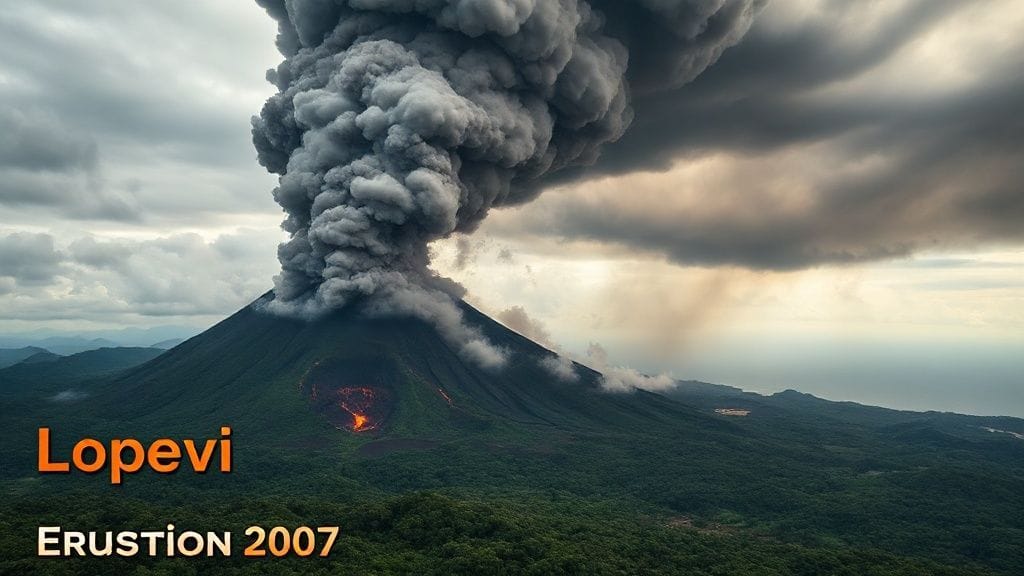
The morning sky above Lopevi island darkened under a thick plume of ash and smoke that stretched miles into the air. The eruption, sudden yet sustained, transformed the island’s silhouette from a dormant volcanic cone into a roaring cauldron of molten rock and choking ash. For the nearby islanders of Epi and other surrounding communities, the event was both terrifying and awe-inspiring. It is in moments like these that nature reminds humanity of its indomitable force—and how precariously balanced life often is.
2. Vanuatu: A Land of Fire and Ocean
Vanuatu, an archipelago of 83 islands situated in the South Pacific, is a land paradoxically shaped by water and fire. This island nation owes its existence to the restless movements of tectonic plates, where the Pacific Plate dives beneath the Indo-Australian Plate. The result is a string of active volcanoes that have sculpted the dramatic landscapes, rich soils, and vibrant cultures of the islands. Life here is intimately connected to volcanic activity; while it nourishes the land, it also holds the potential for devastation.
3. The Sleeping Giant: Lopevi Volcano Before 2007
Lopevi, a volcanic island rising sharply from the ocean, had remained relatively quiet for decades. Its last known eruption before 2007 dated back to the early 20th century, with intermittent but minor tremors thereafter. Locals referred to it as a sleeping giant—one whose slumber was deep but not eternal. Scientists kept a watchful eye, noting the potential for future eruptions given its geological history. Yet, the precise timing of an awakening was always uncertain.
4. Early Signs and Local Wisdom
Months before the dramatic eruption, subtle signs hinted at changes beneath Lopevi. Minor earthquakes and tremors disturbed peaceful nights, while local vegetation appeared stress-stricken. The island’s indigenous communities, steeped in oral traditions, interpreted these phenomena with a blend of scientific observation and spiritual understanding. Elders shared tales of the volcano’s past “anger,” urging caution and respect for the mountain’s moods.
5. The Geological Setting: Why Lopevi?
Understanding Lopevi’s eruption requires a look beneath the earth’s crust, into the fiery mantle where magma brews. Lopevi sits on a complex volcanic arc formed by the subduction of one tectonic plate beneath another. This geological arrangement creates pockets of molten rock that build pressure over years. When that pressure exceeds containment, the volcano explodes, releasing ash, gases, and lava. This process was the invisible force behind Lopevi’s 2007 awakening.
6. The Initial Tremors: March 2007
The rumblings began subtly in early March 2007. Seismographs stationed on nearby islands detected unusual activity, registering deeper-than-normal earthquakes. These initial tremors were accompanied by increased gas emissions, a classic prelude to an eruption. At this stage, evacuation plans were discussed, but the full magnitude of the forthcoming event was underestimated.
7. Eruption Unleashed: April’s Fiery Spectacle
April 2007 marked the explosive crescendo. The volcano erupted violently, sending plumes of ash soaring up to several kilometers into the atmosphere. Lava fountains shot from the summit crater, accompanied by thunderous explosions. This sudden outburst transformed the island's daytime environment into a dim-lit wasteland under an ash veil. By mid-April, the eruption had reached peak intensity, forcing immediate evacuations.
8. Ash Clouds and Lava Flows: Nature’s Wrath in Detail
Ash fallout blanketed the island and nearby settlements, contaminating water sources and destroying crops—a grim reminder of the eruption’s sheer force. Lava flows advanced slowly down the slopes, incinerating vegetation and reshaping the topography. The toxic gases released—sulfur dioxide, carbon dioxide—posed additional threats, complicating rescue operations and monitoring.
9. Human Response: Evacuations and Emergency Measures
The people of Vanuatu reacted with urgency and determination. Authorities coordinated evacuation of Lopevi’s sparse population as well as residents on neighboring islands at risk from ash and lava flows. Emergency shelters were set up, and medical teams prepared for needs arising from respiratory illnesses caused by ash inhalation. The eruption exposed vulnerabilities but also revealed a community’s resilience in crisis.
10. Stories from the Frontline: Eyewitness Accounts
Isaac Tavo, a fisherman from nearby Epi Island, recalled the eerie silence followed by the earth’s sudden roar: “The sky turned black, and the ground shook like a giant’s footsteps.” Others spoke of nights filled with glowing red skies, a surreal spectacle shadowed by fear. These personal stories breathe life into scientific facts, reminding us that human experience is at the heart of every natural disaster.
11. Impact on Local Communities and Ecosystems
Beyond the immediate danger, the eruption brought lasting changes. Agricultural lands covered by ash lost their fertility temporarily; freshwater springs were polluted; and the delicate ecosystems of the island suffered from habitat destruction. Fishing, a mainstay of local livelihoods, was disrupted by water quality deterioration. The social and psychological toll was immense as families grappled with displacement and uncertainty.
12. Vanuatu’s Government and International Aid
The government of Vanuatu acted swiftly, declaring a state of emergency. International aid followed from regional partners including Australia, New Zealand, and humanitarian organizations. Aid focused on food, healthcare, and rebuilding infrastructure. This collaborative response underscored the importance of global solidarity in managing natural disasters in vulnerable island states.
13. Media Coverage and Global Attention
Lopevi’s eruption, though remote, captured global media attention. News outlets highlighted the dramatic visuals of ash plumes and lava flows, while experts discussed the implications of volcanic activity in the Pacific “Ring of Fire.” This attention helped raise awareness of Vanuatu’s geological risks and the need for disaster preparedness in small island nations.
14. Scientific Study: Lessons from Lopevi’s Fury
Post-eruption, volcanologists flocked to Lopevi to collect data—examining lava composition, gas emissions, and ash layers. These studies contributed valuable knowledge to volcanic science, improving eruption prediction models and risk assessments. The eruption became a living laboratory demonstrating the complex interplay between tectonics, magma dynamics, and human impact.
15. Cultural Echoes: Myths, Oral Traditions and Natural Disasters
Volcanoes like Lopevi occupy a special place in Melanesian cosmology. Local myths often describe volcanoes as living beings or spirits expressing anger. The 2007 eruption reinforced traditional beliefs while also intersecting with modern scientific understanding. In this blending of worldview, volcanic activity is both natural hazard and profound cultural symbol.
16. Environmental Consequences: Short and Long Term
In the immediate aftermath, Lopevi’s eruption caused severe environmental disruption—ash devastated vegetation, and lava flows altered drainage patterns. However, volcanic soil, rich in minerals, promised future agricultural renewal over decades. Ecologists studied the resiliency of native species and the slow return of biodiversity, highlighting nature’s remarkable capacity for regeneration.
17. Rebuilding Lives: The Path to Recovery
For displaced families, rebuilding was not just physical but deeply emotional. Communities faced the challenge of restoring homes, replanting crops, and adapting to changed landscapes. Government and NGOs implemented programs to provide seeds, tools, and education on disaster resilience. The recovery journey embodied human hope amid the scars of nature’s fury.
18. Volcano Monitoring and Preparedness Post-2007
The eruption spurred advances in volcanic monitoring within Vanuatu. Seismic stations were increased, and early warning systems established to better protect vulnerable populations. Education campaigns raised awareness about volcanic hazards. These measures aimed to transform past tragedy into future preparedness—a vital step in island nations whose existence depends on coexistence with fire.
19. Comparative Look: Lopevi and Other Vanuatu Volcanoes
Lopevi’s 2007 eruption is part of a broader tapestry of volcanic activity in Vanuatu, including eruptions from Yasur, Ambrym, and Mount Garet. Comparing these events reveals the diversity in eruption styles—from persistent lava lakes to explosive ash clouds—and the varying impacts on local populations. Together, they form a narrative of geological volatility and human adaptability.
20. Reflections on Volcanic Resilience and Human Spirit
The Lopevi eruption underscored a timeless dialogue between earth’s elemental forces and human communities. Facing upheaval, people responded with courage, knowledge, and solidarity. This resilience is a testament to humanity’s ability to endure, adapt, and even thrive amid nature’s grand and sometimes terrifying performance.
21. The Legacy of the 2007 Eruption in Vanuatu
Years later, the Lopevi eruption remains etched in collective memory—a cautionary tale and a chapter of survival. It has influenced Vanuatu’s disaster policies and enriched scientific understanding. For locals, it is a moment of reckoning with nature’s power, shaping identity and cultural narratives that continue to evolve.
22. Volcano Tourism and Education After Lopevi
Interestingly, Lopevi—and Vanuatu’s volcanoes in general—have drawn the attention of adventurous tourists and researchers alike. Volcano trekking and educational tours offer glimpses into a volatile world shaped by fire and water. This emerging sector balances economic opportunity with careful respect for safety and environmental conservation.
Conclusion
The 2007 eruption of Lopevi was more than a geological event; it was a profound encounter between human life and the earth’s restless dynamism. As ash clouded skies and lava reshaped the land, the people of Vanuatu faced uncertainty with courage born from tradition, knowledge, and community. This fiery episode reminds us that beneath the surface, both the earth and humanity carry their own unpredictable energies—sometimes destructive, yet always deeply entwined. From volcanic ashes grow resilience, adaptation, and stories that inspire generations to come.
FAQs
Q1: What caused the 2007 eruption of Lopevi volcano?
A1: The eruption was caused by tectonic activity related to the subduction of the Pacific Plate beneath the Indo-Australian Plate, which increased magma pressure beneath Lopevi leading to its explosive release.
Q2: How did local communities respond to the eruption?
A2: Communities promptly evacuated, relying on government coordination and applying traditional knowledge to navigate the crisis while enduring hardship and disruption.
Q3: What were the environmental impacts of the eruption?
A3: The eruption devastated vegetation, contaminated water sources, disrupted ecosystems, and altered the island’s terrain with lava flows and ash deposits.
Q4: How did the eruption affect Vanuatu’s disaster preparedness?
A4: It led to enhanced volcanic monitoring, early warning systems, and public education campaigns to improve resilience and readiness for future events.
Q5: Did the eruption cause any fatalities?
A5: Thanks to timely evacuations and emergency responses, there were no recorded fatalities directly linked to the 2007 Lopevi eruption.
Q6: How has the eruption influenced Vanuatu’s cultural narratives?
A6: It reinforced traditional volcanic myths and stories, blending indigenous spirituality with modern scientific interpretations of natural disasters.
Q7: What role did international aid play following the eruption?
A7: International aid provided vital support in food, medical care, and rebuilding efforts, underscoring global solidarity in disaster management.
Q8: Is Lopevi still considered an active threat?
A8: Yes, Lopevi remains an active volcano monitored closely by scientists due to its history and geological setting encouraging future activity.

