Table of Contents
- The Breath of a Legend: The Final Days of Lord Byron
- A Greek Odyssey: Byron’s Deepening Commitment to the Cause
- Messolonghi: The Last Sanctuary
- The Siege of Messolonghi: A City Under Siege and a Poet’s Refuge
- April 1824: The Silent March Toward Death
- A Nation in Mourning: Greece Reacts to Byron’s Passing
- Europe’s Intellectual Circles: Grief and Political Shockwaves
- Byron’s Legacy: The Romantic Hero Immortalized
- The Philhellenic Movement: From Passion to Politics
- Byron and the Spirit of Greek Independence
- Medical Misunderstandings: What Killed Lord Byron?
- A Poetic Martyr: Myth and Reality Collide
- The Impact on the Greek War of Independence
- Byron’s Famously Restless Spirit: Personal Struggles Towards the End
- Remembering Byron in Modern Greece
- A Death That Echoes in History and Literature
- The Roumelioti Tradition and Byron’s Place in Local Lore
- From Romanticism to Revolution: Byron’s Enduring Symbol
- Commemorations and Memorials: Pilgrimage to Messolonghi
- Conclusion: The Immortal Flame of Byron’s Final Sacrifice
- FAQs
- External Resource
- Internal Link
The Breath of a Legend: The Final Days of Lord Byron
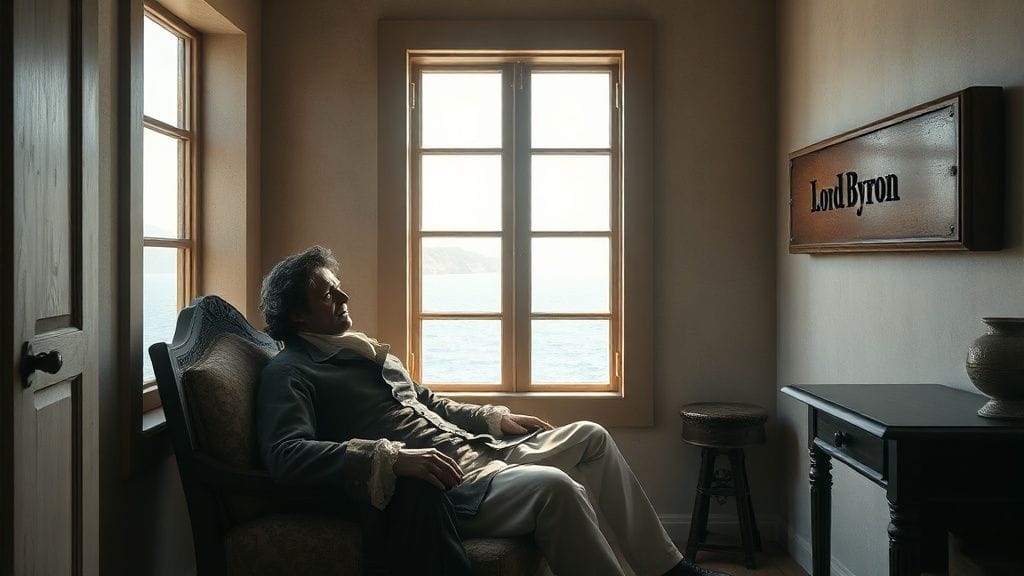
The air hung heavy over Messolonghi in early April 1824, a stillness pregnant with fate. A single man lay gravely ill in a small, dimly lit chamber, far from the grandeur of London’s drawing rooms where he once charmed courts and scandalized societies. The damp Greek dawn filtered through the modest window, casting long shadows on the gaunt face of George Gordon Byron, the 6th Baron Byron—Lord Byron—the poet whose restless spirit had joined the fight for Greek freedom.
His breaths grew shallow, each more fragile than the last, as a war-torn city murmured its prayers beside him. Those final days were a crucible where myth met mortal flesh, the shimmering flames of romantic heroism mingling with the raw pain of human vulnerability. Byron’s death on April 19, 1824, was more than the loss of a literary titan; it was the extinguishing of a beacon for liberty, a symbol for a fledgling nation struggling to break free from the Ottoman yoke.
But what led the infamous British aristocrat, enfant terrible of the Regency era, to this dusty corner of the world, far from fame and fortune? How did the flamboyant poet, who had scandalized London with poetry and persona, become entwined in the blood and fire of the Greek War of Independence? And what were the echoes of his demise—not only for Greece but for Europe, and the very idea of revolutionary sacrifice?
Let us take a journey back into this extraordinary chapter of history, where art and politics collided in the passionate quest for freedom, culminating in the tragic yet triumphant final act in Messolonghi.
A Greek Odyssey: Byron’s Deepening Commitment to the Cause
Byron’s journey to Greece was not a whim of an indulgent aristocrat entertained by the notion of exotic adventure. It was the culmination of a profound personal and ideological transformation. Born into privilege but marred by scandal and exile, Byron found in the Greek struggle a cause that spoke deeply to his restless soul: freedom from oppression, a theater for heroism, and an opportunity to rewrite his own destiny.
The early 19th century was a time when the ancient ideals of classical Greece inspired many intellectuals in Europe, fueling the Romantic movement's passion for freedom and the sublime. Byron, ever the ardent Romantic, first encountered the plight of the Greeks during his travels and correspondence with philhellenic circles. His poetry, filled with vivid imagery of heroic sacrifice—“The Isles of Greece” being a notable chant—foreshadowed his eventual role beyond the page.
When the Greek War of Independence erupted in 1821 against the Ottoman Empire, Byron’s philhellenism moved from verse to action. By 1823, he had sailed to Greece, not merely as a spectator but as an active participant. His imposing presence, coupled with substantial personal funding, offered more than just morale; it was a clarion call to other Europeans to recognize and support the Greek cause.
Yet Byron’s allegiances were complex. He was not simply a foreign volunteer; he inserted himself into the intricate web of Greek politics and factionalism, a heavy burden for an outsider. His motives blended self-exile, political idealism, and personal redemption—a crucible that shaped the final phase of his life.
Messolonghi: The Last Sanctuary
Messolonghi, a town situated on the northwest coast of the Peloponnese, had become a bastion of resistance against Ottoman sieges. For Byron, it was both a military outpost and a refuge where he could lend his influence. The city’s narrow streets and the marshy lagoons around it held a strategic significance for the Greek revolutionaries trying to maintain their foothold.
In late 1823, Byron arrived in Messolonghi, bringing with him renewed hope. His presence galvanized Greek fighters and worried Ottoman commanders alike. But the romantic glow of his arrival soon dimmed against the harsh realities of war: logistical nightmares, disease, waning supplies, and political rivalries.
Byron was not content merely to be a figurehead. Despite suffering from health issues himself, he immersed in military planning and governance, navigating the fractious politics that often threatened to sabotage the Greek struggle from within. His efforts at Messolonghi represented a final, desperate push toward victory—one that fate would cruelly interrupt.
The Siege of Messolonghi: A City Under Siege and a Poet’s Refuge
Throughout 1824, the siege of Messolonghi intensified. Ottoman and Egyptian forces, under the command of Reşid Mehmed Pasha and Ibrahim Pasha of Egypt, pressed the city’s faltering defenders. The damp, unsanitary conditions and constant bombardment created a cauldron of suffering.
Byron’s health deteriorated under these brutal circumstances. Far from the comforts of his English estates, he battled fever, possibly malaria or sepsis, exacerbated by the hardships of the siege. His own letters from this period reveal a man torn between hope and despair, acutely aware of his vulnerability yet determined to remain by the side of those he had adopted as kin.
Messolonghi was more than a backdrop; it was a character itself, embodying the resilience and tragedy of the Greek revolution. The city’s walls, battered but unyielding, mirrored Byron’s stubborn refusal to relinquish his role despite mounting illness.
April 1824: The Silent March Toward Death
April arrived with a grim finality. What began as a slight fever spiraled into debilitating illness. Accounts vary, but common threads suggest Byron succumbed to a combination of illness and medical mistakes—possibly bloodletting and treatment harsh by today’s standards.
The poet faced his final hours surrounded by Greek comrades and physicians who struggled to ease his agony. His last words, though fragmented, hinted at a profound awareness of sacrifice: “Now I can die happy,” one witness remembered him saying, as if his life’s work narrowed into the certainty that his commitment had not been in vain.
On the 19th of April, 1824, Byron breathed his last. The city that he had chosen to be his final home responded with a mixture of profound sorrow and solemn reverence.
A Nation in Mourning: Greece Reacts to Byron’s Passing
The news of Byron’s death spread quickly throughout Greece, casting a somber pall over the revolution. For the Greeks, Byron was more than a foreign mercenary; he was a symbol of international solidarity. His death galvanized morale and recruiting efforts, etching him indelibly in the Greek collective memory.
Stories of his generosity and kindness—his funding of troops, his efforts to improve sanitation and supply chains—became legendary. Local peasants and fighters celebrated him as a modern-day Achilles, a tragic hero who bridged the gap between Greek history and European romantic ideals.
This mourning rippled beyond Messolonghi, with memorials and eulogies emerging throughout liberated territories, reinforcing the spirit of resistance.
Europe’s Intellectual Circles: Grief and Political Shockwaves
Across the continent, Byron’s death struck a different chord. His role as a poet and revolutionary made him a lightning rod of public attention. Newspapers, salons, and literary circles debated the implications of his passing. Was it the tragic end of Romanticism’s greatest icon? Or a cautionary tale about the perils of political engagement?
French, British, and German intellectuals mourned his demise, amplifying his myth. Percy Bysshe Shelley, his close friend and fellow poet, immortalized Byron’s ideals in elegies and letters. European philhellenic societies used his death as both a rallying cry and a diplomatic lever, seeking increased support for the Greek cause.
Yet Byron’s death also unsettled the status quo. Governments wary of revolutionary contagion saw his participation as a dangerous precedent, and his death underscored the volatility of transnational revolutionary commitments.
Byron’s Legacy: The Romantic Hero Immortalized
Byron's death became the crucible in which legend was forged. His image—dark, brooding, defiant—entered folklore and literature as the quintessential Romantic hero: cursed, flawed, yet noble. This legacy persisted through countless biographies, plays, and poems.
His funeral in England was subdued, reflecting complicated family relations, but public fascination only grew. Messolonghi became a Mecca for later philhellenes, a tangible symbol of sacrifice dedicated to liberty and art intertwined.
The Philhellenic Movement: From Passion to Politics
Byron’s involvement helped catalyze the wider philhellenic movement—a tide of European supporters drawn to the Greek struggle. Volunteers, funds, and political pressure began flowing, inspired by Byron’s example.
This outpouring was not solely sentimental. It laid the groundwork for formal diplomatic interventions culminating years later in decisive battles such as Navarino. Byron’s death imparted urgency to philhellenism, connecting Romantic ideals with realpolitik.
Byron and the Spirit of Greek Independence
Byron’s death solidified the fusion of literature and nationhood. Greek independence was not merely a military campaign but an ideological cause shimmering with symbolism. Byron embodied this idea—not just an outsider helping strangers, but a believer in democracy, liberty, and brotherhood.
His poetry, now tinged with martyrdom, became part of school curricula in Greece; his name inscribed alongside Greek heroes. Such veneration sustained the revolutionary spirit long after his physical voice had silenced.
Medical Misunderstandings: What Killed Lord Byron?
For centuries, scholars and historians have debated Byron’s cause of death. Initially thought to be malaria aggravated by medical treatment, later theories suggest septicemia or pneumonia, possibly worsened by the primitive healthcare conditions during the siege.
Reports reveal that repeated bloodletting and purging, common treatments then, may have hastened his demise. This medical misfortune underscores the tragic dimension of his death—not just the battlefield sacrifices but the vulnerabilities of 19th-century medicine.
A Poetic Martyr: Myth and Reality Collide
The image of Byron as a poetic martyr was swiftly constructed, yet it blurred the line between fact and fiction. His flaws—impulsiveness, complex relationships, physical ailments—became subsumed under a narrative of heroic sacrifice.
Nations need heroes, and Byron’s death at a foreign cause elevated him beyond mere mortal failings into the realm of myth. This duality—human and legend—continues to fuel fascination and debate.
The Impact on the Greek War of Independence
Though Byron’s demise deprived the Greek fighters of a charismatic leader and critical funds, it paradoxically strengthened international resolve. Philhellenes across Europe rallied harder, and fundraising increased.
Politically, his death exposed the fragile alliances and desperate conditions of the revolution. Militarily, Greece endured further hardships but was increasingly recognized as a legitimate cause deserving foreign support.
Byron’s Famously Restless Spirit: Personal Struggles Towards the End
Byron’s life was marked by internal turmoil: ill health, financial debts, and emotional complexity, including his fraught relationship with his wife and close friends. His departure from England was both an escape and a search for meaning.
In Greece, despite physical decline, Byron’s restless spirit found purpose. His final letters convey a profound mix of melancholy and hope—a man confronting mortality with the fierce urgency of someone who believed deeply in the cause he adopted.
Remembering Byron in Modern Greece
Centuries later, Byron remains a potent symbol in Greece. Statues in Athens and Messolonghi commemorate him, and annual memorial services recall his sacrifice. Schools and streets bear his name, while his poetry is taught as part of the cultural canon.
Messolonghi itself capitalizes on its historical role, attracting tourists and scholars alike who seek to understand this unique intersection of literature and revolution.
A Death That Echoes in History and Literature
Byron’s death is quoted in biographies, novels, and scholarly works—an event where history and literature bleed into one another. It embodies the Romantic ideal of the artist-warrior whose life is a spectacle of rebellion and tragedy.
This final chapter of Byron’s life intensified the Romantic movement’s fascination with death and martyrdom, influencing generations of writers and thinkers.
The Roumelioti Tradition and Byron’s Place in Local Lore
Locally, Byzantine and folk traditions framed Byron’s participation as both miraculous and fateful. Greek oral histories speak of his kindness, his struggles, and his ghostly presence reminding the town of its sacrifices and hopes.
This blending of history and local myth preserves a unique cultural memory distinct from academic history but equally powerful.
From Romanticism to Revolution: Byron’s Enduring Symbol
Byron embodies the entanglement of Romanticism’s ideals with the messy realities of revolution. His life and death illuminate the complexities of foreign intervention driven by passion, conviction, and personal ambition.
His story continues to resonate with movements for freedom worldwide, reminding us of the costs and paradoxes of revolutionary engagement.
Commemorations and Memorials: Pilgrimage to Messolonghi
Every year, pilgrims—historians, poets, idealists—visit Messolonghi to pay homage. The town’s Byron Museum displays relics and manuscripts, offering a tangible connection to this epoch.
Monuments stand not only as historical markers but as testaments to the enduring power of sacrifice in the human quest for liberty.
Conclusion
Lord Byron’s death in Messolonghi is more than a historical footnote; it is a multifaceted narrative blending poetry, politics, and personal tragedy. His final days in that besieged Greek town were a poignant climax to a life defined by restless ambition, idealism, and a hunger for freedom.
Byron’s passing lit a flame that illuminated the Greek War of Independence and inspired generations worldwide. It reminds us that history is not only shaped by armies and states but by passion, sacrifice, and the fragile human spirit—a spirit that, though mortal, is immortalized through its pursuit of liberty.
His story teaches us about the power and peril of idealism, the intertwining of art and action, and the unforgettable legacy one life can imprint upon the soul of a nation and the conscience of the world.
FAQs
Q1: Why did Lord Byron decide to join the Greek War of Independence?
A1: Byron was inspired by the ideals of freedom and democracy, deeply influenced by Romanticism and philhellenism. His personal exile and search for purpose converged with a desire to aid the Greeks in their struggle against Ottoman rule.
Q2: What was Lord Byron's role in the Greek Revolution?
A2: Byron was more than a symbolic figure; he funded troops, organized military efforts, and engaged in political negotiations, aiming to strengthen the revolutionaries’ position, especially in the Messolonghi region.
Q3: How did Byron die during the siege of Messolonghi?
A3: Byron died likely from illness—most probably malaria or septicemia—aggravated by the poor conditions of siege warfare and medical treatments of the era such as bloodletting.
Q4: How did Byron’s death impact the Greek War of Independence?
A4: Though a loss on the battlefield, Byron’s death became a rallying symbol that invigorated philhellenic support across Europe, increasing funding and volunteerism for the Greek cause.
Q5: How is Lord Byron remembered in Greece today?
A5: Byron is honored as a national hero. His contributions are commemorated through monuments, museums, annual memorials, and the inclusion of his legacy in cultural education.
Q6: What influence did Byron’s death have on European intellectual thought?
A6: Byron’s demise deepened the Romantic ideal of the tragic hero and catalyzed debates on revolutionary activism, inspiring writers and thinkers and fueling philhellenic movements in Europe.
Q7: Was Byron’s medical treatment at Messolonghi effective?
A7: By modern standards, no. The treatments—especially bloodletting—likely weakened him further, reflecting the limitations of contemporary medical knowledge.
Q8: Did Byron’s personal life affect his decision to go to Greece?
A8: Personal scandals, debts, and exile contributed to Byron’s complex motivations. Greece represented a fresh start, a stage for redemption, and a cause worthy of his talents and passion.

