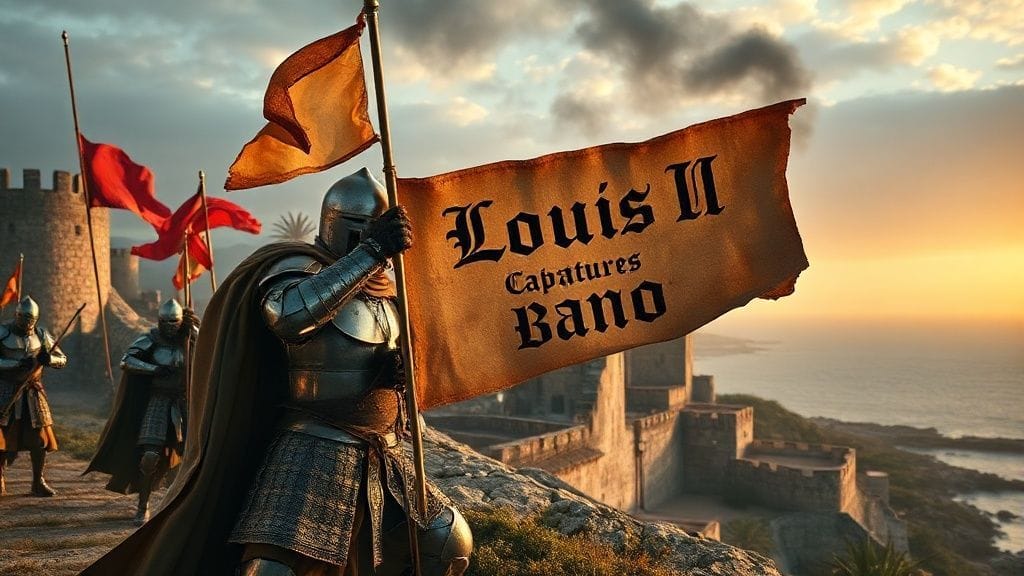
Table of Contents
- A City Divided: Bari on the Eve of 871
- The Mediterranean Crucible: Apulia’s Strategic Importance
- The Rise of Louis II: Emperor of the Franks and a New Hope
- The Emirate of Bari: A Muslim Foothold in Christian Italy
- Political and Religious Stakes: The Clash of Civilizations
- The Siege Begins: Preparations and Early Maneuvers
- The Narrow Siege: Strategies, Tensions, and the Harsh Winter
- The People Inside Bari: Fear, Hope, and Daily Life Under Siege
- Clash of Titans: The Military Campaign Unfolds
- The Role of the Papacy: Spiritual and Political Support
- Louis II’s Allies and Enemies: Lombards, Byzantines, and Saracens
- Breaking the Walls: The Final Assault and Bari’s Fall
- Aftermath of the Capture: Triumph and Tragedy
- The Reimposition of Christian Rule: Policies and Punishments
- Bari’s New Role in Apulia and the Holy Roman Empire
- The Emir’s Legacy: From Stronghold to Symbol
- The Wider Impact on Mediterranean Geopolitics
- Chronicles and Eyewitnesses: How History Remembered the Siege
- Louis II’s Reputation and his Place in Medieval History
- Bari’s Transformation After 871: Cultural and Religious Shifts
- Lessons from the Siege: Religious Conflict and Coexistence
- Long-Term Consequences: Apulia in the Centuries to Come
- The Siege of Bari in Modern Memory and Historical Imagination
- Conclusion
- FAQs
- External Resource
- Internal Link
A City Divided: Bari on the Eve of 871
The damp sea air clung heavily to the walls of Bari, while the sun dipped low over the Adriatic, casting long shadows over the aged battlements of the city. Hassan ibn al-Qasim, the emir, paced anxiously within the encircling fortress, his silhouette outlined against the flickering torchlight. For nearly two decades, Bari had sat like a jewel of Muslim power on the Christian-forged soil of Apulia, a constant thorn in the side of the Byzantine Empire and the Frankish realm alike. But in the winter of 870, as a biting chill swept through the streets and the markets gradually hushed, an ominous presence gathered on the horizon: the forces of Louis II, Emperor of the Franks, were closing in to reclaim this borderland stronghold.
This event, seemingly a mere siege on a Mediterranean port city, belied its epic stakes—a collision of religions, empires, and cultures that played out on the weathered stones of Bari’s walls. The capture of Bari in February 871 was more than a military victory; it was a turning point that echoed across the Christian-Muslim frontiers, reverberating through the corridors of Jerusalem, Rome, and Constantinople. As the final stones of defense fell, the fate of Apulia—and much of southern Italy—would be irrevocably changed. But this story was not merely about armies and rulers. It was about the people trapped within the walls: the fears of families, the prayers of monks, and the brutal calculations of survival under siege.
The Mediterranean Crucible: Apulia’s Strategic Importance
Apulia, the "heel" of the Italian boot, occupies a unique position in the complex tapestry of early medieval geopolitics. Sitting at the crossroads between East and West, its coastline along the Adriatic Sea served as a gateway between the Byzantine Empire's remaining territories and the expanding realms of the Franks. By the mid-9th century, the emirate of Bari was not just a remote outpost; it was an essential node in the Saracen networks dominating Mediterranean trade and naval power.
The city’s harbor was a crucial launching point for raids and commerce alike, linking North Africa, Sicily, and mainland Italy. This strategic importance made Bari a coveted prize for Christian rulers seeking to safeguard their domains and project influence towards the chaotic waters of the Mediterranean. But its capture required more than militaristic might; it demanded navigating a labyrinth of alliances, betrayals, and deep religious enmity.
The Rise of Louis II: Emperor of the Franks and a New Hope
Louis II, crowned Emperor in 855, found himself heir to a fragmented legacy. The Carolingian Empire, once united under Charlemagne, had splintered under the pressure of internal divisions and external threats. Louis’s reign was marked by his determination to restore imperial authority, especially in Italy, where a patchwork of Lombard duchies, Byzantine enclaves, and Muslim strongholds vied for dominance.
Known for his piety as much as for his martial zeal, Louis viewed the Saracen presence in Apulia not only as a political threat but as a profound spiritual challenge. His campaigns in southern Italy combined crusading fervor with calculations of power—a rare combination in a time when political legitimacy and religious conformity were inextricably linked. The siege of Bari, therefore, became a symbol of his broader ambition: to reclaim Christian lands and reinforce the empire’s hold in the peninsula.
The Emirate of Bari: A Muslim Foothold in Christian Italy
The emirate of Bari was established in 847 by Muslim forces, primarily of North African origin but also including adventurers from al-Andalus. It was a daring conquest, seizing a key city from Byzantine control and turning it into a thriving, autonomous entity. Far from being a mere pirate base, Bari developed into a cosmopolitan center where Arabic, Latin, and Greek cultures mingled under the shadow of mosque minarets alongside Christian churches.
Emirate rulers like Kalfun and then Hassan managed to maintain their grip through a mix of diplomacy, trade, and military strength, positioning Bari as a buffer and bridge between Islamic North Africa and Christian Italy. However, this position also made the city a target for both Byzantine reconquest efforts and Frankish ambitions. The emirate’s survival depended on shrewd leadership and the ability to withstand prolonged sieges and naval blockades.
Political and Religious Stakes: The Clash of Civilizations
The capture of Bari cannot be understood without appreciating the profound ideological and religious stakes that framed it. The Mediterranean of the 9th century was a fraught mosaic of competing powers, where faith-based identity and political allegiance were often inseparable. The emirate’s presence in Apulia posed a direct challenge to Christendom’s territorial integrity and religious hegemony.
In Christian eyes, Bari was a “city of the infidel,” a locus of Muslim power that threatened the sanctity and security of the Christian world. For Muslims, Bari represented a strategic outpost to expand influence, challenge Byzantine control, and gain wealth through commerce and warfare. Thus, the siege was not just a battle of armies; it was a spiritual contest, an attempt to define the boundaries of faith and power itself.
The Siege Begins: Preparations and Early Maneuvers
Louis II assembled his forces with careful deliberation. Drawing knights and infantry from his Frankish heartlands, allied Lombard troops, and contingents of local militia, the army marched southward in late 870. The logistical challenge was daunting: maintaining a siege on a fortified coastal city required steady supplies, naval support, and command discipline.
The siege lines encircled Bari by the end of 870, while naval units sought to cut off maritime supply routes. Inside the city, defenders fortified walls, stockpiled provisions, and prepared for a fight not just for survival but for the very soul of the city. Skirmishes erupted as scouts and raiders tested the opposing forces, probing for weaknesses amid the foggy winter months.
The Narrow Siege: Strategies, Tensions, and the Harsh Winter
Winter brought with it biting cold, compounding the hardships on both sides. Disease and hunger gnawed at besiegers and besieged alike as soldiers shivered in damp encampments and civilians huddled behind thick walls. Louis II’s commanders faced frustrations as initial attempts to breach the walls proved futile.
Yet, through patience and relentless pressure, the Frankish forces tightened their grip. They constructed siege engines, launched probing attacks, and attempted to undermine sections of the defenses. The emirate’s defenders, meanwhile, sallied out in desperate sorties, both to disrupt the attackers and seize scant supplies from surrounding countryside.
The People Inside Bari: Fear, Hope, and Daily Life Under Siege
The siege was not fought only by soldiers; the citizens of Bari endured unimaginable privations. Chroniclers recount the terror of night raids, the struggle to find water, and the agonizing wait for relief that never came. Families sheltered in cellars, sharing bread that grew thin as days stretched on.
Yet, amidst the despair, stories of resilience emerged: communities banded together to care for the wounded, priests ministered to the souls of the dying, and even children learned to recognize the call of the enemy’s trumpet. The siege transformed the city into a crucible of human endurance and fear.
Clash of Titans: The Military Campaign Unfolds
The climax of the siege arrived in early 871. Louis II, sensing exhaustion among the defenders, ordered a coordinated assault on multiple fronts. Battering rams smashed against gates, archers rained volleys from the ramparts, and infantry surged through breaches amid cries and bloodshed.
Hassan ibn al-Qasim, the emir, marshaled his last reserves in a desperate defense that would become legendary. Yet amidst the chaos, the walls finally gave way. On a bitter February day, Frankish banners were unfurled atop the newly captured towers. The emirate of Bari was no more.
The Role of the Papacy: Spiritual and Political Support
Pope Adrian II, a staunch ally of Louis II, provided crucial ideological backing for the campaign. The papacy framed the siege as a righteous war against infidels, rallying support throughout Christendom. Messages of blessing and promises of indulgences arrived with clergy eager to accompany or encourage the imperial army.
This alliance between emperor and pope underscored the emerging medieval political order, where the sword and the cross were intertwined. For the Church, the fall of Bari was both spiritual victory and tangible expansion of Christian dominion.
Louis II’s Allies and Enemies: Lombards, Byzantines, and Saracens
Louis II’s campaign was not a simple contest between Franks and Muslims. The fractured political landscape of Italy meant that alliances shifted constantly. Lombard duchies brought troops, but sometimes their loyalty wavered. The Byzantine Empire, though Christian, maintained ambiguous relations with the emirate and occasionally supported Bari or remained neutral.
This complex web of relationships complicated the siege, influencing supply lines, intelligence, and the broader diplomatic context. Understanding these intertwined forces elucidates why the siege lasted as long as it did and what followed after.
Breaking the Walls: The Final Assault and Bari’s Fall
The fall of Bari was a tumultuous moment marked by violence and upheaval. Final breaches were stormed in brutal combat, with both attackers and defenders paying a heavy toll. Many defenders fell in the last stand; civilians suffered pillage and imprisonment.
The capture was not just military conquest but symbolized the restoration of Christian authority in a key Mediterranean city. Yet for many, it was a moment of sorrow and displacement—families torn apart, cultures clashing, and a city forced to reconcile with new rulers and new faith.
Aftermath of the Capture: Triumph and Tragedy
Louis II declared a triumphant return to Bari, establishing Christian administration and purging Muslim elements. Religious ceremonies dedicated churches previously turned into mosques, and policies sought to re-Christianize the city. Yet the capture also brought reprisals, forced conversions, and the exodus of many Muslim inhabitants.
The city’s demographic and cultural fabric changed dramatically, as Apulia slowly began a process of reintegration into the Christian Mediterranean world. But memories of the siege lingered, etched into collective consciousness as a cautionary tale and a symbol of resilience.
The Reimposition of Christian Rule: Policies and Punishments
In the months following the siege, Louis II implemented measures to secure his conquests. Muslim prisoners were executed or enslaved; Christian clergy worked to re-educate and convert. Laws forbade Islamic practices, and fortifications were strengthened to prevent any future Saracen resurgence.
These policies reflected the harsh realities of medieval conquest and the prevailing mentality toward religious “others.” They also marked a step toward the Christian consolidation of southern Italy that would continue for centuries.
Bari’s New Role in Apulia and the Holy Roman Empire
As a reclaimed city, Bari became a linchpin of imperial power in southern Italy. Its port facilitated trade and military logistics, linking the region more closely to the Frankish realm and the Holy Roman Empire’s expanding influence. The city became a bishopric seat and an administrative center supporting papal and imperial goals.
This transformation helped stabilize Apulia and facilitated future crusading ventures from Italy towards the Eastern Mediterranean, linking politics, religion, and commerce into a new medieval Mediterranean order.
The Emir’s Legacy: From Stronghold to Symbol
Though the emirate fell, its influence and memory persisted. The multicultural period shaped cultures, architecture, and even cuisine. The idea of Bari as a frontier city between Islam and Christianity became a potent symbol in medieval imagination and historiography.
Emir Hassan ibn al-Qasim and his predecessors were remembered both as adversaries and as rulers whose tenure highlighted the complexity of Mediterranean identities intersecting across faith and power.
The Wider Impact on Mediterranean Geopolitics
The fall of Bari shifted the balance in the Mediterranean, curtailing Muslim raiding activity in the Adriatic and boosting Christian naval capabilities. It inspired other Christian rulers to undertake campaigns against Muslim enclaves, setting a precedent for later crusading efforts.
Moreover, the siege illustrated the vulnerability and volatility of Mediterranean border zones, where imperial, local, and religious interests repeatedly collided in a contest for supremacy.
Chronicles and Eyewitnesses: How History Remembered the Siege
Contemporary and later sources provide a tapestry of perspectives: Lombard annals, Byzantine chronicles, Arab poets, and Frankish legal texts all narrate the siege with distinctive tones. Some highlight the heroism of Louis II; others mourn the loss of Muslim rule; all reveal the profound human drama embedded within this historical episode.
These texts help us understand not only the facts but the emotional and ideological significance ascribed to the capture of Bari.
Louis II’s Reputation and his Place in Medieval History
Though praised for his military achievements, Louis II’s reign was fraught with challenges. His capture of Bari stands as one of his greatest legacies, symbolizing the struggle to restore imperial authority in Italy. Later medieval writers alternated between reverence and critique, seeing in Louis II both the “savior of Christendom” and a tragic figure caught in the complexities of his time.
His efforts foreshadowed later imperial-papal dynamics and the enduring entanglement of religion and politics in Europe.
Bari’s Transformation After 871: Cultural and Religious Shifts
The aftermath of the siege saw a gradual restructuring of Bari’s social and religious life. Churches were restored or built anew; Latin replaced Arabic as the dominant language of administration. Muslim populations dwindled due to displacement and conversion.
Yet, traces of Islamic culture survived in art, architecture, and local customs, reminding us that even brutal conquests leave complex cultural legacies behind.
Lessons from the Siege: Religious Conflict and Coexistence
The siege of Bari is a vivid example of how religious conflict shaped medieval politics, yet it also hints at possibilities of coexistence given the city’s previous multicultural vibrancy. The later history of southern Italy would oscillate between conflict and accommodation, making the siege a prism through which to view the perennial tensions and exchanges between cultures.
Long-Term Consequences: Apulia in the Centuries to Come
The capture cleaned the path for the eventual Norman conquest of southern Italy, which further shaped the region’s political and cultural landscape. Apulia became a vital bridgehead for Christian influence in the Mediterranean, hosting crusader fleets and serving as a crossroads of trade.
The echoes of 871 reverberated through centuries, influencing identities and historical memory to this day.
The Siege of Bari in Modern Memory and Historical Imagination
Today, the siege is remembered in Italian and Mediterranean historiography as a key episode of medieval history. Archaeological discoveries, historical reenactments, and scholarly debates continue to explore its multifaceted legacy—revealing how a siege from 1,100 years ago still captures the imagination and shapes cultural identity in Bari and beyond.
Conclusion
The capture of Bari in 871 was far more than a military conquest; it was a profound moment where the tides of religion, culture, and empire converged in the crucible of a besieged city. As Louis II’s forces breached the walls, they did not merely reclaim stone and territory—they altered the course of southern Italian history and reshaped the Mediterranean’s fragile mosaic of faiths and powers.
Yet beyond the clash of swords and banners lies a human story: the endurance of citizens caught between worlds, the hopes and fears of rulers fighting for legacy, and the complex legacies of cultural exchange amid conflict. Bari’s fall reminds us that history is never simply about victors and vanquished; it is about the intricate dance of humanity’s shared story across time.
FAQs
Q1: Why was Bari so strategically important in the 9th century?
A1: Bari’s position on the Adriatic Sea made it a key maritime and trade hub, linking Byzantine territories with the western Mediterranean. Controlling Bari meant dominance over vital sea routes and access to both military and commercial influence in the region.
Q2: Who was Louis II and why did he want to capture Bari?
A2: Louis II was Emperor of the Franks, determined to strengthen imperial authority in Italy. Capturing Bari was essential to curb Muslim incursions, secure Christian dominions, and reaffirm religious and political control in southern Italy.
Q3: What was the nature of the Emirate of Bari?
A3: The emirate was a Muslim-ruled city-state established around 847, serving as a strategic base for Saracen power in Italy. It was economically vibrant and culturally diverse, blending Arab, Byzantine, and Latin influences.
Q4: How long did the siege last and what were the main challenges?
A4: The siege began in late 870 and culminated in February 871. Challenges included harsh winter conditions, supply difficulties, disease, and stiff resistance from a well-fortified city.
Q5: What happened to Bari’s Muslim population after the capture?
A5: Many Muslims were killed, enslaved, or forced into exile. Some converted to Christianity under imperial policies that sought to reassert religious uniformity in the city.
Q6: How did the papacy influence the siege?
A6: The pope provided spiritual endorsement and political support, framing the siege as a holy struggle and rallying Christian forces to Louis II’s cause.
Q7: What broader impact did the capture have on Mediterranean geopolitics?
A7: It curtailed Muslim naval power in the Adriatic, emboldened Christian rulers, and set a precedent for future crusading efforts and imperial consolidation in southern Italy.
Q8: How is the siege of Bari remembered today?
A8: It is viewed as a crucial episode of medieval history, symbolizing the clash and coexistence of cultures, and remains a subject of scholarly research, public commemoration, and local pride in Bari.

