Table of Contents
- A June Dawn over the Nile Delta
- From Saintly Prince to Crusading King
- The Road to the Seventh Crusade
- Damietta: Prize of the Nile, Gateway to Cairo
- Fleet of the Faithful: Crossing the Mediterranean
- Shadows of 1219: Memories of a Lost Crusade
- The Vigil before the Landing
- Assault on the Shore: 6 June 1249
- When louis ix captures damietta: The Fall of the River City
- Triumph and Disquiet in an Empty City
- Occupation and Miscalculation
- Egypt Reacts: The Ayyubid Crisis
- From Victory to Quagmire along the Nile
- The Road to Mansourah and the Turning Tide
- Captive King, Broken Crusade
- Echoes in Christendom: Sanctity, Shame, and Memory
- Egyptian Perspectives: Resistance, Pride, and the Mamluk Dawn
- How Historians Read the Day louis ix captures damietta
- Long After the Banner Fell: Social and Spiritual Consequences
- Conclusion
- FAQs
- External Resource
- Internal Link
Article Summary: On 6 June 1249, the French king Louis IX led a vast crusading army onto the shores of Egypt and, in a shocking turn, seized the port city of Damietta almost without a fight. This article follows the full arc of that moment—how louis ix captures damietta in a blaze of early success, yet soon finds his victory turning into a trap. We travel from Louis’s childhood piety to his decision to strike at Egypt, the strategic heart of the Islamic world, and then into the tense hours as soldiers waded from ship to shore under the Nile Delta sun. But this was only the beginning, because the capture of Damietta sparked a political crisis in Cairo, accelerated the rise of the Mamluks, and set the stage for Louis’s disastrous advance into the Egyptian interior. We explore the human stories behind the battle: crusaders writing home, Egyptian chroniclers lamenting the Christian foothold, merchants counting losses, and captives bargaining for their lives. Throughout, we consider how historians have interpreted the day louis ix captures damietta—as brilliant maneuver, tragic miscalculation, or moral test of a king later canonized as a saint. Above all, this narrative shows how one morning’s apparent triumph reshaped crusading strategy, Muslim-Christian relations, and the memory of sanctity and war on both sides of the Mediterranean.
A June Dawn over the Nile Delta
The Nile Delta at dawn on 6 June 1249 was a landscape of pale light and heavy silence. From the seaward horizon, the first line of ships emerged like dark teeth against the shimmering water, their sails slack in the faint breeze, their masts latticed with the creak of wood and the murmur of prayers. At their head, aboard a great transport bearing the oriflamme of France, stood Louis IX, a thirty-four-year-old king whose name and destiny would forever be bound to what was about to unfold. On this morning, louis ix captures damietta—at least, that is how later generations would compress the fear, confusion, and exultation of thousands of men and women into a single, decisive phrase.
Yet in the moments before the first boats slid into the surf, nothing felt guaranteed. The Nile’s mouths were treacherous, the sands uncertain, and the city of Damietta, guarding the eastern channel, had repelled or outlasted Christian armies before. To the west, the faint silhouette of its towers and minarets rose above mist and date palms; within those walls, some believed, the garrison was ready, watchful, seasoned by memories of an earlier siege. But out on the water, among the crowded decks of soldiers from France, Provence, Flanders, and beyond, the talk was less of strategy and more of sin, salvation, and survival. Priests moved along the benches of oarsmen, lifting hands in blessing; armored knights fumbled with buckles and straps made slick by nervous sweat; archers checked bowstrings softened by sea air.
This was not merely another raid on a coastal town. It was the grand opening move of the Seventh Crusade, a boldly conceived strike at Egypt—the beating financial and logistical heart of the Ayyubid sultanate, the power that for decades had checked Frankish hopes in the Holy Land. If Damietta fell quickly, the Nile corridor to Cairo would open, and with it the very possibility, so Louis believed, of bending the Muslim world to negotiation or conquest. Still, under the broad light of that Egyptian morning, the distance between dream and reality seemed fragile. The decks rocked; banners snapped; somewhere, a trumpet sounded the first signal. And on shore, unseen beyond the haze, men in unfamiliar armor were themselves waking, listening, wondering if the Crusaders would truly dare to land on this day.
From Saintly Prince to Crusading King
To understand why louis ix captures damietta at all—why a French monarch risked his life and kingdom on the silty edges of the Nile—we must return to his youth. Born in 1214, Louis became king of France at just twelve years old, his early reign overshadowed by his formidable mother, Blanche of Castile. Pious, politically sharp, and utterly determined to preserve the Capetian dynasty, Blanche raised her son in a court where prayer and power were inseparable. Louis’s education blended canon law and chivalry, Augustine and accounts of battle. From childhood, he absorbed the language of crusade like a birthright, hearing tales of the First Crusade’s glory and the shame of later failures.
The memory that haunted his France most vividly was the debacle at Damietta three decades earlier, during the Fifth Crusade. Then, in 1219, crusaders had captured the same city after a grueling siege, only to squander their advantage and surrender it back to the Muslims in 1221. Louis had been a boy of seven, but the stories lingered: boldness turned to arrogance, negotiation spurned, and, finally, retreat under humiliating terms. It was an open wound in Christendom’s pride. As king, Louis came to see himself as the one who might heal that wound—who might succeed where his predecessors failed, not merely by force but by purity of purpose.
Louis’s personal piety was intense, even by medieval standards. He fasted rigorously, washed the feet of the poor, and was known to slip away from royal banquets to pray alone. Yet behind the stories of saintly humility lay a relentless logic: God had given him power not for comfort, but as a tool of justice. When, in 1244, he fell gravely ill—some said near death—Louis vowed that if he recovered, he would “take the Cross” and lead a crusade. He recovered; and in the religio-political calculus of the thirteenth century, his path was set.
Counselors warned of the risks. France was stable, but not invulnerable. The English crown still eyed the continent, and internal baronial tensions simmered beneath the surface. Yet Louis saw beyond such temporal anxieties. His confessor and allies among the mendicant orders, especially Dominicans and Franciscans, strengthened his resolve: to bear the Cross was a king’s highest calling. From that moment, every policy, every tax measure, every diplomatic move began to bend toward one goal—the assembling of a force capable of striking at the heart of Islam. That heart, Louis was convinced, lay far from Jerusalem’s walls. It lay in Egypt.
The Road to the Seventh Crusade
The Seventh Crusade did not materialize overnight. It was an elaborate machine, slowly constructed over years across courts, cathedrals, and ports. Once Louis announced his vow, papal legates fanned out to preach the Crusade, offering indulgences to those who took the Cross or financed the voyage. Throughout France and in neighboring regions, sermons thundered from pulpits, weaving together tales of Muslim atrocities, the sanctity of Jerusalem, and the personal salvation awaiting those who joined. The response was mixed—genuine fervor entangled with cynicism and calculation, as some nobles saw in the Crusade a chance for glory, others for plunder, and still others for political positioning at the king’s side.
Logistically, the preparations were staggering. Ships had to be contracted from Genoa and Marseille, timber stockpiled, grain procured, arms and armor fashioned in quantities rarely seen. Louis ordered new taxes, some controversial, to fund the enterprise, and personally oversaw much of the organization. Chroniclers describe him walking the docks, asking shipmasters about capacity and seaworthiness, quizzing quartermasters about stores of barley and wine. His involvement was not only administrative; it was spiritual. He wanted this army to be morally disciplined, less a horde of adventurers than a “militia of Christ.” Gambling and prostitution were to be curtailed; looting of Christian lands on the march was forbidden; disputes among his barons were settled with an eye to maintaining unity abroad.
As the 1240s wore on, the context in the Near East was shifting. The Ayyubid sultans, heirs of Saladin, were divided among competing branches in Cairo and Damascus. The Latin Kingdom of Jerusalem, diminished and fragmented, clung precariously to coastal cities like Acre and Tyre. Desperate embassies and letters arrived from the East, urging Louis to hurry, warning that the window of opportunity might close. In 1248, after arranging his kingdom’s governance in his absence—Blanche of Castile would act as regent—Louis finally departed from Aigues-Mortes, his custom-built port on the Mediterranean.
The fleet sailed first to Cyprus, that perennial crossroads of crusading ventures. There Louis convened councils of war, weighed proposals, and studied maps of the eastern Mediterranean and Egypt’s delta. Old veterans of earlier crusades, grizzled knights who had watched the Fifth Crusade falter, argued heatedly with younger commanders eager for swift action. There, in the fortified towns of the island, the concept solidified: rather than sail directly for Palestine, the strike would fall on Damietta. If louis ix captures damietta quickly, they argued, the rest of the Nile Valley could be leveraged against the sultan. With Egypt subdued—or at least coerced—Jerusalem might be restored by treaty or supplicant gesture, its defenses shored up by a weakened enemy.
Damietta: Prize of the Nile, Gateway to Cairo
Damietta was not a legendary city like Jerusalem, Antioch, or Baghdad. It appeared in no epic cycles of chivalry and seldom in Western saints’ lives. Yet for strategists on both sides of the Mediterranean, it was a jewel of enormous value. Nestled along the easternmost branch of the Nile, where the great river fanned into the sea, Damietta controlled one of Egypt’s principal gateways. Grain from the fertile interior, sugar, textiles, spices, and slaves from deeper into Africa flowed through its warehouses and quays. Customs dues enriched the sultan’s coffers; its shipyards and markets hummed with economic life that financed the broader Ayyubid military system.
For Christian merchants, Damietta had long been both temptation and frustration. Italian traders, particularly from Venice and Pisa, had previously enjoyed concessions in Egyptian ports, though always on terms tightly controlled by Muslim authorities. A durable Frankish presence there, or—more radically—Frankish control of the city, promised untold commercial benefits. But for Louis IX, Damietta’s allure went beyond economics. It was a lever. If the crusaders seized it, they could choke off one of the main arteries of Egyptian power, threaten Cairo upriver, and perhaps even negotiate from a position of strength with the Muslim world.
The defenders understood this well. The memory of the Fifth Crusade’s siege of Damietta was etched into Egyptian consciousness. For nearly two years, beginning in 1218, crusaders had hammered at the city’s defenses, enduring pestilence, flood, and the ferocious counterattacks of Sultan al-Kamil’s forces. When Damietta finally fell in 1219, it seemed a catastrophe for the Ayyubid realm. Muslim chroniclers recorded grief and outrage; poets lamented the city’s loss. Yet only two years later, through a combination of Frankish overreach and skilled negotiation, al-Kamil recovered it without conceding Jerusalem.
This history made Damietta both symbol and warning. Its walls had been repaired, its garrison restructured, its river approaches fortified with chains and towers. On paper, it should have been far more difficult for Louis than for his predecessors. But paper, as the events of June 1249 would prove, often fails to capture the chaos of human fear, rumor, and political uncertainty.
Fleet of the Faithful: Crossing the Mediterranean
The crossing from Cyprus to Egypt was not simply a logistical step; it was a ritual transition from the familiar to the unknown. Aboard hundreds of vessels, tens of thousands of men felt the slow shift from European waters to the warmer, dust-laden breezes off the African coast. Chroniclers describe days of cramped boredom broken by bursts of anxiety when storms threatened or strange lights appeared on the horizon. Amid the clatter of harness and the smell of bilge, Louis insisted on maintaining a quasi-monastic rhythm: regular prayers, sermons, collective confessions. The voyage, in his imagination, was a kind of extended vigil leading up to a holy trial by combat.
The army he led was diverse. At its core stood the flower of French chivalry—lords from Champagne, Burgundy, Picardy, and the Île-de-France, each with their contingents of knights and squires. There were also men from the Low Countries, mercenaries from across Europe, and non-combatant followers: artisans, cooks, armorers, and the inevitable swarm of camp followers, including women and children. Alongside them traveled clerics of all ranks, from humble friars to high prelates, eager to shepherd souls and, in some cases, to steer strategy.
Each evening, as the sun bled into the sea, the ships would slacken speed and form rough clusters. Fires were kindled in braziers; priests heard confessions; captains conferred under the creak of rigging. Louis moved between vessels in a smaller boat, his presence a reminder that this was not a loose coalition but an army tied directly to a sovereign’s will. He slept simply, on a pallet little different from that of his men, at least as the chroniclers tell it—a detail meant to underline his virtue, but probably rooted in reality. For Louis, the shared hardship of the crossing strengthened bonds and fostered a sense of collective destiny.
Yet beneath the devotions ran currents of tension. Some barons doubted the choice of Egypt as the primary target. News from the Levant hinted at fragile truces that might be endangered by a bold strike against Cairo’s lifeline. Others worried about supply lines: how would such a large army be fed once ashore, especially in the challenging terrain of the Nile Delta? There was also fear of the unknown. Tales of Nile floods, of deadly fevers, of crocodiles lurking in the reeds circulated among the lower ranks. It’s astonishing, isn’t it, how the most practical concerns—food, disease, weather—can gnaw at the grandest visions of holy war.
Shadows of 1219: Memories of a Lost Crusade
As the Egyptian coast drew near, memories of the earlier Damietta venture resurfaced powerfully among veterans and advisors. The Fifth Crusade had begun with high hopes but had ended in disarray, not because the crusaders lacked courage, but because they lacked unity and strategic clarity. Al-Kamil had offered them Jerusalem in exchange for Damietta back in 1219–1221, and they had refused, convinced that complete victory was within reach. Instead, trapped by Nile floods and logistical failings, they were forced into a humiliating truce and had to relinquish the city with little to show for their efforts.
Some of those who had been young men in 1219 now sailed with Louis as gray-haired counselors. They carried scars, both physical and psychological, from the earlier siege. In councils held aboard the king’s flagship, their voices urged caution and flexibility. If fortune granted Louis Damietta, they argued, he must not cling to it at all costs; he must treat it as a bargaining chip, a means to an end, not an end in itself. The aim, they reminded him, was not merely to plant the lily banner on foreign walls, but to secure Jerusalem and stabilize the Latin presence in the Holy Land.
Louis listened, but his spiritual framework made such pragmatism difficult. For him, to relinquish ground gained in battle felt perilously close to betraying God’s gift. A victory like the one he imagined when louis ix captures damietta—swift, overwhelming, providential—would not be something to barter away lightly. If God showed his favor that clearly, what right had a mortal king to squander it? This tension between strategic prudence and sacral absolutism would hover over every decision he made in Egypt.
The Muslim side, too, remembered. In Cairo, Damietta’s fall a generation earlier and its eventual recovery were part of the political repertoire, invoked to exhort troops and legitimize leadership. Al-Kamil’s maneuvering had been cited as both shrewd and dangerously lenient. Now, in 1249, the Ayyubid realm was no longer unified beneath a single steady hand. Power had fragmented; rivalries between emirs and branches of the ruling family simmered. In such an environment, a sudden Frankish attack on Damietta could unite the factions—or tear them further apart. No one, on either side, could be certain which path events would take.
The Vigil before the Landing
The final night before the landing felt strangely still. The fleet anchored off the Egyptian shore, torches flickering on decks, the low murmur of voices rising and falling like the tide. On the horizon, faint lights marked Damietta’s position, though from this distance it was impossible to tell whether they burned atop watchtowers or in the homes of sleeping citizens. The wind fell, leaving the ships to rock gently on heavy water. Somewhere out there, men in different languages were likewise preparing, or failing to prepare, for what dawn would bring.
Louis spent much of the night in prayer. Sources sympathetic to him describe a king kneeling on the rough planks of his cabin, asking God not for victory alone but for the right spirit in battle—courage without cruelty, zeal without pride. He received communion, then walked among his captains, blessing some in turn, listening to their last-minute concerns. There is a theatrical quality to such accounts, no doubt embellished by hagiographical motives; yet even stripped of exaggeration, the image of a king moving through the half-lit decks, lantern light catching on mail and pale faces, is difficult to dismiss.
Far below the aristocratic consultations, ordinary soldiers tried to sleep or failed to. A young archer from Picardy, perhaps, clutched his bow and whispered a prayer he only half remembered from childhood. A sailor from Marseille, hired for the voyage and indifferent to its spiritual pretext, calculated his share of possible spoils. A cook, worried about supplies, wondered how long the dried meat would last in this heat. Among the clerics, some wrote hastily in notebooks—lists of names, fragments of psalms, snatches of observation that centuries later would inform historians’ work. One might imagine, for instance, a friar jotting down something like, “Tomorrow, if God wills, louis ix captures damietta, and with it begins the liberation of the Holy Places,” never suspecting his words would echo in distant ages as evidence of the mindset of that night.
On shore, the garrison’s readiness remains a subject of debate. Some modern scholars, reading between the lines of Muslim chroniclers, suggest that internal dissension and poor communication left Damietta dangerously exposed, with many troops absent or slow to assemble. Others argue that misinterpretation of the crusader fleet’s movements led to a disastrously delayed response. What is clear is that the defenders were not at full alert. The city that had once withstood a long siege now slept more heavily than it should have on the eve of one of the most consequential dawns in its history.
Assault on the Shore: 6 June 1249
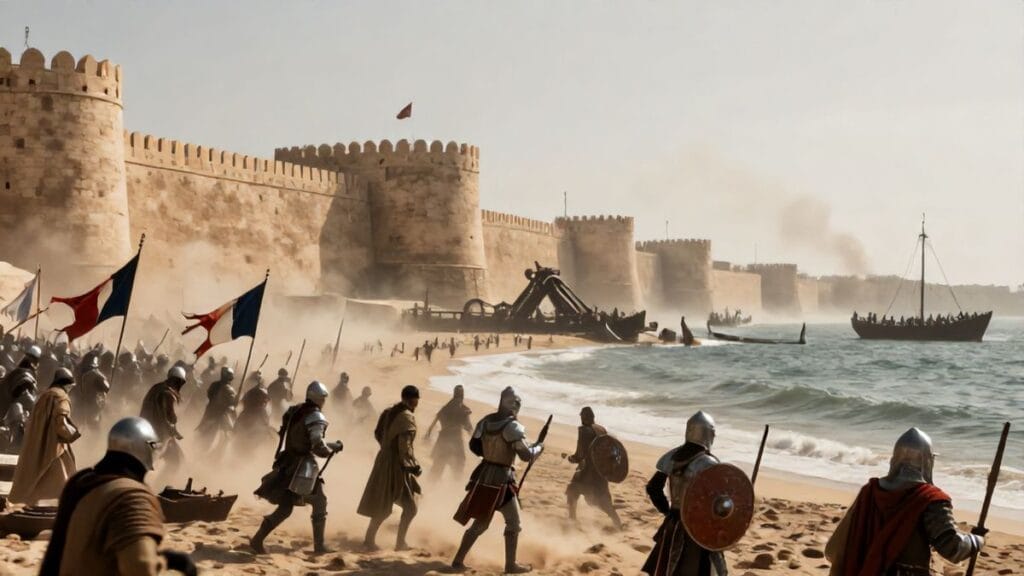
Dawn on 6 June unfolded not with the fanfare of trumpets, but with the practical bustle of men preparing to risk everything. Orders rippled down the chain of command: armor on, weapons ready, boats lowered. The larger transports lay farther offshore, their deep drafts unable to approach too closely; smaller craft were swung into the water, ropes creaking, as soldiers clambered down on rope ladders and makeshift gangways. Horses, snorting in panic, were blindfolded and coaxed or forced into the waiting barges.
Louis insisted on landing among the first waves. His advisors tried to dissuade him, arguing that a king’s life should not be gambled in the confusion of a beachhead assault. But he knew the symbolic power of royal presence. If the sight of their sovereign wading through surf under fire steadied his men and unnerved his enemies, the risk was worth it. Chroniclers depict him, once ashore, standing upright in knee-deep water, sword in hand, banner behind him, as arrows hissed and splashed around. Whether the scene occurred exactly as described, it captured a truth about Louis’s self-conception: he was not merely directing a war; he was offering himself as a living sacrifice of leadership.
In many medieval landings, the first hours were a desperate scramble. Defenders, if well-prepared, could rain missiles down on cramped boats, overturn vessels, or meet attackers at the waterline with spears and scimitars. But here, something unexpected occurred: the resistance was scattered, hesitant, and soon broken. Ayyubid cavalry that might have charged into the surf and driven the Crusaders back seemed absent or slow to engage. Skirmishes did flare along the dunes, yet they lacked the coordinated ferocity that Louis’s men had feared.
By mid-morning, beachheads were secured. Siege equipment began to be offloaded; banners of France and the Cross rose over makeshift encampments. The air filled with the calls of officers organizing units, the groans of men dragging stones and timbers ashore, the whinnies of horses feeling solid ground again. Dust from the dry Egyptian soil mingled with sea spray, coating everything in a thin, gritty film. Under the hardening light, Damietta’s walls seemed closer, more vulnerable than stories had suggested. It was at this still-fluid moment, when possibilities were widest, that events took their most astonishing turn.
When louis ix captures damietta: The Fall of the River City
The phrase “louis ix captures damietta” suggests a fierce contest, a dramatic storming of walls under fire. Reality was stranger and, in some ways, more unsettling. As the crusader army pushed inland from the beach and advanced toward Damietta, they braced for the usual horrors of an assault—engines hurling stones from the ramparts, arrows and Greek fire raining down, desperate sorties by the garrison. Instead, reconnaissance and cautious probes revealed something almost unbelievable: large portions of the city’s population, and apparently its defenders, were in flight.
Panic had broken out within Damietta as news of the landing spread. The reasons remain contested. Some historians point to rumors that the crusader force was vastly larger than it truly was, magnifying fear among civilians and militiamen. Others emphasize the lack of strong central command, with local officials unsure whether to fight, negotiate, or withdraw to regroup with forces from Cairo. Whatever the precise cocktail of rumor, miscommunication, and political calculation, the effect was dramatic. Boats crowded with people, animals, and bundles of possessions jammed the Nile. Roads leading south filled with carts and foot traffic, dust rising like a pall over the exodus.
By the time crusader vanguards reached the outer defenses, they encountered not a disciplined garrison, but scattered resistance that quickly melted away. Gates were found unbarred or thinly held; towers stood manned by only a handful of archers. In some quarters, entire stretches of wall were effectively abandoned. Louis’s commanders could scarcely believe their luck. They moved methodically, securing entry points, sending contingents to guard against ambush or trap. Within hours, the lily banner of France and the cross of the crusade were flying from points along the walls where, thirty years earlier, men had died by the hundreds to gain a foothold.
When louis ix captures damietta in this manner—through the enemy’s sudden flight rather than through prolonged siege—it is tempting to see divine providence or, alternatively, sheer Ayyubid incompetence. Medieval Christian chroniclers leaned heavily on the first interpretation, hailing the emptying of the city as a miracle, a sign that God had cleared the way before his chosen king. Muslim chroniclers, like Ibn Wasil, searching for meaning amid humiliation, highlighted poor leadership and factionalism, using Damietta’s fall as an indictment of those who had failed to stand and fight. Modern historians, balancing these voices, describe a “collapse of nerve” among the defenders, set against an unmistakable display of crusader organizational strength.
For the citizens who remained—too poor, too old, or too slow to flee—the day was one of terror and disorientation. They watched foreign banners rise, heard commands shouted in strange tongues, saw armored figures move through their streets. Some must have remembered the previous occupation during the Fifth Crusade and feared the worst. Yet initial accounts suggest that Louis, intent on demonstrating his piety, ordered a degree of restraint. Looting was curbed, at least officially; major mosques were seized and purified for Christian use, but wanton destruction was discouraged. In the narrative arc of the crusade, this moment stands as the apex of visible success: within a single day, a great Egyptian port had fallen with minimal loss of Christian life. It seemed that God himself had smiled on the enterprise.
Triumph and Disquiet in an Empty City
Damietta under Christian control quickly became a city of odd silences and uneasy triumph. The broad avenues and busy quays that had once hummed with river traffic, traders, and artisans now felt hollow. There were crusaders everywhere, of course—garrisons in towers, patrols along the walls, officers establishing headquarters in commandeered mansions. But the ordinary urban murmur was gone. Whole neighborhoods stood deserted, doors hanging open or nailed shut, courtyards cluttered with abandoned goods that no one yet dared to claim as spoils lest they violate the king’s orders.
Louis entered the city in procession, not as a looter but as a sanctifier. He walked to the principal mosque—its tall minaret a visible symbol of Islam’s presence—and ordered it cleansed and consecrated as a church. The transformation was swift and deeply symbolic: Arabic inscriptions remained on walls, but altars were erected where once men had bowed toward Mecca. Psalms and Latin hymns echoed in a space that yesterday had resonated with the muezzin’s call. For Louis, this act was not merely practical. It dramatized what he hoped would be the wider transformation of Egypt and the Holy Land: from Islamic sovereignty to Christian dominion under the banner of the Cross.
Yet behind the celebrations, disquiet stirred. Some of the more hard-nosed commanders and merchants could not help but ask unsettling questions. Where was the main body of the Egyptian army? Why had the city been abandoned rather than defended? What traps might be forming upriver, closer to Cairo, while the crusaders congratulated themselves on their bloodless coup? Supply officers, surveying Damietta’s granaries and storehouses, realized that while there was food and material to be seized, it would not be enough indefinitely for such a large host. The Nile’s rhythms, its seasonal floods, its network of canals and levees, were unfamiliar to European strategists and could quickly turn from asset to threat.
Louis, however, viewed the occupation primarily through a spiritual and symbolic lens. When louis ix captures damietta in his mind, he does not merely gain walls and quays; he gains a stage upon which to enact Christian kingship in a land long held by “infidels.” He organized processions, called for thanksgivings, and wrote letters to Europe announcing the victory. Bells rang in faraway cathedrals as news trickled back, sometimes distorted by exaggeration into reports that Cairo itself must soon fall. The gap between perception and reality widened by the day.
Inside the city, daily life slowly resumed a semblance of normality under the new regime. Markets reopened, first in a limited way, with crusader quartermasters buying or requisitioning what they needed. A few Muslim residents filtered back, sensing that survival depended on adapting to the occupiers’ presence. Christian chaplains established charitable routines, tending to the sick and distributing alms to the poorest inhabitants as a demonstration of the faith’s mercy. But tension lingered. Every night, patrols braced for surprise attacks, and rumors flickered that the sultan’s forces were mustering somewhere beyond the curve of the river.
Occupation and Miscalculation
Holding Damietta was one thing; turning it into a springboard for wider success was another. In the weeks following the city’s capture, the crusader leadership faced a series of strategic decisions whose consequences would reverberate. Chief among them: should they wait in Damietta for reinforcements and a more favorable season, or should they march upriver swiftly, before the Egyptians fully rallied? The Fifth Crusade’s experience loomed large: hesitation and seasonal flooding had trapped the earlier army. Many argued that speed was essential now, especially since morale was high and the enemy appeared disorganized.
Louis hesitated. His nature leaned toward careful preparation rather than impulsive thrusts. He ordered fortifications in and around Damietta strengthened and insisted on securing sufficient supplies. He also awaited the arrival of his brother, the powerful Charles of Anjou, and other contingents still en route. During this period, the army’s discipline frayed. Despite the king’s best efforts, some soldiers indulged in excess, taking advantage of an undefended population and proximity to abundant, if unfamiliar, goods. Merchants—both Christian and local—saw opportunities in black-market dealings that skirted royal regulations.
Meanwhile, the Nile itself posed danger. Its flood cycle, poorly understood by newcomers, threatened to isolate the city if the army moved at the wrong time. Advisors tried to grasp the patterns by questioning locals and poring over reports, but such knowledge could not be mastered in a few weeks. On top of environmental uncertainty came disease. The climate was alien; sanitation in crowded encampments poor. Dysentery and fevers began to appear, sapping strength and darkening the mood. Victorious though they were, the crusaders found themselves in a precarious position, far from home, dependent on supply lines over water, and surrounded by a landscape that could turn hostile with the slightest shift in fortune.
It was during this fragile interlude that Louis made a choice with immense symbolic weight: he decided to hold Damietta not as a negotiable asset, but as a fixed pledge of Christian presence in Egypt. Later, when the tide of war turned, this decision would haunt him. At the moment, however, it felt consistent with his vision. To abandon the city, or to hint that it might be traded away, seemed to him an affront to divine favor. In his mental narrative, the day louis ix captures damietta was not a bargaining chip; it was the first chapter of a holy conquest that could not be undone without betrayal.
Egypt Reacts: The Ayyubid Crisis
While Damietta settled uneasily under foreign banners, Egypt’s ruling circles plunged into crisis. News of the city’s fall, delivered by panicked refugees and grim messengers, struck Cairo like a thunderclap. The reigning sultan, al-Salih Ayyub, was already in a weakened position, beset by illness and the political machinations of rival emirs. Damietta’s loss threatened not only his prestige but the economic lifeline of his regime. Grain shipments were disrupted, trade routes imperiled, and the prospect of a crusader advance on Cairo itself suddenly felt terrifyingly real.
In this atmosphere, decisions that might otherwise have taken months were made in days. Forces were mobilized from across Egypt and Syria. Emirs who had grudgingly accepted al-Salih’s authority now faced a stark choice: rally around the sultan or risk watching the Franks carve away the richest parts of the Nile Valley. Many chose the former, if only out of self-preservation. Among the troops gathering were elite slave soldiers—the Mamluks—whose discipline and combat experience set them apart. They would soon play a decisive role, not only on the battlefield but in the political upheavals that followed.
The propaganda battle was intense. Friday sermons in mosques denounced the Franks’ incursion, called for jihad, and cast Damietta’s occupation as a test of Muslim faith. Preachers evoked memories of earlier struggles, especially Saladin’s victory at Hattin and subsequent recovery of Jerusalem, urging believers to emulate that resolve. Chroniclers convey a mixture of outrage and steely determination: Egypt might have stumbled, but it would not bow. The contrast between the seemingly effortless way louis ix captures damietta and the complicated, painful mobilization it triggered in Cairo underscored the asymmetry of the moment. One side basked in a quick win; the other scrambled to ensure it would be the last.
At court, voices differed on how best to respond. Some urged immediate confrontation, arguing that any delay would embolden the invaders. Others pressed for a more cautious approach, using the Nile’s geography and seasonal challenges to wear down the crusaders before engaging them directly. Negotiation was also floated: perhaps Damietta could again be exchanged for concessions in the Levant, as in the days of al-Kamil. But the political fabric was too frayed, the sense of humiliation too raw. Pride and anger pushed the realm toward war.
From Victory to Quagmire along the Nile
As summer advanced, the initial euphoria in the crusader camp gave way to a grinding realism. Damietta was secure, but the rest of Egypt lay ahead, and every step beyond the city’s walls drew them deeper into a landscape they only dimly understood. In late 1249 and into early 1250, Louis finally resolved to move upriver toward the key town of Mansourah, a gateway on the route to Cairo. The march would be slow, constrained by the need to keep close to the Nile for water and transport, and haunted by the threat of ambush from forces that knew the terrain intimately.
Riverine warfare posed special challenges. The Crusaders used their fleet to support the advance, carrying supplies and offering floating platforms for archers and siege weapons. But the Nile was not a placid ally. Shifting channels, hidden sandbars, and sudden currents played havoc with navigation. Egyptian forces, drawing on generations of local knowledge, manipulated irrigation canals and embankments to flood certain regions, turning parts of the delta into marshy traps. At times, crusader columns found themselves slogging through thigh-deep mud, horses floundering, armor caked, tempers fraying.
Skirmishes became frequent. Light cavalry and archers from the Egyptian side would harass the march, vanishing into reedbeds and side channels before heavy Frankish knights could engage. Disease continued to stalk the ranks. The heat was relentless, and the unfamiliar diet—supplemented by whatever could be foraged or seized—did little to strengthen bodies already weakened by months abroad. As conditions worsened, the memory of that bright morning when louis ix captures damietta seemed almost like a mirage, a distant episode unmoored from the grim reality of the present campaign.
Yet Louis pressed on, driven by stubborn faith and a sense of obligation to his vow. Turning back without a major engagement felt to him like cowardice and to many of his followers like a betrayal of sacrifices already made. He was bolstered by the presence of his brothers and by the continued arrival of smaller reinforcements from Europe. They all pinned their hopes on a decisive battle near Mansourah, one that might break Egyptian resistance and open the road to Cairo. In this expectation, however, lay the seeds of ruin.
The Road to Mansourah and the Turning Tide
The confrontation at Mansourah forms the hinge of the entire Egyptian campaign. As the crusader army approached the town in early 1250, it encountered well-prepared defenses and a determined enemy. The Mamluk commanders, especially the formidable Baybars, proved adept at using both terrain and tactics to blunt the impact of Frankish heavy cavalry. Early clashes around fortified dykes and narrow causeways gave a foretaste of what lay ahead: brutal, close-quarter fighting in constricted spaces where the knights’ charge, normally so decisive, lost much of its punch.
A key moment came when a contingent of crusaders, led by Louis’s brother Robert of Artois, launched a reckless attack through a partially concealed ford, bypassing some of the Egyptian defenses. Initially, the maneuver worked; they burst into part of Mansourah, catching its defenders off guard. But success quickly turned to disaster. Cut off from the main body, hemmed in by narrow streets, Robert’s men were surrounded and slaughtered in fierce urban combat. The prince himself fell, along with many of the finest knights in the army. The psychological impact was immense: a daring thrust meant to break the stalemate had instead gutted the crusader elite.
In the days and weeks that followed, the campaign devolved into a stalemate of attrition. Both sides suffered, but the Egyptians could better draw on local resources and were closer to their centers of power. The crusaders, increasingly malnourished and diseased, found their position weakening. Attempts to negotiate sputtered amid mutual distrust and conflicting objectives. It became clear that the great promise embodied in the phrase “louis ix captures damietta” had not translated into a viable path to victory. The river that had carried the army forward now threatened to become its grave.
At last, facing mounting casualties and the real risk of encirclement, Louis ordered a retreat toward Damietta. It was a bitter decision, and one made too late. During the chaotic withdrawal, harried constantly by Egyptian forces, the crusader column disintegrated. Supplies were abandoned; discipline crumbled. Near the village of Fariskur, the Egyptian army closed in, and after a desperate, chaotic struggle, the crusaders’ fate was sealed. Louis himself was captured, along with many of his leading nobles. The king who had come to Egypt as God’s champion now found himself a prisoner, bargaining for the lives of his followers and the future of his cause.
Captive King, Broken Crusade
The image of Louis IX in captivity is one of the most poignant in crusading history. Held initially in Mansourah and then in other locations as negotiations proceeded, he experienced a profound reversal of fortune. The man who had walked into Damietta in triumph, consecrating mosques as churches, now stood before Muslim officials as a supplicant. Yet contemporaries, both Christian and Muslim, remarked on his composure. Even in chains, Louis sought to embody royal dignity and Christian fortitude, hearing mass when possible, encouraging his fellow prisoners, and refusing to renounce his faith for freedom.
Negotiations were brutal. The Egyptians had little interest in half measures. They demanded an enormous ransom—ultimately set at 800,000 bezants—and the return of Damietta itself. For Louis, surrendering the city cut directly against the convictions he had formed after that first golden day. But the reality was stark: the crusader army had been shattered, and the lives of thousands hung in the balance. In the end, necessity overrode ideology. Damietta, so dramatically won, would be relinquished to secure his release. As part of the process, Egyptian forces re-entered the city, and the brief experiment of a renewed Christian Damietta came to a humiliating close.
Even amid these losses, some observers found reasons to admire Louis. A famous anecdote, recorded by the chronicler Joinville, describes how, when threatened with torture or death to pressure him into concessions, the king remained unshaken, asserting that no torment could force him to commit sin. Muslim accounts, too, though critical of the invasion, sometimes acknowledged his personal integrity. The historian al-Maqrizi, writing later, noted the Franks’ steadfastness under duress, contrasting it with the fickleness of certain emirs. In such testimonies, we glimpse the complex human reality beneath the clash of faiths: enemies who could still, in limited ways, respect one another.
Upon his release, Louis did not immediately return to France. Instead, he spent several years in the Levant, working to strengthen what remained of the Latin states, repairing fortifications, and engaging in diplomatic efforts. The dream that had animated the day louis ix captures damietta had been shattered, but his sense of duty persisted. Only in 1254 did he sail home, arriving in a kingdom that had managed, thanks largely to Blanche of Castile, to weather his long absence. He returned not as a conquering hero but as a chastened, yet still revered, monarch—one whose sanctity, in the eyes of many, had been proven as much by suffering and endurance as by military success.
Echoes in Christendom: Sanctity, Shame, and Memory
In Europe, news of the crusade’s trajectory hit like alternating waves of exultation and despair. First came the jubilant reports that louis ix captures damietta with astonishing ease, prompting celebrations in cathedrals and marketplaces. Then, slowly, more troubling rumors seeped in: the stalled advance, the terrible battle at Mansourah, the king’s captivity. The final confirmation of defeat and ransom left many stunned. How could a crusade led by such a devout king, backed by so many prayers and resources, have ended in humiliation?
The Church’s response was nuanced. On one level, sermons and letters continued to affirm the legitimacy and sanctity of crusading. Louis himself, far from being condemned, was increasingly portrayed as a model Christian ruler, tested like Job and refined in the furnace of suffering. His personal virtues—his charity, his asceticism, his unwavering adherence to faith under captivity—became the focus of hagiographical narratives. By the time of his canonization in 1297, the official memory had largely reframed the Egyptian adventure: the failure of the Seventh Crusade did not mar Louis’s sanctity; it underlined it.
Yet beneath this spiritual polishing lay harsher secular critiques. Some nobles grumbled that the crusade had drained resources and lives for little tangible gain. Merchants tallied losses from disrupted trade and failed ventures. There were debates in royal councils and among intellectuals about whether crusades of this sort were still viable. Could the West continue to pour men and money into distant campaigns, facing foes increasingly adept at countering their tactics? Voices began to argue, cautiously at first, for alternative strategies: stronger fortifications in the remaining Latin territories, increased diplomatic engagement with certain Muslim powers, or focus on internal reform rather than external conquest.
The memory of Damietta itself remained ambiguous. On feast days and anniversaries, preachers could evoke that luminous moment when the city fell, casting it as proof that God could still grant victory. At the same time, historians and chroniclers, including Jean de Joinville, wove the Egyptian campaign into larger moral narratives—warning against pride, ill-timed aggression, and the neglect of practical wisdom. One modern historian, Christopher Tyerman, has summarized the paradox neatly: “In Damietta’s capture lay both the fulfillment and the undoing of Louis’s crusading hope.”
Egyptian Perspectives: Resistance, Pride, and the Mamluk Dawn
On the Egyptian side, the story of Damietta and the defeat of Louis IX became woven into a different, yet equally powerful, tapestry of memory. Initially, the fall of the city in 1249 was seen as a disgrace, a stain on the honor of the Ayyubid dynasty. Chroniclers castigated the flight of the garrison and the panic of civilians. But the narrative did not end there. The subsequent victories at Mansourah and Fariskur, the capture of the Frankish king, and the eventual recovery of Damietta transformed the episode into a tale of redemption and divine favor toward the Muslim community.
Crucially, these events overlapped with a seismic shift in Egyptian politics: the rise of the Mamluks. Elite slave soldiers who had long been central to the sultan’s military power now moved into the foreground as political actors. In 1250, in the turbulent aftermath of al-Salih Ayyub’s death and under the pressure of ongoing war, Mamluk commanders effectively seized control, founding a new dynasty that would rule Egypt and much of the Syrian region for centuries. Their legitimacy rested in part on their proven ability to defend the realm against the Franks. The story of how they contained and ultimately crushed Louis’s forces became part of their foundational myth.
Muslim historians like Ibn Wasil and later al-Maqrizi framed the episode as evidence of the community’s resilience and God’s guidance. Yes, Damietta had fallen, but only briefly. The infidels had been allowed to advance just far enough to be punished for their arrogance. The capture and ransom of a Christian king were especially potent symbols. They demonstrated, so the argument went, that no matter how pious or wealthy the invaders, they could not overturn God’s decree. In mosque sermons and courtly gatherings, the story served as both warning and encouragement: vigilance and unity were essential, but ultimate victory was assured to the faithful.
For ordinary Egyptians, the memory of the crusader occupation would have been more immediate and visceral: disrupted trade, fear of sudden violence, the sight of foreign armor in familiar streets. Yet even here, over time, the trauma blended with pride. To say that “Louis of the Franks came with a mighty host, took Damietta, and yet was driven back and taken captive” was to affirm both vulnerability and strength. The city by the Nile became a kind of historical mirror, reflecting both the fragility of human defenses and the possibility of renewal through determined resistance.
How Historians Read the Day louis ix captures damietta
Modern historians have long been fascinated by the contrast between the swift, almost effortless capture of Damietta and the catastrophic failure of the overall campaign. The day louis ix captures damietta has been dissected as a case study in military surprise, psychological collapse, and the limits of strategic planning. Scholarly debates swirl around key questions: Was the city’s evacuation primarily the result of panic, or did it reflect a deliberate, if misguided, tactical decision by local commanders? How important was Louis’s personal leadership in orchestrating the landing and occupation? To what extent did structural factors—logistics, climate, disease—predetermine the eventual outcome, regardless of early success?
One influential line of interpretation, advanced by historians such as Jonathan Riley-Smith, emphasizes that the crusade was not doomed from the start. In this view, the capture of Damietta represented a genuinely significant achievement, opening a plausible pathway to victory that was later squandered through misjudgments at Mansourah and an underestimation of Mamluk capabilities. Another perspective, more skeptical of grand crusading ventures, sees the entire enterprise as fundamentally flawed. According to this school, symbolized in the work of Christopher Tyerman and others, the very decision to target Egypt, with its complex hydrology and deep reserves of manpower, placed Louis’s forces in a strategic cul-de-sac from which escape was unlikely.
Primary sources have proved both invaluable and tricky. Jean de Joinville’s glowing portrait of his king, for instance, must be balanced against Muslim accounts that highlight crusader brutality and naiveté. Even within Christendom, different chroniclers shaded their narratives to advance theological or political arguments. Yet, when cross-referenced and critically read, these testimonies offer a remarkably textured view of June 1249: the surf-splashing landings, the half-empty streets of Damietta, the bewildered joy of soldiers who could not quite grasp how they had taken a great city in a single stroke.
Historians also consider the broader patterns of the thirteenth century. By 1249, the crusading movement was entering a more complex phase. The Mongols were reshaping the Eurasian map; trade networks were expanding, linking Mediterranean ports more tightly into a globalizing economy. Against this backdrop, Louis’s Egyptian venture can be seen as both a continuation of traditional holy war and an anachronistic attempt to impose older frameworks on a changing world. The fact that louis ix captures damietta with such startling ease, only to lose it again within a few years, encapsulates the era’s contradictions: extraordinary feats of mobilization and faith, constantly undercut by material limits and shifting geopolitical realities.
Long After the Banner Fell: Social and Spiritual Consequences
The immediate political and military results of the Seventh Crusade are relatively clear: the failure to secure Egypt, the weakening of the Ayyubids and rise of the Mamluks, the reinforcement—but not rescue—of the remaining Latin states. But the deeper social and spiritual consequences unfolded more quietly, in the lives of individuals and communities on both sides of the Mediterranean. Veteran crusaders returned to Europe carrying scars and stories. Some found their faith strengthened by suffering, convinced that their trials had been part of a mysterious divine plan. Others, more disillusioned, questioned the sermons that had promised quick victory and eternal reward.
In villages across France and elsewhere, families mourned sons, brothers, and fathers who never came home. Parish priests struggled to frame the loss in consoling terms. Pilgrimage, always intertwined with crusade, took on new layers of meaning. Ordinary believers, unable or unwilling to take part in distant wars, might instead seek spiritual merit through journeys to local shrines, donations to hospitals, or works of mercy closer to home. In subtle yet significant ways, the focus of Christian piety began to tilt from expansive, outward-looking conquest to more inward forms of devotion and reform.
Among the elites, the Seventh Crusade’s failure sharpened debates about the proper relationship between sanctity and kingship. Louis IX’s eventual canonization, despite—or because of—his Egyptian misadventure, sent a powerful message: holiness did not guarantee worldly success. A king could be both a poor strategist and a great saint. This paradox encouraged later thinkers to draw clearer lines between spiritual ideals and practical governance. While crusading rhetoric persisted, later medieval rulers increasingly weighed such ventures against the demands of domestic stability and the emerging realities of statecraft.
In the Islamic world, too, the memory of Damietta and the defeat of Louis IX fed into larger currents of thought. Jurists and theologians reflected on jihad, governance, and the duties of rulers to defend the community. Popular stories about the captured king circulated, sometimes embellished to emphasize divine justice and the superiority of Islam. At the same time, contact—however violent—between Christian and Muslim societies during the crusade facilitated subtle exchanges: medical knowledge, commercial practices, even certain technologies. The very ships that had carried Louis’s army also carried goods and ideas back and forth, intertwining civilizations even as their leaders clashed.
Centuries later, when historians and readers look back at the brief moment when louis ix captures damietta, they see more than a military operation. They see a nexus of human hopes and fears, of competing visions of God’s will, of courage and cruelty, wisdom and folly. The empty streets of Damietta under new banners, the hurried negotiations in Egyptian courts, the whispered prayers of prisoners in dim cells—all speak to a world struggling to reconcile ideals of holiness with the brute realities of power. In that struggle, the capture and loss of a single city on the Nile became a symbol far larger than its walls.
Conclusion
The capture of Damietta on 6 June 1249 stands as one of those moments in history when the surface of events—triumphant banners over a vanquished city—masks the deeper currents already shifting beneath. Louis IX’s army achieved what many had thought impossible: a major Egyptian port fallen in a single day, its defenses crumbling in the face of determined assault and internal panic. For a brief, heady time, it seemed that God’s favor rested unmistakably on the crusading king. Louis himself regarded the event as confirmation of his vow and his mission, the glorious curtain-raiser to a campaign that would reshape the Holy Land.
Yet the arc of the Seventh Crusade bent quickly away from that luminous beginning. Environmental challenges, strategic missteps, underestimation of Egyptian and especially Mamluk resilience, and the sheer distance from home gradually eroded the crusader position. The same Nile that had carried them toward Cairo became the backdrop to attrition, defeat at Mansourah, and the humiliating capture of a king. In the end, Damietta was given back as ransom, its fleeting tenure under the lilies serving as a cautionary tale about mistaking initial success for lasting victory.
The legacies are complex. For Christendom, the story of how louis ix captures damietta and then loses it again became part of a broader reflection on the meaning of crusade, sanctity, and royal responsibility. Louis emerged not as a triumphant conqueror but as a saintly sufferer, his Egyptian failure transmuted into spiritual capital that underpinned his canonization. For Egypt and the wider Islamic world, the episode fed directly into the rise of the Mamluks and the solidification of a proud narrative of resistance. Damietta’s ordeal symbolized both vulnerability to sudden shock and the capacity for organized counterattack.
Seen from our vantage point, the events at Damietta are neither simple heroism nor simple folly. They are a human drama in which courage, faith, fear, and miscalculation coexist, where individuals on both sides navigate the collision between their deepest convictions and the hard limits imposed by geography, disease, and political division. The day louis ix captures damietta thus invites us to think critically about the allure of decisive moments in history—those instants when walls fall and flags change—while remembering that the true measure of an event lies not only in what happens that day, but in all that unfolds because of it.
FAQs
- Why did Louis IX choose Egypt, and specifically Damietta, as his primary target?
Louis IX targeted Egypt because it was the economic and logistical heart of the Ayyubid realm, whose wealth and grain sustained Muslim power in the Eastern Mediterranean. Damietta, at the Nile’s eastern mouth, controlled vital trade and river access to Cairo, making it a strategic lever: if the crusaders held it, they could threaten the capital and potentially bargain for Jerusalem or other concessions. - How was Damietta captured so quickly in 1249?
Damietta fell with startling speed largely because panic and confusion gripped its defenders and population. As the crusader army secured a beachhead and advanced, many inhabitants and soldiers fled, fearing encirclement and overestimating the size and strength of Louis’s force. This collapse of morale left key defenses under-manned, allowing the crusaders to enter the city with relatively little resistance. - What role did Louis IX personally play in the capture of Damietta?
Louis IX insisted on landing among the first waves of troops, providing a powerful example that steadied his men and strengthened their resolve. He oversaw the organization of the landing, maintained strict discipline to limit looting, and quickly moved to secure and sanctify the city, including converting its main mosque into a church. His leadership was central to both the military seizure and the immediate reordering of Damietta under Christian rule. - Why did the overall campaign fail despite the early success at Damietta?
The campaign unraveled due to a combination of factors: environmental challenges along the Nile, inadequate understanding of Egyptian geography and flood cycles, disease and supply problems, and serious tactical errors—most notably at Mansourah, where a rash attack led by Louis’s brother resulted in heavy losses. Moreover, the Egyptians, and especially the emerging Mamluk leaders, proved far more resilient and adaptable than many crusaders had anticipated. - What happened to Louis IX after he was captured?
Louis IX was held prisoner by Egyptian forces and subjected to intense negotiations. He ultimately agreed to pay a massive ransom and surrender Damietta in exchange for his freedom and that of many of his followers. After his release, he did not immediately return to France; instead, he remained in the Levant for several years, working to strengthen the remaining Latin positions before finally going home in 1254. - How did the capture and loss of Damietta affect Louis IX’s later reputation?
Paradoxically, the failure of the Egyptian campaign did little to tarnish Louis’s reputation in the long term. Medieval hagiographers and later the Church emphasized his piety, personal courage, and steadfastness under suffering rather than his strategic mistakes. When he was canonized in 1297, the Damietta episode was reframed as a crucible that revealed his sanctity rather than as a stain on his kingship. - What impact did these events have on Egypt and the Muslim world?
The fall and recovery of Damietta, coupled with the defeat and capture of Louis, accelerated political changes in Egypt, particularly the rise of the Mamluks, who soon replaced the Ayyubids as rulers. Their success against the crusaders bolstered their legitimacy and reinforced a narrative of divine favor and communal resilience. In the broader Muslim world, the episode underscored the necessity of unity and preparedness in the face of repeated Frankish incursions. - Are there contemporary sources that describe the capture of Damietta?
Yes. On the Christian side, Jean de Joinville’s chronicle is one of the most important sources, providing detailed, if favorable, insight into Louis IX’s character and the campaign. On the Muslim side, historians such as Ibn Wasil and, later, al-Maqrizi offer perspectives that highlight Egyptian experiences and criticisms of their own leaders. Modern historians cross-read these accounts to reconstruct events and interpret their significance.
External Resource
Internal Link
Other Resources
- Encyclopaedia Britannica – general search for the exact subject
- Google Scholar – academic search for the exact subject
- Internet Archive – digital library search for the exact subject

