Table of Contents
- The Final Dawn: Louis XIV on the Last Morning of His Reign
- The Twilight of the Sun King: A Life Nearing Its End
- Versailles in 1715: A Palace of Power and Imminent Change
- The Grand Monarch’s Health Declines: A Lingering Agony
- Court Intrigues and Mourning: Emotions Stirred Behind Palace Walls
- The Passing of an Era: Louis XIV’s Death on September 1, 1715
- Philippe, Duke of Orléans: The Regent’s New Role and Challenges
- France on the Brink: Political and Social Atmosphere Post-Louis XIV
- Versailles After Louis: Shifts in Court Culture and Power Dynamics
- The Financial Burdens Left Behind: War Debts and Economic Strain
- The Sun King’s Legacy in Art and Architecture
- The Sun King’s Shadow over European Politics
- Popular Reactions: Grief, Relief, and Uncertainty in the Streets of Paris
- The Deathbed Scene: Intimate Portraits from Court Witnesses
- The End of Absolutism? Reflections on Louis XIV’s Rule and Its Conclusion
- The Young Louis XV: A Child Monarch and the Regency
- Cultural Memory: How Louis XIV’s Death Shaped French Identity
- The Funeral of Louis XIV: Rituals of Majesty and Mourning
- Historical Interpretations: From Enlightenment Critiques to Modern Views
- Concluding Thoughts: The Death of Louis XIV and the Dawn of a New France
1. The Final Dawn: Louis XIV on the Last Morning of His Reign
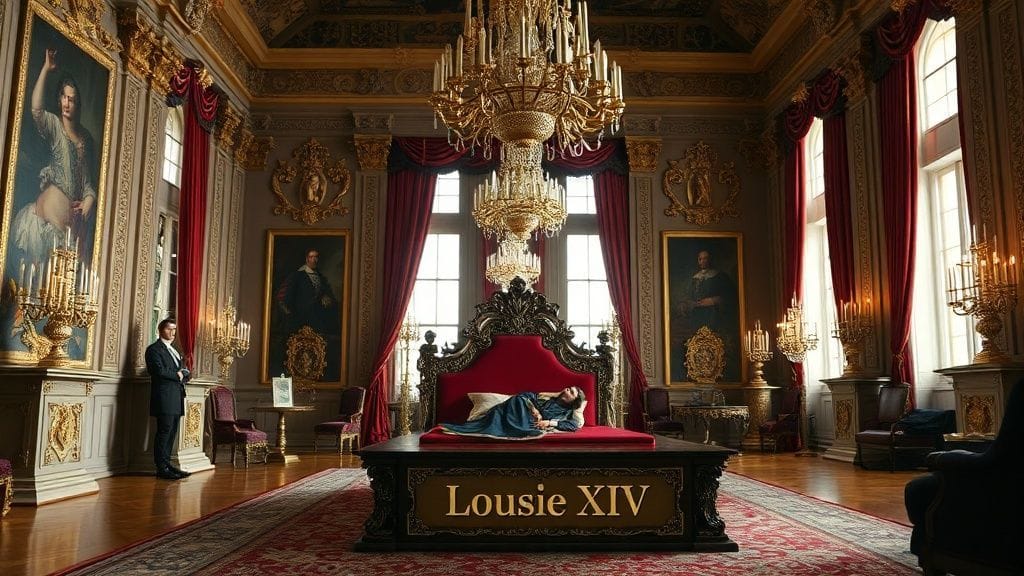
As dawn crept softly over the spired rooftops of Versailles on September 1, 1715, an age quietly drew to a close. The grand Sun King, Louis XIV, the monarch who had dominated France and Europe for over seven decades, lay frail and shrouded in silence. His vast reign, marked by unparalleled opulence, relentless warfare, and masterful statecraft, was now but a shadow in the vast halls that had witnessed his triumphs and trials. The air was thick with a mixture of solemn respect, hushed prayers, and a chilling anticipation—the king’s final breath was awaited by all, a moment saturated with fate and the promise of transformation.
It was not merely the curtain closing on one man’s life, but the pivotal end to an era that had emblazoned itself on the very soul of France. In these last hours, that same palace—Versailles—stood as a silent sentinel, a magnificent stage on which centuries of history would soon pivot.
2. The Twilight of the Sun King: A Life Nearing Its End
Louis XIV’s life was nothing short of mythic. Born in 1638, he ascended to the throne as a child, shadowed by the turbulence of the Fronde and the shaky throne of a still-fractured kingdom. Over seventy-two years later, he reigned as arguably the most powerful monarch his country had ever known—a sovereign who proclaimed “L’état, c’est moi” (“I am the state”). His identity was so intertwined with the notion of absolute monarchy that his death foreshadowed an unimaginable political and social shift.
But this final chapter was far from glorious. Years of bearing the weight of endless wars, famine, and court factionalsm had eroded his once-imposing vigor. His body betrayed him with gangrene and searing pain, each breath a near-battle itself.
3. Versailles in 1715: A Palace of Power and Imminent Change
Named after the tiny hunting lodge Louis XIII had famously converted, Versailles in 1715 was a sprawling palace and the epicenter of France’s monarchy. Marble floors reflected the grandeur of Louis’s vision; gardens stretched endlessly, manicured with divine precision. Yet beneath its golden veneer simmered anxiety. The courtiers whispered of succession, power struggles, and the young dauphin’s uncertain future.
The very heart of the ancien régime was preparing for its transition—some with hope, others with dread.
4. The Grand Monarch’s Health Declines: A Lingering Agony
The king’s health had deteriorated over months. Crippling pain from gangrene in his leg confined him increasingly to his chambers. Physicians attended with urgency that belied their limited success. Rumors spread rapidly through the court—had the invincible monarch finally succumbed to mortality?
One observer noted, “He lies there, still commanding, yet fragile as the finest crystal.” Each visit to his bedside was heavy with unspoken fears.
5. Court Intrigues and Mourning: Emotions Stirred Behind Palace Walls
As word spread, Versailles became a crucible of emotion and political maneuvering. The Duke of Orléans, Louis XIV’s nephew, prepared to assume regency for the boy King Louis XV, barely five years old. Meanwhile, factions jockeyed for influence—some mourning the king’s passing, others anticipating their own rise.
The queen, Marie Thérèse, who had passed decades earlier, was absent as was the king’s much-discussed mistress, Madame de Maintenon—herself a weary figure seeking solace in prayer. The court was a theater of masks: grief, hope, ambition.
6. The Passing of an Era: Louis XIV’s Death on September 1, 1715
At roughly 8 a.m., Louis XIV breathed his last. The Sun King, who had ruled France for seventy-two years and 110 days, closed his eyes forever. Attendants quietly lowered the crown and lavish robes that symbolized his reign. The chambers that had known laughter, decrees, and celebrations felt eerily silent.
His death was more than a personal loss—it was the end of an epoch, a monumental turning point from the height of absolute monarchy to a France teetering on the edge of revolution centuries ahead.
7. Philippe, Duke of Orléans: The Regent’s New Role and Challenges
With Louis XV too young to rule, the Duke of Orléans stepped into the regency, tasked with steering France through political and financial storms inherited from his uncle.
Orléans, a savvy and somewhat controversial figure, faced the daunting task of maintaining order in Versailles, placating rival factions, managing ongoing wars’ debts, and preparing a fragile kingdom for a monarch yet to come of age.
8. France on the Brink: Political and Social Atmosphere Post-Louis XIV
France in 1715 was a land marked by contrasts: incredible artistic and architectural accomplishment but ravaged by many years of warfare. The lavish spending of Louis’s late reign had drained the treasury, while many peasants still suffered famine and heavy taxation.
Politically, nobles quietly contested the regent’s authority, while Enlightenment ideas, still in embryonic form, began to question entrenched power.
9. Versailles After Louis: Shifts in Court Culture and Power Dynamics
The palace itself slowly transformed after Louis’s death. The rigid rituals and hierarchies he had imposed began to loosen during the regency. Smaller, more intimate salons emerged, giving birth to new social worlds where ideas—political, philosophical, artistic—circulated more freely.
The Sun King’s immense shadow cast a long silhouette, but cracks were showing.
10. The Financial Burdens Left Behind: War Debts and Economic Strain
Louis XIV’s numerous military campaigns, from the Franco-Dutch War to the War of the Spanish Succession, had drained the royal coffers. Estimates suggest France was burdened with debts amounting to hundreds of millions of livres.
The regency faced daunting financial reforms to prevent collapse. Tax reforms were debated, though resistance from privileged classes made meaningful change elusive.
11. The Sun King’s Legacy in Art and Architecture
Despite turmoil, Louis XIV’s reign had elevated French culture to unprecedented heights. The construction of Versailles itself was a masterpiece, while patronage of arts flourished.
Figures like Molière, Lully, and Le Brun had defined what became known as the French Classical style. This legacy continued to inspire generations and remain a symbol of royal grandeur.
12. The Sun King’s Shadow over European Politics
Louis’s aggressive foreign policy redrew European borders multiple times. His wars shaped alliances, rivalries, and fragile balances of power.
His death left a vacuum that changed diplomacy and warfare, setting the stage for new conflicts and contests between rising European powers such as Britain and Austria.
13. Popular Reactions: Grief, Relief, and Uncertainty in the Streets of Paris
Outside Versailles, the general populace reacted with a mixture of grief and cautious relief. The monarchy had been both revered and feared.
Pamphlets circulated quickly, some praising the Sun King’s achievements, others lamenting the burdens borne by commoners. Yet beneath this surfaced an undercurrent of uncertain hope for a brighter future.
14. The Deathbed Scene: Intimate Portraits from Court Witnesses
Eyewitness accounts paint vivid pictures of the last moments: the king’s quiet prayers, his frail hand grasping his confessor’s, the silent tears of courtiers.
One noted observer wrote, “In that chamber, the infinite power of a lifetime dissolved into the fragile humanity of a single man.” The personal and political intertwined profoundly.
15. The End of Absolutism? Reflections on Louis XIV’s Rule and Its Conclusion
Though the king wielded absolute power, historians debate whether his death marked the beginning of its end. The regency tested the limits of royal authority, while social and intellectual currents began to undermine assumptions.
Louis’s reign had been a monolith, but cracks were inevitable.
16. The Young Louis XV: A Child Monarch and the Regency
At just five years old, Louis XV ascended as symbol rather than ruler. His regency was marked by political maneuvering, financial crises, and a cultural climate that contrasted sharply with his great-grandfather’s.
This period shaped the future king’s personality and reign, which would be no less complex.
17. Cultural Memory: How Louis XIV’s Death Shaped French Identity
Louis XIV remained a figure of mythic stature in French culture. His death inspired art, literature, and later political rhetoric.
Memories of the Sun King became rallying points—sometimes invoked to call for stability, sometimes to critique monarchy itself.
18. The Funeral of Louis XIV: Rituals of Majesty and Mourning
The king’s funeral was a grand spectacle of royal ceremonial, replete with pageantry designed to reaffirm the monarchy’s enduring authority despite the sovereign’s passing.
Processions, masses, and public displays of mourning united Versailles and Paris alike, offering closure but also a reminder of mortality.
19. Historical Interpretations: From Enlightenment Critiques to Modern Views
Philosophers like Voltaire and Rousseau critiqued the foundations of absolutism that Louis symbolized, sparking debates on governance and liberty.
Modern historians seek a balanced view, neither demonizing nor glorifying, but appreciating the complexity of his age.
20. Concluding Thoughts: The Death of Louis XIV and the Dawn of a New France
Louis XIV’s death was not merely an endpoint, but a threshold. It ended the long reign of the Sun King but ushered in a new dynastic chapter, fraught with challenges both old and new.
The delicate dance between monarchy, nobility, and people continued—shaped forever by the man whose light had once seemed unextinguishable.
Conclusion
The death of Louis XIV on that early morning of September 1, 1715, resonates through history as one of those rare moments when the trajectory of a nation pivots with quiet finality. The Sun King, who embodied the zenith of absolutist monarchy, passed as his courtiers wept and politicians schemed, leaving a France both enriched and exhausted by his long shadow.
Yet beyond the politics and grandeur, there is a deeply human story: a man who bore the weight of a kingdom upon his shoulders for nearly three-quarters of a century, whose twilight hours blended dignity and frailty. His death reminded all that even the mightiest must face their mortal dilemma.
From the gilded halls of Versailles to the bustling streets of Paris, France stood at a crossroads—between the golden age of a legendary monarch and the uncertain dawn of a new era. The Sun King’s light had dimmed, but the stories his reign ignited would continue to illuminate French identity, culture, and politics for centuries to come.
FAQs
Q1: What were the main causes of Louis XIV’s death?
Louis XIV succumbed to complications related to gangrene and chronic health issues exacerbated by his advanced age. His prolonged illness lasted months before his death in 1715.
Q2: How did the death of Louis XIV affect France’s political structure?
With the king’s death, his great-grandson Louis XV, a child, ascended the throne, leading to a regency under Philippe II, Duke of Orléans. This transition weakened the absolute monarchy’s control as France faced financial troubles and court rivalries.
Q3: Who was Philippe, Duke of Orléans, and what role did he play after Louis XIV’s death?
Philippe was Louis XIV’s nephew and the regent for the young Louis XV. He managed the kingdom’s affairs and attempted to stabilize France during a politically volatile period.
Q4: What was the significance of Versailles during Louis XIV’s reign and after his death?
Versailles was the physical and symbolic center of Louis XIV’s absolute monarchy. After his death, Versailles remained important but gradually lost its rigid ceremonial dominance as court life evolved during the regency.
Q5: How did the public react to the death of Louis XIV?
Public response was mixed, with widespread mourning alongside relief among those burdened by high taxes and war hardships. Pamphlets and popular discourse reflected this complex sentiment.
Q6: In what ways did Louis XIV’s death influence European politics?
His death shifted power balances, ending a period of French dominance marked by constant warfare. Europe entered a new phase of diplomacy and conflict with changing alliances.
Q7: How has Louis XIV’s legacy been viewed by historians?
Historians recognize him as a transformative figure in statecraft, arts, and absolutism. Views vary from admiring his centralized governance to critiquing his costly wars and repressive policies.
Q8: What cultural impact did Louis XIV leave behind?
Louis XIV’s patronage of the arts and the creation of Versailles fostered a lasting French cultural identity, influencing art, architecture, music, and literature long after his death.