Table of Contents
- The Siege of Lucknow: A City Under Siege
- The Prelude: India on the Brink of Revolt
- The Spark Ignites: Causes of the 1857 Uprising
- Lucknow’s Strategic and Symbolic Importance
- The Residency: Fortified Refuge Amid Chaos
- The Initial Siege: Trapped and Defiant
- The Leadership of Sir Henry Lawrence: Vision and Loss
- Life Inside the Residency: Courage and Desperation
- The First Relief Attempt: A Race Against Time
- Sir Colin Campbell Arrives: Hope Rekindled
- Breakthrough at Amritsar Gate: The Relief of November 1857
- The Aftermath of Relief: From Survival to Withdrawal
- The Human Toll: Stories of Valor and Tragedy
- Lucknow in the Broader Context of the 1857 Rebellion
- Military Innovations and Challenges During the Siege
- The Impact on British Colonial Policies
- Indian Perspectives: Resistance and Resilience
- The Legacy of Lucknow: Memory, Monuments, and Myth
- Lessons from Lucknow: Courage Amid Collapse
- Conclusion: The End of an Era and Beginning of Change
- FAQs About The Lucknow Relief
- External Resources
- Internal Link: Visit History Sphere
The Siege of Lucknow: A City Under Siege
At the heart of the summer of 1857, Lucknow throbbed with fear and defiance. The city, a jewel of the princely state of Awadh, had become the stage for some of the most harrowing episodes of the Indian Rebellion of 1857—often called the First War of Indian Independence. Within the white-washed walls of the British Residency—an enclave transformed into an improvised fortress—hundreds of men, women, and children awaited the inevitable. All around, Indian sepoys in revolt and local fighters tightened their grip, encircling the compound with a fury borne of decades of frustration and humiliation. The air was thick with gunpowder, smoke, and despair. Yet hope flickered stubbornly in the hearts of the besieged. November 17, 1857, marked the historic day when British forces finally broke the siege and relieved the Residency. The relief was not just a military victory but a symbolic turning point in an uprising that shook the foundations of British colonial rule. But to understand the full magnitude of that moment, one must journey back to the tangled causes and tension that brought Lucknow to the brink.
The Prelude: India on the Brink of Revolt
By the mid-19th century, India was under increasing British dominance through the East India Company, a sprawling mercantile empire that had transformed itself into an unparalleled colonial power. The administration combined commerce, diplomacy, and military conquest, but the discontent among local populations—especially Indian soldiers serving in the Company’s army, known as sepoys—was palpable. Economic hardship, land annexations, and religious interference brewed undercurrents of resentment. Particularly painful was the annexation of the rich kingdom of Awadh in 1856, which alienated thousands of dispossessed soldiers, nobles, and peasants.
The seeds of rebellion sprouted in Meerut in May 1857 when sepoys refused to use new rifle cartridges rumored to be greased with cow and pig fat, offending Hindu and Muslim religious sensibilities alike. The spark exploded into a wildfire quickly engulfing large swaths of northern India, challenging the British military and administration in a fight for survival and supremacy.
The Spark Ignites: Causes of the 1857 Uprising
The revolt was not a spontaneous act but the culmination of layered grievances. The East India Company’s expansionist policies, the undermining of traditional rulers, the imposition of foreign legal and cultural norms, and racial arrogance built an invisible wall of distrust. The military dimension—Indian soldiers’ fear of forced conversion or loss of caste—was the first fuse lit.
Scholars and participants alike recognized that the uprising was as much social and political as religious. Peasants endured heavy taxation, artisans lost livelihoods due to British industrial imports, and tribal areas experienced suppression. The execution of Mughal emperor Bahadur Shah Zafar as a symbolic leader transformed the rebellion from a military mutiny into a broader nationalist struggle.
Lucknow, as capital of Awadh and seat of British political residency, represented both a prize and a problem.
Lucknow’s Strategic and Symbolic Importance
Situated on the banks of the Gomti River, Lucknow was a splendid city known for its refined culture, architecture, and as the seat of the Nawabs of Awadh. When the British annexed Awadh, the city became a microcosm of colonial ambitions and local discontent.
For the British, the Residency in Lucknow was a political nerve center, a symbol of power holding together a fragile grip on northern India. For the rebels, capturing Lucknow was both a tactical necessity and an act of reclaiming sovereign dignity. The siege that followed was marked by its intensity and complexity, unfolding against the backdrop of shifting loyalties, desperate negotiations, and fierce street fighting.
The Residency: Fortified Refuge Amid Chaos
The British Residency—originally a lavish compound of government buildings, bungalows, and gardens—became an armed fortress almost overnight. Walls were reinforced, cannons installed, and trenches dug in hurried preparation for the gathering storm.
Inside were around 1,700 men, women, and children—British officers, soldiers, civilians, native mercenaries loyal to the Crown, and their families. Supplies were limited, medicine scarce, and the strain of constant bombardment and sniping tested morale. The Residency was both a haven and a trap—an island of British authority surrounded by swelling rebel forces.
The Initial Siege: Trapped and Defiant
The siege began in July 1857. The rebel forces, under commanders such as Begum Hazrat Mahal and the notable Nana Sahib, encircled the Residency with thousands of troops, supported by artillery. British defenders endured relentless bombardment, cutting off supplies and reinforcements.
Inside, disease and hunger added to the misery. The walls held, but the defenders knew relief was far from certain. Letters smuggled out spoke of valor but also despair. The courage of British women and native loyalists defied typical Victorian assumptions; some even took up arms to defend their families and the garrison.
The Leadership of Sir Henry Lawrence: Vision and Loss
Major-General Sir Henry Lawrence, the British Resident and commander, was a man of experience and vision. He anticipated the rebellion’s outbreak and had prepared the Residency’s defenses to the best of his ability.
Yet in early July, a shell wounded Lawrence, and he succumbed shortly after, leaving the defenders without their steadfast leader. His death was a severe psychological blow, thrusting command upon others such as Colonel John Inglis.
The new leaders had to balance hope with realism, holding the line despite dwindling resources and increasing pressure.
Life Inside the Residency: Courage and Desperation
Days bled into weeks as the Residency inhabitants lived a wartime existence within cramped quarters. Food shortages meant that rations were meager and carefully stretched. Sanitation was a challenge; the sick and wounded multiplied.
Women such as Mrs. Inglis emerged as unlikely heroines, nursing the wounded, organizing supplies, and bolstering spirits. The mix of British soldiers, their families, and loyal Indian soldiers created a complex social microcosm amid the siege. Letters and diaries reveal intimate moments of fear, hope, humor, and despair.
Yet the outside world seemed indifferent or powerless—as the siege dragged on, questions about when reinforcements would arrive grew urgent.
The First Relief Attempt: A Race Against Time
Several relief attempts were planned to break the siege. The first was mounted under the command of General Havelock in early September 1857, a daring push through hostile territory and rebel forces.
With around 1,500 troops, Havelock surged towards Lucknow, fighting ferocious battles in places like Cawnpore and Dilkusha Gardens. Though he reached the Residency in late September, the force was too exhausted and undersupplied to evacuate the civilians immediately or completely lift the siege.
Havelock’s arrival was a lifeline but not a total victory. The situation remained perilous, and the garrison still needed a stronger relief force.
Sir Colin Campbell Arrives: Hope Rekindled
In late October 1857, General Sir Colin Campbell, commander-in-chief of British forces in India, assumed control of the relief effort. Known for his calm yet resolute leadership, Campbell reorganized his troops and planned a final, decisive campaign.
With reinforcements and artillery, Campbell’s column advanced deliberately but relentlessly, aiming not only to reach the Residency but also to secure a path for the evacuation of non-combatants.
His arrival injected fresh hope into the defenders and changed the dynamics of the siege dramatically.
Breakthrough at Amritsar Gate: The Relief of November 1857
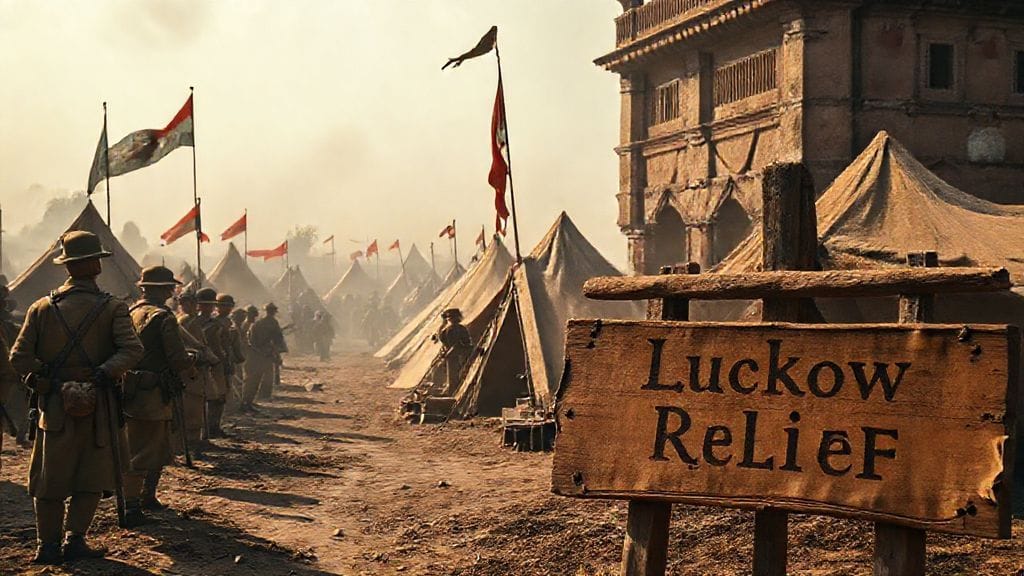
On November 17, 1857, after weeks of grueling combat and significant casualties, Campbell’s forces finally fought their way into the Residency through the heavily fortified Amritsar Gate.
The relief was a mixture of jubilation and exhaustion. The defenders had held on for over four months under siege but were now free from encirclement. Yet the victory came at a cost—hundreds dead on both sides, the Residency damaged, and the city scarred.
Campbell immediately secured supply lines and organized the evacuation of women, children, and the sick, marking the beginning of the end of the siege.
The Aftermath of Relief: From Survival to Withdrawal
Despite the relief, the British did not hold Lucknow permanently at first. Recognizing the precariousness of their position amidst continuous rebel activity and limited manpower, Campbell ordered the evacuation of the Residency by March 1858.
Lucknow itself would later fall back into British hands in the subsequent months, after fierce street fighting and bloody campaigns that destroyed parts of the city.
The immediate post-relief period was a time of reorganization, retribution, and reassessment of British colonial strategies in India.
The Human Toll: Stories of Valor and Tragedy
The siege and relief of Lucknow left scars beyond the physical battlefield. Hundreds of British civilians and soldiers perished; thousands of Indians—rebels, loyalists, and innocents alike—were caught in the brutal crossfire.
Personal accounts tell of extraordinary acts of bravery: women carrying ammunition under fire, sepoys fighting alongside British officers, and medical personnel tending to the wounded with scant resources.
Yet there were dark moments of cruelty and revenge on both sides, reflecting the bitter nature of the conflict. The trauma endured left an indelible imprint on the survivors and the collective memory of India and Britain.
Lucknow in the Broader Context of the 1857 Rebellion
Lucknow’s siege encapsulated the complexity of the 1857 Rebellion. It was a multi-dimensional conflict involving military confrontation, political contestation, cultural assertion, and social upheaval.
While the rebellion ultimately failed to overturn British rule, it galvanized Indian nationalism and forced Britain to reassess its relationship with India. The fall and relief of Lucknow became emblematic of both the heroism and horrors that defined the uprising.
Lucknow was not just a battleground but a symbol of resistance, sacrifice, and the struggle for dignity.
Military Innovations and Challenges During the Siege
The siege witnessed tactical and technological challenges. The utilization of irregular native troops, siege artillery, trench warfare, and guerrilla tactics highlighted the evolving nature of colonial warfare.
British reliance on fortified positions contrasted with the rebels’ mobility and intimate knowledge of local terrain. Both sides adapted and innovated under extreme conditions.
The siege of Lucknow became a case study for military strategists in siegecraft, supply logistics, and urban combat.
The Impact on British Colonial Policies
The experience of the rebellion, and the siege specifically, forced the British government to dismantle the East India Company in 1858, bringing India under direct Crown control.
Policies shifted toward greater military preparedness, cautious engagement with Indian rulers, and reforms aimed at appeasing religious and cultural sentiments.
Yet racial distrust and segregation hardened, introducing a new era of imperial governance characterized by both paternalism and authoritarianism.
Indian Perspectives: Resistance and Resilience
For many Indians, Lucknow was a city of defiance. Leaders like Begum Hazrat Mahal exemplified indigenous resistance to colonial rule, commanding rebel forces and rallying support.
The uprising unified diverse groups—Muslims, Hindus, peasants, soldiers—in a rare coalition born of shared grievance.
While the British narrative often highlighted loyalty and betrayal, Indian perspectives offer stories of patriotism, sacrifice, and the yearning for self-rule.
The Legacy of Lucknow: Memory, Monuments, and Myth
Today, the siege and relief of Lucknow resonate in books, museums, and memorials. The Residency itself stands partly in ruins, a somber testament to the siege.
Every November, stories of courage are retold, heroes commemorated. For British descendants, it is a saga of survival; for many Indians, it symbolizes both colonial oppression and the seed of freedom.
The myths and memories have evolved, reflecting changing political and cultural narratives.
Lessons from Lucknow: Courage Amid Collapse
If there is a lesson from Lucknow’s siege, it is that human resolve persists even amid despair. The defenders held not only through military might but through sheer will, community, and leadership.
The siege also warns of the dangers of cultural arrogance, political miscalculation, and underestimating the power of indigenous resistance.
Lucknow reminds us that history is never merely about dates or battles—it is about people facing extraordinary circumstances and making choices that reverberate through the ages.
Conclusion: The End of an Era and Beginning of Change
The relief of Lucknow in November 1857 was a milestone in a conflict that irrevocably altered the history of India and Britain. It was a victory, yes, but also a herald of transformation.
The siege exposed imperial vulnerabilities and Indian determination in equal measure. The political aftermath redefined colonial rule, planting seeds for future struggles and eventual independence.
History’s voice is clear: Lucknow’s story is one of courage and catastrophe, of empires shaken and identities forged in fire. As we look back, it challenges us to remember the complexity of freedom’s price and the human stories behind the grand narratives.
FAQs About The Lucknow Relief
Q1: Why was the Siege of Lucknow so significant in the 1857 Rebellion?
A1: Lucknow was both a strategic center and symbolic capital of Awadh. The prolonged siege tested British control and Indian resistance, highlighting the rebellion’s scale and complexity.
Q2: Who were the key commanders involved in the siege and relief?
A2: Major-General Sir Henry Lawrence initially defended the Residency; Colonel John Inglis took over after Lawrence’s death. Relief forces were led by General Havelock and later by Sir Colin Campbell.
Q3: How did civilians survive during the siege?
A3: Civilians endured harsh conditions, disease, and shortages, supported by military and non-combatants’ bravery. Women played crucial roles in nursing and defense.
Q4: What was the outcome after the relief of Lucknow?
A4: Although the siege was lifted on November 17, 1857, the British eventually evacuated the Residency due to ongoing rebel threats. Later military campaigns recaptured Lucknow fully.
Q5: How did the siege influence British colonial policies?
A5: It led to the dissolution of the East India Company and the direct administration of India by the Crown, accompanied by reforms and hardened racial policies.
Q6: What role did Indian leaders play in the siege?
A6: Indian leaders like Begum Hazrat Mahal were instrumental in organizing resistance, representing nationalist aspirations against colonial rule.
Q7: Are there surviving monuments related to the siege?
A7: Yes, the ruins of the Residency serve as a monument, along with various museums and memorials commemorating the event and its participants.
Q8: How is the siege remembered differently in Indian and British histories?
A8: British accounts focus on heroism and endurance, while Indian narratives emphasize resistance against colonial domination and the struggle for sovereignty.