Table of Contents
- Introduction
- Early Life in Vienna
- Education and First Steps in Physics
- The Birth of Statistical Mechanics
- Entropy and the Boltzmann Constant
- Struggles for Acceptance
- Teaching and Academic Influence
- Travels and Collaborations
- Personal Life and Character
- The Final Years and Tragic Death
- Legacy in Modern Physics
- Anecdotes and Human Side
- Influence on Future Science
- External Resource
- Internal Link
Introduction
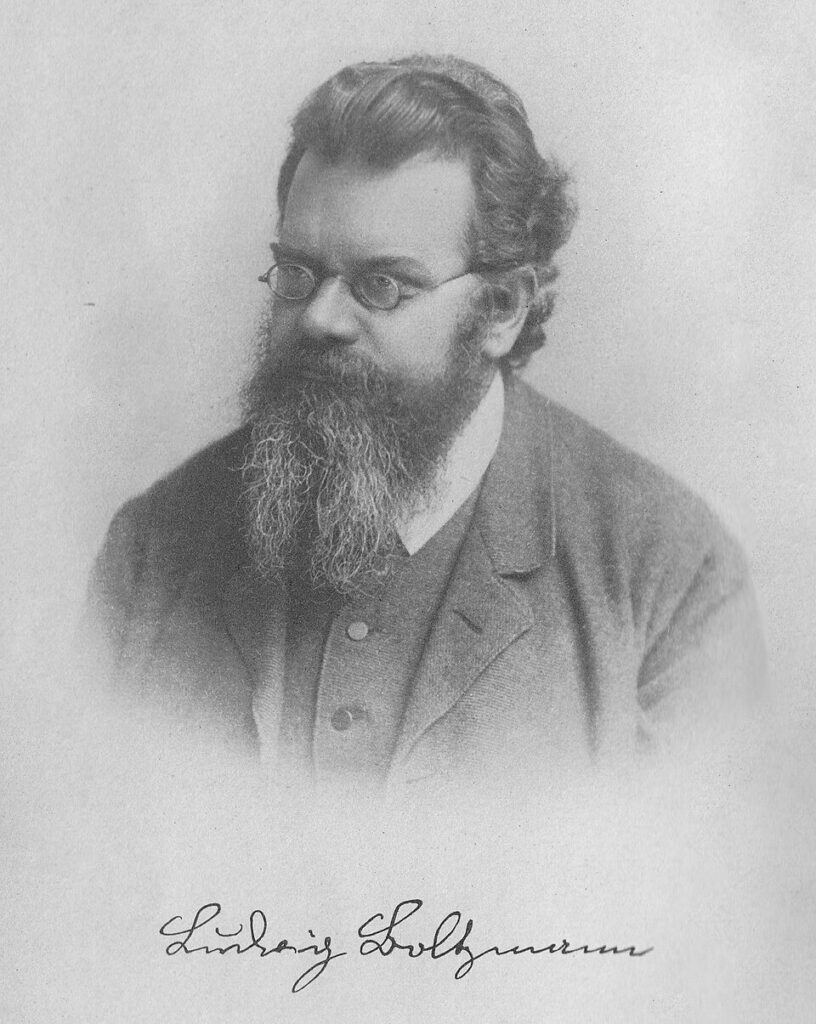
Ludwig Boltzmann’s life was a quest to explain how order emerges from chaos, how the unpredictable motion of countless atoms can give rise to the precise laws of thermodynamics. Born on February 20, 1844, in Vienna, Austria, he became one of the most influential physicists of the 19th century, laying the foundations of statistical mechanics — a framework that connects microscopic particles to macroscopic phenomena. His work would eventually prove indispensable to modern physics, though during his lifetime, it was often misunderstood or rejected.
Early Life in Vienna
Boltzmann grew up in a cultured, middle-class family. His father was a tax official, and his mother came from a musical background. Sadly, he lost his father at the age of 15, an event that deeply affected him. Despite this, young Ludwig showed remarkable aptitude for mathematics and physics.
Vienna in the mid-19th century was a city buzzing with intellectual energy, and Boltzmann’s early education exposed him to the rich tradition of Austrian science and philosophy.
Education and First Steps in Physics
In 1863, Boltzmann began his studies at the University of Vienna, quickly distinguishing himself as a gifted student. By the age of 25, he was already a professor, teaching mathematical physics at the University of Graz. His early research focused on kinetic theory — the idea that gases consist of countless moving particles whose behavior can be described statistically.
The Birth of Statistical Mechanics
Boltzmann’s greatest contribution was the development of statistical mechanics, a theory that bridged the gap between the microscopic world of atoms and the macroscopic laws of thermodynamics. By treating the motion of atoms probabilistically, he could explain temperature, pressure, and other thermodynamic properties as statistical results of molecular motion.
He introduced formulas that remain central to physics today, most notably the famous Boltzmann equation, which describes the statistical distribution of particles in a gas.
Entropy and the Boltzmann Constant
Boltzmann also gave deep physical meaning to entropy, a concept previously introduced by Rudolf Clausius. His statistical interpretation defined entropy (S) in terms of the number of microscopic arrangements (W) that correspond to a macroscopic state:
S = k log W
Here, k is the Boltzmann constant, a fundamental physical constant that now bears his name. This equation, engraved on his tombstone, is one of the most elegant and powerful expressions in science.
Struggles for Acceptance
During Boltzmann’s lifetime, the atomic theory of matter was still controversial. Many influential scientists, particularly in Germany, resisted the idea that atoms were real physical entities. This skepticism meant that Boltzmann’s work often met with fierce opposition, especially from figures like Ernst Mach.
The intellectual battles took a toll on Boltzmann, who was deeply sensitive to criticism. For years, he defended his ideas against those who dismissed them as speculative.
Teaching and Academic Influence
Despite the opposition, Boltzmann was a charismatic teacher. Students admired his passion, humor, and ability to make complex concepts understandable. He held positions at universities in Graz, Leipzig, and finally Vienna, where he inspired a new generation of physicists.
Among his students were scientists who would go on to shape 20th-century physics, building on his statistical approach.
Travels and Collaborations
Boltzmann traveled extensively, visiting England, Italy, and the United States. In England, he met James Clerk Maxwell, whose electromagnetic theory paralleled Boltzmann’s statistical approach in elegance and depth. These meetings broadened his perspective and strengthened the international network of physicists working on the kinetic theory of gases.
Personal Life and Character
Outside the lecture hall, Boltzmann enjoyed hiking, playing the piano, and spending time with his family. He was married to Henriette von Aigentler, with whom he had three children. Friends described him as warm and witty, but also prone to melancholy.
He was a man of contrasts — fiercely logical in his scientific reasoning, yet deeply emotional in his personal life.
The Final Years and Tragic Death
By the early 1900s, the scientific tide was turning in Boltzmann’s favor. Experiments by Jean Perrin and others provided strong evidence for the existence of atoms, vindicating his lifelong work. Sadly, Boltzmann did not live to fully enjoy this recognition.
On September 5, 1906, while vacationing with his family in Duino, Italy, Boltzmann took his own life. The reasons remain debated — a mix of depression, professional stress, and long-standing health issues likely played a role.
Legacy in Modern Physics
Today, Boltzmann is celebrated as one of the giants of physics. His statistical approach underpins much of modern thermodynamics, quantum mechanics, and even information theory. The Boltzmann constant is fundamental in equations that describe everything from gas behavior to blackbody radiation.
Anecdotes and Human Side
One famous anecdote tells of Boltzmann lecturing on entropy to a large class, then suddenly stopping mid-sentence to remark, “If you are not yet confused, you have not understood a word I have said.” It was his way of showing that grappling with complexity is part of learning.
Influence on Future Science
Einstein, Planck, and countless others built directly on Boltzmann’s work. Without his statistical framework, quantum theory might have developed very differently — or much later. In a sense, Boltzmann gave physicists the tools to connect the smallest scales of nature with the grandest physical laws.
External Resource
🌐 Wikipedia – Ludwig Boltzmann