Table of Contents
- The Quiet Dawn at Runnymede: June 15, 1215
- England on the Edge: The Turmoil Before the Magna Carta
- King John’s Reign: A Monarch Under Siege
- The Barons’ Revolt: Seeds of Defiance
- The Road to Runnymede: Negotiations and Tensions
- The Gathering at Runnymede: A Moment Frozen in Time
- The Magna Carta: More Than Just a Document
- The Sealing of the Charter: Ceremony and Symbolism
- Immediate Reactions: Hope and Hostility
- The Charter’s Provisions: A Radical Framework
- The Role of the Church: Archbishop Stephen Langton’s Influence
- The King’s Resentment and the Charter’s Short-Lived Effect
- The First War of the Barons: England in Chaos
- The Legacy of the Magna Carta in English Governance
- The Magna Carta’s Echo through Centuries: From Common Law to Civil Rights
- Women, Peasants, and the Forgotten Voices of 1215
- The Magna Carta in Modern Memory and Myth
- How the Charter Shaped Constitutional Thought Worldwide
- From Runnymede to the Modern Era: Symbolism and Commemoration
- Conclusion: The Enduring Promise of Liberty
- FAQs
- External Resource
- Internal Link
June 15, 1215, dawned with an unusual stillness along the gentle meadows of Runnymede, a stretch of riverside land just west of Windsor. Yet beneath the serene stretch of grass and the whisper of the Thames, a storm of rebellion and hope was taking shape—a storm that would shake the foundations of monarchy and set humanity on an uncharted path toward justice, liberty, and rule of law. By the end of that day, a simple piece of parchment would be sealed, codifying grievances and promises that echoed far beyond its modest 63 clauses. It was the Magna Carta, the Great Charter, forged in tension, sealed in uncertainty, but destined to become a cornerstone of freedom.
England on the Edge: The Turmoil Before the Magna Carta
To understand the gravity of the Magna Carta’s sealing, one must look at England in the early 13th century—a kingdom roiling with discontent. King John, who had ascended to the throne in 1199 following his brother Richard the Lionheart’s death, presided over a realm fraught with internal strife and foreign humiliation. His reign was marked by losses—most notably vast territories in France, public disputes with the Church, extortionate taxation, and perceived cruelty that alienated powerful nobles and common folk alike.
England’s barons, a class of feudal lords controlling vast lands and armed retinues, found themselves squeezed by John’s greed and mistrust. Their outrage culminated in a rare and risky decision: to confront the monarch directly. A coalition formed—comprised of men who had once pledged fealty to their king—and in a defiant show of unity, they demanded redress or rebellion.
King John’s Reign: A Monarch Under Siege
King John’s rule was anything but secure. Nicknamed “Lackland” early on due to the loss of inheritance, he compensated with ruthlessness and cunning. His financial exactions to fund unsuccessful wars, coupled with arbitrary justice that favored royal prerogative over common law, fed widespread resentment. The king’s quarrel with Pope Innocent III over the appointment of the Archbishop of Canterbury led to England’s excommunication in 1209, further undermining his legitimacy.
This chaotic mix fed into a volatile political landscape. By 1215, John’s barons were no longer willing subjects but insurgents determined to wrest concessions from a monarch perceived as tyrannical.
The Barons’ Revolt: Seeds of Defiance
The barons’ rebellion was as much about survival as principle. John’s levies and fines had drained their coffers; his mercenaries threatened their lands. These nobles, many of whom had served loyally before, now joined hands behind closed doors, drafting demands pale in appearance but revolutionary in implication. They sought to guarantee inheritance rights, protect property, limit arbitrary punishment, and curb the king’s unchecked authority.
Negotiations faltered repeatedly, and as tensions mounted, the threat of civil war loomed large. Some historians suggest that it was the threat of outright conflict—as England braced to tear itself apart—that pushed both sides toward a momentous compromise.
The Road to Runnymede: Negotiations and Tensions
Runnymede, that flat meadow by the river, was chosen for its neutrality and accessibility. On a cool June day, King John arrived, armored but uneasy, facing some of the most powerful men in the land. From the very first moments of the meeting, mistrust and urgency hung thick in the air.
Archbishop Stephen Langton, influential and diplomatically skilled, played a pivotal role. Known for his moderate stance, Langton acted as a mediator between rebellious barons and a stubborn king. His ecclesiastical authority lent moral weight to the proceedings, reminding all that the conflict transcended mere politics—it was a quest for justice and order.
The Gathering at Runnymede: A Moment Frozen in Time
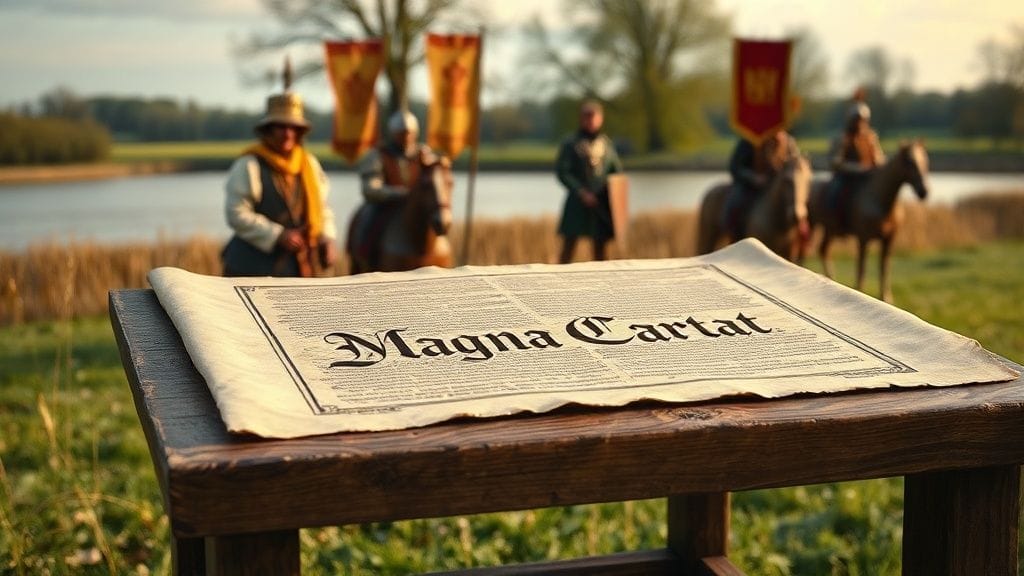
Picture the scene: hundreds of men clad in mail and leather, some carrying banners, assembled under a grey sky. The king, flanked by his advisors, faced his skeptical barons. There was no fanfare, only the hushed murmurs of men weighing fate.
The sealing of the charter was a somber act. King John did not sign but affixed his royal seal—an official stamp denoting authority. This was a medieval signature, bearing immense significance since literacy was rare and a wax seal symbolized the monarch’s public commitment.
The Magna Carta: More Than Just a Document
What emerged was a concise, shockingly forward-looking document. Its language was direct and practical, addressing grievances but also establishing fundamental principles: the king was not above the law; taxation required consent; justice could not be sold or delayed; the protection of church rights was paramount.
The Magna Carta was not a democratic manifesto—far from it. It was a feudal document intended to protect the barons’ privileges and ensure stability, but embedded in its clauses was a latent promise of limits on arbitrary power.
The Sealing of the Charter: Ceremony and Symbolism
The act of affixing the seal, rather than a royal signature, reflected the nature of medieval authority. It was both solemn and strategic: John preserved a semblance of dignity while conceding to demands framed as temporary and pragmatic.
Witnesses included prominent nobles and clerics, all aware of the charter’s potential. For many, this was not the end of conflict but a fragile truce, a pause before the storm.
Immediate Reactions: Hope and Hostility
News spread quickly. For some barons, the Magna Carta was a victory—a symbol of collective strength that tamed a feared monarch. Others in the royal court viewed it as an insidious challenge to sovereignty.
The wider public, including clergy and townsfolk, watched cautiously. For peasants and serfs, the charter meant little directly, but for the future, it planted a seed of legal protections.
The Charter’s Provisions: A Radical Framework
Among the most famous clauses: the right to a fair trial by one’s peers, protections against unlawful imprisonment (prefiguring habeas corpus), and the establishment of a council of barons who would oversee the king’s adherence to the charter.
The document’s scope was wide—addressing feudal fines, inheritance laws, market rights, and the administration of justice. It was an extraordinary attempt to systematize the balance of power.
The Role of the Church: Archbishop Stephen Langton’s Influence
Langton’s role was not merely diplomatic but ideological. He championed the idea that kings were servants of the law and God’s justice, not above it. This ecclesiastical framing provided moral legitimacy to the barons’ cause and reinforced the charter’s vision of lawful governance.
The King’s Resentment and the Charter’s Short-Lived Effect
Despite the grand document, King John quickly resented the restrictions imposed on his power. He sought aid from Pope Innocent III, who annulled the charter later in 1215, branding it “illegal and unjust.” This papal rejection ignited the First Barons’ War, plunging England once more into civil conflict.
The First War of the Barons: England in Chaos
The kingdom became a battleground. Barons invited Prince Louis of France to claim the throne. John’s sudden death in 1216 and the ascent of his nine-year-old son Henry III shifted the conflict dynamics, leading to the charter’s reissuance in later modified forms.
The Legacy of the Magna Carta in English Governance
Though initially a failed peace treaty, the Magna Carta’s clauses were reaffirmed in subsequent reigns. It became a foundational text for English constitutionalism, influencing the evolution of Parliament and legal standards.
The Magna Carta’s Echo through Centuries: From Common Law to Civil Rights
Centuries later, the Magna Carta transcended its medieval context. Its core principles inspired the English Bill of Rights, the American Constitution, and international human rights declarations. It became emblematic of the struggle against tyranny.
Women, Peasants, and the Forgotten Voices of 1215
The charter primarily concerned nobles. Women, peasants, and marginalized groups were largely excluded. Yet, its legacy opened dialogues on justice and rights that would slowly evolve towards more inclusive frameworks.
The Magna Carta in Modern Memory and Myth
Over time, the Magna Carta acquired mythic status—sometimes misunderstood but relentlessly celebrated as the “birth certificate of liberty.” Annual commemorations at Runnymede and worldwide reminder plaques testify to its enduring power.
How the Charter Shaped Constitutional Thought Worldwide
Legal scholars trace modern constitutional principles—from separation of powers to due process—to the Magna Carta. It symbolizes the balance between authority and accountability, a dialogue between rulers and the ruled.
From Runnymede to the Modern Era: Symbolism and Commemoration
Runnymede remains a sacred site for democracy and liberty. From statues to international gatherings, the meadow continues to inspire those who seek freedom under law—an enduring testament to June 15, 1215.
Conclusion
The Magna Carta was born in conflict, sealed in doubt, and sustained by hope. It emerged not as a flawless decree of democracy but as a feudal contract, a cautious first step toward limiting the might of kings. Yet its profound legacy rests in the timeless idea that no ruler is above the law, and every individual deserves protection from arbitrary power.
Every June 15th, when the crowd walks the grass of Runnymede, they are not just remembering a document—they are reclaiming a promise made over 800 years ago. A promise that whispered, sometimes shouted, across centuries: liberty is a fight, but it is a fight worth having.
FAQs
Q1: Why was the Magna Carta sealed at Runnymede?
Runnymede was chosen for its neutral location beside the Thames, accessible to both sides as a meeting ground away from royal strongholds, symbolizing compromise.
Q2: What triggered the barons’ rebellion against King John?
Heavy taxation, unjust treatment in royal courts, loss of lands, and John’s disputes with the Church, especially his excommunication, provoked baronial discontent.
Q3: Did the Magna Carta apply to all English people in 1215?
No, it mainly addressed the interests of the nobles and Church. Peasants and women were largely excluded, though the charter laid groundwork for future rights.
Q4: How soon after the sealing did the Magna Carta come into effect?
Shortly after, King John repudiated it with papal support, leading to war; the charter’s principles survived through reissues and legal tradition.
Q5: Who was Archbishop Stephen Langton, and why was he important?
Langton mediated between barons and king, advocating the concept that the king’s power was bounded by law and divine justice.
Q6: How is the Magna Carta relevant today?
It symbolizes the principle of rule of law, influencing modern constitutional democracies and human rights frameworks globally.
Q7: What role did the Magna Carta play in the development of parliamentary power?
It established the idea that taxation required consent, setting the foundation for Parliament’s role in governance.
Q8: Are there original copies of the Magna Carta today?
Yes, four original 1215 copies survive, preserved in British institutions, treasured as national heritage.

