Table of Contents
- A Crown Amidst Ruins: The Dawn of Majorian's Reign
- The Waning Empire: Italy and Ravenna in the Mid-5th Century
- From Soldier to Sovereign: The Rise of Majorian
- Power Vacuum and Political Turmoil in the Western Roman Empire
- The Path to Ravenna: Majorian’s March to the Throne
- The Coronation Ceremony: Symbolism and Significance in Ravenna
- Majorian’s Early Challenges: Reconciling Factions and Rebuilding Authority
- Military Ambitions: Plans to Reclaim Lost Territories
- The Gothic Dilemma: Allies or Adversaries?
- Majorian and the Senate: Attempts to Restore Imperial Governance
- Religious Undercurrents: Christianity’s Role in Imperial Politics
- Economic Struggles: Financing an Imperial Revival
- Majorian’s Legal Reforms: Justice and Order in a Declining Empire
- The Fleet and Mediterranean Dominance: Naval Preparations
- The Shadow of the Eastern Roman Empire: Relations with Constantinople
- The Vasily of Remembrance: Popular Memory and Historical Legacy
- Twilight of an Emperor: The Fragility of Power in Ravenna
- Consequences for the Western Roman Empire: End of an Era?
- The Ripple Effects Across Europe and Beyond
- Reflections on Leadership in a Time of Collapse
- The Archaeology of Ravenna: Tracing Majorian’s Footsteps
- Modern Interpretations: Historians Debate Majorian’s Impact
- Conclusion: The Luminous Moment Before the Fall
- FAQs: Understanding Majorian’s Crowning and Reign
- External Resource
- Internal Link
1. A Crown Amidst Ruins: The Dawn of Majorian's Reign
The autumn air of 457 A.D. hung heavy over Ravenna, the once-resplendent city now bearing the scars of decades of relentless turmoil. The salt breezes from the Adriatic whispered ancient tales through the mosaic-lined halls, tales of glory and of decline. Within the walls of the imperial palace—the last bastion of Roman authority in the west—an unexpected figure stood poised to carry the empire’s broken hopes: Flavius Julius Majorianus. As the golden diadem was placed upon his head, a hush fell over the gathered nobles and soldiers alike. This moment was more than a coronation; it was a fragile flicker of hope amid the encroaching darkness. In that solemn act, Majorian was crowned Emperor of the Western Roman Empire, a reluctant beacon at the frontier of a world unraveling.
2. The Waning Empire: Italy and Ravenna in the Mid-5th Century
By the mid-5th century, the Western Roman Empire was less an empire than a fractured relic. Once a vast expanse stretching from Britain to North Africa, it had been hollowed out by relentless barbarian invasions, internal strife, and economic decay. Ravenna had replaced Rome as the seat of power, favored for its defensible marshlands and strategic Adriatic ports, yet even this city struggled to cling to the vestiges of imperial dignity.
Italy itself bore the scars of conflict—ravaged farmlands, depleted cities, and a population weary from decades of displacement. The fabric of Roman society was fraying, as Germanic federates entrenched themselves within the empire’s borders, often ambivalent or hostile to central authority. The delicate balance that had once held the empire intact seemed irreparably broken.
3. From Soldier to Sovereign: The Rise of Majorian
Majorian’s ascent was marked not by hereditary claims or senatorial birthrights, but by military prowess and political acumen. Born around 420 A.D. in the provinces of Gaul, he rose through the ranks as a soldier and general, proving himself both brave and strategic. His early campaigns against barbarian incursions made him a respected figure within the dwindling Roman army.
Unlike many aspiring emperors who relied solely on bloodlines, Majorian’s legitimacy was rooted in accomplishment and the trust of his troops. This was a critical advantage in an era when military might often trumped senatorial pedigree. As the old guard faltered, Majorian represented a new breed of leader poised to navigate an increasingly hostile landscape.
4. Power Vacuum and Political Turmoil in the Western Roman Empire
The death of Emperor Avitus in 456 left a power vacuum that intensified the empire’s spiral into chaos. The Roman elite were divided, the military fractured, and regional governors operated more like independent warlords than loyal administrators. In Ravenna, magister militum Ricimer wielded vast influence, effectively kingmaker behind the imperial throne.
Majorian’s candidacy was not without opposition. Ricimer himself had the authority and means to control or depose emperors at will. The tension between Majorian’s ambition and Ricimer’s dominance set the stage for a complex political dance that would shape the remainder of the Western Empire’s twilight years.
5. The Path to Ravenna: Majorian’s March to the Throne
Majorian's road to Ravenna was a testament to his resolve and the fractured state of imperial power. After being proclaimed emperor by his troops in Septimania (modern southern France), he undertook a perilous journey across the Alps to secure his claim. Along the way, he had to negotiate with local rulers and retain the loyalty of his legions.
His arrival in Ravenna was both a demonstration of military strength and political prudence. By securing the support of the Senate and key nobles, he created a facade of legitimacy beyond mere force. This blend of soldierly authority and constitutional respect was crucial in an era when the once-mighty empire was gasping for breath.
6. The Coronation Ceremony: Symbolism and Significance in Ravenna
Majorian’s coronation was held in the Basilica of Saint Apollinaris, a symbolic location connecting the Christian imperial tradition with the city’s historical identity. The ceremony fused Roman ritual with Christian rites, underscoring the empire’s evolving character in the late antique period.
Witnesses wrote of Majorian’s measured demeanor as the crown was placed upon his head, a gesture heavy with expectation and fragile hope. It was a public declaration that, despite despair and disintegration, Rome endured—if only for a moment longer.
7. Majorian’s Early Challenges: Reconciling Factions and Rebuilding Authority
Once crowned, Majorian faced a labyrinth of challenges. The fractured aristocracy was deeply mistrustful, the military weary and scattered, and regional commanders tentative or hostile. Ricimer’s shadow loomed large; although initially cooperative, their relationship was fraught with tension.
Yet Majorian set about restoring centralized control, rallying noble support, reinstating discipline in the army, and attempting to reintegrate rebellious territories. His approach was a mix of stern governance and practical politicking—recognizing that the last hope of the Western Empire lay in unity.
8. Military Ambitions: Plans to Reclaim Lost Territories
Majorian was no mere symbolic ruler. Guided by an ambitious vision, he endeavored to reverse the tide of barbarian encroachment and reclaim lost lands, particularly in Gaul and Hispania. His military reforms included reorganizing the army, building a fleet for Mediterranean operations, and fomenting alliances where possible.
These plans were bold, especially given the depleted resources of the empire. Yet they represented a last desperate assertion of Roman identity in the face of relentless fragmentation.
9. The Gothic Dilemma: Allies or Adversaries?
One of Majorian’s most complex challenges was dealing with the Visigoths and Ostrogoths, powerful Germanic kingdoms established within former Roman territories. These groups oscillated between adversaries and allied federates, creating a precarious diplomatic situation.
Majorian sought to negotiate terms that could integrate these kingdoms into a renewed Roman order or at least neutralize their threat. His efforts highlighted the shifting nature of “Roman” power—no longer an exclusive dominion of Latins, but a political bargain with diverse peoples.
10. Majorian and the Senate: Attempts to Restore Imperial Governance
Restoring the authority of the Roman Senate was another of Majorian’s priorities. Though its power had waned, the Senate remained a vital symbol of Rome’s ancient traditions and a potential source of administrative stability.
Majorian worked to reenergize senatorial participation in governance, attempting to reconcile the aristocracy’s interests with imperial needs. This was a delicate enterprise—the Senate was wary of both military despotism and the ongoing collapse of civil order.
11. Religious Undercurrents: Christianity’s Role in Imperial Politics
By the 5th century, Christianity had become the dominant religion of the empire, profoundly influencing political legitimacy and social cohesion. Majorian’s reign unfolded within this religious transformation, where imperial authority was often intertwined with the Church.
Support from ecclesiastical leaders was crucial for Majorian’s image as a rightful ruler. Yet religious divisions—between Nicene Christianity, Arianism (favored by many Germanic peoples), and lingering pagan practices—complicated the landscape.
12. Economic Struggles: Financing an Imperial Revival
Economic collapse shadowed every facet of the Western Empire. Tax revenues were plummeting, trade disrupted, and infrastructure decayed. Majorian’s government faced the herculean task of financing both administration and military campaigns with scant resources.
Efforts to reform taxation, curb corruption, and mobilize local economies met with mixed success. The challenge revealed the fragility of an empire whose economic foundations had all but crumbled.
13. Majorian’s Legal Reforms: Justice and Order in a Declining Empire
One of Majorian’s often-overlooked legacies was his commitment to legal reform. In an age marked by lawlessness and feudal abuses, he promulgated edicts aimed at restoring order, curbing corruption among provincial officials, and protecting the rights of citizens.
These reforms were part of a broader attempt to reassert imperial justice and moral authority—a reminder that even in decline, Rome sought to uphold its vision of civitas and law.
14. The Fleet and Mediterranean Dominance: Naval Preparations
The Mediterranean was still the lifeline of the empire, and control of its waters meant control of trade, communication, and military reach. Majorian initiated efforts to rebuild a Roman fleet, previously neglected under his predecessors.
This naval resurgence aimed at confronting Vandal piracy based in North Africa, a critical threat that sapped imperial resources and undermined security. The fleet’s construction embodied both Majorian’s ambition and the logistical difficulties facing the empire.
15. The Shadow of the Eastern Roman Empire: Relations with Constantinople
The Eastern Roman Empire, with its capital at Constantinople, survived as a beacon of imperial continuity. Majorian's reign necessitated delicate relations with Emperor Leo I, balancing rivalry with the hope for cooperation.
Constantinople’s backing or indifference could tip the scales for Western survival. Diplomatic correspondence and cautious alliances reflected this geopolitical tightrope, as both halves of the empire navigated mutual decline and rivalry.
16. The Vasily of Remembrance: Popular Memory and Historical Legacy
Majorian was remembered by later chroniclers as a rare competent and virtuous ruler amid the final decades of the Western Empire. His efforts were hailed as a noble, though ultimately unsuccessful, bid to salvage Roman greatness.
Stories of his courage, justice, and military skill echoed in annals and folklore, a testament to the yearning for good governance even in times of chaos.
17. Twilight of an Emperor: The Fragility of Power in Ravenna
Despite his efforts, Majorian’s power remained precarious. In 461, only four years after his coronation, his alliance with Ricimer broke down. The magister militum orchestrated his deposition and subsequent assassination.
This violent end underscored the unreliability of political support in the Western Empire’s twilight, where personal ambition, military clout, and factionalism often eclipsed loyalty to empire or rule of law.
18. Consequences for the Western Roman Empire: End of an Era?
Majorian’s demise marked the acceleration of the empire’s decline. Without his leadership, the Western Roman Empire lost one of its last capable rulers. The power struggles intensified, and territories slipped further from imperial control.
His reign is often seen as the “last hope” of restoration before the inexorable fall culminating in 476 with Romulus Augustulus’s deposition.
19. The Ripple Effects Across Europe and Beyond
The fate of Majorian and the Western Roman Empire rippled beyond Italy. Barbarian kingdoms consolidated power, new political entities emerged, and the map of Europe was fundamentally redrawn.
His attempts at revival influenced later medieval notions of kingship, sovereignty, and Roman legacy, bridging antiquity and the Middle Ages.
20. Reflections on Leadership in a Time of Collapse
Majorian’s story invites reflection on leadership under crisis—how vision, courage, and reform efforts can confront overwhelming odds. His mixture of military skill, legal reform, and political maneuvering offers a case study in the challenges faced by declining states.
The poignancy of his brief reign speaks to the human desire for order and justice amid chaos.
21. The Archaeology of Ravenna: Tracing Majorian’s Footsteps
Archaeological excavations in Ravenna shed light on the city’s imperial past during Majorian’s era. Remnants of palaces, fortifications, and Christian basilicas speak to the cultural and political environment in which he ruled.
These material traces enrich our understanding of the late empire’s urban life and imperial complexity.
22. Modern Interpretations: Historians Debate Majorian’s Impact
Historians remain divided over Majorian’s role—was he a brilliant but doomed reformer or merely a fleeting figure in a larger process of decline? Recent scholarship emphasizes his realistic attempts to restore imperial authority, while some critique his underestimation of internal political enemies.
This debate reflects broader questions about the nature of decline and resilience.
23. Conclusion: The Luminous Moment Before the Fall
Majorian’s crowning in Ravenna was a rare luminous moment in the Western Roman Empire’s protracted twilight. It represented an ember of hope, a last assertion of Roman identity, and the embodiment of leadership striving against dissolution.
Though his reign was brief and fraught, it remains a poignant chapter demonstrating that history is not merely the story of inexorable collapse but of human resolve, ambition, and the complex dance of power.
Conclusion
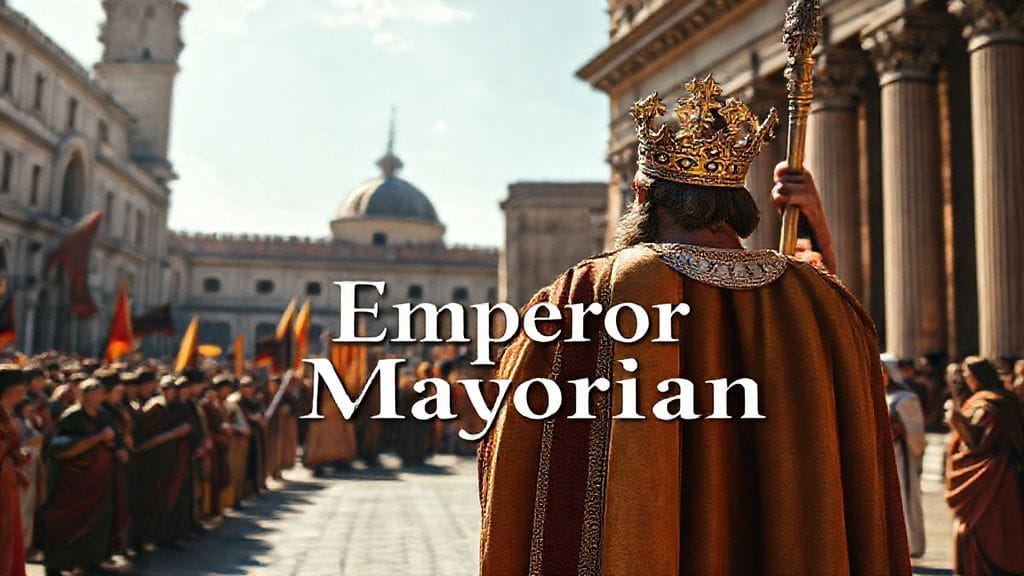
The image of Majorian crowned emperor in Ravenna conjures a profound tableau: a man, elevated amid ruins, attempting to revive the greatness of an empire long past its zenith. His story is one of courage amid collapse, of determined leadership wrestling with forces far beyond individual control.
Majorian’s reign was a fleeting but powerful attempt to reforge Roman unity, law, and military strength in an era dominated by fragmentation and turmoil. His efforts remind us that history is shaped not just by vast impersonal forces, but by the choices, hopes, and tragedies of singular figures.
The lessons from his reign resonate today, offering insights into resilience, the fragility of political order, and the enduring human desire to restore order amid chaos. Majorian’s crown in Ravenna was not just a symbol of authority—it was a beacon, however brief, that illuminates the shadows of empire’s twilight.
FAQs
Q1: Who was Majorian and why was he significant?
A1: Majorian was a Roman general who became Western Roman Emperor in 457 A.D. He is significant for his military skill, legal reforms, and attempts to restore the declining empire’s authority during its final decades.
Q2: Why was Ravenna chosen as the coronation site?
A2: Ravenna was the administrative and military capital of the Western Roman Empire by the mid-5th century, chosen for its defensible location and political importance after Rome’s fall.
Q3: What were Majorian’s main objectives as emperor?
A3: His objectives included military reconquest of lost territories, restoring centralized governance, legal reforms, rebuilding the imperial fleet, and navigating complex relations with barbarian kingdoms.
Q4: How did Majorian’s reign end?
A4: His reign ended in 461 when Ricimer, the powerful magister militum, deposed and assassinated him, underscoring the instability of imperial power in the late Western Empire.
Q5: What was the significance of Majorian’s legal reforms?
A5: The reforms aimed to restore order, curb corruption, and reinforce imperial justice, demonstrating a commitment to Roman law and governance even in decline.
Q6: How did Majorian interact with the Eastern Roman Empire?
A6: Majorian maintained cautious diplomatic relations with Constantinople, balancing rivalry and cooperation, as both halves of the empire faced shared challenges.
Q7: What legacy did Majorian leave behind?
A7: Though his efforts ultimately failed, Majorian is remembered as one of the last competent Western Roman emperors and a symbol of the empire’s final struggle to survive.
Q8: How do modern historians view Majorian’s reign?
A8: Historians consider him a capable reformer and military leader, with debates centering on his realism and the inevitability of the Western Empire’s fall despite his efforts.

