Table of Contents
- A City Holding Its Breath: Rome on the Eve of a New Reign
- From Orphans to Heirs: The Early Lives of Marcus Aurelius and Lucius Verus
- Hadrian’s Grand Design: Adoption, Succession, and an Unfinished Plan
- Antoninus Pius and the Long Interlude of Peace
- The Deathbed of an Emperor: February–March 161 in Lorium and Rome
- The Senate Convenes: A Single Emperor or Two?
- The Day of Decision: 7 March 161 and the Making of Co-Emperors
- Two Men, One Empire: Character, Temperament, and Reputation
- Power Shared: Titles, Offices, and the Architecture of Co-Rule
- In the Shadow of the North: Rome’s Frontiers on the Brink
- The Parthian Storm: Lucius Verus Marches East
- Letters, Legions, and Strategy: Marcus Aurelius Governs from Rome
- Victory with a Hidden Cost: Triumph, Disease, and the Antonine Plague
- Family, Court, and Scandal: The Human Drama Behind the Purple
- The Death of Lucius Verus and the End of a Dyad
- Philosopher and Partner: How Marcus Remembered the Co-Emperor
- The Legacy of a Shared Throne in Roman Political Imagination
- Echoes Through History: Co-Emperors, Co-Rulers, and the Problem of Power
- Conclusion
- FAQs
- External Resource
- Internal Link
Article Summary: On 7 March 161, the Roman world awoke to a political experiment both daring and deeply rooted in imperial tradition: the joint elevation of Marcus Aurelius and Lucius Verus as co-emperors. This article traces their parallel paths from vulnerable orphans to the summit of power, guided by Hadrian’s complex succession design and shaped under the long, steady rule of Antoninus Pius. It explores how the partnership of marcus aurelius and lucius verus was forged in necessity, tested by the Parthian War, and darkened by the arrival of the Antonine Plague. Through cinematic scenes—from nervous senatorial debates in Rome to harsh campaigns in Armenia and Mesopotamia—the narrative reveals the human tensions beneath the official harmony. By weaving political history with personal detail, it shows how their dual reign preserved stability while also inaugurating new forms of imperial collaboration. The article examines how triumph, disease, and death redefined both men’s legacies, and how Marcus, the philosopher, later reflected on power, loss, and duty. Finally, it assesses how the unique experiment of marcus aurelius and lucius verus influenced later Roman co-rulership and still speaks to modern anxieties about shared authority, loyalty, and leadership.
A City Holding Its Breath: Rome on the Eve of a New Reign
On a cool early March morning in the year 161, Rome felt oddly suspended in time. The streets were not yet thronged with the full roar of the day, but the city was already awake. Bakers were rolling dough in cramped, smoky shops. Porters wound through alleys with baskets of dates and amphorae of oil. The Tiber, sluggish and brown, lapped against worn stone embankments. Yet above this ordinary bustle, something tense and electric hung in the air. News had spread in whispers and half-heard rumors: Antoninus Pius, the emperor who had governed so gently and so long, was dead.
No proclamations had yet been nailed to the rostra in the Forum. No heralds had cried the formal words that would echo beneath the colonnades. But Rome knew. The city always knew. A few senators in stiff white togas hurried together up the Palatine slopes, faces grave, not daring to speak more than a few words before falling silent again. On the Capitoline Hill, where Jupiter looked down over the city from the great temple, priests waited for instructions they had rehearsed only in theory for over two decades. The empire stood between rulers, between breaths.
In the days ahead, the world would learn a new phrase, murmured in marketplaces and inscribed in official documents: Imperatores Caesares Marcus Aurelius Antoninus Augustus et Lucius Aurelius Verus Augustus. For the first time, Rome would learn to speak two imperial names together not as rivals, but as partners. The accession of marcus aurelius and lucius verus as co-emperors was about to become an official fact, but on this threshold morning, it was still only a possibility, half shaped, uncertain, fragile.
Imagine, then, somewhere on the Palatine, Marcus Aurelius, forty years old, exhausted and red-eyed, rising before dawn to prepare himself for what was coming. No crowd roared for him yet. No laurel had been placed upon his head. He may have still worn the plain, slightly worn toga of a senator, as he had done the day before, when he was just the emperor’s heir apparent. He had grown used to responsibility—years of it, in fact—but not to this: the knowledge that the weight of the entire Roman world could be his alone by noon.
Elsewhere in the city, perhaps in the same cluster of palaces or in another residence heavy with tapestries and busts, Lucius Verus, ten years younger, might have met the morning differently. More sleep, perhaps. More uncertainty too. He was the son of a man who had once been poised to rule, but fate and adoption had rewritten his destiny. He had lived in Marcus’ shadow, sharing some honors, watching others pass by. On this day, he could not know that history would entwine their names so tightly that centuries later, scholars and storytellers would speak of marcus aurelius and lucius verus in a single breath, as if co-emperorship had always been their shared fate.
But this was only the beginning. The decision that awaited the Senate—not simply to confirm an heir, but to create a partnership at the very apex of Roman power—would send quiet shockwaves through the empire, from the misty frontiers of Britain to the desert fortresses facing Parthia in the East. It would test the flexibility of Rome’s political imagination, its capacity to reconcile monarchical power with republican memory. And in ways no one on that March morning could foresee, it would entangle these two men in a chain of events that would lead to war, pestilence, and a profoundly altered empire.
From Orphans to Heirs: The Early Lives of Marcus Aurelius and Lucius Verus
To understand why their joint elevation mattered so deeply, one must begin much earlier, in two households softened and scarred by early loss. Marcus Annius Verus, who would become Marcus Aurelius, was born in 121 into a prosperous and politically powerful family of Spanish origin. His father died when Marcus was young—perhaps only three—and the boy’s childhood unfolded under the careful supervision of women and uncles who saw something unusual in him: a gravity, a self-containment, a tendency to retreat inward and think.
He was adopted in spirit long before he was adopted in law. The emperor Hadrian, that complex, restless figure who ruled from 117 to 138, noticed the boy early, delighting in his quiet potential. According to later biographers, Hadrian even gave Marcus pet names and pushed him along a carefully arranged educational path. Tutors taught him Greek and Latin with equal rigor. Rhetors trained his voice and gestures. Philosophers, especially Stoics, taught him to look with suspicion on luxury and to prize inner virtue over outward splendor. The child who might have grown into a typical aristocrat instead learned to be a self-scrutinizing observer of his own mind.
Lucius Verus’ childhood had its own trauma, its own redirection. He was born Lucius Ceionius Commodus in late 130 or early 131, son of Lucius Aelius Caesar, the man Hadrian originally chosen as his successor. Lucius grew up with the awareness that his father stood in line to inherit the empire, surrounded by expectation and ambition. But fate intervened cruelly. In early 138, before Hadrian died, Aelius fell ill and was gone. Lucius was seven or eight. In an instant, the path before him dissolved.
The difference in their early experiences left subtle marks on both future emperors. Marcus had the calm, steady support of a family that, while bereaved, was rooted in Rome’s senatorial elite and dignified by a long run of success. Lucius had the memory of seeing promise snatched away, of watching others—older, more strategically placed—claim the role that had once hovered above his own cradle. The disappointment of a family’s unfulfilled imperial aspirations would live under his skin.
Yet fate, and Hadrian’s last-minute improvisations, would entwine their stories. The emperor, ill and embittered in his final months, revised his plans. He adopted Antoninus Pius as his immediate heir but attached a remarkable condition: Antoninus himself must adopt two boys, Marcus and Lucius. It was a brilliant, if enigmatic, arrangement—one that turned the boys into stepbrothers and future partners long before the word co-emperors entered anyone’s vocabulary.
Hadrian’s Grand Design: Adoption, Succession, and an Unfinished Plan
Hadrian’s decision to hinge the future of Rome on a doubly adopted family has fascinated historians for centuries. It shows the strangely personal nature of Roman imperial succession, where blood, popularity, and political pragmatism collided. On paper, the sequence looked almost elegant: Hadrian to Antoninus Pius, then to Marcus, with Lucius in an important, if secondary, role. But behind that neat outline lay fears, calculations, and unfinished ideas.
By 136–137, Hadrian felt his own mortality pressing down. His health deteriorated; his moods darkened. He named Lucius Aelius Caesar his successor, perhaps thinking that younger blood and a strong family network would secure the empire. Aelius’ death forced him back to the drawing board. He turned to Titus Aurelius Fulvus Boionius Arrius Antoninus, a calm, respected senator in his early fifties, and adopted him in February 138. To this adoption he attached a condition that looks, in retrospect, like the beginning of an experiment: Antoninus must adopt Marcus and Lucius.
Some scholars argue Hadrian intended a delicate balance: Marcus, older, more serious, destined to be emperor; Lucius, younger, perhaps more suited to military command, intended as a junior partner or complementary figure. Others see more improvisation than strategy, a dying ruler trying to bind key families to his posthumous will. Yet whatever Hadrian’s exact design, he laid out the framework that would later make the co-rule of marcus aurelius and lucius verus possible, even natural, in the eyes of Rome’s elite.
Adoption in Roman politics was never simply an act of affection. It was a mechanism through which power, prestige, and patronage could be directed beyond the accidents of biology. When Antoninus Pius accepted both boys into his family, giving Marcus the name Marcus Aelius Aurelius Verus and Lucius a series of names that would eventually settle into Lucius Aurelius Verus, he was doing more than reshaping a household. He was creating a new dynastic language in which the empire itself could be “adopted” into hands thought best suited to guard it.
Yet behind the celebrations, something remained unresolved. How exactly would two adopted heirs stand in relation to each other when the time came? Would Marcus be the obvious sole successor and Lucius merely a decorated subordinate, or would they share the purple? Hadrian did not specify—or, if he did in some private instructions, those instructions did not survive. The unanswered question would hang over the next two decades, waiting for the day when Antoninus Pius’ long peace would finally end.
Antoninus Pius and the Long Interlude of Peace
Antoninus Pius’ reign, from 138 to 161, is sometimes dismissed as uneventful, even dull—a long plateau of stability between the dynamic peaks of Hadrian and Marcus Aurelius. Yet for Marcus and Lucius, it was a formative landscape, a school of governance conducted not in battles and crises but in routines, paperwork, and moral example.
Antoninus rarely left Italy. He preferred the calm order of the peninsula to the strain of inspecting distant frontiers. From a certain angle, this sedentary preference looks like negligence, but the evidence suggests something more deliberate: a quiet confidence in the machine of empire, a belief that competent governors and legates could handle slow-burning problems without an emperor’s theatrical presence. Under his watch, the treasury remained healthy, the administration efficient, and the legal system surprisingly humane. It is no coincidence that later, when Marcus wrote in his Meditations about gratitude toward those who shaped his character, he dwelt with special warmth on Antoninus’ self-control, fairness, and simple dignity.
For Marcus, the years under Antoninus were a marathon of preparation. He held a series of offices—quaestor, consul, priestly roles—that sharpened his understanding of law, precedent, and ritual. He shared in judicial responsibilities. He sat alongside Antoninus when the emperor heard petitions or judged disputes, absorbing not only the outcomes but the manner in which they were reached. He learned the weight of silence before speaking, the power of a well-chosen word in the Senate, the importance of seeming predictable in an unpredictable world.
Lucius followed a different track. Younger by a decade, he matured later, and Antoninus treated him with a lighter touch. Honors came his way: he was made consul, he enjoyed the status his lineage afforded. But he was not immediately pressed into the same depth of responsibility as Marcus. Sources hint that Lucius developed a taste for pleasures Marcus regarded with suspicion—games, performances, hunting, and later, when he was older, a more lavish social life. The contrast in temperaments that would define their co-rule began to crystallize in these uneventful years.
And yet, there were signs of coming trouble. On the northern frontiers, pressure from Germanic and other tribes was building, not yet a roar but a slow, grinding push that would one day test Roman arms and Roman nerves. In the East, the Parthian Empire watched Roman moves with patient hostility, particularly in the contested region of Armenia, a perennial chessboard between the two powers. Antoninus, committed to peace where possible, preferred diplomacy, client kings, and limited shows of force. The sword remained sheathed more often than not.
For a generation of Romans, this seemed normal. No emperor had died in battle or on campaign since Trajan. The idea that war on a large scale might return—and with it, the need for an emperor to lead armies personally—felt distant. Yet beneath the polished surface of Antoninus’ long reign, the structures that would invite the experiment of joint rule were slowly being set in place. Rome was becoming a world so vast, so interconnected, that one pair of hands at the helm might no longer be enough.
The Deathbed of an Emperor: February–March 161 in Lorium and Rome
The end, when it came for Antoninus Pius, came quietly, almost in keeping with the rest of his life. Around February 161, he fell ill at his estate in Lorium, along the Via Aurelia west of Rome. The details are hazy, filtered through biographers writing years later, but the broad outlines are compelling. The emperor, in his mid-seventies, weakened by fever or some long-concealed ailment, called for the few people who mattered most: family, advisors, and, above all, his adopted son and heir, Marcus.
Some accounts preserve a striking scene. On the final night, after eating a piece of cheese, Antoninus allegedly developed a high fever. Realizing the end was near, he gave the statue of Fortune, which he kept in his bedroom, to the official charged with overseeing the sacred standards of the cohorts stationed in Lorium, as if handing over the luck of the empire itself. Then, when asked about the succession, he did not pause or hesitate. He reportedly uttered a single Latin word: “Equanimiter”—“with even mind,” referring to how Marcus would face what lay ahead. Others say he simply named Marcus as the man worthy to command.
Whatever the precise words, the intent was clear. On 7 March 161, as news of Antoninus’ death reached Rome, Marcus was the designated heir. The expectation among many was straightforward: the Senate would formally confirm him as sole emperor, as it had done for each of his predecessors since the founding of the Principate under Augustus. The pattern was familiar: one man at the center, with subordinates but no equals. The empire, deeply hierarchical, had never fully embraced genuine power-sharing at the top.
And yet, alongside mourning, another current of thought was active among Rome’s elite. What of Lucius? For years, he had been part of the design, however secondary. Was he to be sidelined entirely? Given a lesser title that acknowledged his lineage but denied real power? Or—and this was the daring possibility—could he share the imperial office?
Marcus, summoned to Rome if he was not already there, would have felt the press of eyes upon him: senators, equestrians, officers, and family members all waiting to see not just if he would take the diadem, but whether he would share it. He had no children old enough to rule with him; Commodus, his future heir, was still a toddler. He himself bore the weight of public expectation, personal conscience, and philosophical training that urged humility. And in the background loomed Hadrian’s legacy, that complex web of adoptions that had shaped his own rise.
The Senate Convenes: A Single Emperor or Two?
The Senate’s meeting in early March 161 was more than a formality; it was a stage on which Rome’s political imagination would be tested. Senators gathered beneath the gilded ceilings and marble columns, aware that the world beyond those walls waited for the familiar script: mourn the departed, then acclaim the new Augustus. But this time, lines were missing, and the key actor—Marcus—was about to improvise.
When the Senate offered him the imperial title, Marcus did what all his predecessors had done, at least in appearance: he feigned reluctance. This ritual modesty was part of the political theatre of Rome. To grasp too eagerly at power risked recalling the hated memory of tyrants. Marcus, trained in self-restraint and painfully aware of the moral stakes of authority, may have felt a genuine inner hesitation that made his outward reluctance all the more convincing.
But here the familiar pattern broke. Marcus conditioned his acceptance. He insisted that Lucius Verus must share in the same imperial honors, not as a subordinate with a lesser title, but as a co-emperor—Augustus in his own right. In that moment, the carefully balanced succession design of Hadrian, extended and softened by Antoninus, reasserted itself. Marcus’ decision was both an act of loyalty to his adoptive family and a political move that diffused potential resentment among those who still remembered that Lucius was the natural son of Hadrian’s first chosen heir.
It is astonishing, isn’t it? In a world accustomed to supreme singular power, the man trained to be emperor asked to share. Some senators may have stiffened, worried about precedent, about rivalry, about the possibility that two emperors might one day draw swords against one another as armies chose sides. Others, perhaps more attuned to the pressures on Rome’s vast frontiers, saw wisdom in dividing duties: one emperor in Rome, one in the field; one mind steeped in philosophy and law, another in command and action.
One ancient biographer, the author of the Historia Augusta, later wrote that Marcus “did not think it reasonable, after he had himself been reared with Lucius, to hold the empire alone.” That source, though flawed and filled with embellishments, catches something true about the moment. Marcus’ sense of justice, his awareness of history’s gaze, and his personal affection for Lucius all converged. The Senate, after some debate, conceded. The experiment would proceed. Rome would have not one but two Augusti.
The Day of Decision: 7 March 161 and the Making of Co-Emperors
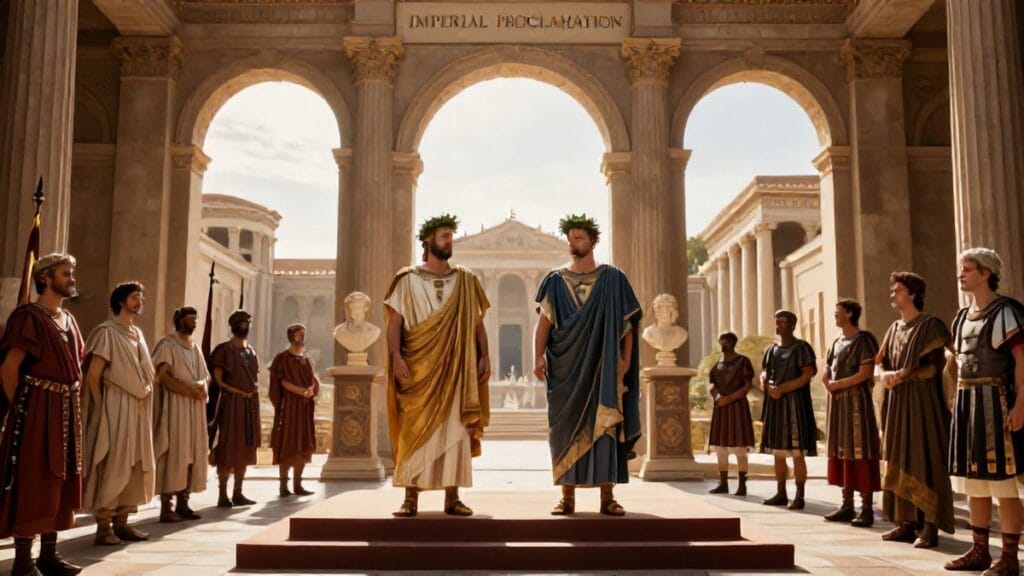
So the day became official—7 March 161, a date that could have passed like any other in Rome’s long calendar, instead crystallized into a hinge of history. Somewhere between the Palatine palaces and the Senate House, the decision turned from discussion to decree. Proclamations were drafted. Scribes scratched new formulas onto tablets and papyrus. Orders went out to mint new coins bearing not one but two imperial portraits. Across the empire, governors would soon receive letters announcing that the world now had Marcus Aurelius Antoninus Augustus and Lucius Aurelius Verus Augustus at its head.
The ceremony itself is largely lost to us, dissolved into a few hints. We can imagine, though, the formal bestowal of titles and the granting of imperium and tribunician powers to both men. Marcus, as the senior, took precedence: he was made Pontifex Maximus, chief priest of Rome, assuming the religious mantle that symbolized the emperor’s role as mediator between human and divine. Lucius received equal imperial rank but not the supreme priesthood. In subtle ways like this, hierarchy remained within equality, giving the partnership structure and preventing complete symmetry, which Romans might have found unsettling.
Outside the elite spaces, how did ordinary Romans react? In the Forum, a vegetable seller passing news from a literate neighbor might have said, “Two emperors now, they say.” A customer, suspicious, might have spat back, “Two? So we pay taxes for two palaces to be gilded?” Another, more hopeful, could have replied, “Two emperors, two pairs of eyes on the frontiers. Perhaps the Germans and Parthians will think twice now.” Public opinion, never monolithic, adapted itself quickly. After all, as long as grain arrived, the games were staged, and the city’s rhythms continued, the shape of the imperial household was a distant abstraction.
But on Rome’s margins—in distant camps along the Danube, in Syrian and Egyptian garrisons, in the homes of provincial elites who had invested heavily in imperial networks—the news carried real weight. Loyalty oaths would now name two Augusti. Coin portraits, sacred and ubiquitous, would show two faces. When orders came, which emperor’s name would they bear? How would soldiers and local leaders navigate this duality if contradictions emerged?
For the moment, though, the experiment had a glow of idealism. It seemed to embody something noble: power shared rather than hoarded, fraternal bonds elevated to political principle. In the formal inscriptional language of the day, Rome proclaimed continuity—another peaceful transition, another member of the adoptive lineage on the throne. But beneath that polished continuity lurked new questions. Could two human beings, with their different desires, fears, and weaknesses, really share the purple without tearing it?
Two Men, One Empire: Character, Temperament, and Reputation
To follow the story from here, one must keep clearly in mind who these two men were, not just as names in textbooks but as distinct personalities. Marcus Aurelius, from all accounts—including his own voice in the Meditations—was introspective, conscientious, often burdened by the sense that he must live up to immense moral expectations. He loved philosophy not as a fashionable pastime but as a way of life; the Stoic discipline of examining impressions, regulating emotions, and aligning one’s will with reason had become for him a daily regimen. He dressed simply for an emperor, worked long hours on administration, and disliked ostentatious flattery.
Lucius Verus, by contrast, stepped more easily into the outward trappings of imperial luxury. He enjoyed the theatre, chariot races, hunting, and the company of performers and courtesans. He cultivated a more glamorous image, growing out his hair and beard in a style that drew comment. Some sources accuse him of indulgence and idleness; others, more charitable, depict a man of average virtue and reasonable ability, overshadowed by comparison with the philosopher-emperor beside him. In any case, the public perception diverged: Marcus, the sober moralist; Lucius, the golden youth.
The Roman historian Cassius Dio, writing a generation later, suggests a tension disguised as harmony. Marcus, he says, “administered everything with the greatest thoroughness and care,” while Lucius “took part in the more agreeable and easier duties.” Yet Dio also notes that Marcus never openly reproached Lucius and defended him against criticism, preferring to preserve harmony at the top than to risk scandal by exposing differences. The co-emperors, aware of how fragile dual rule could be, seem to have worked deliberately to display unity.
This difference in temperament would, paradoxically, become one of the strengths of their joint reign once war came. Someone would need to stay in Rome to manage the bureaucracy, hear petitions, and maintain religious and civic order; someone else could journey east, accepting the harsh discomforts and unpredictable dangers of campaign life. It is perhaps no accident that when the Parthian crisis flared, it was Lucius—the more physically vigorous, the less tied to the routines of governance—who went.
Still, the juxtaposition of their characters, and the way Rome judged them, tells us much about what the empire expected from its rulers. Marcus consciously modeled himself on a line of adoptive emperors held up as paragons of moderation and justice—Trajan, Hadrian, Antoninus Pius. Lucius, in the public imagination, sometimes drifted closer to older, more ambiguous figures like Nero or Domitian—not tyrants in his case, but men associated with courtly pleasures. That the partnership of marcus aurelius and lucius verus endured without open rupture is itself a tribute to how carefully they managed these differences.
Power Shared: Titles, Offices, and the Architecture of Co-Rule
Co-rule, to work at all, needed not just good intentions but structure. The Romans were nothing if not formalists; they believed that offices, titles, and ritual precedence could channel human rivalry into predictable patterns. From 161 onward, official records testify to the delicate architecture of the shared empire.
Both men held the title Augustus, the supreme honor first crafted for Octavian centuries earlier. Both possessed imperium maius, supreme command over the empire’s armies and provinces, and tribunician power, the theoretical foundation of their legislative authority. In inscriptions and edicts, their names appeared side by side, Marcus usually first, reflecting his senior status and earlier adoption.
Yet Marcus retained certain roles exclusively. As Pontifex Maximus, he alone carried the ultimate responsibility for Rome’s religious life. In coinage, his portrait often occupied the obverse, with Lucius on the reverse or appearing in parallel issues. Statues depicted them together, sometimes with concord personified between them, an embodied wish that harmony would endure.
Administrative tasks were divided in practice more than in law. Marcus dominated the day-to-day management of the civil administration, law courts, and senatorial relations. Lucius took a more visible role with the army once the eastern war began. But neither was ever stripped of full imperial status. There was, at least in theory, no “junior emperor” here, no Caesar under an Augustus, as would become more common in later imperial arrangements. Both were Augusti, and Roman subjects were expected to revere and obey them equally.
This formal equality paired with practical differentiation was Rome’s compromise. It allowed the empire to have, in effect, a “home” emperor and a “field” emperor without legally diminishing either. It also pushed the experiment of marcus aurelius and lucius verus beyond mere symbolism. They were not simply co-princes smiling from marble; they were genuinely engaged in governing different aspects of a single, immense organism.
There were risks, of course. Conflicting orders could, in theory, paralyze governors or generals caught between two commands. Factions might develop, aligning with one emperor or the other. Yet in these early years, there is little evidence of such conflicts. Perhaps the sheer momentum of Antoninus Pius’ orderly reign carried over, smoothing the transition. Perhaps, too, the looming threat in the East forced cooperation; events beyond Rome’s control were about to test the new arrangement in unforgiving ways.
In the Shadow of the North: Rome’s Frontiers on the Brink
No emperor, not even one who loved books and meditation, could forget the map. Stretching from the windswept coasts of Britannia to the baked sands of Egypt, from the Atlantic shores of Hispania to the turbulent rivers dividing Rome from Persia and northern tribes, the empire’s frontiers were both its pride and its anxiety. By 161, cracks were visible.
In the north, along the Rhine and Danube, a loose and shifting array of peoples—Marcomanni, Quadi, Sarmatians, and others—watched the empire’s wealth with a mixture of resentment and desire. Trade flowed across the borders; so did migrants, mercenaries, and rumors. Sometimes Rome recruited warriors from these regions into its auxiliary forces, turning potential enemies into partners. But the balance was fragile. Any sign of imperial weakness could invite raids, then wars.
In the East, Rome and Parthia had been staring at each other across a contested middle ground for nearly two centuries. Armenia, perched between the two superpowers, was the classic flashpoint. Whoever controlled Armenia’s throne could claim a strategic advantage, threatening or safeguarding the approaches to Syria and Cappadocia, the eastern bulwarks of Roman Asia Minor. Under Antoninus Pius, diplomacy had kept the peace, but it was a brittle peace with old grievances buried just under the surface.
Marcus, as he settled into his role in 161, knew all this. He had read histories of earlier emperors—Trajan’s bold eastern campaigns, Hadrian’s decision to pull back and consolidate. He understood that leadership in Rome was ultimately judged by how well its frontiers held. Lucius, for his part, may have seen in the possibility of command a chance to define himself beyond the shadow of his philosophic brother, to win military glory and perhaps some of the popular admiration that traditionally attached to successful war leaders.
The stage was thus set when news arrived from Armenia: a new Parthian king, Vologases IV, had moved to replace a Roman-friendly ruler with his own candidate, effectively seizing the buffer state and daring Rome to respond. This was not an isolated local quarrel. It was a calculated challenge. Parthia was watching the experiment of marcus aurelius and lucius verus. Would two emperors mean indecision—or twice the force?
The Parthian Storm: Lucius Verus Marches East
The answer, at least in appearance, came quickly. Rome would fight. The Senate and emperors agreed that the insult in Armenia could not stand. Rome’s prestige, and its claim to protect client kingdoms, demanded a military response. Yet practically, someone had to go. Marcus, bound to Rome by the dense web of administrative duties and perhaps limited by health—sources hint at chronic illness, possibly a weak chest or stomach—stayed in the capital. Lucius was dispatched east, the empire’s youthful war-leader.
It was a calculated move. Lucius’ physical vigor, enjoyment of martial display, and lesser entanglement in legal and civic matters made him the more obvious choice. The propaganda practically wrote itself: two emperors, each in his place—one guiding the state at home, the other defending it abroad. In 162, Lucius left Rome amid processions and cheers, his departure framed as a grand act of duty and courage.
Yet behind the celebrations, some must have whispered doubts. Lucius’ reputation for indulgence and love of pleasure followed him, as did skepticism about his discipline. Would he prove equal to the harsh demands of eastern warfare, where supply lines stretched over deserts and mountain passes, and where Parthian archers, famed for their mobility, could harass Roman legions endlessly?
In practice, as modern historians like Michael Grant and others have argued, Lucius rarely commanded personally on the front lines. Instead, he delegated much of the actual campaigning to capable generals—Statius Priscus, Cassius, and others—while he himself often remained in cities like Antioch, overseeing strategy, receiving reports, and, if his critics are to be believed, indulging in the entertainment such cosmopolitan centers could provide. One ancient source snipes that he spent too much time at games and banquets, hunting and feasting while his legions bled.
But that characterization is not entirely fair. Lucius’ very presence in the East signaled Rome’s seriousness. It allowed a direct imperial eye on logistics, morale, and negotiations. Under his nominal command, Roman forces moved into Armenia, deposed the Parthian-backed king, and installed a new ruler friendly to Rome. From there, they pressed into Mesopotamia, striking deep into Parthian territory. By 165–166, Roman arms had captured Ctesiphon, the Parthian capital, and Seleucia on the Tigris, a major city. Triumph, it seemed, belonged not just to Marcus in Rome but also to Lucius in the field.
The co-rule of marcus aurelius and lucius verus thus passed a critical test. Far from paralyzing decision-making, the division of labor had allowed Rome to conduct a major campaign while preserving continuity at the center. Yet a darker consequence was already on the move, unseen: disease, carried by men and goods along the same routes that had borne Roman victory to the East.
Letters, Legions, and Strategy: Marcus Aurelius Governs from Rome
While Lucius traveled and campaigned, Marcus remained in the capital, at the heart of the imperial machine. It would be easy to imagine this as a quieter, less dramatic role, but in reality, it was a relentless grind of decisions that affected every part of the empire. Petitioners lined the halls of the imperial palace. Provincial delegations sought tax remissions after bad harvests. Cities requested funds for aqueduct repairs or new temples. Legal cases, complex and politically sensitive, flowed to Marcus for judgment.
His desk, if we can picture it, must have been buried under wax tablets, scrolls, and letters—among them, dispatches from the East, reporting troop movements, supply challenges, and diplomatic overtures. Marcus’ Stoic training did not spare him from anxiety; if anything, it sharpened his awareness of how much could go wrong. Yet it also provided a framework for enduring strain. When later, on campaign against northern tribes, he jotted down reflections to himself in what we now call the Meditations, he often returned to the theme of accepting what fate sends while doing one’s duty as best one can. Those reflections, though written later, echo the mental discipline he would have needed already in 161–166.
Communication between the two emperors, though not recorded in surviving letters, must have been constant. Couriers riding from Antioch or other eastern bases could reach Rome in weeks, depending on conditions. Orders and questions went back and forth: reinforcements, financial allocations, instructions regarding conquered cities. Marcus could not micromanage a campaign across such distances, but he could shape the broad policy and approve or veto proposals brought to him by Lucius’ messengers.
The fact that no major policy rupture is recorded between them during these years suggests a working harmony. Marcus did not recall Lucius in anger or strip him of authority, even if he privately disapproved of his brother’s lifestyle. Lucius, for his part, did not seek to build an independent power base in the East or present himself as the “real” emperor in contrast to a bookish sibling. The historian Fronto, tutor and friend to Marcus, implies in surviving letters that Marcus felt genuine affection and concern for Lucius, treating him as both brother and partner rather than rival.
Thus, while legions marched and cities burned in the East, the other half of the dyad of marcus aurelius and lucius verus carried on the less visible but equally essential work of sustaining the empire’s complex life. Roads needed maintenance, grain shipments needed coordination, tax systems needed oversight. Even in wartime, the empire was more than its frontiers; it was also an intricate web of towns, farms, and human relationships that required steady hands to manage.
Victory with a Hidden Cost: Triumph, Disease, and the Antonine Plague
The war against Parthia ended, from Rome’s perspective, in success. Armenia was back under a Roman-friendly ruler; Roman arms had humbled Parthian pride; and new territories had been temporarily occupied in Mesopotamia. In 166, Lucius returned to Rome, and the city staged the kind of spectacle it knew best: a triumph. Crowds thronged the streets to watch the procession of captured arms, exotic animals, and foreign prisoners, symbols of distant victory brought to the heart of the empire.
Marcus and Lucius celebrated together, riding in chariots that rolled slowly through cheering multitudes. This shared triumph underlined the unity of their regime: one emperor had stayed, one had gone, but the victory was credited to both. The partnership of marcus aurelius and lucius verus, at this moment, gleamed with success. The experiment started in that tense March of 161 seemed vindicated. Rome, perhaps, relaxed—just a little.
Yet behind the celebrations, something unseen but far more consequential marched alongside the legions returning from the East: disease. Accounts differ on the exact nature of the illness that would later be called the Antonine Plague, but modern scholars often suspect smallpox or a similar virulent contagion. It appeared first among troops and in eastern provinces, then spread inexorably along trade routes and military roads, reaching Italy and Rome itself. The numbers are staggering: in some regions, mortality may have reached 10–15% or higher over the course of repeated outbreaks.
Cassius Dio, reflecting on these years, writes of a pestilence “which lasted for many years and caused the greatest devastation.” Cities lost significant portions of their populations. Farms lay fallow for lack of workers. Tax revenues dropped even as the demands of defense remained high. The psychological impact of the plague was enormous. For a society deeply attuned to omens and divine favor, such a catastrophe felt like a cosmic judgment.
Marcus, who had so carefully studied how to endure misfortune as an individual, now faced misfortune on a civilizational scale. His Meditations would one day contain sentences written under the shadow of this plague, reminding himself that death is natural, that all things change, that what matters is not what happens but how one responds. Yet philosophy could not restore the dead or balance the books. Practical measures had to be taken—plague victims buried, order maintained, remissions granted where possible, troops recruited to replace those who had perished.
Lucius, too, lived under the shadow of this unfolding disaster. The very war that had burnished his image had likely also brought home the pathogen that was now tearing through the empire. It is difficult to say how much guilt, if any, he felt; ancient sources do not record his inner life. But the association between eastern campaigns and plague would linger in Roman memory. Victory and catastrophe walked hand in hand, bound together by the movement of humans across the empire’s vast spaces.
Family, Court, and Scandal: The Human Drama Behind the Purple
No story of emperors is complete without the more intimate drama of their households—the marriages, friendships, jealousies, and whispered rumors that swirled behind marble walls. Marcus was married to Faustina the Younger, daughter of Antoninus Pius. Their union bound him still more tightly to his adoptive father’s legacy and produced a large brood of children, though high infant mortality meant that not all survived. Among those who did was Commodus, whose future reign would darken the reputations of both his parents in retrospect.
Lucius was married in 164 to Lucilla, Marcus’ daughter, in a move that turned political partnership into literal kinship. The marriage was celebrated with all the pomp appropriate to such a union: banquets, coin issues, public ceremonies. For Rome, this alliance symbolized the integration of the two imperial branches into one family, reducing the risk that future succession would fracture along bloodlines.
Yet behind public harmony, controversies brewed. Faustina was accused by some ancient writers of infidelity and intrigue—a portrayal that modern historians often treat with skepticism, recognizing how common it was to malign powerful women. Lucius himself was criticized for taking up with actors and courtesans, spending heavily on games, and generally living what moralists deemed a lax life. Marcus, aware of this, walked a fine line: he could not let excess become scandalous enough to threaten the regime’s dignity, but he also seemed reluctant to publicly shame his co-emperor and brother-in-law.
One anecdote, preserved in the often-unreliable Historia Augusta, has Marcus gently chiding Lucius for spending too much time in chariot-racing, suggesting that emperors ought to devote themselves to serious matters. Whether true or not, the story captures a plausible dynamic: the philosopher-emperor trying to nudge a more pleasure-loving partner toward responsibility. Another tale has Lucius falling ill after overindulgence on campaign, only to be nursed through by the loyalty of his staff. Such stories, embroidered or invented, reflect the way Romans processed their anxieties about luxury and self-control at the top.
Still, the fact remains: throughout their shared reign, no open rupture split the court. There were no midnight coups, no rival proclamations, no civil wars pitting the supporters of marcus aurelius and lucius verus against one another. The human tensions in the palace never escalated to the level of catastrophe. In that alone, the experiment was remarkable, for Rome had seen plenty of imperial households tear themselves apart long before and would see more do so afterward.
The Death of Lucius Verus and the End of a Dyad
The partnership that had begun with such carefully staged unity in 161 did not end in violence or rebellion, but in sudden illness. In 168 or early 169, as pressure from northern tribes began to escalate into what would become the Marcomannic Wars, Marcus and Lucius traveled together to the front. The plague had not finished with the empire, and the Danube frontier now seethed with danger. They were still, in principle, co-emperors bound by common purpose.
Then Lucius fell sick. Some sources say he was struck down by apoplexy—perhaps a stroke—while traveling with Marcus. Others suggest that the ever-present plague may have claimed him. Whatever the precise cause, the effect was swift. Lucius Verus, still in his thirties, died in 169, leaving Marcus as sole emperor.
The aftermath reveals much about their relationship. Marcus did not seize the opportunity to denounce Lucius or erase him from memory. Instead, he had his brother deified, enrolling him among the gods in a ritual that reaffirmed his dignity. Coins were struck in Lucius’ honor; statues and inscriptions commemorated him as Divus Verus. Public mourning was staged. Marcus, for all his private misgivings about Lucius’ lifestyle, upheld the principle that emperors, once fallen, deserved respect if their rule had not been marked by outright tyranny or treason.
Yet the political reality had changed. The experiment in co-rule that began when marcus aurelius and lucius verus became co-emperors on that March day in 161 was over. The empire was back in the hands of a single man, just as the northern barbarians were pressing hardest and the plague still ravaged communities. Marcus now bore the full burden alone. If the years of partnership had shaped him, they had also perhaps given him a final period of relative interiority before the full horrors of the Marcomannic Wars tested him to the limit.
Lucius’ death passed without civil crisis. No claimant arose immediately to invoke his memory against Marcus. In a sense, this quiet ending vindicated the co-rule’s success: it had not created a rival dynasty or parallel court strong enough to challenge the surviving emperor. Instead, it dissolved back into the single line of succession as if the empire had drawn a deep, experimental breath and then returned to its familiar rhythm—changed, but still beating.
Philosopher and Partner: How Marcus Remembered the Co-Emperor
We do not possess a diary entry from Marcus on the day Lucius died. We have to infer his feelings from his broader writings and from the public actions he took to honor his brother. In the Meditations, written later during the northern wars, Marcus often reminds himself not to be surprised by death, not to resent fate, not to cling too hard to companions however dear. “You have embarked,” he writes to himself, “you have made the voyage, you have arrived at the shore. Get off the ship.” Such sentences carry not only abstract wisdom but also the weight of lived experience—parents, children, teachers, and colleagues lost to time and disease.
In Book I of the Meditations, where Marcus lists the people to whom he owes debts of gratitude, he does not mention Lucius by name, perhaps because those lines were drafted early or because the focus was on formative influences rather than political peers. But his treatment of Lucius in death—deification, commemoration, refusal to blacken his memory—speaks volumes. For Marcus, loyalty to those with whom one had shared duty mattered, even when their virtues differed.
Ancient gossip, preserved in hostile sources, sometimes suggests that Marcus was secretly relieved at Lucius’ passing, finally freed to govern as he thought best without having to accommodate a co-ruler’s foibles. There is no reliable evidence for such feelings. What we can say is that Marcus, already weighed down by war and plague, now had to face a future in which the counsel and companionship of his adopted brother were gone. Even a flawed partner is still a partner; the sudden silence where a familiar voice used to be must have been deeply felt.
In a telling contrast, later generations would remember Marcus primarily for his stoic solitude, the emperor sitting alone in a tent on the Danube frontier, scribbling reflections by lamplight. The years of co-rule with Lucius receded into the background, overshadowed by the drama of the Marcomannic Wars and the tragedy of Commodus’ succession. Yet this cultural memory does Marcus a disservice, for it obscures how much of his reign—and his understanding of power—was shaped by the shared experiment with Lucius.
The Legacy of a Shared Throne in Roman Political Imagination
What, then, did the Romans themselves make of the years when marcus aurelius and lucius verus ruled together? Contemporaries, focused on more immediate concerns—war, prices, disease—may not have dwelt on the constitutional novelty as much as modern historians do. But in inscriptions, coin legends, and official rhetoric, the message of concord between the emperors was repeated often. The word concordia, personified as a goddess, appeared alongside their names, reinforcing the idea that their unity was both a divine gift and a political necessity.
Later writers had mixed views. Some, like the author of the Historia Augusta, used Lucius as a cautionary example of softness amid duty, contrasting his love of pleasure with Marcus’ austere virtue. Others, like Cassius Dio, saw the partnership as functional if imperfect, noting that Marcus had taken on the heavier responsibilities. There is little sense that co-rule per se was blamed for the difficulties of the era; rather, the crises of plague and frontier war were seen as trials inflicted by fate.
Yet the memory of this dyad influenced how Romans thought about future arrangements. Later emperors would more consciously adopt junior partners—Caesars under Augusti—sometimes heirs, sometimes colleagues. Diocletian, in the late third century, would go even further, establishing the Tetrarchy: two senior emperors and two juniors ruling different parts of the empire in a formalized system. In that later design, one can detect a faint echo of the earlier experiment between Marcus and Lucius: the recognition that one mind and one body at the top might not suffice for an empire stretched so wide.
The co-rule also subtly reshaped ideas about legitimacy. Lucius, though not initially the principal heir, was integrated fully into the imperial identity, his lesser moral reputation not preventing him from being recognized as a true Augustus. This flexibility allowed Rome to imagine new kinds of dynastic combinations—adopted sons, biological sons, sons-in-law—all sharing power if circumstances required. The imperial office, while still concentrated, was less rigidly singular than in the early Principate.
Echoes Through History: Co-Emperors, Co-Rulers, and the Problem of Power
From a modern vantage point, the story of marcus aurelius and lucius verus raises questions that still resonate wherever power is shared. Can two leaders truly govern as equals without rivalry? How do personality differences play out under the pressure of public responsibility? What happens when external crises—war, disease, economic shocks—stress-test a partnership built in calmer times?
Rome’s experiment shows both the potential and the limits of co-rule. On the positive side, the arrangement allowed specialization: Marcus focused on law, philosophy, and administration; Lucius, at least officially, on military affairs in the East. The empire could project imperial presence in multiple theaters without neglecting the capital. The arrangement also provided a symbolic reassurance: if one emperor fell, another remained, smoothing succession and discouraging usurpers.
On the negative side, the same duality carried risks of mixed messaging and unequal effort. Lucius’ lifestyle opened him to charges of shirking while Marcus worked. The need to preserve harmony at the top may have constrained Marcus from correcting his partner more forcefully or from appointing others in his place. Co-rule did not remove human frailty; it simply distributed it differently.
In the centuries after, political thinkers—Roman and later—would grapple with similar dilemmas. Medieval co-kings, Renaissance regents, modern cabinets and presidencies with vice presidents or prime ministers: all, in different ways, echo the problem that Rome briefly tried to solve through marcus aurelius and lucius verus. Power is heavy, perhaps too heavy for one person to bear; but when shared, it can fracture along lines of ego and ambition.
And yet, judged by Rome’s own bloody standards, this particular experiment was surprisingly peaceful. There was no civil war between Marcus and Lucius, no proclamation of rival emperors, no splitting of the empire into eastern and western courts under competing Augusti. For nearly eight years, two men sat at the center of the world’s most powerful state and managed to cooperate in the face of war and plague. That alone gives their story a special place in the long, turbulent history of Roman power.
Conclusion
On that March day in 161, when the Senate weighed its options and Marcus Aurelius pressed for Lucius Verus to share the purple, no one could have foreseen the full arc of what was being set in motion. From the vantage point of later centuries, the co-rule of marcus aurelius and lucius verus looks like a carefully framed experiment in spreading the burdens of empire across two shoulders instead of one, born from the adoption policies of Hadrian and matured in the long calm of Antoninus Pius’ reign. It would be tested almost immediately by a war in the East and then by the catastrophe of plague, forcing the emperors to divide their roles—one in Rome, the other on campaign—while striving to present a united front.
Their partnership was marked by contrast as much as concord: Marcus, inward-looking and philosophical, driven by duty; Lucius, more outwardly exuberant, drawn to the pleasures that power could afford. Yet out of these differences emerged a workable, if imperfect, sharing of authority that never collapsed into open conflict. The triumphs they celebrated together, the disasters they faced, and the responsibilities they divided reveal an empire flexible enough to imagine more than one man at its head, even as it clung to the ideal of unity.
Lucius’ early death and Marcus’ subsequent solitary struggle against the Marcomannic Wars and the ongoing plague tend to overshadow the years of co-rule in popular memory. But when we look closely, those shared years stand as a hinge between the “good emperors” of the second century and the more fractured politics that would follow. The experiment did not prevent future crises; no political design could have held back disease and demographic strain forever. Yet it showed that even within an autocratic system, power could be negotiated, moderated, and, at least for a time, shared.
In the end, their story is not simply about institutions or titles, but about two human beings trying, in their flawed and historically conditioned ways, to shoulder an almost impossible task. The image of Marcus in Rome and Lucius in the East, each bearing his part of the imperial load, remains one of the most compelling scenes in Roman history. It reminds us that leadership, whether solitary or shared, is always a negotiation between character, circumstance, and the immense, often unforgiving weight of events.
FAQs
- Why did Marcus Aurelius insist on making Lucius Verus co-emperor?
Marcus Aurelius inherited a political framework shaped by Hadrian’s adoptions, in which both he and Lucius Verus had been brought into Antoninus Pius’ family as potential heirs. When Antoninus died, Marcus likely feared that excluding Lucius would create resentment and possible instability among elites who remembered that Lucius was the son of Hadrian’s first chosen successor. Philosophically inclined toward fairness and aware of the empire’s vast burdens, Marcus pressed the Senate to grant Lucius equal imperial rank, turning what could have been a dynastic rivalry into a formal partnership. - Were Marcus Aurelius and Lucius Verus truly equal in power?
In formal terms, both held the title Augustus, shared supreme military and civil authority, and appeared together in official inscriptions and coinage. However, Marcus was senior in precedence: he became Pontifex Maximus and usually took the lead in legal and administrative matters. Lucius, while not legally subordinate, was more prominent in military affairs during the Parthian War and often deferred to Marcus in policy. So they were equals in theory but functionally differentiated in practice. - How successful was their joint rule overall?
The joint rule can be considered a guarded success. It enabled Rome to respond effectively to the Parthian challenge while maintaining stable governance at the center, and it did not degenerate into civil war or factional conflict, which was always a risk with multiple emperors. On the other hand, their reign coincided with the devastating Antonine Plague and the beginning of major frontier pressures, particularly in the north, which they could not fully contain. The experiment in shared power worked reasonably well on its own terms but could not insulate the empire from larger structural crises. - Did Lucius Verus personally lead armies in the East?
Lucius Verus traveled east as the nominal commander-in-chief during the Parthian War, lending imperial authority and prestige to the campaign. However, ancient sources suggest he often delegated direct battlefield command to experienced generals such as Statius Priscus and Avidius Cassius, while he remained in key cities like Antioch. This was not unusual in Roman practice—emperors frequently oversaw strategy and diplomacy while trusted lieutenants fought the actual battles. - What was the connection between the Parthian War and the Antonine Plague?
Many historians believe that Roman troops returning from the eastern campaigns inadvertently brought back a virulent disease, often identified as smallpox. The movement of legions and supplies along major routes facilitated the spread of what became known as the Antonine Plague throughout the empire. Thus, the same military success that enhanced the prestige of marcus aurelius and lucius verus also likely opened the door to a demographic and social catastrophe that deeply scarred their reign. - How did Marcus Aurelius react to Lucius Verus’ death?
Marcus Aurelius honored Lucius Verus by securing his deification, issuing commemorative coins, and maintaining a respectful public memory of his co-emperor. There is no evidence that he denounced Lucius or attempted to erase his contributions. While we lack direct personal testimony about Marcus’ feelings, his actions suggest a mix of loyalty, duty, and a desire to preserve the appearance of harmony even after Lucius’ sudden death. - Did their co-rule influence later Roman political structures?
Yes. While not the sole precedent, the successful if brief co-rule of marcus aurelius and lucius verus demonstrated that the empire could function with more than one Augustus at the top. Later emperors more frequently appointed co-rulers and junior Caesars, and in the late third century Diocletian formalized multi-emperor rule in the Tetrarchy. The idea that imperial power could be shared without immediate collapse owes something to the earlier experiment under Marcus and Lucius. - Was Lucius Verus really as decadent as some sources claim?
Ancient writers, especially moralizing ones, often exaggerated the vices of emperors to make rhetorical points. Lucius Verus did enjoy games, hunting, and luxurious living more openly than Marcus, and he attracted criticism for associating with entertainers and spending lavishly. However, there is little evidence of outright cruelty or political incompetence. Modern historians tend to view him as a competent but less austere ruler whose reputation suffered because he was compared to a philosopher-king.
External Resource
Internal Link
Other Resources
- Encyclopaedia Britannica – general search for the exact subject
- Google Scholar – academic search for the exact subject
- Internet Archive – digital library search for the exact subject