Table of Contents
- Athens in the Age of Marcus Aurelius
- The Young Emperor Shaped by Philosophy
- A City of Schools and Ruins
- Four Roads to Wisdom: The Great Philosophical Schools
- From Private Circles to Public Institution
- The Decision of 176: An Imperial Gift to Athens
- Inside the marcus aurelius chairs of philosophy
- Stoics, Peripatetics, Epicureans, Platonists: Voices in Tension
- Rhetors, Sophists, and the Battle for Minds
- Students at the Crossroads of Empire
- Women, Outsiders, and the Edges of the Philosophical World
- Politics in the Lecture Hall
- A Pagan University in a Changing Religious Landscape
- The Long Echo: From Athena’s Hill to Medieval Manuscripts
- How the Chairs Shaped the Idea of a University
- The Human Face of an Imperial Policy
- Legacy of the marcus aurelius chairs of philosophy in Modern Thought
- Conclusion
- FAQs
- External Resource
- Internal Link
Article Summary: In 176 CE, the Roman emperor Marcus Aurelius, already famed as a philosopher on the throne, created the marcus aurelius chairs of philosophy in Athens, transforming the ancient city into something astonishingly close to a state-sponsored university. This article follows the story of how a war-weary, introspective emperor chose to endow permanent positions for four philosophical schools and what that meant for Athens and the Roman world. From the faded glory of the classical polis to the bustling cosmopolitan hub of the second century, we trace how these chairs anchored intellectual life at the very moment when the old pagan world was beginning to shift. We explore the lives of teachers and students, the tensions between rival schools, and the subtle power games that played out not in the Senate but in the classroom. Along the way, the marcus aurelius chairs of philosophy reveal how ideas became a kind of soft power, wielded by Rome to win prestige and loyalty. The narrative also looks forward, showing how this experiment helped shape later notions of universities, professorships, and academic autonomy. Finally, the article reflects on the enduring legacy of the marcus aurelius chairs of philosophy, asking what it means that an emperor once believed wisdom deserved not only admiration, but a salary and a home.
Athens in the Age of Marcus Aurelius
The year 176 CE did not feel, to those alive, like the closing of an age. It felt like a moment snatched between storms. The Antonine Plague still hung in the air like a shadow; the empire’s northern frontiers had groaned under the weight of Germanic incursions; and yet, from the Aegean wind-swept hills of Attica, Athens still pretended to be what it had once been: the school of Hellas. Marble colonnades, chipped by time and war, glowed at sunset; in the agora, traders shouted in several languages; and on the Areopagus, old men with parchment-dry hands debated matters of law in phrases borrowed from Demosthenes.
Athens at this time was no longer a sovereign city-state. It was a jewel in Rome’s crown, a free city in name but a client in reality, living on its reputation for wisdom and culture. Pilgrims came not to pay tribute to an empire headquartered there, but to drink at the springs of a remembered greatness—Plato’s Academy, Aristotle’s Lyceum, Zeno’s painted Stoa, Epicurus’s quiet Garden. The stones remembered, even if the institutions around them had waxed and waned.
Into this city came more and more visitors from across the empire: young men from Asia Minor sent by ambitious fathers, Latin-speaking aristocrats from Gaul, restless sons of provincial elites from Syria. They came for rhetoric and philosophy because, in the second century, these were still the recognized pathways to honor, office, and fame. Yet the schools that taught them were precarious: dependent on tuition fees, local benefactors, and the charisma of individual teachers who could vanish as easily as they had appeared.
It is within this anxious radiance that the decision of Marcus Aurelius must be placed. When he established what historians call the marcus aurelius chairs of philosophy in Athens, he was not sprinkling decoration onto an already solid structure. He was pouring imperial concrete into the cracked foundations of Athens’ intellectual life, turning a loose system of masters and pupils into a framework that could outlast the tides of fashion and fortune. But before that act, there was a man, an emperor, and a long journey that had led him to think that philosophy might just be the one defense an empire had against decay.
The Young Emperor Shaped by Philosophy
Marcus Aurelius did not discover philosophy late in life, as a tired ruler searching for consolation. It had gripped him early, like a fever—though a fever of a surprisingly sober kind. Born in 121 CE, Marcus Annius Verus was a child of privilege, yet also of losses. He lost his father while still young and was taken under the wing of Emperor Hadrian and later Antoninus Pius. The boy’s tutors noticed early on that he was serious, reserved, drawn not to spectacle but to reflection.
The roll call of his teachers reads like a census of second-century intellectual greatness. Junius Rusticus, the Stoic whose books, Marcus would later write, “set me on the path to self-discipline.” Claudius Maximus, who embodied for him that rare blend of sternness and kindness. Apollonius of Chalcedon, another Stoic, taught him that philosophy was not a dazzling display of cleverness but a way of life, a training of the soul. In his Meditations, Marcus remembered these teachers with gratitude: for their restraint, for their refusal to be swept away by rhetorical vanity, for their insistence that real philosophy had nothing to prove to the crowd.
And yet Marcus’s education was not conducted in some monastic isolation. He was also immersed in rhetoric, the art of public speech, under men like Fronto. To be an emperor, after all, was to speak—to the Senate, to troops, to foreign embassies. Fronto coaxed him to love style, flourish, and the elegant turn of phrase. Marcus never entirely turned his back on rhetoric, but he did treat it as a tool, not as a master. In his notebooks, he chided himself whenever he caught his mind wandering toward applause.
By the time he ascended to the purple, first as co-emperor with Lucius Verus and then alone, Marcus had become something quietly unprecedented: a ruler whose private passion was the patient dissection of his own judgments, motives, and fears. It is not surprising, then, that when he looked outward upon the empire, he saw not only legions, roads, and taxes, but also the human beings who had to carry the burden of rule—men trained for office, judges and administrators, ambitious provincials eyeing the cursus honorum. If they were to govern well, what shape should their minds take? Athens, with its long memory and visible ruins of genius, seemed to offer an answer.
A City of Schools and Ruins
Walk through Athens in 176 and you would have sensed the tension between presence and absence. The Parthenon still loomed over the city, a white crown catching the Mediterranean light. Yet the old political life that had animated it—debates in the Ecclesia, frantic votes on war and peace—had dissolved into history. The city survived, but as a stage set repurposed for a different play.
The philosophical schools themselves had a similarly ghostly quality. Plato’s Academy had endured for centuries, moving locations, changing leaders, often more a tradition than a fixed institution. The Lyceum, once Aristotle’s stomping ground, had seen its own cycles of glory and obscurity. Zeno’s Stoa Poikile, where Stoicism was born, had been damaged in earlier conflicts; Epicurus’s Garden, once a shockingly egalitarian experiment in communal living, had withered into a quiet doctrinal enclave. Each school had a story of resilience, yet none had secure, permanent support.
Athenian elites and foreign benefactors periodically endowed chairs, funded repairs, or sponsored festivals. We know from inscriptions that patrons might pay for a philosopher’s salary for a year or two, or set up honorific statues for a favorite teacher. It was a patchwork system, vulnerable to the whims of donors and the fluctuations of local politics. In choosing to establish the marcus aurelius chairs of philosophy, the emperor was not inventing the idea of patronage; he was nationalizing it, giving it the weight of the imperial treasury and the imprimatur of Roman law.
Still, this was not only about money. It was about prestige. For Athenians, the presence of officially recognized, salaried philosophers reinforced the city’s self-image as the intellectual heart of the Greek world. For Rome, it was a way of proclaiming that the empire saw itself as the heir to Greek wisdom, not merely its conqueror. The stones of abandoned gymnasia and colonnades were being given, once again, voices.
Four Roads to Wisdom: The Great Philosophical Schools
To grasp the significance of these imperial appointments, one must understand what exactly was being endowed. Marcus Aurelius did not create a single chair of “philosophy” in the abstract. He funded four distinct and often competing traditions: the Platonic, the Aristotelian (Peripatetic), the Stoic, and the Epicurean. Each claimed to offer not just arguments but a way of life—a roadmap for how to live as a rational being in a fragile world.
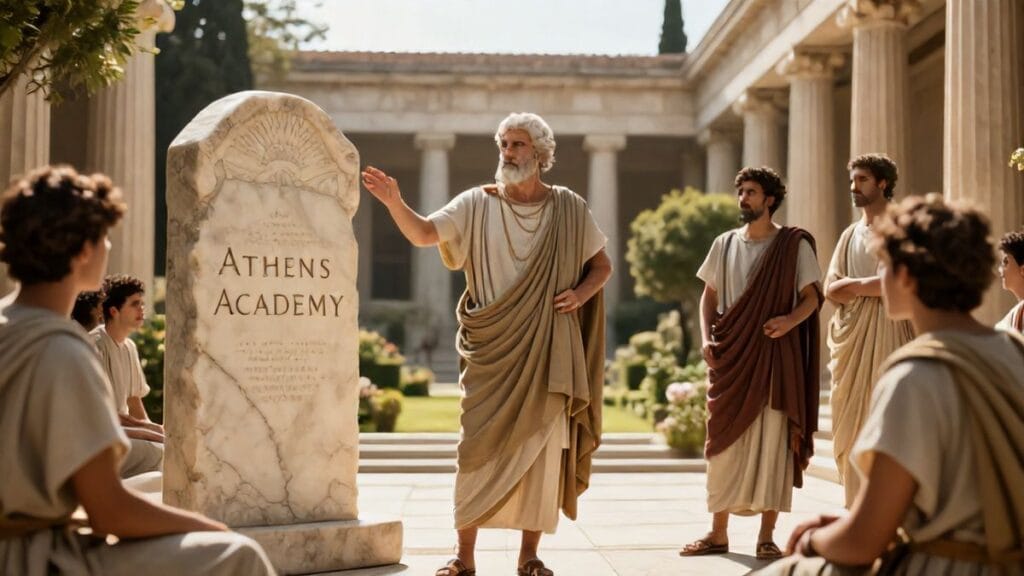
The Platonists traced their lineage, in one form or another, back to the dialogues of Plato, with their dizzying mix of myth, rigorous analysis, and flashes of irony. For them, the visible world was a shadow, an echo of a more perfect, intelligible realm of forms. A Platonist teacher in 176 might stand beneath the Athenian sky and tell his students that geometry was not merely useful but purifying, turning their minds away from the transient and toward the eternal. His lectures would have wandered from logic to ethics to metaphysics with a sense that these were all strands of a single tapestry.
The Peripatetics, inheriting Aristotle’s more empirical bent, reminded their pupils that forms do not float above reality; they are immanent in the substances around us. They dissected animals, analyzed constitutions, catalogued the winds and stars. A Roman aristocrat’s son studying under a Peripatetic might have learned to see politics as a natural outgrowth of human sociability, not as some divine intrusion. Balance, moderation, and careful observation were their watchwords.
The Stoics, to whom Marcus himself was deeply attached, preached that virtue is the only true good and vice the only true evil; everything else—health, wealth, reputation—is indifferent. Yet within those indifferents, some are “preferred” because they make the practice of virtue smoother. A Stoic philosopher teaching in Athens under the new imperial endowment would have spoken often of the logos, the rational principle ordering the cosmos. To live well was to align one’s inner judgments with this order, accepting fate without resentment and acting justly even when the world rewarded injustice.
Epicureans, often caricatured as hedonists, taught a subtler doctrine: that pleasure, understood as the absence of pain and disturbance, is the highest good. They urged their followers to withdraw from political life, to cultivate friendships in small, quiet communities, to pierce the superstitious fear of gods and death. In the leafy tranquility of a recreated Garden, an Epicurean chair-holder of Marcus’s time would have explained atomism to skeptical youths, assuring them that thunder was not the wrath of Zeus but a natural phenomenon.
Four roads, then—sometimes meeting, often diverging—were given imperial recognition under the marcus aurelius chairs of philosophy. It is astonishing, isn’t it, that an emperor would bless not one, but several contending visions of the good life? Yet in that plurality, we glimpse something of the second century’s intellectual confidence, its belief that truth could afford debate.
From Private Circles to Public Institution
Before 176, a philosophical “school” in Athens was often literally that: a circle of students around a charismatic master, walking through groves or sitting beneath porticoes. Admission depended on personal recommendation, capacity to pay, and the teacher’s willingness. There were no standardized degrees, no official oversight, only reputation. A brilliant young man might study under several masters, picking and choosing doctrines as he moved, gradually stitching together his own worldview.
The rise of the so-called Second Sophistic—star rhetors who toured cities giving dazzling performance speeches—had already begun to professionalize intellectual life. Cities competed to recruit famous sophists, offering hefty salaries and honorary titles. Philosophy, by comparison, had a more austere allure, less lucrative but, at least in theory, more serious. Still, the pattern was similar: a market for talent, paid by those who could afford it, subject to the volatility of fame.
Marcus Aurelius, steeped in Stoic respect for order and stability, saw the value of erecting a firmer scaffolding. When he endowed the marcus aurelius chairs of philosophy, he created permanent, salaried positions that would persist across the lifespan of individual teachers. These chairs were not merely honorary; they paid a regular stipend from imperial funds, guaranteeing that Athens would always have, at least in principle, one official representative of each school.
With salary comes responsibility and, inevitably, some degree of regulation. The holders of these chairs were not simply private individuals; they were quasi-public figures, imperial intellectuals. Their appointment, renewal, and possible dismissal intersected with Roman administrative structures. Cities could petition, local elites could lobby, and emperors could intervene. The classroom, always a place of power, became subtly more political.
Yet behind this formalization lay something more personal: Marcus’s own gratitude to philosophy. He had written in his notebooks during a military campaign, “If you have been well trained in philosophy, your duty is to show the world what that training can produce.” By institutionalizing philosophical training in Athens, he was, in a sense, making it easier for future generations to undergo a formation like his. The empire would not leave souls entirely to the accidents of birth and fortune; it would provide at least a few stable beacons of wisdom.
The Decision of 176: An Imperial Gift to Athens
The precise administrative steps that led to the creation of the chairs are buried in lost dispatches and destroyed archives. What we do know comes from later testimonies and a handful of inscriptions. The Athenian sophist Philostratus, in his Lives of the Sophists, describes Marcus as a generous patron of learning in Athens, noting explicitly that he “endowed the chairs of the philosophers,” giving salaries to the heads of the four major schools. Philostratus wrote with a sophist’s fondness for embellishment, but his account aligns with the broader pattern of Marcus’s benefactions.
Why 176? Part of the answer lies in the emperor’s own journey. Around this time, Marcus visited the eastern provinces, inspecting cities, temples, and garrisons. Athens, always a cherished stop for cultivated rulers, would have received him with solemn honors. The city had lavished praise on emperors before; Hadrian, for instance, had been made archon and celebrated as a second founder. Marcus, more austere by temperament, may have found the pomp uncomfortable, yet he understood the game. Emperors gave buildings and privileges; cities gave statues and loyalty.
But this gift was different. Instead of another temple or bath complex, Marcus offered teachers. He effectively said: Let Athens be what it claims to be—the living heart of philosophy. The marcus aurelius chairs of philosophy were an invisible monument, made not of stone but of salaries and titles, anchored in the minds of future generations. They would not tower over the skyline, but they would, if they worked as intended, reshape the inner landscapes of thousands of students.
We can imagine the ceremony of announcement in a crowded Athenian theater or council hall. The city magistrates, robed and garlanded, read aloud the imperial decree. Murmurs spread: four chairs, regular stipends, imperial recognition of each school. Philosophers who had long worried about how to feed their families might have felt an unaccustomed sense of security. Others, more cynical, perhaps wondered what strings were attached. But the general tone, one suspects, was elation. In a world where war and disease could sweep away whole communities, the promise of stability in the realm of the mind felt almost miraculous.
Inside the marcus aurelius chairs of philosophy
What did it mean, in practical terms, to hold one of these coveted positions? A chair-holder in the marcus aurelius chairs of philosophy was, first of all, a teacher. He lectured regularly, often in public spaces—gymnasia, porticoes, or dedicated halls. He attracted a circle of regular students, many of whom had traveled great distances. Others drifted in and out, sampling different teachings like intellectual merchants in a busy agora of ideas.
The daily rhythm of such a life blended the repetitive and the dramatic. Mornings might begin with a reading from a foundational text: a passage from Plato’s Republic, a section of Aristotle’s Nicomachean Ethics, a few lines of Chrysippus, or a letter of Epicurus. The philosopher would expound, analyze, digress into ethical examples, ask questions of his listeners. Some days were devoted to logic, others to physics or ethics, but the boundaries were porous. Real teaching, after all, responds to the questions of the day.
The salary from the chair allowed these men—I say men because, as far as our sources show, the official chairs were held by males—to devote themselves primarily to intellectual work. They might still take on paying pupils from wealthy households or receive gifts, but their livelihood no longer depended entirely on such arrangements. This shifted the power dynamic in subtle ways. A teacher who does not fear the loss of a single patron can, in principle, be bolder, more honest, perhaps even more willing to challenge the assumptions of his audience.
Yet the chairs also created expectations. A philosopher too eccentric, too aggressively anti-social, or too openly critical of imperial policy might find his position jeopardized. Athens was not a democracy of speech in the old sense; it was a free city within a Roman empire that valued stability over radical innovation. The marcus aurelius chairs of philosophy therefore sat at a delicate intersection between independent thought and public decorum.
Some modern historians, reading between the lines of scattered testimonies, suspect that competition for these chairs could be fierce. Students would praise their masters in inscriptions, local elites might lobby for their favorite candidate, and distant emperors or governors could be drawn into disputes. Where there are salaries and prestige, there are rivalries. The chairs did not purify philosophy of human weakness; they merely reframed its setting.
Stoics, Peripatetics, Epicureans, Platonists: Voices in Tension
The beauty and volatility of Athens under Marcus lay in the proximity of disagreement. Within a short walk, a student could move from a Stoic lecture on the rationality of providence to an Epicurean argument that the gods, if they exist, are blissfully indifferent to human affairs. Next door, a Platonist might be insisting on the pre-existence of the soul, while a Peripatetic calmly catalogued the varieties of civic virtue.
The marcus aurelius chairs of philosophy did not erase these tensions; they highlighted and formalized them. Official recognition of each school was, in effect, an imperial acknowledgment that reasonable people could diverge on some of the most basic questions: What is the good life? Is the universe guided by a benevolent mind? Should a wise person enter politics or withdraw?
There must have been debates—some courteous, others sharp. A Stoic, defending the unity of virtue, might accuse Epicureans of a disguised selfishness. An Epicurean, in turn, could mock Stoic calls for duty as a kind of voluntary slavery to abstract ideals. Platonists questioned the adequacy of any philosophy that did not reach toward a transcendent Good; Peripatetics shook their heads at metaphysical flights untethered from observed reality.
Yet for all their disputes, there was also a shared culture. All these schools revered argument, texts, and traditions of commentary. All saw the training of character as inseparable from the training of mind. An anecdote preserved by later writers tells of a Stoic and an Epicurean attending the same festival, jostled together in the crowd. Recognizing each other, they fell into conversation—not to insult, but to test each other’s reasons. Such scenes, repeated thousands of times, wove a dense web of intellectual kinship around Athens.
Marcus, reading reports from the city or hearing tales from visitors, would have known that his chairs had not created harmony. They had, instead, created a more visible arena for disagreement—an arena he believed was itself a form of civic good. For a Stoic emperor, a world where men reasoned together, even if they disagreed, was less dangerous than a world where they shouted slogans.
Rhetors, Sophists, and the Battle for Minds
To imagine philosophy in isolation from rhetoric in second-century Athens would be a mistake. The city seethed with oratorical spectacles. Sophists like Herodes Atticus—one of the wealthiest men of his time and a great benefactor of Athens—built theaters, funded public works, and dazzled audiences with polished declamations. These performances were not mere entertainment; they were the training ground for the elite’s sense of what language could do.
Philosophers, especially those under the marcus aurelius chairs of philosophy, found themselves in a uneasy partnership and competition with such figures. They needed rhetoric to attract and hold students, yet they often preached suspicion of rhetorical excess. Marcus himself, in his Meditations, cautioned against the seductions of empty eloquence, yet he knew well that a poorly spoken truth dies in the marketplace of ideas.
In practical terms, a student might divide his day between a philosopher and a sophist: morning in a sober discussion of duty, afternoon in a glittering exercise imagining himself as a general addressing his troops. Parents, paying the bills, wanted both: moral seriousness and social effectiveness. Philosophy promised inner integrity; rhetoric promised careers.
The chairs helped philosophy hold its own in this battle for minds. With imperial salaries, philosophers could charge less or grant more generous terms to their pupils. They could devote time to commentary and writing, strengthening their schools’ intellectual capital. Some of them, no doubt, borrowed sophistic techniques—carefully crafted anecdotes, emotional rhythms of speech—to make their lectures memorable.
Yet behind the competition lay a convergence: both rhetoric and philosophy trained the art of decision-making. An official in a distant province, faced with a rebellious town or a corrupt subordinate, would draw unconsciously on both—the ability to frame an argument persuasively and the capacity to judge its ethical worth. Marcus’s policy in Athens therefore did not simply bolster abstract speculation; it fortified one half of a double education that sustained Roman governance.
Students at the Crossroads of Empire
It is tempting to focus on the chair-holders and forget those who sat at their feet. But the true measure of the marcus aurelius chairs of philosophy lies in the lives of the students who passed through Athens and then scattered back across the empire like seeds.
They came from everywhere. Inscriptions mention students from Bithynia, Syria, Egypt, Gaul. Some were scions of ancient Greek families; others were newly minted citizens whose grandfathers had spoken different tongues. They boarded ships at distant harbors, their luggage full of letters of recommendation, their heads crowded with expectations. Athens had, for them, an almost mythical status. To walk the same streets as Plato or Demosthenes felt like stepping into a dream.
Their daily life mixed discipline and indulgence. Mornings in lectures, afternoons in libraries or gymnasia, evenings in symposia where wine loosened tongues and arguments. They lived in rented rooms, negotiated with landlords, formed friendships and rivalries. Some fell in love with the city’s beauty; others grumbled about its prices and dust. Many stayed only a few years; a few lingered, drawn into deeper study or local politics.
We know of individuals like Aulus Gellius, the Latin author who studied in Athens and later wrote his Attic Nights, a miscellany of anecdotes and reflections. In one passage, he recalls listening to a philosopher patiently explain a subtle point of grammar, then pivot to a moral lesson about diligence. Such moments—small, forgotten by all but the participants—were the true heart of the educational experience.
When these students returned home, they carried more than notes. A future governor of a province, trained under a Stoic chair-holder, might approach his task with a heightened sense of responsibility to a universal human community. A judge influenced by an Epicurean might be more skeptical of appeals to divine wrath, insisting instead on tangible evidence. A city councilor, touched by Platonic ideals, might push for fairer local laws. The marcus aurelius chairs of philosophy thus left their mark not only in treatises but in decrees, verdicts, and policies, often anonymously.
Women, Outsiders, and the Edges of the Philosophical World
Official narratives of Athenian intellectual life in the second century are overwhelmingly male, but silences are as telling as words. There is no evidence that women held the imperial chairs. Yet that does not mean women were absent from the world the chairs helped shape.
We catch glimpses of educated women in inscriptions and letters: daughters of elites who could quote poetry, discuss philosophy, or host salons. Some may have listened from the fringes of lectures; others, if their families allowed, might have participated more directly in philosophical circles. The Epicurean tradition, with its history of including women in the Garden, probably remained more open than most. A teenage girl from a prosperous Athenian household, her curiosity piqued by ideas of ataraxia and freedom from fear, might have persuaded a sympathetic uncle to introduce her to an Epicurean master.
There were other outsiders too: non-citizens living in Athens, freedmen who had clawed their way out of slavery, even the occasional foreigner of modest means who attended a few open lectures without ever enrolling as a full-time student. Philosophy, at its best, cannot entirely seal itself off. A striking passage in an early Christian writer mentions “pagan philosophers discussing virtue in the streets,” overheard by the poor. These discussions, amplified by gossip and informal teaching, seeped into the broader culture.
Yet we should not romanticize. The marcus aurelius chairs of philosophy were still instruments of an elite world. They did not overturn hierarchies; they refined them. Access to the deepest levels of instruction remained shaped by money, status, and gender. The empire’s commitment to wisdom was real, but it ran along the channels of an unequal society. The tragedy and irony are intertwined: some of the most profound reflections on justice and human dignity unfolded in spaces that only a fraction of humanity could enter.
Politics in the Lecture Hall
In theory, philosophers addressed timeless questions; in practice, they taught during very specific crises. Marcus Aurelius’s reign was marked by the Antonine Plague, recurring wars, and mounting pressure on imperial frontiers. Rumors of disasters filtered even into the quietest Athenian classrooms, carried by travelers and official notices pinned in public places.
How did the holders of the marcus aurelius chairs of philosophy respond? A Stoic might seize on the epidemic as a teaching moment about the nature of fate and the proper attitude toward death. “These bodies were always lent to us,” he might say, echoing Epictetus. “We must be ready to return them without complaint.” An Epicurean would stress that plague is a natural phenomenon, not a punishment from angered gods, urging his listeners to reject fear and superstition. A Platonist might speak of the soul’s journey beyond the body; a Peripatetic could examine the political consequences, the need for rational policy in the face of panic.
Direct criticism of the emperor or imperial policy would have been rare and risky. But subtler forms of political reflection abounded. When a Peripatetic lectured on Aristotle’s analysis of constitutions, his students inevitably compared those typologies with the empire under which they lived. When a Platonist spoke about the corrupting influence of unchecked power, some in the audience may have thought quietly of provincial governors or local magnates.
Occasionally, tensions flared. A philosopher too outspoken about tyranny might attract the attention of Roman authorities. There are later stories—hard to verify—of philosophers exiled or silenced. Even if such cases were exceptional, the mere possibility formed part of the mental background. So teaching became a kind of dance: how to tell the truth about justice in an unjust world without inviting destruction.
Marcus, from his vantage point, likely saw the value of such indirect criticism. A ruler secure enough to fund philosophy was, at least in his own eyes, secure enough to tolerate some questioning. Yet the tolerance had limits; and the chairs, for all their promise, could become golden cages if their occupants grew too timid. That tension between institutional security and intellectual audacity is one that universities, even now, have not entirely resolved.
A Pagan University in a Changing Religious Landscape
The Athens of Marcus Aurelius was not only a city of philosophers. It was also a landscape of altars, temples, and cults: the Parthenon on the Acropolis, the Eleusinian Mysteries a short journey away, the rituals of Dionysus, Demeter, and countless local deities. Philosophy and cult coexisted, sometimes in harmony, sometimes in quiet tension. A Stoic could attend public sacrifices while inwardly interpreting the gods as manifestations of cosmic reason; an Epicurean might smile politely and see mere human convention in the smoke.
But something new was stirring at the empire’s edges and even within it: Christianity. By 176, Christian communities already existed in Athens and other Greek cities, though they were still small minorities, often meeting in private homes, sometimes persecuted. They too claimed a form of wisdom, a path to salvation that did not pass through Plato’s Academy or the Stoa.
Christian apologists such as Justin Martyr, himself a philosopher converted to the new faith, engaged directly with the traditions embodied in the marcus aurelius chairs of philosophy. Justin famously argued that all who lived according to reason (logos) were, in a sense, Christians before Christ—citing Socrates and Heraclitus as examples. Yet he also attacked Epicureans for their materialism and criticized the moral laxity he perceived in some philosophical circles. His dialogues, written in Rome, echo with the mental world of Athens.
To future generations of Christians, the chairs would appear as bastions of pagan thought. Centuries later, when emperors like Justinian shut down the last pagan philosophical schools, it was in conscious opposition to a tradition that traced its institutional roots back, in part, to Marcus’s reforms. What began as a Stoic emperor’s attempt to stabilize Greek philosophy would, in hindsight, look like the erection of a structure that Christianity would eventually displace—or absorb.
Still, in 176, that outcome was far from obvious. In the lecture halls, philosophical gods and principles still reigned. The marcus aurelius chairs of philosophy formed part of a world in which rational discourse about ethics and metaphysics could still unfold under the sign of Zeus, Athena, and the anonymous logos. The twilight of pagan philosophy had not yet begun; the sky was merely overcast with distant omens.
The Long Echo: From Athena’s Hill to Medieval Manuscripts
Institutions rarely know when they are making history. The first holders of the chairs in Athens probably imagined their work in local, perhaps generational terms. Yet the structures they inhabited would echo across centuries in ways none of them could have foreseen.
After Marcus’s death in 180, the empire entered more troubled waters. The third century brought political chaos, economic crisis, invasions. Athens suffered like other cities. Yet the idea of stable philosophical posts persisted, surviving in altered forms even as the city’s fortunes rose and fell. Teachers still spoke in the shadow of the Acropolis; students still came, though perhaps in fewer numbers or with different expectations.
Meanwhile, texts—lectures transformed into treatises, commentaries, or compilations—began their own journeys. A Platonist professor, building on Platonic and Aristotelian legacies, might write a commentary that would be copied in late antique scriptoria, carried to Constantinople, then to medieval monasteries. The physical institution of a chair could be destroyed by war or neglect; the intellectual institution, housed in parchment, could march on.
Citation chains bear witness to this continuity. Late antique Neoplatonists such as Proclus, teaching in Athens in the fifth century, still saw themselves as heirs to a tradition Marcus had helped fortify materially. When Proclus commented on Plato or Euclid, his teaching notes were copied by students whose descendants would transmit them to the Byzantine world. From there, during the Renaissance, they would leap into Latin translations, influencing thinkers in Florence, Paris, and beyond.
It is no exaggeration to say that the marcus aurelius chairs of philosophy helped sustain the living presence of Greek thought during centuries of upheaval. Without institutional support, philosophical traditions can splinter into scattered voices, preserved only in fragments. With it, they can accumulate mass, producing commentaries on commentaries, debates on debates, a density of discourse thick enough to endure fire and flood. The dusty serenity of an Athenian lecture in 176 might thus lie, invisible yet real, behind a medieval scholastic’s margin note or a Renaissance humanist’s astonished praise of Plato.
How the Chairs Shaped the Idea of a University
Looking back from our own world of universities, tenure, and endowed professorships, it is hard not to see in Marcus’s act a distant ancestor of modern academic structures. Of course, the differences are immense, but the family resemblance is there: a political authority endowing permanent posts so that certain disciplines may endure across generations.
In medieval Europe, cathedral schools and later universities like Bologna and Paris developed their own systems of chairs, often tied to ecclesiastical or royal patronage. Professors of theology, law, and medicine held positions that, while not identical to the Athenian chairs, echoed their logic: the community, through a powerful institution, guarantees not only that knowledge is taught now, but that someone will be paid to teach it in the future. The continuity matters as much as the content.
When a Renaissance cardinal endowed a chair of Greek or a king funded a lectureship in moral philosophy, they sometimes did so with explicit reference to the glory of ancient Athens. Humanists like Bessarion collected Greek manuscripts, citing their admiration for the city that had once housed Plato and Aristotle. In this culture of reverence, the fact that Marcus Aurelius—himself a philosopher—had once endowed chairs in Athens became a potent symbol, an example of the proper alignment between power and wisdom.
Modern historians of education sometimes point to Marcus’s decision as one of the earliest clear instances of state-supported higher learning in the Western tradition. There were earlier precedents—Hellenistic monarchs supporting libraries, for example—but the specificity of the marcus aurelius chairs of philosophy, with their focus on defined schools and salaried posts, gives them a particular clarity. They represent a moment when an empire said: these debates about the good, the true, and the just are not private luxuries; they are public goods worth paying for.
Of course, the university as we know it would also draw on Christian monastic traditions, Islamic madrasas, and countless local experiments. No single lineage explains it all. But among its many ancestors, those four chairs in second-century Athens deserve a quiet, sturdy place.
The Human Face of an Imperial Policy
Policies are made in palaces; their consequences unfold in human faces. To feel the reality of the marcus aurelius chairs of philosophy, imagine a particular day, a few years after their creation.
An aging Stoic, hair gone to silver, stands before a semicircle of students. His name is lost to history. He began his career wandering from city to city, living leanly on small fees, unsure whether he could continue. Then the imperial decree came. He was chosen, after disputes and recommendations, to hold the Stoic chair in Athens. The salary is modest, but steady. He has moved his family here; his children play in the same streets that Socrates once walked.
Today he is speaking about anger. A student has asked how a just man should respond to the abuses of a corrupt official. The philosopher listens, then quotes, perhaps, from Epictetus or Cleanthes, then adds his own gloss. He admits the temptation of rage; he describes the internal practice of stepping back, of seeing one’s judgments as modifiable, of choosing not to consent to the passion. His voice does not thunder; it is low, steady, almost tired—but the students lean in.
Among them is a young provincial, wide-eyed, who will later become a minor magistrate in a far-off town. He will remember this lecture when confronted with his own injustices, his own power. Perhaps he will not always succeed in mastering his anger; perhaps he will fail spectacularly at times. But something of that day in Athens will remain, a counter-voice inside him. This is how policies become persons.
Elsewhere in the city, an Epicurean chair-holder debates privately whether to accept a wealthy student whose family is notorious for exploitation. A Platonist walks the Academy grounds at dusk, worrying about the creeping influence of new religious movements. A Peripatetic helps a struggling student with logic, staying after the scheduled hour. All of them are, knowingly or not, enacting Marcus’s hope that philosophy could make human lives more coherent, less ruled by fear and impulse.
“The marcus aurelius chairs of philosophy”—the phrase feels abstract. But behind it lie food on tables, books purchased, children educated, dilemmas faced more thoughtfully than they might have been. It is there, in those small, unrecorded acts, that the true measure of the policy resides.
Legacy of the marcus aurelius chairs of philosophy in Modern Thought
When we read Marcus Aurelius today, it is usually through the pages of the Meditations, that haunting notebook of self-admonitions penned in military camps along the Danube. There he barely mentions specific policies. He exhorts himself to do his duty, to accept fate, to remember that fame is smoke. Yet in the background of those pages stands the emperor who also chose, in quieter times, to fund chairs of wisdom in a distant city.
Modern philosophy, fragmented and specialized, might seem far removed from the world of second-century Athens. Yet certain continuities persist. The very idea that philosophy belongs not only to private reflection but also to public institutions—that there should be professors of philosophy, departments, curricula—is a distant echo of the marcus aurelius chairs of philosophy. When a contemporary student enrolls in a course on ethics or ancient philosophy, sits in a lecture hall, and listens to a salaried scholar expound, she participates unconsciously in a lineage that passes through Athens.
Moreover, the pluralism Marcus enshrined—the coexistence of rival schools under one institutional roof—finds its mirror in modern universities where analytic, continental, Marxist, feminist, phenomenological, and other traditions jostle. The belief that truth can survive disagreement, that institutions should house contesting viewpoints rather than impose a single orthodoxy, owes something to this ancient willingness to pay for diversity of thought.
Intellectually, the survival of Stoicism, Platonism, and Aristotelianism into modernity depended, in part, on their endurance as organized traditions. Scholars like Pierre Hadot have argued that ancient philosophy was above all a way of life, a series of spiritual exercises. Institutions like the Athenian chairs allowed those ways of life to reproduce themselves, to train new generations in practices of self-examination, logical rigor, and ethical commitment. The rediscovery of these traditions in early modern Europe—Cicero’s moral works, Seneca’s letters, the Platonic dialogues—fueled everything from Christian humanism to Enlightenment rationalism.
Today, when people turn to Marcus’s Stoicism for guidance in anxiety, leadership, or personal crisis, they do so in a world whose conceptual vocabulary was, partly, preserved by the institutional memory he once strengthened. The chairs he endowed did not guarantee the survival of wisdom; nothing can. But they tilted the odds, built infrastructure around insight. In a universe where so much depends on chance, that decision remains a remarkable act of hope.
Conclusion
In 176 CE, a tired emperor looked toward Athens and chose, against the grain of imperial self-indulgence, to invest not in triumphal arches or new palaces but in teachers. The establishment of the marcus aurelius chairs of philosophy was a modest act by the standards of Roman grandeur, almost invisible against the backdrop of wars, plagues, and political intrigues. Yet its subtle consequences radiated across centuries.
It stabilized a fragile intellectual ecosystem in a city that lived as much on memory as on present power. It gave philosophers, whose vocation is often precarious, a measure of security, and thus a freer voice. It nurtured students who would administer, judge, and govern in the vast territories of Rome, infusing their decisions—however imperfectly—with something of the rigor and humanity they had absorbed in Athenian classrooms. It placed, within an empire built on force, a small but enduring wager on the persuasive strength of reason.
The story of these chairs reminds us that ideas do not float in a vacuum. They need rooms, salaries, schedules; they need bodies that eat and sleep; they need institutions robust enough to withstand the churn of history. Marcus Aurelius, the philosopher-emperor, understood that inner transformation and outer support are not enemies but allies. His decision to endow philosophy in Athens was both an expression of gratitude to the discipline that had shaped him and an act of faith that, long after his own body had returned to dust, there would still be, in a sunlit portico under the Acropolis, a voice asking young minds the oldest questions: What is the good? How should we live? And what do we owe, not only to ourselves, but to the whole human city?
FAQs
- What were the marcus aurelius chairs of philosophy?
The marcus aurelius chairs of philosophy were four salaried professorships in Athens, endowed by Emperor Marcus Aurelius around 176 CE, each assigned to a major philosophical school: Platonic, Aristotelian (Peripatetic), Stoic, and Epicurean. They provided stable incomes and official recognition for these traditions, effectively turning Athens into a kind of state-sponsored center of higher learning. - Why did Marcus Aurelius create these chairs?
Marcus Aurelius, deeply influenced by Stoic philosophy, believed that wisdom and ethical training were essential for both rulers and citizens. By funding permanent chairs in Athens, he aimed to stabilize and honor Greek philosophical traditions, support education for the imperial elite, and strengthen the cultural prestige of the empire by aligning it with the legacy of classical Athens. - How did the chairs change philosophical life in Athens?
The chairs transformed philosophy from a largely precarious, privately funded activity into a more institutionalized profession. Philosophers with chairs had regular salaries, greater security, and enhanced prestige, which attracted more students and solidified Athens’s status as a premier educational center. At the same time, the positions created competition and political maneuvering around appointments. - Did these chairs influence the later development of universities?
Yes, in an indirect but important way. They are one of the earliest clear examples of state-supported professorships dedicated to specific disciplines and schools of thought. Later medieval and early modern institutions—cathedral schools, universities, and royal chairs—echo this model of permanent, endowed posts, making the Athenian chairs a distant ancestor of modern academic structures. - Were Christians involved in or opposed to these philosophical chairs?
Early Christians generally did not hold the chairs, which were embedded in a pagan intellectual framework. However, Christian thinkers engaged vigorously with the philosophies taught in Athens, sometimes using their concepts and methods, sometimes attacking them. Over time, as Christianity gained imperial favor, these pagan institutions would come under pressure, culminating in later Christian emperors restricting or closing them. - Do any writings from the original chair-holders survive?
We do not have a clear, continuous record directly attributed to the first chair-holders themselves, but later philosophical works—especially in Platonism, Aristotelianism, and Stoicism—bear the imprint of teaching and commentary traditions that passed through Athens. Some late antique philosophers known to have taught in Athens, such as Proclus, left extensive writings that reflect the institutional legacy Marcus helped secure.
External Resource
Internal Link
Other Resources
- Encyclopaedia Britannica – general search for the exact subject
- Google Scholar – academic search for the exact subject
- Internet Archive – digital library search for the exact subject