Table of Contents
- An Empire Under Siege: Rome Before the Quadi Campaign
- The Northern Frontier Fractures: Origins of the Marcomannic Wars
- Marcus Aurelius, the Philosopher Emperor Thrust into War
- The Quadi and Their World Beyond the Danube
- From Scrolls to Shields: Rome Mobilizes for Total War
- Crossing the Danube: The Road to Confrontation
- Into Hostile Forests: The Long March Through Quadi Territory
- The Crisis Before Triumph: Encircled by the Quadi
- The So‑Called “Miracle of the Rain” and the Turn of Battle
- When Marcus Aurelius Defeats the Quadi: The Decisive Victory of 174
- Captives, Treaties, and Hostages: Aftermath of the Quadi Defeat
- A Philosopher in Armor: How War Shaped the Meditations
- Wounds on the Frontier: Social and Demographic Consequences
- Rome Rewrites Its Myths: Memory, Propaganda, and the Thunderbolt Legion
- The Unfinished Victory: Why Peace Never Truly Came
- Echoes Through Time: Historians Debate the Quadi Campaign
- Lessons from a Frozen Frontier: Power, Fate, and Human Fragility
- Conclusion
- FAQs
- External Resource
- Internal Link
Article Summary: In the bitter years of the Marcomannic Wars, the Danubian frontier became the stage on which Marcus Aurelius defeats the Quadi and struggles to hold together a weary empire. This article traces how a philosopher emperor, more at home with books than with battle standards, was transformed by invasion, famine, and betrayal into an unrelenting war leader. It explores who the Quadi were, why they crossed the frozen Danube, and how their clash with Rome culminated in the climactic campaign of 174. Moving chronologically, it follows the armies into the dense forests beyond the frontier, through disasters and reversals, toward a victory layered with myth, including the famous “miracle of the rain.” Yet behind the celebrations, the cost to Roman society—empty villages, conscripted peasants, displaced barbarians—was immense and lasting. Through narrative and analysis, the article shows that when marcus aurelius defeats the quadi, the triumph is as philosophical as it is military, revealing his stoic resolve in the face of chaos. It also examines the political propaganda that turned hard-fought survival into divine favor, and the later debates among historians over what truly happened on that storm‑lashed battlefield. Ultimately, the story of the Quadi defeat becomes a meditation on power, fate, and the fragility of borders, both physical and human.
An Empire Under Siege: Rome Before the Quadi Campaign
In the middle of the second century CE, the Roman Empire still appeared to be at the height of its power. From the windswept moors of Britain to the baked deserts of Egypt, Roman law, coinage, and soldiers seemed to hold sway. Yet behind the shining marble of the cities and the calm, practiced tone of senatorial speeches, hairline fractures were already spreading through the imperial edifice. Grain supplies were vulnerable to disruption, the army was stretched thin across thousands of miles of frontier, and the first great pandemic in imperial history—the Antonine Plague—had begun quietly decimating the population. When we later say that marcus aurelius defeats the quadi in 174, we are looking at a single, triumphant frame from a much longer, darker reel.
By the time Marcus Aurelius ascended the throne in 161 CE alongside his adoptive brother Lucius Verus, Rome’s greatest dangers did not seem to come from the north at all. Instead, the focus lay on the east, where the Parthian Empire challenged Roman prestige in Armenia and Syria. Legions marched in glittering columns toward Mesopotamia while senators in Rome debated honor and glory. The frontier along the Danube, where the Quadi and Marcomanni dwelled beyond Roman borders, was considered tense but manageable, policed by seasoned garrisons and reinforced by a network of forts and watchtowers.
But the empire’s strength was deceptive. The Parthian War brought something far worse than military losses: disease. Soldiers returning from the eastern campaigns carried with them an invisible invader, likely smallpox, which would explode through the tightly packed tenements of Rome, through legionary camps, and through villages and towns across the Mediterranean. The Antonine Plague killed indiscriminately—peasants, merchants, soldiers, and aristocrats. It reduced tax revenues, thinned the ranks of the legions, and eroded the manpower that underpinned Rome’s power. When the barbarians of the north began to move, they were pushing against an empire already weakened from within.
On the Danubian frontier, governors sent back increasingly anxious reports. Winter ice sometimes bound the Danube into a solid sheet, and rumors spread that entire warbands could cross into Roman territory without even needing boats. Years before marcus aurelius defeats the quadi, small raids and skirmishes multiplied. The Marcomanni, the Quadi, and other tribes felt the weight of their own crises: population pressures, climate shifts, and the chain reactions of migrations from deeper in the barbaricum. The world beyond Rome’s frontier was boiling, and the heat was radiating outward toward the imperial borders.
The Northern Frontier Fractures: Origins of the Marcomannic Wars
The Marcomannic Wars did not erupt out of a clear blue sky; they built slowly, like a storm bank gathering on the horizon. For generations, Rome had managed the peoples beyond the Danube with a combination of intimidation, subsidy, and diplomacy. Tribal kings were courted with valuable trade goods, Roman titles, and the promise of support against their rivals. In return, they agreed—at least on parchment—to respect the frontier and even provide troops as auxiliary forces in Roman armies. The Quadi, dwelling largely in what is now western Slovakia and Moravia, had periodically followed this pattern, benefiting from access to Roman markets and gifts.
Yet in the late 160s CE, this fragile arrangement began to unravel. The Antonine Plague undermined Rome’s capacity to project power on the frontier. Garrisons were reduced or left undermanned; recruitment slowed; logistics faltered. At the same time, pressure from tribes farther north and east—many of them poorly known to Roman writers—pushed the Marcomanni, Quadi, and their neighbors southwards. Archaeological evidence hints at shifting settlement patterns and perhaps climatic stresses; fields and villages may no longer have produced enough food, driving communities to seek new lands or richer plunder.
Rome’s vulnerability was not lost on its neighbors. Around 167–168, large coalitions of Germanic tribes, including the Marcomanni and Quadi, launched unprecedented incursions over the Danube. One attack was so deep and so successful that it crossed the Alps and reached as far as Aquileia on the Adriatic, a city not far from the Italian heartland itself. The fear this caused in Rome was profound and raw; many Romans had believed themselves insulated by natural barriers and the disciplined strength of their legions. Suddenly, the specter of another catastrophe like the Gallic sack of Rome centuries earlier seemed terrifyingly plausible.
These early blows marked the true beginning of the Marcomannic Wars, a series of conflicts that would occupy Marcus Aurelius for much of the rest of his reign. While later generations would compress them into a single chapter and highlight a moment when marcus aurelius defeats the quadi, contemporary Romans experienced them as an exhausting, grinding struggle. It was not a neat war with a clear starting gun and a triumphant parade at the end, but a messy, evolving contest across multiple fronts, with setbacks, desperate defenses, and scattered, bloody engagements all along the Danube.
In the ensuing chaos, the Quadi emerged as one of Rome’s most troublesome antagonists. Once among the more reliable neighbors, they became enmeshed in the great coalition of tribes testing Rome’s resolve. Motives were mixed. Some leaders sought plunder; others, land; others still may have hoped to renegotiate power and status in relation to the empire. For the Quadi nobles, Rome was both a threat and an opportunity—its weakness invited attack, but its wealth, if properly harnessed, could promise a different future. The war that followed would test these calculations ruthlessly.
Marcus Aurelius, the Philosopher Emperor Thrust into War
Marcus Aurelius had not been formed for war, at least not in the way that earlier emperors like Trajan or Hadrian had been. Born in 121 CE into an aristocratic but not imperial family, he spent his youth immersed in rhetoric, philosophy, and law. The young Marcus was drawn early to Stoicism, cultivating ideals of self-control, duty, and inner clarity. Had history been kinder, he might have become a senior statesman, a respected legal mind, or a philosopher whose writings stayed within the lecture halls of Rome. Instead, history forced him into armor.
Adopted by Antoninus Pius and made heir to the throne, Marcus inherited a vast empire and a set of expectations he took with grave seriousness. When he became emperor in 161, he shared power with Lucius Verus, perhaps hoping that together they could balance the burdens of rule. But events would soon conspire to intensify those burdens beyond anything the Stoic manuals had prepared him for. The Parthian War pulled resources east; the plague followed; then the northern tribes advanced. By the late 160s, Marcus realized that imperial stability could no longer be managed from the marble halls of Rome.
He went to the front himself. This decision was not inevitable; emperors had increasingly preferred to delegate frontier command to trusted generals. But Marcus chose, or perhaps felt compelled, to stand with the legions on the Danube. Surviving sources, including the later biographer in the Historia Augusta, emphasize his presence among the soldiers: sharing their hardships, listening to their petitions, and attempting to maintain discipline and morale in the face of disease and cold. In the long winters on the frontier, he would write the private notes to himself that we now know as the Meditations, pondering the nature of duty and suffering while the fires of war crackled outside his tent.
By the time marcus aurelius defeats the quadi in the pivotal campaign of 174, he is no longer the bookish young aristocrat of his youth, but a hardened war leader whose philosophical convictions had been tested repeatedly. It is this duality that gives the story of his campaigns such enduring fascination. He could order brutal reprisals, oversee the resettlement of captured barbarians as laborers within the empire, and demand unrelenting effort from exhausted provinces—yet at night he reminded himself in writing that all glory is fleeting, all men are brothers, and power should be wielded with justice. The emperor who crushed the Quadi was also the man who wrote, “Do not act as if you had ten thousand years to live.”
The Quadi and Their World Beyond the Danube
To Roman observers, the Quadi were one among many Germanic peoples who inhabited the forests and plains beyond the empire’s northern rivers. Yet to themselves, the Quadi were a distinct community, with their own customs, leaders, and ancestral lands. They occupied a region roughly corresponding to parts of modern Slovakia and Moravia, a zone of rolling hills, rivers, and mixed agriculture and pastoralism. Archaeological traces—settlement sites, pottery, cemeteries—suggest a society of small villages, kin-based groups, and warrior elites whose prestige rested on their ability to protect and enrich their followers.
We glimpse the Quadi through Roman eyes, in texts that are often hostile or dismissive. Tacitus, writing a generation before the Marcomannic Wars, mentions them as neighbors of the Marcomanni, ruled by kings whose legitimacy was reinforced by Roman approval and gifts. This detail is crucial: by the second century, Rome was deeply intertwined with the politics of the tribes beyond its borders. To be acknowledged as king by the emperor in distant Rome was to receive a kind of international recognition, which could bolster a leader’s standing against rivals at home. Trade with the empire brought not only goods—wine, metalware, coins—but also status.
Yet this interdependence was unstable. Roman interference in succession disputes could breed resentment. Economic dependence on frontier trade left the Quadi vulnerable when Rome’s own crises reduced the flow of goods. Moreover, the Quadi were themselves situated along a kind of internal frontier: they faced pressure from other, less Romanized peoples further north and east. When these outer tribes moved, seeking resources or fleeing hardship, the shockwaves pushed against the Quadi first, and then, through them, against Rome.
By the 170s, the Quadi were not simply faceless barbarians at the edge of the map. They were a politicized, war-hardened society whose elites had gained experience in both negotiation with Rome and violent raiding. They understood Roman weaknesses more clearly than many senators in the capital did. Some had likely served as auxiliary fighters alongside Roman troops, learning their tactics and observing their vulnerabilities. They knew that legions could break, that forts could fall, and that the empire’s claims of invincibility were propaganda as much as reality.
In this light, the episode in which marcus aurelius defeats the quadi becomes not a one-sided conquest but the culmination of a contest between two political worlds. On one side stood the bureaucratized colossus of Rome, with its legions, supply chains, and imperial ideology; on the other, a confederation of tribal warriors and their leaders, whose authority depended on tangible success and visible courage. When they crossed the Danube, the Quadi were not only seeking plunder; they were staking their claim in a shifting geopolitical landscape, gambling that Rome’s time on the northern frontier might be drawing to a close.
From Scrolls to Shields: Rome Mobilizes for Total War
The first great incursions of the Marcomanni and Quadi into Roman territory shattered any illusion that frontier skirmishes could be contained as mere local troubles. The attack that reached Aquileia in 170 underscored that the Danube barrier had been breached in more than one sense: psychologically, as well as geographically. The Senate, normally cautious in matters of expensive war, now fully recognized that the conflict in the north threatened the very core of the empire.
Marcus Aurelius responded with measures that were, for his time, extraordinary. He raised new legions—II and III Italica—recruiting heavily from Italy itself, a region long shielded from the burdens of frontier defense. He drew upon gladiators, slaves, and even criminals to refill the depleted ranks, granting freedom or commutation of sentences in exchange for military service. The financial cost of these measures was staggering. To help pay for them, the emperor famously ordered the sale of imperial treasures: golden bowls, elaborate jewelry, even the finery of the imperial household was auctioned off in the Forum of Trajan. It is astonishing, isn’t it, that one of Rome’s most powerful emperors found himself pawning the symbols of his own majesty in order to sustain the fight.
Logistics became a monumental challenge. Armies must eat, and the legions along the Danube required not just rations but winter clothing, equipment, and fodder for animals. Provinces already strained by plague were obliged to deliver more grain, more recruits, more taxes. The complaints of cities and landowners found their way to Marcus, but he could offer little relief. Every compromise increased the risk at the frontier; every harsh demand eroded loyalty at home. In this balance between security and stability, he consistently leaned toward securing the borders, convinced that without safety there could be no prosperity.
The empire’s bureaucracy whirred into motion, drafting orders, coordinating governors, and shuffling units from quieter provinces to the inferno on the Danube. Veterans who had hoped for peaceful retirement were recalled. Young men, whose fathers had died in the plague or in earlier phases of the war, now found themselves marching north. Even as marcus aurelius defeats the quadi in later campaigns, we must remember the anonymous thousands whose lives were diverted or extinguished to make that victory possible.
Crossing the Danube: The Road to Confrontation
By the early 170s, Marcus Aurelius had moved his center of operations to the northern theater. The emperor’s headquarters shifted between fortified towns such as Carnuntum and Sirmium, anchoring campaigns that pushed Roman power across the Danube into enemy territory. Unlike earlier imperial policy, which had mostly emphasized defense and reactive strikes, Marcus now envisioned something more ambitious: an aggressive, sustained presence beyond the river, designed to break the capacity of the Marcomanni and Quadi to launch further incursions.
The Danube itself was both a barrier and a lifeline. In winter, when the river sometimes froze, enemies could march across; in warmer months, Roman engineers built pontoon bridges or used fleets of flat-bottomed boats to maintain supply routes and facilitate troop movements. Crossing such a river with tens of thousands of soldiers, animals, and equipment was no minor operation. It demanded careful timing, disciplined coordination, and calculated risk. Once on the far bank, the legions entered a world of deep forests, unfamiliar terrain, and hostile eyes.
These trans-Danubian campaigns were not just raids; they were meant to destroy or cow the tribes’ capacity to wage war. Villages were burned, food supplies were seized or destroyed, and captives—especially women and children—were taken in large numbers. Many of these captives would be transported south, to be resettled as colonists in depopulated regions of the empire or sold into slavery. Others would be exchanged for Roman prisoners in grim, negotiated rituals on muddy riverbanks.
Marcus’s strategy combined force and diplomacy. While one column devastated Quadi territory, another might attempt to bring a faction of their nobles to the bargaining table, offering terms contingent on the surrender of hostages or the provision of auxiliary troops. The emperor had learned that complete annihilation was both impossible and undesirable. What he sought was a reordered frontier in which the Quadi and others were too weakened and too dependent on Rome to threaten it again. The decisive campaign of 174, when marcus aurelius defeats the quadi in a fashion remembered for centuries, was prepared by these earlier, grueling advances.
Into Hostile Forests: The Long March Through Quadi Territory
Once the legions crossed into Quadi lands in force, the war assumed a different character. On the Roman side, battle formations and siege techniques were well codified, the product of generations of military evolution. But the dense forests, marshes, and broken terrain of the Quadi homeland blunted many of these advantages. The enemy refused to offer a single, decisive confrontation on open ground. Instead, Roman columns encountered ambushes in narrow passes, hit‑and‑run attacks on supply lines, and villages abandoned just ahead of their arrival, with food stores removed or burned.
For the Roman soldier trudging through this landscape, the campaign was an exhausting, nerve-wracking ordeal. Scouts ranged ahead and to the flanks, straining to detect signs of movement in the woods. Every snapped twig might herald a shower of javelins; every hill crest could conceal an enemy skirmish line. Auxiliary units recruited from other frontier peoples—Sarmatian cavalry, archers from the east—proved invaluable in countering the Quadi’s mobility. Yet even with these advantages, the legions found themselves harried and worn down, fighting an enemy who knew the land intimately.
Accounts of the war hint at the psychological toll. The historian Cassius Dio, a senator who later served under Marcus, describes grim scenes of siege and slaughter in the broader Marcomannic campaigns. Roman troops, he notes, could be driven to the edge of mutiny by starvation or by the sense of being abandoned in a hostile wilderness. Marcus Aurelius, acutely aware of morale, visited the camps, delivered speeches, and enforced discipline with a combination of firmness and clemency. He could not allow fear to spread unchecked; cohesion was the empire’s shield.
By 173 and early 174, the offensive against the Quadi intensified. Reports suggested that key strongholds and gathering places had been identified. The emperor and his generals planned a series of converging movements designed to trap significant Quadi forces and force them into a major battle. If successful, this strategy would end the cycle of raids and counter-raids and open the door for a more durable peace on Rome’s terms. The stage was thus set for the climactic moment when marcus aurelius defeats the quadi, but that victory would emerge from the brink of disaster.
The Crisis Before Triumph: Encircled by the Quadi
War rarely follows neat, rational plans. As Roman forces pressed deeper into Quadi territory, one legion—often identified with the XII Fulminata or related units, though the exact identification is debated—found itself in a perilous predicament. Pushing ahead in pursuit of what seemed to be a retreating enemy, the Roman column extended its lines, leaving its supply routes more vulnerable. Sensing opportunity, Quadi warriors gathered in large numbers, perhaps bolstered by neighboring allies, and moved to encircle the advancing Romans.
The sources differ in detail but agree on the essentials: a significant Roman force, in summer heat, far from secure water sources, suddenly realized it was trapped. The Quadi had taken control of the surrounding high ground. Roman foraging parties could not move safely; attempts to break the encirclement were beaten back. The legionaries, heavily armored and burdened with gear, began to suffer from thirst and exhaustion. If the situation persisted, the proud Roman army risked annihilation far from the Danube, an outcome that would have sent shockwaves all the way to Rome.
Cassius Dio paints a vivid picture of this crisis. He describes Roman soldiers collapsing where they stood, their tongues swollen, their throats burning, while the enemy, better acclimatized and less heavily burdened, harassed them with missiles and taunts. The Quadi could afford to wait; time and heat were on their side. Roman officers must have walked the lines, exchanging grim glances, calculating how long they could hold out. To lose one legion in such a fashion would be a grievous blow in any era, but in the strained circumstances of the Marcomannic Wars it would be catastrophic.
It is at this desperate moment that the story of the so‑called “miracle of the rain” emerges, an episode that would be remembered, reinterpreted, and exploited for propaganda in the years to come. Before marcus aurelius defeats the quadi on the field, he first had to see his men delivered from a slow, humiliating death by thirst. Whether through coincidence, prayer, or divine intervention—depending on which account one believes—the skies would soon open over the encircled Romans, changing the course of the campaign.
The So‑Called “Miracle of the Rain” and the Turn of Battle
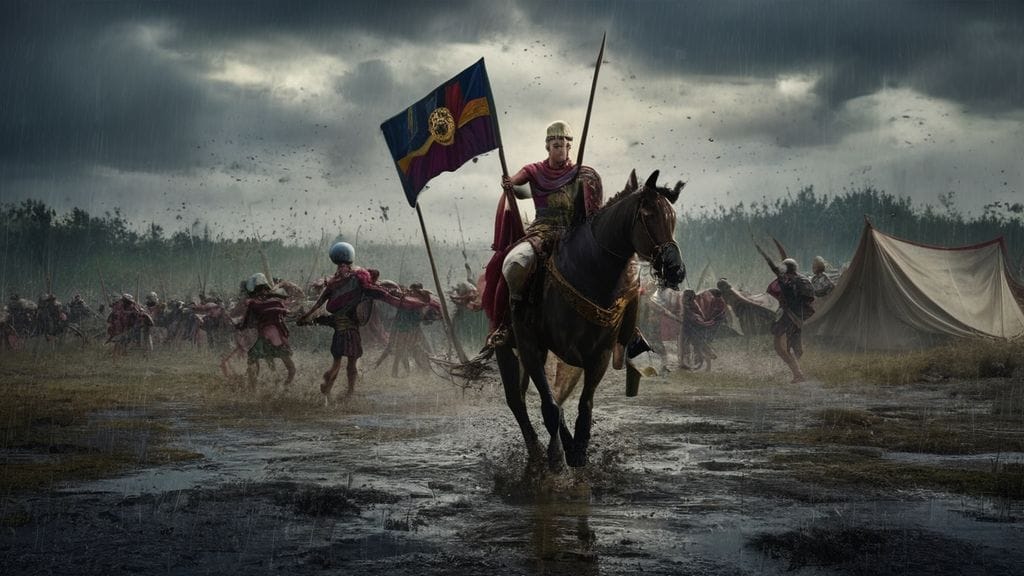
According to Cassius Dio, just when the Roman army’s situation seemed hopeless, a storm began to gather. Dark clouds rolled in over the parched landscape, and suddenly, rain poured down upon the exhausted legionaries. The men lifted their shields and helmets, catching water wherever they could, drinking greedily, pouring it over their faces and the mouths of their horses. Lightning flashed and thunder roared. Dio adds a dramatic twist: the storm, while refreshing the Romans, also struck terror into the Quadi. Lightning bolts felled some of their warriors, and the deluge turned the battlefield into a quagmire, hampering their movements.
This is the version that would be immortalized in Roman art. On the famed Column of Marcus Aurelius in Rome, one panel depicts a towering, divine figure—perhaps a personification of a rain god or Jupiter Pluvius—hovering above terrified barbarians, while streams of water flow around Roman soldiers. The visual message is unmistakable: the gods favored Marcus; they saved his army from annihilation. When later Romans thought about how marcus aurelius defeats the quadi, they saw not only strategy and courage, but divine endorsement blasting down from the heavens.
Yet other versions complicate this neat narrative. The Christian writer Tertullian, for example, claimed that the miracle resulted from the prayers of Christian soldiers within the Roman ranks, members of what he called the “Thundering Legion.” In this telling, it was not Jupiter but the Christian God who intervened, cementing an early precedent for divine assistance to Christian believers in uniform. Modern historians, parsing these competing claims, see behind them a struggle over memory and meaning: pagans and Christians each eager to incorporate the extraordinary storm into their own theological frameworks.
Stripped of its interpretive layers, the core event—a sudden, timely storm relieving Roman thirst and disrupting Quadi attacks—is not impossible. Weather on the frontier could be unpredictable, and armies were permanently vulnerable to environmental shocks. But the meaning imposed on this storm mattered far more than its meteorological explanation. It turned a near disaster into an emblem of providence. It gave Marcus Aurelius, the philosophical emperor, a story that could be used to rally support at home, reassure a war-weary populace, and legitimize the heavy sacrifices still required.
In the immediate tactical sense, the storm allowed the Romans to recover and counterattack. Rehydrated, invigorated, and heartened by what many took as a sign of divine favor, they renewed their efforts to break the Quadi encirclement. The barbarians, disoriented by the changing conditions, could not maintain their tight grip. It was in the wake of this escape, and the subsequent maneuvers that followed, that marcus aurelius defeats the quadi decisively in 174.
When Marcus Aurelius Defeats the Quadi: The Decisive Victory of 174
Following the dramatic escape from encirclement, Roman forces regrouped and pushed aggressively against the Quadi. The emperor, though not necessarily at the precise location of every engagement, directed an overall campaign whose objective was to break the Quadi militarily and politically. In 174, a series of confrontations culminated in what contemporaries and later propagandists alike treated as a decisive Roman victory. It is in this year that, in the language of imperial triumph, marcus aurelius defeats the quadi and seizes the initiative for good on this sector of the frontier.
The exact details of the battle or battles in 174 are not fully preserved in our sources. There is no surviving single, detailed account akin to Caesar’s descriptions of his Gallic victories. Instead, we must piece together fragments: references in Cassius Dio, passages in the Historia Augusta, and above all the iconography of the Column of Marcus Aurelius and inscriptions commemorating the emperor’s deeds. These suggest that Roman forces managed to bring substantial Quadi contingents into open battle, perhaps after systematically destroying their capacity to retreat or regroup.
In straight fight on relatively open ground, the legions had the advantage. Roman heavy infantry, trained to fight in coordinated ranks, could withstand the initial rushes of Germanic warriors and then grind them down with disciplined counter-attacks. Auxiliary cavalry exploited any breach, while archers and slingers thinned enemy ranks from a distance. Quadi warriors fought with courage and ferocity—there is no reason to doubt that—but they lacked the organizational depth and logistical base of the imperial machine. By 174, moreover, they were likely worn from years of marching, fighting, and enduring Roman raids in their own homelands.
Contemporary reliefs and later accounts revel in images of barbarians thrown to the ground, pleading for mercy, or lying piled beneath the standards of Rome. Such depictions must be read critically; they are art, not photography. Yet they communicate something real about the balance of power at that moment. The Quadi leadership faced a choice: continue a war that was increasingly unsustainable, risking annihilation, or negotiate with the emperor now that he held the stronger hand. The decision to sue for peace, to present themselves as suppliants, marked the point at which marcus aurelius defeats the quadi not simply on the battlefield, but at the level of political will. Their resistance, though not eliminated entirely, was broken.
Victories in antiquity were always multidimensional. Marcus needed more than tactical success; he needed a story. The battle of 174, paired in memory with the miracle of the rain, provided exactly that. It could be cast as the moment when, after years of suffering and sacrifice, the empire turned the tide. Marcus Aurelius, the emperor who had sold his own treasures to fund the legions, could now stand before his soldiers and envoys of defeated tribes as the man who had safeguarded Italy, restored the frontier, and mastered both fortune and fear. The phrase marcus aurelius defeats the quadi thus compressed into a few words the anxieties and hopes of millions who would never see the Danube, but whose fates were intertwined with what happened there.
Captives, Treaties, and Hostages: Aftermath of the Quadi Defeat
Military victory was only the beginning of a more complex process: reshaping the political landscape beyond the Danube to ensure that such a crisis would not recur soon. After 174, as Quadi envoys approached the Roman camp under flags of truce, the language of negotiations was one of submission and guarantee. Marcus Aurelius demanded hostages—often the sons or close relatives of tribal leaders—to be taken into Roman custody, usually raised or held in cities deep within the empire. These young nobles would be educated in Latin, exposed to Roman culture, and used as leverage to secure their families’ good behavior.
Treaties were drawn up, stipulating limits on Quadi movements near the frontier, requirements to return Roman prisoners, and commitments to provide auxiliary troops in future Roman campaigns. In some cases, defeated groups were allowed, or forced, to resettle within imperial territory as laeti or dependent communities, providing agricultural labor and recruits in exchange for land and relative protection. The boundaries between “Roman” and “barbarian” grew more permeable, even as the ideological insistence on Roman superiority remained rigid.
The human cost of these arrangements is difficult to overstate. Captives—men, women, and children—were marched southward in long columns. Some would end up as slaves on Italian estates, working vineyards and olive groves far from the forests of their birth. Others would be absorbed into rural communities on the frontier, slowly losing their language and customs over generations. A few, especially among the hostages of high status, might rise to notable positions in the Roman military or administration, their origins gradually blurred by time and assimilation.
From the Roman perspective, this was a rational, even merciful strategy. Rather than exterminating their enemies, they redirected them into the imperial system. From the Quadi perspective, it was both defeat and transformation: a partial erasure of their autonomy and a reorientation of their elites toward the very power that had crushed them. The moment when marcus aurelius defeats the quadi on the battlefield thus echoes in the quiet tragedies of families divided, of young nobles learning to speak Latin in distant schools, and of ancestral lands emptied or repopulated under Roman oversight.
A Philosopher in Armor: How War Shaped the Meditations
It is one of history’s most intriguing juxtapositions: the same man who ordered campaigns that devastated Quadi and Marcomannic territories also penned some of the most introspective and humane reflections in ancient philosophy. Many scholars believe that Marcus Aurelius wrote substantial portions of the Meditations during the Marcomannic Wars, perhaps while encamped on the Danube frontier between campaigns. In one passage he notes, “On the Gran, among the Quadi,” suggesting the very landscape in which his armies marched and fought.
The pressures of war clearly permeate his writing. The Meditations are preoccupied with mortality, with the insignificance of fame, with the fragile nature of human plans. The emperor reminds himself repeatedly that all men, emperor and barbarian alike, will soon be dust; that anger and hatred are self-destructive; that one must do one’s duty without complaint. Reading these lines alongside the story of how marcus aurelius defeats the quadi creates a poignant tension. Here is a man who commands legions, orders executions, and decides the fates of entire peoples, telling himself every night that power is a loan from fate, not a possession.
Some modern readers have criticized Marcus for a kind of hypocrisy: preaching universal brotherhood while waging ruthless wars. Yet this view underestimates both the severity of the threats he faced and the conceptual world in which he operated. To a Roman emperor, protecting the empire—its citizens, its order, its laws—was a moral obligation. Allowing the Danube frontier to collapse would have meant not only humiliation but chaos and slaughter within imperial provinces. In his mind, the campaigns against the Quadi were not wars of aggression but of preservation, painful duties imposed by circumstance.
At the same time, the Meditations leave room for doubt and weariness. Marcus writes of being “sick and weary” of his own role, of longing for rest, of striving not to be hardened by cruelty and despair. One can imagine him, after hearing reports of another devastated village or another ambush in the forests, retreating to his tent and forcing himself to remember that the Quadi too were “rational beings, partakers of the same logos.” The fact that he continued to prosecute the war with determination does not nullify this awareness; it only makes the inner conflict more profound.
Thus, when we say that marcus aurelius defeats the quadi, we should hear not only the clash of arms but the quiet scratching of a stylus on wax tablets, as the victorious general tries to convince himself that he has acted as a man of virtue in a world that often seems devoid of it.
Wounds on the Frontier: Social and Demographic Consequences
The Marcomannic Wars, including the decisive campaigns against the Quadi, left deep scars on the northern frontier. Entire provinces had been ravaged by raids and counter-raids. Farms lay abandoned, cities had spent their treasuries on defense and fortification, and the population losses from both war and plague were enormous. Scholars debate exact numbers, but it is clear that the Danubian region—Pannonia, Noricum, parts of Moesia—emerged from the conflict exhausted.
Roman policy after the victory sought to address these wounds in practical ways. Captives from defeated tribes were settled on underpopulated lands, sometimes as semi-free tenant farmers. Veterans were granted plots in frontier areas, tying their personal fortunes to the recovery and stability of the region. Colonies were reinforced, roads repaired or extended, and fortresses upgraded. The aim was to transform a once-bleeding border into a more resilient belt of Romanized communities, anchored by military outposts.
Yet integration came with tensions. Local Roman provincials did not always welcome large numbers of resettled “barbarians.” Cultural differences, legal inequalities, and economic competition could spark friction. Over time, some of these newcomers adopted the Latin language and Roman customs, while others maintained distinct identities for generations, serving under their own tribal names in auxiliary units. The frontier became even more ethnically and culturally complex, a mosaic whose pieces might hold together in times of strength but could easily fracture under renewed stress.
The economic impact was equally profound. Warfare had disrupted trade routes along the Danube and drained resources from wealthier provinces to pay for legions and fortifications. Cities that once flourished as commercial hubs now diverted income to defense. While the defeat of the Quadi in 174 marked a turning point, it did not magically restore what had been lost. Recovery would take decades, and even then, the frontier never returned fully to the relative calm of the early second century.
For ordinary people—soldiers’ families in frontier towns, peasants in ravaged valleys, captive Quadi resettled under foreign laws—the phrase marcus aurelius defeats the quadi would have carried personal meanings. For some, it meant the end of terrifying raids and the return of a fragile sense of security. For others, it meant exile, new masters, and the slow erosion of ancestral ways of life.
Rome Rewrites Its Myths: Memory, Propaganda, and the Thunderbolt Legion
Victories must be remembered if they are to serve their full political purpose. In Rome, the story of the campaigns against the Quadi and other northern tribes was carved in stone and cast in bronze. The Column of Marcus Aurelius, raised in the Campus Martius, spiraled upward with scenes of marching legions, pleading barbarians, and divine interventions. Inscriptions across the empire hailed the emperor as Restitutor Orbis, the “Restorer of the World.” Coins were minted bearing images of a subdued Germania or defeated barbarians kneeling before a personified Rome.
The “miracle of the rain” episode, in particular, proved irresistibly rich for narrative appropriation. Official, pagan-leaning accounts framed it as the work of Jupiter or a rain deity answering the emperor’s pious supplications. Christian writers, for their part, reclaimed the event as proof that the God of the Christians was already active within the pagan army, rescuing those who called upon him. An anecdote preserved by later authors tells of a unit dubbed the “Thundering Legion,” its very nickname turned into evidence of divine thunderbolts unleashed on behalf of the faithful.
Historians like Cassius Dio, writing within living memory of the events, navigated these competing claims cautiously. He acknowledged the extraordinary storm but attributed it in a more generalized way to divine favor without specifying the mechanism. Modern scholars note these ambiguities and see in them a window into a society negotiating the meaning of chance and providence. As the classicist Michael Grant observed, “the rain that saved Marcus’s army fell not only from the sky but into the imagination of every faction that sought to own it.”
Over time, the statement that marcus aurelius defeats the quadi was smoothed and simplified in public discourse. The messy contingencies of the campaign—the anxieties, the near disasters, the moral compromises—were largely effaced in official memory. What remained was a reassuring myth: under a wise and virtuous emperor, Rome had been tested by barbarians and had triumphed with the help of the gods. This memory worked to legitimize not only Marcus’s reign but the very structure of imperial power, suggesting that heaven itself sanctioned Rome’s dominion over the peoples beyond the Danube.
The Unfinished Victory: Why Peace Never Truly Came
Although 174 and the defeat of the Quadi constituted a major turning point, they did not put an end to the Marcomannic Wars. Fighting continued in various forms; treaties were made, broken, and renegotiated. Marcus Aurelius considered, at least for a time, transforming some of the conquered territory beyond the Danube into formal provinces—Marcomannia and Sarmatia—under direct Roman administration. Such a move would have extended the imperial frontier northward, creating a deeper defensive buffer.
Logistical difficulties, ongoing resistance, and perhaps senatorial reluctance complicated these plans. Moreover, the strain on Roman finances and manpower remained acute. Every new province required garrisons, roads, administrators, and subsidies. The empire was already struggling to maintain its existing structures under the combined weight of war and plague. In this context, even a brilliant victory could not resolve structural vulnerabilities.
Furthermore, the peoples beyond the Danube were not static. Even as the Quadi and Marcomanni were subdued, other groups shifted and stirred. The frontier remained a zone of dynamic movement, not a fixed line between civilization and barbarism. The defeat in 174 weakened the Quadi for a generation, but it did not erase the broader forces—demographic change, economic need, political ambition—that drove migrations and conflict.
When Marcus died in 180, his son and successor Commodus almost immediately sought peace, eager to abandon the arduous northern campaigns and return to Rome. The treaties he concluded rolled back some of his father’s more ambitious visions, sacrificing potential long-term security for short-term stability and popularity. Future emperors would face their own crises along the Danube, sometimes on a scale that made the Marcomannic Wars seem like a prelude. The Gothic War of the later fourth century, culminating in the disaster at Adrianople, showed just how fragile Rome’s control over the frontier truly was.
From this vantage point, the moment when marcus aurelius defeats the quadi appears less as a final triumph and more as a brilliant but temporary stabilization. It was an achievement of immense skill and determination, but it could not halt the slow rebalancing of power between Rome and the peoples beyond its borders.
Echoes Through Time: Historians Debate the Quadi Campaign
The story of Marcus Aurelius and the Quadi has preoccupied historians for centuries, in part because it sits at the crossroads of several compelling themes: the tension between philosophy and power, the fragility of empires, and the role of chance or providence in human affairs. Modern scholarship, drawing on literary sources, archaeology, and comparative studies of frontier societies, has revisited many traditional assumptions about the Marcomannic Wars.
One area of debate concerns the scale and nature of the threat posed by the Quadi and their allies. Older narratives tended to cast the conflict as a kind of existential showdown between Rome and the barbarians, with the empire on the verge of collapse. More recent work suggests a more nuanced picture: while the invasions were serious and damaging, Rome still possessed significant reserves of strength. The fact that marcus aurelius defeats the quadi and continues to wage offensive campaigns beyond the Danube indicates that the imperial military machine, though strained, remained formidable.
Another contested point is the veracity and interpretation of the “miracle of the rain.” Some scholars regard it as a heavily embellished tale built around a ordinary storm; others see it as a near-contemporary memory of an extraordinary and psychologically decisive event. The way various groups—pagans, Christians, imperial propagandists—appropriated the miracle raises questions about how societies encode trauma and rescue into their collective narratives. As one modern historian, Peter Brown, has suggested in another context, “miracles in late antiquity are never just about the supernatural; they are about identity, authority, and the stories communities tell about themselves.”
The Quadi themselves, who left no written records, pose a different kind of challenge. Archaeology offers mute traces of their settlements, burials, and artifacts, but their voices are largely absent from the story. We know how Romans described them; we do not know how they described Rome. Did Quadi elders speak with awe or resentment of the empire beyond the river? Did they interpret the storms and battles as signs from their own gods? In reconstructing the narrative in which marcus aurelius defeats the quadi, historians must remain aware of this asymmetry, careful not to let Roman self-justifications stand unexamined as objective truth.
Despite these gaps, or perhaps because of them, the episode continues to invite reflection. Each generation of historians finds in it new angles: studies of logistics and military adaptation, analyses of imperial ideology, examinations of how personal belief systems like Stoicism intersect with the brutal realities of war. The story is not finished; it is reinterpreted each time we ask what it meant, and means, for a philosopher emperor to win a war on the empire’s frozen edge.
Lessons from a Frozen Frontier: Power, Fate, and Human Fragility
Stand, in imagination, on a winter bank of the Danube. The river flows dark and cold; on one side lie the battered forts and towns of the Roman provinces, on the other the forests and hills of the Quadi. Somewhere in this landscape, in 174, men in armor clashed, shouted, bled, and died. Somewhere beyond the sound of swords and shields, Marcus Aurelius sat in his tent, calculating risks, signing orders, and perhaps later that night writing to himself about the brevity of life and the necessity of virtue.
The episode in which marcus aurelius defeats the quadi is more than a chapter in military history; it is a lens through which to view the fragile equilibrium that holds large human systems together. Empires, like individuals, are vulnerable to cumulative stresses: disease, environmental change, external pressure, internal dissent. The Marcomannic Wars revealed just how quickly a frontier that had seemed stable could ignite. They showed that no amount of marble and ceremony in Rome could insulate the capital from decisions made in distant forests by men whose names the Senate did not even know.
Yet they also revealed the enduring human capacity for adaptation and resilience. Roman administrators reorganized supply systems; generals learned to fight in unfamiliar terrain; communities rebuilt after devastation. Quadi leaders, even in defeat, found ways to negotiate survival for their people, striking bargains that would reshape their relationship to the empire. The storm that saved the encircled legion, whether regarded as a miracle or as meteorological coincidence, symbolizes this unpredictability. Fate—the Stoic heimarmenē Marcus often invoked—was not a straight line but a tangled web of forces beyond anyone’s full control.
In the end, the story forces us to grapple with contradictions. A philosopher who preached compassion presides over a scorched-earth campaign. A supposedly eternal empire turns out to be acutely vulnerable to raids from beyond a river. A people known to history mainly as “barbarians” reveal, in their stubborn resistance and their complex interactions with Rome, a political sophistication that belies the stereotype. Nothing is as simple as the phrase marcus aurelius defeats the quadi might suggest. Victory is real, but it is partial, costly, and temporary; defeat is crushing, but it also opens paths toward transformation.
Conclusion
The defeat of the Quadi during the Marcomannic Wars in 174 stands at the intersection of empire, philosophy, and human endurance. What at first glance appears a straightforward military success—marcus aurelius defeats the quadi, the frontier is saved—reveals, on closer inspection, a dense weave of suffering, resilience, and moral ambiguity. The campaign grew from long-standing tensions along the Danube, magnified by plague and demographic pressures, and unfolded in a harsh landscape that tested the legions as severely as any enemy spear.
Marcus Aurelius emerges from this story not as a flawless sage in purple robes, nor as a simple warlord, but as a deeply burdened ruler navigating impossible choices. His victories relied on harsh measures—heavy taxation, ruthless campaigns, forced resettlements—yet they were also shaped by his determination to act, as he understood it, in accordance with reason and duty. The Quadi, for their part, were not merely foils in an imperial drama: they were a people fighting for space, security, and dignity on the margins of a superpower whose influence they both feared and coveted.
The “miracle of the rain” encapsulates the whole episode’s complexity: a natural event transformed into a symbol of divine favor, claimed by different communities to validate their beliefs, and turned into sculpted stone on a Roman column that still stands today. Behind such images lie the anonymous lives altered or ended by decisions made in marble halls and smoky war councils. When we look back on the year 174 and say that marcus aurelius defeats the quadi, we should hear the echo of marching feet on frozen ground, the murmured prayers of thirsty soldiers, the cries of captives crossing the river, and the quiet scratching of a philosopher’s stylus in the lamplight.
History preserves the outlines; imagination must fill in the human texture. The Danube frontier, once a line of fire, has long since quieted, its forts in ruins, its tribal names largely forgotten. But the questions it posed—about power and responsibility, fear and courage, chance and providence—remain unsettlingly familiar. The story of Marcus Aurelius and the Quadi reminds us that every map of borders is, at bottom, a map of human choices and vulnerabilities, drawn in ink, but also in blood.
FAQs
- Who were the Quadi in the time of Marcus Aurelius?
The Quadi were a Germanic people living north of the Danube, in regions corresponding roughly to parts of modern Slovakia and Moravia. They were organized into tribal groups under kings and nobles, many of whom maintained complex relationships with Rome through trade, diplomacy, and occasional military service. During the Marcomannic Wars, they became key participants in the coalitions that invaded Roman territory, prompting the campaigns in which marcus aurelius defeats the quadi. - What triggered the conflict between Rome and the Quadi?
The war emerged from a combination of Roman weakness and pressures on the tribes beyond the frontier. The Antonine Plague had badly reduced Rome’s manpower and finances, while demographic and possibly climatic changes pushed northern peoples southward. The Quadi and their allies saw opportunities for plunder and territorial advantage, launching raids across the Danube that escalated into full-scale conflict. - What is the “miracle of the rain” associated with Marcus Aurelius?
The “miracle of the rain” refers to an episode during the Marcomannic Wars when a Roman army, reportedly encircled by Quadi forces and suffering from severe thirst, was suddenly saved by a violent storm. Ancient accounts describe the rain as revitalizing the Romans while lightning and thunder disoriented or harmed the enemy. Pagans attributed the event to Jupiter or a rain deity, while Christian writers claimed it as an answer to Christian soldiers’ prayers. - How did Marcus Aurelius ultimately defeat the Quadi?
Marcus Aurelius defeated the Quadi through a sustained, multi-year campaign that combined relentless military pressure with strategic diplomacy. Roman forces crossed the Danube, devastated Quadi territory, and eventually forced significant Quadi contingents into open battle, where disciplined legions held the advantage. After the key victories of 174, Quadi leaders sought peace, agreed to provide hostages and auxiliaries, and accepted terms that placed them firmly under Roman influence. - What role did Stoic philosophy play in Marcus Aurelius’s conduct of the war?
Stoic philosophy shaped how Marcus understood his responsibilities and endured the hardships of war. In his Meditations, likely written in part on the Danube frontier, he emphasizes duty, self-control, and the acceptance of fate. While Stoicism did not stop him from waging harsh campaigns, it appears to have guided his efforts to remain fair, to avoid cruelty for its own sake, and to view both victory and defeat as transient in the larger order of things. - Did the defeat of the Quadi bring lasting peace to the Danube frontier?
No, the defeat in 174 brought an important but temporary stabilization. Fighting continued in various forms, and other tribes remained active beyond the frontier. Marcus considered creating new provinces beyond the Danube but died before this strategy could be fully realized. His successor Commodus opted for peace and withdrawal, and in the longer term the Danubian frontier remained a zone of recurring crisis for the Roman Empire. - How reliable are our sources for the Marcomannic Wars?
Our sources are fragmentary and biased. Cassius Dio provides the most important narrative, but his account survives only in later excerpts and summaries. The Historia Augusta contains useful material but is riddled with inventions. Inscriptions, coins, and monuments like the Column of Marcus Aurelius add visual and epigraphic evidence, while archaeology sheds light on destruction layers and settlement changes. Historians must carefully cross‑examine these materials to reconstruct what actually happened. - What were the long-term consequences for the Quadi after their defeat?
In the short term, the Quadi lost autonomy, land, and people. Hostages were taken; some groups were resettled within the empire; and their leadership had to align more closely with Roman interests. Over generations, many Quadi would be absorbed into broader frontier populations that interacted constantly with Rome. Their distinct identity faded from the historical record, though elements of their culture and lineage likely persisted among later groups in the region. - Is there physical evidence of the battles against the Quadi?
Direct battlefield archaeology is limited, but there is substantial evidence of fortifications, temporary camps, and destruction layers in Roman frontier provinces corresponding to the time of the Marcomannic Wars. The Column of Marcus Aurelius in Rome offers a sculpted visual narrative of the campaigns, including confrontations with Quadi and Marcomannic warriors. Together with inscriptions, these remains corroborate the literary accounts of intense, prolonged conflict along the Danube. - Why does the conflict with the Quadi still matter today?
The episode highlights timeless themes: how states respond to multiple simultaneous crises, how leaders balance morality and necessity, and how societies remember or distort traumatic events. It also illustrates the permeability of borders and the complex relationships between so‑called “civilizations” and their neighbors. In studying how marcus aurelius defeats the quadi, we gain insight into the dynamics of power, migration, and identity that continue to shape our world.
External Resource
Internal Link
Other Resources
- Encyclopaedia Britannica – general search for the exact subject
- Google Scholar – academic search for the exact subject
- Internet Archive – digital library search for the exact subject

