Table of Contents
- The Early Morning Tremor: Awakening Market Rasen
- A Rare Shake in England: The Context of Seismic Events
- Geological Details: The Fault Beneath the Lincolnshire Sky
- The Scale of the Quake: Measuring Magnitude and Impact
- Immediate Reactions: Shockwaves Through a Quiet Community
- The Role of the British Geological Survey: Analyzing the Data
- Comparing Past English Earthquakes: From Dover to Market Rasen
- Human Stories: From Fear to Resilience in the Aftermath
- Infrastructure and Damage: When Stone and Brick Meet the Earth
- Emergency Response and Local Authorities: Coordinated Calm
- Media Coverage: Reporting Tremors in a Land of Stability
- Scientific Interest: Renewed Attention on British Seismology
- Psychological Impact: The Unexpected Anxiety in a Tranquil County
- Lessons Learned: Preparedness in a Low-Risk Region
- Cultural Echoes: How Market Rasen’s Shake Entered Local Lore
- Earthquake Monitoring Improvements Post-2008
- Legacy of the Event: Public Awareness and Policy Shifts
- Market Rasen Today: Living Above a Quiet Fault
- Reflections from Seismologists: Predicting the Unpredictable
- Conclusion: A Tremor that Stirred More Than the Ground
- FAQs: Understanding the Market Rasen Earthquake
- External Resources
- Internal Link: History Sphere
The Early Morning Tremor: Awakening Market Rasen
It was an unexpected awakening in the early hours of February 27, 2008. The tranquil market town of Market Rasen, nestled in the gentle rolling hills of Lincolnshire, England, was stirred not by the chirps of waking birds or distant farm life, but by a sudden, low rumble beneath the earth. In an instant, windows rattled, floors shuddered, and the usual calm of a rural English dawn fractured into an uneasy moment of primal uncertainty. The earthquake that struck just before 7 a.m. wasn’t just a geological phenomenon; for the people of Market Rasen and beyond, it was a rare, startling reminder that even the most stable lands carry hidden tremors beneath their feet.
That morning shattered centuries of complacency, bringing questions, fears, and a wave of curiosity. How could England, a nation not synonymous with earthquakes, suddenly feel the earth move so dramatically? This event will forever mark itself as a singular, unnerving moment where history, geology, and human experience collided.
A Rare Shake in England: The Context of Seismic Events
England’s reputation is that of a quiet, geologically stable island, far removed from the trembling fault lines that define places like California or Japan. Yet, it’s not immune to the occasional shudder from beneath the earth’s crust. The British Isles sit on a minor tectonic plate influenced more by ancient stresses and far-flung plate boundaries than direct subduction zones or active rifts. Earthquakes here are usually minor, often unnoticed trembles that go unrecorded by the general public.
Historically, earthquakes larger than magnitude 4 have been infrequent but not impossible. The 2008 event’s magnitude 5.2 reading made it one of the more substantial quakes in recent British history. For context, the average annual earthquake magnitude recorded in the UK barely crosses 2.5. Yet this rarity does not equate to absence; rather, it creates a fragile dormancy, ready to interrupt daily life when least expected.
Underlying this infrequency are the subtle movements of an ancient network of faults, relics of geological episodes long passed but still restless. Market Rasen’s shock was a vivid sign that England’s seemingly immutable earth still harbors possibilities for upheaval.
Geological Details: The Fault Beneath the Lincolnshire Sky
Beneath the pastoral beauty of Lincolnshire lies a story layered in millions of years. The Market Rasen earthquake originated on a fault line relatively unknown to most locals—a minor, buried fracture deep within the Earth’s crust shaped by glacial and tectonic pressures from epochs ago.
Seismologists traced the origin near the well-documented Lincolnshire Fault Zone, part of a complex network of faults that have shaped the region’s topography. These faults, while often locked and silent over centuries, still contain accumulated stress. The slow grinding and sudden release of this stress is what caused the earthquake’s shaking.
The depth of the quake was approximately 18 kilometers beneath the surface, striking deep enough to release energy that radiated outward, shaking homes and businesses across a sizable area. Geological instruments recorded clear aftershocks, minor but enough to remind residents that the earth was still settling the score.
The Scale of the Quake: Measuring Magnitude and Impact
Magnitude 5.2 may seem modest compared to the colossal quakes world history remembers, but its effect in a non-seismic area was amplified. The Richter scale, logarithmic by nature, means that every step up reflects a tenfold increase in amplitude. For Market Rasen, the quake was the strongest recorded in the UK since 1984 and the strongest in Lincolnshire ever documented.
The quake’s intensity varied, with the epicenter experiencing the most violent shaking, labeled as VI (Strong) on the Modified Mercalli Intensity scale. Across nearby towns, residents felt moderate tremors; wooden furniture vibrated, windows crackled, and small cracks appeared in plaster walls.
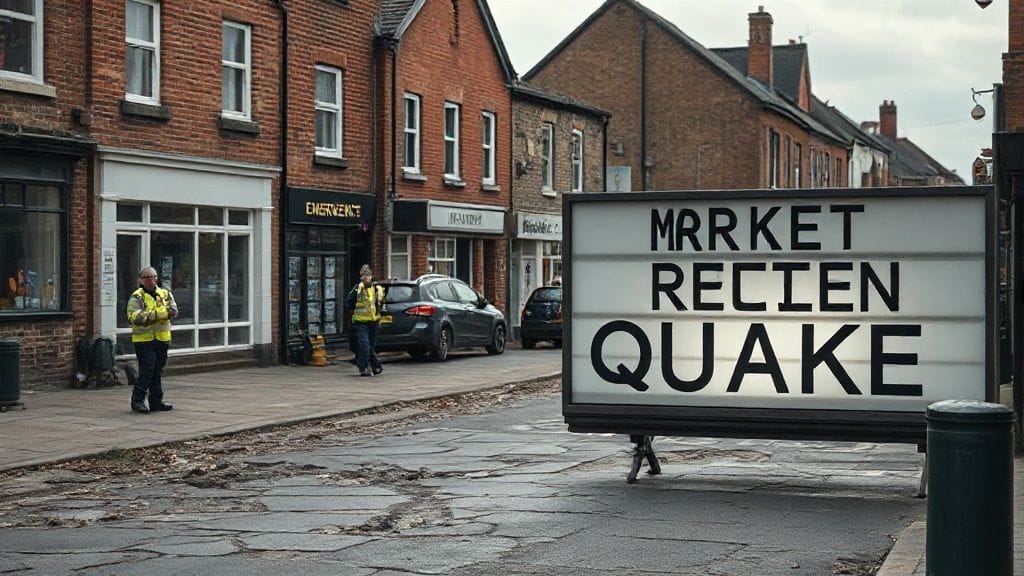
Minor structural damages occurred—chimneys collapsed, plaster flaked, and some historical brick buildings showed signs of stress, but remarkably, no fatalities or major injuries were reported. For a nation unaccustomed to such events, the consequences were tangible yet managed with calm and efficiency.
Immediate Reactions: Shockwaves Through a Quiet Community
Imagine waking up suddenly not to the alarm clock or rooster’s crow but to the violent, ground-shaking sensation of an earthquake. For Market Rasen residents, the early morning was torn between fear and disbelief. Phones clogged with calls seeking explanation; overnight guests told stories of swaying beds.
Within minutes, news spread beyond Lincolnshire’s borders. National emergency services activated monitoring protocols, but the event lacked the catastrophic devastation of more earthquake-prone regions.
Local baker Mary Fields recalled, “I thought a heavy truck had crashed into the shop, then the floor seemed to ripple beneath me. It was strange, unsettling…like something out of place in our quiet lives.” Stories like hers became common, humanizing the geological event into a shared communal memory.
The Role of the British Geological Survey: Analyzing the Data
In the aftermath, the British Geological Survey (BGS), the UK’s foremost seismological authority, worked swiftly to analyze the phenomenon. Their network of seismographs across England picked up the event immediately, confirming the magnitude and mapping the aftershock sequence.
Dr. Richard Bailey, a senior seismologist at the BGS, remarked, “The Market Rasen earthquake was a wake-up call for British seismology. It highlighted the need for comprehensive seismic monitoring in regions we tend to consider inactive.”
Data gathered allowed scientists to study the fault's behavior, the nature of aftershocks, and the geological forces at play—a rare chance to deepen understanding of intra-plate earthquakes that slip beneath the radar in this part of the world.
Comparing Past English Earthquakes: From Dover to Market Rasen
Though rare, the Market Rasen quake was not an isolated incident in England’s seismic history. The country has witnessed sporadic tremors—some more infamous than others. The 1931 Dogger Bank earthquake under the North Sea reached magnitude 6.1, causing a sizable stir along the East Coast.
Even in historic times, records mention shaking events dating back centuries, such as the 1580 Dover Straits earthquake, felt widely across southern England and northern France.
Market Rasen’s tremor, while not the largest, stood out due to its location in a region not traditionally known for seismic activity, prompting re-evaluation of regional risk assessments.
Human Stories: From Fear to Resilience in the Aftermath
Beyond data and magnitude, it is the lives upturned or briefly disturbed that give earthquakes their true emotional weight. The Market Rasen community showed resilience. Neighbors checked on one another, schools reassessed emergency drills, and local councils consulted experts on improving preparedness.
One elderly resident, George Harris, said, “I’ve lived here for over 70 years and never felt a thing like it. For a moment, it reminded us how small we are. But it also brought us closer. People talked more openly thereafter.”
This shared experience—collective shock followed by collective strength—cemented the event in local memory as more than just a geological footnote.
Infrastructure and Damage: When Stone and Brick Meet the Earth
The architectural heritage of Market Rasen, dotted with traditional brick and stone homes, churches, and commercial buildings, faced its first real test. Chimneys toppled, cracks appeared in walls, and some older structures required immediate assessments.
Damage was limited but symbolic. It awakened public and government awareness about the vulnerability of Britain’s historical and civic infrastructure to such rare natural events.
The town hall, Victorian in design, escaped significant harm, but nearby residential properties required repairs. Insurance claims surged temporarily, reflecting a community grappling with unforeseen risk.
Emergency Response and Local Authorities: Coordinated Calm
Market Rasen’s emergency services acted with steady coordination. Though not accustomed to the urgency of seismic disasters, their protocols blended elements of fire response, structural safety checks, and public reassurance.
Local police liaised with fire brigades and health authorities, facilitating communications while ensuring no panic broke out. Temporary shelters were readied, and public information broadcasts helped quell rumors.
This incident sparked proposals for emergency planning drills tailored to seismic risks in UK towns, rarely a priority before 2008.
Media Coverage: Reporting Tremors in a Land of Stability
National media seized on the quake with a mix of intrigue and disbelief. Headlines emphasized rarity—"England’s Ground Shakes: Market Rasen Earthquake Rattles Residents"—reflecting both the novelty and the small scale of the crisis.
Documentaries and news programs quickly followed, explaining Britain’s geology to a wide audience previously unaware that earthquakes happened on these shores.
Yet, the media coverage also balanced sensationalism with reasoned analysis, helping foster a more informed public conversation about geological risks in the UK.
Scientific Interest: Renewed Attention on British Seismology
Market Rasen reinvigorated scientific interest in the seismicity of the British Isles. Universities and geological institutions launched studies revisiting tectonic stress maps, potential fault lines, and regional historical earthquake records.
Researchers questioned assumptions of safety based on low frequency alone and examined whether similar unnoticed faults existed elsewhere in the country.
Internationally, the UK’s experience contributed to broader discussions on intra-plate earthquakes—that is, earthquakes away from plate edges—an area still not fully understood.
Psychological Impact: The Unexpected Anxiety in a Tranquil County
For many locals, the earthquake provoked a lingering psychological unease. In a nation accustomed to low natural disaster risk, the tremor underscored vulnerability to the unpredictable forces of nature.
Mental health professionals noted increases in anxiety and sleep disturbances among some residents, especially older adults. Counselling services were mobilized, and community groups organized talks on coping with natural disasters.
This dimension revealed how geological events ripple beyond the physical, touching the psyche and social fabric of a community.
Lessons Learned: Preparedness in a Low-Risk Region
The Market Rasen quake highlighted a gap in preparedness planning. Historically, the UK had prioritized flooding, storms, or terrorism over earthquakes in civil defense strategies.
Post-2008, authorities began incorporating seismic scenarios into disaster planning exercises. Schools introduced earthquake drills, and building regulations reassessed structural tolerance in vulnerable regions.
The event became a catalyst for proactive resilience, turning a moment of surprise into sustained vigilance.
Cultural Echoes: How Market Rasen’s Shake Entered Local Lore
Stories of the February 2008 earthquake wove themselves into local culture. Annual town meetings remembered the date; oral histories preserved eyewitness testimonies; even local pubs replayed the event as a ‘night that the earth spoke.’
Artists, poets, and writers found inspiration in describing how the rural countryside briefly trembled, blending science with storytelling in ways that enriched community identity.
The Market Rasen earthquake transcended its scientific footprint, entering the imagination and traditions of those who felt its ground shake.
Earthquake Monitoring Improvements Post-2008
In response to Market Rasen’s tremor, seismic monitoring in the UK expanded. New sensors were deployed, data sharing increased, and public alert protocols refined.
The BGS strengthened partnerships with international seismological agencies, integrating real-time data streams and predictive modeling.
For a nation often viewed as geologically stable, these developments marked a decisive step towards recognizing and adapting to inherent natural risks.
Legacy of the Event: Public Awareness and Policy Shifts
The legacy of the Market Rasen earthquake is found in heightened public awareness. Media education, government preparedness, and academic inquiry flourished.
Policy-wise, local councils adjusted land-use planning, and emergency response frameworks now included earthquake contingencies—even if the chances seemed slim.
It’s a story of a small quake’s outsized impact on how a country thinks about its place in the restless natural world.
Market Rasen Today: Living Above a Quiet Fault
Today, Market Rasen goes about its daily rhythms, fields stretching under the wide Lincolnshire sky, shops bustling, and community events thriving. Yet beneath this calm lies the quiet fault that reminded residents their homes sit upon a dynamic planet.
The 2008 earthquake remains a chapter in local history—sometimes discussed with nervous smiles or sober respect. The town embraces its legacy, symbolizing resilience, adaptability, and the complex dance between humanity and the earth itself.
Reflections from Seismologists: Predicting the Unpredictable
Seismologists reflect on Market Rasen as a humbling lesson on unpredictability. “Earthquakes don’t read maps or respect our definitions of ‘safe zones’,” Dr. Bailey reminds us. “Our job is to anticipate, educate, and prepare, even where the risk seems remote.”
The event sparked research emphasizing that no region is entirely free from seismic possibility. It challenges both scientists and citizens to maintain awareness despite geological tranquillity.
Conclusion: A Tremor that Stirred More Than the Ground
The Market Rasen earthquake of February 27, 2008, was much more than a geological incident. It was a rupture in perception as much as the earth—a reminder that beneath the familiar calm lie forces ancient and potent. It disrupted routines, challenged assumptions, and ultimately united a community in shared experience and resilience.
It echoes a broader truth: in every corner of the world, human lives are intertwined with the planet’s restless nature. No land, no matter how settled, is untouched by time’s geological march. Market Rasen’s tremor reminds us to respect this delicate balance and prepare wisely, embracing both science and humanity’s capacity to endure.
FAQs
1. How common are earthquakes in England?
Earthquakes in England are generally rare and small, with most below magnitude 3. Significant quakes like Market Rasen 2008 (magnitude 5.2) are unusual but not unprecedented.
2. What caused the Market Rasen earthquake?
It was caused by the sudden release of stress along a fault line beneath Lincolnshire, part of ancient geological structures reacting to ongoing crustal pressures.
3. Were there any injuries or deaths from the Market Rasen earthquake?
No fatalities or major injuries were reported. Damage was mainly structural and limited.
4. How did emergency services respond?
Emergency services acted promptly but calmly, conducting inspections, ensuring public safety, and providing information to prevent panic.
5. Has the UK improved earthquake monitoring since 2008?
Yes. The British Geological Survey expanded seismic networks and developed better public and governmental alert systems post-2008.
6. Could a larger earthquake happen in England?
While unlikely, there is a remote possibility of larger earthquakes due to ancient faults and intra-plate stresses, necessitating preparedness.
7. How did the Market Rasen event affect public awareness?
It significantly raised awareness of earthquake risks, leading to improved safety planning and education tailored to the UK context.
8. Is Market Rasen situated on an active fault today?
Market Rasen lies above a known buried fault. It’s considered low risk but not inactive, as evidenced by the 2008 quake.