Table of Contents
- A Winter Morning at Westminster: The Wedding That Promised Peace
- From Red Rose and White Rose to Blood and Ashes: The Wars of the Roses
- A Welsh Exile and a Yorkist Princess: Two Lives on a Collision Course
- Secrets, Oaths, and Missing Princes: The Shadow of Richard III
- Bosworth Field and the Making of a New King
- Promises in Rennes and Politics in London: Negotiating the Royal Match
- Crown Before Bride: Why Henry Delayed His Marriage
- London in January 1486: Expectation, Fear, and Hope in the Capital
- The Procession to Westminster: Velvet, Tapestries, and Watching Crowds
- Inside Westminster Abbey: Ritual, Symbolism, and Silent Calculations
- A Union of Flesh and Heraldry: How Tudor Rose and Royal Blood Intertwined
- Love, Duty, or Strategy? Imagining the Private World of Henry and Elizabeth
- From Wedding to Heir: Arthur’s Birth and the Stabilization of the Dynasty
- Plots, Pretenders, and the Pressure on a Royal Marriage
- Mother of a New England: Elizabeth of York’s Quiet but Profound Influence
- Grief in the Tudor Court: Death, Distance, and the Hardening of a King
- The Tudor Rose Endures: Long-Term Political and Cultural Consequences
- Historians, Myths, and Modern Memory of a Foundational Union
- Conclusion
- FAQs
- External Resource
- Internal Link
Article Summary: On a cold January day in 1486, the marriage of Henry VII and Elizabeth of York in Westminster Abbey promised an end to three decades of civil war and dynastic bloodshed. This article traces the violent backdrop of the Wars of the Roses, the unlikely rise of a Welsh exile to the throne, and the careful crafting of a union that would symbolically and literally fuse Lancaster and York. It explores how political necessity shaped the betrothal, coronation, and wedding, while also examining the human story of two young people whose personal feelings are partly lost to history. Through narrative scenes, archival detail, and analysis, we follow the early years of their marriage, the birth of heirs, and the crises of pretenders like Lambert Simnel and Perkin Warbeck. The article also considers Elizabeth of York’s quieter but vital role in legitimizing Tudor rule, soothing Yorkist anxieties, and shaping the next generation, including the future Henry VIII. Yet behind the triumph lay grief, strain, and distance, especially in the final years of their partnership. By the end, we see how the marriage of henry vii and elizabeth of york became more than a dynastic arrangement; it was the cornerstone of the Tudor age, reshaping English politics, culture, and monarchy for generations. It’s a story of ceremony and calculation, but also of loss, resilience, and the fragile hope that a single wedding could heal a wounded kingdom.
A Winter Morning at Westminster: The Wedding That Promised Peace
On the morning of 18 January 1486, London awoke under a low, winter sky. Frost clung to the stone buttresses of Westminster Abbey; the Thames moved sluggishly, muffled in mist. Yet inside the city walls there was a restless, vibrant anticipation. People pressed into the streets and craned their necks toward the river route and the palace, drawn by rumors, proclamations, and the irresistible pull of spectacle. For decades England had been torn apart by the Wars of the Roses. Now, they were told, a wedding might end it all.
At the heart of that day stood two figures: Henry Tudor, recently crowned Henry VII, and Elizabeth of York, the eldest daughter of the dead king Edward IV. The marriage of Henry VII and Elizabeth of York was more than a union of man and woman; it was a carefully staged answer to an entire generation’s trauma. He came from the red rose of Lancaster, tenuous in his claim, hardened by years of exile. She was the living embodiment of the white rose of York, whose blood had flowed across English battlefields from Towton to Tewkesbury. As they prepared to walk into Westminster Abbey, the weight of those roses, those graves, and those hopes lay on their shoulders.
The abbey itself, with its high, vaulted Gothic arches, seemed designed to carry prayers of reconciliation upward into the grey light. The royal almoners and stewards had spent days arranging tapestries, hangings, and candles. Heralds in their brilliantly embroidered tabards rehearsed the order of procession; choirboys tested hymns that floated into the cold air like fragile promises. Outside, common Londoners muttered to each other: would this really end the bloodshed? Could any king, any bride, quiet the factions that had torn their world apart?
The marriage of henry vii and elizabeth of york was, from the moment it was conceived, a ritual of healing and a calculated performance of legitimacy. Henry had been crowned in October 1485, after his victory at Bosworth, but his crown alone was not enough. To reconcile Yorkist loyalists, to reassure the great nobles, to soothe international anxieties, he needed Elizabeth. She, in turn, needed him: without Henry’s victory, the Yorkist line had been shattered by internecine betrayal and the mysterious disappearance of her brothers, the “Princes in the Tower.” Now, whether she wished it or not, her person had become political capital.
Yet in the stillness before the ceremony, before the liturgy, before the exchange of vows, there was still a sliver of something human and unknowable. Did Elizabeth feel dread, or acceptance, or a quiet relief at the thought of stability? Did Henry, who had once sworn in a Breton cathedral to marry her if fortune favored him, think of promises made in exile? The chronicles emphasize symbols and heraldry, but behind the rich fabrics and solemn oaths, two young people—Henry was twenty-nine, Elizabeth around nineteen—stepped toward each other, toward power, and toward a future that neither could fully see.
From Red Rose and White Rose to Blood and Ashes: The Wars of the Roses
To understand why this single marriage could carry such immense weight, one has to look back over the thirty years of bloodshed that preceded it. The Wars of the Roses were not one continuous conflict but a jagged, stuttering series of uprisings, reversals, and vendettas that pitted the houses of Lancaster and York against one another for the English crown. What began as a dispute over royal competence under the fragile, pious Henry VI had become, by the 1470s, an intergenerational trauma etched into every noble household in England.
The Lancastrian line held power through Henry VI, descendant of John of Gaunt, but his mental instability and political weakness opened the door to ambitious rivals. The Yorkist claim, carried by Richard, Duke of York, traced another branch from Edward III. On paper, it was a matter of genealogies and precedence; in practice, it was a fight over land, patronage, and survival. Towton in 1461, often cited as the largest and bloodiest battle fought on English soil, left thousands dead in the snowdrifts of Yorkshire, the air thick with the metallic tang of blood. Chroniclers like Polydore Vergil would later describe these decades as a time when “no place was void of cruelty” and neighbor turned against neighbor.
Elizabeth of York was born in 1466, in the uneasy yet glittering aftermath of Yorkist victory. Her father Edward IV had seized the crown by force and charm, a towering, charismatic king whose household dazzled with feasts and tournaments. The white rose seemed triumphant. But beneath the polished illusion of stability, rivalries continued to smolder. Edward’s own brother Clarence schemed and fell; nobles remembered dispossessions and humiliations suffered in Lancastrian or early Yorkist purges. Add to this the bitter survival instincts of Margaret of Anjou, Henry VI’s formidable queen, and you have a kingdom with no real peace, only exhausted pauses between storms.
The Lancastrian cause flickered out, temporarily, with the death of Henry VI and his son. Yet every death only generated new questions, new resentments. Families lost fathers, sons, uncles; titles and estates shifted hands abruptly. Children grew up in the shadow of stories about betrayal and sudden royal wrath. Among those children was Henry Tudor, a distant Lancastrian claimant, and Elizabeth of York, whose status and very future were bound up with the shifting fortunes of her house. The marriage of Henry VII and Elizabeth of York would later be presented as a balm over these wounds, but it was also a reminder that every Tudor rose was rooted in graves.
By the 1480s, the wars had grown more complex than a simple York versus Lancaster narrative. Yorkists fought Yorkists; kings unseated other kings from their own family. Richard III’s seizure of the throne in 1483, at the expense of his young nephews, showed just how fractious things had become. Yet it is precisely out of this chaos that the idea of a healing marriage arose—a union that could, at least symbolically, bind the broken branches together. It would take more than a wedding to erase decades of suspicion, but the desperate longing for a definitive end to the conflict made that January day in Westminster Abbey seem almost miraculous.
A Welsh Exile and a Yorkist Princess: Two Lives on a Collision Course
Henry Tudor’s path to Westminster began far from London’s stone walls. Born in Pembroke Castle in 1457, he was the son of Margaret Beaufort, a teenage heiress with Lancastrian blood, and Edmund Tudor, a half-brother of Henry VI. His father died before he was born; his childhood unfolded in a swirl of siege, flight, and captivity. When the Yorkists triumphed, Henry’s existence became dangerous. By the time he was a teenager, he had been bundled off to Brittany, a political pawn in foreign hands, living in a kind of gilded captivity in the courts of dukes and bishops.
His claim to the throne was, strictly speaking, fragile: it ran through the Beaufort line, originally born of a royal illegitimate branch later legitimized but barred from succession. But in politics, what matters is not only law, but perception and timing. As each Lancastrian male heir fell on the battlefield or met a quieter, murkier end in a cell, Henry’s profile rose. He grew up in exile, surrounded by a small circle of loyalists who whispered of destiny and restoration. Imagine the impression this must have made on the young man: the idea that his survival itself was charged with meaning.
Elizabeth of York’s upbringing could not have been more different—until disaster struck. Born into the glittering Yorkist court, she was cherished as the eldest daughter of a powerful king and his controversial queen, Elizabeth Woodville. She would have known silks, music, courtly manners, the elaborate rituals of royal feasts. But court life was no fairy tale. She watched her father flee into exile when the Earl of Warwick briefly restored Henry VI, then return triumphantly. She saw her mother hunted, then powerful again, then on the defensive once more as factions rose and fell around the throne.
When Edward IV died suddenly in April 1483, Elizabeth’s world changed overnight. Her young brother Edward was proclaimed Edward V, but power quickly slipped into the hands of their uncle, Richard, Duke of Gloucester. Within months, the new king’s coronation was canceled; the princes were declared illegitimate on the grounds of an alleged prior contract invalidating Edward IV’s marriage; Richard took the crown as Richard III. Elizabeth, once the daughter of a reigning king, became a politically inconvenient princess, her status uncertain, her family divided. This was the crucible in which the idea of her future marriage to Henry Tudor, a man she had never met, began to take shape.
Thus, two separate trajectories—one moving through Breton and French corridors of power, the other through the guarded chambers of English palaces and sanctuaries—slowly bent toward convergence. The marriage of Henry VII and Elizabeth of York would be the collision point of these lives: that of a hardened exile with a cause and that of a princess whose bloodline had lost its throne but not its allure. Their union was not born of youthful romance, but of political necessity and historical momentum.
Secrets, Oaths, and Missing Princes: The Shadow of Richard III
The reign of Richard III casts one of the darkest shadows over this story. In 1483, after being named Protector for his nephew Edward V, Richard rapidly consolidated power. The young king and his brother, Richard of Shrewsbury, were lodged in the Tower of London—nominally for their safety and preparation for coronation. Then, abruptly, they vanished from public view. Rumors swirled: they were ill, they were moved, they were dead. No official statement was made; no bodies were produced. The silence itself was damning.
Contemporary accounts vary, and historians still debate the princes’ fate. Thomas More, writing decades later, offered a chilling narrative of their smothering at Richard’s command—a version popularized by Shakespeare, though modern scholars caution that More wrote with Tudor hindsight and moral purpose. Yet whatever the precise truth, the political effect was devastating. Richard’s legitimacy, already fragile due to his usurpation, was fatally compromised in the eyes of many Englishmen and foreign powers. Whispers that he was a child-murderer clung stubbornly to his name.
For Elizabeth of York, this was not abstract politics. Those missing boys were her brothers, with whom she had shared tutors, meals, and games. She and her sisters were placed in “honorable” but controlled conditions, while their mother, Elizabeth Woodville, sought sanctuary in Westminster Abbey. During this dark interlude, a plan began to form in the minds of those opposed to Richard’s rule: a marriage alliance between Elizabeth and Henry Tudor, the exiled Lancastrian hope. This would unite the Yorkist and Lancastrian lines, restore a sense of lawful succession, and provide a rallying figure to oppose Richard.
In December 1483, in the Breton city of Rennes, Henry Tudor stood in a cathedral and swore a solemn oath that, if he gained the throne, he would marry Elizabeth of York. It was a vow intended as much for his allies as for heaven, a binding public declaration that he would not try to rule merely as a Lancastrian conqueror but as the husband of the Yorkist heiress. The marriage of Henry VII and Elizabeth of York thus began its existence as a promise in exile, a weapon in the propaganda war against Richard III.
Richard, for his part, seems to have realized the danger of this projected union. There were moves—tentative, controversial—to consider marrying Elizabeth of York himself if his own queen, Anne Neville, died without producing a surviving heir. Such an alliance would have been deeply scandalous and politically explosive; chroniclers report that even rumors of it provoked unease. Whether Richard seriously contemplated it or merely toyed with the idea, the fact that such talk existed underscores how central Elizabeth’s person had become to plans of legitimization and consolidation.
In this tense atmosphere, every rumor about the missing princes, every sign of noble discontent, and every move from across the Channel fed into a sense that Richard’s reign balanced on a knife’s edge. The kingdom was weary of conflict, but it was also wary of a king under such suspicion. The stage was set for Henry Tudor’s landing, for Bosworth, and for the translation of that oath in Rennes into a very real bridal procession in London.
Bosworth Field and the Making of a New King
On 22 August 1485, near the small Leicestershire village of Market Bosworth, the question of England’s future was fought out in mud and steel. Henry Tudor, landing in Wales with a modest force and gathering support as he moved eastward, confronted King Richard III, whose banners of the white boar fluttered over a numerically superior army. The battle of Bosworth was both climactic and uncertain. Much would depend on which way key magnates—especially the powerful Stanley family—would turn their lances.
Accounts of the battle tell of a fierce, short struggle, punctuated by betrayals and acts of startling courage. Richard, who had earned a reputation as a bold commander in earlier campaigns, is said to have led a direct charge toward Henry himself, seeking to end the conflict with one decisive blow. For a moment, the outcome hung on a few yards of ground and the sharpness of swords. But the Stanleys, after a long, calculating hesitation, threw their weight behind Henry. Surrounded, Richard died fighting. According to later tradition, his crown was found in a hawthorn bush and placed upon Henry’s head on the field itself.
With Richard’s death, the Yorkist regime crumbled, but Henry’s problems were far from over. His claim to the throne remained technically weaker than that of many Yorkist nobles. His authority depended on more than victory; it required a narrative. Henry moved quickly and cleverly. He dated his reign from the day before Bosworth, thus legally defining Richard’s supporters as traitors. Yet he did not immediately launch a wave of bloody purges; he understood that reconciliation, not terror, would better secure his position in the long term.
Key to this strategy was fulfilling the long-promised union: the marriage of henry vii and elizabeth of york. But Henry, cautious and politically astute, would not rush into the wedding before establishing his own independent legitimacy. First he sought and obtained a coronation sanctioned by the church and, crucially, the recognition of Parliament. The wedding, when it came, would be a seal upon a sovereignty already proclaimed—not the sole source of it.
Still, the seeds of the marriage were present in every calculation Henry made in the early months of his reign. He needed to reassure Yorkists that he did not come as a vengeful Lancastrian conqueror intent on stripping them of honor and land. He needed to show foreign powers, particularly France and Spain, that England would be stable under his rule. And he needed to neutralize any rival around whom discontented factions could rally. Marrying Elizabeth would help to achieve all of these aims. It would make their children heirs acceptable to both Yorkist and Lancastrian sympathizers and cloak Henry’s new dynasty in the prestige of her Plantagenet blood.
Promises in Rennes and Politics in London: Negotiating the Royal Match
Henry’s vow in Rennes had created an expectation, even a moral obligation, that he would marry Elizabeth of York. But what had served as a weapon against Richard III now had to be translated into delicate political practice. Elizabeth’s mother, Elizabeth Woodville, and her allies expected that she would be restored to full royal status; Yorkist loyalists wanted assurance that their bloodline would not be eclipsed. At the same time, Henry needed to be careful not to appear as though he derived his crown solely through his wife.
One of Henry’s first acts was to secure Elizabeth’s person. She had been under the control of Richard III’s regime, passed between custody and relative seclusion. With his victory, she moved into his orbit. But contrary to romantic imaginings of an immediate joyful reunion and betrothal, Henry proceeded methodically. He called a Parliament in November 1485, which confirmed Richard’s usurpation and declared Henry the rightful king by “just title of inheritance” and the “decree of Almighty God.” Only after this act of political theater did he formally signal his intention to marry Elizabeth.
The negotiations included legal and symbolic work. Parliament reversed the act that had declared Edward IV’s children illegitimate. This move, while necessary to strengthen Elizabeth’s position as queen consort, was delicate; Henry did not wish to open the door too widely to other Yorkist claimants. But Elizabeth’s restored legitimacy was crucial. Without it, the marriage of Henry VII and Elizabeth of York could not function as the grand union of warring houses that Henry wished to present to the realm.
Behind the scenes, there were likely discussions about dowry, jointure, and the financial arrangements that would underpin Elizabeth’s status. Chroniclers do not dwell on these negotiations, but they mattered. A queen’s ability to maintain her household, reward servants, and sponsor religious foundations depended on the lands and revenues legally assigned to her. Henry, always careful with money, appears to have ensured that Elizabeth would be well provided for, though never so independently wealthy as to become a rival center of patronage.
In late 1485 and early 1486, Londoners would have seen signs of this coming transformation: heralds announcing royal intentions, clerics preparing liturgical texts, courtiers whispering about preparations at Westminster. For many in the city, the details of parliamentary debates and legitimizing statutes were distant matters. What they understood was that a king and a Yorkist princess would soon wed, and that this union might at last quiet the drumbeat of war.
Crown Before Bride: Why Henry Delayed His Marriage
One decision, in particular, reveals Henry VII’s instinct for control: he insisted on being crowned before taking Elizabeth as his wife. His coronation took place on 30 October 1485, months before their wedding. This sequence was no accident. Henry wanted it to be entirely clear that his kingship did not rest upon his wife’s bloodline, however useful that bloodline might be for wider acceptance.
By reversing the expected order—securing crown, then bride—Henry addressed a fundamental concern. If he were seen as king merely by marriage to Elizabeth, then his authority might be challenged whenever her Yorkist kin grew restless or if a more “pure” Yorkist male claimant emerged. By crowning himself first, he proclaimed to the world that he reigned in his own right and that the marriage of Henry VII and Elizabeth of York was an act of political reconciliation, not the foundation of his legitimacy.
This approach shaped the wedding’s symbolism. When they finally stood together in Westminster Abbey in January 1486, Henry was already a crowned and anointed monarch; Elizabeth was the bride coming to share in a sovereignty he already possessed. In practical terms, this meant she accepted not just a husband but an existing regime. In the long run, it protected Henry’s control over the narrative of their union: he could present himself as the magnanimous victor who chose peace and unity through marriage, not as a dependent consort.
Yet this delay also created a peculiar emotional rhythm. Elizabeth, already of marriageable age and with a history of her family’s fortunes rising and falling, spent additional months in a kind of political limbo. She knew the match was promised and expected, but until all legal and ceremonial obstacles were cleared, nothing was certain. Her mother’s influence at court was not what it had been; the Woodvilles were viewed with suspicion by many of Henry’s Lancastrian supporters. Elizabeth herself, however, remained invaluable—a living bridge between past and present.
When the formal betrothal and announcements finally came, they did so in the context of a king who had already defined his power on his own terms. This would shape the dynamics of their marriage and court life. Elizabeth would be revered, even loved by many subjects, as the daughter of Edward IV and mother of the future. But Henry would always be the architect, the strategist behind the public use of their union.
London in January 1486: Expectation, Fear, and Hope in the Capital
As January 1486 began, London was a city both scarred and hopeful. Merchants in Cheapside remembered riots and executions; guildsmen recalled how quickly allegiance could become treason when kings changed. Yet in the weeks leading up to the wedding, the streets filled with a different energy, a blend of curiosity and cautious optimism. Proclamations announced the approaching nuptials; preparations in churches and palaces signaled that something significant, something unprecedented, was underway.
For ordinary Londoners, the marriage of Henry VII and Elizabeth of York meant several things at once. It was a spectacle, a rare chance to see the royal couple in full state. It was an economic opportunity: tailors, goldsmiths, innkeepers, and food sellers all found new customers among visiting nobles and their retainers. But it was also a barometer of security. If this marriage held, if it produced heirs, if rival claimants could be coaxed or forced into submission, perhaps there might be an end to the unpredictable swings of fortune that had marked the past decades.
Chroniclers describe the city adorned with banners and tapestries, the bells of numerous churches ringing out. Henry’s council ensured that the streets along the royal route were cleared and guarded; symbols of both Lancaster and York appeared side by side. The new emblem of the Tudor rose—red and white petals combined—began to show up in carvings and badges. This was visual propaganda in stone and cloth, a quiet insistence that ancient antagonisms could be literally woven together.
Yet behind the color and noise lurked unease. Some staunch Yorkists viewed Henry with suspicion, if not outright hostility. They had pledged loyalty to Edward IV and Richard III; now they were expected to cheer the man who had toppled the last Yorkist king. Others, especially those who had suffered under Richard or who had long cherished Lancastrian loyalties, were more willing to give him a chance. The city itself had grown used to surviving under changing rulers; its people were practiced in the art of outward conformity.
In inns and workshops, men would have debated in low voices what the future held. Would Henry follow the example of past victors and seek revenge on his enemies? Would the new queen intercede for Yorkists, acting as a “good lady” to mitigate harshness? Could one royal wedding really silence all whisperings about lost princes, dispossessed nobles, and the rights of others with rival claims? None could know for sure. But on that cold morning, as the abbey bells rang and the procession formed, many were willing—perhaps eager—to suspend their doubts and treat the day as a sign of new beginnings.
The Procession to Westminster: Velvet, Tapestries, and Watching Crowds
The wedding day itself was a carefully choreographed piece of political theater. From the moment Henry and Elizabeth emerged from their respective lodgings, every detail was designed to communicate order, magnificence, and unity. Royal processions were not merely decorative; they were statements of hierarchy and power, moving pageants in which every color and fabric carried meaning.
Henry, already accustomed to the weight of robes and the gaze of thousands, rode or walked with a retinue of great lords, bishops, and officers of state. His clothing would have been rich but controlled, likely dominated by deep reds and cloth of gold, colors associated with royal dignity and his Lancastrian heritage. Elizabeth, by contrast, embodied Yorkist splendor. Dressed in elaborate gowns—perhaps in white or a pale hue symbolizing purity, with jeweled accents—she would have looked every inch the daughter of Edward IV, recalling the brilliance of her father’s court.
As the couple made their way toward Westminster, crowds lined the paths, some cheering, some silent, most intensely curious. Children clambered onto barrels; apprentices abandoned their work for a glimpse; women tugged their cloaks tighter against the cold and squinted for a sight of the new queen. The colors of liveries told their own story: badges of noble households that had once fought on opposite sides now moved together in a single, orchestrated stream.
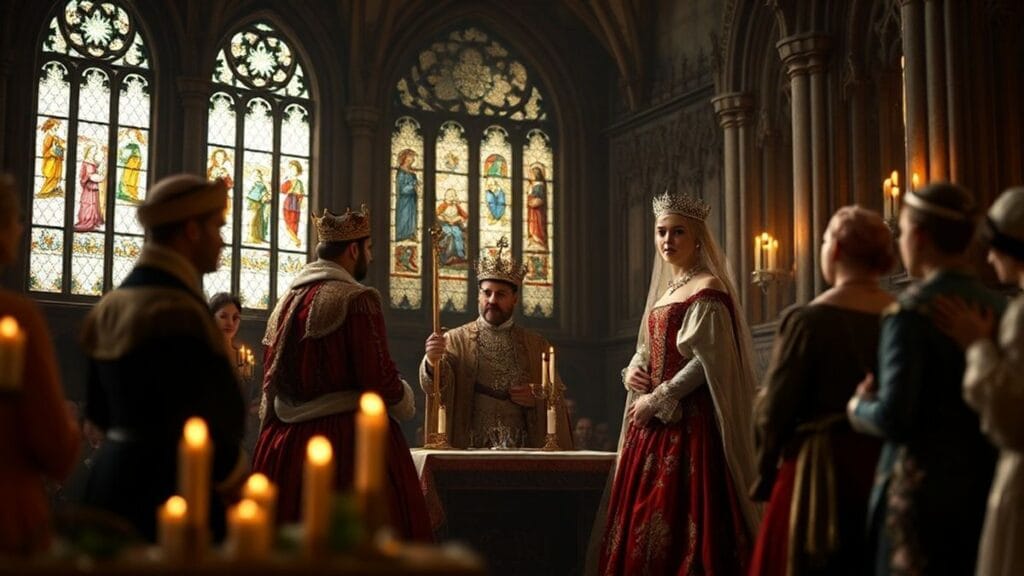
The abbey’s great west doors, dark wood bound with iron, swung open to admit the procession. Inside, candles burned in their hundreds, casting a golden, flickering light against stone and glass. The nave had been dressed with rich tapestries, possibly depicting biblical scenes of reconciliation or royal triumphs. Musicians stood ready, instruments poised. The smell of incense mingled with the breath of the crowd and the faint chill of the winter air.
This procession, in which Henry and Elizabeth approached the altar, represented the outward unification that the marriage of Henry VII and Elizabeth of York promised. It was a spectacle meant not only for the people present but also for those who would hear about it secondhand in distant shires and European courts. Ambassadors would write home of the magnificence and apparent harmony of the occasion. Those who opposed Henry, or still dreamed of another Yorkist claimant, had to reckon with the sheer, compelling visual authority of this joint display.
Inside Westminster Abbey: Ritual, Symbolism, and Silent Calculations
Within the soaring spaces of Westminster Abbey, the wedding unfolded as a tapestry of ritual and unspoken calculation. The church, long a place of royal coronations and burials, provided a powerful sense of continuity. By choosing to marry there, Henry and Elizabeth inscribed their union into the sacred geography of English kingship.
The ceremony would have followed the Sarum rite, the prevalent liturgy in late medieval England. At its heart were familiar gestures: the joining of hands, the exchange of vows, the blessing of rings. As the officiating bishop intoned the sacred words, Henry and Elizabeth stood before the altar, watched by assembled nobles, clergy, and selected common witnesses. In that moment, their individual biographies—as exile and dispossessed princess—melted into the collective story of a realm seeking peace.
Yet even in this solemnity, politics hovered. When Henry took Elizabeth’s hand, he bound not only himself to her but also his regime to the legacy of Edward IV. When Elizabeth spoke her vows, she accepted not only her husband but also the reality that his victory at Bosworth had reshaped her world. In the heads and hearts of those watching, calculations whirred: Would their children be strong? Would this king prove firm enough to control ambitious lords but wise enough to avoid needless vendettas?
At key points, the symbolism became almost overwhelming. The mass celebrated after the marriage underscored divine sanction. Prayers for the fruitfulness of the union—the hope for sons who would secure the succession—rang through the vaulted arches. In every spoken word, there was an implicit plea: let this be the end of civil strife, let this union bear the weight history has thrust upon it.
One can imagine Elizabeth’s face, framed by a headdress of rich fabric and jewels, composed but perhaps shadowed by the memory of her dead father and vanished brothers. Henry, whose letters and accounts reveal a cautious, methodical mind, may have stood with controlled dignity, aware of each pair of eyes upon him. The marriage of henry vii and elizabeth of york, in that charged, candlelit space, was both profoundly intimate and wholly public.
When the final blessings were pronounced and the ceremony concluded, a new royal couple emerged. They had stepped into a role larger than themselves. Outside, the world would interpret this union according to its own fears and desires; inside, two lives had been permanently yoked together, for better and for worse, in the service of a dynastic experiment called Tudor.
A Union of Flesh and Heraldry: How Tudor Rose and Royal Blood Intertwined
In the months and years that followed the wedding, the fusion of Lancaster and York became something more than rhetoric. It entered visual culture, law, and daily life. The most enduring symbol of this union was the Tudor rose: a white rose nested within a red one, or vice versa, their petals interlocking in delicate symmetry. This motif appeared in carvings, stained glass, textiles, and royal documents, a constant reminder that the marriage of Henry VII and Elizabeth of York was a foundational myth for the new dynasty.
But the union was not just symbolic; it was biological. The bloodlines of Plantagenet kings, of Yorkist and Lancastrian branches, mingled in their children. In the Tudor imagination, and in later historical memory, this mixing of blood carried a sense of destiny. Here, at last, was a line that could claim descent from both sides of the old conflict, potentially defusing rival claims. Of course, in practice, ambitious men continued to find reasons to challenge the crown. But the idea of the Tudors as natural mediators between Lancaster and York remained powerful.
Heraldry played a crucial role in reinforcing this identity. Royal coats of arms, badges, and mottos were reconfigured to emphasize harmony. Elizabeth’s own lineage—her ties to Edward IV, to the old Plantagenet house—was not suppressed but prominently displayed. She was not a conquered Yorkist, grudgingly attached to a Lancastrian victor; she was presented as the rightful queen whose marriage had healed a rift in providential history.
Within court pageantry, this union found expression in masques, tournaments, and processions. Knights might ride beneath banners showing both red and white roses; poets could compose verses praising the couple as instruments of divine peace. The court became a stage on which the drama of reconciliation was endlessly replayed. Foreign ambassadors reported these images and performances back to their masters, helping to cement the perception abroad that the Tudor regime was stable and widely accepted.
Yet, as always, the brilliance of heraldry and spectacle partly masked more complicated realities. Not all Yorkists were reconciled; not all Lancastrians were pleased with Henry’s careful, often restrained rule. The royal marriage provided a powerful frame, but inside that frame, human ambition and anxiety continued to roam. Still, whenever doubts threatened, the Tudor rose—and the quiet, dignified presence of Elizabeth of York beside her husband—served as a reminder that, at least in theory, old divisions had been overcome.
Love, Duty, or Strategy? Imagining the Private World of Henry and Elizabeth
The private relationship between Henry VII and Elizabeth of York remains elusive. The sources tell us far more about their political roles than their emotions. No cache of intimate letters survives to reveal whispered endearments or sharp marital quarrels. Yet by reading between the lines of account books, diplomatic reports, and later chroniclers, historians have tried to sketch the contours of their marriage.
It is clear that their union functioned effectively as a dynastic partnership. They produced several children—indispensable for any medieval royal couple—and presented a united front in public. Elizabeth fulfilled the expected duties of a queen consort with quiet grace. She accompanied Henry on some progresses, participated in ceremonies, and distributed alms, gaining a reputation for piety and kindness. Henry, for his part, appears to have respected her standing as the daughter of Edward IV; he never repudiated or sidelined her publicly, as some earlier kings had done when political winds shifted.
Whether love grew between them is harder to say. Some later accounts, influenced by Tudor nostalgia and the tragic nature of Elizabeth’s early death, romanticize their bond. Others emphasize Henry’s reserved, financially meticulous character and suggest that deep emotion played little part. The truth likely lies somewhere in between. Shared experiences—the anxieties of securing the throne, the joy and fear of childbirth, the grief of losing children—could hardly fail to create a bond of some kind.
The marriage of Henry VII and Elizabeth of York also bore the constant pressure of expectation. Every pregnancy was a matter of state; every birth or miscarriage was watched and interpreted by those with an eye on the succession. Their first son, Arthur, was born in September 1486, less than a year after the wedding, an event heralded as a sign of divine favor. Yet subsequent pregnancies and infant deaths reminded the couple, again and again, how fragile even royal bodies could be.
In their private apartments, away from the gaze of courtiers and ambassadors, Henry and Elizabeth would have confronted a different set of questions: How to balance affection for surviving children with the knowledge that they were also political instruments? How to reconcile individual grief when a child died with the need to maintain an image of unshaken royal strength? It is in these unseen conversations, rather than the grand public ceremonies, that the true texture of their marriage must have been woven.
From Wedding to Heir: Arthur’s Birth and the Stabilization of the Dynasty
If the wedding at Westminster was the symbolic beginning of Tudor rule, the birth of Arthur just months later was its vital confirmation. On 20 September 1486, Elizabeth of York delivered a healthy son at Winchester—deliberately chosen as the legendary capital of King Arthur. The name was not subtle. By christening their heir “Arthur,” Henry and Elizabeth reached deep into the well of British myth, presenting their child as a new, unifying figure for the realm.
The celebrations were immense. Bells rang; bonfires were lit; money was given in alms. For a kingdom that had watched rival kings rise and fall with alarming speed, the arrival of a male heir offered something solid, tangible. The marriage of henry vii and elizabeth of york had already promised unity; with Arthur’s birth, it now promised continuity. A line of succession began to take shape: from Henry to Arthur and, beyond him, to the future.
Over the next decade, more children followed: Margaret, destined to become queen of Scotland; Henry, the spare who would become Henry VIII after Arthur’s death; Mary, later queen of France; and others who died young. Each child reshaped political calculations, both at home and abroad. Foreign courts now had to consider not only Henry VII but also the future kings and queens he was breeding—a dynasty, not just a solitary victor of Bosworth.
The presence of heirs also strengthened Elizabeth’s position. As queen consort and mother of the royal children, she occupied an indispensable role. She could plead for mercy on behalf of petitioners, influence household appointments, and serve as a focus of loyalty for those who revered the memory of Edward IV. Her Yorkist blood, transmitted to Arthur and his siblings, helped reassure those who had fought for the white rose that their heritage had not been wholly erased.
Yet the birth of heirs did not end all threats. Pretenders would still arise; discontented nobles would still seek opportunities. But Arthur’s existence meant that any rebellion now had to reckon with the prospect of not just unseating Henry VII but also disinheriting his innocent children. That moral and political calculation made some potential rebels hesitate and allowed Henry to govern from a firmer foundation.
Plots, Pretenders, and the Pressure on a Royal Marriage
Despite the apparent harmony symbolized by the royal family, Henry’s reign was troubled by persistent plots and pretenders. Two in particular—Lambert Simnel and Perkin Warbeck—posed real dangers, testing not only Henry’s nerves but also the resilience of the narrative built around his marriage.
In 1487, only a year after the wedding and Arthur’s birth, a boy named Lambert Simnel was put forward as “Edward, Earl of Warwick,” a Yorkist claimant. Backed by discontented Yorkist nobles and even foreign forces, Simnel’s supporters launched a rebellion that culminated in the Battle of Stoke. Henry’s victory there is sometimes seen as the last military engagement of the Wars of the Roses. Yet the very fact that such a rebellion could gather momentum so soon after the marriage of Henry VII and Elizabeth of York reveals how fragile the new peace remained.
Later, in the 1490s, Perkin Warbeck emerged, claiming to be Richard, Duke of York—one of the missing princes from the Tower. This was a far more menacing challenge, because it struck directly at the heart of the Yorkist story and, by extension, at Elizabeth herself. If Warbeck were truly her brother, then he had a stronger hereditary claim than Henry; if he were an imposter, he still embodied the unresolved trauma surrounding the princes’ disappearance. Foreign powers, including Margaret of Burgundy and James IV of Scotland, saw in him a useful tool against the Tudor regime.
Imagine the emotional tension this must have created at court. Elizabeth, whose own legitimacy and status rested partly on accepting that her brothers were dead, now lived in a world where a man claiming to be one of them gathered armies and allies. Henry, always inclined toward suspicion and control, responded with a mixture of diplomacy, espionage, and, eventually, harsh repression. Warbeck was captured, paraded, and finally executed in 1499. The message was brutal but clear: no alternative Yorkist narrative would be allowed to flourish.
These crises inevitably put pressure on the royal marriage. Whenever Henry faced a new plot, he had to consider how far he could trust those around Elizabeth, including surviving Yorkist relatives. Some scholars have suggested that in later years he kept a tighter rein on her movements and contacts, not out of personal animosity, but from anxiety about security. The very Yorkist connections that made her valuable as a queen consort also made her, in his eyes, a potential channel for discontent.
Yet outwardly, the couple maintained unity. Public appearances, joint patronage of religious institutions, and the continuing presence of their children projected an image of stability that helped weather the storms. In a sense, every time a pretender rose and was defeated, the underlying message—that the true heirs were the offspring of Henry and Elizabeth—was reinforced.
Mother of a New England: Elizabeth of York’s Quiet but Profound Influence
Elizabeth of York did not dominate public life in the way that some queens, such as Margaret of Anjou or later Catherine de Medici, would. Her influence was quieter, exercised through the domestic sphere, patronage, and sheer presence. But quiet does not mean insignificant. Without her, the Tudor project would have been far more brittle.
As queen, Elizabeth cultivated an image of piety, gentleness, and mediation. She intervened in legal disputes, petitioned for clemency, and supported religious houses. People seeking royal favor often addressed their pleas to her, hoping that the “good queen” would soften the king’s sometimes harsh financial policies. In doing so, she became a kind of emotional counterweight to Henry’s austerity. Where he collected revenues and enforced fines, she distributed alms and patronage, ensuring that the monarchy was associated not only with control but also with generosity.
Her role as mother was even more consequential. She presided over the upbringing of children who would become key players in European politics: Arthur, trained from birth to be king; Margaret, whose marriage to James IV of Scotland would eventually pave the way for the union of the English and Scottish crowns; Henry, the future Henry VIII, who absorbed both his father’s sense of majesty and his mother’s Yorkist pride. Through them, her blood and temperament shaped the political landscape of the sixteenth century.
According to the historian David Loades, Elizabeth’s “uncomplaining acceptance of her role” bolstered Henry’s regime by providing an aura of normalcy and continuity after decades of upheaval. She embodied a kind of idealized queenship: fertile, dutiful, charitable, notably free of scandal. In an age when rumors could topple reputations and stir rebellions, her steady respectability was an asset of great value.
The marriage of henry vii and elizabeth of york thus operated on more than one level. Publicly, it was a union of rival houses; privately, it was a partnership in building a family whose branches would reach across England and Europe. The queen’s apartments, often dismissed as mere domestic spaces, were in fact crucial laboratories where the next generation of rulers and influencers were shaped in language, religion, and sense of self.
Grief in the Tudor Court: Death, Distance, and the Hardening of a King
No royal marriage, however politically successful, is free from sorrow. For Henry and Elizabeth, grief came repeatedly, altering the texture of their relationship and the atmosphere of their court. Several of their children died young, a common tragedy in the fifteenth century but no less painful for that. Each small funeral, each shuttered nursery, reminded them that even kings and queens could not command life and death.
The most shattering blow came in 1502 with the death of Arthur, Prince of Wales, at Ludlow. Barely fifteen, newly married to Catherine of Aragon, Arthur had been the embodiment of Tudor hopes. His death plunged the court into mourning. Contemporary accounts describe Henry and Elizabeth as inconsolable. In one poignant report, the queen is said to have tried to comfort her husband in his grief, only to collapse into tears herself once she was alone. Whether or not the scene unfolded exactly as later writers imagined, it captures something of the shared devastation they must have felt.
Arthur’s death had political and personal consequences. It shifted the burden of succession onto the younger Henry, a boy whose character and upbringing would differ markedly from that of his elder brother. It also intensified Henry VII’s anxieties about the future of his dynasty. His response, over the next few years, was to tighten financial controls and pursue ever more cautious diplomacy, actions that earned him a reputation for parsimony and suspicion.
In 1503, scarcely a year after Arthur’s death, Elizabeth herself died following complications from childbirth at the Tower of London. She was only around thirty-seven. The loss of his queen and the mother of his surviving children hit Henry hard. Reports suggest that he withdrew for days, emerging more withdrawn and rigid than before. With her gone, the last living link between his regime and the Yorkist house of Edward IV was severed at the very heart of the royal household.
After her death, Henry did not remarry, despite considering it for diplomatic reasons. This decision has invited speculation: was it a sign of lingering affection, or simply a cold calculation that a new queen might unsettle the succession by introducing new claimants? Perhaps it was both. What is certain is that the final years of his reign, without Elizabeth, felt harsher and more lonely. The human warmth and Yorkist legitimacy that she had brought to the marriage of Henry VII and Elizabeth of York could not be replaced.
The Tudor Rose Endures: Long-Term Political and Cultural Consequences
Though Henry and Elizabeth did not live to see it, the consequences of their union echoed far beyond their lifetimes. Their surviving son Henry VIII would become one of the most famous—and infamous—kings in English history, profoundly reshaping the relationship between crown and church. Their daughter Margaret’s line would, through her great-grandson James VI of Scotland, inherit the English throne in 1603, uniting the crowns and setting the stage for the Stuart era. In this way, the marriage of 1486 indirectly paved the way for the eventual political union of England and Scotland.
Culturally, the idea of the Tudors as peacemakers between warring roses took firm root. Tudor chroniclers, writing under the patronage of Henry VIII and Elizabeth I, crafted a retrospective narrative in which the marriage of Henry VII and Elizabeth of York appeared almost providential—an event foreseen and favored by God, healing a riven kingdom. Shakespeare, in his history plays, would later echo this motif, portraying the union as the culmination of a long, tragic arc of civil conflict. In Richard III, for example, Richmond’s (Henry VII’s) victory and projected marriage to Elizabeth stand as the dawn after a long, dark night.
This storytelling had political uses. By presenting the Tudors as restorers of order and unity, it helped legitimize later, more controversial actions, such as Henry VIII’s break with Rome or Elizabeth I’s resistance to foreign and domestic threats. The myth of the healing marriage became part of the ideological toolkit of English monarchy, invoked whenever rulers sought to present themselves as guardians of national harmony.
On a more tangible level, the Tudor rose—born from the union of Lancaster and York—persisted as a national emblem. It appears today in architecture, coinage, and even popular design, often detached from its fifteenth-century roots but still resonant. Visitors walking the cloisters of Westminster or the halls of Hampton Court can see carved or painted Tudor roses, visual fingerprints left by a dynasty determined to make its origins unforgettable.
In international terms, the strength of the Tudor regime, underpinned by the legitimacy supplied through Elizabeth of York, allowed England to navigate the turbulent waters of European politics at the dawn of the modern age. Alliances with Spain, Scotland, and France—often cemented by marriages involving Henry and Elizabeth’s children—were made possible by the perception that the Tudors represented a stable, rightful, and enduring royal house.
Historians, Myths, and Modern Memory of a Foundational Union
Over the centuries, the marriage of Henry VII and Elizabeth of York has attracted both scholarly scrutiny and romantic imagination. Early Tudor historians like Polydore Vergil and later chroniclers crafted a version of events that emphasized divine providence and moral order: a wicked usurper overthrown, a rightful king restored, a healing union formed. This narrative served the political needs of the Tudor state and profoundly shaped how later generations understood the period.
Modern historians, equipped with critical methodologies and access to a wider range of sources, have offered more nuanced portraits. They highlight Henry’s calculated use of propaganda, his financial stringency, and the persistence of opposition long after 1486. Elizabeth, once a shadowy figure in the background, has received increasing attention as scholars seek to recover the experiences and agency of medieval and early modern women. While direct evidence of her thoughts is scarce, careful reading of household records and royal accounts has illuminated her influence in patronage, charity, and the shaping of her children’s upbringing.
Their marriage also sits at the intersection of several historiographical debates: Was the Wars of the Roses primarily a dynastic struggle or a symptom of deeper social and economic tensions? How decisive was Bosworth as a turning point? Did the Tudors truly usher in a new era, or were they, as some “new monarchy” skeptics argue, more continuous with late medieval kingship than once believed? The union at Westminster Abbey becomes, in these discussions, both a symbol and a test case.
Popular culture has further complicated the picture. Historical novels, television dramas, and films often foreground the emotional dimensions of the relationship, imagining dialogues, jealousies, and tender moments for which there is no direct documentary evidence. While such portrayals can bring the era to life for modern audiences, they also risk blurring the line between fact and fiction. Nonetheless, they testify to the enduring fascination that this marriage holds. It is a story that combines war and peace, calculation and possible affection, all against the atmospheric backdrop of late medieval England.
Even when we strip away the mythmaking, what remains is striking. In an age where marriage among the powerful was always political, the marriage of henry vii and elizabeth of york stands out as exceptionally consequential. It did not by itself end all conflict, but it provided a framework within which a new political order could slowly take root. The historian’s task is to recognize both the limits and the genuine potency of that union, to acknowledge how much work remained to be done after 1486, and yet to see clearly how without this marriage, the story of England—and indeed of Britain—would have unfolded very differently.
Conclusion
On that cold January morning in 1486, as Henry VII and Elizabeth of York stood before the altar in Westminster Abbey, few could have fully grasped the long shadow their vows would cast. They were, at that moment, two individuals shaped by exile, loss, and dynastic expectation, stepping into roles that demanded more of them than any human life could reasonably give. Yet their union became the hinge on which English history swung.
The marriage of Henry VII and Elizabeth of York did not erase the scars of the Wars of the Roses, but it offered a coherent story with which a traumatized kingdom could make sense of its past and imagine a different future. It fused bloodlines, created heirs, and wrapped a fragile new regime in the comforting symbols of reconciliation: the Tudor rose, the joint arms, the image of a royal family bridging old divides. It also carried a heavy private cost—repeated bereavements, political suspicion that crept even into domestic spaces, and, finally, the early death of the queen who had personified Yorkist legitimacy.
In the centuries that followed, their marriage would be remembered, embroidered, and sometimes distorted by those who needed its meaning to fit their own times. Kings and queens invoked its legacy; playwrights and chroniclers turned it into moral drama; modern historians dissected its realities. Through it all, one fact remains: without this union, there would have been no Henry VIII as we know him, no Elizabeth I in her golden age, no smooth path for the Stuarts to inherit both English and Scottish crowns.
It is astonishing, isn’t it, that a single ceremony—a few words spoken beneath vaulted stone, a ring placed on a finger, a kiss sealed before witnesses—could exert such a lasting influence? Yet when we look closely, we see that the power of the marriage lay not in the romance of the moment but in the dense web of history that converged upon it. Civil war, exile, prophecy, ambition, and hope all found temporary resolution at that abbey altar.
Today, when visitors walk through Westminster, gaze at the carved Tudor roses, or read the names of Henry and Elizabeth among the long roll of England’s monarchs, they encounter only the faintest echo of that day. But behind the stone and script lies a deeply human story of two people and one kingdom, trying, against the odds, to turn violence into peace and uncertainty into dynasty.
FAQs
- Why was the marriage of Henry VII and Elizabeth of York so important?
The marriage united the rival houses of Lancaster and York after decades of civil war known as the Wars of the Roses. By combining Henry’s Lancastrian claim with Elizabeth’s strong Yorkist bloodline, it gave the new Tudor dynasty broader legitimacy and helped persuade both factions to accept a single royal family. It also produced heirs who embodied this union, making future succession more secure. - Did Henry VII and Elizabeth of York love each other?
The historical record does not clearly reveal their private emotions. Their marriage was arranged for political reasons, but evidence suggests a functional and sometimes affectionate partnership. They shared in grief over lost children and worked together to establish their dynasty. While it is difficult to prove romantic love, there is little sign of open conflict, and Henry did not remarry after Elizabeth’s death. - How did their marriage help end the Wars of the Roses?
While the wedding itself did not instantly end all conflict, it provided a powerful symbol and framework for peace. The union showed that Lancaster and York could be reconciled within one royal household. Many former opponents were willing to support or at least tolerate Henry’s rule because his queen was the daughter of Edward IV. Over time, as their children grew and pretenders were defeated, the idea of a single, post-war dynasty took firmer root. - Who were the most famous children of Henry VII and Elizabeth of York?
Their most famous children were Arthur, Prince of Wales, who died young; Henry, who became Henry VIII; Margaret, who married James IV of Scotland and became an ancestor of the Stuart kings; and Mary, who briefly served as queen of France. Through these children, the couple’s bloodline shaped not only England but also Scotland and continental politics. - What happened to Elizabeth of York?
Elizabeth of York served as queen consort from 1486 until her death in 1503. She died after complications from childbirth at the Tower of London, likely from postpartum infection. Her early death deeply affected Henry VII and left their surviving children, including the future Henry VIII, without a mother during crucial formative years. - How did the disappearance of the Princes in the Tower affect their marriage?
The mystery of Elizabeth’s younger brothers haunted the political landscape of their marriage. Pretenders like Perkin Warbeck claimed to be one of the missing princes, challenging Henry’s legitimacy and reviving Yorkist hopes. These threats deepened Henry’s anxieties and may have led him to keep a closer watch on remaining Yorkist connections, including those around Elizabeth, even as he relied on her for legitimacy. - Was Henry VII’s claim to the throne strong without Elizabeth?
Genealogically, Henry’s claim was relatively weak, stemming from the Beaufort line, which had been barred from succession. His real strength came from victory at Bosworth, parliamentary recognition, and his careful statecraft. Marrying Elizabeth of York significantly strengthened his position by linking him to the widely respected Yorkist line, but he made sure to be crowned before the marriage to assert that his kingship did not depend solely on her. - How is the marriage symbolized in Tudor art and heraldry?
The union is most famously symbolized by the Tudor rose, which combines the red rose of Lancaster and the white rose of York. This emblem appears throughout Tudor architecture, manuscripts, and decorative arts. Joint representations of Henry and Elizabeth, often with their children, also reinforce the message that their marriage healed old divisions and established a new, legitimate royal house. - Did their marriage immediately stop all rebellions?
No. Rebellions continued for several years, notably those involving Lambert Simnel in 1487 and Perkin Warbeck in the 1490s. These episodes show that not everyone accepted the new dynasty right away. However, the marriage made it harder for rebels to gain broad support, because many people saw the royal family as a genuine attempt to bridge old divides. - Where can I learn more about Henry VII and Elizabeth of York?
You can consult modern biographies and scholarly works on late medieval England and the early Tudor period. For example, historians such as S.B. Chrimes and David Loades have written influential studies of Henry VII, while recent research has focused more on Elizabeth’s life and role. A useful starting point for general readers is the detailed overview provided on Wikipedia and in standard histories of the Wars of the Roses and the Tudor dynasty.
External Resource
Internal Link
Other Resources
- Encyclopaedia Britannica – general search for the exact subject
- Google Scholar – academic search for the exact subject
- Internet Archive – digital library search for the exact subject

