Table of Contents
- A Kingdom Between Scaffold and Altar
- From Courtly Shadow to Queen: Jane Seymour’s Early Years
- Henry’s Road to Whitehall: From Golden Prince to Restless King
- Lady-in-Waiting to Two Queens: Jane in the Courts of Catherine and Anne
- The Fall of Anne Boleyn and the Rise of a Quiet Rival
- Courting in the Ashes of a Marriage: Secret Meetings and Political Calculations
- From Tower to Treasury: Negotiations, Rings, and Royal Resolve
- The Eve of a New Union: London on the Brink of Change
- The Wedding Morning: Whitehall in Late May 1536
- The Ceremony: Vows Amid the Echoes of Death
- A New Queen in a Fractured Realm
- The Politics Behind the Wedding: Religion, Factions, and Foreign Eyes
- Everyday Life with a Dangerous Husband: Jane’s Short Reign
- The Longed-for Son: Conception, Hopes, and Fears
- Birth, Blood, and Bereavement: Jane Seymour’s Final Days
- After Jane: Memory, Myth, and the King’s “True” Wife
- Wider Consequences: Dynasty, Reformation, and the English Future
- Inside the Sources: How We Know What We Think We Know
- Conclusion
- FAQs
- External Resource
- Internal Link
Article Summary: On 30 May 1536, at the Palace of Whitehall in London, the marriage of Henry VIII and Jane Seymour bound together a widowed king and a seemingly modest court lady only eleven days after the execution of Anne Boleyn. This article traces the long road to that union, from Henry’s early frustrations over the Tudor succession to Jane’s quiet rise through the courts of Catherine of Aragon and Anne. It explores how the marriage of henry viii and jane seymour became both a personal refuge for a volatile monarch and a political instrument for court factions hungry for influence. Through vivid scenes—furtive courtship, whispered negotiations, and a wedding overshadowed by recent bloodshed—we see how this union reshaped the English court. The narrative then follows Jane’s brief queenship, her pregnancy, and her death shortly after giving Henry his long-desired son. Interwoven analysis considers the religious upheaval of the Reformation and the precarious balance of power among nobles, ambassadors, and commoners. By the end, the article shows how the marriage of Henry VIII and Jane Seymour reverberated through the Tudor dynasty and the future of England itself.
A Kingdom Between Scaffold and Altar
On the morning of 30 May 1536, London awoke to a strange, dissonant peace. The city’s air still carried the memory of metal and fear: only eleven days earlier, on a scaffold within the Tower of London, Anne Boleyn—Henry VIII’s second wife and former queen—had knelt before a French swordsman and lost her head. Now, seemingly without pause, the same king who had orchestrated her downfall prepared himself for a new bride. The marriage of Henry VIII and Jane Seymour was not just a personal decision; it was a declaration, an insistence that life—and dynastic politics—would surge forward, even over the fresh graves of the recent past.
It is astonishing, isn’t it, how quickly a court can change its colors? Courtiers who had once bowed deeply to Queen Anne already practiced new forms of reverence, testing out the softer syllables of “Queen Jane.” At Whitehall, tapestries were shaken free of dust, floors scrubbed, candles ordered in greater number. The smell of rushes mingled with beeswax, the murmur of servants with the clipped commands of officers of the Household. Yet behind the preparations was a palpable tension: if the king could raise one woman to a throne and send another to the block, what security did anyone truly possess?
In this charged atmosphere, the marriage of henry viii and jane seymour emerged as both balm and threat. To Henry, it promised stability, perhaps even redemption: a new wife who might finally give him the legitimate male heir his two previous marriages had failed to deliver to his satisfaction. To many in England, it was a disorienting spectacle. Less than a month earlier, Anne Boleyn had been queen; now, official proclamations already spoke of a “pure and lawful” union soon to be celebrated at Whitehall. Church bells, those same instruments that had tolled ominously during Anne’s indictment and execution, would now ring in celebration.
But this was only the beginning. To understand what that May morning really meant—to grasp why this quiet woman from an old but relatively modest family could step into the heart of Tudor power—we must step backward. We must trace Jane Seymour’s journey from the unremarkable stone manor of Wulfhall to the glittering, treacherous court of Henry VIII, and we must follow Henry’s own path from golden prince to aging, anxious monarch. Only then can we see the marriage of Henry VIII and Jane Seymour not as a sudden, isolated event, but as one violent turning point in a long, turbulent story of lust, faith, power, and the desperate need for a son.
From Courtly Shadow to Queen: Jane Seymour’s Early Years
Jane Seymour appears to us through history’s mist as a quiet figure: pale, serious, modest in demeanor. Even her earliest years are cloaked in partial darkness. Born around 1508 or 1509, most likely at Wulfhall in Wiltshire, she entered a family that was respectable but not dazzling. The Seymours were old gentry, connected to nobility through careful marriages, yet they could not rival the towering reputations of the Howards, the Percys, or the Staffords. Jane’s father, Sir John Seymour, served Henry VII and then Henry VIII with loyalty, fighting in France and maintaining the king’s good opinion.
In the cold stone halls of Wulfhall, Jane’s childhood would have been practical rather than luxurious. She likely learned the skills required of a gentlewoman: embroidery, household management, perhaps a touch of music and French. Unlike Anne Boleyn, who had been polished at the courts of Burgundy and France, Jane’s education appears, by the standards of the day, comparatively simple. Contemporaries noted she could read English but was not an accomplished linguist. It is tempting to romanticize this—Jane as the honest English rose, unadorned by continental artifice—but such a portrait is as much Tudor propaganda as truth. Still, the contrast mattered in a court obsessed with comparisons.
For a younger daughter like Jane, the surest path to advancement lay not in books but in proximity: proximity to power, to royal favor, to the king himself. Sometime in the late 1520s, perhaps around 1527 or 1528, Jane made the leap that would define her life. She was chosen to serve at court as a lady-in-waiting, an honor that brought her from Wulfhall’s relative quiet to the seething, glamorous world of the Tudor palace. There, beneath the carved beams and painted ceilings, she would pass silently behind queens, witness private sorrows and public triumphs, and learn the subtle art of surviving under Henry’s gaze.
No one looking at the new arrival from Wiltshire would have predicted the marriage of Henry VIII and Jane Seymour. She was not renowned for beauty in the hyperbolic way Anne Boleyn was, nor was she of such high birth as Catherine of Aragon. Yet Jane possessed what many in Henry’s circle came to value: obedience, apparent humility, a reassuring Englishness in both upbringing and manner. These qualities, initially unremarkable, would prove potent in a court grown weary of high drama and high theology.
Henry’s Road to Whitehall: From Golden Prince to Restless King
To understand why Henry VIII rushed so swiftly into his third marriage, we must remember the boy he once was and the king he had become. When Henry ascended the throne in 1509, he was eighteen years old, tall, broad-shouldered, and full of promise. Chroniclers and ambassadors alike marveled at his vigor. He jousted, hunted, played music, debated theology, and charmed Europe with his magnificence. His marriage to Catherine of Aragon, the Spanish princess who had first been wed to his late brother Arthur, seemed a dynastic triumph and a romantic story rolled into one.
Yet beneath the glitter of tournaments and masques lay a harder reality. A Tudor king was only as secure as his heir, and that heir needed to be male. The wars of the Roses, still a fresh and bleeding memory, had taught England the chaos that followed a disputed succession. Henry’s father, Henry VII, had founded the Tudor dynasty upon a shaky claim, cemented by force and marriage. Now, the young Henry needed to keep the line alive. Catherine bore him several children; most died in infancy. Only one survived: a daughter, Mary, born in 1516. Affectionate as Henry often was toward Mary, she could not, in his mind, replace the need for a son.
By the late 1520s, Henry’s frustration curdled into obsession. He convinced himself that his marriage to Catherine had been cursed from the start, citing Leviticus to argue that taking his brother’s widow had offended God. Whether this was genuine religious scruple or convenient justification—likely it was both—it set him on a collision course with the papacy. His desire for an annulment, and his growing infatuation with a dark-eyed courtier named Anne Boleyn, drove him to decisions that would break the religious unity of his realm.
The years that followed were brutal and transformative. Between 1527 and 1533, Henry struggled to free himself from Catherine, while Europe watched and judged. When the Pope refused to grant an annulment, Henry turned against papal authority. Through Parliament and compliant clergy, he declared himself Supreme Head of the Church of England. Monasteries felt the first tremors of impending dissolution. Catherine was cast aside, declared merely the Dowager Princess of Wales, her marriage declared void. Anne Boleyn was crowned queen in 1533 and, that same year, gave birth to a healthy child—another daughter, Elizabeth.
By 1536, the once golden prince was heavier, more suspicious, and far less patient. Two marriages had failed to deliver the unquestioned male heir he craved. A kingdom had been torn from Rome for the sake of a union that now seemed cursed by miscarriages and stillbirths. Henry VIII’s need for stability—dynastic, political, and emotional—had reached a fever pitch. It was into this world, full of religious upheaval and personal bitterness, that Jane Seymour stepped quietly, waiting, listening, learning.
Lady-in-Waiting to Two Queens: Jane in the Courts of Catherine and Anne
Perhaps the most extraordinary thing about Jane Seymour’s rise is that she served both of the women Henry cast aside before choosing her. First came Catherine of Aragon, the Spanish-born queen whose dignity and piety impressed many at court. Then Anne Boleyn, whose wit and charisma dazzled and divided England. Jane, stationed modestly in the background, saw both models of queenship—and both examples of married life with Henry—up close.
Service in Catherine’s household would have offered Jane a portrait of a traditional queen: devout, conscientious in charity, fluent in statecraft. Catherine had been a trusted counselor to Henry in his early reign, even commanding troops in his absence during the 1513 campaign against Scotland. Yet Jane would also have witnessed the shadow Catherine carried: repeated pregnancies that ended in death, a husband growing distant, and the terrible humiliation of being publicly set aside after decades of loyalty.
Anne Boleyn’s court was different in tone and texture. Where Catherine epitomized old-world Catholic piety, Anne became, in many ways, the face of the new order. Books by reform-minded theologians circulated among her ladies. Conversations turned toward Scripture, conscience, and the limits of papal authority. Music, fashion, and flirtation often took center stage. Jane’s time in Anne’s household exposed her to a queen whose very existence symbolized the break with Rome and the daring, precarious experiment of an English church led by a king.
Standing just behind these women—passing them letters, tightening their sleeves, sharing their meals—Jane observed more than she spoke. It is easy to imagine her learning what pleased and angered Henry, noting the arguments that made his eyes harden, the gestures that softened his temper. She saw Catherine’s defiant refusal to accept an annulment and Anne’s fierce assertiveness. Both women, in their own ways, held to their convictions at great cost. In the end, both lost their crowns: one through enforced separation and exile, the other through the executioner’s sword.
Was Jane calculating during these years, or simply surviving? The evidence is thin, and historians disagree. Yet later events suggest she understood, consciously or not, that Henry had grown weary of confrontation. Where Catherine and Anne argued, Jane would submit. Where they challenged, she would appear to defer. In the minds of many courtiers and foreign observers, Jane would come to represent a soothing alternative to the storms that had battered the kingdom. The stage was set: the quiet lady-in-waiting, standing in the wings, as the reigning queen started to lose her grip on Henry’s heart.
The Fall of Anne Boleyn and the Rise of a Quiet Rival
The speed of Anne Boleyn’s downfall in the spring of 1536 remains chilling. In late April, she was queen of England, still speaking confidently of her position. By 2 May, she had been arrested and taken to the Tower. On 15 May, a hastily convened trial declared her guilty of adultery, incest, and treason—charges that many modern historians regard as at best exaggerated, at worst fabricated. On 19 May, she was executed. Within this compressed timeline, Jane Seymour’s fortunes rose as Anne’s plummeted.
Jane first appears clearly on the king’s romantic horizon around 1535, though it is likely that Henry had noticed her earlier. She had the advantage of being neither loudly ambitious nor obviously opinionated in matters of religion. Some at court, particularly those aligned with the conservative faction led by her brothers Edward and Thomas Seymour, saw in Jane a vehicle for their own return to favor. If Henry could be turned away from Anne—and the fragile network of reformers she favored—conservatives might reassert themselves in royal policy.
As rumors circulated that Anne had failed again to provide a living son, Henry’s dissatisfaction sharpened. The miscarriage Anne suffered in January 1536, which contemporary reports suggested might have been a male fetus, hit the king particularly hard. Around this time, observers began to note Henry’s increasing attention to Jane. The imperial ambassador Eustace Chapuys, ever eager to report damaging details to his master, Charles V, mentioned Jane cautiously at first, then with greater emphasis. According to Chapuys, Jane had been carefully schooled by her allies in how to respond to the king’s advances: to accept his gifts but not his body, to seem modest yet receptive, to present herself as a woman whose honor required lawful marriage.
When Anne was arrested, the path for Jane’s rise cleared with brutal swiftness. On the very day of Anne’s imprisonment in the Tower, Henry moved Jane to a more secluded lodging, away from prying eyes. He visited her frequently, ensuring that the court saw where his affections now lay. Within corridors that still echoed with Anne’s cries of injustice, new whispers began: if the king was already courting another, how safe could the queen be?
The marriage of Henry VIII and Jane Seymour was thus born out of a vacuum created by political necessity and personal cruelty. Henry needed to erase Anne, not simply from his heart, but from the legal record. Her execution not only removed her as an obstacle; it allowed Henry to portray his previous union as an aberration, a tragic misstep now corrected by a return to virtue. In this narrative, Jane would be the woman who restored moral order, swept away the scandal, and opened the possibility of a legitimate male heir untainted by controversy.
Courting in the Ashes of a Marriage: Secret Meetings and Political Calculations
Imagine the atmosphere in May 1536: the Tower’s cold stones bearing fresh bloodstains, and across the river, doors closing softly on private conversations between king and courtier. Henry’s wooing of Jane, though less flamboyant than his pursuit of Anne, was nonetheless intense. He sent her gifts of money and jewelry, gestures of royal favor that no lady could lightly refuse. Yet if contemporary accounts are to be believed, Jane, guided by her family and allies, carefully refused to surrender her virtue outside wedlock.
One story, recorded by later chroniclers and echoed in various forms, tells of a moment when Henry, in a private chamber, attempted to embrace Jane and kiss her. She reportedly fell to her knees and begged him not to “entertain any ill opinion of her,” for she was an honest woman of good family who could not be his mistress. Whether or not the dialogue unfolded exactly in that manner, the core message is plausible: Jane positioned herself as fundamentally different from Anne, whose pre-marital relationship with Henry had been portrayed by critics as a scandalous seduction.
Behind these scenes of personal intimacy lay an intricate web of political calculations. Jane’s brothers, Edward and Thomas, were adept courtiers, alert to every flicker of royal favor. Their alignment with Thomas Cromwell—Henry’s powerful minister and architect of the break with Rome—shifted as needed. In May 1536, Cromwell himself was engaged in dismantling Anne Boleyn’s faction; supporting Jane gave him a way to maintain his influence over the king through a new queen. At the same time, more traditional nobles saw in Jane’s conservative religious sympathies a chance to curb the pace of reform.
For Henry, the allure was multifaceted. Jane’s apparent modesty soothed him after the stormy arguments he had endured with Anne. Her background rooted in the English shires flattered his sense of national identity at a time when foreign rulers, especially the Emperor Charles V, had condemned his second marriage. Most of all, Jane represented possibility: the prospect of starting again, as if the turbulent years with Anne could be washed away by the promise of new vows at Whitehall.
The court watched, mouths politely neutral, eyes wide open. No one could safely question the speed with which the king had shifted his affections; to do so might be read as disloyalty. Servants continued their routines, musicians played in the great hall, but beneath the surface, everyone understood: a third queen was being fashioned while the second queen still breathed imprisoned in the Tower. And when execution day came, it would clear the final obstacle to the marriage of Henry VIII and Jane Seymour.
From Tower to Treasury: Negotiations, Rings, and Royal Resolve
Anne Boleyn died on 19 May 1536, a bright, cool day. The French swordsman, specially brought to ensure a swift clean stroke, did his grim work before a small crowd of officials and witnesses. Henry VIII was not present. When the blow fell, when Anne’s head tumbled and her ladies gathered up her body for hurried burial, Henry was already thinking of the future—or, more precisely, of Jane Seymour.
According to one famous anecdote, Henry dressed in white that day to mark his liberation from an “ill” marriage. That detail may be more theatrical than factual, but what we know for certain is stark enough: the day after Anne’s execution, Henry and Jane became formally betrothed. On 20 May, at the home of Nicholas Carew, a long-time courtier and ally, Henry declared his intention to marry Jane. By 29 May, elaborate preparations at Whitehall signaled that the wedding would be imminent. Proclamation drafts and official documents were already being formulated to present the new union as not only lawful, but divinely favored.
In the days between Anne’s death and Jane’s wedding, the question of property and status had to be settled. Jane would need lands, incomes, jewels—the tangible signs of a queen’s position. The king’s treasury and confiscated Boleyn assets provided ample resources. It is telling that the transition was managed with such brisk efficiency: the things that had symbolized Anne’s power would now adorn Jane, as if queenship itself were a garment one might pass from one woman to the next.
Cromwell was central in orchestrating these details. His letters and the reports of foreign ambassadors reveal a man adept at staging political theater. By ensuring that the marriage of Henry VIII and Jane Seymour followed swiftly upon Anne’s death, he helped Henry project an image of unstoppable authority. The king did not linger in grief, did not allow gossip about his role in Anne’s fall to ferment. Instead, he presented himself as a monarch restored to moral order, fully prepared to embark on a union that—so the narrative insisted—aligned with God’s will.
Rings were exchanged, contracts sealed, and the court’s tailor and jewelers summoned. New gowns in the royal colors had to be cut for Jane, along with the rich robes befitting a consort. While her measurements were taken and fabrics chosen, Jane herself likely moved through a whirlwind of ritual and instruction. She was about to become the center of a world where every gesture, from the tilt of her head at Mass to the placement of her hand on Henry’s arm, would be scrutinized by allies and enemies alike. And all of it would culminate in a ceremony within the walls of Whitehall Palace, on the 30th of May.
The Eve of a New Union: London on the Brink of Change
On the night before the wedding, London must have hummed with speculation. Inns and taverns, from the bustling riverside alehouses to the smaller establishments tucked into crooked side streets, hosted arguments over the king’s behavior. Some would have cheered his decisiveness, convinced by proclamations that Anne’s crimes had been monstrous and that justice, though harsh, had been rightly done. Others, more cautious or secretly sympathetic to the fallen queen, might have spoken obliquely, their language wrapped in metaphors to avoid charges of treason.
The bells of the city lay silent in anticipation. Soon they would ring for a new queen, though for many Londoners, life went on with familiar hardships. Bread still needed to be bought, apprentices supervised, river barges loaded and unloaded. Yet beneath the continuity of daily routines, the scale of recent events was clear. A queen executed, a new queen selected, and all within weeks: such a sequence would have seemed almost unthinkable under previous monarchs.
Inside Whitehall Palace, the atmosphere was more focused but equally tense. Servants rushed about clearing chambers, hanging arras tapestry, arranging benches and stools for those privileged enough to attend the ceremony. The Chapel Royal, or one of the palace’s richly decorated chapels, would soon host the private nuptials. Musicians rehearsed motets and processional hymns; scribes prepared clean copies of marriage service texts reflecting England’s new ecclesiastical reality, where the king, not the pope, stood at the summit of religious authority.
Jane Seymour, lodged in her newly appointed apartments, faced a night of awe-inspiring transition. The woman who, months before, had been merely a lady-in-waiting, now knew that by the next day’s end, she would be queen. Did she pray for guidance, for strength, for a son? Did she fear the volatile temper of the man she was about to marry, a king who had discarded two wives and destroyed one of them? We cannot know her private thoughts. Yet the historical record suggests a woman deeply conscious of piety and reputation, determined to embody a quieter, more traditional style of queenship than the one Anne Boleyn had symbolized.
Outside, the Thames flowed steadily, bearing merchant vessels and royal barges alike. Its surface reflected the flicker of torches from the palace embankment. Somewhere across the water, within the Tower’s grim silhouette, Anne Boleyn’s freshly buried body lay in an unmarked grave beneath the Chapel of St Peter ad Vincula. The nearness of those two worlds—the newly widowed Tower and the expectant Whitehall—formed a haunting juxtaposition. Between scaffold and altar, London held its breath.
The Wedding Morning: Whitehall in Late May 1536
The morning of 30 May 1536 dawned with late-spring brightness. In the palace precincts, the day began before sunrise. Grooms in the stables checked on the king’s horses, cooks in the kitchens prepared meals fit for a wedding feast, and attendants lit candles and braziers in the chill of the early hours. The Palace of Whitehall, a sprawling complex of brick and timber, rose beside the Thames as the chosen stage for the marriage of Henry VIII and Jane Seymour.
Unlike Henry’s earlier weddings, this ceremony was not accompanied by immense public spectacle. The court had only recently witnessed the drama of a queen’s execution; flamboyant pageantry risked prompting unwelcome comparisons. Instead, the union with Jane was arranged as a relatively private affair, though “private” in royal terms still meant a substantial assembly of nobles, prelates, and favored courtiers. These were the men and women whose support—and silence—mattered most in the days ahead.
Henry VIII, now in his mid-forties, prepared himself in his private chambers. Servants dressed him in rich fabrics: perhaps a doublet of cloth-of-gold, a fur-lined gown appropriate for a solemn occasion, jewel-encrusted chain and sword-belt. His face, once the open countenance of a laughing young prince, bore the heavier lines of cares and disappointments. Yet on this morning, he could cast himself anew in his own mind: a king cleansed of a “polluted” second marriage, about to join himself to a woman whose virtue and obedience had been loudly praised.
Jane, meanwhile, was dressed in the formal garments befitting a bride and a queen-to-be. We have no surviving, detailed inventory of her wedding gown, but contemporary custom and later portraits suggest rich brocades, perhaps in white or another pale hue signifying purity. Her hair might have been worn loose under a headdress, in the traditional style of English brides, or confined beneath the flat gable hood associated with conservative modesty. Jewels, many likely reassigned from the royal collection that had adorned Catherine and Anne, would have sparkled at her throat and wrists.
As the hour approached, the palace’s corridors filled with the shuffle of shoes and the soft clink of weapons and ornaments. Gentlemen of the Privy Chamber, ladies-in-waiting, high-ranking bishops, and leading nobles filed toward the chapel. Each person present knew they were not merely attending a wedding but bearing witness to a critical turning point in the kingdom’s fortunes. The marriage of Henry VIII and Jane Seymour would shape the future of the Tudor dynasty as surely as any battle or treaty.
The Ceremony: Vows Amid the Echoes of Death
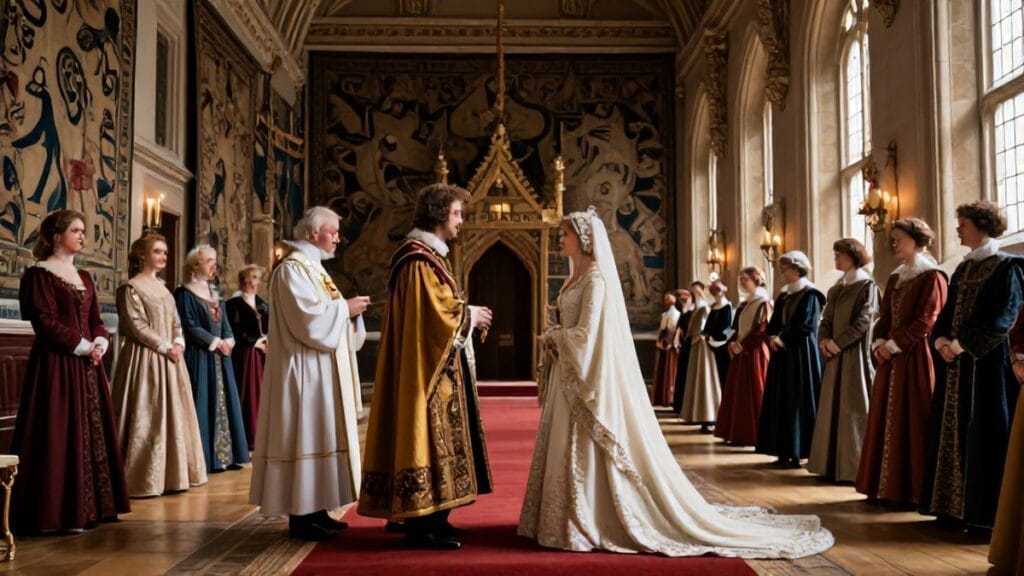
The wedding itself, conducted within one of Whitehall’s chapels, followed the religious rites of the newly reoriented English church. Though the liturgy still resembled the Latin ceremonies of the Catholic past, subtle differences in authority and implication hung in the air. Here stood a king who had rejected papal power, who had declared himself Supreme Head of the Church of England—and who now sought divine blessing on a third marriage, after annulment and execution had effaced the first two.
Jane Seymour entered the chapel escorted by senior nobles, her steps measured and slow. The eyes of the court rested on her: some curious, some calculating, some silently supportive, others quietly skeptical. Before the altar, Henry waited. The height difference between them—the king tall and broad, Jane smaller and more slender—visually underscored their unequal power, yet the moment still bore the intimacy of a union declared before God and man.
The officiating priest, likely with a carefully selected cohort of clerical attendants, began the service. Latin phrases rolled through the incense-scented space, accompanied by choral responses. The familiar questions were posed: Would Henry take this woman, Jane Seymour, as his lawful wedded wife, to love, honor, and keep her, forsaking all others? Would Jane accept him, obey and serve him, as a wife should in the eyes of God and the law? Their responses, clear and unequivocal, stitched them together in the tapestry of marriage.
For those present, the ceremony may have carried an uncanny resonance. Many had stood in similar spaces, years before, to see Henry with Catherine, and then Henry with Anne. Each time, hopes for peace and heirs had surged, only to be dashed in conflict and scandal. Now, as bride and groom exchanged rings—tokens glinting softly in candlelight—some must have wondered how long this new queen would endure. Yet the official line, repeated in proclamations and courtly flattery, was unambiguous: Jane was the virtuous consort who would finally stabilize the king’s life and the nation’s future.
When the priest declared them man and wife, the chapel air seemed to thicken with the mixture of relief, fear, and expectation. The marriage of Henry VIII and Jane Seymour was accomplished. Applause, muted but real, rustled through the assembled courtiers. Musicians struck up celebratory pieces as the newlyweds moved away from the altar. Outside, heralds prepared to spread the news. Bells would ring; proclamations would soon describe Jane as queen of England, rightful consort to the sovereign and, it was hoped, future mother of a prince.
Yet behind the celebrations, the ghosts of Henry’s previous marriages lingered. Catherine, now dead in January of that same year, had died calling herself the king’s lawful wife. Anne, buried in unconsecrated soil, had proclaimed her innocence to the very end. Their fates cast long shadows over the moment Henry’s hand closed over Jane’s. History would judge this union in light of what came before—and what it would bring forth afterward.
A New Queen in a Fractured Realm
In the days following the wedding, Jane Seymour assumed the public and private roles of queen. Formal homage was paid; courtiers adjusted their speech and gestures to the new order. The royal household began a slow but steady transformation to reflect Jane’s preferences. Her badge, the phoenix rising from fire, was adopted as a symbol of her queenship—an image heavy with suggested meaning for a court still reeling from the destruction of Anne Boleyn’s regime.
Jane’s demeanor in these early weeks seems to have confirmed expectations: she was modest, courteous, and careful. Reports from the period emphasize her gentleness and piety. Unlike Anne, whose sharp tongue and political engagement had earned her both admiration and hatred, Jane maintained a more subdued presence. She dressed with elegance but without the daring French styles that had become Anne’s signature. In religious observance, she leaned toward traditional practices, though she never openly defied the king’s supremacy over the church.
The people’s reaction, as far as we can glimpse it through surviving accounts, was mixed but generally accepting. Many had never warmed to Anne Boleyn, seeing her as the cause of Catherine of Aragon’s disgrace and the break with Rome. For such subjects, Jane’s English birth and less flamboyant manner offered a measure of comfort. Yet others, particularly in regions strongly attached to the old faith, remained suspicious of all that had happened in recent years. They saw in any queen sanctioned by the “heretical” royal supremacy a problematic figure, however personally virtuous she might be.
Henry presented Jane as the answer to his long-standing troubles. Official language lauded her chastity, obedience, and suitability. At court masques and banquets, poets and musicians began to craft compliments celebrating the new queen’s virtues. It was a deliberate reshaping of royal imagery. Where Anne had been associated with reformist ideas and political assertiveness, Jane would be framed as serene, domestic, and devoted above all to the production of healthy heirs. The marriage of Henry VIII and Jane Seymour thus became a foundational myth-in-the-making: the story of a wounded kingdom healed by a gentle, restorative feminine presence.
The Politics Behind the Wedding: Religion, Factions, and Foreign Eyes
To view the wedding as merely a love match is to miss the dense political forest surrounding the Whitehall chapel. The marriage of Henry VIII and Jane Seymour had profound implications for the balance of power at court, the direction of religious policy, and England’s standing among European monarchies.
Within the court, factions immediately repositioned themselves. The Seymours, naturally, gained influence. Jane’s eldest brother, Edward Seymour, would soon be elevated to Viscount Beauchamp and then to Earl of Hertford, his fortunes riding the wave of his sister’s queenship. Thomas Cromwell, who had helped orchestrate Anne Boleyn’s destruction, aimed to keep Henry’s trust by facilitating the new marriage and aligning himself with Jane’s kin where possible. Conservative nobles, many of whom had despised Anne and the evangelical reformers she patronized, saw an opportunity to slow or redirect the religious changes sweeping through the realm.
Religiously, Jane’s personal sympathies leaned toward traditional Catholic piety, but she was no open rebel against the king’s ecclesiastical policies. She supported, at least outwardly, Henry’s supremacy over the church. However, her intercessions later on—particularly on behalf of the rebels during the Pilgrimage of Grace, when she reportedly begged Henry to show mercy—suggest a queen whose conscience tugged toward moderation and compassion. In a court where Scripture was increasingly deployed as political weapon, Jane offered a gentler, if still cautious, tone.
Abroad, foreign ambassadors watched the shift with astonishment and sometimes horror. Eustace Chapuys, imperial ambassador and a long-time supporter of Catherine of Aragon and Princess Mary, wrote vivid letters to Emperor Charles V describing the king’s rapid remarriage. In one dispatch, he reported with thinly veiled contempt how “the concubine” (Anne) had been replaced with “the new lady,” Jane, as if queenship were a costume changed backstage in a play. French and Spanish courts both weighed the implications: would Jane bring England closer to traditional alliances, or deepen its isolation as a schismatic power?
At stake was more than personal reputation or even theology; it was the future of the Tudor dynasty. If Jane bore Henry a legitimate son, that child would not only secure the succession but also set the religious and diplomatic tone for decades. A prince raised by a mother inclined to traditional faith might sympathize with Catholic powers, even under a royal supremacy. Alternatively, the institutional reforms already in motion might prove more irreversible than any single queen’s influence. Thus, from Rome to Brussels, from Paris to Madrid, the news of Whitehall’s wedding was parsed with anxious care.
Everyday Life with a Dangerous Husband: Jane’s Short Reign
After the initial flurry of ceremony and proclamation, Jane settled into the routines of queenship. Her days followed a structured pattern: morning prayers, meals, audiences, embroidery or other domestic arts, evening devotions. She presided over her household with a firmness softened by kindness, rewarding loyal service and, as far as we can tell, avoiding the bitter internal rivalries that had plagued Anne’s entourage.
Yet Jane’s “ordinary” life was anything but secure. Her husband was Henry VIII, a man whose anger could topple servants, ministers, and queens alike. Jane learned quickly where the lines lay. When, for example, she dared to speak in favor of the monasteries—perhaps moved by appeals from sufferers of the Dissolution—Henry reportedly rebuked her sharply, warning her not to meddle in his affairs as her predecessor had done. It was a chilling reminder: the price of pushing too far could be annihilation.
Even so, Jane did exert influence in areas that mattered to her. Perhaps her most significant personal victory was the partial reconciliation between Henry and his eldest daughter, Mary. Under Anne, Mary had been forced to accept her own illegitimacy and the invalidity of her mother’s marriage, living effectively in disgrace. Jane, who had likely known Mary during their shared time in Catherine’s household, pleaded with Henry to be kinder to the princess. While full restoration to the succession would come only later, Jane’s advocacy helped soften the king’s attitude and allowed Mary to return to court in improved circumstances.
The queen also took care to cultivate a public image of charity and piety. She gave alms, patronized religious houses that had not yet been dissolved, and supported petitions from the poor. At court festivities, she favored themes of harmony and renewal over the more aggressive, triumphalist spectacles associated with earlier phases of Henry’s rule. These gestures, though modest compared to grand policies, contributed to a sense that Jane’s presence might temper the harsher edges of the king’s governance.
Yet time was not on her side. Jane’s queenship lasted barely a year and a half. Within that brief window, she had to navigate a treacherous court, manage the expectations of a husband desperate for a son, and establish herself as a figure of stability in a country still racked by religious and political upheaval. Everything came to hinge on one question: could she give Henry the male heir he had sought for so long?
The Longed-for Son: Conception, Hopes, and Fears
When news spread that Jane Seymour was pregnant, the court exhaled a collective breath of hope. The marriage of Henry VIII and Jane Seymour had always been framed as a promise of dynastic salvation, but now that promise took flesh. The queen’s swelling belly became the focus of prayers and flattery, anxiety and calculation. Treatises and sermons spoke of God’s favor being restored to England through the prospect of a legitimate male heir.
For Henry, the pregnancy brought a mixture of joy and terror. He had seen pregnancies go wrong before—Catherine’s repeated losses, Anne’s miscarriages. This time, the stakes felt even higher, for the kingdom’s religious settlement and foreign relationships had grown more precarious. A son born of Jane would, in Henry’s eyes, vindicate his earlier choices. The annulments, the executions, the break with Rome—all could be retroactively justified by the arrival of a prince securing the Tudor line.
Jane’s condition altered the rhythm of court life. Physical activities were curtailed; ceremonial arrangements were adjusted to protect and honor the expectant mother. Physicians and midwives were consulted with the seriousness of generals planning a campaign. Household records hint at increased provisioning for the queen’s chambers: fine linens, warming pans, restorative foods. Every precaution that wealth and rank could procure was deployed.
Yet fear lurked in every corner. What if the child were stillborn? What if it were another girl? What if the queen herself died in childbirth, as so many women, even noblewomen, did? Jane, versed in pious contemplation, must have known these dangers intimately. She had watched other women at court endure the ordeal; now her own body would be tested in the most perilous of ways. In her private prayers, perhaps before small devotional images in her chamber, she likely begged for the safe delivery of a healthy boy.
Outside the palace walls, people whispered and wondered. The Pilgrimage of Grace, a massive northern rebellion against Henry’s religious policies in 1536–37, had already exposed the fragility of the king’s authority. A male heir might soothe some anxieties, promising continuity even if the present king’s reforms remained controversial. In taverns, churches, and marketplaces, news of the queen’s pregnancy mingled with rumors of political unrest and shifting religious practice. The future of England, it seemed, was being shaped simultaneously in the womb of Whitehall and in the restless hearts of its subjects.
Birth, Blood, and Bereavement: Jane Seymour’s Final Days
In October 1537, the long-awaited moment arrived. After a difficult labor lasting several days—sources suggest nearly three—the queen gave birth on 12 October at Hampton Court Palace to a healthy son. Bells rang throughout London; bonfires were lit; wine flowed in the streets. The child was christened Edward, after both his royal grandfather and his maternal uncle, Edward Seymour. Henry VIII, now in his mid-forties, finally had what he regarded as a secure male heir.
The elation was immense. The marriage of Henry VIII and Jane Seymour had achieved what his unions with Catherine and Anne had not: the production of a living, legitimate male child surviving infancy. For the king, this was proof, in his mind, that God had blessed his choices at last. At the lavish christening, held in the Chapel Royal at Hampton Court, the infant prince was carried in a magnificent procession. His sisters, Mary and Elizabeth, took part in ceremonial roles, a hint that despite their complicated legal status, they would not be erased from the royal stage.
But behind the celebrations, Jane’s health faltered. In the days following the birth, she showed signs of infection or postpartum complications—likely puerperal fever, a common and often fatal condition in an age before germ theory. Physicians and attendants tried what remedies they knew, but the queen grew weaker. Henry, so jubilant at his son’s arrival, now faced the possibility of losing the woman who had given him that son.
Jane Seymour died on 24 October 1537, less than two weeks after Edward’s birth. She was probably in her late twenties. The court went into mourning; black cloth replaced bright hangings; music turned to solemn requiems. Henry’s grief appears to have been genuine and deep. Unlike Catherine, whom he had cast aside, and Anne, whom he had destroyed, Jane left him in a way he could not control. She had fulfilled her duty in the harsh calculus of Tudor queenship, giving him a male heir at the cost of her own life.
The king ordered that Jane be buried at St George’s Chapel, Windsor, with all the honors befitting a queen. There, in a vault meant to hold future royal bodies, her coffin was laid to rest. Years later, Henry would choose to be buried beside her, ensuring that in death, at least, he would share eternity with the wife he came to regard as his “true” consort. The marriage of Henry VIII and Jane Seymour had been brief, scarcely more than a year and a half in life, yet through their son and his own insistence, its legacy would endure far longer.
After Jane: Memory, Myth, and the King’s “True” Wife
In the years following Jane Seymour’s death, her memory took on a glow that blurred reality and idealization. Henry married three more times: to Anne of Cleves, whom he divorced; to Catherine Howard, whom he executed; and finally to Catherine Parr, who survived him. Yet when asked about his wives, or in decisions concerning his burial, he consistently elevated Jane above the others.
Why Jane? Part of the answer lies in simple dynastic arithmetic: she gave him a son. Edward VI, however short-lived his reign (1547–1553), embodied the success of Henry’s obsessive quest for a male heir. In the king’s mind, and in later tradition, Jane became the vessel through which the Tudor line had been secured. That achievement blotted out any faults she might have had and overshadowed concerns about the ruthless circumstances of Anne Boleyn’s fall.
Another part of the answer is psychological. With Catherine and Anne, Henry had engaged in protracted, bitter conflicts that forced him to confront limits to his own will—limits imposed by canon law, papal authority, and public opinion. By contrast, Jane’s queenship ended before any deep marital discord could erupt. Death froze her image at a moment of apparent harmony. Henry could remember her as the gentle, obedient wife who never opposed him—whether or not such a memory captured the full truth of their relationship.
Over time, artists and writers helped cement this ideal. In Hans Holbein’s portraits, Jane appears composed and demure, her hands folded calmly, her clothing richly adorned but conservative. Later chroniclers, sympathetic to traditional religion, lauded her as a quietly Catholic-leaning influence in an increasingly radical court. In some Protestant narratives, she was praised for her loyalty to the king’s supremacy while still embodying feminine virtues of humility and piety. Jane became, in short, what many wanted her to be: a blank canvas onto which competing versions of “the good queen” could be painted.
Yet beneath the myth, the hard outlines remain. The marriage of Henry VIII and Jane Seymour emerged from a cauldron of violence and ambition; it rode on the destruction of another woman’s life and reputation. Jane may have been personally kind, may even have felt compassion for Catherine and Mary, but she nonetheless stepped into a place made vacant by calculated cruelty. Recognizing this complexity does not require us to condemn her absolutely. Instead, it invites us to see all the Tudor queens as women constrained, shaped, and sometimes crushed by a system in which their survival depended on male favor and reproductive success.
Wider Consequences: Dynasty, Reformation, and the English Future
The ripple effects of the Whitehall wedding extended far beyond the personal sphere. By producing Edward, the marriage of Henry VIII and Jane Seymour altered the trajectory of the English monarchy and the course of the Reformation in Britain.
Dynastically, Edward’s birth provided what Henry saw as unassailable legitimacy for his religious and political choices. In the Third Succession Act of 1543, Henry restored Mary and Elizabeth to the line of succession after Edward, but the central priority remained clear: Edward first, as the male heir produced by what the king regarded as his most correct marriage. This legal framework would have dramatic consequences after Henry’s death, when rival claims and confessional allegiances turned succession into a battlefield of competing faiths.
Under Edward VI, the English Reformation accelerated dramatically, pushed forward by Protestant regents, including Jane’s own brother, Edward Seymour, by then Duke of Somerset and Lord Protector. Ironically, the son of a queen with conservative religious sympathies presided over a period of iconoclasm, liturgical change, and doctrinal experimentation. The same dynasty secured by Jane’s womb became an engine of reforms that would probably have unsettled her, had she lived to see them.
In foreign policy, the existence of a male Tudor heir gave England more bargaining power. Potential marriage alliances for Prince Edward became a subject of intense diplomatic interest. Continental powers calculated how best to respond to a realm that, though excommunicated and religiously deviant in their eyes, now appeared more politically stable thanks to a clear line of male succession. Had Edward lived to old age and produced heirs of his own, the balance of European power might have developed along very different lines.
Socially and culturally, the tale of Henry’s third marriage helped cement certain expectations about queenship. The narrative of the gentle, fertile, self-effacing queen—embodied in the later myth of Jane Seymour—served as a model against which subsequent royal consorts would be judged. Women who appeared too intellectual, too assertive, or too politically engaged risked being compared unfavorably to Jane’s supposed ideal. The story of her quiet virtue, however embellished by later generations, thus shaped gender norms at the highest level of society.
At the same time, the very extremity of Henry’s marital history, with its annulments and executions, contributed to growing unease about the concentration of power in the monarch’s hands. While open criticism was dangerous in Henry’s own reign, the memory of his treatment of wives and ministers lingered into the Elizabethan age and beyond, informing debates about tyranny, conscience, and the rights of subjects. In that sense, the glittering moment in Whitehall’s chapel was also a step along the path toward later questions about the limits of royal authority.
Inside the Sources: How We Know What We Think We Know
Much of what we know—or think we know—about the marriage of Henry VIII and Jane Seymour comes from a patchwork of letters, ambassadorial reports, financial accounts, chronicles, and later histories. These sources, while invaluable, are far from neutral. They bear the biases and agendas of those who created them.
Imperial ambassador Eustace Chapuys, whose dispatches to Emperor Charles V are among our richest narrative sources, was fiercely loyal to Catherine of Aragon and Princess Mary. His descriptions of Anne Boleyn are colored by hostility, and his early remarks about Jane are tinged with skepticism. When he reports that Jane was coached to resist Henry’s advances and to insist on marriage, we glimpse not only Jane’s possible strategy but also Chapuys’s tendency to frame events in ways that further imperial perspectives. As historian Eric Ives has noted in his seminal work on Anne Boleyn, Chapuys’s reports must be read critically, their barbs and sympathies carefully weighed.
Court account books, wardrobe records, and royal proclamations provide a different kind of evidence: dry, factual entries that, when pieced together, allow us to reconstruct timelines and ceremonial details. Through such documents we track the date of betrothal, the arrangements for the wedding at Whitehall, the gifts and lands assigned to Jane as queen. These records are less overtly opinionated but tell their own story of priorities: what the crown deemed important enough to itemize and preserve.
Later chroniclers, such as the Tudor-era historian Edward Hall, wrote narratives that blended fact, rumor, and moral interpretation. Hall, for instance, drew sharp contrasts between the “good” and “bad” queens, reinforcing patterns that would echo through centuries of popular history. Modern scholars—from Agnes Strickland in the nineteenth century to more recent biographers like David Loades and Alison Weir—have revisited these accounts, challenging simplifications and probing the silences in the record.
Even the physical spaces connected to the story bear witness. The site of the Palace of Whitehall, largely destroyed by fire in 1698, survives today only in fragments and archaeological traces. Windsor’s St George’s Chapel, where Jane lies beside Henry, offers a more tangible link. Standing before their shared tomb, one can feel the weight of the constructed memory: here, in stone and heraldry, the king and the queen who gave him a son are forever paired, as if the conflicts, cruelties, and complexities that surrounded their union had faded into mere background noise.
As historians, we move between empathy and skepticism, between the pull of narrative and the rigor of analysis. The marriage of Henry VIII and Jane Seymour is not simply a love story, nor merely a cold political alliance. It is both and more, a knot of personal desire, institutional transformation, and historical contingency. By reading the sources closely—aware of their gaps, contradictions, and motives—we come closer to understanding how a single wedding, on a May morning in Whitehall, could reverberate through the centuries.
Conclusion
Seen from the distance of nearly five centuries, the marriage of Henry VIII and Jane Seymour is at once intimate and monumental. On the one hand, it is the story of a man and a woman standing before an altar, speaking vows that bind their lives together. On the other, it is a pivot point in a much larger drama: the struggle to secure a dynasty, the convulsions of the English Reformation, and the remaking of monarchy itself.
Jane’s path from Wulfhall to Whitehall, from the shadowed ranks of ladies-in-waiting to the exposed summit of queenship, illuminates the precarious opportunities available to women at the Tudor court. Her apparent virtues—modesty, obedience, quiet piety—were celebrated even as they masked the sharp edges of the world she inhabited, a world where a queen’s primary duty was to risk her life in childbirth for the sake of a son. Henry, for his part, appears as a figure both commanding and haunted: capable of sweeping institutional change and brutal personal decisions, yet forever chasing the elusive security that only a male heir, in his view, could provide.
In the chapel at Whitehall on 30 May 1536, vows were spoken that seemed to promise a new era of peace and legitimacy. For a brief moment, it looked as if the storms stirred up by Catherine of Aragon’s refusal and Anne Boleyn’s rise might settle into calmer waters. Yet even this union, successful in producing Edward, could not escape tragedy. Jane’s death in childbirth left Henry bereft, her image suspended in idealized memory, her son destined for a short and transformative reign. The consequences rippled outward: through Mary’s eventual Catholic resurgence, Elizabeth’s long Protestant settlement, and the enduring English fascination with Henry and his six wives.
Ultimately, the story of Henry and Jane’s marriage reminds us how tightly personal choices can intertwine with national destinies. A private ceremony in a palace chapel can alter succession laws, religious identities, and the lives of millions yet unborn. To walk back through that morning in May is to grasp, if only for a moment, how history is made not just by battles and parliaments, but by whispered conversations, calculated courtships, and the exchange of rings in the half-light of a royal chapel.
FAQs
- Why did Henry VIII marry Jane Seymour so soon after Anne Boleyn’s execution?
Henry VIII moved quickly to marry Jane Seymour for both personal and political reasons. He believed his marriage to Anne Boleyn had been morally and legally flawed, and he was desperate to restore a sense of order and legitimacy, especially regarding the succession. By marrying Jane only eleven days after Anne’s death, he signaled decisiveness, erased the previous union from public focus, and embraced a new consort whose reputation for modesty and obedience contrasted sharply with Anne’s. Court factions and key ministers like Thomas Cromwell also supported the rapid remarriage as a way to stabilize the regime. - Was Jane Seymour really as modest and gentle as tradition suggests?
Contemporary sources describe Jane as quiet, pious, and modest, and there is no strong evidence to contradict this general impression. However, she was not simply passive. Her rise required navigating a complex court, and she seems to have cooperated with family and political allies who saw her as a useful alternative to Anne Boleyn. Jane also intervened on behalf of Princess Mary and, reportedly, for rebels during the Pilgrimage of Grace. So while she likely was gentle in manner, she also showed political awareness and a willingness to act within the narrow space allowed to her. - Where did the wedding of Henry VIII and Jane Seymour take place?
The wedding took place on 30 May 1536 at the Palace of Whitehall in London, then one of Henry VIII’s principal residences. The ceremony was held in a palace chapel, probably in relatively private fashion compared to larger, more public royal weddings. Nonetheless, it was attended by leading nobles, clergy, and courtiers, and it quickly became a matter of official proclamation and public knowledge. - Did Jane Seymour influence religious policy in England?
Jane Seymour personally favored more traditional forms of worship and was sympathetic to Catholic practices, but she did not openly oppose Henry’s supremacy over the Church of England. Her influence on formal religious policy appears limited; the major legislative and doctrinal shifts were driven by Henry himself and advisers like Thomas Cromwell. Jane’s main religious impact lay in her tone: she softened the court’s atmosphere, displayed personal piety, and occasionally advocated mercy, as in her reported plea for leniency toward northern rebels. However, she did not reverse or halt the broader course of the Reformation. - How did Jane Seymour die?
Jane Seymour died on 24 October 1537, less than two weeks after giving birth to Prince Edward. Most historians believe she succumbed to puerperal fever, a postpartum infection common and often deadly in the 16th century. Despite the best efforts of court physicians, there was little effective treatment. Her death underscored the perilous nature of childbirth even for queens and cemented her image as a woman who sacrificed her life to give Henry the son he so desperately wanted. - Did Henry VIII truly love Jane Seymour more than his other wives?
Henry later claimed to regard Jane as his “true” wife and chose to be buried beside her at Windsor, which suggests a special attachment. Part of this preference likely stemmed from the fact that Jane gave him a male heir and died before serious marital conflicts could develop, allowing him to remember her idealized. However, it is difficult to measure love across his six marriages. At different times he showed deep affection for Catherine of Aragon, passionate desire for Anne Boleyn, and real respect for Catherine Parr. Jane’s posthumous status as his favorite owes much to the success of their union in dynastic terms. - How long did the marriage of Henry VIII and Jane Seymour last?
The marriage lasted about seventeen months. They wed on 30 May 1536, and Jane died on 24 October 1537. In that short period, she became queen, navigated intense court politics, and bore Henry a son. Though brief compared to his first marriage with Catherine of Aragon, which lasted over twenty years, this relatively short union had disproportionate historical impact because of Edward’s birth. - What happened to Jane Seymour’s family after her death?
Jane’s family, especially her brothers, saw their fortunes rise dramatically thanks to her marriage and the birth of Edward. Edward Seymour became Earl of Hertford and later Duke of Somerset, eventually serving as Lord Protector during Edward VI’s minority. However, the Seymour ascendancy was unstable. Edward Seymour was overthrown and executed in 1552. Thomas Seymour, Jane’s younger brother, was also executed in 1549 for treasonous schemes involving the young King Edward and Princess Elizabeth. The family’s story illustrates both the rewards and dangers of proximity to the Tudor throne. - How did the marriage affect Henry’s daughters, Mary and Elizabeth?
Jane Seymour played a significant role in easing tensions between Henry and his eldest daughter, Mary. She advocated for Mary’s reconciliation with her father, and Mary’s eventual return to court owed much to Jane’s intercession, though Mary still had to accept her own illegitimacy officially. Elizabeth, Anne Boleyn’s daughter, was less directly favored, but her position remained secure enough for her to grow up at court. The birth of Edward demoted both daughters in the line of succession, yet all three would ultimately wear the crown, reflecting the long-term complexity of Tudor inheritance. - Why is the marriage of Henry VIII and Jane Seymour still significant today?
This marriage is significant because it crystallizes many of the central tensions of the Tudor era: the clash between personal desire and political necessity, the intersection of dynastic ambition with religious upheaval, and the precarious roles assigned to royal women. The union produced Edward VI, whose brief reign accelerated England’s Protestant turn, and it helped shape the later succession of Mary I and Elizabeth I. Moreover, the story of Henry and Jane continues to captivate modern audiences, reminding us how individual relationships can influence the fate of nations.
External Resource
Internal Link
Other Resources
- Encyclopaedia Britannica – general search for the exact subject
- Google Scholar – academic search for the exact subject
- Internet Archive – digital library search for the exact subject

