Table of Contents
- A November Wedding on the Edge of War
- Two Kingdoms at War, Two Children at the Altar
- Richard II: A King in Search of Peace and Legitimacy
- Isabella of Valois: A Child Bride Shaped by Court and Conflict
- The Road to Calais: Negotiations, Envoys, and Calculated Smiles
- Calais Transformed: Preparing a Frontier Town for a Royal Union
- The Wedding Day: Ceremonies, Oaths, and Silent Fears
- A Marriage of Peace: The Twenty-Eight Year Truce and Its Promises
- Spectacle and Symbolism: Clothing, Ritual, and the Theater of Power
- Whispers in the Great Halls: English and French Reactions
- Husband and Child: The Uneasy Intimacy of Richard and Isabella
- Courtly Life in London: From Calais Pageantry to Westminster Routine
- Storm over the Truce: Factions, Intrigues, and the Question of War
- The Fall of Richard II and the Fate of a Queen-in-Name
- Memory, Myth, and the Long Echo of a Political Wedding
- Historians Debate: Diplomacy, Exploitation, or Tragic Necessity?
- Legacy in Literature and Culture: How the Marriage Was Remembered
- Conclusion
- FAQs
- External Resource
- Internal Link
Article Summary: On 4 November 1396, in the English-held port of Calais, the marriage of Richard II and Isabella of Valois became a glittering performance of peace staged atop decades of brutal conflict. This article traces how the wedding emerged from the exhausted stalemate of the Hundred Years’ War, and how two royal children were placed at the heart of a vast diplomatic gamble. It follows Richard II’s quest for stability after rebellion, Isabella’s transformation from pawn to symbolic queen, and the fragile twenty-eight-year truce that promised more than it could deliver. Through court ceremony, political maneuvering, and personal tragedy, the narrative explores how the marriage reshaped Anglo-French relations, if only briefly. Yet behind the magnificence of Calais, tensions simmered in both kingdoms, undermining the hope that a child bride and a embattled king could hold back the tide of war. The story continues through Richard’s deposition, Isabella’s forced return, and the lingering sorrow that shadowed both courts. In the end, the marriage of richard ii and isabella of valois appears less as a fairy-tale union than as a poignant testament to the limits of dynastic diplomacy in an age of steel, banners, and blood.
A November Wedding on the Edge of War
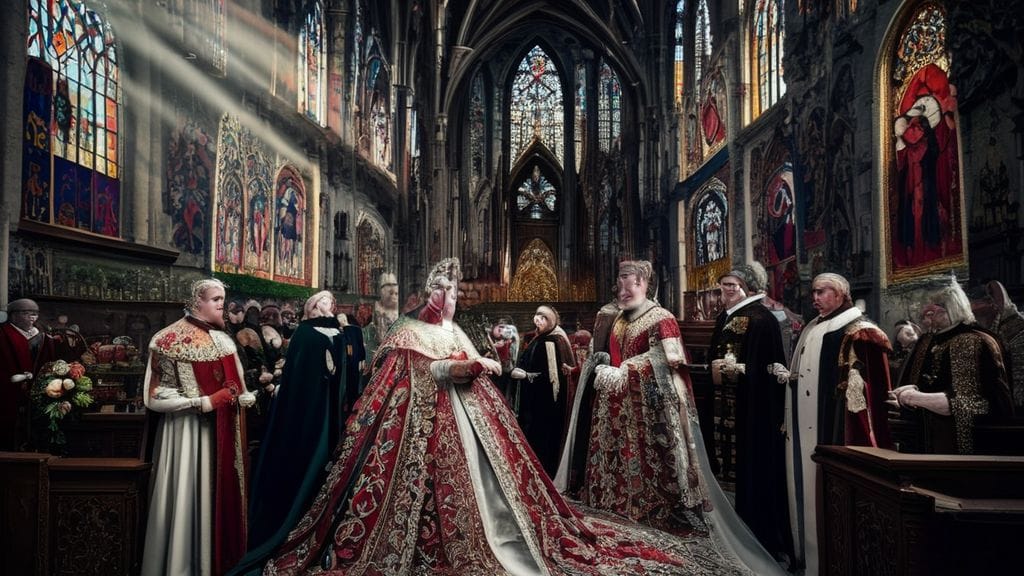
On a raw November morning in 1396, the sea wind clawed at the walls of Calais, hurling salt and mist against its stone defenses. Within those walls, however, the world was transformed. Streets that normally echoed with the rough shouts of soldiers and dockworkers now shimmered with banners, tapestries, and the soft, purposeful bustle of courtiers. At the very frontier between enemy realms, the marriage of richard ii and isabella of valois was about to be solemnized—a carefully staged moment of peace on a coastline that had known almost nothing but war for sixty years.
Calais, the hard-won English bridgehead on French soil, had been held since 1347, a symbol of English persistence and French humiliation. That such a place would host a royal wedding seemed astonishing, almost defiant. Yet it was precisely this tension that made the choice deliberate: both kingdoms wanted to display their capacity for reconciliation without surrendering their pride. Ships crowded the harbor, their masts creaking like forest groves, while galleys from England and France rode at anchor under their respective flags, watching each other as though unsure if they had come for a festival or a final confrontation.
Within the royal lodgings, tapestries depicted scenes of biblical unions—Isaac and Rebecca, Jacob and Rachel—obvious reminders that dynastic marriage had long been the language of peace. But this particular marriage bore an uneasier weight. Richard II of England was nearly thirty, a seasoned ruler bearing the scars of rebellion and crisis. Isabella of Valois, daughter of Charles VI of France, was not yet eight years old. The disparity in age, the fragility of the truce that had led them here, and the heavy presence of armed escorts on both sides turned the wedding into something more than a celebration. It was a gamble written in the lives of a man and a child, upon whose union the crowns of England and France now dared to pin their hope.
Outside, the locals of Calais craned their necks to glimpse the arriving processions. They saw French nobles in rich silks, their garments slashed and embroidered in the latest Parisian fashion; English lords clad in velvets and furs, their badges—Lancaster’s red rose, Gloucester’s rampant beasts—displayed with careful flourish. Trumpets shrilled; church bells answered in iron chorus. The marriage of richard ii and isabella of valois was not a private vow but a public spectacle, a living treaty to be witnessed and remembered by all who stood within earshot of the Latin words of the priest.
Yet behind the trumpets there was unease. Soldiers, disciplined and stern, lined the approaches, their hands never far from their sword hilts. They knew, as everyone did, that truces between England and France had broken before, sometimes within months. Still, for this one day, the clang of weapons was replaced by the clatter of carriages and the murmur of diplomatic greetings. In the balance hung not just the lives of Richard and Isabella, but the fragile hope that an entire generation might grow up without the drumbeat of the Hundred Years’ War as its constant refrain.
Two Kingdoms at War, Two Children at the Altar
The union at Calais could only be understood against the backdrop of a Europe long accustomed to the rhythm of conflict between England and France. Since the mid-fourteenth century, the Hundred Years’ War had ebbed and flowed across the Channel and countryside. Its origin lay partly in overlapping claims: English kings of the Plantagenet line had held territories in France for centuries and, after the extinction of the direct Capetian line, had claimed the very crown of France itself. What began as a dynastic quarrel had hardened into a generational struggle for supremacy, played out in campaigns, sieges, and pillaging raids.
By the 1390s, both kingdoms were exhausted. The early English triumphs—Crécy (1346), Poitiers (1356), and the stunning capture of Calais—had faded into bitter memory. France, under Charles V, had recovered much of its lost territory, while Charles VI initially inherited a comparatively stabilized realm. Yet the war never truly ended; it lingered, a chronic disease flaring into violence whenever truces broke or ambitious nobles saw opportunity. Trade faltered, peasants suffered, and tax burdens escalated on both sides of the Channel.
Into this storm were born the two central figures of our story. Richard II, grandson of Edward III and son of the Black Prince, had grown up knowing that his family’s identity was intertwined with warfare in France. Isabella of Valois, granddaughter of Charles V and daughter of Charles VI, entered a court riven by internal factionalism and haunted by the question of how to contain English ambitions. Their bloodlines, almost mirror images of each other, revealed the strange intimacy of enemy monarchies whose genealogies wrapped around one another like tangled vines.
The war’s impact filtered into every layer of life. English archers who had once marched triumphantly through French fields now returned home with fewer spoils and more scars. French villages rebuilt after one raid only to be ravaged by another. Merchants, dependent on cross-Channel trade, saw fortunes rise and fall as piracy and blockades divided the seas. Chroniclers like Jean Froissart wrote of chivalric deeds, tournaments, and dazzling knights, but even in his ornate prose one senses the underlying weariness of lands that had grown too accustomed to fire and famine.
Thus, when diplomats proposed a truce bolstered by marriage, it was not merely a gesture of courtly elegance. It was a desperate search for stability. The marriage of richard ii and isabella of valois represented a kind of wager: that blood might succeed where banners and blades had failed. The children at the altar were heirs to a century of hostility, yet they were also its potential undoing. One had been groomed to rule a divided England; the other raised amid the splendor and instability of a French court teetering between brilliance and breakdown.
Richard II: A King in Search of Peace and Legitimacy
Richard II ascended the English throne in 1377 at the tender age of ten, following the death of his grandfather Edward III. The kingdom he inherited was stretched thin. The long war in France had drained treasuries, and the plague had repeatedly scythed through the population. Perhaps even more critical, the legend of the Black Prince, Richard’s father—hero of Poitiers and darling of English chivalry—cast a long shadow over the young king. Where the father had been a warrior, the son was a boy with a delicate face and a temperament more inclined to ceremony than to the rigors of the campaign tent.
Richard’s early reign was dominated by powerful uncles and magnates, none more formidable than John of Gaunt, Duke of Lancaster. Their presence, though stabilizing at first, undercut the sense that the king himself commanded. In 1381, the Peasants’ Revolt exploded across southern and eastern England, a searing reminder of social unrest. Richard, still only fourteen, met the rebels at Smithfield and, in a moment that would be celebrated for generations, spoke bravely to the mob and promised reforms. While many chroniclers praised his composure—“the young king showed the courage of a lion,” one would later write—the aftermath saw a reassertion of aristocratic control and a hardening of attitudes among the political elite.
In the 1380s, Richard’s efforts to carve out his own authority collided with the interests of the Lords Appellant, a group of high nobles who effectively staged a political coup in 1387–1388. They tried and executed many of the king’s confidants, accusing them of treason and mismanagement. The “Merciless Parliament” of 1388 was a trauma Richard never forgot. It taught him that, in England, a king could not rule by mere inheritance and pageantry; he had to negotiate, sometimes submit, and sometimes strike back. When Richard finally reasserted his power in the early 1390s, he did so with a more authoritarian edge.
By the time the prospect of marriage to Isabella of Valois arose, Richard was a man in search of both personal and political stability. His first queen, Anne of Bohemia, had died in 1394, and her death deeply affected him. He reportedly ordered the demolition of the manor at Sheen where she had died, unable to bear the memory. Their marriage, though childless, had been affectionate and companionable. The loss left him bereft, but also dangerously exposed: without an heir, the question of succession loomed, intensifying the ambitions of his cousins, especially those related to the House of Lancaster.
Peace with France offered Richard something more than a respite from war; it promised breathing room to consolidate his authority at home. A long truce could relieve the financial pressure on the crown and remove one of the rallying causes used by his domestic opponents. Moreover, a marriage alliance with the Valois dynasty would cast him as a European statesman, a ruler capable of turning away from endless conflict toward diplomacy and grandeur. The marriage of richard ii and isabella of valois thus aligned with Richard’s self-image as a cultured monarch who preferred ordered ceremony, fine art, and divinely sanctioned kingship to the rough-and-tumble of battlefield glory.
Yet Richard’s desire for peace was not purely altruistic. It also served his increasingly absolutist tendencies. Freed from the need to constantly finance war, he could weaken the role of Parliament and rely more heavily on loyal retainers and a vision of kingship that brooked little dissent. As some modern historians, such as Nigel Saul, have argued, Richard sought to transform the English crown into a more sacral, almost semi-divine institution. In this scheme, marrying the daughter of the French king—himself crowned in a ceremony steeped in sacred oil and old ritual—fit perfectly. It would link the English throne to the prestige of the French monarchy and reinforce Richard’s belief that he, too, ruled by a special grace.
Isabella of Valois: A Child Bride Shaped by Court and Conflict
Isabella of Valois entered the world in 1389, the second daughter of King Charles VI of France and Queen Isabeau of Bavaria. Her earliest years coincided with a time of outward brilliance at the French court. Paris dazzled with pageantry; the royal household sponsored literature, music, and elaborate religious observances. Yet beneath the silk and gold, fault lines were already widening. Charles VI suffered from episodes of madness that would define his reign, periods during which he could become violent, confused, or catatonic. In his absence, factions among the royal uncles and cousins vied for influence, turning the court into a battleground of whispers and alliances.
For a child like Isabella, the royal palace was both a playground and a stage. She learned to walk under the watchful gaze of nurses and ladies-in-waiting, her small steps echoing in halls lined with tapestries. Even before she could read, she was an object of diplomacy. Foreign envoys observed her, whispered about her health and appearance, and reported back to their masters. Her clothes carried symbolic weight: the richness of her garments, the colors chosen, even the jewels that glittered at her throat could signal the prosperity and confidence of the Valois dynasty.
Her mother, Isabeau, quickly understood that Isabella’s future would almost certainly be decided at the negotiation table. Royal daughters in late medieval Europe were, in effect, living treaties. Marriages concluded not only alliances but also economic arrangements, territorial concessions, and promises about future succession. Isabella’s elder sister had already been marked for an important match, and it was not long before talk turned to whether Isabella herself might play a role in stabilizing relations with England.
At the time of the truce negotiations of 1396, Isabella was still a child in every sense: she played with dolls, practiced basic reading and piety, and was gently introduced to court etiquette. The distance between her world and that of Richard II, a man approaching thirty, was immense. Chroniclers described her as delicate and pretty, with the sort of innocent charm that made the contrast to her political role all the more jarring. When she was told she would become Queen of England, she may have understood only that she was to leave her family, her language, and her familiar surroundings for a distant, foreign shore.
Yet even at seven, Isabella would have absorbed the language of ceremony that structured her life. She knew how to bow, how to respond when addressed, how to move in processions with quiet dignity. These rehearsed gestures would serve her in Calais, where thousands of watching eyes would seek in her expression clues to the future of peace. The marriage of richard ii and isabella of valois would thrust her into a role that combined vulnerability and power in a way few adults might manage, let alone a child just out of the nursery.
Her later life suggests that Isabella possessed a quiet resilience. After her return to France following Richard’s deposition, she refused for a time to acknowledge a second forced marriage and remained loyal, at least symbolically, to the memory of her first husband. But that was still in the future. In 1396, as the plans solidified and seamstresses stitched her wedding garments late into the night, Isabella existed at the center of a diplomatic storm she could not possibly comprehend, a small figure onto whose shoulders two kingdoms placed their hope for peace.
The Road to Calais: Negotiations, Envoys, and Calculated Smiles
The idea of sealing a truce with marriage did not spring up overnight. It emerged from months of laborious negotiation, conducted by seasoned diplomats and powerful nobles who had long danced the precarious minuet of Anglo-French relations. On both sides, there were advocates of peace and champions of renewed war. The challenge lay in convincing enough of the political nation that peace could be more profitable—materially and symbolically—than continued conflict.
French envoys traveled to the English court bearing proposals. They argued that a long truce, underpinned by marriage, would allow both kingdoms to heal their finances, stabilize border regions, and assert better control over restless nobles. English negotiators, wary but intrigued, explored the implications. Could a truce really last twenty-eight years, as the French suggested? What would become of long-contested claims? How might such a peace influence England’s relationships with Flanders, Burgundy, and other key players?
One can imagine the tense meetings in chambers heavy with incense and candle smoke, parchment spread across tables, witnesses and scribes in attendance. Words like “perpetual friendship” and “amity” flowed freely, yet underneath it all lay the practical arithmetic of power. If Richard accepted a marriage with a French princess as young as Isabella, he would gain prestige but forego any immediate hope of an heir. In the near term, the wedding would not strengthen his dynastic line. It would, however, demonstrate that France recognized him as a legitimate monarch worth binding itself to by blood.
In Paris, some courtiers balked at the idea of sending a child to England. Others saw opportunity: the match could pacify English aggression while Charles VI struggled with his illness and internal strife. Queen Isabeau, keenly aware of how fragile the French crown could be in times of royal incapacity, saw in England not only an enemy but also a mirror. If both kingdoms burned themselves out in endless war, who would truly benefit? The Burgundians? The papacy? Ambitious neighbors like the King of Aragon?
When French and English delegations finally agreed in principle, the location of the marriage became the next question. Calais, though English-held, lay on French soil and had symbolic resonance for both sides. It had seen siege, starvation, and surrender. Now it would see silks rather than steel. Agreements were drafted that ensured safe conduct: armed escorts would accompany the royal visitors, but no overt shows of military force would be allowed near the wedding spaces. It was a careful choreography, designed to keep both pride and fear in check.
In a sense, the road to Calais was paved not just with political calculation but with wary optimism. The marriage of richard ii and isabella of valois could fail like previous truces, of course. But the scale of the ceremony, the long duration of the proposed peace, and the personal involvement of both crowns suggested a greater seriousness this time. To step onto that road was to accept a measure of vulnerability—for England, in admitting the need for respite; for France, in trusting their child to the care of a foreign king.
Calais Transformed: Preparing a Frontier Town for a Royal Union
In the months leading up to November 1396, Calais became a construction site and rehearsal stage on an almost unprecedented scale. The town, normally a stark military outpost with a strong garrison and a harbor teeming with merchant ships and warcraft, was temporarily reshaped into a royal city. Wooden galleries were erected to allow spectators to watch processions without crowding the streets; temporary halls were built for feasts; churches were cleansed, adorned, and rehearsed for liturgical choreography befitting a king’s wedding.
English officials responsible for Calais, including its captain and municipal leaders, received detailed instructions from the crown. Roads were to be repaired, lodging secured not only for the English court but also for the incoming French delegation. Bakers and butchers increased their production, while vintners brought in barrels of wine from Gascony and beyond. Tailors and goldsmiths worked in a frenzy to finish garments and adornments that, when displayed, would silently argue the wealth and sophistication of Richard’s realm.
On the French side of the frontier, similar activity unfolded. The journey to Calais had to be carefully staged to avoid any hint of danger to Isabella or her entourage. Bridges were checked for safety, villages along the route prepared to host royal parties, and heralds dispatched to coordinate every detail of timing. The movement of a king or his children was never simple; in this case, it was layered with the psychological weight of sending a small girl into what had long been enemy territory.
The physical space of Calais conveyed a powerful message. Its towering fortifications and English guards reminded everyone that this was a town won by siege, held by force, and maintained at great expense. For the French, crossing the threshold into Calais was a symbolic acknowledgment of English strength; for the English, inviting the French court within its walls required a leap of trust. Every banner hung, every dais erected for viewing, was part of a fragile pact that violence would be set aside, at least for the duration of the festivities.
Witness accounts, though not always precise, give us glimpses of the décor. Churches glittered with candlelight; reliquaries were displayed; altars were draped in cloth-of-gold. In the streets, English soldiers in polished armor stood beside French knights in flamboyant surcoats, an uneasy but compelling tableau. Merchants hawked trinkets and food to the crowds, their voices blending with the more formal calls of heralds who proclaimed stages of the ceremony. For a brief time, Calais ceased to be merely a fortified port; it became the living theater for the marriage of richard ii and isabella of valois, a stage upon which centuries of conflict would attempt a momentary reconciliation.
The Wedding Day: Ceremonies, Oaths, and Silent Fears
On 4 November 1396, the day of the wedding dawned gray and cold, typical of the Channel coast in late autumn. The chill, however, did nothing to dampen the atmosphere of anticipation. From early morning, church bells tolled, calling the devout to prayer and the curious to vantage points along the processional routes. Trumpeters practiced fanfares, their notes cutting thin and bright through the damp air. In their lodgings, Richard II and Isabella each prepared in their own very different ways for the ceremony that would bind them.
Richard’s servants helped him into garments appropriate for the gravity of the occasion. We can imagine a tunic of rich cloth, perhaps crimson or deep blue, heavily embroidered with gold thread and featuring the royal arms of England quartering the lilies of France—a visual statement of his enduring claim to the French crown. Around him clustered his closest advisers, bishops, and nobles, their conversation circling around ceremonial order, diplomatic niceties, and the many eyes that would be upon them.
Isabella, by contrast, was likely surrounded by women: her mother, Queen Isabeau, ladies-in-waiting, nurses, and perhaps a confessor or chaplain to provide spiritual comfort. Her dress would have been exquisite but also somewhat constraining for a child: layers of fine fabric, a headdress weighted with jewels, perhaps a mantle lined with fur. Servants would have instructed her on how to walk slowly, how to hold her head, how to keep her hands demurely positioned—even as excitement, fear, or confusion might have swelled in her chest. One wonders what words her mother offered: reassurances of honor and duty, or perhaps whispered promises that she would one day return to France.
The processions through Calais were choreographed displays of power and goodwill. Crowds watched as the French entourage escorted Isabella to the appointed place, where English dignitaries awaited. The meeting of the two parties, with bows and formal greetings, symbolized the hoped-for meeting of their nations’ hearts. Into the church—likely the grandest in Calais—thronged clergy in elaborate vestments, nobles blazing with color, and representatives of both kingdoms prepared to witness the vow.
The marriage rite itself followed the form of the medieval Latin Church. A priest, perhaps a high-ranking bishop, asked the necessary questions, though Isabella was too young to respond in full understanding. Richard spoke his vows in clear, deliberate tones; Isabella’s responses may have been guided, repeated after a prompter. A ring was placed upon her finger, a tangible symbol of a bond far more complex than she could grasp. The mass that followed invoked blessings on their union, calling on God to grant fruitfulness, peace, and mutual fidelity—a poignant contrast to the realpolitik that had brought them there.
Yet behind the solemn words, silent fears thrummed. English observers worried that the French might use the occasion to press for concessions later or that domestic critics would deride Richard for wedding a child. French onlookers fretted over Isabella’s safety in England and the possibility that, if the truce collapsed, their princess might become a hostage in all but name. Even the clergy, invoking divine sanction, must have been aware that many previous treaties, sworn as solemnly, had been broken upon the anvil of ambition.
When the ceremony concluded, trumpets blared and shouts rang out. The marriage of richard ii and isabella of valois was now a fact, inscribed in the sacramental life of the Church and in the annals of two hostile realms. The newly married couple processed from the church, surrounded by a whirling tapestry of sound, color, and expectation. Feasts awaited them, tournaments, and celebrations—but this was only the beginning of the story, not its end.
A Marriage of Peace: The Twenty-Eight Year Truce and Its Promises
The wedding at Calais was not an isolated event; it formed the keystone of a much wider diplomatic arch. Central to that structure was the agreement for a truce between England and France—remarkably, one that was to last twenty-eight years. In an age when truces might be measured in months or a handful of years, such a duration seemed almost utopian. It implied that children born in the late 1390s could come of age without ever having seen open war between the two crowns.
The terms of the truce addressed several key flashpoints. They regulated the behavior of soldiers and privateers, sought to reduce raids and piracy along the Channel, and established guidelines for the treatment of merchants. Border disputes in regions like Aquitaine, that perennial bone of contention, were frozen rather than resolved—left in a kind of suspended animation in the hope that time, and perhaps dynastic blending, would blunt their urgency. In essence, the truce was a promise to step back from the brink, to allow both kingdoms to breathe.
For Richard II, the immediate benefit was clear. Without the pressure of financing large-scale war, he could lower certain extraordinary levies and thus placate a weary populace. He could also present himself as a peacemaker, a king wise enough to halt the spiral of conflict that had burdened his grandfather and father. To his supporters, and indeed to some neutral observers, this made him appear enlightened. To his critics, however, it looked like abdication of a sacred duty to maintain England’s martial honor and claims abroad.
In France, Charles VI and his advisers hoped that the truce would grant them the space to address internal turmoil. The king’s bouts of insanity made long-term governance precarious. Rivalries between the dukes of Burgundy and Orléans, among others, threatened to erupt into open civil strife. Easing tensions with England, even temporarily, would free up resources and attention to deal with these domestic storms. Moreover, having his daughter on the English throne—albeit as a child queen—offered a form of security, a living reminder that cooperation was possible.
Yet the very ambition of the twenty-eight-year truce contained a kernel of fragility. Few men who signed it could expect to see its full duration. Political landscapes could shift dramatically in a single decade; what then of three? The truce depended not only on the goodwill of kings but on the self-restraint of restless nobles, the discipline of soldiers accustomed to plunder, and the forbearance of merchants impatient with restrictions. It is astonishing, isn’t it, to imagine such a wide network of human desires and fears being held in place by parchment, seals, and the marriage of a man and a child.
Still, for several years after 1396, relative peace did hold. Cross-Channel trade revived; some border communities began to rebuild more confidently; pilgrims and students traveled with greater ease. The marriage of richard ii and isabella of valois had not, of course, erased the memory of past battles, but it had offered a different story for people to tell: one of reconciliation, however fragile, enacted in the sight of God and man on a chill morning in Calais.
Spectacle and Symbolism: Clothing, Ritual, and the Theater of Power
To understand the full impact of the wedding, one must look beyond the formal documents and into the spectacle itself. Medieval politics was as much about performance as it was about policy. Every cloak, every banner, every gesture during the marriage ceremony and associated festivities carried layers of meaning. The theater of power was deliberate and studied, designed to impress upon the watching world that these two crowns could, if they wished, turn from swords to silk.
Richard II was particularly attuned to such symbolism. His reign saw a flowering of court art and ceremonial innovation. He commissioned the famous “Wilton Diptych,” which shows him kneeling before the Virgin and Child, presented by English saints—a vivid icon of his belief in divinely-centered kingship. In Calais, his appearance alongside Isabella was arranged with similar attention to imagery. Their clothing and positioning would have reinforced his role as protector and lord, but also as partner in a sacred bond with France.
Isabella’s attire for the wedding likely included cloth-of-gold, pearls, and fine embroidery, making her seem almost like a living relic or icon. Her small size, accentuated rather than disguised by the gravity of her garments, only sharpened the audience’s awareness of her youth. To see such a child in royal finery was to be reminded, perhaps uncomfortably, of the human vulnerability embedded within the machinery of diplomacy. At the same time, her finery asserted the wealth and magnificence of the French crown, which could send forth its daughters as radiant embodiments of its prestige.
Ritual acts underscored the shifting, delicate balance of power. When the royal parties first met at the frontier, who bowed first? Whose heralds spoke, and in what order? Which symbols were displayed most prominently: the lions of England, the lilies of France, or a carefully balanced combination of both? Chroniclers often lingered on such details because they knew that contemporaries read them as carefully as any written treaty.
Even the banquets following the wedding served as semiotic battlegrounds. Platters groaned with game, fish, and elaborately shaped pastries; wine flowed freely; minstrels and jongleurs entertained; heralds proclaimed genealogies and heroic deeds. But beneath the music and merriment lay the serious work of alliance-building. Nobles from both sides mingled, exchanged courtesies, and tested one another’s temperaments. It was in such informal settings that animosities could soften—or harden—depending on the success of the host’s hospitality.
Later observers, including some modern historians, have argued that the marriage of richard ii and isabella of valois was as much a piece of political theater as a genuine attempt at reconciliation. Yet to dismiss it as mere spectacle is to misunderstand medieval political culture, in which spectacle itself was a powerful tool. The image of an English king and a French princess standing side by side in a sacred space, before the eyes of hundreds, imprinted itself on the collective imagination. It became a reference point for those who wished to advocate peace, a cherished memory for some, and a bitter symbol of compromise for others.
Whispers in the Great Halls: English and French Reactions
As the last echoes of the festivities faded from Calais, reactions to the wedding rippled through both realms. In the great halls of English castles and the tiled chambers of French palaces, people discussed the union in hushed tones, over shared cups of wine or during long winter evenings by the fire. The official chronicles might emphasize harmony and triumph, but private conversations were more ambivalent.
In England, many commoners welcomed the prospect of peace. They had borne the brunt of taxation and levies, sending sons and husbands to war in France with mixed results. A twenty-eight-year truce promised economic relief and a respite from the grinding uncertainty that accompanied campaigns overseas. Merchants in port towns and market centers saw opportunity in renewed trade. For them, the marriage of richard ii and isabella of valois seemed a practical blessing.
Among the nobility, however, reactions were more divided. Some lords, especially those who had profited from war through ransoms and seized lands, lamented the loss of opportunity. Others, loyal to Richard or simply weary of conflict, saw in the marriage an elegant solution to a costly problem. And there were those who eyed the union skeptically, not because they opposed peace, but because they feared it would boost Richard’s power at their expense. If the king could govern without constant recourse to Parliament for war funds, might he not sideline the political nation?
Criticism also focused on Isabella’s age. Whispers circulated that Richard had chosen a child bride to avoid immediate obligations of fatherhood and to keep his own succession questions conveniently unsettled. Some insinuated that this was a ploy to maintain leverage over rival claimants like the Lancastrians. Others, more charitably, suggested that Richard might genuinely have wished to delay the pressures of dynastic reproduction after the emotional blow of Anne of Bohemia’s death. Whatever the motives, the image of a grown king marrying a seven-year-old girl unsettled some observers, even within the norms of the time.
In France, court opinion was equally complex. Many nobles applauded the match as a diplomatic triumph. To send a princess to the English court under a truce of such length appeared to place France in the role of generous elder sibling, graciously offering peace and kinship. Yet some worried that Isabella might be mistreated, or used as a pawn if relations soured again. Charles VI’s unstable health added an extra layer of anxiety: what would become of French policy if the king were incapacitated when a crisis with England arose?
Among ordinary French people, news of the marriage was more abstract. They knew of the English as enemies, marauders, or distant tyrants. To imagine one of their own princesses on an English throne required a leap of imagination. Some accepted it as the way of the world, where high-born children were always subject to the will of diplomacy. Others no doubt muttered that no treaty, however adorned with jewels and music, would change the fundamental enmity between the two realms.
Despite the murmurs, the official narrative framed the wedding as a glorious success. Chroniclers like Froissart, writing with characteristic flourish, emphasized the magnificence of the ceremonies and the hopeful symbolism of peace. One later historian would note that “for a brief hour, the swords of Europe seemed sheathed in deference to two royal children.” Yet beneath this shining veneer, the unresolved tensions of power, succession, and national honor remained potent, waiting for circumstances to bring them roaring back to center stage.
Husband and Child: The Uneasy Intimacy of Richard and Isabella
After the trumpets and banners of Calais, life settled into a quieter rhythm as Richard and Isabella made their way to England. Their relationship, such as it could be between a grown man and a young child, has fascinated historians and storytellers alike. It was not a conventional marriage, even by medieval standards. For the foreseeable future, it would be a union in name and politics rather than in the full personal sense.
Contemporary accounts suggest that Richard treated Isabella with kindness and even a sort of paternal affection. He reportedly referred to her as “ma petite reine”—my little queen—and ensured that she was surrounded by suitable attendants and tutors. Lessons in English, court manners, and piety would have filled her days. She was introduced to the rituals of the English court, presented at feasts and ceremonies in ways that highlighted her status without exposing her to undue strain.
Richard, perhaps still mourning Anne of Bohemia, does not appear to have sought in Isabella a replacement for his first wife. Instead, Isabella became a symbol of peace and a living link to France. It is telling that efforts were made to maintain her sense of identity as a French princess even as she was groomed for queenship in England. She likely continued to speak French in daily life, a language well understood at the English court. Her household may have included fellow French-speakers, helping to ease the isolation of exile.
Yet no amount of kindness could fully bridge the chasm between their ages and experiences. Richard bore the burdens of kingship, haunted by memories of rebellion and the constant dance of politics. Isabella, meanwhile, was growing from child to adolescent in unfamiliar surroundings, separated from her parents and siblings. She must have felt, at times, a piercing homesickness, tempered only by the attention and affection she received from those who recognized her loneliness.
In public, their appearances together were carefully managed. They processed side by side at major celebrations, attended masses and royal entries, and sat near one another at high feasts. These moments displayed to England, and to any foreign observers, the ongoing reality of the alliance. The marriage of richard ii and isabella of valois was not a mere memory; it was a daily fact, embodied in the presence of the young queen at the heart of English political theater.
Privately, we can only speculate about their interactions. Perhaps Richard took some comfort in her youth, finding in her innocence a respite from the cynicism and betrayals of adult politics. Perhaps Isabella, over time, came to see him as a distant but reassuring figure, a man whose kindness alleviated the more frightening aspects of her displacement. There is little evidence of tension between them; instead, their relationship seems to have been defined by circumstance and duty, framed by an unspoken awareness that its full marital implications lay far in the future.
Courtly Life in London: From Calais Pageantry to Westminster Routine
Once in England, Isabella’s world shifted from the liminal, contested space of Calais to the established centers of royal power: Westminster, the Tower of London, various royal manors stretching across the kingdom. The English court in the late fourteenth century was a complex organism: part government center, part itinerant family household, part theater of magnificence. Isabella, as queen, occupied one of its central orbits.
At Westminster, she would have seen the great hall with its soaring hammer-beam roof, murals, and heraldic decoration. Here Parliament met, royal banquets were held, and justice was ceremonially dispensed. As she processed through such spaces, her small stature draped in costly fabrics, she lent a visual reminder of the Anglo-French truce. Foreign envoys arriving at court could hardly fail to notice her; their letters and reports confirmed that the marriage of richard ii and isabella of valois remained a central reference point in discussions of policy.
Isabella’s daily life was structured by ritual. She attended mass, was instructed in reading and embroidery, listened to music and stories, and occasionally participated in public events. Her household staff included ladies-in-waiting, chaplains, physicians, and servants of various ranks. These people formed the small society within which she lived, laughed, learned, and sometimes wept. They were the mediators between her inner world and the larger currents of English politics.
At times, the court decamped from London to other residences—Sheen, Eltham, Windsor. Each move involved a miniature migration of furniture, clothing, documents, and people. Isabella traveled with this tide, adapting to new spaces, new landscapes, and new arrangements. Gardens, hunting parks, chapel interiors: all became familiar textures in the tapestry of her young life abroad.
Periodically, the court staged grand festivities: Christmas feasts, saints’ day processions, and chivalric tournaments. In these settings, Richard showcased his queen, seating her in places of honor, having her watch the jousts and ceremonial combats that echoed, in sanitized form, the real wars the truce had temporarily muted. For English knights eager to prove their prowess, the presence of a French-born queen offered an extra layer of drama. They performed not just for their king, but for the living emblem of a former enemy court.
Yet, despite the outward magnificence, the English court was not a safe haven from political turbulence. Tensions simmered beneath the polished floors and painted ceilings. Richard’s assertive style of kingship, his conflicts with certain nobles, and his reliance on favorites all generated resentment. Isabella, protected by her youth and symbolic status, may have been insulated from the worst of this. Still, one imagines that even a child could sense, in whispers and sudden silences, that not all was well in the kingdom her marriage was meant to stabilize.
Storm over the Truce: Factions, Intrigues, and the Question of War
While Richard and Isabella played their designated roles at court, the political world around them grew more volatile. The truce with France had not, and perhaps could not, resolve the deeper issues of English governance. In the years after 1396, Richard’s relationship with the English nobility deteriorated. His memories of the Merciless Parliament and his determination to secure royal authority pushed him toward increasingly autocratic measures.
He cultivated a close circle of loyalists, rewarding them with lands and offices. He cracked down on dissent, using legal mechanisms to punish those he deemed disloyal. Some of his most powerful critics, including Henry Bolingbroke, son of John of Gaunt, found themselves sidelined or exiled. Richard’s vision of a sacral, elevated monarchy clashed with an entrenched expectation among English nobles that the king must rule in concert with them, respecting their privileges and voices in Parliament.
The peace with France became both an asset and a liability in this struggle. On the one hand, it removed the constant pressure of war finance, allowing Richard to operate more independently. On the other, it deprived militarily inclined nobles of their traditional outlet for ambition and glory. For such men, the marriage of richard ii and isabella of valois might increasingly seem less like a noble achievement and more like a gilded cage, confining English energy at a moment when they hungered for action.
Abroad, the truce faced its own tests. Skirmishes and acts of piracy continued along the Channel despite official prohibitions. Local feuds and frontier disputes sometimes threatened to drag the kingdoms back toward open hostilities. Diplomats and royal envoys had to work constantly to patch up these ruptures, invoking the sanctity of the marital bond as a reason to preserve calm. The idea that the injury of one realm could wound the shared dignity of the royal couple became a rhetorical tool—but not always an effective one.
Within France, Charles VI’s illness deepened, and factions around the throne grew more bitterly divided. Some parties favored closer cooperation with England; others argued for a harder line. Isabella’s presence in London, while a reminder of peace, also raised questions: What if she bore an English heir who would one day claim both thrones? Could this actually be a strategic danger to France in the long term?
Thus, while the surface of relations between the two kingdoms remained relatively calm through the late 1390s, the currents beneath were treacherous. Domestic discontent, personal rivalries, and long-standing dynastic claims continued to churn. The marriage of richard ii and isabella of valois had bought time, but time without structural reform or genuine reconciliation can be a deceptive gift. It can lull rulers into complacency even as the foundations beneath them erode.
The Fall of Richard II and the Fate of a Queen-in-Name
The fragile equilibrium finally shattered in 1399. When John of Gaunt died that year, his son Henry Bolingbroke, previously exiled, expected to inherit his father’s vast estates. Richard, however, moved to seize much of this inheritance for the crown, an action that alarmed many nobles already wary of his consolidation of power. Sensing opportunity, Henry returned to England while Richard was campaigning in Ireland, initially proclaiming that he sought only to reclaim his rightful lands.
The situation escalated with dizzying speed. Henry gathered support from disaffected nobles and gentry, framing his cause as a defense of traditional rights against royal overreach. As he advanced through England, resistance was sporadic and muted. Richard, returning from Ireland, found his position collapsing. Betrayals and defections thinned his forces. Eventually, he was captured and brought to London, where a carefully orchestrated political process led to his deposition.
In September 1399, Parliament formally recognized Henry Bolingbroke as King Henry IV. Richard was compelled to abdicate, his previous misdeeds paraded as justification. Shortly thereafter, he was removed to Pontefract Castle in Yorkshire, where he died in early 1400 under murky circumstances—most likely starved to death. The theatrical, peace-seeking king who had married the child Isabella in Calais met a lonely and ignominious end.
For Isabella, the deposition of her husband shattered the world carefully crafted around her. At around ten years old, she found herself a queen without a king, a peace-bride whose bridge had collapsed beneath her feet. Henry IV and his advisers faced a delicate problem. Isabella was both a political asset and a potential embarrassment. She represented the truce with France and the memory of a legitimate, anointed king whom Henry had displaced.
Initially, Henry proposed that Isabella marry his son, the future Henry V. Such a match would have allowed him to appropriate the diplomatic capital of the original marriage of richard ii and isabella of valois, folding it into his own dynasty. But the French court, outraged by Richard’s deposition and suspicious of Henry’s legitimacy, rejected this plan. Queen Isabeau and Charles VI demanded Isabella’s return, insisting that she had been wronged by the overthrow of her husband.
Isabella herself, according to some sources, refused to recognize Henry IV as her king and insisted on being treated as Richard’s widow. This might partly reflect later romanticization, yet it aligns with the broader pattern of French resistance to Henry’s regime. Eventually, after prolonged negotiations, Isabella was allowed to return to France in 1401. She left England still very young, carrying with her the memory of a court that had seen her as both a promise of peace and a silent witness to the downfall of its monarch.
Back in France, Isabella’s life continued along the well-worn track of dynastic necessity. In 1406 she married Charles, Duke of Orléans, a significant figure in the complex factional politics of the French realm. Tragically, she died in childbirth in 1409, not yet twenty years old. Her short life, bookended by the glittering show at Calais and an early grave, testified to the human cost of treaties written in the names of royal children. The marriage of richard ii and isabella of valois had failed to secure lasting peace, and its principal actors paid a heavy price.
Memory, Myth, and the Long Echo of a Political Wedding
After Richard’s death and Isabella’s return to France, the memory of their union did not vanish. Instead, it lingered like a ghost at the edge of subsequent events, invoked by different parties for different purposes. For supporters of Richard, both in his lifetime and among later sympathizers, the marriage symbolized his higher, more visionary aspirations: a king who preferred negotiation to bloodshed, refinement to brutality. For his enemies, it exemplified his detachment from the martial traditions that had once made England feared on the continent.
In England, as Henry IV and later Henry V tried to consolidate and extend their rule, the story of Richard and Isabella became a cautionary tale. It warned of the risks of relying too heavily on personal diplomacy and ceremony without securing the domestic consensus necessary to sustain them. Henry V’s later campaigns in France, culminating in the victory at Agincourt in 1415 and his marriage to another French princess, Catherine of Valois, can be read in part as a deliberate reworking of Richard’s strategy. Where Richard’s marriage had aimed at truce, Henry’s sought outright conquest.
In France, Isabella’s experience fed into a broader narrative of suffering at the hands of foreign enemies and unreliable allies. Her forced exile, her status as a widowed child queen, and her early death all lent themselves to a kind of tragic romanticization. Later French writers and chroniclers could look back and see in her story a microcosm of the kingdom’s vulnerability during the turbulent early fifteenth century, when civil war between Armagnacs and Burgundians tore apart the royal family and opened the door to English intervention.
The symbolic power of the marriage extended beyond official histories into the more fluid realm of cultural memory. Ballads, poems, and anecdotes circulated, some likely embroidered over time. One can imagine domestic storytellers in English towns recalling the day when a tiny French princess came to be their queen, or French grandmothers describing the sadness of a girl sent away too young, only to be widowed before she had even grown to womanhood. These stories may not be recorded in formal chronicles, but they lived in the murmurs of memory.
Even centuries later, historians would continue to debate the significance of the marriage of richard ii and isabella of valois. Was it a noble attempt at peace thwarted by darker forces? Or a naïve gesture by a king out of touch with the realities of power? The answer, as is often the case in history, lies somewhere in between. The marriage was both sincere and strategic, both hopeful and compromised. Its long echo reminds us that political decisions, once embodied in human lives, cannot be neatly separated into categories of success and failure.
Historians Debate: Diplomacy, Exploitation, or Tragic Necessity?
Modern scholarship has taken a keen interest in re-evaluating late medieval diplomacy, and the marriage of richard ii and isabella of valois often stands at the center of such discussions. Historian Jonathan Sumption, in his extensive study of the Hundred Years’ War, notes that the 1396 truce marked one of the most serious attempts to halt the conflict, even if it ultimately failed. He argues that both kingdoms genuinely needed a respite, suggesting that the marriage should be seen less as a cynical ploy and more as a pragmatic response to exhaustion.
Other historians focus on the gendered and ethical dimensions of the union. The use of a seven-year-old girl as the linchpin of high politics raises, for contemporary readers, unsettling questions about agency and exploitation. Medieval norms regarding marriageable age differed from ours, but even then, Isabella’s youth was notable. Some scholars contend that this reveals the stark realities of dynastic politics, in which personal autonomy was sacrificed without much hesitation on the altar of statecraft. In this view, the marriage exemplifies the tragic necessity of the era—a system in which the bodies of royal children were instruments of policy.
Yet there is also a more sympathetic interpretation, one that emphasizes the possibilities contained within such alliances. By marrying across enemy lines, rulers acknowledged, however implicitly, a shared humanity that transcended national identity. The image of an English king holding the hand of a French princess in a church at Calais challenged entrenched narratives of unbridgeable enmity. Scholars influenced by the “cultural turn” in history have highlighted how these marriages created spaces of cross-cultural exchange at court: in language, fashion, literary tastes, and religious practices.
The effectiveness of the marriage as diplomacy is likewise contested. Some point out that the truce did, in fact, bring about a significant reduction in large-scale hostilities for several years, allowing both realms to regroup. In this sense, the marriage “worked,” at least in the short term. Others counter that because it did not address the core conflict over claims to the French crown and territorial sovereignty, it was doomed to be temporary. When new leaders with different priorities arose—Henry IV in England, factional chiefs in France—the treaty’s underpinnings crumbled.
Then there is the figure of Richard himself. Was he an idealist ahead of his time, trying to shift the basis of kingship from conquest to ceremonial unity? Or a vain, insecure ruler hiding behind glittering rituals while neglecting the hard work of political compromise at home? Shakespeare, drawing on earlier chroniclers like Holinshed, famously portrayed him as a poetic, introspective monarch unsuited to the brutal world of realpolitik. “Down, down I come, like glist’ring Phaëton,” he laments in Richard II. That literary image has colored interpretations of the marriage as well, inviting us to see it as an extension of Richard’s penchant for symbolic action.
Ultimately, the historical debate underscores the richness of this episode. The marriage of richard ii and isabella of valois resists simple categorization. It was at once diplomatic and deeply personal, exploitative by our standards yet infused with genuine hope by many of its participants. Its significance lies not just in what it achieved or failed to achieve, but in what it reveals about how medieval peoples imagined peace, power, and the very nature of rulership.
Legacy in Literature and Culture: How the Marriage Was Remembered
The echo of the Calais wedding can be traced not only in political histories but also in the realm of literature and cultural imagination. Shakespeare’s Richard II, written about two centuries after the events, does not dramatize the marriage itself, but it captures the aura of Richard’s reign: its ceremonial splendor, its preoccupation with legitimacy, and its tragic unraveling. Within that dramatic framework, the king’s union with a French princess hovers like an unseen backdrop, part of the fabric of his contested kingship.
Other literary works and chronicles from the late medieval and early modern periods made more explicit reference to the marriage. Some French writers lamented Isabella’s fate, portraying her as an innocent victim of English treachery and political upheaval. English accounts varied, with some viewing her as a dignified young queen wronged by the turbulence of her adopted land. William Stubbs, the influential nineteenth-century English historian, would later remark that “in the tender figure of Isabella, we see the human face of a diplomacy too often written in iron rather than ink,” a line frequently cited in discussions of the period.
The iconography of queenship also absorbed elements from Isabella’s story. Illuminated manuscripts sometimes depicted scenes of royal marriages that critics have linked, at least thematically, to her union with Richard. These images often show a young bride, richly dressed, approaching an older groom under the watchful eyes of bishops and saints. While not labeled as Isabella, they capture the archetype her life helped reinforce: the child-bride peacemaker, simultaneously exalted and endangered.
In more recent centuries, novelists and popular historians have returned to the marriage as a rich source of drama. Historical fiction has imagined Isabella’s inner life in detail—her fears on leaving France, her impressions of England, her reaction to Richard’s downfall. These reconstructions, though speculative, respond to a genuine emotional gap in the record. The official documents and chronicles are largely silent about her feelings, concerned instead with treaties and genealogies. Fiction steps in to provide the interiority that the sources lack.
Museums and heritage sites in England and France occasionally reference the wedding in exhibits about the Hundred Years’ War and medieval queenship. Visitors may encounter panels summarizing the truce of 1396, displays of period clothing or jewelry, and timelines that place the Calais ceremony alongside major battles and coronations. Through such interpretations, the marriage of richard ii and isabella of valois is woven into a broader public understanding of how Europe’s past was shaped not just by conflict, but by attempts—however flawed—to transcend it.
In cultural memory, then, the marriage survives as a multi-faceted symbol. It is a story of a child thrust into adult politics, of a king seeking to reframe his reign, of two nations momentarily choosing pageantry over bloodshed. It reminds us that even in an age often caricatured as brutally pragmatic, there was space for gestures toward peace—gestures embodied in the fragile, hopeful figures of a man in his prime and a girl scarcely old enough to hold the weighty crown placed upon her head.
Conclusion
Seen in its full historical and human dimensions, the marriage of richard ii and isabella of valois emerges as one of the most poignant episodes of the late medieval era. Far from being a mere footnote in the chronicle of the Hundred Years’ War, it encapsulates the central tensions of that age: between war and peace, ceremony and violence, dynastic ambition and individual vulnerability. In a wind-battered town that symbolized English victory and French loss, two royal children were brought together to bear the burden of hopes that vastly exceeded their years.
The union did secure a meaningful, if temporary, reduction in open conflict between England and France. Trade revived, some communities rebuilt, and a generation briefly glimpsed the possibility that hostility might be tamed by kinship. For Richard II, the wedding was both a personal turning point and a political statement, aligning his kingship with ideals of peace and sacral majesty. For Isabella, it inaugurated a life marked by displacement, brief splendor, and early death—a stark reminder of how little control royal women, especially as children, could exert over their destinies.
Yet the deeper currents of power and resentment continued to flow. Richard’s failure to secure broad domestic support, and the entrenched rivalry over the French crown, ultimately pulled both kingdoms back toward conflict. His deposition and Isabella’s return to France underlined the fragility of treaties that rest on unstable thrones. The twenty-eight-year truce, so ambitious on paper, dissolved in the face of new rulers with new priorities, culminating in Henry V’s renewed campaigns and yet another Anglo-French royal marriage.
And still, the memory of Calais matters. It shows that even in a world accustomed to deciding issues by siege and sword, there were those who believed in other instruments of statecraft: in words, in rituals, in the clasping of hands across former battle lines. The marriage of richard ii and isabella of valois did not end the Hundred Years’ War, but it carved out a space of relative calm within it, and left behind a story that continues to move and trouble us centuries later. In that sense, its legacy lies not only in what it achieved, but in the searching questions it poses about the price of peace, the uses of power, and the lives of the young and powerless caught in history’s unforgiving gears.
FAQs
- Who were Richard II and Isabella of Valois?
Richard II was King of England from 1377 to 1399, grandson of Edward III and son of the Black Prince. Isabella of Valois was the daughter of King Charles VI of France and Queen Isabeau of Bavaria, born in 1389. Their marriage in 1396 formed part of a major truce during the Hundred Years’ War. - How old were Richard II and Isabella at the time of their marriage?
Richard II was nearly thirty years old when he married Isabella, who was about seven. Because of her age, the marriage was not intended to be consummated immediately; instead, it served primarily as a diplomatic and symbolic union. - Why was the marriage arranged in Calais?
Calais was an English-held town on the French coast, captured in 1347 and heavily fortified. Holding the wedding there allowed both kingdoms to meet on territory under English control but geographically close to France. It had deep symbolic value as a site of past conflict repurposed for a display of peace. - What was the main political purpose of the marriage?
The marriage underpinned a twenty-eight-year truce between England and France, intended to reduce warfare, stabilize finances, and create conditions for longer-term reconciliation. It also enhanced Richard II’s prestige by linking him to the French royal family and presenting him as a peacemaker rather than a conqueror. - Did the marriage produce any children?
No, the marriage produced no children. Isabella was far too young at the time of the wedding, and Richard II was deposed and died before she reached an age at which the union might have been fully consummated. The lack of an heir from this marriage left the English succession question unresolved. - How long did the peace created by the marriage last?
The truce of 1396 brought several years of relative calm between England and France, but it did not last the full twenty-eight years envisaged. Richard’s deposition in 1399 and the rise of Henry IV altered the political landscape, and large-scale hostilities were eventually renewed under Henry V in the early fifteenth century. - What happened to Isabella after Richard II was deposed?
After Richard II was deposed by Henry Bolingbroke in 1399, Isabella remained in England for a time, treated as a royal ward rather than as Henry’s queen. Plans to marry her to Henry’s son were rejected by France, and she was eventually returned to her homeland in 1401. In 1406 she married Charles, Duke of Orléans, but died in childbirth in 1409. - How do historians view the marriage today?
Historians are divided but generally see the marriage as a serious, if ultimately unsuccessful, attempt to secure peace in a war-weary Europe. Some emphasize its pragmatic diplomatic value, while others highlight the ethical issues surrounding the use of a very young child as a political tool, and the failure to address the core causes of the Hundred Years’ War. - Did the marriage influence later Anglo-French relations?
Yes, it set a precedent for using royal marriages to manage Anglo-French tensions. Later, Henry V’s marriage to Catherine of Valois in 1420 echoed this pattern but pursued a more aggressive agenda of conquest. The memory of Richard and Isabella’s union also colored French perceptions of English claims and legitimacy in the fifteenth century. - Why is the marriage still studied and remembered?
The marriage is studied because it illuminates the intersection of personal lives and high politics in the late Middle Ages. It offers insight into medieval diplomacy, concepts of kingship and queenship, and the human cost of dynastic strategy. Its poignant elements—a child bride, a deposed king, and a peace that could not last—continue to resonate with modern readers and scholars.
External Resource
Internal Link
Other Resources
- Encyclopaedia Britannica – general search for the exact subject
- Google Scholar – academic search for the exact subject
- Internet Archive – digital library search for the exact subject

