Table of Contents
- The Final Winter of 1546: Eisleben Awaits a Legend’s Last Breath
- A Revered Figure at the Crossroads of History
- Saxony in the Mid-16th Century: A Land in Turmoil and Transformation
- The Weight of a Reformation: Martin Luther's Journey to His Birthplace
- The Illness That Would Silence the Reformer
- February 18, 1546: The Day Eisleben Held Its Breath
- Quiet Farewells and Last Testaments in a Town Steeped in History
- The Death of Martin Luther: A Turning Point for the Reformation
- The Political Shockwaves Across the Holy Roman Empire
- Sorrow and Reverence: Public Mourning and the Luther Family
- Theological Ramifications: Who Would Lead the Movement?
- The Legacy Preserved: Luther’s Writings and Shattered Institutions
- Eisleben’s Memory: The Place That Witnessed a Giant’s End
- Long-Term Impacts: The Reformation’s Transformation After Luther
- The Shadow of Luther on Modern Christianity and European Identity
- Remembrance and Reverence: How History Has Honored Luther’s Departure
- Reflections on Mortality and Faith: The Human Side of the Martyr of Wittenberg
- From Eisleben to Eternity: Luther’s Death as a Historical Symbol
- Cultural Echoes: Art, Music, and Literature Inspired by Luther’s Final Days
- Conclusion: The End of an Era, The Dawn of a Movement
- FAQs: Unveiling the Mysteries of Luther’s Death and Its Aftermath
- External Resource
- Internal Link
The cold winds of February swept relentlessly through the narrow, cobbled streets of Eisleben, a modest town nestled in Saxony's rugged landscape. The year was 1546, and though winter cast its icy fingers around the town, inside modest houses and the local inn, a different kind of chill settled—a tense breath held by those who awaited news from a chamber where a man of unparalleled influence lay gravely ill. Martin Luther, the figure whose thunderous voice had cracked the edifice of medieval Christendom and ignited flames that would engulf Europe in religious upheaval, was dying where he had once been born.
A hushed stillness pervaded the town as the Reformer wrestled with his failing body. The world outside seemed unaware of the monumental silence nestled in this relatively obscure Saxon town—here, in 1546, the heart of the nascent Protestant Reformation slowed to a fateful beat. Luther’s death was not just the passing of a man but a seismic rupture imbued with uncertainty, hope, and a profound human pathos.
A Revered Figure at the Crossroads of History
Martin Luther's name resounded far beyond the walls of Eisleben. Born in 1483, his fiery spirit and theological genius had radically challenged the dominant religious paradigms of his time. His 95 Theses, nailed to the Wittenberg church door in 1517, did not merely question the Catholic Church’s indulgence practices but called into question the very nature of faith, salvation, and religious authority.
By 1546, Luther had spent nearly three decades as the lightning rod for reform, a voice for the scorned and oppressed, and a profound agitator against the status quo. Yet, beyond the theologian’s armor, he remained a man beset by physical ailments and inner turmoil—a fragile soul bearing the weight of history.
Saxony in the Mid-16th Century: A Land in Turmoil and Transformation
The Holy Roman Empire under Emperor Charles V was a patchwork of principalities and bishoprics, a political and religious mosaic rife with conflict. Saxony, Luther’s homeland, was crucial in this volatile panorama, serving as both a political pivot and a cultural crucible for the Reformation. The theological schisms had escalated into open conflicts such as the Schmalkaldic Wars, underscoring the volatile fuse laid by competing religious and political interests.
In this landscape, Eisleben was a symbolic yet strategic place. It connected Luther’s origins with the present struggles, a geographical testimony to the man whose doctrines were reshaping Europe’s spiritual map.
The Weight of a Reformation: Martin Luther's Journey to His Birthplace
By early 1546, Luther's health had already begun to fail. Yet, in a decision layered with personal and symbolic meaning, he traveled from Wittenberg back to Eisleben, the town of his birth. Officially, he had been summoned to mediate a territorial dispute between the Counts of Mansfeld, a task suited for his weight as both a spiritual and social leader.
But the journey was more than bureaucratic—it was a pilgrimage into the shadows of memory, a frail return to the cradle of his existence as he faced an uncertain twilight. The journey itself tested his enduring resilience and revealed the human vulnerability behind the icon.
The Illness That Would Silence the Reformer
Luther suffered from a litany of chronic ailments—malarial fevers, arthritis, and severe digestive disorders weakened him continuously. During this last journey, his health worsened dramatically. On February 16, 1546, he was reported to have suffered intense chest pains and debilitating weakness.
Doctors of the era, armed with scant medical knowledge, could do little but offer rudimentary treatments. The specter of death loomed large, the inevitability writing itself into the faces of those around him.
February 18, 1546: The Day Eisleben Held Its Breath
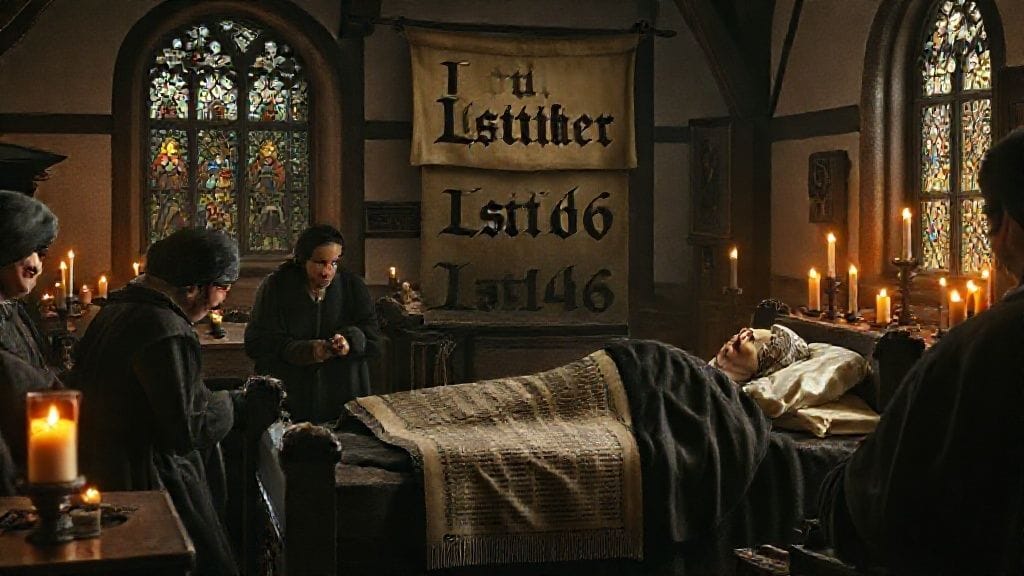
On this bitter winter morning, Martin Luther’s final breath was drawn within the austere walls of his family’s home in Eisleben. Witnesses recorded that Luther faced death with the unwavering faith he had espoused throughout his life. His last words were reportedly a prayer for God’s grace and the unity of the Christian church—a poignant echo of the man’s lifelong mission.
The intimate details of his passing tell a story of quiet dignity and spiritual conviction, a moment suspended between the mortal and the divine.
Quiet Farewells and Last Testaments in a Town Steeped in History
In the immediate aftermath, family, disciples, and townsfolk gathered to mourn. Luther had requested a simple funeral, yet the event quickly became a major occurrence drawing dignitaries and signaled the end of an epoch. Letters and messages poured in from across Europe, reflecting the magnitude of the loss felt far beyond the small Saxon town.
His final testament, carefully prepared, reiterated his theological stances and hopes for the continuation of reformation ideals—words that would become scripts for generations.
The Death of Martin Luther: A Turning Point for the Reformation
Luther's death left a theological and leadership vacuum. His role as the irreplaceable figurehead meant the Reformation had to evolve into something less personal, more institutionalized, and broader in scope. The movement, initially very much centered on Luther’s charisma and intellectual leadership, now faced the challenge of forging a collective identity.
The ensuing years saw the rise of new leaders but also internecine conflicts—doctrinal disputes and political maneuvering that complicated the unity Luther had dreamed of.
The Political Shockwaves Across the Holy Roman Empire
Emperor Charles V and Catholic powers viewed Luther’s death as both a threat and an opportunity. The religious landscape was increasingly polarized—while some hoped to roll back reformist gains, others recognized that Luther’s ideals had catalyzed irreversible change.
The Schmalkaldic League, Protestant territories aligned against the Emperor, found themselves navigating an altered terrain without their most potent symbol. The ensuing decades would witness conflict, negotiation, and rearrangement that shaped Europe’s political and religious trajectory for centuries.
Sorrow and Reverence: Public Mourning and the Luther Family
Contemporaries described the public funerals as charged with emotion, a mix of lamentation and celebration. Luther’s widow, Katharina von Bora, herself a formidable figure in the movement, ensured the preservation of his legacy through careful stewardship of his estate and writings.
The town of Eisleben transformed into a site of pilgrimage, where people came to honor the man who had altered the course of history.
Theological Ramifications: Who Would Lead the Movement?
Without Luther, reformers like Philipp Melanchthon, Johannes Bugenhagen, and others stepped forward. Melanchthon in particular, known as the "Teacher of Germany," sought to temper some of Luther’s more radical pronouncements, advocating for cohesion and theological clarity.
Yet, Luther’s death fomented debates over doctrine that underscored fractures within Protestantism—from Lutheranism to emerging Calvinist and Anabaptist doctrines. These schisms would color the religious landscape for centuries onward.
The Legacy Preserved: Luther’s Writings and Shattered Institutions
Luther’s vast corpus of writings—sermons, treatises, biblical translations—became foundational texts that underpinned Protestant theology and praxis. His German Bible translation made Scriptures accessible to millions and fostered a cultural and linguistic unification in the German-speaking lands.
Simultaneously, institutions like the Catholic Counter-Reformation rose in response, signaling an era of confessional rivalry that would entangle Europe in religious wars and transformations.
Eisleben’s Memory: The Place That Witnessed a Giant’s End
Eisleben remains indelibly marked by Luther’s death. The house where he was born and where he died is today a museum, a physical space connecting modern visitors to the palpable drama of the 16th century.
The commemorations held over centuries reinforce how death, place, and memory intertwine to shape historical consciousness.
Long-Term Impacts: The Reformation’s Transformation After Luther
Luther's passing did not signal the end but rather a new phase of the Reformation. His ideas inspired rebellions, theological trailblazing, and societal reforms—education expanded, literacy increased, and questions of individual conscience took root.
Europe would be forever altered by this ripple effect, influencing the Enlightenment, modern democracy, and notions of religious freedom.
The Shadow of Luther on Modern Christianity and European Identity
Today, Luther is revered not just as a religious figure but as an architect of Western modernity. His insistence on personal faith and scriptural access echo through contemporary debates on society, politics, and human rights.
In Germany and beyond, Luther’s image adorns churches, statues, and literature, emblematic of a struggle for spiritual authenticity and moral courage.
Remembrance and Reverence: How History Has Honored Luther’s Departure
Centuries have passed, but on every anniversary of his death, ceremonies rekindle his memory. The Lutheran Church celebrates his contributions annually, while ecumenical dialogues often recall his quest for Christian unity that remained unfulfilled in his lifetime.
His death in Eisleben remains one of those moments when personal fate and historical destiny collide, still resonant and instructive.
Reflections on Mortality and Faith: The Human Side of the Martyr of Wittenberg
Beyond theological debates, Luther’s final days reveal a man grappling with human frailty and spiritual hope. His words, full of humility and resolve, invite reflection on the universal experience of mortality intersecting with ideals.
The personal dimension of his death nurtures empathy, reminding us that history’s giants are flesh and blood, bound by time's imperatives.
From Eisleben to Eternity: Luther’s Death as a Historical Symbol
Luther’s passing remains a profound symbol of transformation—the end of an era characterized by unquestioned authority and the dawn of individual conscience. Eisleben, modest and quiet, holds a universal story of an idea’s power to challenge, endure, and ultimately transcend the mortal coil of its progenitor.
Cultural Echoes: Art, Music, and Literature Inspired by Luther’s Final Days
From paintings depicting his deathbed scenes to musical compositions evoking the turbulence of 16th-century Germany, Luther’s final moments have inspired countless artists. These works provide a lens into how society processes grief, legacy, and change.
The narrative of Luther’s death permeates cultural memory, anchoring complex histories in accessible, emotive forms.
Conclusion
The death of Martin Luther in Eisleben on February 18, 1546, marked far more than the end of a life—it signaled a profound turning point in European history. As the cold winter closed around the small town, the world felt the tremors of a tectonic shift in faith, politics, and culture.
Luther’s final moments encapsulate the tension between frailty and ferocity, human limitation and enduring influence. In reflecting on his passing, we confront the intimate realities behind epochal change, recognizing that history is, at its core, the story of people—fallible, passionate, immortalized by their ideas.
As we remember Luther in Eisleben, we are reminded that every great movement is built upon the courage and convictions of individuals, whose endings give birth to new beginnings.
FAQs
1. What caused Martin Luther’s death in 1546?
Martin Luther succumbed to a combination of chronic health problems including severe heart and respiratory issues. Contemporary reports suggest congestive heart failure possibly compounded by pneumonia or a stroke. His deteriorating health was evident during his last trip to Eisleben, where he ultimately died.
2. Why was Martin Luther in Eisleben at the time of his death?
Luther had been summoned to mediate a territorial dispute between the Counts of Mansfeld. The journey was also personally significant as Eisleben was his birthplace, making it a poignant location for his final days.
3. How did Luther’s death impact the Protestant Reformation immediately?
His death left a leadership void that was difficult to fill because Luther had embodied the movement’s core force and theology. The Reformation soon experienced internal divisions and had to transition from being centered on a single leader to a broader institutional structure.
4. How was Luther’s death received by the Catholic Church and the Holy Roman Empire?
For the Catholic Church and Emperor Charles V, Luther’s death was seen both as an opportunity to curb Protestant influence and a challenge due to the extensive reforms that had become entrenched. The religious conflict and political tensions only intensified in subsequent decades.
5. What role did Luther’s family and followers play after his death?
His wife, Katharina von Bora, preserved his legacy by safeguarding his writings and estate. Followers like Philipp Melanchthon continued advocating Luther’s theological principles while trying to maintain unity within the reform movement.
6. How is the place of Luther’s death remembered today?
Eisleben honors Luther’s memory with museums at the house where he was born and died. It remains a pilgrimage site for Lutherans and historians alike, symbolizing the birthplace and terminus of a movement that reshaped history.
7. Did Luther’s death influence religious wars in Europe?
Yes, the power vacuum and theological disputes following his death contributed to escalating conflicts, including the Schmalkaldic Wars and later the Thirty Years’ War, which profoundly affected Europe’s political and religious landscape.
8. How does Luther’s death resonate in modern times?
Luther’s death invites reflection on the complex interplay of faith, leadership, and change. His legacy continues to shape religious thought, cultural identity, and debates on conscience and reform around the world.