Table of Contents
- The Last Dawn of a Fallen Monarch
- Scotland’s Tumultuous Crown: A Prelude to Tragedy
- Mary’s Flight to England: Seeking Sanctuary or Doom?
- The Web of Intrigue: Catholic Plots and Protestant Power
- Elizabeth I: The Reluctant Executioner
- The Tower of London: Imprisonment and Political Chess
- Fotheringhay Castle: The Stage Is Set for Judgment
- The Trial That Shook a Kingdom
- February 8, 1587: The Final Act
- A Queen’s Last Moments: Courage and Condemnation
- The Immediate Shockwaves Across Britain and Beyond
- The Fall of a Catholic Hope: Religious Reverberations
- Political Ripples: England, Scotland, and Continental Powers
- Mary’s Legacy in Memory and Myth
- The Execution’s Shadow Over Elizabeth’s Reign
- Cultural Reflections: From Ballads to Shakespearean Drama
- Modern Reassessments: Historical Debates and Interpretations
- Conclusion: The End of a Queen, the Birth of a Legend
- FAQs: Untangling the Threads of Mary’s Tragic Fate
- External Resource
- Internal Link
1. The Last Dawn of a Fallen Monarch
The cold February morning of 1587 in Fotheringhay, England, was heavy with a grim finality. Outside the stone walls of Fotheringhay Castle, the world remained indifferent to the quiet footsteps echoing in the corridors within—footsteps of a queen whose fate had long been sealed. Mary, Queen of Scots, once a powerful monarch reigning over her homeland and a symbol of Catholic hope against Protestant England, prepared to face the ultimate judgment: death by execution.
She was no longer the vibrant, regal figure who had flashed her youthful ambitions across the courts of Europe. Instead, she was a prisoner, a woman burdened by decades of political misfortune, religious conflict, and personal tragedy. Yet, in her final hours, Mary’s dignity never faltered, her spirit refusing to bow even as her life slipped away. The executioner’s axe would fall, but the story of Mary Stuart was far from over—it was the beginning of a legend that would echo through history.
2. Scotland’s Tumultuous Crown: A Prelude to Tragedy
Mary Stuart's life was entwined with the violent, unrelenting strife of 16th-century Scotland. Born in 1542, she ascended to the throne as an infant after the death of her father, King James V. Her early rule was shaped by regents and dynastic rivalries, but her eventual return from France in 1561 to reclaim her kingdom would sow the seeds of her downfall.
The religious landscape was shifting violently; Scotland was torn between Catholic tradition and the rising Protestant Reformation. Mary, a Catholic queen in a predominantly Protestant country, faced opposition not only from the nobility but increasingly from the theological currents reshaping her realm. Her marriage to Henry Stuart, Lord Darnley, further complicated matters — a union marked by vanity, jealousy, and enmity that culminated in Darnley's mysterious, brutal death.
Her tumultuous reign was marred by scandal, rebellion, and betrayal. The murder of her second husband, the Earl of Bothwell, and her sudden abdication in favor of her infant son, James VI, forced her into exile, desperate for protection and an ally.
3. Mary’s Flight to England: Seeking Sanctuary or Doom?
By 1568, Mary crossed the Scottish border into England, expecting refuge from her cousin, Queen Elizabeth I. What Mary did not foresee was that this sanctuary would become a gilded cage.
Elizabeth, herself under constant threat from Catholic factions and European powers, faced a dilemma. To support Mary risked igniting religious civil war; to imprison her risked alienating Catholic supporters abroad. Thus began Mary’s 19-year captivity, during which her royal dignity was maintained but her freedom brutally restrained.
Mary’s presence in England transformed her into a living symbol of Catholic resistance and a legitimate claimant to the English throne. This made her a dangerous pawn, attracting conspiracies, plots—and suspicion.
4. The Web of Intrigue: Catholic Plots and Protestant Power
The years of Mary’s imprisonment were marked by a storm of conspiracies. Catholic nobles and foreign powers, determined to overthrow Elizabeth and restore Catholicism in England, saw Mary as their beacon.
Among the most infamous was the Babington Plot (1586), a plan to assassinate Elizabeth and place Mary upon the throne. Secret letters passed between Mary and her supporters were intercepted by Elizabeth’s spymaster, Sir Francis Walsingham, unveiling a treasonous network.
Each new plot deepened Elizabeth’s mistrust and hardened her resolve. Yet every accusation came with a price—the political and personal tensions surrounding Mary’s fate intensified, casting a long shadow over the English court.
5. Elizabeth I: The Reluctant Executioner
Elizabeth I, the formidable Virgin Queen, bore the weight of an empire and the constant threat of internal and external upheaval. Deciding Mary’s fate was a tormenting dilemma. To execute a fellow sovereign was unprecedented and could alienate powerful allies.
But the evidence from the Babington Plot forced Elizabeth’s hand. The queen’s hesitation tugged between mercy and political necessity. She wavered, hoping to avoid bloodshed, yet aware that sparing Mary endangered her own crown.
Ultimately, Elizabeth authorized the sentence, signaling a grim determination to secure her reign and the Protestant establishment.
6. The Tower of London: Imprisonment and Political Chess
Mary’s years in the Tower of London were a bleak purgatory. Here, she faced not only physical confinement but psychological warfare. The corridors echoed with whispered interrogations, visits from her jailers, and the cold scrutiny of court officials.
Mary maintained correspondence with supporters, refusing to yield her claims. Her strength of spirit in captivity was notable; she decorously dressed for audiences, composed letters with imperial poise, and confronted interrogators with dignified defiance.
The Tower was both prison and theater—a place where Mary’s political relevance dimmed yet simmered beneath the surface.
7. Fotheringhay Castle: The Stage Is Set for Judgment
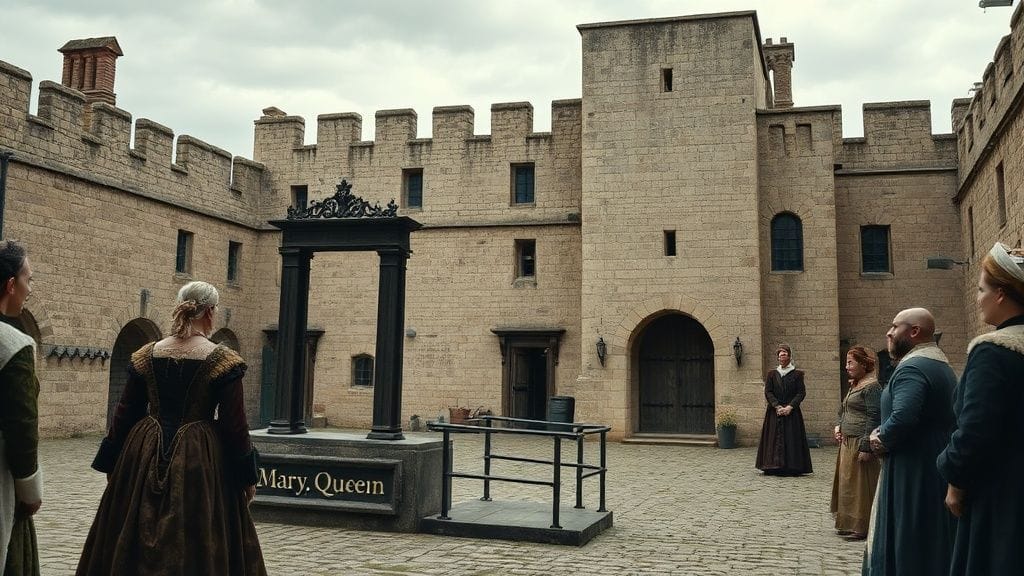
For the final chapter, Mary was transferred to Fotheringhay Castle in Northamptonshire, a narrower, more isolated fortress that underscored the solemnity of her impending execution.
The castle’s austere halls became the backdrop for the last days of a queen whose life had pivoted between royal splendor and tragic downfall. Guards watched her constantly, while an uneasy curiosity from locals and nobles gathered around—their world about to witness a historic yet harrowing spectacle.
8. The Trial That Shook a Kingdom
Mary's trial in 1586 was a meticulously orchestrated event, a legal spectacle with profound political stakes. Charges of treason were brought against her, based primarily on her alleged complicity in plots against Elizabeth.
Despite the overwhelming pressure, Mary defended herself with remarkable eloquence, claiming she was a victim of political machinations and religious persecution. She insisted on her status as a sovereign and condemned the notion of being tried by a rival queen.
Yet the trial was less about justice and more about political expediency—a foregone conclusion in a world where power often trumped fairness.
9. February 8, 1587: The Final Act
The cold morning of February 8th arrived, and with it the end of Mary’s long ordeal. Clad in black velvet and a crimson petticoat symbolizing her royal blood and Catholic faith, Mary stepped resolutely onto the scaffold.
Witnesses described her bearing as calm and composed—a queen until the last breath. She delivered a final speech affirming her innocence and her faith, beseeching God’s forgiveness for all.
The executioner’s strike was swift, but even in death, Mary’s story continued to resonate, her head severed yet her legacy immortalized. The brutal event was more than a political necessity—it was an event etched in pathos, faith, and eternal conflict.
10. A Queen’s Last Moments: Courage and Condemnation
Contemporary accounts and later repeated narratives portrayed Mary’s final moments with dramatic intensity. Some spoke of her serene acceptance, others of a tragic vulnerability—reminders of the human heart beating beneath regal veneer.
Her attendants described how, after the fall of the axe, silence filled the courtyard before a sob broke it. Her death was not just execution, but a poignant spectacle—a woman steadfast amid chaos, whose life had become a symbol of both political martyrdom and religious struggle.
11. The Immediate Shockwaves Across Britain and Beyond
News of Mary’s execution rippled swiftly across Europe. Catholic monarchs mourned the loss of a rightful Catholic sovereign, condemning Elizabeth’s harsh resolve.
In England, responses were mixed; some hailed it as a necessity for national security, others felt unease at the execution of a queen, a deed itself controversial and unsettling.
The event hardened divisions, signaling a point of no return in the religious and dynastic struggles that defined late-16th-century Britain.
12. The Fall of a Catholic Hope: Religious Reverberations
Mary’s death marked a decisive blow to the Catholic cause in England and Scotland. For English Protestants, it was a grim affirmation of their nation’s religious identity and political independence.
On the continent, her martyrdom inspired Catholics to rally, fueling counter-reformation zeal. Jesuit missionaries and Catholic propagandists promoted Mary as a saint-like figure, deepening her mythos.
The execution became a symbol in the wider European conflicts between Protestantism and Catholicism, reverberating far beyond the British Isles.
13. Political Ripples: England, Scotland, and Continental Powers
Politically, Elizabeth’s decision to execute Mary changed the landscape dramatically. The removal of a rival claimant diminished direct threats to her throne but intensified hostilities with Spain, contributing to the worsening tensions that would lead to the Spanish Armada’s attempted invasion in 1588.
In Scotland, Mary's son, James VI, inherited a complicated legacy, both burdened and bolstered by his mother’s fate—a future king whose diplomacy would eventually unite the crowns of Scotland and England.
14. Mary’s Legacy in Memory and Myth
Mary, Queen of Scots, transcended her historical role to become a figure of fascination and empathy. Stories of her beauty, intelligence, and misfortune intertwined with the tragic poetry of her life.
Her image oscillated between victim and villain, saint and sinner—a symbol invoked in political, religious, and cultural narratives for centuries.
In her, countless authors and artists found inspiration for exploring themes of power, gender, faith, and betrayal.
15. The Execution’s Shadow Over Elizabeth’s Reign
Though victorious, Elizabeth’s reign faced new challenges after Mary’s death. The queen had avoided the danger Mary represented, yet the act left an indelible mark on her legacy.
Elizabeth’s governance shifted toward a more cautious and pragmatic approach, balancing sovereignty with emerging political realities. The execution exposed the harsh measures rulers sometimes took to preserve stability, reflecting the brutal realities of monarchy and survival.
16. Cultural Reflections: From Ballads to Shakespearean Drama
Mary’s tragedy permeated culture deeply. Ballads and songs mourned her fate; plays dramatized her life and death. William Shakespeare’s "Mary Stuart," though written centuries later, reflects the enduring fascination with her story.
Artists depicted her with a mix of reverence and pathos, immortalizing the queen’s story in portraits, literature, and theater, making Mary a timeless archetype of noble tragedy.
17. Modern Reassessments: Historical Debates and Interpretations
Historians continue to debate Mary’s responsibility and victimhood. Was she a naïve player in a perilous political game or a determined sovereign betrayed by circumstance?
Recent scholarship often frames her as a complex figure caught in the violent religious and dynastic struggles of her age—a woman whose fate reveals the ruthless intersections of gender, power, and faith.
18. Conclusion: The End of a Queen, the Birth of a Legend
Mary, Queen of Scots, did not simply die on February 8, 1587. She stepped from history into myth, from monarchy into legend. Her life and death remain testimonies of ambition, faith, tragedy, and resilience.
Her execution closed a tragic chapter but opened a narrative that has pierced through centuries, inviting us to ponder the costs of power, the frailty of human dreams, and the eternal struggle between conscience and duty.
Conclusion
The execution of Mary, Queen of Scots, was a moment steeped in symbolism and profound consequence. It marked the violent intersection of personal tragedy and immense geopolitical transformation—a royal life sacrificed amid religious upheaval and dynastic rivalry. Yet, this brutal act did not extinguish Mary’s influence; it fueled a legend that has survived monarchies, revolutions, and centuries of reinterpretation.
Mary’s story challenges us to see beyond the surface of history’s grand events and into the intimate heart of human experience—the hopes, fears, and defiance of a queen who, even in death, commanded the world’s attention.
FAQs
Q1: Why was Mary, Queen of Scots, executed?
Mary was executed primarily due to her involvement in plots to overthrow Elizabeth I and restore Catholicism in England. The Babington Plot brought clear evidence against her, making her a political liability.
Q2: What was the relationship between Mary and Elizabeth I like?
Their relationship was fraught with rivalry, suspicion, and political tension. Though cousins, Elizabeth viewed Mary’s claim to the English throne as a threat, balancing hesitation with eventual condemnation.
Q3: How did Mary’s execution affect England’s politics?
It consolidated Elizabeth’s rule but escalated tensions with Catholic powers like Spain, contributing to conflicts such as the Spanish Armada’s attempted invasion.
Q4: What role did religion play in Mary’s downfall?
Religion was central: Mary’s Catholic faith clashed with Protestant England, making her a focal point for Catholic resistance and a danger to Elizabeth’s rule.
Q5: Was Mary truly guilty of treason?
This remains debated. While letters implicated her in plots, some historians argue she was a victim of political manipulation rather than an active conspirator.
Q6: How has Mary been remembered culturally?
Mary has been portrayed as both martyr and tragic heroine in literature, music, and theater, symbolizing the complex interplay of power, faith, and gender.
Q7: Did Mary’s execution impact Scotland?
Yes, it deeply affected Scottish politics and the young James VI, influencing his future policies and the eventual union of the Scottish and English crowns.
Q8: Where can I learn more about Mary, Queen of Scots?
The story of Mary Stuart is detailed in many historical works and remains accessible online, including comprehensive entries on platforms like Wikipedia.

