Table of Contents
- The Grim Dawn of October 782: A Massacre Unfolds
- The Saxon Wars: Prelude to a Bloody Confrontation
- Charlemagne’s Vision: Conquest and Conversion
- The Saxon Resistance: A Defiant People
- The Betrayal and Capture of the Saxons
- The Execution of 4,500 Saxon Prisoners: Unfolding the Massacre
- Historical Accounts and Controversies: Einhard and the Royal Frankish Annals
- Political Motivations Behind the Massacre
- Religious Zeal and Forced Christianization: A Clash of Faiths
- The Aftermath for the Saxons: Trauma and Subjugation
- The Impact on Charlemagne’s Reign and the Frankish Empire
- Memory and Myth: How the Massacre Was Remembered
- Contemporary Reactions and Later Historical Judgments
- The Massacre’s Legacy in German and European History
- Lessons from Verden: Violence and Power in Medieval Europe
1. The Grim Dawn of October 782: A Massacre Unfolds
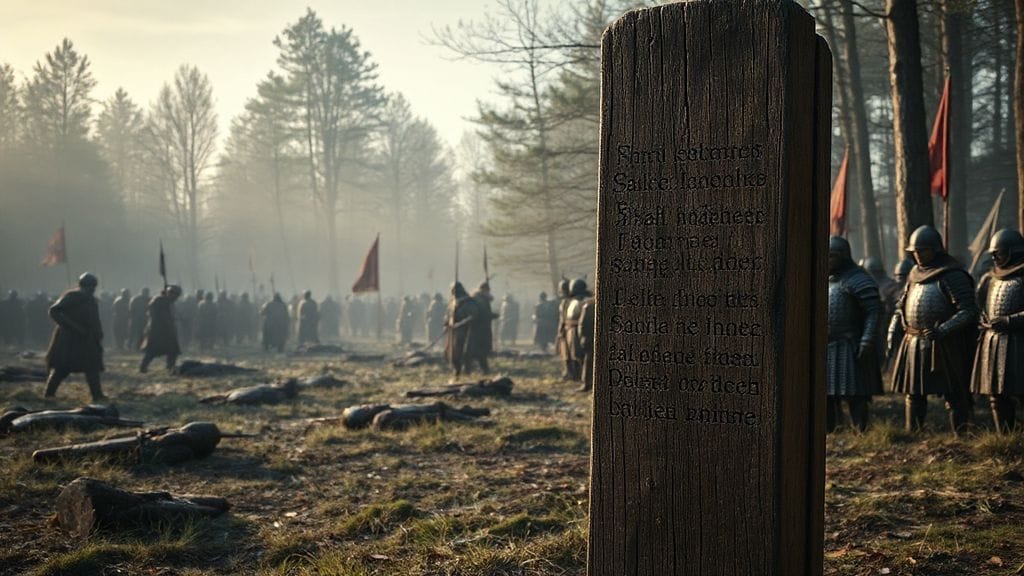
The skies over the River Weser that October morning were cold and gray, casting a pall over the settlement of Verden. On the mist-laden fields beyond the palisade, thousands of figures stood—bound, weary, and silent. Their faces, worn by months of warfare and desperation, betrayed a haunting resignation. A chilling order was about to be carried out—a state act that would resonate through centuries as both a symbol of brutal conquest and a testament to the merciless logic of early medieval power.
Somewhere amidst the ranks of Frankish soldiers, the weight of authority pressed heavily on commanders awaiting Charlemagne’s infamous decree. Around them, the subdued murmur of Saxon prisoners spoke to a story of defeat, betrayal, and unwavering resistance. But in the following hours, 4,500 Saxons would be executed in a single, grim gesture—an event etched forever in the annals of the Saxon Wars, known ever after as the Massacre at Verden.
2. The Saxon Wars: Prelude to a Bloody Confrontation
The 8th century was an era defined by the expansionist ambitions of the Frankish Kingdom under Charlemagne, the grandson of Charles Martel. Between 772 and 804, a series of brutal campaigns known as the Saxon Wars marked one of the longest, most violent attempts at forced conquest in medieval Europe. The target: the fiercely independent Saxons, a Germanic tribal confederation inhabiting the dense, forested lands of northern Germany.
The Saxons were pagans with a deeply entrenched culture intertwined with their ancient gods—Woden, Thor, and others—who were central to their identity. Meanwhile, Charlemagne’s aspirations were twofold: political domination and the imposition of Christianity as a unifying ideology. This collision of cultures and beliefs precipitated a grudging, bloody conflict punctuated by revolts, massacres, and shifting allegiances.
By 782, the war had escalated significantly. The Saxons, refusing to submit, had continuously harassed Frankish supply lines, attacked garrisons, and rallied to their ancestral cause of independence. Against such relentless defiance, Charlemagne’s strategy hardened, culminating in an unforgiving campaign to crush all opposition.
3. Charlemagne’s Vision: Conquest and Conversion
Charlemagne, crowned King of the Franks in 768, was no ordinary monarch; his vision transcended mere territorial gain. He sought to establish a Christian empire that would revive the glory of Rome under his rule—a vision fueled by religious conviction and political pragmatism. The Saxon Wars became the crucible through which he intended to forge this new order.
For Charlemagne, the forced baptism of the Saxons was essential. To convert them was not only to save souls but to bring stability to his expanding realm. Frankish chroniclers often portray Charlemagne as a pious warrior-king, yet the reality on the ground was one of ruthless military expeditions and uncompromising demand for submission.
The Saxons, for their part, viewed the Frankish incursions as existential threats to their gods, culture, and autonomy—a war that was as much spiritual as it was political.
4. The Saxon Resistance: A Defiant People
The Saxons were not a monolithic entity but a composite of several tribes bound by common language, customs, and pagan worship. This alliance gave them resilience, but also a fragmented command structure that complicated efforts to face the Frankish juggernaut.
Saxon leaders like Widukind emerged as symbols of resistance. Widukind’s guerrilla warfare tactics harassed Frankish camps, striking at weak points with ferocity. His ability to rally scattered warriors into a coherent force posed perhaps the gravest threat to Charlemagne’s campaign.
Despite repeated defeats, the Saxons refused to surrender their identity or faith. Their persistence only hardened Frankish resolve, as Charlemagne himself was reportedly enraged by their continuous rebellion, interpreting it as an affront to divine order.
5. The Betrayal and Capture of the Saxons
The events leading directly to the Massacre at Verden hinge on a grim episode of betrayal and forced submission. In the summer of 782, after a series of fierce battles, a large group of Saxons—estimated at 4,500 combatants—were captured near the Weser River.
Some sources suggest that promises of clemency were extended in exchange for immediate surrender and baptism. However, tensions were high, and the Frankish commanders viewed the prisoners with deep suspicion, uncertain whether their capitulation was genuine.
Historians debate whether the Saxons plotted to revolt within Frankish lines, triggering Charlemagne’s infamous decision. Regardless, the captured men found themselves interned in Verden Castle, awaiting their fate.
6. The Execution of 4,500 Saxon Prisoners: Unfolding the Massacre
The execution order from Charlemagne was staggering by any standard—4,500 men sentenced to death in a single operation. According to the Royal Frankish Annals, the prisoners were dispatched with ruthless efficiency, their throats cut on what can only be imagined as a chilly autumn day.
It is difficult to grasp the sheer scale of the massacre: thousands of men, many of them warriors, slaughtered in cold blood. The human cost was immense, stripping the Saxon resistance of thousands of potential fighters and sending a clear signal across the region.
But why such extreme measures? For Charlemagne, arguably, it was a calculated act designed to terrorize the Saxon population into submission and deter further revolt. It was an act of state violence designed to consolidate power through fear.
7. Historical Accounts and Controversies: Einhard and the Royal Frankish Annals
The Massacre of Verden is known primarily through two contemporaneous sources: the Royal Frankish Annals and Einhard’s Vita Karoli Magni. The Royal Frankish Annals describe the event succinctly, noting the executions on Charlemagne’s orders but offer little explicit moral judgment.
Einhard, Charlemagne’s biographer, was more circumspect, emphasizing the king’s piety and military success while glossing over the grim details. This silence has fueled centuries of scholarly debate and controversy about the massacre’s nature and necessity.
Some modern historians argue that the number of executed Saxons was exaggerated or that the event has been rationalized within the context of medieval warfare. Others see it as emblematic of Charlemagne’s brutal methods of empire-building.
8. Political Motivations Behind the Massacre
Beyond the veneer of religious crusade lay cold, pragmatic political calculations. Charlemagne understood that to govern the fractious Saxons, he needed to break their will completely—not only by military might but through psychological domination.
The massacre was intended as a decisive blow to Saxon morale, a deterrent against future uprisings. In medieval Europe, acts of large-scale violence against prisoners were rare but not unheard of; they served as grim affirmations of sovereignty and justice as interpreted by the conquering power.
Moreover, by enforcing Christianization through force, Charlemagne aimed to integrate the Saxon lands into his empire, cutting off pagan cultural roots to ensure long-term stability.
9. Religious Zeal and Forced Christianization: A Clash of Faiths
The massacre cannot be separated from the religious dimension underpinning the Saxon Wars. For Charlemagne and the ecclesiastical establishment, the Saxons’ paganism represented both spiritual error and political defiance. Conversion was a weapon and an ideology.
Baptism was made compulsory under the penalty of death; Saxons who renounced Christianity risked execution or exile. Missionaries accompanied Frankish armies, their crosses symbols brandished alongside iron swords.
Yet, the Saxons’ pagan faith was deeply woven into social and legal traditions. Forced conversion triggered further rebellions, highlighting the limitations of violence in achieving spiritual change. Still, the Frankish ruler’s unyielding attitude reflects the inseparability of faith and power in the early Middle Ages.
10. The Aftermath for the Saxons: Trauma and Subjugation
The massacre at Verden left an indelible scar on Saxon society. The loss of thousands of warriors not only weakened military resistance but fractured families and communities. Survivors lived under harsh Frankish rule, facing enforced religious practices, tribute, and loss of autonomy.
Over time, the Saxons were gradually integrated into the Carolingian system. Christian churches sprang up, Frankish law replaced customary codes, and Saxon nobility was either co-opted or displaced.
Yet, memory of the massacre lingered, sustained by oral histories and regional identity. The trauma was not only military but existential—a violent rupture in the story of an entire people.
11. The Impact on Charlemagne’s Reign and the Frankish Empire
While the massacre was brutal, it played a pivotal role in securing Charlemagne’s hold over Saxony and expanding his empire’s borders. Saxony became a cornerstone of his realm, its conquest paving the way for further campaigns into Central and Eastern Europe.
Charlemagne, later crowned Emperor of the Romans in 800, used the Saxon Wars to legitimize his authority as defender of Christendom. His image as a warrior king was inseparable from his role as conqueror and Christianizer.
However, the violence also cast shadows over his legacy, raising moral questions about the cost of empire-building and the use of terror as policy.
12. Memory and Myth: How the Massacre Was Remembered
In the centuries following the massacre, Verden became a symbol of both Frankish supremacy and Saxon martyrdom. Medieval chroniclers often omitted or downplayed the event, while German nationalists in later eras reinterpreted it within the rhetoric of resistance and victimhood.
The site itself, in modern-day Lower Saxony, became a place of reflection—sometimes commemoration, sometimes condemnation. Over time, the massacre entered folklore, intertwining fact and legend.
Such memory conflicts reveal the complexities of historical narrative in shaping cultural identity and collective memory.
13. Contemporary Reactions and Later Historical Judgments
In Charlemagne’s time, mass executions were not uncommon as punitive measures in warfare, but even then, the spectacle at Verden provoked unease among some contemporaries. The Church, though aligned with Frankish objectives, sometimes questioned the morality of such extreme measures.
Historians through the ages have debated whether the massacre was a necessary evil or an atrocity. Enlightenment and modern historians have tended to view it through the lens of human rights, labeling it a massacre unequivocally.
The event challenges us to consider the tension between state security and ethical constraints in conduct of war—not an easy balance to achieve then, nor now.
14. The Massacre’s Legacy in German and European History
The massacre at Verden stands as one of the darkest chapters in early medieval European history. It marks a moment when political ambition, religious fervor, and military brutality collided with devastating human cost.
This event illustrates the complex process of European state formation, where violence often accompanied cultural and religious transformation. It also resonates as a cautionary tale about the dangers of coercive conversion and mass violence.
In Germany, it informs the narrative of Saxon identity and resistance, while in wider European history, it underscores the ethical dilemmas at the birth of Christendom’s greatest empire.
15. Lessons from Verden: Violence and Power in Medieval Europe
The Massacre at Verden compels us to reflect on the exercise of power in history. Charlemagne’s act was born from a context of warfare, cultural clashes, and religious imperatives—but at its heart lies a human tragedy of monumental scale.
It forces a confrontation with uncomfortable truths about state violence and the often-brutal roots of political authority. Yet, it also reveals the complexities and contradictions inherent in historical actors driven by duty, belief, and ambition.
From Verden, historians and readers alike learn that history is never simply a tale of heroes or villains—it is a complex weave of choices, consequences, and the human cost of empire-building.
Conclusion
The chilling silence that fell over Verden on that autumn day in 782 resonates through history as a powerful reminder of the human cost embedded in the grand narratives of conquest and civilization. Charlemagne’s orders, carried out without mercy, reshaped the Saxon lands and their people, ushering an era marked by profound cultural and religious transformation at a terrible price.
Yet, beyond the stark figures and political strategies, the massacre is a story about identity, resistance, and the tragic consequences when the forces of faith and power collide. It challenges us to consider how history remembers violence—not merely as distant events but as defining moments that shape collective memory and human experience.
The legacy of the Massacre at Verden is not only one of loss but of lessons—reminding us that the pursuit of unity and order sometimes demands a reckoning with the darkest facets of human nature and governance.
FAQs
Q1: What triggered the Massacre at Verden during the Saxon Wars?
The massacre was largely a response to continued Saxon resistance against Frankish rule, and the capture of approximately 4,500 Saxon warriors led Charlemagne to order their execution as a deterrent and assertion of dominance.
Q2: Who were the key figures in the Saxon Wars and the massacre?
Charlemagne, the Frankish king, was the principal figure ordering the massacre. On the Saxon side, leaders like Widukind led resistance, though the massacre targeted a broad group of captured warriors rather than specific individuals.
Q3: How did religion influence the massacre?
The forced Christianization of the pagan Saxons was central to the conflict; Charlemagne combined military conquest with religious conversion, viewing pagan resistance as both political rebellion and heresy.
Q4: What sources provide information about the Massacre at Verden?
The Royal Frankish Annals and Einhard’s biography of Charlemagne are primary contemporaneous sources that mention the massacre, though both exhibit biases and leave room for debate.
Q5: What were the consequences for the Saxon people after the massacre?
The event significantly weakened Saxon military power and morale, leading to gradual subjugation, forced Christianization, cultural assimilation, and loss of autonomy under Frankish rule.
Q6: How is the massacre remembered in modern history?
It is remembered both as a brutal episode of medieval warfare and a symbol of resistance among Germans. Historians debate its morality, and it remains a point of reflection on the costs of empire-building.
Q7: Did Charlemagne’s empire benefit from the massacre?
Politically and militarily, yes; the massacre helped consolidate Frankish control over Saxony, securing a strategic region of Charlemagne’s expanding empire.
Q8: What lessons does the Massacre at Verden offer contemporary readers?
It teaches about the complexities of power, the brutal realities of historical conflicts, the interplay of faith and politics, and the enduring consequences of state violence on societies.

