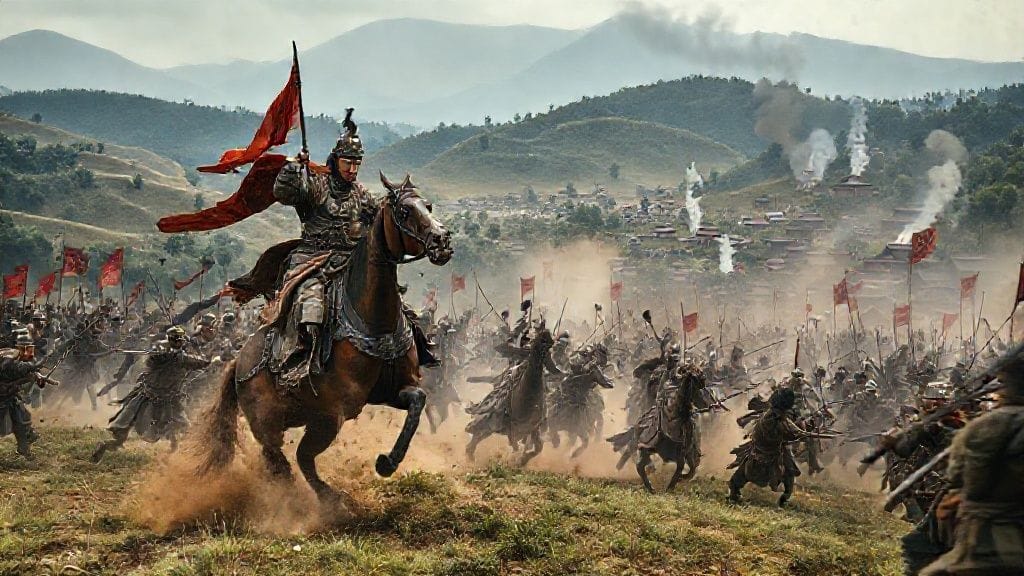
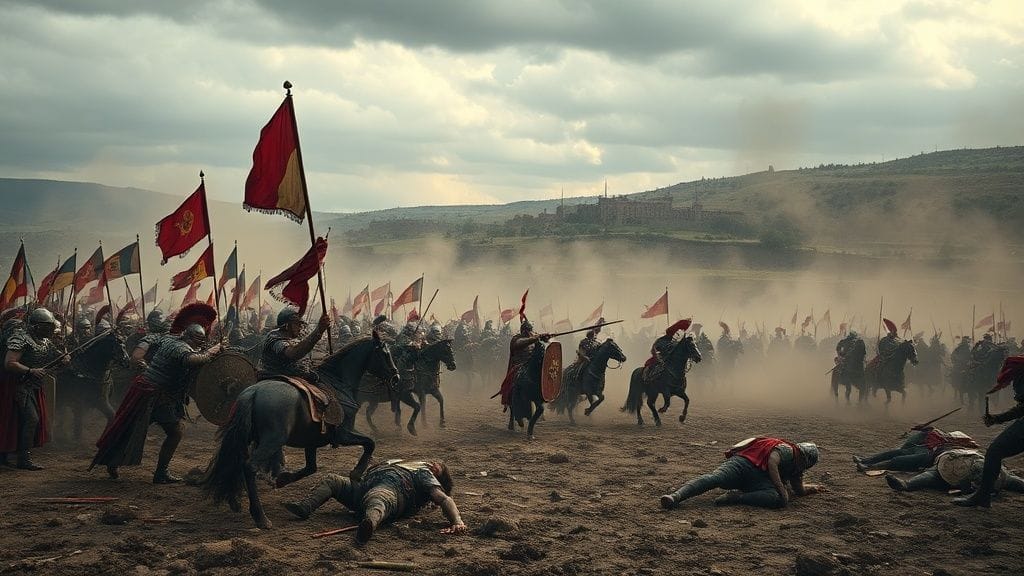
Table of Contents
- An Empire on the Edge of the Desert
- The Berber World Before Rome’s Thunder
- Maximian, Soldier-Emperor of the Tetrarchy
- Mauretania at the Turn of the Fourth Century
- Storm Clouds over Africa: Why the Campaign Began
- Musters, Oaths, and War Councils: Preparing the Legions
- Crossing into Mauretania: The First March of the Army
- Fire in the Hills: Berber Resistance and Guerrilla War
- Fortresses, Roads, and Trade: The Strategic Heart of the Campaign
- Voices from the Frontier: Soldiers, Settlers, and Captives
- Victory Declarations and Triumphal Images
- After the Battles: Reorganization of Mauretania
- Religion, Identity, and Memory in a War-Torn Province
- Echoes Across the Centuries: Historians and the Campaign
- From Desert Raids to Imperial Policy: Long-Term Consequences
- Conclusion
- FAQs
- External Resource
- Internal Link
Article Summary: In the late third century, the Roman Empire turned its gaze toward the rugged lands of Mauretania, where Berber tribes challenged imperial authority along the empire’s southern flank. This article reconstructs the maximian campaign against berbers in 297, weaving together political decisions in distant palaces with the dust and blood of the North African frontier. It explores the world of the Berber communities, their autonomy, and their complex relationships with Rome long before the first Roman standards appeared on the horizon. From Maximian’s rise as a hard-bitten soldier-emperor within Diocletian’s Tetrarchy to his meticulously organized offensive, the story unfolds as a tense dialogue between empire and desert. We follow the legions as they march through Mauretania, facing ambushes, hunger, and the elusive enemies who knew every ravine and pass. Beyond battles, the narrative examines how the campaign reshaped local societies, fortified cities, trade routes, and religious landscapes. In doing so, it shows how the maximian campaign against berbers became a turning point in Rome’s African strategy, leaving echoes that reverberated in later revolts and in the eventual fall of Roman North Africa. Ultimately, the article asks what it meant—for emperors, soldiers, and Berber chiefs alike—when an empire of stone roads and laws collided with a world of mobility, kinship, and memory.
An Empire on the Edge of the Desert
The year was 297. Somewhere between the salt-scented coastal winds of North Africa and the hot breath of the Sahara, Roman scouts rode ahead of a column of dust and iron. At their back lay the immense machinery of the Roman state; before them, the broken ridges and sun-scorched highlands of Mauretania, homeland of peoples that Roman writers would call simply “Berbers.” The maximian campaign against berbers did not begin with a trumpet blast alone—it began with anxiety, calculation, and the sense that the empire itself was standing on an ever-narrowing strip of solid ground.
Rome in the late third century was an empire recently pulled back from the brink. Civil wars, invasions, and economic collapse had gnawed at its frontiers and shaken the faith of its subjects. Though the Mediterranean still gleamed at its center, the “Mare Nostrum” no longer felt safely encircled by unshakable Roman power. The borders throbbed with pressure—from Goths along the Danube, Persians in the East, and innumerable tribal confederations along the Rhine, Danube, and the deserts of Africa.
On paper, Africa remained one of Rome’s most secure and lucrative provinces. Its granaries filled the bellies of Rome and Carthage; its cities boasted basilicas, baths, and forums; its aristocrats sent their sons to the imperial bureaucracy or the clergy. Yet the Roman hold on Africa had always been lopsided: strong in the cities and rich coastal plains, far thinner in the deep interior and mountain chains. In the wilds of Mauretania—territory stretching roughly across parts of modern Algeria and Morocco—Roman power was more a net of posts and alliances than a solid wall.
It was into this fragile balance that Maximian stepped, a man whose instincts were sharpened not in libraries but in camps. When unrest and raids along the fringes of Mauretania threatened the delicate line between empire and hinterland, the decision was made: the maximian campaign against berbers would drive Roman authority deeper, strike Berber chieftains who defied imperial rule, and rebalance the frontier in Rome’s favor. Or so it was hoped.
Yet behind the proclamations of strength, there was vulnerability. The Tetrarchic system—four emperors ruling together—sought to answer an uncomfortable question: could a single man really govern a world-spanning state under siege from all sides? The African frontier was only one front among many. But in the calculus of the Tetrarchy, no frontier could be allowed to slip, for the fall of a single province might inspire others to test Rome’s resolve.
And so, on the fringe of the Sahara, the drama of empire unfolded: an emperor leaving the marbles of Italy to ride through dust and scrub, confronting tribes whose names barely appeared in official records, but whose arrows and spears could undo the fragile peace of an entire region.
The Berber World Before Rome’s Thunder
To understand the maximian campaign against berbers, one must first stand in the shoes—often sandaled, sometimes bare—of those whom the Romans called Mauri or “barbari.” Long before Roman legions had marched along the African coast, Berber-speaking peoples lived in scattered villages, fortified hilltop settlements, and mobile clans across the landscapes of Mauretania. Their world stretched from the Atlantic coastline to the foothills of the Atlas Mountains, from the Mediterranean littoral down into the desert oases that shimmered under a brutal sun.
They were no homogeneous mass. Some groups cultivated terraced fields, coaxing grain and olives from rocky soil. Others controlled herds of goats, sheep, and camels, following seasonal pastures. Lineage, clan ties, and the authority of chiefs bound communities together, often more powerfully than any distant king or emperor. Local shrines to ancient deities—sometimes later cloaked in Roman names—stood on hilltops and near springs, and the dead were buried in tumuli or rock-cut tombs that dotted the landscape like scattered memories.
By the late third century, two and a half centuries after Roman conquest of coastal North Africa, many Berber groups had long experience in dealing with empire. Some entered Roman service as auxiliaries, providing skilled horsemen that Roman generals prized for their speed and desert-hardiness. Others traded with coastal cities, bringing hides, animals, salt, and even slaves. In these markets, a Berber chief might run his hands across Roman fabrics or inspect imported wine, negotiating through translators or bilingual intermediaries.
But other communities had little use for Roman laws or markets. For them, Rome was a distant rumor, a source of occasional gifts or threats. The empire’s very presence could disrupt patterns of movement, block access to water or routes, and upset the delicate politics between tribes. Raiding—whether for cattle, goods, or captives—was not mere banditry but part of a long-standing system of prestige and survival. When such raids struck Roman estates or small frontier towns, imperial officials labeled them “rebellion” or “terror,” words that flattened the complex motivations behind them.
Roman authors, men like the historian Cassius Dio in earlier times or writers known only from later quotations, tended to paint these communities in strokes of fear or contempt. They described “Moorish” horsemen vanishing into the hills, “barbarian” tribes who slipped from one allegiance to another. Yet, as modern historians such as Yves Modéran have argued, beneath this rhetoric lay webs of negotiation and coexistence. Some chiefs accepted Roman titles and stipends, becoming “friends of the empire,” while others refused any form of submission except on their own terms.
In the late third century, pressures were mounting. Climate fluctuations, local rivalries, and shifting trade patterns could all heighten tension. When grain prices fluctuated or taxes rose, when imperial officials squeezed provincial elites, the cracks widened further. For Berber groups close to the frontier, Rome was both opportunity and threat. A miscalculation—too bold a raid, too visible a coalition—could invite a response of terrifying scale. That is precisely what would happen when imperial attention, embodied in the person of Maximian, turned south and west.
Maximian, Soldier-Emperor of the Tetrarchy
Maximian, born Marcus Aurelius Valerius Maximianus, did not grow up expecting to command the destinies of African tribes. He emerged from the rough world of the Illyrian military aristocracy, where promotion came through courage, discipline, and the favor of powerful patrons. His early career unfolded not under African suns but along the Rhine and Danube, in cold camps braced against Germanic incursions. He was, above all, a soldier who had seen the empire’s edges fray.
When Diocletian rose to power in 284, he recognized in Maximian a man of similar hardness and ambition. By 286, Diocletian made him co-emperor, Augustus of the West. The Tetrarchy would later expand to include two junior emperors, the Caesars, but the foundation of this new system lay in the partnership between Diocletian in the East and Maximian in the West. While Diocletian concentrated on the Danube and Persia, Maximian took responsibility for Gaul, Italy, Spain, and crucially, Africa.
For Maximian, legitimacy was carved through action, not speeches. Early in his reign, he faced the Bagaudae, peasant rebels and bandit bands in Gaul and Spain who challenged imperial authority. Crushing them gave him a reputation as a restorer of order, but also as a ruler willing to wield ruthless force. When the usurper Carausius declared himself emperor in Britain and parts of Gaul, Maximian again confronted the challenge of a fractured empire. His reign was thus marked by a continuous struggle against fragmentation.
Within this context, Africa was both a resource and a test. The African provinces supplied Rome with grain and wealth; any disruption there could reverberate across the empire. Diocletian’s reforms—in taxation, military structures, and administration—sought to make provinces more governable and frontiers more resilient. But reforms on paper required enforcement on the ground. For this, the Tetrarchs, including Maximian, often chose direct engagement. They did not always delegate frontier crises to distant generals; instead, they traveled, inspected, and sometimes led campaigns personally.
The maximian campaign against berbers in 297 fits this pattern. Some ancient inscriptions and panegyrics—formal speeches praising emperors—depict Maximian as a kind of tireless warlord, riding from one corner of his domains to another. One panegyric, delivered at Trier, praises him for victories in Africa, describing how he “broke the fierce spirits of the Mauri” and brought peace to the African provinces. It is propaganda, to be sure, but propaganda that likely reflects a real, hard-fought campaign.
Maximian’s mindset, shaped by decades in armor, saw frontier unrest as both a danger and an opportunity. Defeating Berber groups in Mauretania would not only secure the grain-fleets and trade routes; it would demonstrate to friends and foes alike that the Western Augustus could still command fear and loyalty. The desert, with its elusive enemies, became another stage on which Maximian had to prove that the Tetrarchic experiment could hold the empire together.
Mauretania at the Turn of the Fourth Century
By 297, Mauretania was no longer the loosely defined kingdom that had once produced the infamous King Juba and later client rulers like Ptolemy, assassinated under Caligula. It had been drawn into Rome’s provincial framework, partitioned and re-partitioned as Diocletian’s administrative reforms took hold. Yet even as lines on maps were redrawn in distant chancelleries, the land itself resisted neat compartments.
Mauretania, in Roman conception, lay on the empire’s far western shoulder. Portions bordered the Mediterranean, studded with small ports and Romanized towns. In these coastal strips, Latin inscriptions, temples, and baths proclaimed the presence of the empire. Here, Roman-style villas spread across estates owned by local elites intertwined with Roman administration. Many of these families blended Berber origins with Roman names, wearing togas over inherited traditions.
Further inland, however, Roman presence grew thinner. The mountains and plateaus were dotted with fortified posts, small forts, and tower-like structures—burgi—where soldiers watched over valleys and tracks. Road networks linked these posts, but the lines were narrow ribbons in vast spaces. In the highlands, local communities continued to live by patterns that predated Rome. Some paid taxes or tribute; others entered into treaties with provincial governors; still others hovered somewhere in between, acknowledging imperial power when it suited them and ignoring it when it did not.
The late third century brought new tensions. Diocletian’s fiscal reforms aimed to rationalize taxation and ensure regular supplies to the army. For landowners near the frontier, this could mean higher levies, stricter records, and less room to negotiate. If some Berber groups depended on trade or informal arrangements with these landowners, they too could be squeezed. Simultaneously, military units posted in Mauretania faced their own strains—stretched thin, tasked with policing wide areas, and not always paid promptly in an era of repeated currency reforms.
Frontier provinces like Mauretania also became staging grounds for larger strategic experiments. The Tetrarchs pursued a policy of deep defense, strengthening lines of forts, creating mobile field armies, and relocating populations when necessary. In some cases, Berber groups were transplanted closer to the frontier under supervised conditions; in other cases, they were pushed back, their movements monitored or restricted. Each adjustment carried risks. Force a tribe away from its water sources, and you might trigger a cycle of raids and retaliation.
Thus, when the maximian campaign against berbers began, it unfolded in a province already in flux. Roman officials in Tingitana and Caesariensis—names given to different parts of Mauretania—faced the challenge of implementing imperial policy while still negotiating daily realities: the needs of garrisons, the fears of rural settlers, the demands of local city councils, and the unpredictable responses of Berber leaders whose prestige often hinged on their ability to resist encroachment.
From the emperor’s perspective, Mauretania was one tile in a vast mosaic. But for those living there, it was the entire world: a world now about to be convulsed by the arrival of an emperor and his army.
Storm Clouds over Africa: Why the Campaign Began
No emperor marches to war without a story to justify the dust and the dead. In the case of the maximian campaign against berbers, our evidence is fragmentary, refracted through panegyrics and later histories, yet certain themes emerge with clarity: frontier raids, disrupted trade, threatened cities, and the fear that local unrest could ignite a wider blaze.
In the years leading up to 297, reports filtered into imperial courts of increasing Berber incursions into Roman-held lands. Small detachments of horsemen and foot warriors struck at villas, seized livestock, and sometimes carried off inhabitants. Watchtowers lit warning fires; local militias scrambled to respond, but often too late. A pattern took shape: swift attack, swift withdrawal, a mocking absence when Roman troops finally arrived.
Some raids may have been little more than traditional forays; others perhaps linked to broader coalitions of tribes dissatisfied with Roman encroachments or with the behavior of local officials. A corrupt tax collector, a heavy-handed military commander, a disputed treaty—all could feed resentment. But to governors and emperors, the details mattered less than the cumulative effect: a frontier that no longer felt secure.
There was also the matter of prestige. The Tetrarchy sought to present itself as the regime that brought an end to the “Crisis of the Third Century.” Emperors like Gallienus and Aurelian had already done much to restore stability, but Diocletian and Maximian needed visible victories to confirm that the age of chaos was truly over. Panegyrists praised them as “restorers of the world,” and such rhetoric demanded real-world demonstrations.
North Africa had symbolic weight. The grain fleets that left Carthage and other ports for Rome were lifelines; riots in Rome’s streets could erupt if shipments were delayed. If raids in Mauretania threatened supply routes or discouraged investment in fertile lands, the repercussions could ripple far beyond local boundaries. Moreover, Africa had long been a stage for imperial triumphs. From Scipio’s victory over Carthage to Augustus’ annexation of Egypt, success in Africa was woven into Rome’s understanding of its own greatness.
Thus, around 296–297, a decision crystallized in imperial councils: the unrest in Mauretania could no longer be handled piecemeal by provincial forces. A concentrated campaign was needed, led or at least overseen by Maximian himself. One late source suggests that Maximian “subdued the peoples of Mauretania who had cast off the yoke of Roman obedience,” language that implies not mere brigandage but organized defiance.
It’s astonishing, isn’t it, how quickly labels like “rebellion” can simplify complex realities? For Berber leaders, the choice to raid or resist might have seemed a matter of honor or survival. For Rome, it was a challenge to sovereignty that had to be crushed. Between these perspectives, the desert wind carried messages, rumors, and, increasingly, the sound of marching feet.
Musters, Oaths, and War Councils: Preparing the Legions
Once the order was given, the vast machinery of Roman war began to turn. The maximian campaign against berbers required not only courage but coordination: units drawn from different provinces, supply lines mapped across harsh terrains, diplomatic overtures to neutral tribes, and careful timing to avoid marching entire armies into the furnace of high summer.
In key hubs—Carthage, perhaps, and cities of Numidia and Mauretania—scribes unrolled lists, counting troops and reserves. The legions in Africa were fewer than those stationed on the Rhine or Danube, but they were supplemented by auxilia: cavalry units drawn from local or foreign peoples, archers, and light infantry skilled in rough terrain. Some detachments may have been summoned from nearby provinces, forming a composite force under commanders loyal to Maximian.
War councils assembled under painted ceilings and in tented encampments. Maps—more schematic than precise—were spread before officers. Lines marked rivers and known passes; dots signaled forts and friendly settlements. Intelligence from scouts and defectors informed discussions: which tribes were most active? Where did they winter? Which chiefs had old grievances against Rome, and which might be tempted with gifts?
Logistics, that unglamorous skeleton of war, posed some of the greatest challenges. Grain, fodder, weapons, replacement equipment—all had to be assembled. Wagons could carry provisions along decent roads, but in rougher terrains, pack animals would bear the burden. Water sources were charted with a care that sometimes exceeded attention to enemy dispositions. A misjudged march could lose more men to thirst than to Berber javelins.
Then there was the matter of morale. Veterans in the army had fought Germans, Bagaudae rebels, perhaps even Persians. Africa, for some, was a prized posting with sun and relative comfort; for others, it was unnerving, a land of mirages and unknown peoples. Before departing on campaign, soldiers renewed their oaths of loyalty—sacramentum—to emperor and empire. The presence, or at least the anticipated arrival, of Maximian himself gave the endeavor added gravity. To fight under the eye of an Augustus was both a burden and an honor.
In the ports, ships bobbed with loaded cargoes. Inland, blacksmiths hammered, and tailors patched tunics. Christian communities, still living in an uneasy peace before the Great Persecution would begin under Diocletian and Galerius, prayed quietly for loved ones in the ranks. Pagan temples received sacrifices for victory; entrails were examined for omens. The empire’s spiritual and material resources alike were mobilized.
At last, bugles sounded. Standards were raised. Columns began to move west and south, dust plumes lifting behind them. What had been reports and plans now became an approaching thunder, whose echoes were felt in Berber camps long before the first Roman helmet appeared on a distant ridge.
Crossing into Mauretania: The First March of the Army
The opening movements of the maximian campaign against berbers were as much about presence as about battle. As Roman columns crossed into Mauretania’s more troubled zones, the shimmer of metal and the ordered tramp of boots carried a message: Rome was here, and Rome meant to stay.
Imagine the scene through the eyes of a legionary from Pannonia or Gaul. The countryside was both familiar and strange. There were Roman milestones along the roads, inscribed with the names of emperors; there were small towns with forum squares and perhaps a modest amphitheatre. Yet as the army progressed, these signs thinned. Olive groves and tilled fields gave way to scrub, rocky tracks, and scattered patches of cultivation. The air grew drier; the vegetation tougher.
Along the way, the army passed or garrisoned existing forts. Some of these small stone outposts had seen decades of duty, their walls stained by sun and dust, their wells the lifeblood of isolated communities. Local villagers might gather as the army passed—some pleading for protection, others watching warily, mindful that an army consumes everything in its path. Provincial officials came out to meet imperial officers, bearing reports and petitions heavy with wax seals.
For Berber leaders in the interior, news of this movement spread quickly. Scouts rode across ridges and dry riverbeds, counting standards, estimating numbers. Some chiefs sent emissaries, reasserting loyalty or seeking to clarify their status. Others retreated deeper into defensible terrain, moving herds and families. There would be no pitched battle on Roman terms if they could help it.
Night camps became small cities of canvas and leather. Fires flickered, casting shadows on shields and helmets stacked in neat piles. Stories circulated: of ambushes in earlier wars, of the cunning of “Mauri” cavalry who could ride up steep slopes where heavy infantry struggled. Superstitions thrived in the dark. A strange constellation in the African sky might be read as a sign; the sudden howl of a jackal could set teeth on edge.
Yet discipline held. Roman armies, by this period, were experienced in frontier warfare. They built temporary fortifications—ditches and earthen ramparts—where needed, a habit ingrained from centuries of campaigning. Sentries were posted; scouts rode ahead at dawn. As days turned into weeks, the landscape entered the bodies of the soldiers: the rhythm of marches under a blazing sun, the taste of rationed water, the contact of sand that found its way into every seam of clothing and armor.
Maximian, whether physically present throughout or represented at times by trusted generals, would have received constant updates. The campaign’s early phase was a test of endurance and patience more than military genius. The empire was pushing its weight into the interior, probing for the centers of resistance. Somewhere ahead, beyond the next chain of hills or the next dry wadi, the confrontation would sharpen.
Fire in the Hills: Berber Resistance and Guerrilla War
When the first real clashes came, they did not look like the set-piece battles described in schoolboy tales of legions and phalanxes. The Berber resistance to the maximian campaign against berbers drew on intimate knowledge of terrain, mobility, and the logic of hit-and-run war.
Small warbands shadowed Roman columns, staying just beyond bowshot. At night, they cut stragglers off, stole animals, and sometimes attacked isolated pickets. They vanished into ravines that looked to outsiders like nothing more than shadows in rock. Their horses were lean, fast, and used to scant water; their equipment lighter, their camps less encumbered by wagons and baggage. If forced into a skirmish, they loosed javelins and arrows, then broke contact before heavy infantry could fully deploy.
Roman officers adapted, forming their own scouting parties and light detachments. Auxiliary cavalry, some drawn from other African peoples, proved crucial. When possible, commanders tried to force Berber forces into positions where retreat would be difficult—narrow valleys, ridges backed by steep drops. But such opportunities were rare. More often, Roman troops found themselves marching, countermarching, and reacting to sudden flares of violence that died down as quickly as they had erupted.
One can imagine a clash described, perhaps, in a now-lost local chronicle: a group of Berber warriors descending at dawn onto an outlying Roman detachment, the cries, the clash of iron on leather shields, the dust churning under hooves. For a moment, the disciplined lines faltered, men fighting in small knots rather than formed ranks. Then the centurions’ shouted orders cut through the chaos, the line reformed, and the attackers, having inflicted what damage they could, melted back toward the hills where Roman armor and discipline mattered less than speed and knowledge.
Guerrilla war is exhausting for both sides. For the Berbers, the cost was borne in burned villages when Romans identified suspected bases of operations, in captured kin whose fate might be slavery or worse, in the constant fear that a familiar pass had suddenly become a Roman trap. For Roman soldiers, the cost was in frayed nerves, mounting casualties from invisible arrows, and the frustration of marching for weeks without the clear, decisive victory their training and pride craved.
Yet behind the skirmishes lay politics. Some Berber leaders weighed their options: continued resistance at the risk of annihilation, or negotiation that might preserve autonomy at the price of tribute. Roman commanders likewise assessed which groups could be broken and which might be bribed or co-opted. In late antique Africa, war and diplomacy were never far apart. A chieftain might one day be Rome’s “enemy,” the next day a foederatus, a federated ally sworn to guard a segment of the frontier in exchange for subsidies.
In the midst of these calculations, atrocities were almost inevitable. A devastated oasis, a slaughtered herd, a line of prisoners dragged to market—these were the unrecorded, human costs of the maximian campaign against berbers. Roman panegyrics would later speak of “pacification” and “restored peace,” but for those who endured the campaign in the hills and valleys of Mauretania, peace was something that arrived with scars.
Fortresses, Roads, and Trade: The Strategic Heart of the Campaign
While battles and skirmishes filled the immediate horizon of soldiers and raiders, Maximian and his planners had a broader goal: to reshape the infrastructure of Roman control in Mauretania. The maximian campaign against berbers was as much about building and securing as it was about destroying.
Key passes and crossroads were identified for fortification. Existing forts were strengthened: walls raised, ditches deepened, towers repaired or added. New outposts might have been constructed at strategic chokepoints, where watchmen could survey wide expanses of land and signal quickly to neighboring posts. These fortified nodes formed what modern historians call a “defense-in-depth,” a layered system that allowed the empire to monitor movement and respond rapidly to threats.
Roads, too, received attention. Some stretches were repaired to handle military traffic, stones reset, bridges shored up over wadis that could suddenly flood after rare but violent rains. Along these routes, relay stations enabled messages to pass quickly; imperial couriers could carry orders, intelligence, and pleas for reinforcement across distances that would otherwise take weeks. Trade benefited incidentally from this work. Merchants whose caravans had once risked attack on barely patrolled paths now found certain routes safer, at least for a time.
The strategy extended to economic measures. By securing markets and demanding hostages or formal oaths from certain Berber groups, Roman authorities sought to tether local leaders to imperial interests. A chieftain who depended on Roman goods or whose relatives lived under Roman oversight had more to lose by open rebellion. Meanwhile, Romanized elites in Mauretanian towns were encouraged to invest in estates and projects that tied their wealth to a stable frontier—villas, olive presses, and warehouses that required peace to prosper.
Coins minted during and after the Tetrarchy sometimes hinted at these efforts: legends proclaiming “Restitutor Africae” (“Restorer of Africa”), images of emperors receiving the submission of personified provinces. Such iconography, though general, reflected a real ideological thrust. The campaign was meant to show that no corner of the empire was beyond reorganization, that Roman order could be inscribed not only on people but on landscapes.
Yet the new or reinforced fortresses were two-edged symbols. To some Berber communities, they epitomized encirclement and pressure. A previously open valley now lay under the gaze of Roman watchtowers; a customary route for moving herds ran too close to a garrison that might demand tolls or block passage entirely. These tensions could simmer long after the dust of battle had settled, feeding new cycles of resistance, but for the moment, from the imperial point of view, the web was tightening.
Trade, inevitably, adapted. Merchants who once bought stolen Roman goods from raiding parties quietly shifted to working more closely with garrison commanders, who themselves might have no qualms about dabbling in profitable side arrangements. Smuggling thrived in the gaps of imperial oversight, as it always did. Somewhere in a Mauretanian market, a Roman helmet and a Berber cloak might be haggled over at the same stall, emblems of two worlds locked in rivalry yet entangled in daily life.
Voices from the Frontier: Soldiers, Settlers, and Captives
History often preserves the names of emperors and generals while swallowing the stories of those who fought, fled, or waited. To grasp the full impact of the maximian campaign against berbers, one must listen for the faint echoes of such lives at the edge of empire.
Consider a veteran soldier stationed in Mauretania, perhaps originally from far-off Thrace. For him, the campaign was another chapter in a long service record. In a letter, now imagined but grounded in countless similar documents preserved on papyri from other provinces, he might write to his family: “We march often now, further from the sea. The people here ride like the wind and vanish among the rocks. The emperor himself is said to be in Africa. They say this will bring order, but we have already lost good men to arrows from nowhere. Pray for me.”
Settlers in frontier towns—small farmers, artisans, local notables—experienced the campaign differently. When rumors of impending raids spread, they might rush to nearby forts, seeking shelter behind Roman walls. Some lost crops to scorched-earth tactics on both sides. Roman troops sometimes requisitioned food and animals without compensation, citing urgent need. A potter who had once depended on steady orders from villa owners might find his customers bankrupted or killed.
For Berber communities, the war was deeply personal. A young warrior might gain renown in a successful ambush, his song sung around fires. Yet if Roman retribution followed, his village could be burned, relatives killed or sold into slavery. Captives taken by Rome might be marched to coastal markets, their fates diverging: some ending up as farm laborers, others incorporated into household staffs, a few perhaps even enlisted as soldiers once they proved their loyalty.
Women’s experiences, largely silent in the written record, were nonetheless central. They bore the brunt of displacement, caring for children on the move, hiding food, preserving oral histories of wrongs and losses. In Berber societies where lineage and honor were paramount, they might be the ones to remind future generations of massacres or of chiefs who chose to negotiate rather than fight to the death.
Religious figures also observed and interpreted events. In Romanized towns, priests of Jupiter, Saturn, and local syncretic deities held ceremonies for victory and thanksgiving. Emerging Christian communities read the turmoil as a sign of a world in flux, though Christianity’s spread in Mauretania at this precise moment remains opaque. In Berber sanctuaries, offerings might be made to ancestral spirits or gods of the mountains and sky, seeking protection from both spear and sword.
Even silence can be a source. Archaeologists today sometimes find layers of ash in settlement sites, abrupt changes in pottery styles, or abandoned farms that suggest sudden crisis. Inscriptions praising emperors for victory sit atop these mute traces of disruption. One might read: “To the unconquered Augustus Maximian, savior of Africa, the council of this city dedicates [this].” Beneath the polished Latin and carved stone lies the story of those who had no say in who would be called “savior.”
Victory Declarations and Triumphal Images
No Roman campaign was complete without its narrative of triumph. Once major resistance had been broken—whether through decisive engagements, a series of draining skirmishes, or negotiated submissions—the maximian campaign against berbers was recast in the gleaming language of victory.
In distant cities of the empire, particularly in the West, panegyrists rose in ceremonial halls to address Maximian, or audiences gathered to hear written praises read aloud. In one surviving Latin panegyric, delivered in 289 but echoing themes later repeated, the speaker extols the emperor for taming wild peoples and restoring order in Africa. Though not a precise battlefield dispatch, such orations reveal how campaigns were framed: enemies portrayed as fierce yet ultimately overwhelmed, emperors as almost superhuman guardians of peace.
Coins minted in this period sometimes bore legends celebrating victories over “barbarians,” with images of a kneeling figure in foreign dress before a standing emperor. While these might reference multiple conflicts, Africa was certainly among the frontiers where such images resonated. The message was simple and potent: chaos had been forced to bow to Roman power.
Back in Africa, local city councils seized the opportunity to align themselves with this triumphant story. Dedication inscriptions to Maximian and the Tetrarchic college were carved, commemorating restored security. Statues might be erected in forums, depicting the emperor in cuirass and cloak, gazing sternly over markets where traders hoped the worst was over. Public ceremonies of thanksgiving—games, sacrifices, feasts—reinforced the sense of a renewed world.
Yet behind the celebrations, tensions lingered. Some Berber leaders had submitted, perhaps sending hostages as guarantees. Others had been killed or driven into remote pockets where Roman arms could not reach without prohibitive cost. The campaign could not and did not erase the fundamental fact that vast areas of Mauretania were better known and more easily traversed by its indigenous peoples than by Roman forces.
Still, for the Tetrarchy, optics mattered. Africa had been tested, and Africa had not been lost. Diocletian and Maximian could present themselves as emperors who safeguarded the empire from Britain’s foggy coasts to the sands of Mauretania. Later writers, like the author of the Epitome de Caesaribus, would compress such efforts into succinct lines about emperors who “controlled” or “subdued” provincial peoples. Within those lines lay entire campaigns, now mostly silent, but at the time trumpeted as proofs that the empire had transcended its recent age of chaos.
After the Battles: Reorganization of Mauretania
Once the dust settled, the work of reordering Mauretania began in earnest. The maximian campaign against berbers had not been a random punitive expedition; it formed part of a broader Tetrarchic project to redraw administrative and military maps across the empire.
Provincial boundaries in North Africa were refined. Mauretania was divided more clearly into Mauretania Caesariensis and Mauretania Tingitana, each with its own governor. This division predated 297 but now took on sharper significance, allowing imperial authorities to concentrate resources and attention where needed. Governors reported to higher-ranking officials within an increasingly hierarchical system designed by Diocletian, who loved order and tiers of responsibility.
Military command structures were adjusted. Certain units that had performed well in the campaign might be rewarded with honors or better quarters. Others were relocated along the frontier, their posts now defined with an eye toward preventing a recurrence of the unrest that had prompted the campaign. In some cases, entire communities might have been resettled, moved closer to Roman oversight or relocated to depopulated areas where their labor could be harnessed to rebuild agriculture.
Economic policy followed. Taxation in newly secured zones was recalibrated, at least in theory, to reflect their productive capacities. Imperial agents encouraged cultivation in safer areas, offering incentives to landowners willing to invest. Inscriptions suggest ongoing investment in civic amenities—baths, city walls, temples—well into the fourth century, indicating that, for a time, the frontier could feel stable enough for such projects.
Yet reorganization also meant greater entanglement in the imperial system. Communities once only loosely integrated into Roman structures now faced regular assessments, demands for recruits, and the watchful eyes of officials. For local elites willing to play by Rome’s rules, this could be profitable: they gained status, Roman citizenship if they did not already possess it, and access to imperial networks. For others, it felt like encroachment.
Nonetheless, on the surface, Mauretania entered the fourth century as a province refitted for a new era. Administrative capitals bustled; garrisons kept wary eyes on the horizons; caravans resumed, carrying goods from interior to coast. Roman Africa, as a whole, would remain a vital part of the empire for more than a century yet, a fact due in no small part to the kind of military and administrative interventions exemplified by Maximian’s campaign.
Religion, Identity, and Memory in a War-Torn Province
War does more than shift borders; it alters how people see themselves and their gods. The maximian campaign against berbers left impressions not only on fort walls and tax registers, but on identities and memories across Mauretania.
For Romanized urban elites, the campaign affirmed their self-image as intermediaries between empire and hinterland. Many of them bore Roman names, spoke Latin in official contexts, and funded temples where Roman and local deities blended. They could look at the outcome of the campaign and see it as a vindication: Rome had, once again, defended civilization against the wild. In dedicatory inscriptions, they praised emperors as “perpetual victors” and “defenders of the provinces,” aligning their civic pride with imperial ideology.
For Berber communities more distant from Roman centers, identity remained anchored in clan, language, and land. Their memories of the campaign might be preserved in oral tradition rather than inscription. Stories told around fires could linger for generations: of the year the emperor’s men came, of the chief who refused to bow, of the village that burned and the shrine that miraculously survived. These narratives might cast Romans as relentless invaders, cunning negotiators, or even occasional allies, depending on local experiences.
Religious life absorbed the shock of war in various ways. In Roman towns, sacrifices would have been offered to Jupiter, Mars, and provincial protectors in thanksgiving for victory. Some shrines in the countryside might be linked—at least in later memory—to deliverance from raids or safe return from military service. By the early fourth century, Christianity was spreading further among both urban and rural populations in North Africa. While it is difficult to trace precise Christian responses in Mauretania around 297, the broader pattern suggests that conflicts and insecurities often drove people to seek new religious meanings.
Later Christian writers like Augustine, himself a North African though from Hippo Regius in Numidia rather than Mauretania, would grapple with the legacies of Rome and its violence. Writing more than a century after Maximian’s campaign, Augustine referenced the unrest of Donatist schismatics and the violence of imperial suppression. Though he did not discuss the 297 campaign directly, his world was shaped by the long history of how Roman power had been applied in Africa.
For Berber Christians who emerged in later centuries, the memory of imperial campaigns could blend uneasily with their faith in a universal church that often reached them through Roman channels. Some would later participate in movements like Donatism, which, among other things, expressed a deep mistrust of imperial interference in spiritual matters. The fault lines between empire and periphery, exposed in campaigns like Maximian’s, thus had religious as well as political afterlives.
Memory, of course, is selective. In imperial narratives, the maximian campaign against berbers shrank to a line of victory. In local oral tradition, it might swell into a saga. Between these extremes lay countless ordinary recollections—of fear, hardship, and eventual adjustment to a new normal—that vanished unrecorded, yet collectively shaped how communities navigated the empire’s presence for generations.
Echoes Across the Centuries: Historians and the Campaign
Our knowledge of the maximian campaign against berbers is filtered through a thin and patchy documentary veil. Unlike the meticulously detailed accounts of Julius Caesar’s Gallic War, late third-century African campaigns survive mostly through brief references, panegyrics, and later summaries. This scarcity has turned the episode into a kind of historical echo, one that modern scholars strain to catch and interpret.
Ancient sources such as the anonymous Epitome de Caesaribus and later chroniclers like Orosius mention Maximian’s victories in Africa in passing, often as part of broader narratives about the Tetrarchy. A Latin panegyric delivered at Trier lauds Maximian for subduing African unrest, though, being court oratory, it is rich in praise and poor in precise detail. The Historia Augusta, a notoriously unreliable late antique collection of imperial biographies, hints at African campaigns but mixes fact with fiction so freely that historians treat its statements with extreme caution.
Modern historians have therefore had to read these textual crumbs against the backdrop of archaeology and broader patterns in Roman frontier policy. Works on Roman Africa by scholars such as Yves Modéran, Brent D. Shaw, and others have pieced together how the Tetrarchy reoriented its African defenses, the role of Berber groups in regional politics, and the long-term pressures along the southern frontier. In some cases, they must rely on parallels from better-documented frontiers to reconstruct likely strategies and outcomes in Mauretania.
One historian has compared this process to “listening through a wall”—we hear muffled voices, occasional sharp phrases, but rarely the full conversation. Yet even these fragments tell us something important: that the late Roman state invested real resources and high-level imperial attention in African security; that conflict with Berber groups was not a marginal concern but a recurring feature of North African history; and that the Tetrarchic solution, while effective in the short term, did not erase deeper structural tensions.
Historiography also reflects changing modern perspectives. Earlier generations of scholars often adopted the Roman view, presenting Berbers primarily as troublesome raiders in need of “pacification.” More recent work, influenced by postcolonial critiques, has tried to center Berber agency, seeing them as political actors navigating imperial expansion rather than passive recipients of Roman violence. This shift encourages us to rethink the maximian campaign against berbers not just as an episode of “restoring order” but as a contested encounter between different ways of inhabiting and governing land.
Interestingly, archaeological finds in Mauretania—such as strengthened fortifications dated to the late third and early fourth centuries, or hoards buried amid signs of disturbance—often corroborate the broad outlines of a significant military effort in this period. A coin hoard sealed around 300 in an inland site, for example, may hint at local fears of raiding or reprisal, while inscriptions celebrating emperors as restorers of peace in Africa align with textual claims of successful campaigns. As so often in ancient history, it is the convergence of thin lines of evidence that grants us confidence.
From Desert Raids to Imperial Policy: Long-Term Consequences
Measured on the scale of a single human life, the maximian campaign against berbers might have seemed decisive: a forceful assertion of imperial power, followed by years or even decades of relative quiet in certain zones. But history also demands a longer view, one in which the deeper consequences of such interventions reveal themselves more slowly.
In the immediate aftermath, the frontier in Mauretania did grow more structured. Fortified lines, administrative divisions, and a clearer chain of command helped Roman authorities respond more effectively to threats. Trade routes regained a measure of safety, encouraging investment and cultivation. Urban centers, especially along the coast and major roads, enjoyed a renewed sense of security that allowed for civic construction and cultural life to flourish into the fourth century.
Yet the underlying dynamics that had produced conflict remained. The ecological realities of North Africa—the need to move herds, the variability of rainfall, the geography that favored mobility and local knowledge—continued to shape Berber societies. Their relationship with Rome oscillated between cooperation and confrontation. Some groups became intertwined with the empire, their chiefs gaining titles, wealth, or military commands. Others remained wary or hostile, adapting their tactics as Roman defenses evolved.
Over the next century, North Africa saw further episodes of unrest and negotiation. The Donatist controversy, beginning around 311, revealed fissures within African Christianity but also intersected with social and regional grievances that imperial force, honed in campaigns like Maximian’s, was again called upon to suppress. Berber groups appear recurrently in the record as both allies and enemies, a constant reminder that the frontier was not a fixed line but a living, shifting zone of contact.
By the early fifth century, with the arrival of the Vandals in North Africa (429) and the eventual loss of key provinces to this new power, the long arc of Roman rule in the region bent toward fragmentation. That later catastrophe cannot be blamed on any single earlier campaign, yet it unfolded in a landscape long conditioned by Roman efforts to manage and sometimes coerce local populations. The memory of prior imperial interventions, including the maximian campaign against berbers, likely colored how local communities responded to new invaders and to the beleaguered Western Roman state.
In another sense, the campaign’s legacy can be traced in patterns of identity that persisted long after Rome’s political structures collapsed. Berber polities that emerged in the post-Roman period, and even in the Islamic era centuries later, inhabited territories and social worlds shaped by earlier Roman roads, cities, and patterns of alliance. Some tribal names appear across these centuries, suggesting lines of continuity in which memories of Roman times—of emperors and their armies, of fortresses and forced treaties—may have echoed in oral genealogies and local lore.
Thus the dust raised by Maximian’s legions did not simply settle; it layered itself into the complex sediment of North African history. Each subsequent wave of conquest or reform moved over ground already inscribed with older struggles between empire and desert, between central authority and local autonomy.
Conclusion
In the year 297, on the far western edge of Rome’s African dominions, the maximian campaign against berbers unfolded as a test of both imperial will and local resilience. It brought an emperor or his closest lieutenants to the rugged lands of Mauretania, where fortresses clung to hillsides and Berber riders traced paths through stone and scrub that no Roman map fully captured. The campaign emerged from a matrix of fears—of raids, of economic disruption, of political fragmentation—that haunted a state still recovering from a century of crisis.
Through musters and marches, skirmishes and sieges, negotiation and retribution, the Roman state sought to impose its rhythms on a frontier that had stubbornly kept its own. The result, in the short term, was a reassertion of imperial authority: fortified lines strengthened, trade routes guarded, urban elites reassured, panegyrics composed in praise of Maximian as restorer of Africa. For many in the empire, this was proof that the Tetrarchy worked, that emperors could ride out to the margins and bend distant lands once more to Roman order.
Yet the human cost was real and lasting. Berber communities saw villages destroyed, kin dispersed, and new constraints placed on their movements. Roman soldiers carried away scars and memories of an enemy who rarely stood still long enough to be decisively crushed. Settlers on the frontier learned again that “peace” under empire often followed in the wake of devastation. The campaign’s legacy thus mingled security with trauma, order with simmering resentment.
Over the longer span of history, Maximian’s African war illustrates the paradox of late Roman power. The empire could still concentrate force impressively, mobilizing armies and resources across great distances. But each assertion of control hinted at underlying vulnerabilities: the need to constantly renegotiate authority at its edges, the difficulty of reconciling rigid administrative schemes with fluid local realities. The Berbers of Mauretania were not merely obstacles to be overcome; they were enduring actors in a landscape that outlasted Rome itself.
Today, what remains of the campaign emerges only in fragments—an inscription praising victory, a fort wall thickened in the late third century, a historian’s brief note about subdued Mauri. Yet by listening to these fragments, and by imaginatively restoring the people whose lives they touched, we can glimpse a world where an aging soldier-emperor turned his gaze toward the desert and tried, one more time, to convince a vast, diverse empire that its borders were secure and its future assured.
FAQs
- Who was Maximian and what role did he play in Roman history?
Maximian (Marcus Aurelius Valerius Maximianus) was a Roman emperor and co-ruler with Diocletian, serving as Augustus of the Western Roman Empire from 286 to 305. A career soldier from the Balkans, he was central to establishing the Tetrarchy, a system of rule by four emperors meant to stabilize the empire after a century of crises. He led major military campaigns in Gaul, against the usurper Carausius, and in North Africa, including the campaign against rebellious groups in Mauretania. His reign exemplifies the militarization and administrative reorganization that marked the late third and early fourth centuries. - Why did Maximian launch a campaign against the Berbers in Mauretania?
Maximian’s campaign against the Berber groups in Mauretania was driven by increasing frontier instability: raids on Roman estates and settlements, threats to trade and grain supplies, and the broader Tetrarchic goal of demonstrating that imperial authority had been restored after decades of turmoil. Reports of recurring incursions and local unrest convinced imperial leaders that provincial forces alone were insufficient. By personally directing or closely supervising the campaign, Maximian aimed to reassert Roman control, secure key routes and cities, and project the image of a strong, responsive imperial regime. - How did the Berbers resist the Roman campaign?
Berber resistance relied on mobility, knowledge of terrain, and guerrilla tactics rather than pitched battles. Small, fast-moving warbands harassed Roman columns, ambushed isolated detachments, and then melted back into hills, ravines, and desert edges where heavily equipped legionaries struggled to follow. They targeted supply lines and vulnerable frontier settlements, forcing Roman commanders to spread their forces and remain constantly alert. Some leaders also used diplomacy, shifting between confrontation and negotiation to preserve autonomy while avoiding total destruction. - What changes did the campaign bring to Mauretania?
The campaign resulted in a tighter Roman grip on Mauretania. Forts were reinforced or newly built at strategic points, roads and communication lines improved, and administrative divisions—such as those between Mauretania Caesariensis and Mauretania Tingitana—were integrated into Diocletian’s broader reforms. Local elites who cooperated with Rome gained status and opportunities, while some Berber groups were drawn into formal arrangements as allies or relocated under closer supervision. In the short term, this increased security for trade and urban life, though at the cost of greater imperial intrusion into local affairs. - How do historians know about the maximian campaign against berbers if sources are scarce?
Historians piece together the campaign from a combination of brief mentions in literary texts, such as late Roman panegyrics and summaries like the Epitome de Caesaribus, and from inscriptions, coinage, and archaeological evidence. Dedications in North African cities praise emperors for restoring peace in Africa, while fortified sites and military installations show signs of strengthening around the late third and early fourth centuries. By correlating these clues with what is known about Tetrarchic policy elsewhere, scholars reconstruct the outlines and significance of the campaign even without detailed narrative accounts. - Did the campaign permanently pacify the Berber tribes?
No, the campaign did not permanently pacify the Berber peoples, though it likely reduced large-scale unrest in Mauretania for a time and reshaped local power balances. Berber groups remained a constant presence along and beyond the frontier, sometimes serving as allies or auxiliaries, at other times engaging in renewed conflict with Roman authorities. Over the following centuries, they played major roles in the region’s politics, including during the Vandal period and after the formal end of Roman rule in North Africa. The campaign was a significant episode but not a final solution. - What wider impact did Maximian’s African campaign have on the Roman Empire?
Maximian’s success in Africa bolstered the legitimacy of the Tetrarchy by showing that its leaders could respond effectively to frontier crises across vast distances. It helped secure a vital economic region, protecting grain and trade routes that fed and financed the empire. The campaign also fit into a broader pattern of military and administrative reform, reinforcing the late Roman model of layered frontier defenses and closer provincial supervision. Symbolically, it allowed imperial propaganda to present the Tetrarchs as guardians of a restored, orderly world after the upheavals of the third century.
External Resource
Internal Link
Other Resources
- Encyclopaedia Britannica – general search for the exact subject
- Google Scholar – academic search for the exact subject
- Internet Archive – digital library search for the exact subject