Table of Contents
- Storm over the Channel: The Night Maximian’s Ambition Drowned
- Britannia on the Edge: A Province between Rome and Rebellion
- The Rise of Carausius: Smuggler, Admiral, Emperor
- Diocletian and Maximian: Reforging a Broken Empire
- Plotting the Crossing: How the Invasion Fleet Was Forged
- Ships, Oars, and Iron: Anatomy of a Late Roman Invasion Fleet
- Signals from the Shore: Carausius Prepares for the Storm
- The Battle No One Saw: When Maximian’s Invasion Fleet Was Defeated by the Sea
- Whispers of Battle: Reconstructing a Lost Engagement
- Propaganda and Power: How Carausius Turned Disaster into Triumph
- Life in the Shadow of Invasion: Soldiers, Sailors, and Civilians
- Rome Embarrassed: Political Shockwaves on the Continent
- Coins, Forts, and Poems: The Archaeology of a Sunken Armada
- From Humiliation to Vengeance: The Road to Constantius Chlorus
- Myths, Gaps, and Guesses: How Historians Read a Vanished Battle
- Echoes in the Channel: The Long Memory of 289
- Conclusion
- FAQs
- External Resource
- Internal Link
Article Summary: In the late third century, the Roman Empire shuddered under civil wars, invasions, and rebellions, and into this chaos sailed an armada bound for Britain—only to be wrecked in the English Channel. This article follows the episode in which the maximian invasion fleet defeated itself upon the waves and perhaps upon British steel, unraveling the fragile strategies of Emperor Maximian and the daring defiance of the rebel ruler Carausius. We explore the political desperation that led to the attempted crossing, the technology of late Roman warships, and the unforgiving conditions of the Channel that turned imperial ambition into scattered timbers. Through narrative and analysis, we show how the phrase “maximian invasion fleet defeated” came to symbolize not only a maritime disaster but also the limits of Roman power at the edge of the known world. Each section pieces together clues from fragmentary sources, coins, and archaeology to reconstruct what happened in 289 and why it mattered so deeply. We follow the human stories of sailors, soldiers, and coastal communities who lived with the constant tension of a looming seaborne attack. By the end, the maximian invasion fleet defeated in the Channel stands revealed as a turning point in the final century of Roman Britain, its failure shaping imperial policy, military reform, and the legend of Britannia as a stubborn, storm-lashed frontier.
Storm over the Channel: The Night Maximian’s Ambition Drowned
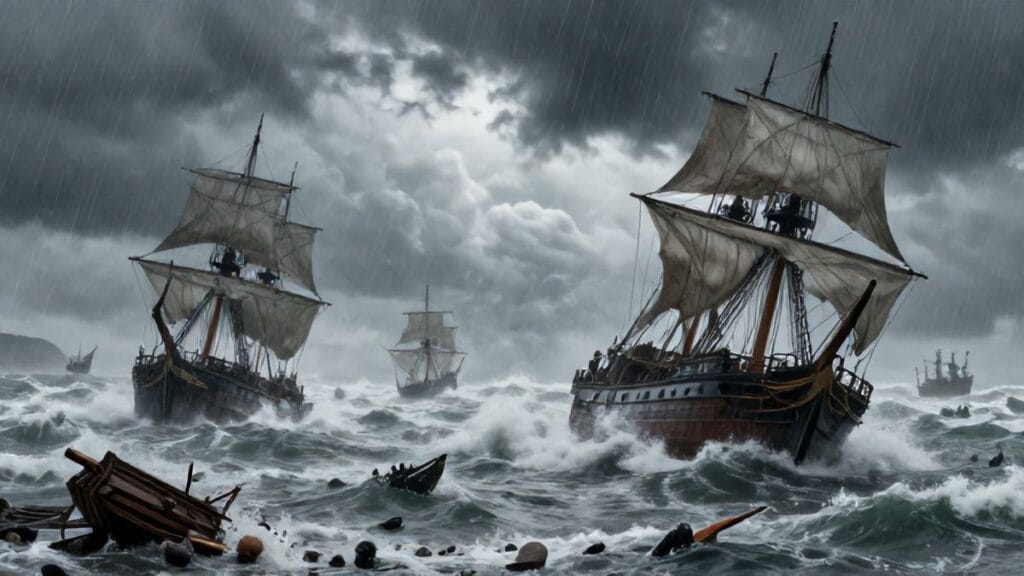
The wind came first—low, muttering, as if the sea itself were taking a breath before it spoke in thunder. Somewhere off the Gallic coast, under a sky that had lost its stars, hundreds of Roman hulls strained against their moorings, black silhouettes shifting on the swell. Men muttered prayers to Jupiter, to Neptune, to Christ, to anyone who might listen. They had been told this fleet would restore unity, that they would crush a pirate-turned-emperor in distant Britain in a quick, decisive campaign. Yet as the water hissed against the sides of their ships and rigging creaked like old bone, a different story was already being written across the Channel.
This was the night the maximian invasion fleet defeated itself, the night when ambition, haste, and the brutal physics of the sea conspired to unmake an emperor’s design. In 289, the Roman world did not look like the confident empire etched into schoolbook maps. It was fractured, twitching with rebellions, and clinging to power through hurried reforms and desperate shows of strength. The grand invasion of Britain mounted by Maximian, colleague of Diocletian and Augustus of the West, was meant to be such a show—a spectacle of imperial will projected across the narrow waters that separated Roman Gaul from its rebellious island province.
But the English Channel—cold, crowded, and treacherous—was no mere blue scratch on a map. To Roman sailors it was a living adversary, notorious for its sudden squalls and unpredictable currents. On that night, as the fleet prepared to cross, the Channel struck with the kind of brutal indifference that can erase human plans in a matter of hours. By morning, the maximian invasion fleet defeated by storm and confusion lay in scattered planks and overturned hulls; some ships were driven back, some sank without a trace, and others were left drifting, their crews praying to be washed ashore rather than out into the wide, empty ocean.
Yet even if the storm was the principal combatant, it did not act alone. Across the water, Carausius—the renegade naval commander who ruled Britain as his own small empire—had not been idle. He watched the continent with hard eyes, gathering intelligence, strengthening ports, and training his sailors in the same currents Maximian’s men were now failing to master. Whether or not British ships actively attacked during that doomed crossing, the result was the same: later chroniclers, stunned by the scale of the disaster, would compress all its causes into a harsh, memorable verdict—“maximian invasion fleet defeated.” In that phrase lies not just the story of one storm, but of a crumbling political order and a frontier that refused to yield.
Britannia on the Edge: A Province between Rome and Rebellion
To understand why an emperor risked such an operation, we must step back from the spray and the shouting decks, and look at the broader stage. In the third century, Britannia was no longer a distant curiosity tacked onto a Mediterranean empire. It was a strategic anchor: a source of grain, wool, and metal, a recruiting ground for soldiers, and a crucial flank of the northern frontier. Control of Britain meant control of the Channel. Control of the Channel meant the ability to move troops, goods, and ideas along the western edge of the Roman world—an artery of power that could either nourish the empire or bleed it dry.
But Britannia had always been uneasy under Roman rule. Excavated letters from Vindolanda and other forts along Hadrian’s Wall record the weary complaints of officers, the shortages of boots and bread, the persistent chill of the northern rains. Local elites might enjoy Roman baths and tableware, but beyond the villas stretched a countryside that remembered conquest as something recent and raw. Rebel leaders like Carausius did not appear in a vacuum; they rose from landscapes where loyalty was transactional and Roman identity only thinly painted over older tribal and regional ties.
By the 280s, Rome’s central authority had been rattled by decades of crisis—assassinated emperors, barbarian raids, economic malaise, and the brief secession of the so-called Gallic Empire in the west. Army units along the Rhine and in Britain had grown accustomed to making and unmaking emperors. When Diocletian and Maximian finally attempted to restore order, they inherited provinces that had seen too many promises broken and too many commanders come and go. Britannia, a proud, militarized frontier zone, was ripe for another strongman who could claim to protect local interests better than distant Rome.
The Channel, accordingly, became more than a body of water. It was a boundary between two versions of Rome: the official empire on the continent and the breakaway regime that would soon grow under Carausius in Britain. Moving an army across that water was not just a logistical challenge; it meant confronting the fact that the empire’s unity now depended on the most fragile of bridges—ships, weather, and the shifting loyalties of the men who sailed them. It is against this backdrop that the maximian invasion fleet defeated in 289 begins to look less like an isolated misfortune and more like a symptom of a deeper sickness in imperial power.
The Rise of Carausius: Smuggler, Admiral, Emperor
Before the Channel swallowed Maximian’s hopes, it raised up another man. Carausius, the antagonist—some would say the hero—of this story, emerged from obscurity on the damp fringes of empire. The ancient sources do not agree on his origin. Aurelius Victor, writing later in the fourth century, calls him a Menapian from the region of modern Belgium, a man of humble birth and formidable talent. He knew ships. He knew tides. Above all, he knew opportunity when he smelled it on the wind.
In the 280s, pirate activity in the Channel and North Sea surged. These were not romantic freebooters but agile raiders, many from Frankish and Saxon groups along the North Sea coast, who exploited the empire’s distraction to plunder shipping and coastal settlements. Desperate to restore security, Maximian appointed Carausius to command a new fleet based at Bononia (Boulogne). It was a high-stakes appointment: whoever controlled the fleet controlled the Channel, and whoever controlled the Channel could shape the politics of Gaul and Britain.
Carausius performed too well—and in a manner too independent for imperial taste. Reports reached Maximian that his admiral was allowing pirates to raid, only to attack them after the fact and keep much of the captured loot for himself. Whether this was true or imperial slander, it convinced the court that Carausius was becoming dangerously powerful and personally rich. An order went out for his arrest and execution.
Carausius did not wait for the axe. Around 286 or 287, he took his fleet, crossed the Channel, and seized control of Britain, along with parts of the northern Gallic coast. In a daring stroke, a provincial commander turned himself into a rival emperor. His rule was no mere bandit kingdom; he issued coins, courted the loyalty of British and Gallic elites, and even used Roman symbols and slogans to legitimize his regime. One famous coin type, bearing the legend Restitutor Britanniae—“Restorer of Britain”—proclaimed his vision: not a rebel, but a savior of the island from imperial neglect.
For Maximian, this was intolerable. The Channel, once the empire’s protective moat, had become a shield for defiance. Every ship that crossed under Carausius’s orders mocked the notion that the emperors held a monopoly on imperial identity. The decision to assemble a massive armada and strike across the water was not only military; it was psychological. Only a spectacle of arms, a resounding victory, could erase the insult. That is what makes the story of the maximian invasion fleet defeated so piercing: the stage had been carefully set for redemption, and instead the performance ended in silence and splintered timber.
Diocletian and Maximian: Reforging a Broken Empire
When Diocletian seized power in 284, the Roman Empire was weary, stretched thin, and haunted by the memory of soldier-emperors who barely lasted a year before being murdered by their own men. Diocletian understood that the empire’s size and complexity had outgrown the ability of a single ruler to manage it. His answer was bold: share power, formalize hierarchy, and rebuild the machinery of government.
Maximian, a seasoned soldier, became his colleague as Augustus in the West in 286. The two men divided responsibilities—Diocletian took the east, Maximian the west—but presented themselves as a united front. Their propaganda emphasized divine favor, military discipline, and a return to order after chaos. On coinage and inscriptions, the emperors appeared as near-mythical figures, chosen by the gods to restore the old virtues.
It is astonishing, isn’t it, that in the midst of this self-conscious program of renewal, a single upstart admiral in Britain could so thoroughly disrupt imperial narratives? The Carausian revolt exposed a key vulnerability in Diocletian’s system: while the Tetrarchy could project ideological unity, it still depended on the loyalty and competence of individual commanders. In the west, where Maximian bore the brunt of military responsibility, a rebel across the Channel was not just an inconvenience. It threatened to brand him as ineffective, perhaps even weak. In an age when legitimacy depended heavily on military success, the maximian invasion fleet defeated in 289 was a personal humiliation.
Thus the decision to launch a massive seaborne assault on Britain was bound up with the internal psychology of the Tetrarchy. It was meant to demonstrate that Maximian could do what earlier emperors had done: cross to Britain and reassert control. Julius Caesar had done it. Claudius had done it. Successful emperors, in Roman memory, were men who bridged water and made distant lands bow. To fail at this ancient test would be to speak a dangerous question aloud: if Maximian could not master the Channel, could he master the West?
Plotting the Crossing: How the Invasion Fleet Was Forged
By the late 280s, preparations along the northern Gallic coast had acquired a new urgency. The imperial administration had already invested in coastal defenses and naval installations in the face of Frankish and Saxon raids. Now these facilities were turned toward a different goal: assembling a fleet large enough to transport a strike force across the Channel and sustain it on hostile shores.
The sources are silent on exact numbers, and modern historians must reconstruct the picture from scattered hints. Later writers like Panegyrici Latini—collection of Latin panegyrics praising emperors—describe, in another context, an invasion fleet assembled by Constantius Chlorus with “innumerable ships.” It is reasonable to imagine that Maximian’s earlier attempt, driven by the same strategic logic, also involved hundreds of vessels: troop transports, supply ships, lighter craft for scouting, and warships meant to protect the convoy.
Ports like Bononia (Boulogne), Gesoriacum, and perhaps Rotomagus (Rouen) and other coastal stations buzzed with activity. Shipwrights worked long hours shaping hulls, caulking seams, and installing masts and rigging. Blacksmiths churned out nails, anchors, weapons. Quartermasters struggled to gather sufficient grain, salted meat, wine, and water, all of which had to be carefully stowed in casks for the crossing. Horses—if cavalry were to be transported—posed an especially difficult challenge; they needed space, fodder, and stable platforms on which to stand during the rough Channel passage.
On land, units were assembled from legions and auxiliary cohorts stationed in Gaul, perhaps reinforced by vexillations—detachments—from more distant provinces. These men drilled not only in standard infantry formations but also in embarkation and disembarkation. It is one thing to march in neat lines on a parade ground, quite another to clamber down a ship’s gangplank onto a heaving, shingle-strewn British shore under hostile eyes.
Throughout these preparations, imperial officers would have been keenly aware of the stakes. They no doubt heard rumors—embellished in the telling—of Carausius’s naval prowess, of his intimate knowledge of the tides, shoals, and storms of the Channel. To defeat such an adversary required not only numbers but timing and luck. Each delay risked giving Carausius more time to prepare; each hurried decision risked disaster at sea. In the tension between those two imperatives, we can almost feel the hinge on which the story turns, the moment where boldness tips into overconfidence and the maximian invasion fleet defeated by the elements becomes a possibility.
Ships, Oars, and Iron: Anatomy of a Late Roman Invasion Fleet
When we imagine Roman ships, we often think of sleek triremes slicing through Mediterranean waters—or of lumbering grain ships on their way from Egypt to Rome. The vessels in Maximian’s fleet looked different. By the late third century, Roman naval technology in the northern seas had adapted to a harsher environment: shorter sailing seasons, colder waters, and more violent storms.
Archaeological finds from the North Sea and Channel coasts—such as the late Roman boats discovered at Zwammerdam and other sites along the Rhine—suggest that many vessels combined sail and oars, with stout hulls built in the “shell-first” tradition: planks joined edge to edge, then reinforced by frames. Some ships had relatively shallow drafts, useful for approaching coasts with shifting sandbanks. Others were larger, capable of carrying hundreds of soldiers or substantial cargoes of grain, equipment, and animals.
Armament varied. Dedicated warships might mount ballistae—torsion-powered artillery capable of hurling heavy bolts or stones at enemy decks. Marines carried spears, javelins, shields, and short swords, ready to board or repel boarders. Some craft may have been fitted with strengthened prows for ramming, though in rough northern waters, collisions were as likely to damage friend as foe.
Navigation relied on experience more than instruments. Roman pilots in the Channel learned to read currents, cloud formations, and the changing color and texture of the water. The dangers were many: hidden sandbanks, sudden fog, contrary winds, and tides that could transform a safe channel into a lethal trap in a matter of hours. Even in the twenty-first century, the English Channel remains one of the world’s most unpredictable stretches of water; for late Roman sailors in heavily laden troop transports, it was an unforgiving test.
Within this environment, Maximian’s commanders had to orchestrate the synchronized movement of scores—possibly hundreds—of such vessels. Keeping formation, protecting slower transports with faster warships, and ensuring that the fleet did not become scattered in the dark required careful planning and rehearsed signals. Torches, flags, and sound signals—horns, trumpets, shouted orders—served as the nervous system of the armada. But as any sailor knows, when the sea decides to rise, such systems can quickly dissolve into chaos.
Signals from the Shore: Carausius Prepares for the Storm
Across the water, Carausius listened. Spies moved through ports in Gaul, carrying scraps of information: unusual recruiting, new ship construction, movements of high-ranking officers. Merchant captains, some loyal to Carausius, others simply willing to talk for a price, reported on the bustling activity in Bononia and along the coast. Even the rhythm of trade could give clues—ships being requisitioned for military use, grain supplies being diverted—all signs that Maximian was preparing something big.
Carausius had advantages the official emperors lacked. He was physically close to the likely landing sites in Britain, and he knew the local geography intimately. He could strengthen existing forts, repair lighthouses, and set watchers on headlands from Kent to the Solent and beyond. He could also adjust his strategy more nimbly, unburdened by the bureaucratic machinery of the wider empire. If Maximian assembled a fleet, Carausius could respond with hit-and-run naval tactics, coastal defenses, or simply a decision to let the Channel’s notorious weather fight on his side.
Archaeology hints at this defensive effort. Late third-century upgrades to forts along the so-called Saxon Shore—such as those at Richborough, Reculver, and Portchester—suggest that the coastline was being militarized in response to threats by both pirates and imperial counter-attacks. Massive stone walls, projecting towers, and improved harbor facilities transformed these sites into potential staging points or last-stand fortresses. Within them lived garrisons of soldiers and their families, people for whom the rumor of an invasion was not an abstraction but a looming, tangible fear.
Carausius also crafted a psychological defense. His coinage, minted in Britain and circulating among soldiers and civilians, proclaimed messages of stability, prosperity, and legitimacy. Some coins even paired his image with that of Maximian or Diocletian, implying harmony where none existed—a clever attempt to blur lines of loyalty and sow hesitation among those who might otherwise rally to an invasion. When the maximian invasion fleet defeated itself in the Channel, these coins suddenly seemed prophetic; the man who styled himself Restorer of Britain had withstood the might of an emperor’s armada, whether by force of arms, force of weather, or a combination of both.
The Battle No One Saw: When Maximian’s Invasion Fleet Was Defeated by the Sea
The precise sequence of events in 289 remains veiled by time, but the fragments we possess tell a story of grand plans broken in a single night. Later imperial panegyrists, who were not inclined to dwell on failures, mention the attempt only obliquely. One such speech, delivered to Constantius Chlorus in 297, recalls that earlier efforts to recover Britain had been thwarted by storms and the skill of the enemy fleet. The combination is telling.
Imagine the scene: under orders to strike swiftly and decisively, Maximian’s admirals choose what seems an opportune moment. The wind is favorable, or at least manageable. The fleet puts out from Bononia, sails billowing, oars dipping in unison. As the Gallic coast recedes, the Channel opens ahead—grey, heaving, indifferent. For a while, all goes well. Columns of ships maintain rough order, signal flags ripple in the breeze, officers calculate distances and times, hoping to reach British waters by dawn.
Then the wind shifts. Perhaps clouds, previously distant, mass quickly overhead. The Channel is notorious for such sudden changes: a calm evening can turn to chaos in less than an hour. Gusts hammer the sails, rigging screams, and captains shout orders to reef canvas, to turn, to hold formation. Some ships sway dangerously, overloaded transports wallowing as waves slam against their sides. Visibility drops as spray and rain churn the air into a screaming white noise.
In that moment, every complexity of a large fleet becomes a liability. Ships collide, oars snap, carefully spaced lines of vessels knot into confusion. Warships meant to protect the convoy from British raiders must now struggle simply to avoid ramming their own charges. A vessel that loses its rudder becomes a helpless projectile, driven by wind and current into its neighbors. In the darkness, even the bravest crew can panic when it feels the deck tilt too steeply beneath their feet.
Whether Carausius’s ships were present to exploit this breakdown is debated. Some historians argue for a purely meteorological disaster: the maximian invasion fleet defeated not by enemy but by elements alone. Others suggest that Carausius, anticipating such an attempt, kept his own fleet ready to dart out when the Romans were most vulnerable, harrying stragglers, capturing or burning ships that had already succumbed to wind and wave. Given his reputation as a sea-wolf, the latter possibility has a certain cruel logic.
By dawn—if dawn could be seen through the cloud and rain—the scale of the disaster would have become evident. Some ships had vanished entirely, swallowed whole. Others drifted half-wrecked, their masts snapped, their hulls leaking. Survivors clung to floating debris or huddled shivering on beaches where they had been unceremoniously thrown ashore, sometimes on the wrong side of the Channel, sometimes far from any friendly port. What had begun as an imperial demonstration ended as a scattered, sodden rabble of men thanking whatever gods they believed in simply for being alive.
In the terse summary of later memory, the verdict was clear: maximian invasion fleet defeated. No triumphal arch recorded the operation, no detailed campaign narrative celebrated a hard-fought but ultimately victorious struggle. Silence and embarrassment settled over the imperial record, leaving historians to piece together the story from hints, lacunae, and the unrelenting logic of geography and weather.
Whispers of Battle: Reconstructing a Lost Engagement
How do we write about a battle—or perhaps an aborted battle—that no ancient historian chose to describe in detail? The answer lies in the careful reading of what was said, and what was not. The late Roman panegyrics, though they often read like staged flattery, contain nuggets of historical truth. In one speech delivered at Trier in 297, the orator praises Constantius Chlorus for succeeding where “others” had failed to recover Britain, and he specifically mentions storms and the enemy fleet as obstacles.
The “others” in question likely include Maximian. That brief allusion, combined with the known chronology of Carausius’s revolt and the coin evidence that places Carausius firmly in power in Britain by 289, allows scholars to infer that an earlier military attempt had indeed been made and had failed badly. The fact that the orator attributes the failure not to imperial incompetence but to natural and martial forces—the sea and the British fleet—fits well with a scenario in which weather and Carausius’s preparations worked together to break the invasion.
Modern historians such as A. H. M. Jones and later specialists on the Tetrarchy have argued that an operation on this scale could not have gone entirely unrecorded in administrative documents, even if narrative histories are lacking. The very existence of fortified ports and upgraded coastal defenses suggests that the empire took the Channel threat extremely seriously. If Constantius’s successful expedition in 296–297 required massive effort, it is improbable that Maximian, facing the same political necessity, would have been content with mere saber-rattling. The evidence points instead to an earnest, large-scale attempt, and to an equally large-scale failure.
Archaeology adds faint but suggestive echoes. Occasional finds of late Roman ship timbers off the coasts of northern France and southern England, while difficult to date precisely, remind us that the Channel’s floor is littered with lost voyages. Coastal erosion periodically exposes concentrations of Roman-era material—iron fittings, amphorae, military equipment—that hint at shipwrecks. None can be definitively tied to 289, but collectively they underscore the material plausibility of the story: fleets did sail, and fleets did sink.
Thus, when we speak of the maximian invasion fleet defeated, we are extrapolating from a thin but coherent web of clues. The silence of detailed narrative sources becomes itself a kind of evidence: a failure too embarrassing to celebrate, yet too significant to ignore entirely. The historian’s task is to listen to that silence, to note the edges of the missing story, and to reconstruct, as honestly as possible, the human drama that played out between its lines.
Propaganda and Power: How Carausius Turned Disaster into Triumph
If Maximian tried to minimize discussion of his failure, Carausius had every incentive to magnify it. For a ruler whose legitimacy rested on courage and competence—on being the man who could protect Britain when Rome could not—the sight, or even just the rumor, of a shattered imperial fleet was political gold. He could present himself as the defender of the island, the sea-lord whose mastery of the Channel had humbled an emperor.
We do not possess a British chronicle of these events, but Carausius’s coins speak eloquently. Struck in fine style, they depict him in the full panoply of a Roman emperor: laurel wreath, radiate crown, cuirass, sometimes holding a globe or a victory figure. The legends proclaim virtues like Virtus Aug (the courage of the emperor), Felix Adventus (fortunate arrival), and Concordia Militum (harmony of the soldiers). After 289, such messages would have carried a sharpened edge. The emperor across the sea had tried and failed; Carausius remained, unchallenged on his island throne.
It is not hard to imagine how stories of the disaster spread among his followers. Sailors and coastal traders would bring tales of wrecked ships washing up on distant shores, of Roman soldiers trudging back into Gallic ports with no victories to report. Around fires in forts and villages, these stories would grow: Maximian’s armada, once “innumerable,” reduced to a handful of battered survivors; imperial standards lost to the waves; panicked retreat in the face of Carausius’s superior seamanship. The historical truth—likely a complex interplay of storm and scattered skirmishes—would be simplified into a compelling legend of pride humbled and Britain spared.
Carausius may also have used the moment to strengthen his diplomatic position. Knowing that Maximian had just suffered a humiliating reversal, he could present the idea of coexistence as the rational choice. Instead of escalating the conflict, perhaps the emperors might tacitly accept his rule in Britain in return for stability along the Channel. Indeed, some of his coin types seem to gesture at such an arrangement, pairing his image with those of Diocletian and Maximian as if they were all colleagues in harmony. Reality was far harsher, but the propaganda was shrewd: the maximian invasion fleet defeated could be spun not merely as a military failure but as proof that the gods themselves favored Carausius’s kingship.
Life in the Shadow of Invasion: Soldiers, Sailors, and Civilians
Behind the movements of emperors and fleets lay thousands of lives lived in anxiety and anticipation. On the Gallic coast, townspeople watched their harbors fill with conscripted vessels and unfamiliar soldiers. Taverns rang with speculation: How many ships were being prepared? Would they succeed where others had failed? Markets swelled with suppliers hoping to profit from the sudden demand for provisions—bread, salted meat, wine, timber. For some, the imperial project meant new income; for others, it meant requisitions, disruptions, and the fear that a failed expedition would bring reprisals or raids.
For the men in the fleet, the experience was different. Many were veterans of riverine operations along the Rhine, more accustomed to sheltered waterways than to the open fury of the Channel. They drilled in embarkation drills, practiced loading and unloading equipment quickly, and tried to suppress the queasy dread that can haunt even the bravest when facing an unknown sea. Some were Britons serving in the Roman army, perhaps uneasily aware that they might soon be fighting their own kin, or at least their former neighbors, under a different banner.
Across the Channel in Britain, the sense of expectation took another form. Along the coasts of Kent and Sussex, people scanned the horizon for sails that might herald invasion. Local communities knew that imperial attempts to reconquer the island would not be gentle affairs. Villages could be requisitioned for supplies, farms trampled by marching troops, coastal settlements turned into battlegrounds. Yet others, especially those invested in Roman commerce or bitter at Carausius’s taxes, might quietly hope that Maximian would succeed. Loyalties in frontier societies are rarely monolithic; they shift with circumstance, kinship, and personal advantage.
When word arrived that the maximian invasion fleet defeated itself before even reaching British shores, reactions were likely mixed. In Carausius’s power base, there would have been relief and celebration: the threat had receded, at least for the moment. In other circles, perhaps disappointment, even cynicism: once again, distant emperors had proven unable to match their boasts with deeds. Among soldiers on both sides, the lesson would have been clear: the Channel was an enemy in its own right, one that cared nothing for Roman titles or rebel dreams.
For the families of those who did not return, the disaster was not a story of imperial strategy but of sudden bereavement. Wives in Gaul waiting at harbors that grew quieter with each day, mothers in inland villages who never saw their sons again, children who would learn that their father’s last view of the world was of water closing over his head. These lives, largely invisible in the written record, form the human cost hidden behind the terse formula “maximian invasion fleet defeated.”
Rome Embarrassed: Political Shockwaves on the Continent
Empires do not like to advertise their failures, but they cannot entirely escape their consequences. In the wake of 289, Maximian faced a difficult calculus. Publicly acknowledging the disaster risked undermining his authority just as the Tetrarchy was attempting to project an image of renewed stability. Yet ignoring it entirely would leave a gap that rumors and enemies could fill gleefully.
Within the imperial court, the episode likely triggered harsh discussions. Who had misjudged the weather? Which admiral had failed to keep the fleet together? Should further attempts be delayed until the empire’s internal reforms were more complete, or should Maximian redouble his efforts to avoid looking weak? Unfortunately, the internal memoranda of the late Roman imperial administration have not survived to satisfy our curiosity, but the subsequent evolution of policy offers clues.
One clear result was the eventual decision to delegate the British problem to a new figure: Constantius Chlorus. In 293, Diocletian and Maximian expanded their system by appointing two junior emperors, or Caesars, to help govern the sprawling empire. Constantius became Caesar in the West under Maximian, with a remit that included Gaul and, not coincidentally, the ongoing challenge posed by Carausius and his successor Allectus. In effect, Maximian acknowledged that the problem required fresh leadership—and perhaps that his own failed attempt had made another frontal assault politically and militarily unpalatable in the short term.
Propaganda also shifted. Instead of emphasizing a looming reconquest of Britain, imperial messages increasingly stressed the internal strength and harmony of the Tetrarchy. Statues and coins depicted the four rulers as a unified college, identical in dress and posture, standing shoulder to shoulder. By foregrounding the abstract unity of the imperial college, the regime could downplay inconvenient local setbacks. Only later, when Constantius succeeded where Maximian had failed, would panegyrists circle back and reframe the story so that the earlier failure became a necessary prelude to a greater triumph.
In a sense, then, the maximian invasion fleet defeated in 289 contributed indirectly to the shaping of the Tetrarchic system. It underscored the limits of individual emperors and the need for a more flexible distribution of responsibility. It also demonstrated, in painful fashion, that propaganda without corresponding military success could easily ring hollow. The Channel had humbled an Augustus; he would respond by constructing a political order meant to spread both risk and glory more widely.
Coins, Forts, and Poems: The Archaeology of a Sunken Armada
The sea does not preserve history kindly. Wood rots, iron corrodes, and over centuries silt buries the material traces of human endeavor under shifting layers of sand and shell. Yet fragments survive. Off the coasts touched by the 289 expedition, marine archaeologists sometimes bring up odd pieces of the past: a corroded nail of Roman manufacture, a length of timber scarred with ancient tool marks, a cluster of amphorae frozen in the posture of a ship’s cargo hold overturned on the seabed.
On land, the evidence is more legible. Forts of the Saxon Shore system, once used to counter seaborne threats, reveal phases of rebuilding and reinforcement around the time of Carausius and Maximian. At Richborough, for instance, the monumental stone walls and defensive ditches bear witness to a period when the fear of invasion was very real. Scholars debate whether these modifications were primarily aimed against pirates, imperial expeditions, or both, but the timing aligns suggestively with the years of Carausius’s independent rule.
Coins, too, serve as a kind of archaeological echo. Hoards buried hastily in troubled times and never recovered by their owners often turn up in British fields and construction sites. Among them are issues of Carausius and Allectus, sometimes mingled with earlier imperial coins and, later, with those of the Tetrarchs. The geographic distribution of these hoards—denser in certain regions, sparser in others—can hint at centers of political and economic activity, areas more deeply integrated into Carausius’s regime and more likely to have felt the direct impact of the maximian invasion fleet defeated in 289.
Literary traces are rarer but intriguing. Late antique poets and panegyrists occasionally allude to storms wrecking fleets or to the dangers of crossing seas in winter. While these references are often generalized, they contribute to the broader atmosphere in which specific events like the 289 disaster occurred. They remind us that Romans, even at the height of imperial power, remained acutely aware of nature’s capacity to overturn human designs. One late writer, lamenting a different shipwreck, called the sea “the most ancient and most impartial tyrant,” a ruler who spared neither emperor nor slave.
Piecing all this together, the historian confronts the paradox of maritime history: some of the most consequential moments in human affairs vanish almost without a trace, leaving behind only patterns and probabilities. Yet within those patterns, the story of the maximian invasion fleet defeated emerges not as a ghost tale but as a plausible, even inevitable, consequence of an empire pushing its luck against both man and nature.
From Humiliation to Vengeance: The Road to Constantius Chlorus
The 289 disaster did not end Rome’s ambition to reclaim Britain; it merely deferred it. Over the next several years, Maximian and Diocletian focused on consolidating their reforms, shoring up frontiers, and suppressing other challenges. Meanwhile, Carausius’s luck began to fray. Internal dissent, economic pressures, and perhaps disillusionment among elites eroded his support. Around 293, he was assassinated by his finance minister Allectus, who took power in Britain but could not command the same aura of invincibility.
Enter Constantius Chlorus, the man who would finally reverse the humiliation of 289. Appointed Caesar in 293, he moved systematically: first securing the Gallic coast, recapturing key ports like Bononia, and cutting Britain off from its continental footholds. In doing so, he made it harder for Allectus to gather intelligence and supplies, reversing the strategic advantage Carausius had once enjoyed.
Only when the logistical groundwork was complete did Constantius assemble his own invasion fleet. The panegyrics that celebrate his campaign portray it as a masterclass in planning and execution, a deliberate contrast to the earlier failure. Multiple fleets set out, one under Constantius himself, another under the general Asclepiodotus. While a storm again played a role—this time cloaking the approach of Roman ships to the British coast—it acted as an ally rather than a saboteur. Asclepiodotus’s force landed near Southampton, defeated Allectus’s troops in battle, and marched on Londinium, where they suppressed remaining resistance and relieved Roman civilians who had suffered under the usurper’s regime.
In the rhetorical language of the day, the “maximian invasion fleet defeated” became an unspoken foil to Constantius’s triumph. Panegyrists like the anonymous orator of 297 cast the Caesar as the man whose prudence and piety succeeded where rashness and ill fortune had previously failed. The Tetrarchic system itself could now claim vindication: by distributing authority and allowing a younger, energetic leader to tackle the British question, the empire had finally mastered the Channel once more.
Yet the memory of 289 did not vanish entirely. Within military circles, it likely persisted as a cautionary tale about underestimating the sea and overestimating the power of imperial will. In the long arc of Roman Britain’s history, it stands as a reminder that even great empires can falter at narrow straits, and that failure, as much as success, shapes the strategies of those who follow.
Myths, Gaps, and Guesses: How Historians Read a Vanished Battle
Standing at this distance, we must acknowledge how much of the story remains conjectural. The fragmentary nature of our sources forces us to balance imagination with discipline. We know that Carausius ruled Britain independently; we know that Maximian remained determined to end that independence; we know that a later, successful invasion attributed its difficulty to storms and enemy fleets. From these facts, we infer the 289 disaster and tentatively reconstruct its contours.
Some might ask: Are we building castles on sand? The answer lies in comparative reasoning. Other episodes in Roman history—better documented but similar in pattern—help us calibrate our expectations. Julius Caesar’s invasions of Britain in 55 and 54 BCE, for example, were repeatedly thwarted or complicated by storms wrecking his ships and damaging his supply lines. Centuries later, in 367 CE, the so-called Great Conspiracy saw coordinated raids across Roman Britain’s frontiers, including maritime attacks that exploited lapses in coastal defense. In both cases, the interplay of weather, logistics, and enemy action resembled what we suspect occurred in 289.
Moreover, the logic of imperial decision-making supports the idea. It would have been politically impossible for Maximian to accept a secessionist Britain indefinitely without at least one serious attempt to retake it. The fact that Carausius remained in power into the late 280s, combined with the timing of Constantius’s later campaign, points toward an earlier, failed effort. In that context, the simple phrase “maximian invasion fleet defeated” encapsulates a probable reality, not a romantic invention.
There is also the matter of how ancient authors used silence. Omission was a powerful rhetorical tool. Panegyrists praised successes lavishly, but they were under no obligation to catalog every misstep. A campaign that ended before actual land battles could even be fought—snuffed out by a storm—would offer little material for the heroic tropes of Roman oratory. It was easier to hint at previous failures in order to highlight the magnitude of later successes than to give those failures their own full treatment.
In this delicate space between evidence and absence, historians tread carefully. They cross-check numismatic sequences, archaeological strata, and scattered literary references; they model likely fleet sizes and seasonal weather patterns; they argue, sometimes fiercely, over interpretations in specialized journals. Through this long, cumulative labor, the outline of 289 emerges with increasing clarity, though never with absolute certainty. It remains a story told in the conditional—“likely,” “probable,” “consistent with”—but it is no less compelling for that. Indeed, the very elusiveness of the maximian invasion fleet defeated invites us to think more deeply about how history is made, remembered, and forgotten.
Echoes in the Channel: The Long Memory of 289
Long after the last Roman standard fell in Britain, the English Channel remained a contested frontier. Saxon raiders, Viking longships, Norman invaders, Spanish armadas, and German U-boats would, in turn, test its waters and its defenders. Each generation discovered anew what Maximian’s sailors had learned in 289: that this narrow strait can be either bridge or barrier, depending on wind, tide, and human preparation.
There is a certain poetic justice in this continuity. The storm that helped scatter the maximian invasion fleet defeated in the third century prefigures the weather that frustrated the Spanish Armada in 1588, or the fog and swell that complicated the D-Day landings in 1944. Different ships, different weapons, different empires—but the same sea, with the same capacity to reshape human plans in a single, violent night.
On both sides of the Channel, coastal communities carry older memories, too deep to be easily articulated, of watching horizons for hostile sails. Shorelines that once saw Carausius’s patrols and Maximian’s wreckage later hosted medieval watchtowers, Napoleonic forts, and radar stations. The archaeology of these coasts is layered: beneath the concrete of the twentieth century lie the stone walls of the Saxon Shore forts; beneath those, perhaps, the silted remains of harbors that once launched and received the ships of 289.
In this perspective, the events of that year become part of a much longer story about islands and continents, about the fragility of power when it tries to cross water. The Roman Empire, in all its might, discovered that dominance on land did not automatically translate into mastery at sea. The maximian invasion fleet defeated in 289 stands as an early chapter in a recurring lesson: that control of the Channel requires not just ships and soldiers, but intimate knowledge of local conditions, careful timing, and a healthy respect for a body of water that has no interest in human glory.
Today, historians and enthusiasts who stand on the white cliffs of Dover or the beaches of Boulogne can, if they choose, imagine those Roman ships beating against the wind, their crews struggling, their officers cursing the darkness. They can imagine Carausius, somewhere in Britain, waiting for news that would tell him whether his brinkside kingdom would be crushed or confirmed. And they can feel, in the gusts that still rake these coasts, a faint echo of the storm that once decided the fate of an emperor’s ambition.
Conclusion
In the end, the story of Maximian’s failed armada is not simply the tale of ships lost in a storm. It is a window into a world in flux: an empire experimenting with new forms of rule, a frontier province asserting its own destiny, and a narrow stretch of water that could unmake emperors as surely as any battlefield. The maximian invasion fleet defeated in the English Channel around 289 crystallizes many of the tensions of the late third century—between center and periphery, ambition and prudence, human planning and natural forces beyond control.
We have followed the threads of this episode through political calculation, naval technology, propaganda, and personal experience. We have watched Carausius rise from obscurity to carve out a British empire of his own, and we have seen how one failed attempt to topple him nudged the Roman state toward the more collective, flexible Tetrarchic model. We have listened to the silence of the sources and learned how to read their omissions as carefully as their words. Most of all, we have tried to restore some sense of the human drama—of cold, frightened sailors on heaving decks, of coastal villagers peering at stormy horizons, of rulers waiting anxiously for messengers who might bring news of victory or disaster.
Like many episodes in ancient history, the 289 expedition remains partly hidden, forever beyond complete recovery. Yet its outlines are clear enough to serve as a powerful reminder that even the greatest powers are vulnerable when they step onto uncertain ground—or sail into treacherous waters. In the broken, salt-soaked remains of that armada lies a universal lesson: that history is as often shaped by what fails as by what succeeds, by the plans that drown as much as by the ones that reach the far shore.
FAQs
- What was Maximian’s invasion fleet, and why was it launched?
The invasion fleet assembled by Emperor Maximian around 289 was a large Roman armada intended to cross the English Channel and reconquer Britain from the rebel ruler Carausius. It was launched to reassert imperial control over a strategically vital province that had effectively seceded under Carausius’s leadership. - How do we know that the maximian invasion fleet was defeated?
No detailed ancient narrative survives, but later panegyrics praising Constantius Chlorus refer to earlier, failed attempts to recover Britain that were thwarted by storms and the enemy fleet. Combined with the known chronology of Carausius’s reign and subsequent events, historians infer that a major expedition under Maximian ended in failure. - Did Carausius’s ships directly defeat Maximian’s armada?
The evidence suggests that severe weather in the English Channel played a major role in scattering and damaging the Roman fleet. Some scholars believe Carausius’s navy may also have harried the disorganized ships, but the exact balance between storm and combat remains uncertain due to the fragmentary nature of the sources. - Why is the English Channel so important in this story?
The Channel was both a strategic corridor and a natural barrier. Controlling it meant controlling movement between Gaul and Britain. Its notoriously unpredictable weather and currents turned the 289 expedition into a high-risk undertaking, and they likely contributed decisively to the fleet’s destruction. - What were the political consequences of the failed invasion?
The defeat was a serious embarrassment for Maximian and highlighted the limits of imperial power. It strengthened Carausius’s position in Britain, at least temporarily, and contributed to the eventual decision to appoint Constantius Chlorus as Caesar with responsibility for resolving the British problem. His later, successful invasion in 296–297 was framed partly in contrast to the earlier failure. - What kinds of ships were in Maximian’s fleet?
The fleet likely included a mix of transport ships, supply vessels, and warships adapted for northern seas: sturdy, plank-built hulls powered by both sails and oars, with relatively shallow drafts for coastal operations. Some carried mounted artillery, while others were designed primarily to move troops, horses, and equipment. - Who was Carausius, and why did he rebel against Rome?
Carausius was a naval commander of humble origin who had been tasked with suppressing piracy in the Channel. Accused of profiteering and facing execution, he fled to Britain with a loyal fleet around 286–287, seized control of the province, and declared himself emperor, ruling Britain and parts of northern Gaul as an independent regime. - Is there archaeological evidence for the 289 disaster?
No shipwreck has been definitively linked to the 289 fleet, but late Roman naval remains in the Channel region, fortified coastal sites, and coin hoards from the era all support the broader picture of intense maritime activity and conflict. The absence of direct wreck evidence is not surprising given the age, depth, and shifting conditions of the Channel seabed. - How did the Romans eventually reconquer Britain from the rebels?
In 296–297, Constantius Chlorus, serving as Caesar under Maximian, mounted a carefully prepared campaign. After securing Gallic ports and isolating Britain, he sent multiple fleets across the Channel. A force under Asclepiodotus landed near the south coast, defeated Allectus (Carausius’s successor) in battle, and reoccupied Londinium, bringing Britain back under imperial rule. - Why does the story of the maximian invasion fleet defeated still matter today?
The episode highlights timeless themes: the vulnerability of great powers, the challenges of amphibious warfare, and the ways in which geography and weather can shape political outcomes. It also offers a case study in how historians reconstruct major events from minimal evidence, reminding us that the past is often as much about what we cannot see clearly as about what is preserved in neat, official narratives.
External Resource
Internal Link
Other Resources
- Encyclopaedia Britannica – general search for the exact subject
- Google Scholar – academic search for the exact subject
- Internet Archive – digital library search for the exact subject