Table of Contents
- Dawn of Disaster: The Morning of Merapi’s Fury
- The Sleeping Giant: History of Merapi Volcano
- The Heart of Java: Communities at the Volcano’s Edge
- A Volcanic Warning: Signs and Scientific Preparation
- The Eruption Unleashed: Chronology of the 2018 Disaster
- Lava, Ash, and Pyroclastic Flows: Understanding Merapi’s Violence
- The Human Toll: Lives Disrupted and Lost
- Evacuations in Chaos: Responses and Rescue Operations
- The Role of Indonesian Authorities and Volcanologists
- International Support and Regional Solidarity
- Media Coverage: Capturing the Volcano’s Wrath
- The Aftershock: Environmental and Economic Fallout
- Rebuilding from Ashes: Recovery Efforts and Community Resilience
- Memory and Myth: How Local Culture Embraces Merapi
- Lessons Learned: Advances in Volcanology and Disaster Management
- The Legacy of 2018: Merapi’s Place in Indonesia’s Volcanic History
- Conclusion: Nature’s Dual Face—Destruction and Renewal
- FAQs: Understanding the 2018 Merapi Eruption
- External Resource
- Internal Link
Dawn of Disaster: The Morning of Merapi’s Fury
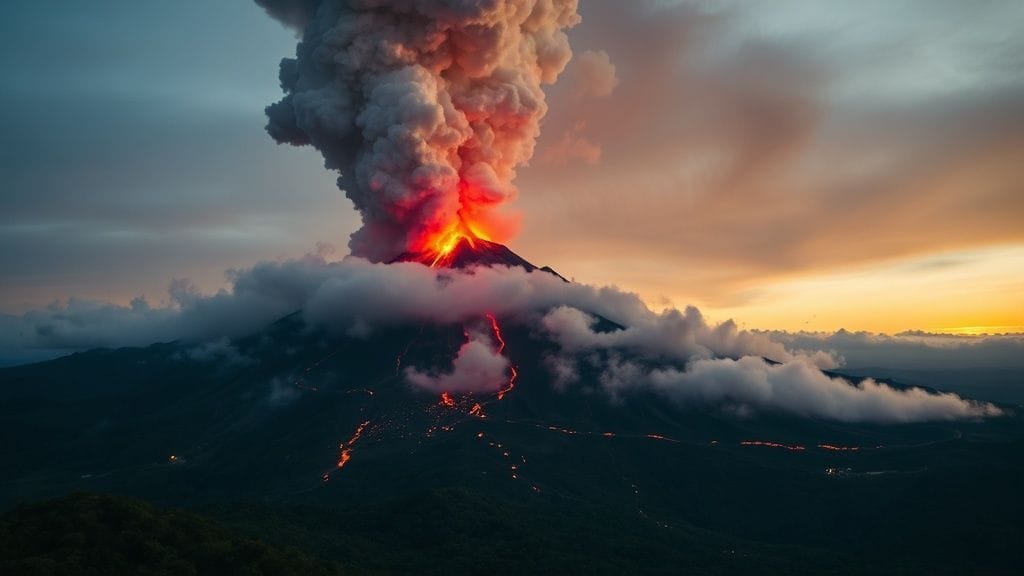
The air was thick with anticipation on the morning of May 22, 2018, as the slopes of Mount Merapi glowed faintly under the first light of dawn. Java’s most notorious volcano, known for its violent temperament, was about to remind the world why it commands both reverence and fear. Villagers near Kaliurang, a small town nestled perilously close, awoke to a sky darkening unnaturally early, as massive ash clouds billowed upward, blotting out the sun. The earth trembled—a low rumble escalating into deafening roars. These were no distant growls but the very breath and roar of Merapi itself, vomiting hot pyroclastic flows that devoured forests and fields alike. Homes were buried, lives endangered, and the fabric of everyday existence shattered in an instant. It was a day when nature’s wrath asserted its uncontrollable power, etching an unforgettable chapter into Indonesia’s long history of volcanic upheaval.
But this violent awakening, catastrophic as it was, was not without warning. The 2018 eruption would become one of the most closely monitored and studied in recent history, highlighting the formidable challenges of living in the shadow of a sleeping giant.
The Sleeping Giant: History of Merapi Volcano
To truly grasp the tragedy and resilience surrounding Merapi’s 2018 eruption, one must first understand the volcano’s nature. Located on the border between Central Java and the Special Region of Yogyakarta, Merapi—literally "Mountain of Fire" in Javanese—is Southeast Asia’s most active volcano. Over thousands of years, it has shaped the geology and culture of the island of Java, a land home to millions.
Merapi’s history reads like a chronicle of violence and rebirth. For centuries, its eruptions have been both a source of fertile soil and devastating destruction. Since 1548, documented eruptions have occurred more than 80 times, often characterized by deadly pyroclastic flows—fiery avalanches of gas, ash, and volcanic debris that speed down its flanks. The eruption of 1930 remains etched in collective memory as one of the deadliest, claiming more than 1,300 lives.
The volcano’s activity follows a rhythm unpredictable yet familiar to volcanologists, who call Merapi a "complex stratovolcano," prone to dome growth and collapse. This fragile dome-building process builds pressure beneath the surface, making explosive eruptions inevitable—a deadly dance on Java’s volatile crust.
The Heart of Java: Communities at the Volcano’s Edge
For centuries, fertile volcanic soils drew dense populations to Merapi’s foothills despite the risk. The region is among the most densely populated volcanic areas in the world, home to diverse communities that have woven the mountain into their identity.
Villages such as Kinahrejo, Srunen, and Kepuharjo lie precariously close to the crater. Farmers cultivate rice paddies and chili fields, while families construct homes in the shadow of constant risk. Culturally, Merapi is both feared and revered as a sacred mountain, a spiritual guardian whose mood swings govern daily life. Rituals and offerings to appease the volcano’s spirit reflect a deep, centuries-old coexistence.
This intimate relationship challenges disaster management. How do you ask entire communities to abandon land so entwined with their heritage, livelihood, and faith? The 2018 eruption would test this delicate balance between survival, belief, and the forces of nature.
A Volcanic Warning: Signs and Scientific Preparation
In the months leading up to May 2018, alert signs grew increasingly clear. Scientists monitoring Merapi observed heightened seismic activity from January, coupled with swelling of the volcanic dome detected through infrared cameras and satellite imagery.
Indonesia’s Geological Agency (PVMBG) issued a series of alert level escalations, eventually placing Merapi at the highest “Siaga” (alert) status. Volcanologists warned of imminent dome collapse and subsequent pyroclastic flows, urging evacuations.
Yet, this was no straightforward warning. The volcano’s capricious nature meant periods of calm punctuated the threat, lulling some into a dangerous sense of security. Communication channels were often challenged by logistic hurdles, local skepticism, and the tension between scientific predictions and cultural perceptions. Despite these difficulties, disaster readiness improved considerably compared to previous eruptions, reflecting hard-earned lessons and technological advances.
The Eruption Unleashed: Chronology of the 2018 Disaster
At 3:00 AM on May 22, Merapi announced its fury with explosions that shook the region. Over the next days, the volcano spewed vast quantities of ash clouds reaching altitudes of up to 4,000 meters, blanketing villages below in a grey, choking shroud.
The critical moment came with the collapse of the lava dome itself. The overpressurized dome gave way, releasing pyroclastic flows that swept rapidly down the southern and southeastern slopes. Dense clouds of searing gas, rock fragments, and ash obliterated everything in their path at speeds exceeding 100 km/h.
The eruption continued in spurts—strong volcanic tremors accompanied by incandescent balls of molten rock ejected into the night sky. Ashfall persisted for weeks, disrupting air traffic and contaminating water supplies. By early June, Merapi’s activity subsided slightly, but the threat had not vanished.
Lava, Ash, and Pyroclastic Flows: Understanding Merapi’s Violence
What made Merapi’s 2018 eruption so deadly was the complex combination of geophysical phenomena. Unlike slow lava flows that give time for escape, Merapi’s explosive pyroclastic flows are instantaneous death traps.
The dome of viscous lava forms gradually, plugging the volcanic vent like a cork. Pressure builds silently until the dome’s structure fails spectacularly, unleashing streams of glowing gas-rock mixtures—some hotter than 1,000°C. They race down valleys, incinerating vegetation and incinerating or burying human settlements.
Ash clouds can travel far, damaging lungs, collapsing roofs, and contaminating water. Merapi’s eruption typified this double threat: direct destruction near the cone and widespread environmental hazard across Central Java.
The Human Toll: Lives Disrupted and Lost
The eruption’s human impact was harrowing yet mitigated by prior warnings. Five fatalities were officially reported, a tragic loss but far fewer than in past eruptions due to improved evacuations.
Thousands of families fled, overcrowding emergency shelters and leaving homes behind. Agricultural livelihoods suffered severely as thick ash layers smothered crops and livestock.
Interviews with survivors reveal a tapestry of fear, resilience, and profound loss. One elderly woman from Kinahrejo described waking to a terrifying orange glow and deafening noise—then a frantic rush through ash-covered roads. Children, once playing near the mountain’s base, suddenly found their world transformed by silence and darkness.
Evacuations in Chaos: Responses and Rescue Operations
Despite advances, evacuations faced enormous challenges. Narrow mountain roads became gridlocked, communication networks faltered, and intermittent power cuts compounded confusion.
Local authorities coordinated with the military and disaster agencies to establish safe zones up to 20 kilometers away from the crater. Evacuation centers offered shelter, but resources were stretched thin. Health concerns soared due to ash inhalation and sanitation issues.
Still, the collective spirit of communities, emergency workers, and volunteers shone brightly. Stories emerged of neighbors helping the elderly, youths guiding families, and government officials risking their lives to save others. The human capacity for compassion amid catastrophe was a beacon amid volcanic ruin.
The Role of Indonesian Authorities and Volcanologists
Indonesia’s disaster management framework took center stage. The PVMBG provided continuous monitoring, issuing real-time data and advisories that guided decisions.
President Joko Widodo visited affected regions, pledging recovery aid and prioritizing citizen safety. Coordination between local governments, health agencies, and military units ensured streamlined responses, although gaps remained.
Scientists closely studied Merapi’s behavior, using seismic sensors, drone surveys, and remote sensing. These efforts sharpened eruption forecasting models, not just for Merapi but for Indonesia’s numerous volcanoes—a country with over 130 active volcanoes.
International Support and Regional Solidarity
The international scientific community swiftly responded, offering expertise, satellite imagery, and humanitarian aid. ASEAN neighbors monitored the ash cloud’s transboundary effects. Aid organizations supplied medical kits, protective masks, and food.
This eruption reaffirmed the global interconnectedness in facing natural disasters. The plight of Java’s mountain communities resonated worldwide, reminding humanity that volcanoes are not merely local hazards but showcase Earth’s volatile dynamism demanding collective respect and preparedness.
Media Coverage: Capturing the Volcano’s Wrath
From dramatic drone footage of glowing lava rivers to poignant interviews with displaced families, media outlets worldwide brought Merapi’s story into living rooms across continents.
Social media amplified eyewitness accounts, while journalists highlighted the tension between science and superstition, survival and ritual.
This coverage shaped public discourse on volcanic risk, emphasizing the need for balance between economic development and environmental safety in volcanic zones.
The Aftershock: Environmental and Economic Fallout
Beyond direct destruction, Merapi’s eruption disrupted Central Java’s delicate ecosystems. Forests were charred, watersheds clogged with sediment, and air quality severely compromised.
Economically, rural farmers saw their incomes collapse. Infrastructure damage to roads, schools, and clinics delayed recovery efforts.
Government initiatives targeted rehabilitation, incorporating soil restoration, reforestation, and support for displaced workers.
Rebuilding from Ashes: Recovery Efforts and Community Resilience
Communities began reassembling their shattered lives within months. Traditional agricultural practices adapted to ash-enriched soils. New housing designs factored in evacuation routes and safety zones.
Local NGOs partnered with government bodies fostering psychological counseling, skill training, and disaster education.
Merapi’s aftermath revealed the powerful human instinct not only to survive but to rebuild, reinventing identity while respecting nature’s commanding presence.
Memory and Myth: How Local Culture Embraces Merapi
In Javanese tradition, Merapi is more than a mountain; it’s a living spirit, an ancestral force. Rituals persisted even amidst disaster—offerings to the volcano’s guardian spirits continued in evacuation camps, proving cultural roots run deep.
Festivals marked the mountain’s cycles, blending tragedy and hope.
This intangible heritage confers strength and unity, shaping narratives of pain and renewal handed down generation to generation.
Lessons Learned: Advances in Volcanology and Disaster Management
The 2018 eruption accelerated innovations in eruption prediction, including dome monitoring via drones and real-time seismic alert systems.
Indonesia refined evacuation protocols and risk communication strategies, promoting community-based disaster preparedness.
Scientists balanced urgency with uncertainty, underscoring that despite technology, nature retains wild unpredictability.
The Legacy of 2018: Merapi’s Place in Indonesia’s Volcanic History
The 2018 eruption reaffirmed Merapi’s role as both destroyer and creator—a force of nature testing urban expansion and human fortitude.
It catalyzed national reflection on living with volcanoes, pushing governance, science, and culture toward coexistence with the elemental fires beneath Java.
As Merapi settles into quiet once more, its scars remain—a living testament to nature’s volatile power and humanity’s enduring spirit.
Conclusion: Nature’s Dual Face—Destruction and Renewal
The eruption of Mount Merapi in 2018 was a staggering display of earth’s fury, a reminder that beneath our feet lie forces far older and vaster than human ambition. Yet, amidst the ash and fire, stories of resilience, community, and hope shone brightly.
Indonesia’s response demonstrated the strength of preparation and cooperation, while the mountain’s surrounding communities embodied an extraordinary bond with their environment—a relationship of respect, fear, and reverence.
Merapi’s fiery breath is a harsh teacher, but also a guardian of vitality and renewal. It shapes land and life in one relentless, eternal cycle. Understanding this complex dance between destruction and rebirth remains crucial not only for Java but for all who dwell in the shadows of the world’s active volcanoes.
FAQs
1. What caused the 2018 eruption of Mount Merapi?
The 2018 eruption was caused by the growth and subsequent collapse of a lava dome inside Merapi’s crater, leading to pyroclastic flows and ash emissions. Increased seismic activity and magma pressure signaled the eruption months prior.
2. How many people were affected by the eruption?
Thousands of people were displaced, with five deaths officially reported. The ashfall and lava flows devastated homes, farms, and infrastructure across several villages near the volcano.
3. What measures were taken to prepare for the eruption?
Indonesia’s Geological Agency raised alert levels, conducted constant monitoring, and coordinated evacuations. Local authorities and communities implemented preparedness drills and established evacuation routes.
4. How did cultural beliefs influence responses to the eruption?
Local Javanese communities view Merapi as a sacred entity. Rituals to appease the mountain’s spirit persisted even during evacuation, reflecting deep cultural ties that sometimes complicated scientific warnings and risk management.
5. What were the main environmental impacts of the eruption?
Forest fires, ash-covered agricultural land, sediment-choked rivers, and air pollution were significant. The eruption disrupted ecosystems and rural economies, requiring extensive rehabilitation.
6. How has science advanced since the 2018 eruption?
Monitoring technology improved, with the use of drones and real-time sensors enhancing eruption prediction. Disaster communication and community engagement strategies were also upgraded.
7. What is the significance of Merapi in Indonesia’s volcanic landscape?
Merapi is the most active and dangerous volcano in Indonesia, a symbol of the country’s volatile geology. Its eruptions influence millions of lives and provide invaluable data for volcanic science.
8. What lessons can other volcanic regions learn from the 2018 eruption?
The event highlights the importance of early warning systems, local community involvement, integration of traditional knowledge, and swift coordinated response efforts for effective disaster management.

