Table of Contents
- Dawn of a New Optical Era: The Birth of the Metalens Optical Chip
- The Science Behind the Revolution: Understanding Metalenses
- The Unseen Visionaries: Key Figures and Institutions
- Breaking the Limits: Traditional Lenses and Their Struggles
- The Quest for Miniaturization: Why Size Mattered
- Silicon Valley Meets Optics: USA’s Strategic Innovation Move
- 2018: The Year that Changed Vision Technology Forever
- The First Prototype: Challenges and Breakthroughs
- Metalens Optical Chip in Action: Early Demonstrations and Impact
- The Global Race: Competing Nations and Technologies
- Beyond the Lens: Integrations with Smartphones and IoT
- Scientific Communities React: Praise and Skepticism
- Economic Ripples: Startups, Patents, and Market Shifts
- Environmental and Practical Implications of the Technology
- The Human Element: Stories of the Scientists Behind the Scenes
- From Lab to Industry: Commercialization Paths
- Challenges Ahead: Manufacturing, Scaling, and Adoption
- The Metalens Optical Chip’s Legacy in the Landscape of Optics
- Looking Forward: Potential Futures and Emerging Applications
- Conclusion: The Lens that Focused Humanity’s Gaze at Tomorrow
- FAQs: Decoding the Metalens Optical Chip Phenomenon
- External Resource
- Internal Link
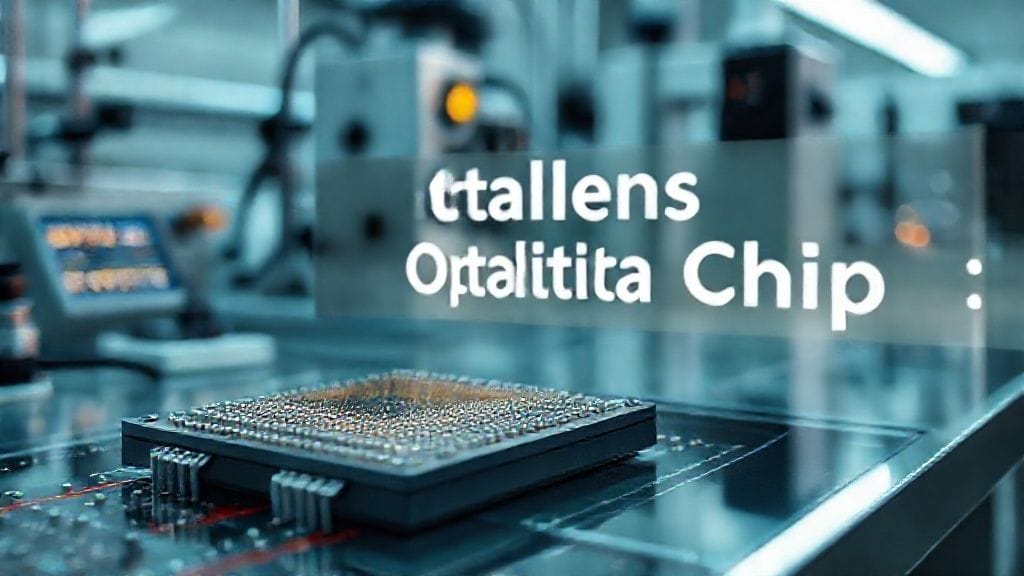
The year was 2018, and somewhere within the quiet, sterile halls of a U.S. research laboratory, a revolution was quietly unfolding. A tiny chip, no larger than a coin, promised to redefine how we manipulate light itself — a breakthrough poised to upend centuries of optical tradition. This was not science fiction. This was the birth of the metalens optical chip.
Dawn of a New Optical Era: The Birth of the Metalens Optical Chip
In the early months of 2018, a group of researchers unveiled the first functional metalens optical chip in the United States. What made this leap extraordinary wasn’t just the innovation itself but its gravity: a lens thinner than a human hair with the power to focus light in ways previously thought impossible. Imagine a camera lens no bigger than a postage stamp, yet capable of surpassing the performance of the thick, curved glass lenses that had dominated optics since antiquity.
Walking through the corridors of the research center, one could almost feel the pulse of an epochal moment. The air was thick with anticipation, the faint hum of computers juxtaposed against excited whispers of breakthrough data. Yet, beneath this cool technological veneer lay years of frustration, experimentation, and a relentless chase to bend photons to human will at an atomic scale.
The Science Behind the Revolution: Understanding Metalenses
Before this invention, lenses struggled with inherent problems — aberrations, bulkiness, and fabrication limits. Metalenses, however, turned to a new principle: metasurfaces. These surfaces, patterned with nanoscale structures smaller than the wavelength of light, could manipulate light waves precisely. Instead of relying on curved surfaces to refract light, metalenses used nano-antennas to sculpt the wavefronts, allowing unprecedented control over focus, color, and resolution.
The optical chip embodied these metasurfaces, creating flat lenses capable of replacing cumbersome traditional optics. The chip was not merely a miniaturized lens—it was a completely novel paradigm of optics, one that held vast potential across industries from consumer electronics to medical imaging and beyond.
The Unseen Visionaries: Key Figures and Institutions
Behind this disruptive technology stood a dedicated cadre of scientists and engineers, many affiliated with U.S. universities and federal institutions. Names such as Federico Capasso, a pioneer in metasurface technologies, come to mind, along with teams from Harvard University and MIT. Their combined expertise in nanofabrication, quantum optics, and material science converged to surmount challenges that had stalled similar efforts for decades.
These visionaries often operated out of modest lab spaces, masked by jargon and equations few outside the field could decipher. Yet their intensive passion and dogged perseverance turned what seemed like esoteric physics into practical innovation.
Breaking the Limits: Traditional Lenses and Their Struggles
To truly grasp the metalens optical chip’s impact, one must understand the limitations it sought to overthrow. Conventional lenses are made of glass or plastic, shaped finely to bend light in specific ways, but are bound by physical constraints. Thick, heavy, and complex to manufacture, they introduce distortions and require multiple elements to correct color and focus properly.
This complexity meant devices using high-quality lenses—like professional cameras, microscopes, and telescopes—were bulky and expensive, hindering portability and accessibility. Engineers strived for decades to miniaturize and improve them, but progress was incremental, a slow-burning evolution rather than a revolution.
The Quest for Miniaturization: Why Size Mattered
In an age driven by compact devices—think smartphones, drones, AR/VR headsets—the demand for ultra-thin, lightweight optical components became urgent. The metalens optical chip answered this call, packing superior optical functionality into microscopic form factors.
Shrinking cameras without sacrificing quality meant transforming consumer tech, making advanced imaging accessible everywhere. This quest wasn’t just technical; it was deeply human. Users yearned for devices that delivered high performance without bulk—portable medical instruments, wearable tech, even autonomous vehicle sensors—all hinged on this innovation.
Silicon Valley Meets Optics: USA’s Strategic Innovation Move
The U.S. recognized early that controlling this frontier could define the future. Investments flowed from government agencies like DARPA and private sector innovators eager to secure leadership in nanophotonics. Silicon Valley startups sprang up, eager to commercialize breakthroughs and embed metalens chips in the next generation of consumer and industrial devices.
This confluence of public and private sectors accelerated development, creating a fertile ecosystem where science met entrepreneurship. In 2018, when the first working metalens optical chip was revealed, it was both a scientific triumph and a strategic victory.
2018: The Year that Changed Vision Technology Forever
That year symbolized a turning point. Early prototypes demonstrated an ability to focus visible light across broad wavelengths while being only a fraction of the thickness of traditional lenses. The remarkable precision fabricated at nanoscale levels stunned the scientific community.
Breakthrough reports flooded journals; media outlets hailed it as “the lens of the future.” Careful, meticulous experiments validated its capabilities, while conferences buzzed with excitement over potential applications.
Yet, this achievement was not the end. It was a key opening chapter in a still-unfolding narrative about humanity’s relationship with light and vision.
The First Prototype: Challenges and Breakthroughs
Creating the first metalens optical chip demanded overcoming formidable barriers. Precise nanofabrication technologies had to be developed to shape the metasurface elements. Ensuring durability and repeatability required novel materials and manufacturing protocols.
Initial prototypes suffered from limited field of view or chromatic aberrations. The debut chip needed fine-tuning for industrial viability. However, each obstacle fueled further innovation, pushing teams toward cleaner, more scalable designs.
Metalens Optical Chip in Action: Early Demonstrations and Impact
When placed in cameras, the chip yielded images with surprising sharpness and clarity. Unlike traditional lenses that relied on stacking multiple components, the metalens could perform the same feats singularly, heralding a future of simpler, cheaper devices.
Medical imaging devices employing the chip gained unprecedented miniaturization, making bedside examinations and portable diagnostics increasingly feasible. Even early experiments integrating the chip into AR glasses promised lighter, more comfortable wearables.
These early successes inspired wide-reaching enthusiasm across technology sectors, setting imaginations alight about the possibilities ahead.
The Global Race: Competing Nations and Technologies
While the USA took a dominant early lead, several countries were quick to respond. South Korea, China, Japan, and European research hubs intensified their efforts in metasurface optics, sparking a veritable race heightening innovation but also geopolitical tensions.
Commercial strategies oscillated between open science and guarded patent wars. The global community recognized metalenses as not just scientific novelties but potential economic game-changers.
Beyond the Lens: Integrations with Smartphones and IoT
Even in the year of its birth, speculation ran rampant about embedding metalens optical chips into smartphones, tablets, and IoT devices. Imagine ultra-thin, flexible cameras enabling ubiquitous sensing and vision capabilities previously impossible due to physical constraints.
These integrations hinted at a future where optical hardware might merge seamlessly with digital technology, creating new paradigms of human-computer interaction and data gathering.
Scientific Communities React: Praise and Skepticism
Despite widespread acclaim, some skeptics in the optics community questioned whether metalens technology could scale economically or match the optical quality of high-end glass lenses in all conditions.
Critical voices stressed the need for rigorous testing, noting that early prototypes, though promising, remained proof of concept rather than mature products. This healthy debate pushed researchers to fortify their work with extensive empirical evidence, fostering a more robust scientific foundation.
Economic Ripples: Startups, Patents, and Market Shifts
Following its debut, the metalens optical chip catalyzed new market dynamics. Startups multiplied, seeking venture capital fueled by the promise of revolutionary devices. Incumbent lens manufacturers began pivoting strategy, either investing in research or acquiring promising firms to safeguard their positions.
Patent filings skyrocketed, sometimes leading to legal disputes. The metalens suddenly became a coveted asset, driving shifts in industry structure and investment flows.
Environmental and Practical Implications of the Technology
The metalens’s smaller size and simpler production offered environmental advantages: less raw material usage, lower energy consumption, and the potential for biodegradable or recyclable components.
Moreover, its durable, flat design allowed deployment in harsh environments—space missions, underwater explorations—where traditional optics’ fragility limited performance.
These qualities made the metalens optical chip appeal not only to commercial sectors but also to scientific and humanitarian ventures.
The Human Element: Stories of the Scientists Behind the Scenes
Behind every breakthrough is a human story—a story of late nights, experiments gone awry, hopes dashed and resurrected.
One particular narrative recalls a graduate student tirelessly tweaking nanostructures on the metasurface, her eyes bloodshot but resolute. Another speaks of a senior researcher’s epiphany in the lab corridor—a sudden insight that altered the entire design philosophy.
These human moments brought warmth and depth to the metalens saga, reminding us innovation thrives on perseverance and passion.
From Lab to Industry: Commercialization Paths
Post-2018, the path from prototype to product included scaling nanofabrication, forging partnerships with electronics manufacturers, and navigating regulatory landscapes.
Companies launched pilot projects embedding metalens chips into consumer devices. The process revealed new challenges—cost efficiency, quality control, supply chain logistics—but the momentum held firm.
Challenges Ahead: Manufacturing, Scaling, and Adoption
Scaling metalens technology beyond the lab remained a daunting task. Nanofabrication at commercial volumes demanded breakthroughs in cost-effective lithography, error minimization, and material optimization.
Additionally, educating consumers and industries about the benefits proved essential for adoption. Overcoming inertia of established technologies required clear demonstrations of superior value.
The Metalens Optical Chip’s Legacy in the Landscape of Optics
Though just a few years old, the metalens optical chip had already reshaped how the scientific community thought about lenses. It served as a beacon of what could be achieved when physics, materials science, and nanotechnology converged.
Its legacy endures in labs, startups, and products worldwide, inspiring new generations to think beyond curved glass and envision a flat, flexible future of light.
Looking Forward: Potential Futures and Emerging Applications
The metalens optical chip points toward a horizon where optical devices can be integrated everywhere: smart contact lenses offering augmented reality, miniature spectrometers for on-the-go health monitoring, ultra-compact satellites enhancing earth observation.
Its principles may also inspire advances in acoustic metamaterials, quantum computing interfaces, and beyond—testament to the broad ripple effect of a single breakthrough.
Conclusion
The unveiling of the metalens optical chip in 2018 marked more than a technological milestone—it was an invitation to reimagine humanity’s relationship with light and vision. Within a tiny, exquisitely engineered surface, centuries of optical tradition met the future’s promise. The journey that brought this chip from theory to reality was a testament to human curiosity, resilience, and ingenuity.
As we peer through these atom-thin lenses, our gaze extends beyond yesterday’s horizons. It is a powerful reminder that sometimes, the smallest inventions hold the greatest capacity to refocus our world.
FAQs
Q1: What exactly is a metalens optical chip?
A metalens optical chip is a flat, nanoscale device that uses engineered metasurfaces to focus and control light, replacing traditional bulky glass lenses with a thin, lightweight alternative.
Q2: Why was the 2018 development in the USA significant?
In 2018, researchers in the USA demonstrated the first functional metalens optical chip with visible light capabilities, showcasing a practical, scalable design that could revolutionize optical devices.
Q3: Who were the key figures behind this breakthrough?
Leading researchers like Federico Capasso from Harvard and teams from MIT and other institutions played vital roles, combining expertise in nanophotonics, material science, and quantum optics.
Q4: How does the metalens optical chip differ from traditional lenses?
Unlike curved glass lenses that bend light through shape, metalenses manipulate light via nanoscale patterns, enabling ultra-thin, lightweight, and highly customizable optical elements.
Q5: What industries are most impacted by metalens technology?
Smartphones, medical imaging, augmented reality, autonomous vehicles, and IoT devices stand to gain significantly from metalens-based optics due to miniaturization and enhanced functionality.
Q6: Are there any challenges in mass-producing metalens optical chips?
Yes, manufacturing challenges include cost-effective nanofabrication, consistency, and scaling while maintaining optical quality, which researchers and companies continue to address.
Q7: How does this technology affect environmental sustainability?
Metalenses require less material and energy for production, offer durability, and enable devices with longer lifespans or enhanced recyclability, contributing positively to sustainability.
Q8: What is the future outlook for metalens optical chips?
The future is promising with potential applications in smart wearables, contact lenses, compact sensors, and even quantum optics, suggesting a broad and transformative impact ahead.