Table of Contents
- The Final Dawn: Madrid on April 22, 1616
- The Life and Legacy of Miguel de Cervantes: A Brief Prelude
- Spain at the Crossroads: Society and Politics in Early 17th Century
- From Soldier to Scribe: The Man Behind “Don Quixote”
- The Late Days: Cervantes’ Final Years in Madrid
- The Illness That Claimed a Literary Giant
- Last Words and Final Moments: Witnesses and Records
- The Burial: San Ildefonso and the Mysterious Grave
- The Coincidence of Deaths: Cervantes and Shakespeare, Bridging Nations
- Immediate Aftermath: Madrid’s Mourning and Literary Circles’ Tribute
- The Unfinished Work and Posthumous Publications
- Cervantes’ Death in the Context of Spain’s Golden Age
- How Cervantes Changed Literature Forever: A Global Perspective
- The Search for Cervantes’ Remains: Archaeology and Controversies
- The Enduring Memory: Memorials, Monuments, and Popular Culture
- Cervantes at the Heart of Spanish Identity
- Death and Immortality: The Paradox of Literary Legacy
- The 400th Anniversary: Commemorations and Rediscoveries
- How Cervantes’ Death Shaped the Perception of “Don Quixote”
- Conclusion
- FAQs
- External Resource
- Internal Link
The Final Dawn: Madrid on April 22, 1616
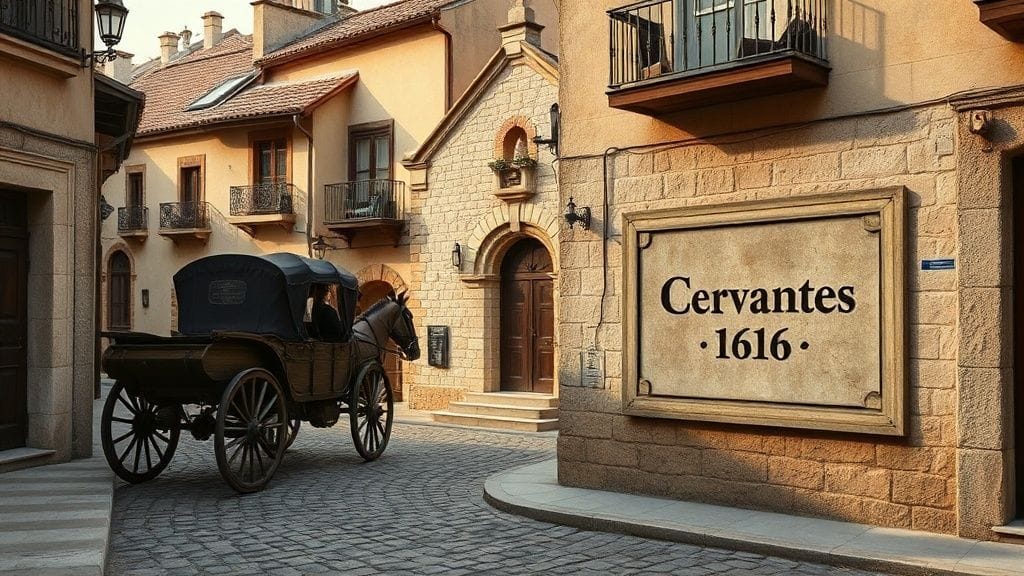
The morning of April 22, 1616, dawned cold and gray over Madrid, suffused with the quiet gravity of an ending. In a modest home not far from the bustling heart of the Spanish capital, Miguel de Cervantes Saavedra took his last breath. The world slipped away from one of its most imaginative, persistent, and quietly revolutionary minds. It was not a death heralded with fanfare or ceremony, but rather one marked by the hushed solemnity that history often casts upon its most enduring figures—a man folding himself permanently into the fabric of Spain’s Golden Age.
A city heavy with political tension, religiosity, and the slow decay of imperial grandeur bore witness to the extinguishing of a poetic beacon. Cervantes’ final moments were rooted in obscurity and simplicity, yet the resonance of his passing stirred ripples far beyond his humble chamber in Madrid. Somehow, this very death, shrouded in the commonplace, sowed the seeds for a literary immortality that no empire, no political edict could quell.
The Life and Legacy of Miguel de Cervantes: A Brief Prelude
To understand the significance of April 22, 1616, one must journey through the labyrinth of Cervantes' life—the winding roads of knighthood, captivity, literary struggle, and creative triumphs. Born in 1547 in Alcalá de Henares, Cervantes’ journey to literature greatness was neither linear nor assured. Soldier, tax collector, poet, and playwright—his life was a mosaic, reflecting the contradictions and aspirations of early modern Spain.
His magnum opus, Don Quixote, published in two parts (1605 and 1615), revolutionized literature, introducing a complex, metafictional hero whose quixotic battles with windmills became a metaphor for the human condition itself. Cervantes, however, lived far from the acclaim and riches his work eventually earned him. Poverty, imprisonment, and ill health were constants in his twilight years, making the serenity of his final day all the more poignant.
Spain at the Crossroads: Society and Politics in Early 17th Century
Cervantes died in an era of tumult and transformation. The Spanish Empire under Philip III was a colossus beset by military strains, fiscal crises, and an increasingly rigid social hierarchy. The fervent Catholicism of the Counter-Reformation permeated every level of society, while the arts blossomed under royal patronage and the cultural ferment known as the Siglo de Oro—the Golden Age.
Yet beneath the glitter of imperial Spain lay fractures: economic hardship for the common people, decaying feudal structures, and seeds of discontent that would later unfurl into decline. Cervantes’ works, deeply reflective of his society’s contradictions, capture this vital historical moment—a tapestry of glory and despair.
From Soldier to Scribe: The Man Behind “Don Quixote”
Cervantes was no stranger to hardship. As a young man, he fought bravely at the Battle of Lepanto (1571), where he lost use of his left hand, earning the moniker "the cripple of Lepanto." His military valor contrasted with his later misfortunes—captured by Barbary pirates in 1575 and enslaved in Algiers for five years before a ransomed release.
These experiences, fraught with pain and revelation, seep into his writing: the nuanced portrayal of valor, folly, and human resilience. Cervantes’ literary voice gathered colors from these trials, weaving realism with satire in a way that forever altered narrative art.
The Late Days: Cervantes’ Final Years in Madrid
The last decade of Cervantes’ life saw the publication of Don Quixote, now met with growing success but not fortune. Living mostly in Madrid, he suffered from recurring health issues and continued financial instability. His role as purchasing agent for the royal tobacco monopoly barely subdued his material struggles.
Still, Cervantes insisted on writing—finishing dramatic works and other prose. Friends and contemporaries noted his unshakeable commitment to the craft, despite the encroaching presence of illness and solitude.
The Illness That Claimed a Literary Giant
Details about the exact cause of Cervantes’ death remain scarce, yet historical records suggest a lingering fever, possibly exacerbated by diabetes or a stroke. Contemporary accounts describe him as bedridden and weak in the days leading up to April 22. The signature on his will, dated April 19, 1616, is shaky and almost illegible, a heart-wrenching reminder of his fading vitality.
His final illnesses were endured quietly, in the home he had rented in Madrid’s poor quarter. There, surrounded perhaps by a handful of faithful friends and family, Cervantes whispered the end of a long and storied life.
Last Words and Final Moments: Witnesses and Records
The scarcity of eyewitness accounts means much of Cervantes’ death is pieced together through wills, parish records, and secondhand testimony. His will reveals a humble man, concerned with honor and duty, calling on his daughters and friends. It is said he requested a simple burial, avoiding pomp.
A few contemporary references hint at a sad but dignified death, marked by religious solace consistent with his Catholic faith. This quiet closing chapter of a literary giant echoes the paradox that often accompanies true genius—intense inner life, outward modesty.
The Burial: San Ildefonso and the Mysterious Grave
Cervantes was interred in the Convent of the Barefoot Trinitarians (Convento de las Trinitarias Descalzas) in Madrid, a place close to his heart owing to his role as a knight of the Trinitarian Order. The exact location of his grave has remained elusive for centuries—a lost secret guarding his mortal remains beneath layers of time, war, and urban transformation.
Repeated searches and archeological investigations have yet to conclusively locate his burial site, fueling a poignant mystery that intertwines with the man’s immortal legacy.
The Coincidence of Deaths: Cervantes and Shakespeare, Bridging Nations
A striking historical coincidence is that Miguel de Cervantes and William Shakespeare both died in April 1616—albeit on different dates depending on calendars used. Spain followed the Gregorian calendar; England not yet. This seeming symmetry has fostered much romantic speculation about the twin deaths of the two paragons of Western literature.
Though the two never met, their legacies form a profound cultural bridge—Spanish and English literary traditions forever entwined by this shared moment of loss.
Immediate Aftermath: Madrid’s Mourning and Literary Circles’ Tribute
News of Cervantes’ death circulated quickly within Madrid’s literary and social circles. Though none could foresee the global renown his work would shortly attain, his peers recognized the passing of a distinguished, if modest, craftsman of letters.
Pilgrimages to his resting place began, even as his works spread quietly beyond Spain’s borders. The initial grief was private but would swell into a collective homage over decades.
The Unfinished Work and Posthumous Publications
At the time of his death, Cervantes left behind drafts and incomplete manuscripts, notably for Los Trabajos de Persiles y Sigismunda, a romantic novel published posthumously in 1617.
These posthumous works added texture to his oeuvre, confirming his restless creativity to the very end. Yet it was Don Quixote that continued to dominate his reputation, evolving into a foundational text for the modern novel.
Cervantes’ Death in the Context of Spain’s Golden Age
The passing of Cervantes symbolized more than the loss of a writer; it marked the closing of a vital chapter in Spain's cultural renaissance. The Golden Age’s literature, art, and thought were at a pinnacle, but also nearing transformation under new influences and historical pressures.
His death stands as a cultural landmark, a quiet end that presaged the eclipse of the Spanish Golden Age itself.
How Cervantes Changed Literature Forever: A Global Perspective
Cervantes’ death did not mark an ending but rather intensified the diffusion of his work worldwide. Don Quixote inspired the novel’s emergence as a literary form, influencing writers from Europe to the Americas.
His innovative narrative techniques—metafiction, irony, psychological complexity—transcended borders, reshaping storytelling across languages and centuries.
The Search for Cervantes’ Remains: Archaeology and Controversies
Over the last two centuries, multiple archeological endeavors have sought Cervantes’ remains beneath the convent. Claims of finding bones were periodically made but met with skepticism.
Recent technological advances promise progress, yet the mystery endures—symbolic of the enigma surrounding Cervantes’ life and art.
The Enduring Memory: Memorials, Monuments, and Popular Culture
Spain honors Cervantes extensively through statues, museums, and the Cervantes Prize—the highest Spanish literary award.
Madrid’s Plaza de España boasts a grand monument depicting Don Quixote and Sancho Panza, a public testament to the man whose tales still captivate millions.
His influence pervades modern culture, with films, literature, and adaptations continually reviving his spirit.
Cervantes at the Heart of Spanish Identity
Cervantes embodies a cultural touchstone for Spain, synthesizing its historical achievements, struggles, humor, and spirit.
His death sealed his status, forging him into an emblem of national pride and artistic genius, inseparable from Spain’s soul.
Death and Immortality: The Paradox of Literary Legacy
The mundane circumstances of Cervantes’ passing contrast starkly with the boundless life his works have since enjoyed.
His death reveals the paradox many great artists face: mortal and often forgotten in their time, yet eternalized through their creations.
The 400th Anniversary: Commemorations and Rediscoveries
April 22, 2016, marked four centuries since Cervantes’ death, inspiring global celebrations, academic conferences, and new interpretive works.
This milestone rekindled interest in his life, unresolved questions about his burial, and underscored the timelessness of his vision.
How Cervantes’ Death Shaped the Perception of “Don Quixote”
The immediate vacuum left by Cervantes’ death prompted readers and critics to re-examine Don Quixote as a completed whole.
Posthumous interpretations highlighted its revolutionary spirit and melancholic undertones, fueling its ascent as a literary cornerstone.
Conclusion
The death of Miguel de Cervantes on April 22, 1616, was a quiet moment cloaked in the ordinary rhythms of early 17th-century Madrid. Yet within this unassuming exit lay the genesis of a literary immortality unmatched in history. Cervantes’ life, a patchwork of hardship, valor, innovation, and unyielding creative drive, culminated not in a grand spectacle, but in a gentle closure that belies the profound impact he would have on literature and culture worldwide.
From the shadows of obscurity to the power of narrative, his passing reminds us of the fragile human heart behind great art—and how the ink of a determined spirit can outlast empires, wars, and centuries. The world still walks alongside Don Quixote, laughing and weeping, dreaming and seeking, far beyond the humble room in Madrid where Cervantes took his final breath.
His death invites reflection on the nature of legacy, the cost of genius, and the enduring question of how a single voice, once silenced, can echo through eternity.
FAQs
1. What caused Miguel de Cervantes’ death on April 22, 1616?
While no definitive diagnosis exists, historical documents suggest Cervantes suffered from a lingering illness, likely a fever related to diabetes or stroke complications, leading to his death.
2. Where was Cervantes buried?
He was buried in the Convent of the Barefoot Trinitarians in Madrid, but the exact location of his grave remains unknown, sparking ongoing archaeological interest.
3. How did Cervantes’ death affect the publication of his works?
Some of his works, like Persiles y Sigismunda, were published posthumously, and his death intensified focus on Don Quixote, confirming its status as a foundational novel.
4. Why is Cervantes’ death often mentioned alongside Shakespeare’s?
Both died in April 1616, marking a historic coincidence between two literary giants of different nations. However, calendar differences mean their death dates do not precisely align.
5. What was Madrid like when Cervantes died?
Madrid was a vibrant but challenging city, witnessing the height of Spain’s Golden Age yet facing economic and social pressures under the Habsburg monarchy.
6. How does Spain commemorate Cervantes today?
Through monuments like the Plaza de España statue, the Cervantes Prize, museums, and annual celebrations, Spain honors his legacy as a national treasure.
7. Did Cervantes receive recognition during his lifetime?
Though Don Quixote brought him some acclaim, Cervantes struggled financially and socially, receiving limited honors compared to his posthumous renown.
8. Why is Cervantes’ resting place still a mystery?
The convent where he was buried was altered over centuries, records are incomplete, and multiple burials overlay one another, complicating identification efforts.

