Table of Contents
- The Eve of a World on Edge: Europe in 1939
- Shadows over Diplomacy: The Strategic Calculus of Molotov and Ribbentrop
- Behind Closed Doors: The Secret Negotiations in Moscow
- The Pact That Stunned the World: Signing on August 23, 1939
- Anatomy of the Molotov–Ribbentrop Pact: Public Terms and Hidden Clauses
- Immediate Repercussions: Shockwaves Across Europe and Beyond
- The Invasion of Poland: The Dark Dawn of World War II
- Stalin’s Calculated Gamble: Seeking Time or War?
- Hitler’s Tactical Masterstroke or Overreach?
- The Western Powers’ Reaction: Betrayed and Unprepared
- The US and the Global Stage: Echoes from Afar
- The Pact’s Role in Shaping the Eastern Front
- The Secret Protocol’s Human Cost: Dividing Nations and Peoples
- Diplomacy Undermined: Trust and Treachery in International Relations
- The Pact in Soviet and Nazi Propaganda
- The Molotov–Ribbentrop Pact and the Outbreak of the Second World War
- When Allies Became Enemies: The Pact’s Demise in 1941
- Historical Debates and Controversies: Interpreting the Pact’s Legacy
- The Memory of the Pact in Postwar Europe and Russia
- Lessons from August 1939: Diplomacy, Ethics, and Realpolitik
- Conclusion: The Pact That Changed the Course of the Twentieth Century
- FAQs About the Molotov–Ribbentrop Pact
- External Resources
- Internal Link
1. The Eve of a World on Edge: Europe in 1939
Europe in the summer of 1939 was a powder keg dripping with tension. The skies over Berlin and Moscow held a silence that belied the storm soon to erupt. For years, the continent had been bruised by the scars of the First World War, and the rise of totalitarian regimes in Germany, Italy, and the Soviet Union only thickened the dark clouds gathering over the horizon. As the summer sun rose on August 23, a quiet yet earth-shattering pact was signed in the Kremlin — an accord that would reshape the fate of millions and ignite the hellfire of the Second World War.
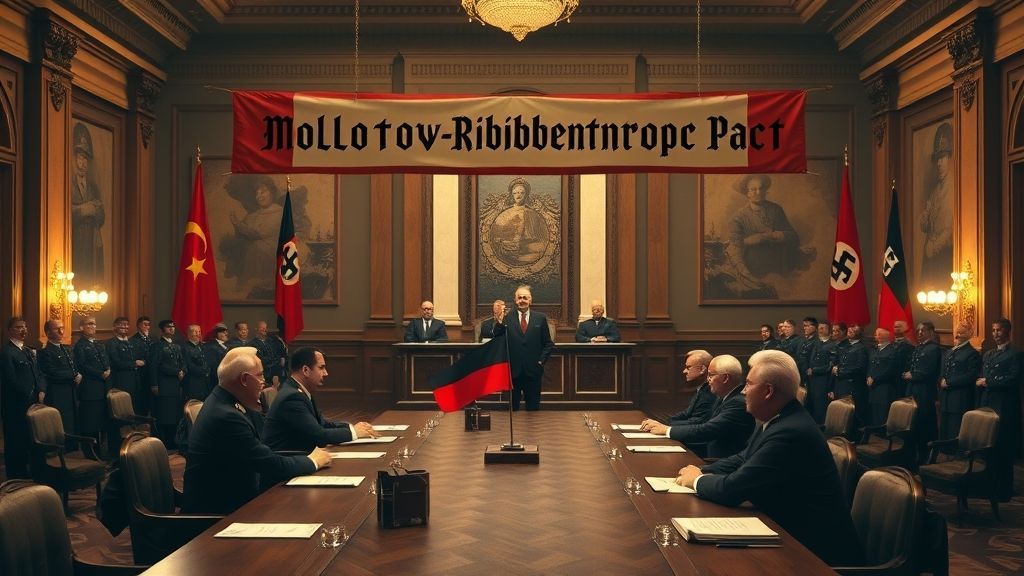
Imagine the hushed corridors of the Soviet Foreign Ministry, the steely eyes of Vyacheslav Molotov meeting those of Joachim von Ribbentrop, the Nazi foreign minister. They shook hands, not as friends, but as wary partners in a cynical game of power and survival. The pact they sealed was not just a treaty; it was a gesture loaded with betrayal, fear, and strategic calculation.
This was a moment when ideology bowed to realpolitik, when two sworn enemies inked an agreement that stunned the world and set in motion a chain of events nobody—and yet everybody—had seen coming.
2. Shadows over Diplomacy: The Strategic Calculus of Molotov and Ribbentrop
By 1939, Hitler's Germany had already torn Europe apart with its annexation of Austria and the Sudetenland. The Soviet Union, under Joseph Stalin’s iron grip, was equally assertive but isolated, surrounded by wary neighbors and anxious Western powers. Diplomatic channels buzzed with rumors, but the concept of a pact between two ideological archrivals—the communist USSR and fascist Nazi Germany—was inconceivable, even unthinkable.
Molotov and Ribbentrop were no strangers to the brutal chess game of diplomacy. For Stalin, the pact offered a buffer—a breathing space to prepare for an inevitable war. For Hitler, it was the green light to invade Poland without fear of Soviet intervention. Both men were shrewd, but their motivations reflected fundamentally different existential fears, even if they achieved a precarious alignment.
Behind closed doors, Stalin’s cautious pragmatism clashed with Hitler’s aggressive expansionism. Yet, the diplomatic dance swayed, and in August 1939, the contours of a pact that would freeze alliances and redraw borders began to emerge.
3. Behind Closed Doors: The Secret Negotiations in Moscow
For weeks, secret talks unfolded in Moscow between representatives of the two regimes. Negotiations were tense, laced with mutual suspicion and veiled threats. Neither side trusted the other, but both saw benefit in an uneasy truce.
Molotov and Ribbentrop’s meetings were as much displays of personality as they were negotiations of power. Ribbentrop, the flamboyant and ruthless German, sought to impress with promises and threats. Molotov, cold and calculating, carefully guarded Stalin’s intentions. It was during these discussions that a clandestine protocol was drafted—an agreement to divide Eastern Europe into spheres of influence, unbeknownst to the world.
The secret protocol was the pact’s most sinister element, predetermining invasions, occupations, and the fates of nations like Poland, the Baltic States, and Finland. This treachery was kept out of the public eye—an invisible noose tightening around the neck of European sovereignty.
4. The Pact That Stunned the World: Signing on August 23, 1939
On August 23, 1939, the Molotov–Ribbentrop Pact was formally signed in Moscow. The ceremony was a theatrical display of camaraderie—smiles, handshakes, and speeches proclaiming peace, friendship, and non-aggression. The world’s press briefly hailed it as a surprising but hopeful moment in international relations.
Yet, beneath the surface, the pact was a ticking time bomb. It guaranteed that neither Germany nor the USSR would attack each other, allowing Hitler to concentrate on Western Europe without fear of an Eastern front. In exchange, Stalin secured territory and time but also sealed the fate of vulnerable nations caught between these two giants.
The pact’s signing was a diplomatic earthquake whose tremors would ripple across the globe within days.
5. Anatomy of the Molotov–Ribbentrop Pact: Public Terms and Hidden Clauses
Publicly, the pact was presented as a non-aggression treaty—a promise that two great powers would abstain from warfare against each other. The official document spoke lofty language: mutual respect, territorial integrity, peaceful resolution of disputes.
However, the hidden secret protocol, known only to a few elites, was the pact’s dark heart. It carved up Eastern Europe into spheres of influence: Poland was split between Germany and the USSR; the Baltic States—Estonia, Latvia, Lithuania—were assigned to Soviet control; Finland and parts of Romania also fell under Soviet interest.
This secret annex not only enabled invasions but also justified mass deportations, political purges, and the onset of brutal repressions in occupied territories. The real Molotov–Ribbentrop Pact was a treaty signed in shadows—one that betrayed the very principles it publicly proclaimed.
6. Immediate Repercussions: Shockwaves Across Europe and Beyond
News of the pact sent tremors through diplomatic circles. Churchill, though not yet Prime Minister, reportedly described the alliance as a "mad pact of friends and enemies." Western democracies, cornered and confused, struggled to apprehend the implications.
For Poland, caught in the monumental gambit, the pact was a death knell. The country, a vibrant democracy re-established after World War I, found itself betrayed by its eastern neighbor and exposed to the full blitzkrieg fury of Nazi Germany.
In Paris and London, hopes for a collective security arrangement with the USSR were dashed. The pact undermined decades of diplomatic efforts aimed at containing Hitler and preserving peace. Around the globe, nations braced for the rupture that would soon ignite.
7. The Invasion of Poland: The Dark Dawn of World War II
Just days after the pact’s signing, on September 1, 1939, Nazi Germany launched a brutal invasion of Poland. The blitzkrieg was swift and merciless, a ferocious onslaught of tanks, planes, and infantry that overwhelmed Polish defenses. What many had feared now unfolded: Europe had plunged, inexorably, into war.
On September 17, the Soviet Union too invaded Poland from the east, crushing any hopes of a unified defense. The Polish state, overwhelmed by two totalitarian powers, was partitioned and erased from the map.
This joint assault was a chilling fulfillment of the secret protocol, a sobering testament to the pact’s devastating power.
8. Stalin’s Calculated Gamble: Seeking Time or War?
Stalin’s motives remain a complex subject of historical debate. Was the pact a strategic masterstroke to buy time, modernize the Soviet military, and prepare for a future conflict? Or was it a dangerous gamble that delayed an inevitable war and cost millions?
For Stalin, the world was a hostile place with no real allies. The pact temporarily kept Soviet borders safe and expanded Soviet control. Yet, it also entangled the USSR in a messy web of occupation and repression that would haunt Stalin’s regime.
The calculus behind the pact reveals how geopolitics often tramples morality—a grim reminder that statesmen often deal in power, not principles.
9. Hitler’s Tactical Masterstroke or Overreach?
Hitler’s reasoning was more straightforward: the pact cleared the path to war in the West with no fear of fighting a two-front conflict. With Britain and France left as the only obstacles, Hitler unleashed war with brutal efficiency.
Yet, some historians argue this was a short-sighted move, underestimating the Soviet will and capacity to resist. The subsequent German invasion of the USSR in 1941 shattered the pact and unleashed one of the largest and bloodiest theaters in history.
The Molotov–Ribbentrop Pact, in this light, was both a stroke of genius and a Pandora’s box.
10. The Western Powers’ Reaction: Betrayed and Unprepared
Britain and France, bound by guarantees to Poland, declared war on Germany following the invasion but remained ill-prepared for the enormity of the conflict that loomed. The Soviet pact with Germany demoralized Western leaders who had hoped for a united front against fascism.
Diplomatic efforts faltered, and alliances fractured. The pact also sowed deep mistrust between the USSR and the Western democracies—suspicion that would harden into Cold War animosity decades later.
For leaders and citizens alike, it was a bitter awakening: the old order was dead, replaced by ruthless power politics.
11. The US and the Global Stage: Echoes from Afar
Across the Atlantic, the United States watched with growing concern. Officially neutral, the US was grappling with its own debates about intervention, isolationism, and aid.
The Molotov–Ribbentrop Pact complicated American perceptions of the Soviet Union, revealing a Soviet regime willing to collude with fascists. This ambiguity influenced US policy, from the Neutrality Acts to the eventual Lend-Lease support.
The pact’s reverberations illuminated the increasingly interconnected nature of global politics—no treaty was merely local anymore.
12. The Pact’s Role in Shaping the Eastern Front
The agreement redrew the borders and the fates of countless peoples across the East. The Soviet occupation of Eastern Poland, the Baltic States, and parts of Finland launched a series of political purges, mass arrests, and forced deportations.
Estonia, Latvia, and Lithuania, once proud sovereign nations, fell under the Soviet grip. The repression that followed sowed resentment, resistance, and tragedy.
The Eastern front would become the deadliest battleground of the entire war, shaped in no small part by the early decisions carved in the Molotov–Ribbentrop Pact.
13. The Secret Protocol’s Human Cost: Dividing Nations and Peoples
The little-known secret protocol was more than a diplomatic footnote—it was a death sentence for millions. Families were uprooted, communities split, and nations erased from maps.
In Poland, thousands were executed or deported under Soviet control, including the chilling massacre at Katyn, where over 22,000 Polish officers and intelligentsia were murdered by Soviet forces.
The Baltic States lost their independence, with brutal political repression following annexation. The human cost of the pact’s secret clauses reverberated for generations.
14. Diplomacy Undermined: Trust and Treachery in International Relations
The Molotov–Ribbentrop Pact shook the foundations of trust in international relations. Ideology was cast aside in favor of opportunistic alliances, revealing the fragility of diplomatic norms.
It demonstrated how propaganda could mask harsh realities, and how fragile alliances may be when confronted with realpolitik. The pact also exposed the dangers of appeasement and the limits of diplomatic engagement in the face of totalitarian ambition.
It left an enduring question: can genuine peace ever be secured through deals made in the shadows?
15. The Pact in Soviet and Nazi Propaganda
Both regimes spun their ratification of the pact to suit their narrative. The Soviets proclaimed it a defensive measure to protect Soviet borders and signaled a break from “imperialist wars.” Nazi Germany presented it as a guarantee for peace in Europe.
Meanwhile, domestic propaganda demonized enemies and justified aggressive expansion. Yet, the majority of populations on both sides remained wary, sensing the yawning gulf between words and actions.
The pact became a powerful symbol of betrayal—its legacy embedded in the propaganda machinery of totalitarian states.
16. The Molotov–Ribbentrop Pact and the Outbreak of the Second World War
Though the causes of WWII were complex and multifaceted, few events were as catalytic as this pact. By neutralizing the Soviet threat to Germany, it allowed Hitler to unleash devastation on Poland and then pivot westward.
The war that followed reshaped the global order, redrew borders, and caused unprecedented human suffering. The pact was, in many ways, the powder keg’s spark.
Yet, had it not been signed, would the war have begun differently, or would it have been delayed? Such questions fuel ongoing debates but never diminish the pact’s undeniable impact.
17. When Allies Became Enemies: The Pact’s Demise in 1941
The fragile peace unraveled on June 22, 1941, when Nazi Germany launched Operation Barbarossa, the massive invasion of the Soviet Union, breaking the pact’s terms and plunging the two former signatories into brutal war.
This betrayal was a turning point, drawing the USSR into the Allied camp and dramatically widening the conflict. The Eastern Front became a crucible of sacrifice and heroism, as well as horror.
It marked the tragic reminder that in the world of despots, treaties are only as lasting as the convenience of their makers.
18. Historical Debates and Controversies: Interpreting the Pact’s Legacy
Historians remain divided on the Molotov–Ribbentrop Pact’s interpretation. Some view it as Stalin’s realpolitik, necessary for Soviet survival. Others see it as moral bankruptcy—an act of cynicism that emboldened fascism.
The secret protocol’s disclosure after the war sparked fury, condemnation, and reevaluation of Soviet actions. The pact’s memory complicates narratives of WWII heroism and villainy.
It invites reflection on the seductive dangers of compromise with evil, and the complex human calculus of power.
19. The Memory of the Pact in Postwar Europe and Russia
For decades, the Molotov–Ribbentrop Pact was either suppressed or vilified—depending on the political context. In the Soviet Union, the pact was initially justified, then quietly ignored or denied.
Post-Soviet states, especially the Baltic countries and Poland, have recorded the pact as a grave injustice and an initial act of World War II aggression. It remains a painful memory in national histories.
Russia’s current discourse around the pact reflects ongoing tensions over historical narratives—a testament to its enduring relevance.
20. Lessons from August 1939: Diplomacy, Ethics, and Realpolitik
The Molotov–Ribbentrop Pact stands as a stark lesson in the perils of diplomacy divorced from moral considerations. It challenges us to consider the price of strategic convenience, the dangers of ideological betrayal, and the human cost buried beneath treaties.
In a world still torn by alliances of convenience and cynical deals, the pact’s legacy warns that peace bought at the expense of justice is brittle and temporary.
Understanding August 1939 is not merely revisiting history—it is grasping enduring truths about power, sacrifice, and the fragility of trust.
Conclusion
The Molotov–Ribbentrop Pact remains one of the most astonishing and consequential agreements of the twentieth century—a pact between sworn enemies that redefined geopolitics, unleashed one of history’s deadliest wars, and left a legacy etched in pain and mistrust.
Its story is one of paradoxes: peace sealed in shadow, unity forged on betrayal, and power leveraged at tremendous human cost. It teaches that diplomacy can be both a shield and a weapon, that beneath the formal text of treaties lies a deeper battle of interests and ideologies.
As we look back, we see not just a frozen moment in time but a vivid lesson on how history is shaped by the choices of leaders balancing ambition with fear, idealism with pragmatism.
The Molotov–Ribbentrop Pact is a testament to the complexities of human nature and international affairs—a reminder that history demands both our study and our conscience.
FAQs About the Molotov–Ribbentrop Pact
Q1: Why did the Soviet Union and Nazi Germany sign the Molotov–Ribbentrop Pact despite their ideological opposition?
A: Both regimes were motivated by pragmatic considerations. Stalin sought to buy time to build Soviet military strength and secure territorial gains, while Hitler aimed to avoid a two-front war and swiftly conquer Poland. The pact was convenience trumping ideology.
Q2: What was included in the secret protocol of the pact?
A: It outlined the division of Eastern Europe into German and Soviet spheres of influence, dividing Poland, assigning the Baltic States, Finland, and parts of Romania to Soviet control, enabling future invasions and annexations.
Q3: How did the Molotov–Ribbentrop Pact influence the outbreak of World War II?
A: The pact removed Soviet opposition to a German invasion of Poland, facilitating Hitler's attack and prompting Britain and France to declare war, marking the official beginning of WWII.
Q4: What was the reaction of Western countries to the pact?
A: Western powers felt betrayed and alarmed. The agreement undercut efforts for collective security and left democracies unprepared for the sudden German-Soviet alliance.
Q5: When and why did the Molotov–Ribbentrop Pact end?
A: It ended in June 1941 when Germany launched Operation Barbarossa, invading the Soviet Union and breaking the pact’s non-aggression terms, bringing the USSR into the Allied camp.
Q6: How is the pact remembered today in countries affected by it?
A: It is remembered as a cynical betrayal, marking the start of occupation and suffering. In Poland and the Baltic States especially, it symbolizes the loss of sovereignty and the horrors that followed.
Q7: Was the pact a cause or a symptom of the wider conflicts leading to WWII?
A: It was both. It was a catalyst enabling war to start as planned, but also the outcome of broader failures in diplomacy and security arrangements in interwar Europe.
Q8: What lessons does the Molotov–Ribbentrop Pact hold for contemporary international relations?
A: It serves as a warning against alliances that prioritize strategic gain over ethical considerations, highlighting the fragility of peace built on opportunistic deals and the importance of trust and transparency in diplomacy.