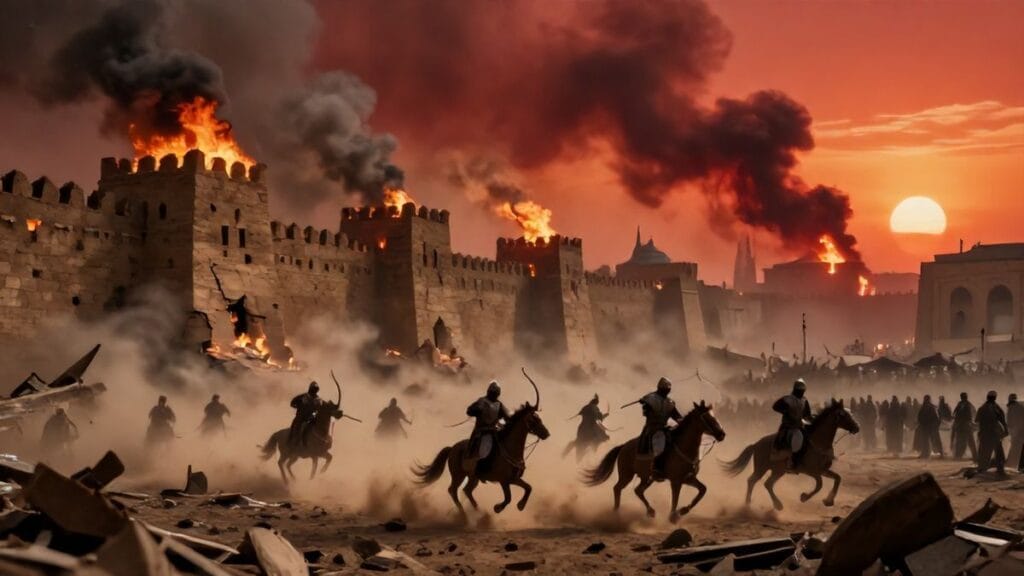
Table of Contents
- Whispers Before the Storm: Baghdad on the Eve of Catastrophe
- An Empire of Books and Minarets: The Abbasid World Before 1258
- From the Steppes to the Tigris: How the Mongols Reached the Gates of Baghdad
- Hulagu Khan’s March: Letters, Threats, and the Caliph’s Fatal Miscalculation
- Encircled by Fear: The Siege Lines Tighten Around the City of Peace
- Engines of Destruction: Mongol Siegecraft Meets Abbasid Walls
- Collapse at the Eastern Gate: Betrayals, Surrenders, and Broken Defenses
- When the Mongols Sack Baghdad: Six Days that Shattered a Civilization
- Blood in the Streets and Fire in the Libraries: Human Voices from the Ruins
- The Death of a Caliph: Ritual Humiliation and the End of an Era
- Ashes of Knowledge: The Destruction of the House of Wisdom and Baghdad’s Learned World
- Survivors and Collaborators: Who Lived, Who Died, and Who Adapted
- From Caliphate to Khanate: Political Aftershocks Across the Islamic World
- A Wound in the Tigris: Social and Economic Ruin in the Aftermath
- Chroniclers of Doom: How Medieval Historians Remembered 1258
- From Trauma to Legend: The Mongols Sack Baghdad in Memory and Myth
- Long Shadows: How 1258 Reshaped the Middle East and Global History
- Conclusion
- FAQs
- External Resource
- Internal Link
Article Summary: On a February morning in 1258, the city once called the “Jewel of the World” fell to a storm of steel and fire as the Mongols sack Baghdad and ended the Abbasid Caliphate. This article traces the long road from Baghdad’s golden age of learning and trade to the tense miscalculations that placed the caliph al-Mustaʿsim face to face with Hulagu Khan. It narrates the siege, the breaching of the walls, and the week-long catastrophe when the Mongols sack Baghdad and turned the Tigris black and red with ink and blood. Alongside the political story run the human stories of scholars, merchants, soldiers, and ordinary residents caught between loyalty, faith, and survival. We explore how the destruction of libraries, hospitals, and mosques symbolized a wider collapse of an entire urban civilization. The narrative follows the spread of shock waves across the Islamic world, as rulers, jurists, and poets tried to make sense of the moment the Mongols sack Baghdad and the caliphate crumbled. It also examines how different chroniclers—Muslim, Christian, and even Mongol—remembered the siege and debate its numbers, motives, and meanings. In the final analysis, the article reflects on how the memory of the mongols sack baghdad still shapes modern understandings of violence, empire, and the fragility of cultural achievement.
Whispers Before the Storm: Baghdad on the Eve of Catastrophe
On the night before the walls shook and the sky glowed with fire, Baghdad did not feel like a dying city. The bakeries in the great markets still opened before dawn, sending thin streams of bread smoke into the cool February air. Lanterns flickered along the Tigris as ferrymen called out to late travelers. In the mosques and madrasas, students bent over manuscripts, tracing inked lines of Aristotle and al-Ghazali in the soft light of oil lamps. Yet, beneath this fragile normality, rumor moved quietly through the streets: the Mongols were coming.
The phrase “mongols sack baghdad” was not yet fixed in memory, but the dread behind those words already lived in every conversation held in hushed tones at corners of tea houses and under vaulted bazaars. Caravans from the east arrived with news of cities burned, of fortresses reduced to rubble, of rivers running thick with corpses. Merchants who had traded through Khurasan and Persia spoke of Hulagu Khan—grandson of Chinggis Khan—leading an army the size of which they had never seen, bringing with it siege engineers from China and subject nations eager to prove their loyalty through destruction.
Inside the palaces of the Abbasid caliph al-Mustaʿsim, however, the mood was strangely divided. Courtiers, eunuchs, and bureaucrats argued fiercely over how serious the Mongol threat really was. Some, remembering that previous Mongol envoys had treated the caliph with ritual respect, insisted this too could be managed through diplomacy, gifts, and prayers. Others brought letters from border commanders warning that this time was different, that the Mongols had vowed to end the caliphate itself. But Baghdad, nestled in the bend of the Tigris and girded by walls that had stood for centuries, seemed invincible to many of its officials. The city of Harun al-Rashid, of the fabled tales of the “Thousand and One Nights,” surely could not vanish in a single campaign.
It’s astonishing, isn’t it, how often civilizations feel immortal just before catastrophe? Scholars debated fine points of theology while armies moved inexorably closer. The markets remained stocked; the call to prayer still marked the hours with a familiar rhythm. Yet, beyond the horizon, Hulagu’s vanguard advanced, and every step they took shortened the life of the Abbasid capital. In just a short time, the phrase “when the mongols sack baghdad” would no longer be a fear but a reality etched into stone, memory, and ink.
An Empire of Books and Minarets: The Abbasid World Before 1258
To understand what was lost in 1258, one must first step back into the Baghdad that had dazzled the medieval world for half a millennium. Founded in 762 by the Abbasid caliph al-Mansur, Baghdad grew rapidly from a planned circular city into an immense metropolis that stretched along both banks of the Tigris. Its nickname, “Madinat al-Salam”—the City of Peace—reflected not only theological aspirations but also the prosperity that came from sitting at the crossroads of Asia, Africa, and Europe.
The Abbasid Caliphate, though politically fragmented by the thirteenth century, still carried immense symbolic weight. The caliph, a descendant of the Prophet Muhammad’s uncle, Abbas, represented unity and legitimacy for Sunni Muslims from al-Andalus in the west to the borders of India in the east. Even when powerful regional dynasties—Seljuks, Buyids, and others—held real military authority, they still sought the caliph’s recognition. By 1258 the caliphate’s territory had shrunk, but its spiritual prestige was not yet extinguished.
Baghdad’s greatest achievement, however, lay in its role as a cultural and intellectual magnet. In the ninth and tenth centuries, the city had hosted the Bayt al-Hikma, the House of Wisdom, where scholars translated Greek, Persian, and Indian texts into Arabic and then built on that knowledge. By the time the Mongols approached, this earlier golden age had dimmed somewhat, but its afterglow still illuminated the city. Libraries attached to mosques and colleges held thousands of volumes. Physicians trained in hospitals that combined practical medicine with theoretical learning. Astronomers observed the heavens from observatories, and jurists in the four Sunni legal schools issued opinions on questions that linked daily life to divine law.
To a visitor in the early 1200s, Baghdad might have seemed crowded and somewhat decayed in places, but still unmistakably grand. The markets along the Khuld and Rusafa districts thrummed with trade: textiles from Damascus, spices from India, furs from the north, slaves from Central Asia and Africa, and fine paper produced in the workshops along the Tigris. The city’s population is difficult to estimate—medieval chroniclers often exaggerated—but even conservative guesses place it in the hundreds of thousands, making it one of the largest cities in the world.
Religiously and ethnically, it was a mosaic. Arabs, Persians, Turks, Kurds, Armenians, Jews, Christians, and others mingled in the same streets. Each community maintained its own institutions and leaders, yet all were tied together by trade and the authority of the caliph. Sufi lodges hosted mystics and commoners seeking spiritual guidance. Christian monasteries outside the city copied manuscripts in Syriac and Arabic. Jewish scholars debated Talmudic law and philosophy. All of this would be thrown into chaos when the mongols sack baghdad just a few decades later.
Politically, however, the Abbasid state that faced Hulagu Khan was not the disciplined, confident empire of the early caliphs. Real power increasingly resided in military commanders and bureaucratic factions. The caliph al-Mustaʿsim, who came to the throne in 1242, inherited a palace culture rife with intrigue. He was devout and personally pious, but by many accounts indecisive and too easily swayed by favorites. The caliph’s vizier, Ibn al-‘Alqami, would later be accused—fairly or not—of treachery in some chronicles; others portrayed him as a desperate man trying to manage an impossible situation between a fragile court and an unstoppable storm from the east.
From the Steppes to the Tigris: How the Mongols Reached the Gates of Baghdad
The story of how the Mongols reached Baghdad begins half a century earlier on the cold grasslands of Mongolia. Under Chinggis Khan and his successors, the Mongols forged the largest contiguous land empire in history, stretching from the coasts of China to the plains of Eastern Europe. Renowned for their cavalry, discipline, and ruthless use of terror as a tool of policy, they shattered long-standing dynasties and redrew political maps with shocking speed.
By the early thirteenth century, the Mongols had already touched the Islamic world. They struck Khwarezmia after its ruler rashly executed a Mongol trade delegation. What followed was a brutal series of campaigns in which cities like Urgench, Bukhara, and Samarkand were sieged, looted, and partially or wholly destroyed. Tales of pyramids of skulls constructed outside city walls spread like wildfire across the region. Refugees poured into other Islamic lands, including Iraq, bringing with them horror stories that etched the name “Mongol” into the Muslim imagination as a symbol of apocalyptic violence.
Yet, for a time, the Abbasid Caliphate remained on the margins of these catastrophes. The Mongols turned their attention to China, Eastern Europe, and the Caucasus. Internal succession struggles among Chinggis Khan’s descendants temporarily slowed their advance. It was only when Möngke Khan took the position of Great Khan in 1251 that a new strategic vision emerged: to consolidate Mongol control over the Islamic heartlands as part of a wider imperial unification.
Möngke entrusted this task to his brother Hulagu Khan. Unlike earlier Mongol commanders who had raided and withdrawn, Hulagu was tasked with a deeper transformation: subjugate or destroy the Isma‘ili Assassins in their mountain fortresses of Iran, bring the Abbasid caliph to heel, and assert Mongol authority over Syria and beyond. Hulagu gathered an enormous army—sources suggest up to 150,000 troops, including Mongol core units, Turkic allies, Armenian and Georgian contingents, and specialized engineers from China and Central Asia.
As Hulagu’s forces moved westward in the early 1250s, they first targeted the Nizari Isma‘ili strongholds, whose castles had long vexed both Sunni and Shi‘a rulers. One by one, fortresses fell—most famously Alamut in 1256. Their destruction removed a complex player from the political chessboard but also sent a clear message to the Abbasids: no mountain stronghold, no remote bastion, was beyond Mongol reach. Baghdad, a city on a plain, with no great hills to hide behind, must have watched these events with growing alarm.
By 1257, the Mongols had secured much of Iran and northern Mesopotamia. The road to Baghdad lay open. Hulagu sent envoys ahead, demanding the caliph’s submission. Baghdad was not just another city to be plundered; it was the symbolic heart of Sunni Islam. For the Mongols, who often sought to co-opt existing political structures where possible, there was still room—at least theoretically—for a caliph who would accept vassal status. But the stage was being set for confrontation instead.
Hulagu Khan’s March: Letters, Threats, and the Caliph’s Fatal Miscalculation
Diplomacy between Hulagu Khan and al-Mustaʿsim unfolded as a tense dance of pride, fear, and misjudgment. Chroniclers such as Ibn al-Fuwati and later historians preserved fragments of letters exchanged before the siege. While the exact wording varies between sources, a common pattern emerges: Hulagu demanded that the caliph dismantle Baghdad’s defenses, appear in person, and accept Mongol overlordship; the caliph responded with prayers, appeals, and at times veiled defiance.
One account describes Hulagu warning that if the caliph refused submission, the Mongols would treat Baghdad as they had treated other defiant cities. The caliph, steeped in centuries of Islamic imperial confidence, believed that his spiritual authority and the prestige of the city would protect him. Some advisers reportedly assured him that previous Mongol incursions into the region had faltered, that no infidel army would be allowed by God to destroy the seat of the caliphate. Others, more cautious, urged conciliation, arguing that paying tribute and symbolically acknowledging Mongol authority might buy time and preserve the city.
The vizier Ibn al-‘Alqami appears at the center of this drama. Later Sunni historians, seeking a scapegoat for the catastrophe, painted him as a treacherous Shi‘a who deliberately weakened the city’s defenses and misled the caliph. Other sources, including some Shi‘a writers, depict him as a reformer frustrated by military incompetence and palace corruption, caught between an obtuse caliph and an implacable invader. Either way, the Abbasid court failed to present a united front. While Hulagu methodically organized his supply lines and siege equipment, Baghdad’s rulers argued over budgets, troop levies, and the etiquette of addressing a Mongol khan.
Hulagu, meanwhile, advanced with calculated menace. He secured cooperation from regional forces—most notably some Christian Armenian and Georgian princes who had grievances against Muslim neighbors. The Mongol army approached along both banks of the Tigris, encircling the city’s approaches. A cold logic guided their campaign: break the Abbasid symbol, and the rest of the region would be easier to dominate. Resistance would then seem futile to other rulers.
In late 1257, Hulagu issued a final ultimatum. Its terms, as preserved by some chroniclers, were harsh but not unprecedented in Mongol diplomacy: surrender the city, submit the caliph, and avoid total destruction. The caliph’s response was tragically inadequate. Either deceived by overconfident advisers or unable to imagine true disaster, al-Mustaʿsim failed to muster sufficient troops and supplies. He did not call effectively on distant Muslim powers for coordinated aid. Baghdad, which once commanded armies across continents, now faced the greatest threat in its history largely alone.
This was the last quiet moment before the phrase “when the mongols sack baghdad” was carved onto the very timeline of the Islamic world. The die was cast; the armies moved into position; the City of Peace braced, unprepared, for war.
Encircled by Fear: The Siege Lines Tighten Around the City of Peace
The siege of Baghdad began in January 1258 under gray winter skies. The Mongols advanced with frightening efficiency, establishing camps on both sides of the Tigris to ensure no escape routes remained. They brought with them not only horse archers but an arsenal of siege equipment: catapults, counterweight trebuchets, battering rams, and sappers trained to undermine walls. Chinese and Persian engineers, compelled into Mongol service, supervised the construction of massive engines that could hurl stones and incendiary projectiles far into the city.
Inside Baghdad, panic slowly replaced denial. At first, some residents believed this was just another raid, a test of the city’s bravery. But as reports arrived of nearby towns ravaged and as smoke appeared on the horizon, fear took over. The caliph ordered the city’s defenses manned; soldiers took their positions along the walls, and volunteers from among the populace joined them, armed with what they could find—bows, swords, even farm tools.
The Tigris itself became both shield and trap. Bridges were fortified or destroyed to hinder Mongol movement, but the attackers were adept at crossing rivers. They constructed pontoon bridges and rafts, ensuring constant communication between forces on either bank. Mongol scouts probed the defensive lines, mapping weaknesses, measuring the walls’ height, noting the morale of the defenders through the frequency of arrows and insults from the ramparts.
For the ordinary people of Baghdad, the siege meant hunger, uncertainty, and spiritual terror. Markets shrank as goods became scarce. Prices soared. Families hoarded grain. The wealthy stockpiled provisions in their mansions; the poor begged at their doors. Preachers in mosques exhorted the faithful to repent, to pray, to trust in divine deliverance. It was hard to reconcile the image of Baghdad as the protected heart of Islam with the very visible reality of Mongol banners fluttering just beyond bowshot.
Some attempted to flee early, before the ring of steel fully closed, but Mongol cavalry hunted down many would-be escapees. Refugees from suburbs and nearby villages crowded into the city, bringing tales that robbed even the most optimistic residents of hope. They spoke of other sieges where Mongols promised mercy, then unleashed annihilation after any sign of resistance. These stories gave a strange weight to every rumor, every sound outside the walls.
Yet behind the gathering dread, life did not quite stop. Children still chased one another through alleys, not fully understanding what the term “Mongol” meant. Scribes still copied documents; judges deliberated cases; marriages were arranged in haste. In times of looming disaster, people cling to normality as if routine itself could shield them. But the walls that had protected generations were about to face a force designed to break exactly such illusions.
Engines of Destruction: Mongol Siegecraft Meets Abbasid Walls
As January drew to a close, the Mongols moved from encirclement to active assault. Siege engines were pushed forward under the cover of archers. The defenders’ arrows rattled against wooden frames and leather hides that protected the machines. Soon, massive stones began to arc over Baghdad’s walls, crashing into houses, markets, and mosques with deafening force.
The Abbasids were not entirely helpless. They possessed their own artillery and tried to counter-fire. On the walls, defenders poured boiling liquids and hurled rocks at any Mongol troops who approached too closely. Archers targeted the crews of siege engines whenever gaps in the protective coverings appeared. For a brief time, it looked as though the city might hold out longer than expected.
But Mongol siege warfare had been refined in campaigns across China, Central Asia, and Persia. Their engineers adapted rapidly. When defenders damaged a trebuchet, another was assembled. When arrows from the walls found their mark too often, shield lines advanced or trenches were dug for protection. Sappers tunneled toward the base of the walls, seeking to undermine them by burning wooden supports and collapsing foundations.
Rain and cold complicated the struggle. Mud sucked at the feet of soldiers; supplies became harder to move. For the residents of Baghdad, the season’s chill seeped into bones already numbed by fear. In some districts, people spent nights in basements or inner rooms, listening for the terrifying whistle and crash of incoming projectiles. Every dawn revealed new ruins, fresh craters, and the growing sense that the city’s defenses were unraveling.
Mongol archers, famed for their skill, maintained a constant pressure. Anyone who appeared on the walls risked being shot. Over time, fatigue and casualties reduced the number of defenders able to man every tower and parapet. The Abbasid command structure, already fragile, struggled to coordinate coherent resistance. Communications between different sectors of the walls were slow and often interrupted by bombardment.
Within this grinding, methodical onslaught, there were moments of heroism. Chronicles speak of unnamed warriors who refused to abandon their posts, of imams who prayed for the defenders while under fire, of women carrying water and stones to the ramparts. Yet courage could not make up for structural weakness and demographic imbalance. Hulagu’s army simply had more men, more machines, and more experience in overcoming city walls than Baghdad had in defending them.
As the days passed, the phrase “if the mongols sack baghdad” turned, in the minds of many within the city, into “when the Mongols do.” The walls trembled; the will to fight eroded. A single breach, they knew, would turn siege into slaughter.
Collapse at the Eastern Gate: Betrayals, Surrenders, and Broken Defenses
The fall of Baghdad’s defenses was not a single dramatic moment but a sequence of failures and desperate decisions. Most sources agree that a crucial breach occurred on the eastern side of the city, though details vary. Some describe Mongol sappers successfully collapsing a segment of the wall. Others suggest that a gate was opened, either through treachery or negotiation gone wrong.
The question of betrayal has haunted the memory of 1258. Accusations centered on certain court factions and military leaders who, disillusioned with the caliph’s leadership, may have considered negotiation their only hope. Later chroniclers, such as the great historian Ibn al-Athir writing slightly earlier about other Mongol assaults, framed such collapses as moral failures as much as military ones. Although Ibn al-Athir died before 1258, his lament for earlier Mongol devastations—“I wish my mother had not borne me, or that I had died before seeing what I have seen”—has often been echoed by writers describing Baghdad’s fate.
However the breach occurred, when Mongol troops finally poured into the outer districts, the defenders’ line effectively broke. Panic swept through nearby neighborhoods; residents tried to flee deeper into the city. The Abbasid troops, outnumbered and exhausted, could not form a coherent second line of defense. Some fought to the last; others stripped off their armor in an attempt to vanish into the civilian population.
The caliph’s court, confronted with the reality that the walls had failed, faced an agonizing choice. To continue resistance might mean total destruction of the city’s population; to surrender might mean humiliation, exile, or execution. Envoys were sent out to Hulagu to discuss terms. We do not know exactly what words passed between them, but the outcome is clear: within days, al-Mustaʿsim himself left the safety of his palace and placed himself in Mongol custody, hoping that his status as Commander of the Faithful would restrain Hulagu’s fury.
This gesture did not save Baghdad. Some sources suggest that certain Mongol commanders argued for sparing the city, pointing to its potential value as a tax base and administrative center. Others, angered by the initial resistance and perhaps by the caliph’s earlier refusal to submit, favored exemplary punishment. Hulagu ultimately chose devastation as a warning to the rest of the Islamic world: defiance of Mongol power would bring annihilation.
With the caliph effectively neutralized, organized resistance within the city disintegrated. The remaining defenders were cut down or fled. Mongol units fanned out through the streets, mapping out the quarters to be looted and destroyed. The siege was over; the sack was about to begin. And in that transition—from a besieged but still functioning city to an open victim—the world of medieval Islam crossed a threshold it would never fully recross.
When the Mongols Sack Baghdad: Six Days that Shattered a Civilization
On or around 10 February 1258, the Mongols sack Baghdad in a fury of killing, burning, and looting that lasted roughly a week. Many medieval sources agree that the slaughter continued for several days, though the exact length and casualty figures remain debated. Some chroniclers, perhaps in shock, gave astronomical numbers—hundreds of thousands, even a million dead. Modern historians tend to be more cautious, but even conservative estimates point to a scale of destruction unmatched in the city’s history.
Mongol troops moved systematically from quarter to quarter. They were not an unrestrained mob; they were soldiers following orders. Certain groups—particularly scholars associated with Hulagu’s adviser, the polymath Naṣir al-Dīn al-Ṭūsī, and some Christian communities who had ties to Mongol-allied powers—were reportedly spared or suffered less. But most of Baghdad’s ordinary population, Muslim and non-Muslim alike, bore the brunt of the violence.
Men of fighting age were prime targets. Many were slaughtered on the spot, their bodies left where they fell. Women and children were taken captive or killed. Houses were broken into, valuables seized, and structures sometimes set alight. The narrow twisting lanes of Baghdad, once alive with music, prayer, and bargaining, became killing grounds. Survivors, years later, would recall streets so filled with corpses that it was difficult to walk without stepping on bodies.
The Mongols sack Baghdad not only in terms of human life but also in terms of material culture. Palaces were stripped of treasures accumulated over centuries. Artworks, tapestries, jeweled Qur’ans, and porcelain from China—symbols of world-spanning trade—vanished into Mongol wagons or were destroyed in the chaos. The great markets of the city, with their covered stalls and bustling merchants, were gutted. Fire leaped from rooftop to rooftop, consuming entire blocks.
Water, the city’s lifeblood, became a conveyor of death. The Tigris reportedly ran thick with bodies. Some accounts claim so many books from Baghdad’s libraries were thrown into the river that the water turned black from ink and that bridge-like masses of manuscripts formed briefly before being carried away. While these images may be exaggerated, they capture a fundamental truth: the Mongols sack Baghdad not just as conquerors but as executioners of a whole urban civilization. As the flames climbed and the smoke blotted the winter sun, the City of Peace looked less like a place on earth than a vision of the apocalypse.
Blood in the Streets and Fire in the Libraries: Human Voices from the Ruins
To grasp the emotional reality of 1258, it helps to listen—through the cracks of time—to the voices of those who witnessed or remembered. A later historian, Ibn al-Fuwati, who himself lived in Baghdad during the Mongol period, described the scale of loss with a stunned sobriety, noting that mosques, madrasas, and hospitals were “laid waste and destroyed” and that few were spared the sword. Another chronicler, the Christian writer Bar Hebraeus, whose community survived under Mongol rule, estimated that almost the entire population of the city perished. Their numbers differ, but their tone converges: horror, disbelief, mourning.
Imagine the physician making his way to the Bimaristan, the hospital where he has worked for years, only to find its wards full of corpses and its apothecary looted bare. Imagine the bookseller whose shop, once lined with carefully arranged volumes of poetry, philosophy, and law, lies blackened and empty, the charred remains of paper swirling in the air like strange ash-filled snow. Imagine the teacher who returns to his madrasa and finds the courtyard stained red, his students gone forever.
Among the victims were not only anonymous citizens but also leading lights of scholarship and piety. Judges, imams, poets, and administrators were killed in large numbers. Some scholars tried to gain protection by invoking their skills; a few, like Naṣir al-Dīn al-Ṭūsī, had already aligned themselves with Hulagu’s camp and survived to serve the new regime. But for many, the networks of patronage and learning that had sustained them evaporated overnight.
In later decades, survivors and their descendants would tell stories of miraculous escapes and quiet acts of mercy. A Mongol soldier who secretly allowed a family to flee; a neighbor who shared his hidden food stockpile with widows; a Christian or Jewish household that sheltered Muslim friends. These rare moments of humanity, however, could not undo the overwhelming impression that, for six days, the city had been abandoned to death.
One often-cited hadith, or prophetic saying, circulating at the time spoke of a people with faces like hammered shields and narrow eyes—interpreted by some as the Mongols—who would bring ruin in the end times. For many Baghdadis, the events of February 1258 seemed to confirm that they were living in apocalyptic days. Yet even apocalypses eventually end, leaving survivors to pick through the ruins and attempt to rebuild lives from fragments.
The Death of a Caliph: Ritual Humiliation and the End of an Era
Amid the carnage, the fate of the last Abbasid caliph in Baghdad, al-Mustaʿsim, took on symbolic meaning far beyond his personal story. Once the city had been subdued, Hulagu turned his attention to the man whose refusal to submit had, in his eyes, justified such destruction. The details of al-Mustaʿsim’s death are shrouded in legend, but all sources agree on its ritual character: the caliph, symbol of a universal Islamic order, was to be removed in a way that sent a message.
Several medieval historians report that the Mongols, following a taboo against spilling royal blood onto the earth, killed the caliph by wrapping him in a carpet or sack and trampling him under horses, or by some similar method that avoided direct bloodshed. Whether this precise detail is true or not, the core point remains: al-Mustaʿsim was executed after being forced to witness, at least in part, the fall of his city and the end of his line’s rule.
His family, too, was largely wiped out, though a few members escaped and later appeared in Cairo under Mamluk protection, claiming the title of caliph in a much-reduced, ceremonial capacity. But in Baghdad itself, the caliphate ended in 1258. For over five centuries, the Abbasid caliphs had been the theoretical leaders of the Sunni Muslim world. Their authority waxed and waned; they were sometimes puppets, sometimes reformers, sometimes mere figureheads. Still, the institution had endured, providing continuity across waves of political change. Now that continuity was broken.
The death of al-Mustaʿsim reverberated throughout the Islamic world. In Friday sermons from Damascus to Cairo, imams had for generations mentioned the caliph’s name alongside local rulers. Suddenly, that name was gone. Political theorists and jurists had long debated the nature of the caliphate—its necessity, its ideal form, its relationship to sultans and emirs. 1258 forced them to confront a new reality: Sunni Islam without a caliph in its traditional seat.
The Mongols, for their part, cared little for these theological tremors. By orchestrating the caliph’s death, Hulagu announced that the old order was over. The message was clear: allegiance was no longer to an invisible community under a distant caliph, but to the visible, tangible power of the khan and his deputies. When the Mongols sack Baghdad, they not only toppled walls and burned books; they also decapitated a political-theological system that had shaped centuries of history.
Ashes of Knowledge: The Destruction of the House of Wisdom and Baghdad’s Learned World
More than the palaces or markets, it was the destruction of Baghdad’s intellectual infrastructure that turned 1258 into a symbol of civilizational loss. By the thirteenth century, the original House of Wisdom founded by early Abbasids had likely changed, fragmented, or declined. Yet the city still contained an extraordinary density of libraries, private collections, and teaching institutions. These were not abstract symbols; they were living systems: scholars, copyists, students, and patrons woven into a vibrant culture of learning.
When the Mongols sack Baghdad, this world suffered a blow from which it would never fully recover. The burning of libraries, whether in deliberate bonfires or as collateral damage from the assault, meant the loss of many unique manuscripts. Commentaries on philosophy, rare copies of medical treatises, local histories, poetic anthologies, and works of theology vanished. Medieval authors later wrote of the Tigris running black with the ink of discarded books, a striking image even if physically unlikely on the literal level. It captured the felt sense that centuries of accumulated memory had been poured into the river and lost.
Some scholars were killed; others fled. Those who survived often carried with them only a fraction of what they had produced or studied. Centers like Damascus, Cairo, and later Anatolian and Persian cities absorbed some of Baghdad’s displaced intellectuals, helping those regions rise in relative prominence. Yet the particular alchemy that had made Baghdad the beating heart of a transcontinental knowledge network could not simply be transplanted elsewhere.
Science and philosophy also suffered. The Mongols, contrary to later stereotypes, did value certain forms of knowledge—especially astronomy and administration. Hulagu’s patronage of Naṣir al-Dīn al-Ṭūsī led to the establishment of the famous observatory at Maragha in Persia after Baghdad’s fall. But this did not offset the immediate devastation. The laboratories, observatories, and teaching hospitals of Baghdad either fell silent or had to be rebuilt from near-scratch under a new, alien regime.
In the Islamic historiographical tradition, 1258 often appears as a sharp dividing line between an age of flourishing and an age of fragmentation. The reality is more nuanced: decline and transformation had begun earlier, and impressive scholarship continued afterward. Yet the image of the mongols sack baghdad burning books and scattering scholars became a shorthand, a narrative pivot, for a perceived end of a classical age.
Survivors and Collaborators: Who Lived, Who Died, and Who Adapted
No sack, however brutal, kills everyone. When the fires dimmed and the Mongol soldiers withdrew to their camps, there were survivors picking their way through the ruins. The pattern of who lived and who died reflected a mix of chance, social connections, and Mongol policy.
Reports suggest that certain groups were deliberately spared or at least treated less harshly. Artisans and craftsmen with useful skills—builders, metalworkers, weavers—were valuable to any conqueror seeking to profit from a captured city. Some physicians and astronomers, recommended by figures like al-Ṭūsī, found new patrons in Hulagu’s entourage. Christian and perhaps some Jewish communities, especially those linked to powers allied with the Mongols, survived at statistically higher rates, though they, too, suffered losses.
Among Muslims, survival often hinged on being able to demonstrate immediate utility or having someone of influence plead their case. There were also, inevitably, collaborators: local notables who quickly aligned themselves with Mongol authority in order to secure positions as tax collectors, administrators, or intermediaries. Posterity has often judged them harshly, but their choices were made in a world where the old state had vanished and the new one held the sword.
For ordinary survivors—widows, orphans, merchants who lost everything, laborers now jobless—the immediate question was far more basic: how to eat, where to sleep, how to bury their dead. Many neighborhoods lay in rubble. Wells were contaminated. Disease, always a companion of war, began to spread. Some attempted to leave the city, joining the streams of displaced people moving toward other Iraqi towns or further afield to Syria and Egypt. Others had no means to travel and stayed amidst the ruins, slowly reweaving a semblance of community life under Mongol orders.
The psychological toll was immense. Those who lived through the sack faced memories of screaming nights, burning buildings, and sudden deaths. Trauma echoed in later stories, in poetry and sermons. Yet over time, as children grew up knowing only a post-1258 world, adaptation set in. New patterns of loyalty, fear, and hope emerged. The Mongols were no longer an invading storm; they were the rulers one had to navigate, flatter, or resist in quieter ways.
From Caliphate to Khanate: Political Aftershocks Across the Islamic World
The political consequences of the Mongol conquest of Baghdad rippled far beyond the city’s scorched walls. When the Mongols sack Baghdad and executed the caliph, they created a vacuum at the symbolic center of Sunni Islam. Rulers from Cairo to Delhi watched with a mixture of terror and opportunity as the old axis of legitimacy collapsed.
In the immediate term, Hulagu established the Ilkhanate, a Mongol-ruled state encompassing much of Iran, Iraq, and parts of Anatolia and the Caucasus. Baghdad, once capital of an empire, became a provincial city within this new order. The Ilkhans experimented with different administrative models, combining Mongol military rule with Persian bureaucratic expertise and, eventually, conversion to Islam by some of their rulers. But in 1258, these future developments were still distant possibilities; what mattered then was the triumphant sense that no Muslim ruler was beyond Mongol reach.
In Egypt, the recently formed Mamluk Sultanate—ruled by former slave soldiers—recognized the danger and seized the moment. They welcomed a surviving Abbasid prince and, in 1261, installed him in Cairo as a kind of “shadow caliph.” This office had little real power, but it provided the Mamluks with a valuable ideological asset: they could present themselves as defenders of Sunni Islam acting on behalf of a legitimate caliph. This arrangement would later underpin Mamluk resistance to Mongol expansion, culminating in the famous Battle of ‘Ayn Jalut in 1260, where the Mamluks halted a Mongol advance into Syria.
Elsewhere, Muslim rulers recalibrated their diplomatic strategies. Some, like certain Anatolian princes, sought accommodation with the Ilkhans, recognizing their overlordship in exchange for internal autonomy. Others pinned their hopes on the Mamluks as the new champions of Islamic independence. The idea of a single, unitary caliphate gave way to a more fragmented, multipolar landscape in which legitimacy was negotiated through a combination of lineage claims, military success, and religious patronage.
Within Islamic political thought, debates sharpened. Was the existence of a caliph necessary for proper Islamic governance? Could local sultans and emirs embody the community’s authority in his absence? Thinkers like Ibn Taymiyya, writing decades later in a world still shaped by Mongol rule and the memory of 1258, wrestled with these questions, arguing for new frameworks that privileged justice, adherence to law, and defense of the community over formal caliphal institutions.
In this sense, the day the Mongols sack Baghdad did not simply mark the end of something; it forced the beginning of new experiments in Islamic statecraft whose echoes can be heard even in modern debates about authority and governance in the Muslim world.
A Wound in the Tigris: Social and Economic Ruin in the Aftermath
The physical and demographic damage inflicted on Baghdad in 1258 translated directly into long-term social and economic decline. The city’s prosperity had rested on several pillars: its strategic location on trade routes, its dense population, its skilled artisan class, and its agricultural hinterland nourished by an intricate irrigation system. The Mongol conquest struck at all of these.
First, trade suffered a sharp blow. Merchants who survived often lost their capital—warehouses burned, goods stolen, caravans disrupted. News of the city’s fate spread quickly along commercial networks. For some time afterward, traders avoided Baghdad, preferring safer routes through other cities. Over the long run, the Pax Mongolica—the general stability across Eurasia under Mongol rule—actually facilitated certain long-distance trades, but Baghdad no longer sat at the center of these flows as it once had.
Second, the city’s population was drastically reduced. Even if we treat medieval casualty figures with caution, archaeology and later demographic patterns confirm that Baghdad’s urban footprint shrank. Fewer people meant fewer consumers, fewer workers, fewer students. Entire neighborhoods remained in ruins or were rebuilt only partially. The urban culture that had once drawn poets and scholars from across the world now felt hollowed out.
Third, and perhaps most devastating in the long term, the irrigation and canal systems of Iraq were neglected or destroyed. These networks, some dating back to pre-Islamic Mesopotamian civilizations, had required constant maintenance: cleaning silt from canals, repairing floodgates, coordinating water usage between villages. War damage and the collapse of the Abbasid bureaucratic machinery disrupted this delicate infrastructure. Fields that had once produced grains, dates, and other crops in abundance began to revert to marsh or desert.
The Mongol administration, focused initially on military security and revenue extraction, did not immediately invest in large-scale reconstruction. Tax burdens on surviving peasants and townspeople could be heavy, discouraging initiative. Over time, some Ilkhanid rulers and their Persian viziers did attempt reforms and restorations, but the old equilibrium was gone. Baghdad, while never entirely irrelevant, became a shadow of its former economic self.
Socially, the city’s fabric was rewoven with new threads. The balance between different ethnic and religious communities shifted; certain families rose or fell depending on their post-conquest fortunes. The memory of 1258 infused social life with a sense of vulnerability. Parents, telling bedtime stories to children, no longer spoke only of Harun al-Rashid’s splendor; they also spoke of Hulagu’s fire.
Chroniclers of Doom: How Medieval Historians Remembered 1258
Our knowledge of the events of 1258 comes from a tapestry of voices, each with its own perspective and agenda. Muslim, Christian, and Mongol-friendly chroniclers all contributed threads, and their accounts sometimes diverge sharply. Yet together they construct the image that has come down to us: the Mongols sack Baghdad and unleash unparalleled destruction.
One of the most important Muslim voices is that of Ibn al-Fuwati, who lived through the Mongol period in Iraq and later worked in libraries under Ilkhanid patronage. His biographical dictionary and historical notes preserve valuable details about scholars, institutions, and the transformations that followed the conquest. Another major historian, al-Juwayni, served the Mongol administration and wrote the “Ta’rikh-i Jahan-gusha” (“History of the World Conqueror”), which offers an inside view of Mongol campaigns, though Baghdad’s fall receives less emotional emphasis within his broader imperial narrative.
Christian chroniclers like Bar Hebraeus brought a different lens. As a member of a community that often found new room to maneuver under Mongol rule, he combined empathy for Muslim suffering with cautious acknowledgment of his own people’s relative survival. His chronicles, written in Syriac and later translated into Arabic, emphasize the sheer scale of the catastrophe while situating it within a Christian understanding of providence and history.
Later Mamluk-era historians, such as al-Maqrizi and Ibn Kathir, wrote from perspectives shaped by ongoing conflict with the Mongols and by the Mamluks’ claim to be saviors of Islam. Ibn Kathir, in particular, framed the events of 1258 within a narrative of divine punishment and eventual redemption. In his “al-Bidaya wa-l-Nihaya” (“The Beginning and the End”), he described the sack in somber tones, using it as a moral lesson about the dangers of injustice, disunity, and neglect of religious obligations.
Across these sources, certain images recur: the rivers clogged with corpses, the libraries burning, the carpet-wrapped caliph. Historians today must sift through hyperbole, ideological coloring, and the natural tendencies of traumatized witnesses to magnify. Yet even after applying critical methods, the core remains: a major city was devastated, and an entire regional order collapsed.
It is telling that, in Muslim collective memory, the phrase “the mongols sack baghdad” became shorthand for civilizational vulnerability. While other cities suffered as well, Baghdad’s fall carried a weight that chroniclers could not ignore. Their sentences quake with the effort of describing the indescribable, of turning screams and smoke into ink on a page.
From Trauma to Legend: The Mongols Sack Baghdad in Memory and Myth
Over the centuries, the historical events of 1258 transformed into layered legends. Preachers in later generations embellished sermons with vivid, sometimes fantastical details about Mongol atrocities. Storytellers in bazaars wove the sack of Baghdad into moral tales about arrogance, sin, and divine wrath. Folklore compressed the complexity of Hulagu’s campaign into a stark drama of good and evil.
In some Shi‘a narratives, the vizier Ibn al-‘Alqami was recast as either villain or misunderstood figure, depending on sectarian viewpoints. In Sunni moralizing tales, his alleged betrayal and the caliph’s weaknesses served as warnings about internal division. Popular stories sometimes claimed that the Mongols spared certain mosques because of miraculous interventions, or that saints foresaw the disaster and left cryptic warnings. These legends soothed as much as they instructed, offering a sense that, even in catastrophe, divine patterns remained.
Outside the Islamic world, the fall of Baghdad appeared in European and East Asian accounts as one episode in the larger Mongol storm. Some Latin Christian writers, initially hopeful that the Mongols might become allies against Muslim powers, received news of Baghdad’s destruction with ambiguous feelings—horror at the scale of killing, but also a sense that a rival religious center had been humbled. Over time, as the Mongols themselves converted to Islam in many regions, Western perceptions shifted again, and 1258 receded behind other events.
In modern times, especially during the nineteenth and twentieth centuries, the phrase “when the Mongols sack Baghdad” resurfaced in nationalist and reformist discourse. Intellectuals in the Middle East, grappling with European colonialism and internal weaknesses, sometimes pointed back to 1258 as the beginning of a “decline” that they argued must be reversed through education, unity, and technological progress. While historians now challenge simplistic decline narratives, the emotional power of 1258 as a symbol remains strong.
Contemporary media and popular culture occasionally invoke the sack in novels, television series, and political rhetoric. In debates about war and occupation in Iraq during the twenty-first century, commentators sometimes drew analogies—careless or careful—between modern bombings and the medieval siege, between Hulagu’s armies and modern invaders. These comparisons, whatever their analytical flaws, testify to how deeply embedded the Mongol sack of Baghdad remains in cultural memory.
Long Shadows: How 1258 Reshaped the Middle East and Global History
Looking back from the vantage point of global history, the events of February 1258 stand as more than a local tragedy. They mark a turning point in the balance of power between regions and civilizations. Before the Mongols sack Baghdad, the Islamic world—with Baghdad as one of its jewels—stood at the crossroads of Afro-Eurasian trade and knowledge. After 1258, power gradually shifted north and west: toward the Mediterranean ports, toward new centers in Cairo, Damascus, and eventually Ottoman Istanbul, and further afield toward Europe’s rising maritime powers.
It would be simplistic to say that 1258 “caused” the Renaissance or European expansion. Yet the weakening of old centers of power, the redirection of trade routes, and the eventual stabilization of Mongol-ruled territories into corridors of exchange all contributed to a reconfiguration of the Old World. Chinese technologies and goods, Persian and Arab ideas, and European ambitions intersected in new ways along routes that the Mongols had opened or secured, often bypassing the broken heart of Iraq.
Within the Middle East, the long-term consequences included the rise of the Mamluk Sultanate as a major power, the eventual emergence of the Ottoman Empire, and the persistence of fragmented polities where a single caliphal authority had once claimed theoretical supremacy. The memory of Baghdad’s fall nourished both caution and resilience. Political elites learned to take external steppe-based threats more seriously; religious scholars developed more flexible theories of governance that did not depend exclusively on a powerful, universally recognized caliph.
In intellectual terms, the loss of Baghdad slowed but did not stop Islamic scholarship. Centers like Cairo’s al-Azhar, Damascus, and later cities such as Isfahan and Istanbul took up the mantle in various fields, from law and theology to architecture and the arts. Still, something unique—an early cosmopolitan synthesis—had been interrupted. The phrase “mongols sack baghdad” thus functions in world-historical narratives as a bookmark: before, a certain pattern of urban-centered Islamic cosmopolitanism dominated; after, new configurations, equally creative but differently arranged, took its place.
Today, historians debate how sharp the break really was. Some emphasize continuity and adaptation, pointing to the resilience of Islamic institutions and the eventual Islamization of the Mongol rulers themselves. Others underscore the demographic, economic, and cultural shocks involved. Both perspectives contain truth. The sack of Baghdad in 1258 was neither the absolute end of Islamic civilization nor a mere bump in the road. It was, rather, a profound rupture that forced a great civilization to reinvent itself under drastically altered circumstances.
Conclusion
In the chill days of February 1258, as catapults hurled stones and fire over aged walls and the Tigris filled with the detritus of a dying city, an era ended. The Mongols sack Baghdad not only in the literal sense of plunder and slaughter, but in the deeper sense of dismantling a world. The Abbasid Caliphate, heir to centuries of imperial and spiritual authority, crumbled in a week of organized fury. Palaces, mosques, hospitals, and libraries that had once symbolized the heights of urban Islamic civilization lay reduced to rubble, ash, and ghostly memories.
Yet history did not stop at Baghdad’s burning gates. Survivors scattered and adapted; scholars rebuilt careers under new patrons; political thinkers reimagined legitimacy and authority in a caliph-less world. Neighboring powers, especially the Mamluks, seized the moment to position themselves as guardians of a battered yet enduring religious community. Over generations, the trauma of 1258 was woven into stories, sermons, and scholarly interpretations, becoming both a warning and a touchstone.
To walk mentally through the Baghdad of 1257 and then through the Baghdad of 1259 is to feel the weight of historical contingency. A different diplomatic choice, a more unified defense, or another Mongol succession crisis might have altered the outcome. But what happened did happen, and its echoes shaped political borders, trade routes, and cultural trajectories far beyond Iraq. The story of how the mongols sack baghdad is thus not just an episode of medieval brutality; it is a lens through which to see the fragility of complex societies and the enduring capacity of human communities to rebuild, remember, and reinterpret even their darkest hours.
FAQs
- Why did the Mongols target Baghdad in 1258?
The Mongols targeted Baghdad as part of a broader strategy ordered by the Great Khan Möngke to subdue the Islamic heartlands. Baghdad was not only a rich city but also the symbolic center of Sunni Islam as the seat of the Abbasid caliph. By destroying or subjugating it, Hulagu Khan aimed to eliminate a major source of ideological and political resistance and to demonstrate that no ruler, however prestigious, was beyond Mongol power. - How long did the siege and sack of Baghdad last?
The siege itself lasted only a few weeks in early 1258, with active bombardment concentrated in late January and early February. Once the walls were breached and the caliph surrendered, the sack—the period of widespread killing and looting—lasted about six or seven days, according to most medieval sources. Despite its brevity, the intensity of violence and destruction made it one of the most devastating episodes in the city’s history. - How many people died when the Mongols sack Baghdad?
Medieval chroniclers give extremely high casualty figures, sometimes claiming hundreds of thousands or even over a million deaths. Modern historians consider such numbers exaggerated but still agree that the death toll was enormous, likely in the high tens of thousands or more. The exact figure is impossible to determine, but archaeological and textual evidence supports the conclusion that a very large portion of the city’s population perished or was displaced. - Did the Mongols destroy the House of Wisdom?
The classic “House of Wisdom” of the early Abbasid period had probably changed or declined by the thirteenth century, but Baghdad still contained many important libraries and institutions of learning. During the sack, these were heavily damaged: books were burned, looted, or discarded, and scholars were killed or scattered. Later stories about the Tigris turning black from the ink of drowned manuscripts are likely metaphorical exaggerations, but they reflect the real loss of a rich intellectual infrastructure. - What happened to the Abbasid Caliphate after 1258?
In Baghdad, the Abbasid Caliphate effectively ended with the execution of al-Mustaʿsim. However, an Abbasid prince later took refuge in Cairo, where the Mamluk sultans installed him and his successors as ceremonial caliphs. These Cairo-based Abbasids held little political power but provided religious legitimacy to the Mamluk regime until the Ottoman conquest of Egypt in the sixteenth century. - Did the Mongols adopt Islam after conquering Baghdad?
Hulagu Khan himself did not convert to Islam; he remained religiously eclectic and often sympathetic to Buddhism and Christianity. However, over the following decades, several Ilkhanid rulers in Persia embraced Islam, notably Ghazan Khan in 1295. This conversion helped integrate the Mongol elite into the Islamic societies they governed and marked a major shift from conquerors seen as outside the faith to rulers who claimed to uphold it. - How did the sack of Baghdad affect the wider Islamic world?
The sack sent shockwaves through the Islamic world, undermining the idea of a single, central caliphate and encouraging the rise of regional powers like the Mamluks. It disrupted trade and scholarly networks centered on Iraq, pushing the focus of political and intellectual life toward places like Cairo, Damascus, and later other cities. The event also deeply influenced Islamic political thought, prompting new debates about governance and legitimacy without a strong caliph. - Was Baghdad ever able to recover its former glory?
Baghdad did recover to some extent under later Mongol and post-Mongol regimes, and it remained an important regional center. However, it never fully regained its earlier status as the unrivaled capital of the Islamic world. Population levels, economic activity, and cultural influence all remained diminished relative to the city’s golden age, even though Baghdad continued to be inhabited and to play roles in regional politics and trade.
External Resource
Internal Link
Other Resources
- Encyclopaedia Britannica – general search for the exact subject
- Google Scholar – academic search for the exact subject
- Internet Archive – digital library search for the exact subject

