Table of Contents
- The Dawn of a New Hemisphere: December 2, 1823
- The Post-Napoleonic World and Global Shifts
- The Rise of American Confidence: Young Republic’s Bold Vision
- Europe’s Old Powers and the Shadow of Colonial Ambitions
- President James Monroe: The Man Behind the Doctrine
- John Quincy Adams: The Diplomatic Mindpower
- The Continent in Flux: Latin American Independence Movements
- The British Role and Subtle Support from Across the Atlantic
- Washington’s Calculated Message to Europe
- The Doctrine Announced: Content, Tone, and Immediate Reception
- Varied Reactions: European Powers, Latin America, and American Citizens
- How the Doctrine Defined American Foreign Policy for a Century
- The Doctrine’s Role in Shaping U.S.-Latin America Relations
- Contradictions and Criticisms: Between Protection and Hegemony
- The Monroe Doctrine and Manifest Destiny: An Uneasy Alignment
- The Doctrine Through Time: From 19th Century Warnings to 20th Century Interventions
- The Legacy in Modern Diplomacy: Echoes and Modern Interpretations
- Cultural Impact: How the Doctrine Entered American National Identity
- Remembering Monroe Day: Educational and Political Commemorations
- Revisiting the Doctrine: Contemporary Scholarship and Debates
- Conclusion: The Monroe Doctrine as a Living Historical Force
- Frequently Asked Questions about the Monroe Doctrine
- External Resource
- Internal Link
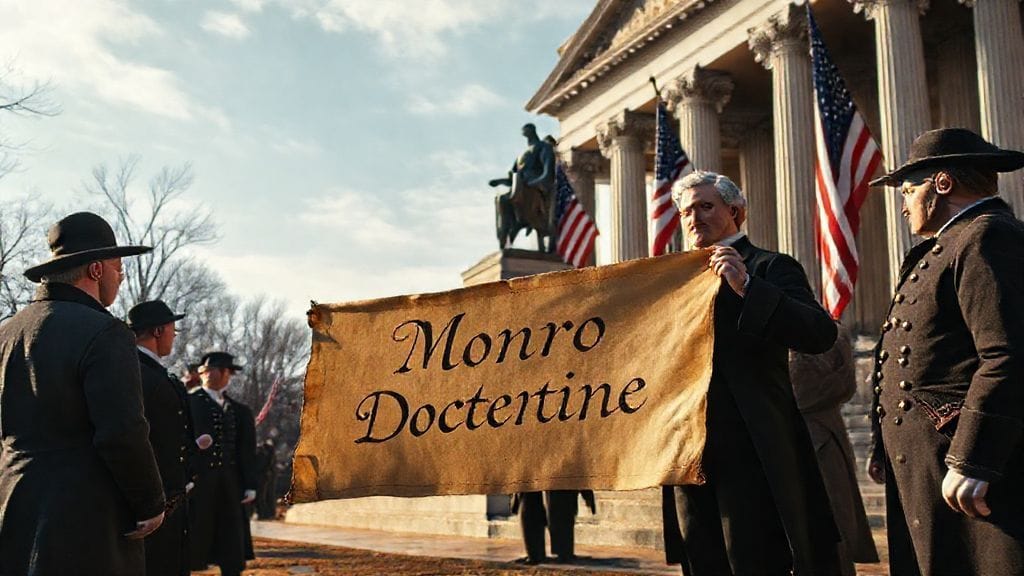
On the crisp winter day of December 2, 1823, in the hallowed halls of the United States Congress, a statement resonated far beyond the marble walls and ornate chambers of Washington, D.C. It was not a war cry but rather a declaration — a defining moment not just for a young nation but for an entire hemisphere. President James Monroe stood before a joint session of Congress, presenting a bold doctrine that would shape the geopolitical landscape of the Americas for centuries. The Monroe Doctrine, as it would come to be known, was at once a declaration of caution, a warning, and an assertion of the nascent United States’ resolve to command respect in a world still dominated by colonial empires.
The room was thick with anticipation, and beneath the formal and stately words was a palpable current of hope and defiance. America had come a long way since its revolutionary birth only a few decades prior. No longer content with being a fledgling republic hesitant under the shadow of European ambitions, it now sought a voice — a louder, unmistakable voice — in world affairs. The very essence of the Monroe Doctrine was to draw a line in the sands of the Western Hemisphere, signaling that further attempts by old-world European powers to colonize or interfere in the newly independent lands of Latin America would be viewed not just as political meddling, but as a direct threat to American peace and security.
But what led to this pivotal declaration? And what forces, both visible and unseen, had coaxed the United States to the forefront of hemispheric authority? To understand this seminal moment, we must journey back into the revolutionary fires of a rapidly evolving world, where empires clashed, ideas of sovereignty flourished, and a young republic found its voice amid the tumult.
The Post-Napoleonic World and Global Shifts
By the early 1820s, the world order was in dramatic flux. The Napoleonic Wars had shaken Europe to its core, redrawing borders and unsettling old monarchies. Yet, amidst this upheaval, the Age of Empire had not waned; it had simply paused, ready to make its next move. Monarchs and colonial powers eyed their overseas possessions with vigilance, anxious to restore dominance where it had been threatened. Meanwhile, the ideas of republicanism and self-determination, electrified by the American and French revolutions, were spreading like wildfire, inspiring waves of independence movements throughout South and Central America.
Spain and Portugal, once commanding empires that spanned continents, found their control unraveling. Faced with insurrections led by fiery leaders like Simón Bolívar and José de San Martín, Latin America was carving new nations out of old colonial territories. The old world’s grip was losing strength, and the contest for influence in these emerging nations became fierce.
The Rise of American Confidence: Young Republic’s Bold Vision
The United States, barely half a century removed from its own war for independence, was emerging from the so-called “Era of Good Feelings” — a phase marked by a rare sense of political unity and national purpose. The idea of manifest destiny, though not yet fully articulated, was simmering beneath public consciousness. Economically and militarily less formidable than the European powers, America nonetheless was intent on securing its own sphere of influence.
The nation’s leaders foresaw a hemisphere free of colonial intervention, where democratic ideals might take root and flourish. This vision was not merely altruistic; it was infused with pragmatic concerns about security, trade, and the balance of power. The doctrine would serve as a protective shield for the Western Hemisphere but also as a stepping stone toward asserting American dominance.
Europe’s Old Powers and the Shadow of Colonial Ambitions
Despite its focus on internal reconstruction, Europe observed the American hemisphere with keen interest. The Holy Alliance — Russia, Austria, and Prussia — alongside Great Britain and France, kept a wary eye on revolutionary movements breaking out in the colonies. The possibility of European powers attempting to reclaim or expand their territories in the Americas was very much alive. Britain in particular, possessing its own vast empire, was ambivalent but pragmatically supportive of Latin American independence for trade reasons, even as it feared instability might spread.
President James Monroe: The Man Behind the Doctrine
James Monroe, America’s fifth president, was a veteran revolutionary soldier and seasoned statesman. His tenure was marked by a steady hand and a vision for continental stability. Monroe understood the importance of asserting American sovereignty without appearing aggressive. The doctrine would carry his name, but its intellectual and diplomatic roots owe much to his Secretary of State, John Quincy Adams.
John Quincy Adams: The Diplomatic Mindpower
Adams, a polymath and experienced diplomat, was instrumental in crafting the doctrine’s subtle but firm language. His keen sense of international law, coupled with his vision for American republican ideals, shaped the strategic tone of the declaration. It was Adams who advised Monroe that the United States should avoid entangling alliances but still maintain a firm stance against European intervention in the Western Hemisphere.
The Continent in Flux: Latin American Independence Movements
The early 1820s were turbulent for Latin America. Countries from Mexico to Argentina were shedding colonial chains, but were marked by internal strife and vulnerable to foreign intrigue. The Monroe Doctrine sought to offer these new republics a measure of protection against re-colonization without direct American military intervention. It was a bold political calculation and a message of solidarity to fledgling nations struggling for sovereignty.
The British Role and Subtle Support from Across the Atlantic
It is no coincidence that Great Britain, the rising global naval power, had a vested interest in supporting the doctrine. Britain’s naval dominance helped enforce the blockade against any European attempts to retake colonies, at least tacitly supporting the American position. Yet, the Americans were cautious not to be seen as mere British proxies. The Monroe Doctrine was presented as an independently American pronouncement, underlining the United States’ arrival on the world stage.
Washington’s Calculated Message to Europe
Monroe’s message was carefully constructed: the Americas were closed to new European colonization, no European power should interfere in the affairs of the Western Hemisphere, the U.S. would not meddle in European politics or existing colonies, but would view any effort to extend monarchical control in the Americas as a threat to its peace and safety. The elegance of balance — between warning and reassurance — was central to its impact.
The Doctrine Announced: Content, Tone, and Immediate Reception
Delivered as part of the annual message to Congress, the doctrine’s tone was sober but resolute. Monroe declared that the American continents were henceforth not to be considered as subjects for future colonization by any European powers. The doctrine declared a new hemispheric order, one where the Western Hemisphere would be under a protective American umbrella.
At first, the statement did not provoke immediate action or reaction—it was a subtle diplomatic gambit rather than a bold manifesto. Yet, it set a precedent and tone that Washington’s foreign policy would echo for decades. Within diplomatic and political circles, the doctrine was understood as a bold assertion that signaled an end to the old European colonial paradigm in the Americas.
Varied Reactions: European Powers, Latin America, and American Citizens
Across the Atlantic, reactions were mixed—some powers like Russia and Austria dismissed it as bluff, believing America lacked the military power to enforce it. Britain saw it as conducive to peaceful trade dominance without committing troops. Latin American nations received it with cautious optimism—a diplomatic shield they desperately needed but feared might mask American self-interest.
Domestically, the doctrine stoked national pride. It offered a unifying narrative standardizing American exceptionalism and hemispheric guardianship. Newspapers echoed the doctrine’s themes, and future generations would grow up understanding this moment as foundational.
How the Doctrine Defined American Foreign Policy for a Century
Though the Monroe Doctrine initially lacked military enforcement, it became a cornerstone of U.S. foreign policy. It justified multiple future interventions in the hemisphere, from the Spanish-American War to the Roosevelt Corollary and beyond. Its flexible interpretation allowed America to oscillate between isolationism and interventionism, always anchoring its actions to preserve the doctrine’s principles.
The Doctrine’s Role in Shaping U.S.-Latin America Relations
While the doctrine promised protection, it also imposed limitations and implicit control. For many Latin American countries, it represented a double-edged sword—guaranteeing independence but also subjecting them to American oversight and occasional interference. This dynamic would sow suspicion and conflict, complicating diplomatic ties throughout the 19th and 20th centuries.
Contradictions and Criticisms: Between Protection and Hegemony
Critics viewed the doctrine as a thinly veiled justification for American imperialism. While it condemned European colonialism, it permitted U.S. expansionism. Manifest Destiny and the doctrine intertwined, often resulting in policies that subordinated Latin American sovereignty to American interests.
The Monroe Doctrine and Manifest Destiny: An Uneasy Alignment
The spiritual kinship between the doctrine and manifest destiny fueled America’s continental expansion, leading to territorial acquisitions and clashes over borders. This expansionistic zeal often conflicted with the doctrine’s original spirit of non-intervention, revealing tensions between ideals and actions.
The Doctrine Through Time: From 19th Century Warnings to 20th Century Interventions
Throughout the 19th century and well into the 20th, the doctrine served as justification for interventions — from Cuba to Panama — evolving as America itself grew into a global power. The Roosevelt Corollary expanded on the doctrine, asserting the right for the U.S. to police Latin America, marking a shift from defensive to proactive foreign policy.
The Legacy in Modern Diplomacy: Echoes and Modern Interpretations
In contemporary diplomacy, the Monroe Doctrine is often debated and revisited. It remains a symbol of hemispheric identity and American influence but also a warning of the challenges of balance between sovereignty, intervention, and global power politics.
Cultural Impact: How the Doctrine Entered American National Identity
Beyond politics, the doctrine seeped into American culture, shaping national narratives of exceptionalism and guardianship. It entered textbooks, public discourse, and popular imagination as a symbol of American resolve and continental unity.
Remembering Monroe Day: Educational and Political Commemorations
Though less widely commemorated today, Monroe’s December message is still remembered in academic and political circles for its historic impact. Educational initiatives often use the doctrine to explore early U.S. foreign policy and hemispheric relations.
Revisiting the Doctrine: Contemporary Scholarship and Debates
Modern historians continue to explore the complexities of the doctrine, reevaluating its motives and outcomes, and how it shaped—and was shaped by—Americas’ evolving identity. Questions of imperialism, sovereignty, and international law remain central to its study.
Conclusion
The Monroe Doctrine announced on that December day in 1823 was more than a policy statement; it was a defining moment when the United States declared its audacious claim not just to independence but to leadership and guardianship over the Western Hemisphere. It was born of hope, caution, realpolitik, and idealism all intertwined, reflecting the complexities of a young nation navigating a turbulent world.
Its legacy is layered with contradictions — at once a shield for fledgling republics and a tool of American power; a testament to the spirit of self-determination and a justification for intervention. Yet, above all, it stands as a living historical force, shaping hemispheric relationships and global diplomacy. Monroe’s doctrine reminds us that history is never static; it evolves with each interpretation, challenge, and change in the international arena.
It is incredible, isn’t it, that a single message could echo through centuries — a testament to the power of ideas, the weight of words, and the unfolding story of nations finding their place in the world.
Frequently Asked Questions about the Monroe Doctrine
Q1: What were the main causes that led to the announcement of the Monroe Doctrine?
A1: The doctrine was primarily driven by fears of European re-colonization of the Americas after the Napoleonic Wars, the emergence of Latin American independent states, and a desire by the U.S. to assert hemispheric influence without direct conflict.
Q2: Who were the key figures behind the Monroe Doctrine?
A2: President James Monroe presented the doctrine, but key intellectual and diplomatic groundwork was done by Secretary of State John Quincy Adams.
Q3: How did European powers initially react to the Monroe Doctrine?
A3: Reactions varied—some dismissed it as American bravado, others like Britain saw it as aligned with their interests, while nations like Russia and Austria were more skeptical.
Q4: Did the Monroe Doctrine immediately change global politics?
A4: While it did not trigger immediate action, it set a precedent and framework for future U.S. policy and established a new hemispheric order that gained influence over time.
Q5: In what ways did the Monroe Doctrine influence U.S. relations with Latin America?
A5: The doctrine acted as a protective shield but also established a form of American oversight that sometimes created tensions and suspicions of imperialism in the region.
Q6: How has the interpretation of the Monroe Doctrine changed over time?
A6: Initially defensive, later it was used to justify interventions and expansions under policies like the Roosevelt Corollary, and today it is studied with a critical eye regarding imperialism and sovereignty.
Q7: Is the Monroe Doctrine still relevant in contemporary international relations?
A7: Its principles of hemispheric influence persist symbolically, and debates about foreign intervention and sovereignty continue to invoke its legacy, though the global context has shifted.
Q8: How is the Monroe Doctrine remembered culturally in the United States?
A8: It became a symbol of American exceptionalism and guardianship, shaping national identity and historical education, though its commemoration is more subdued today.