Table of Contents
- A Fiery Dawn: The Unexpected Awakening of Mount Cameroon
- Setting the Stage: Geography and Geological Grandeur
- Early Signs: Whispers Beneath the Surface
- The First Tremors: Local Response to the Unknown
- The Eruption Unfolds: Flames and Lava in June 1999
- Communities on the Brink: Human Stories Amidst Chaos
- Government Reaction: Mobilization and Challenges
- Scientific Observations: Lessons from the Fire Mountain
- The Psychological Toll: Fear, Hope, and Resilience
- Displacement and Destruction: Mapping the Damage
- Ecological Impact: Renewal Amidst Ruin
- The Media Lens: Narratives and International Attention
- The Role of Tradition and Belief in Crisis
- Recovery Efforts: Rebuilding Lives and Landscapes
- Monitoring Mount Cameroon: Advances Post-1999
- Mount Cameroon in the Shadow of History: Past Eruptions Revisited
- Comparing Global Volcanic Events of the Late 20th Century
- The 1999 Eruption’s Place in Cameroon's National Identity
- Long-Term Economic Consequences and Adaptation
- Volcanoes and Climate: Broader Environmental Contexts
- Cultural Memory: How the Eruption Lives On
- Scientific Legacies: Enhancing Volcanology in Africa
- Hope and Preparedness: Toward Future Eruptions
- Concluding Reflections: Fire, Earth, and Human Spirit
1. A Fiery Dawn: The Unexpected Awakening of Mount Cameroon
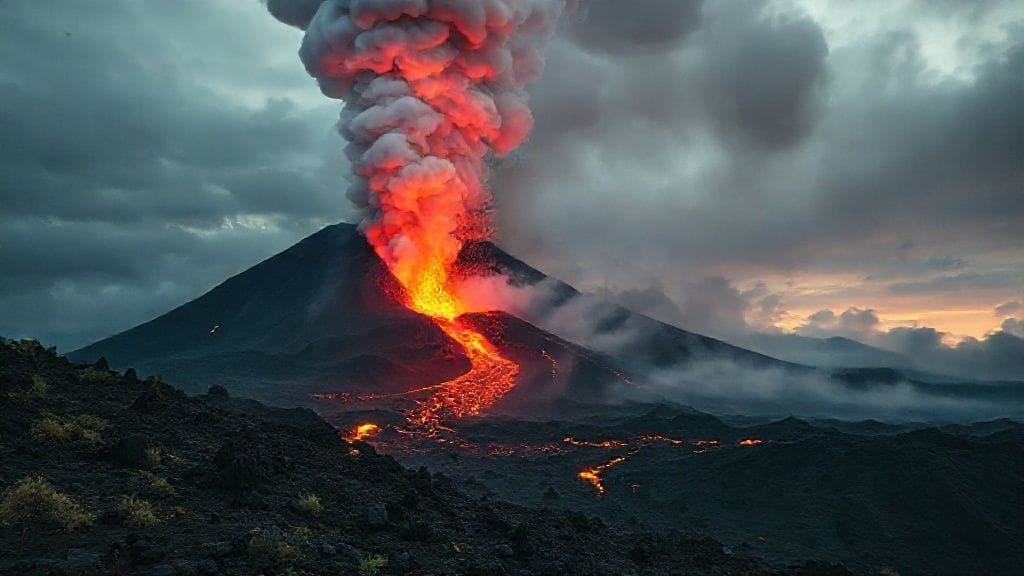
It was a quiet June evening in 1999 when the earth beneath the lush slopes of Mount Cameroon began to stir. Villagers, who had long since viewed the mountain’s sporadic grumbles as distant echoes of an ancient giant’s restless slumber, felt a change in the air—a sudden, uneasy stillness shattered by a low rumble that steadily grew louder. What came next was a spectacle both terrifying and awe-inspiring: fiery rivers of molten lava carving their way down the verdant hillsides, enveloping everything in an infernal glow against a night sky thick with ash and flame. The eruption of Mount Cameroon in 1999 was not just an event of nature; it was an eruption of human stories, fears, and resilience that would etch itself indelibly into the collective memory of Cameroon and the world.
2. Setting the Stage: Geography and Geological Grandeur
Mount Cameroon, known locally as “Fako,” towers at 4,040 meters, making it the highest peak in West Africa. Its imposing figure looms over the Southwest Region, a testament to ancient geological forces that shaped the continent. Part of the Cameroon Volcanic Line, the volcano is an active stratovolcano with a history of eruptions dating back thousands of years. Its fertile slopes support diverse ecosystems and bustling human settlements, forming a fragile coexistence between life and the subterranean fire beneath.
The region's tectonic activity is tied to the opening of the Atlantic and the shifting African plate, rendering Mount Cameroon a geological marvel but also a potential threat. By 1999, the mountain had shown signs of restlessness in earlier decades, but nothing on a scale that prepared the population for what was to come that summer.
3. Early Signs: Whispers Beneath the Surface
In early 1999, subtle signals began to emanate from Mount Cameroon. Seismic activity intensified, with clusters of small earthquakes rippling through the earth. Local elders, whose knowledge of the mountain is steeped in legend and passed down orally, noticed changes in the behavior of animals and the appearance of unusual vapors above the summit.
Initially dismissed as routine volcanic restlessness, scientists began to monitor the increased tremors with growing concern. Yet communication infrastructure was limited, and much of the monitoring took place under precarious conditions, highlighting the challenge of predicting volcanic disasters in remote regions.
4. The First Tremors: Local Response to the Unknown
As tremors multiplied in frequency and intensity, local populations faced an ambiguous threat. For many communities, the mountain was a source of sustenance and spiritual importance. The notion that it could erupt violently did not fit easily into familiar narratives.
Residents reported unsettling noises, minor rockfalls, and ground fissures, but the absence of explicit warnings created confusion. Some evacuated preemptively, driven by intuition and ancestral memories of eruptions past, while others hesitated, constrained by economic realities and disbelief.
5. The Eruption Unfolds: Flames and Lava in June 1999
On the night of June 10, 1999, Mount Cameroon’s wrath was unleashed. The volcano expelled powerful fountains of lava from fissures near its summit, illuminating the sky with a hellish red blaze. The first flows cascaded over the slopes, engulfing vegetation and threatening nearby villages.
Volcanic ash spread rapidly, coating the air and land in a suffocating shroud. The eruption progressed in phases, combining explosive bursts with steady lava flows. Scientists measured lava temperatures exceeding 1,000 degrees Celsius, while thick plumes of smoke were carried by prevailing winds toward the sea.
This was the most significant eruption in over three decades, a reminder of nature’s unyielding power and unpredictability.
6. Communities on the Brink: Human Stories Amidst Chaos
The eruption was more than geological drama—it was a human crisis. For residents of Manengouba, Limbe, and surrounding settlements, it meant forced evacuations, the loss of homes, and an uncertain future. Elder Ngi Okon, a village chief, recalled later, “We watched our fields burn and the mountain’s fire swallow our past. But we also saw neighbors become family again in those hard days.”
Children were sent to temporary shelters, women struggled to secure food, and families clung to hope as night after night lava tongues neared their doorsteps. The resilience of these communities was a poignant testament to human endurance under siege.
7. Government Reaction: Mobilization and Challenges
The Cameroonian government faced an enormous challenge. With limited financial and logistical resources, emergency services scrambled to coordinate evacuations and provide aid. Communication with remote areas was patchy, complicating relief efforts.
President Paul Biya publicly addressed the nation, emphasizing unity and resilience. Military and civilian agencies were deployed, but the scale of the eruption revealed systemic vulnerabilities in disaster preparedness. International aid trickled in, though the crisis highlighted the need for better infrastructure and planning.
8. Scientific Observations: Lessons from the Fire Mountain
The 1999 eruption was a crucial moment for volcanologists studying Mount Cameroon. Researchers from the University of Buea and international teams intensified seismic monitoring, gas emission studies, and geological surveys.
Dr. Francis Tchoua, a leading volcanologist, noted, “This eruption allowed us to understand magma movement beneath Fako in unprecedented detail. It also underscored the importance of community engagement in volcanic risk management.”
Data collected during and after the event has since informed early warning systems and global scientific knowledge about stratovolcano behavior in tropical regions.
9. The Psychological Toll: Fear, Hope, and Resilience
Beyond physical destruction, the eruption inflicted deep psychological wounds. The trauma of sudden displacement, the loss of ancestral lands, and the uncertainty of return weighed heavily on survivors.
Local counseling initiatives emerged, blending Western psychological support with traditional healing practices. Stories of hope—neighbors sheltering one another, children continuing their education in camps—illuminated the profound human capacity to rebuild spirit amidst ashes.
10. Displacement and Destruction: Mapping the Damage
The lava flows obliterated approximately 20 square kilometers of farmland, homes, and forest. Over 30,000 people were displaced, their livelihoods interrupted indefinitely.
The town of Buea, located just 15 kilometers from the volcano’s peak, experienced ash fall and minor tremors but was spared direct lava damage. Nonetheless, economic activities were severely disrupted across the Southwest Region.
Recovery databases reported losses exceeding hundreds of millions of FCFA, highlighting the eruption's huge economic burden on a developing nation.
11. Ecological Impact: Renewal Amidst Ruin
Volcanic eruptions, paradoxically, can be both destructive and fertile. The 1999 flows destroyed vast swathes of vegetation, but volcanic ash also enriched soils with minerals.
Ecologists observed recolonization patterns beginning within months—grasses and pioneer species reclaiming blackened earth. Over years, biodiversity slowly returned, a powerful reminder that nature, though scarred, is remarkably resilient.
12. The Media Lens: Narratives and International Attention
National and international media outlets captured the drama, broadcasting fiery images that fascinated and appalled audiences worldwide.
While coverage brought in humanitarian aid, it also sometimes sensationalized the event, portraying local populations as helpless victims rather than active agents. This media framing sparked discussions about representation and dignity in disaster reporting.
13. The Role of Tradition and Belief in Crisis
For many communities, Mount Cameroon is more than a mountain—it is a sacred entity imbued with spiritual significance. Traditional beliefs shaped perceptions of the eruption as an expression of ancestral anger or cosmic balance.
Rituals and prayers accompanied evacuations, blending faith and survival instincts. Religious leaders played pivotal roles in maintaining morale, illustrating how culture intertwines with crisis response.
14. Recovery Efforts: Rebuilding Lives and Landscapes
In the months and years following the eruption, concerted efforts sought to restore infrastructure, agriculture, and housing.
NGOs worked alongside government agencies to supply seeds, tools, and reconstruction materials. Training programs for disaster preparedness and sustainable agriculture emerged, aiming to reduce future vulnerabilities.
Successes were uneven, but incremental progress testified to the dedication of a population determined to reclaim their homeland.
15. Monitoring Mount Cameroon: Advances Post-1999
The eruption catalyzed investment in monitoring technologies, including seismic stations, GPS arrays, and gas analyzers. Local scientists were trained in hazard assessment and crisis communication.
These enhancements improved eruption forecasting capabilities and have contributed to reduced casualties during subsequent volcanic activity.
16. Mount Cameroon in the Shadow of History: Past Eruptions Revisited
The 1999 eruption recalled a long lineage of volcanic events, with significant activity recorded in years such as 1922, 1954, and 1982. Each episode shaped regional folklore and scientific understanding.
By placing the 1999 eruption within this continuum, historians appreciate its role as a chapter in the mountain’s enduring saga, a force shaping identity and environment alike.
17. Comparing Global Volcanic Events of the Late 20th Century
Globally, the late 1900s witnessed multiple eruptions, from the catastrophic 1980 Mount St. Helens to the Ash Clouds of Mount Pinatubo in 1991.
Mount Cameroon’s 1999 eruption, though less globally catastrophic, was significant regionally both in scale and social impact, offering valuable comparative insights into eruption dynamics and disaster management in diverse settings.
18. The 1999 Eruption’s Place in Cameroon's National Identity
In a country rich in ethnic and linguistic diversity, the eruption became a symbol of unity and collective endurance. Annual remembrances and cultural events celebrate the resilience forged in fire.
Mount Cameroon itself emerged not just as a natural feature, but as a metaphor for the nation’s strength and adaptability.
19. Long-Term Economic Consequences and Adaptation
Agriculture, the backbone of the Southwest Region’s economy, faced prolonged disruption. Farmers adapted by diversifying crops, adopting new techniques, and shifting to less vulnerable lands.
Infrastructure improvements, though slow, paved the way for economic revitalization. International partnerships focused on sustainable development helped communities mitigate future risks.
20. Volcanoes and Climate: Broader Environmental Contexts
Volcanic eruptions can influence climate by injecting aerosols into the atmosphere, affecting sunlight and temperature. Though the 1999 eruption was moderate in this respect, it contributed valuable data to global climate science.
Moreover, understanding volcanic impacts has gained urgency amid concerns about climate change and environmental fragility.
21. Cultural Memory: How the Eruption Lives On
Songs, oral histories, and artistic expressions preserve the memory of the eruption. Schools include its lessons in curricula, ensuring that new generations appreciate both the hazards and beauty of their landscape.
This cultural transmission fortifies community bonds and respect for the environment.
22. Scientific Legacies: Enhancing Volcanology in Africa
The eruption underscored the need for robust volcanological expertise on the continent. It stimulated partnerships between African universities and international research centers, fostering knowledge exchange.
Mount Cameroon thus became a focal point for advancing earth sciences in a region often marginalized in global research agendas.
23. Hope and Preparedness: Toward Future Eruptions
Today, Mount Cameroon remains an active volcano closely watched by scientists and communities alike. Emergency drills, education campaigns, and improved communication networks promise better outcomes should another eruption occur.
The 1999 event serves as a catalyst for building a culture of preparedness grounded in science and community participation.
Conclusion
The 1999 eruption of Mount Cameroon was far more than a natural disaster—it was a crucible of human experience, where earth’s raw power met the indomitable will of communities. Flames tore through forests and fields, yet from the ashes rose stories of courage, solidarity, and renewal. This volcanic event revealed vulnerabilities but also strengths, laying bare the complex dance between nature and society.
As we reflect on those fiery days, we grasp an essential truth: in the face of overwhelming force, humanity’s greatest resource is its spirit. Mount Cameroon’s 1999 eruption remains an enduring chapter—not just in the annals of geology but in the living narrative of a people who faced the inferno and carried on.
FAQs
Q1: What caused the 1999 eruption of Mount Cameroon?
A1: The eruption was caused by tectonic activity along the Cameroon Volcanic Line, where magma rose through faults in the crust, leading to fissure eruptions typical for this stratovolcano.
Q2: How many people were displaced by the eruption?
A2: Approximately 30,000 people were displaced, with entire villages evacuated due to lava flows and ash fallout threatening their homes and livelihoods.
Q3: What were the main challenges faced by the Cameroonian government during the crisis?
A3: Limited resources, poor communication infrastructure, and logistical difficulties complicated evacuation and relief efforts, highlighting the need for improved disaster preparedness.
Q4: How did local communities respond culturally and spiritually to the eruption?
A4: Many engaged in traditional rituals seeking to appease the mountain’s spirit, blending faith and communal solidarity as part of their coping mechanisms during the crisis.
Q5: What environmental impacts did the eruption have beyond immediate destruction?
A5: While the lava flows destroyed ecosystems, volcanic ash replenished soil fertility over time, allowing ecological renewal and new growth in subsequent years.
Q6: What scientific advancements resulted from studying the 1999 eruption?
A6: Improved monitoring equipment, better understanding of magma behavior beneath tropical stratovolcanoes, and enhanced early warning systems were key legacies.
Q7: How is Mount Cameroon’s 1999 eruption remembered today?
A7: Through cultural memory, education, and annual commemorations, the eruption is remembered as both a tragedy and a symbol of resilience.
Q8: Could a similar eruption happen again soon?
A8: Yes, Mount Cameroon remains active. Continuous monitoring and community preparedness aim to mitigate risks from future eruptions.

