Table of Contents
- Dawn over the Himalaya: Setting the Scene for a World-Changing Climb
- From Mythic Peak to Measured Summit: Early Encounters with Everest
- Empire, Cartographers, and the Naming of the World’s Highest Mountain
- The Preludes to Glory: Failed Attempts and Fatal Lessons
- Choosing the Climbers: Politics, Personality, and the 1953 British Expedition
- Sherpas, Soul of the Mountain: Culture, Faith, and Labor on Everest
- Into the Icefall: The Route through the Khumbu’s Shifting Labyrinth
- Storms, Sickness, and Strategy: Building the Ladder of Camps
- The Final Push: From South Col to the Roof of the World
- News that Shook the Globe: Coronation Day and the Age of Everest
- Heroes and Shadows: Media Narratives and Silenced Voices
- Mount Everest in the Cold War Imagination
- The Sacred and the Profane: Local Meanings of a Global Triumph
- From Pioneers to Crowds: The Commercialization of the Summit
- Risk, Memory, and the Ethics of High-Altitude Pursuit
- Everest in Culture: Books, Films, and the Making of a Modern Myth
- Legacies in Stone and Ice: Climate Change on the World’s Highest Stage
- Conclusion
- FAQs
- External Resource
- Internal Link
Article Summary: On 29 May 1953, on the remote Nepal–Tibet border, the mount everest first ascent by Edmund Hillary and Tenzing Norgay marked a turning point not just in mountaineering, but in global imagination. This article traces how a peak once wrapped in myth and local reverence became the focus of imperial cartographers, national ambitions, and the restless human urge to stand where no one has stood before. It follows the long chain of failed expeditions, tragedies, and hard-won techniques that culminated in the carefully planned British 1953 attempt. Through a blend of narrative and historical analysis, it explores the lives, politics, and cultures entangled in the mount everest first ascent, from Sherpa labor and spiritual beliefs to British post-war identity and Cold War symbolism. The story continues into the late twentieth and twenty-first centuries, as the summit transforms from an almost impossible dream into a crowded, commercialized goal. Along the way, the article asks what is won and what is lost when a sacred, deadly mountain becomes a global icon. Returning again and again to the mount everest first ascent as a reference point, it connects past and present debates over risk, ethics, and environmental change. By the end, Everest emerges not just as a mountain of rock and ice, but as a mirror of human ambition, frailty, and memory.
Dawn over the Himalaya: Setting the Scene for a World-Changing Climb
In the thin, brittle air of the high Himalaya, dawn does not so much arrive as detonate. The first light explodes off the fluted ridges, off ice crenellations and hanging seracs, revealing a landscape that looks almost hostile to the idea of human life. On 29 May 1953, at the edge of the Nepal–Tibet border, two tiny figures in down suits stood far above this world of shadow and fire, their oxygen masks frosting as they drew each labored breath. Beneath them stretched a slope of snow angled so sharply toward the sky that each axe placement felt like a question posed to gravity itself. Above them, there was almost nothing—just a final corniced ridge, a sliver of blue-black void, and the faint suggestion of a crest that might, at last, be the highest point on Earth.
This was the moment toward which decades had been moving: the mount everest first ascent, the culmination of imperial rivalries, scientific surveying, and the private dreams of men who could not abide an unmapped horizon. But at that instant, Edmund Hillary of New Zealand and Tenzing Norgay of the Khumbu region were not thinking in terms of empires or grand narratives. Their world had narrowed to the crunch of crampons on brittle snow, the hiss of oxygen, the terror of a misstep that would pitch them thousands of meters down the South-West Face. The summit was close enough to taste in the metallic tang of blood in their mouths. It was also close enough to be snatched away by a gust of wind, a slipping foot, or the sudden collapse of their courage.
Far below them, the British-led expedition sat in tents on the South Col, watching the mountain through gaps in rippling canvas, trying to imagine the struggle taking place beyond sight. Even farther away—in Kathmandu, in Delhi, in London and Wellington—few yet knew that something extraordinary was unfolding in the clouds above the Nepal–Tibet border. They knew only that Everest, the impossible mountain, had been challenged once again, and that the odds, as usual, were cruel. But this was only the beginning of the story, because the path to this moment wound back through centuries of myth, cartography, exploration, and loss.
To understand how Hillary and Tenzing came to stand on that razor of snow, ice crystals blowing like smoke around them, we must move backward—to a time when the mountain had no “Everest” name, when it was a distant white pyramid glimpsed from lowland plains, rumored but not measured. We must trace how a peak known locally as Chomolungma and Sagarmatha became the object of British geographical obsession, how early climbers suffered and died on its flanks, and how geopolitical shifts in Nepal and Tibet opened and then closed access to its approaches. Only then does the drama of the mount everest first ascent come fully into view: not as an isolated feat of two men, but as the climax of a global story about knowledge, power, faith, and the lure of the unknown.
From Mythic Peak to Measured Summit: Early Encounters with Everest
Long before the world spoke the name “Everest,” the mountain loomed in the imaginations and cosmologies of Himalayan peoples. In Tibet, it was Chomolungma—often translated as “Goddess Mother of the World”—a presence at once physical and spiritual. For Sherpa communities in the Khumbu and for other highland groups, such peaks were not playgrounds or objectives but dwelling places of powerful deities, to be honored and feared rather than climbed. The idea of deliberately walking into the realm of such spirits, much less setting foot on the summit, would have seemed at best foolish and at worst sacrilegious.
For outsiders, however, the Himalaya remained a distant, shimmering wall. European travelers and missionaries in the early modern period heard rumors of enormous mountains to the north, glimpsed snowfields on the horizon, and wrote back to their patrons of a world where the earth seemed to touch the sky. But it was not until the nineteenth century, with the systematic expansion of the British Empire in the Indian subcontinent, that the question of the world’s highest peak became more than a curiosity. Empire required maps—precise, measured, rational maps that would transform unknown spaces into administrable territory. Mountains became data points and obstacles to be charted, their local sacred meanings pushed aside by the logic of survey lines and triangulation.
The Great Trigonometrical Survey of India, begun in 1802, was one of the most ambitious scientific projects of its age. Over decades, British and Indian surveyors hauled cumbersome theodolites across jungles, deserts, and ridgelines, sighting distant peaks and calculating heights through painstaking geometry. From far in the plains, masked by atmospheric haze, a particular pyramid in the Himalaya drew attention. Measured repeatedly and cross-checked against other peaks, it emerged as higher than anything yet recorded. In 1856, Surveyor General Andrew Waugh announced that “Peak XV” was the highest mountain on Earth, estimating its height at 29,002 feet—a figure astonishingly close to the modern measurement of 29,031.7 feet (8,848.86 meters).
Even then, the mountain remained almost entirely abstract, a distant triangulation problem more than a concrete place in Western minds. Local names for the peak were known, but Waugh argued that the confusion of languages and boundaries justified giving it a new, standardized designation. And so Peak XV became “Mount Everest,” in honor of his predecessor, Sir George Everest, a man who had never seen the mountain. It’s astonishing, isn’t it, that a mountain revered as a goddess would be renamed in a colonial office thousands of miles away, in a language foreign to the people who lived in its shadow?
Yet this act of naming was more than symbolic. It marked the beginning of a long-term shift: Everest would increasingly belong to the world’s imagination, not just to the peoples of the Himalaya. Once its primacy was established, the question was inevitable: if this was the highest point on Earth, could a human being ever stand on top of it? The mount everest first ascent was still almost a century away, but the conditions for it—scientific ambition, imperial pride, and a new cultural fascination with high mountains—were already forming.
Empire, Cartographers, and the Naming of the World’s Highest Mountain
The naming of Everest occurred in an age when cartographers were, in a sense, quiet conquerors. By drawing borders and naming features, they translated messy realities into neat lines of ink, and in doing so, justified and extended state power. In British India, the Great Trigonometrical Survey did more than determine heights; it provided the skeletal structure upon which the colonial administration could hang its highways, railways, and telegraph lines. The notion that “Peak XV” might be the highest mountain became another point of imperial pride, evidence that British science had revealed a global “first” hidden for centuries.
Sir George Everest himself was uneasy about having his name bestowed on the mountain. Pronounced “Eev-rest” rather than “Ever-est,” his surname was often misread and misspoken. More importantly, he knew that local names existed. But Andrew Waugh pressed ahead, arguing that existing Tibetan and Nepali appellations were uncertain or disputed. In retrospect, historians see this as typical of a colonial mindset: local knowledge was too complex, too inconvenient, to be fully integrated, so an Anglophone label was imposed instead. As mountaineering historian Walt Unsworth later noted, the very act of calling the mountain “Everest” symbolized “a distance between the Western imagination and the Himalayan reality.”
Maps began to show Mount Everest as a sharp black triangle on the border between Nepal and Tibet, but politically the area remained closed to Westerners. Nepal, wary of outside influence after centuries of carefully managed isolation, blocked foreign entry. Tibet, similarly protective of its sovereignty and culture, offered few openings. Everest might be the highest mountain, but it was effectively off-limits. From the 1860s through the turn of the century, no serious climbing attempts were made. Still, in Alpine clubs and geographical societies in London, Berlin, and Vienna, discussions took place in smoke-filled rooms: how high could a man climb? How would the human body tolerate the thin air near 8,800 meters? Was the summit of Everest within the realm of possibility, or did the laws of physiology draw an invisible barrier that human ambition could not cross?
These questions were sharpened by developments elsewhere. In the European Alps, peaks once deemed impossible—like the Matterhorn—had been climbed by the late nineteenth century. On other continents, mountaineers sought new “firsts,” attempting higher summits in the Caucasus, the Andes, and the Karakoram. Yet Everest remained untouched, a white question mark at the edge of the known world. When the British faced a crisis of confidence after World War I, the idea of a grand imperial adventure—an attempt on the planet’s highest peak—became increasingly attractive. It could serve as proof that Britain, though bloodied and economically strained, still had the nerve and organizational skill to lead the world in feats of exploration.
The Preludes to Glory: Failed Attempts and Fatal Lessons
The story of the mount everest first ascent cannot be told without lingering on its failures, for they laid every rung of the invisible ladder that Hillary and Tenzing would later climb. In the early 1920s, the political landscape shifted just enough to make an approach from the north possible. Tibet, under increasing pressure from China and courting foreign allies, allowed the British to attempt Everest from the Tibetan Plateau side. Nepal remained shut, so the now-famous South Col route via the Khumbu Icefall and Western Cwm was still unknown to climbers. Instead, expeditions set out from Darjeeling, across Sikkim, and onto the high, dry plateau of Tibet, their yak caravans stretching like moving punctuation across the landscape.
The 1921 British Reconnaissance Expedition, led by Charles Howard-Bury, was less about summiting and more about seeing. Among its members was a tall, charismatic young schoolmaster named George Leigh Mallory. Mallory fell instantly under the spell of Everest’s angular grace. It was during this period that he famously answered the question “Why climb Everest?” with “Because it is there”—a line that, though perhaps apocryphal in its exact wording, captured the romantic ethos of the age. The 1921 team explored possible routes, identified the North Col as a key gateway, and gauged the effect of high altitude on the human body. They did not reach high elevations but returned convinced that Everest might, with skill and luck, be climbed.
The 1922 expedition was the first full-scale assault on the summit. Oxygen equipment—bulky and temperamental—was used experimentally. Several parties pushed above 8,000 meters, setting altitude records. But catastrophe struck when an avalanche on the North Col route killed seven Sherpa porters. For the first time, the British public confronted a fact that local communities already knew: Everest was not simply a theater for heroic European endeavor, but a workplace of death for dozens of anonymous high-altitude laborers. Still, in the narrative shaping that followed, the sacrifice of the Sherpas was often minimized. The climbers returned hailed as pioneers, while the names of the dead rarely appeared in the headlines.
Two years later came the most haunting chapter of all. In 1924, Mallory returned with another British expedition, bringing with him a young engineering student named Andrew “Sandy” Irvine, skilled in tinkering with oxygen apparatus. On 8 June, Mallory and Irvine set out from a high camp for a final summit attempt via the Northeast Ridge. They were seen through a gap in clouds by teammate Noel Odell, who later claimed he spotted them “going strongly for the summit” before mist swallowed them whole. They never returned. For decades, the question lingered: had Mallory and Irvine reached the top before falling? If they had, the mount everest first ascent would have occurred nearly thirty years earlier than Hillary and Tenzing’s famous climb.
The lack of proof turned their fate into a kind of high-altitude ghost story. Books, lectures, and club debates wrestled with scraps of evidence: the photo Mallory carried of his wife, which was not found on his body when he was discovered in 1999; the position of his remains, suggesting a terrible fall; the testimony of Odell, which some accused of being colored by hope rather than certainty. As historian Maurice Isserman later wrote, the Mallory expeditions turned Everest into “a place where death and aspiration met and embraced.” Their failures did not deter future climbers; instead, they deepened the mountain’s allure, adding a tragic dimension to the dream of standing on the summit.
Other attempts followed, but political earthquakes soon altered the terrain. With the rise of a more assertive Chinese state and the eventual closure of Tibet, the northern route became impossible. World War II interrupted high-altitude exploration entirely. The mountain waited, monolithic and indifferent, as the human world tore itself apart. By the late 1940s and early 1950s, the map of Asia had been radically redrawn: India had gained independence, Pakistan had been created, and Nepal, under new pressures, began to crack open its borders. With Tibet closing and Nepal haltingly opening, the path to the South Col via the Khumbu region emerged as the likely way forward. The failures of the North were not forgotten—they had taught climbers about oxygen, acclimatization, and logistics—but the stage had now shifted to the southern, Nepali face of the mountain.
Choosing the Climbers: Politics, Personality, and the 1953 British Expedition
By the early 1950s, several nations eyed Everest as a potential stage on which to project prestige. The Swiss made strong attempts in 1952, coming tantalizingly close via the South Col route, but stopping just short of the summit. Their efforts, especially those of climbers like Raymond Lambert and Tenzing Norgay—then working with the Swiss—proved that the southern approach was not only possible but promising. At the same time, the British establishment sensed that a window was closing. Only one major expedition was typically allowed each year by the Nepali authorities. If Britain wanted to claim the symbolic prize of the mount everest first ascent, it needed to move quickly and decisively.
The 1953 expedition would thus be both a climbing venture and a national project, carefully orchestrated and scrutinized. The leader chosen was Colonel John Hunt, a British Army officer with experience in the Alps and the Karakoram, known for his organizational rigor and diplomatic tact. His appointment was not without controversy: some members of the climbing community favored a less hierarchical, more “alpinist” leader drawn from their own ranks. Yet in the end, the scale of the enterprise—hundreds of porters, tons of supplies, experimental oxygen sets—seemed to justify a military-style chain of command.
The team reflected both continuity and change. Many were British, drawn from climbing clubs and regiments, but the roster also included figures from across the fading empire. Edmund Hillary was a beekeeper from New Zealand whose lanky frame and understated manner concealed a steely endurance honed on peaks in his home country and in the Alps. Tenzing Norgay, by then one of the most experienced high-altitude porters and climbers in the Himalaya, brought not only strength but a depth of local knowledge that no European could match. By 1953, he had already been on multiple Everest expeditions, including the near-miss Swiss attempt the previous year.
Selecting who might make the final summit bid was as much about temperament as about skill. Hunt had to balance egos, national expectations, and team dynamics. In his memoir “The Ascent of Everest,” Hunt later wrote of the strain these decisions placed upon him, admitting that any configuration would leave some climbers disappointed. Ultimately, he organized a series of assault teams, with the first attempt assigned to Tom Bourdillon and Charles Evans, using closed-circuit oxygen sets, and a second attempt—should it be necessary—to Hillary and Tenzing, using open-circuit equipment.
Behind these names stood an entire invisible army. Sherpa climbers and porters, cooks, liaison officers, and support staff made the expedition possible. While the public in Britain would later focus on Hillary and Tenzing as archetypal heroes, the reality was more collective, more complex. The politics of recognition—who would be allowed to stand on the summit, whose faces would appear on front pages—were intertwined with colonial legacies and evolving attitudes about race and representation. Tenzing, as a Nepal-based climber of Tibetan heritage, occupied a particularly delicate position. Some feared that a “non-British” first ascent would be seen as a blow to national pride; others realized that any success without giving a Sherpa climber equal opportunity would be morally hollow and politically disastrous.
Sherpas, Soul of the Mountain: Culture, Faith, and Labor on Everest
In many popular accounts of the 1953 climb, Sherpas appear as an almost anonymous collective—“the Sherpas”—supporting the real protagonists, who are almost always white Westerners. Yet the mount everest first ascent was as much a Sherpa story as it was a British or New Zealand one. Communities in the Khumbu region had long adapted to high-altitude life, developing physiological and cultural strategies for thriving where others struggled. When expeditions began to arrive in the early twentieth century, these communities provided not only porters but sophisticated mountain workers who quickly grasped the technical and logistical challenges of big-peak climbing.
Sherpa culture is rich with Buddhist belief, rituals, and a deep respect for the landscape. Chortens (stone stupas), prayer flags, and mani stones mark paths leading toward Everest, inscribing sacred texts into the very routes that climbers follow. Before the 1953 team set foot on the icefall, local lamas performed puja ceremonies, asking the mountain deities for safe passage. Butter lamps flickered, rice and juniper were offered, and prayer flags snapped in the frigid wind—acts that recognized Everest not just as a physical obstacle, but as a powerful being. Hillary, Hunt, and their companions, though not Buddhist, participated respectfully, aware that dismissing these rituals could alienate the very people whose lives were tied so closely to their own survival.
The Sherpas’ role was not merely spiritual. They carried loads to progressively higher camps, fixed ropes, and often went ahead to break trail in deep snow. Tenzing himself had evolved from porter to sirdar (head Sherpa) to full-fledged climber, bridging the worlds of local labor and international mountaineering. As Tenzing later recalled in his autobiography “Tiger of the Snows,” climbing Everest was, for him, not just about personal ambition but about “showing what our people could do.” He understood that if the mount everest first ascent were achieved with a Sherpa climber as co-summiteer, it would challenge the stereotypes that painted Sherpas as mere load-bearers rather than as mountaineers in their own right.
Yet behind such aspirations lay harsh realities. Sherpas were paid a fraction of what Western climbers received, and their exposure to risk was often higher, given their repeated trips through dangerous zones like the Khumbu Icefall. Deaths among Sherpa workers were often treated as tragic but acceptable costs of expeditions, woven into logistical reports rather than into the heroic narratives reserved for Western casualties. Over time, this imbalance would fuel a reevaluation of whose stories deserved to be told. But in 1953, the structures of inequality remained mostly intact, even as Tenzing’s fame would briefly break through them.
Into the Icefall: The Route through the Khumbu’s Shifting Labyrinth
From the Sherpa village of Namche Bazaar, the route to Everest’s summit leads first through forests of rhododendron and juniper, then up into scrub and moraine, until finally, above the last pasture, the glacier begins. The Khumbu Icefall is a chaotic cascade of blue and white, where the glacier tumbles over a bedrock step and fractures into an intricate forest of seracs and crevasses. For the 1953 expedition, this shimmering labyrinth represented both opportunity and terror. It was the key to the Western Cwm and thus to the South Col, but it was also alive, moving steadily downhill at a rate of nearly a meter a day. Ladders, ropes, and steps carved today might be ripped apart tomorrow by the glacier’s slow violence.
Climbing the icefall required a new kind of mountaineering: industrial-scale, repetitive, and logistical. Teams of Sherpa and Western climbers probed for safe passages, placed ladders over yawning blue crevasses, and set fixed ropes up icy walls. They moved through before dawn, when the night’s cold held the ice in a more stable grip; by afternoon, the sun’s heat could trigger collapses. Each ascent and descent was a roll of dice played with gravity and time. One misjudgment, one chunk of ice breaking free, could wipe out an entire rope team. Still, the work went on, day after day, until tracks became firm and the line of ascent established.
Above the icefall, the Western Cwm opened like a secret valley—a high, snow-filled basin ringed by the black cliffs of Lhotse, Nuptse, and Everest itself. Yet its apparent gentleness was deceptive. Dubbed “the valley of silence,” it trapped solar radiation and reflected light so brutally that temperatures soared inside down suits while the air remained desperately thin. Here, the expedition set up higher camps, inching their way toward the Lhotse Face and, eventually, the South Col. Each new camp was like a forward operating base on an alien planet, stocked with food, fuel, and oxygen brought laboriously from far below.
The discipline and systematization of the climb were striking. Unlike the lighter, faster attempts of later decades, the 1953 team built a ladder of camps—Base Camp, Camps I through IX—designed to support repeated trips up and down the mountain. Acclimatization rotations allowed bodies to adjust, gradually increasing red blood cell counts and improving tolerance to the low-oxygen environment. Doctors monitored climbers’ conditions, while technicians fussed over oxygen sets, tinkering and improvising repairs with whatever materials they had at hand. The summit would not be won by a single extraordinary push, but by the cumulative effort of hundreds of journeys between camps, laying down the infrastructure for the final few hours above 8,500 meters.
Storms, Sickness, and Strategy: Building the Ladder of Camps
As May advanced, the mountain’s temperament grew more capricious. Clear days yielded to sudden whiteouts, winds screamed off the ridges with a force that shredded tents, and thin snow slabs threatened avalanches. Every setback forced John Hunt and his team to reconsider their timeline. Monsoon clouds brewed far to the south; if the expedition delayed too long, they risked being caught in heavy snow and gale-force winds that would end the season. Yet hurrying was no better: bodies pushed too fast at high altitude can break down catastrophically, with fluid flooding the lungs or brain.
Inside wind-battered tents at high camps, climbers fought off headaches, nausea, and the creeping apathy that altitude brings. Simple tasks—melting snow for water, lighting a stove, lacing up boots—became exhausting ordeals. Conversations were punctuated by long silences in which the men simply focused on breathing, each inhalation an effort. Frostbite nipped at fingers and toes. Rations were monotonous; appetites waned. Yet, woven through the discomfort, there was also a growing sense of momentum. Camps rose higher along the Lhotse Face, each stocked with carefully calculated quantities of food, fuel, and oxygen cylinders.
The first summit bid by Bourdillon and Evans reached astonishing heights, climbing to the South Summit at over 8,750 meters. Using their experimental closed-circuit oxygen sets, they came within a tantalizing reach of the true summit. But problems with the equipment and worsening exhaustion forced them to turn back. Their retreat was both a disappointment and a gift: it proved that success lay within reach if conditions, equipment, and human strength could be aligned just a fraction more favorably. Hunt decided that the second assault team—Hillary and Tenzing—would use open-circuit oxygen, simpler but heavier, and that they would launch from a slightly higher camp to conserve energy.
Coordination among climbers and Sherpas became even more crucial at this stage. Porters carried loads to the South Col under brutal conditions, faces lashed by wind-driven ice crystals. Many were pushed to their limits; some had to be sent down due to exhaustion or illness. Hillary and Tenzing, selected as the final pair, were not aloof heroes waiting backstage; they were intimately involved in ferrying loads, fixing ropes, and building the camps that they themselves would later use. This shared labor forged a deep mutual respect between them, rooted not just in polite conversation but in the shared ordeal of dragging oxygen cylinders and tent poles up steep slopes in air that felt almost devoid of substance.
As the summit window appeared—small, fragile, uncertain—the expedition shifted into its endgame. Hunt’s careful planning, informed by decades of earlier attempts and failures, had brought them to this brink. Yet the mountain, as ever, would have the final say. Success or failure would hinge on what happened in a narrow band of atmosphere a few hundred meters wide, in a timeframe measured not in weeks or days, but in hours.
The Final Push: From South Col to the Roof of the World
On the evening of 28 May 1953, the South Col camp lay under a sky scoured clean by high winds. At roughly 7,900 meters, it was a place few living creatures could endure for long. Tents snapped and groaned, held down by rocks and ice-axes, while inside, Hillary and Tenzing prepared as best they could for the ordeal ahead. They melted snow for water, forcing down food despite the altitude-induced nausea. Oxygen equipment was inspected, reassembled, and checked again. Every buckle, every valve mattered. Any failure above 8,500 meters could mean not just a turned-back summit attempt, but death.
At dawn, filtered and weak through thin air, they began their ascent. Laden with oxygen sets, clothing, and essential gear, they moved slowly up the steep, frozen slopes leading toward the South Summit. The snow underfoot alternated between hard, crampon-biting crust and treacherous powder over rock. Each step was a deliberate, measured act: plant axe, kick steps, move one foot, then the other. Between movements, they paused to breathe, to let their pounding hearts catch up. The oxygen masks hissed and wheezed, issuing plumes of vapor that crystallized instantly in the frigid air.
Beyond the South Summit lay a knife-edge ridge, overhanging drop-offs on both sides that plunged thousands of meters. Here, the world narrowed to a corridor no wider than a city sidewalk. The stakes felt absolute. One slip could tear both men from the mountain, dragging them into space. At one notorious obstacle—a near-vertical step of rock and ice later christened the “Hillary Step”—Hillary paused, evaluating the options. With quiet determination, he jammed himself into a crack between the rock and an overhanging cornice, using his elbows, knees, and crampons to wriggle upward, inch by exhausting inch. He then hauled Tenzing up on the rope, the two of them moving like parts of a single, straining organism.
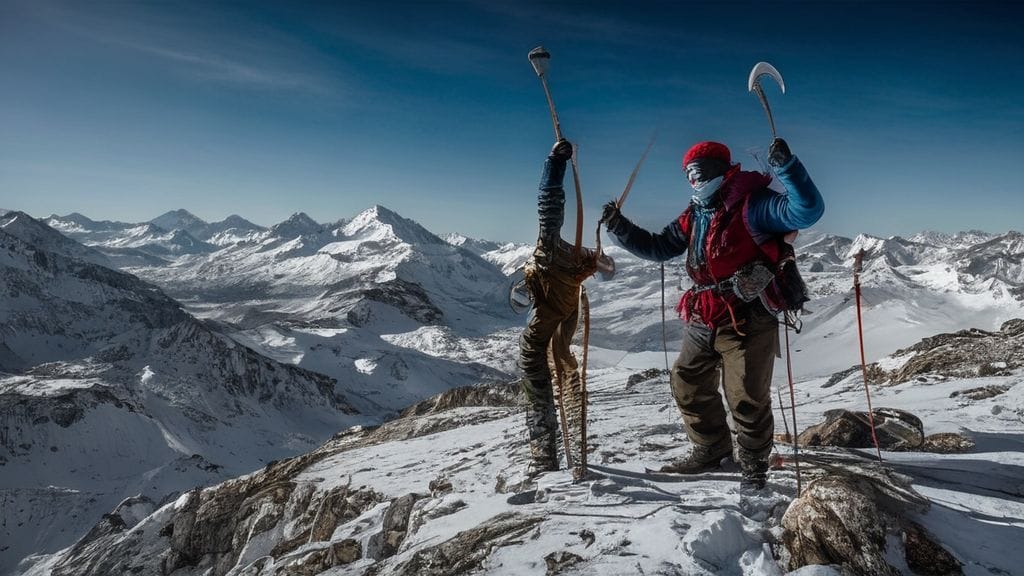
Above the step, the ridge leveled somewhat, though the altitude made any incline feel monstrous. At approximately 11:30 a.m. on 29 May 1953, Hillary and Tenzing stepped onto the highest point they could find on the crest. The world fell away on all sides—Tibet to the north, Nepal to the south; a sea of lesser peaks stretching toward horizons curved by the Earth’s roundness. For a brief, almost unreal interval, these two men stood on the apex of the planet. The mount everest first ascent, long imagined and often attempted, was no longer hypothetical; it was happening beneath their boot soles.
They stayed only about fifteen minutes. Tenzing planted his ice-axe, to which were lashed the flags of the United Nations, Nepal, India, and the United Kingdom—a quiet acknowledgment that this was more than a British story. Hillary took photographs, careful to capture evidence that they had truly reached the top. Tenzing, in his own account, described leaving chocolates and sweets in the snow as an offering, while Hillary left a small crucifix given by John Hunt. Neither performed a grand gesture of ownership. They were too aware, perhaps, of their own fragility; the mountain had allowed them passage, but made no promises about their return.
The descent was no victory march. Fatigue, brewing headaches, and the ever-present danger of mishap accompanied them down past the Hillary Step and along the ridge. Only when they reached lower camps did the significance of what they had done begin to crystallize. In Hillary’s understated phrase to teammate George Lowe, “Well, George, we knocked the bastard off.” Beneath the laconic bravado lay an emotional torrent: relief, disbelief, gratitude, and an inkling that their lives—and the world’s relationship to Everest—had just been irreversibly altered.
News that Shook the Globe: Coronation Day and the Age of Everest
In an era before satellite phones and instant messaging, news traveled down the mountain and across continents by relay. A coded message descended from camp to camp, then from Base Camp to Kathmandu, and finally out into the wider world. On 2 June 1953, as Queen Elizabeth II was crowned in London, British newspapers carried banner headlines announcing that Everest had been climbed. The timing could not have been more symbolically perfect. In the midst of a carefully choreographed ceremony affirming continuity and renewal in the monarchy, the nation awoke to discover that its climbers had conquered the planet’s highest peak.
For a country still recovering from the devastation of World War II and the emotional shock of losing India, this double event provided a potent, if fleeting, sense of unity and pride. Images of Hillary and Tenzing—faces windburned, eyes crinkled against the glare—were splashed across front pages. Newsreels in cinemas replayed grainy footage of the expedition moving through ice and snow. In London, crowds cheered the “conquerors of Everest,” as the phrase quickly became. The mount everest first ascent was framed not merely as an athletic victory but as a reaffirmation of British ingenuity and resolve in a changing geopolitical landscape.
Yet behind the celebrations lay complex negotiations over narrative. The initial press reports sometimes implied that Hillary was the lead summiteer, with Tenzing in a supporting role. In India, Nepal, and among Sherpa communities, there was anger at any suggestion that Tenzing had been the junior partner, especially given his crucial experience and effort over multiple expeditions. Tenzing himself tried to quash speculation by stating that they had reached the summit together, as a team. Still, media outlets in different countries bent the story to their own preferences: Western publications sometimes emphasized Hillary; South Asian outlets often highlighted Tenzing, seeing in him a symbol of non-European capability.
At official ceremonies, the expedition members were feted and decorated. Queen Elizabeth II conferred knighthoods and honors; Hillary became Sir Edmund, Hunt a peer, while Tenzing received the George Medal and other distinctions. Crowds in Kathmandu and New Delhi turned out to celebrate, garlanding Tenzing with silk scarves and marigolds. The summit, which had silently received their brief presence and then gone back to its icy solitude, became a screen onto which many kinds of hopes and gratitudes were projected. For some, it was proof that human beings could overcome any obstacle through courage and planning. For others, it was a vindication of local peoples long underestimated by imperial powers.
Heroes and Shadows: Media Narratives and Silenced Voices
The immediate post-1953 narrative of Everest tended to follow a familiar pattern: a small group of heroic men conquer a wild, unyielding nature. In this telling, the mount everest first ascent was the climax of a linear saga of exploration, with Hillary and Tenzing as tidy endpoints. But history, like a mountain, is rarely that simple. Even as the duo toured capitals and gave interviews, quieter questions arose. Who was missing from the story? Whose names were relegated to footnotes—or omitted entirely?
Among the expedition’s Sherpa workforce were men who had climbed repeatedly through the icefall, carried staggering loads to high camps, and risked their lives far more often than the summit pair did. Many of them returned home with some extra money but little public recognition. In Western media, they were often referred to generically—“the Sherpas”—their individuality dissolved into a category. Only in later decades would oral historians and anthropologists begin to record their personal accounts, revealing a world of hopes, fears, and motives as rich and nuanced as those of any European climber.
Even within the British team, competing narratives emerged. Some climbers felt overshadowed, believing that their own contributions had been downplayed in official accounts. John Hunt’s leadership style, though generally praised, did not escape criticism. Some argued that military-style hierarchy had stifled individual initiative; others thought it necessary for such a large undertaking. Memoirs and retrospective interviews, such as those collected by historians like Harriet Tuckey and Ed Douglas, show that the emotional aftermath of the 1953 expedition was complicated, with pride interwoven with resentments and disappointments.
Then there was the lingering ghost of Mallory and Irvine. Did Hillary and Tenzing “conquer” a summit already reached and lost three decades earlier? The 1999 discovery of Mallory’s body by an American-led search team revived the debate, but provided no conclusive answer. Most historians now conclude that even if Mallory had somehow reached the top, the lack of evidence and the fact that he did not return make the 1953 ascent the first uncontested climb. Still, the fixation on a “first” can obscure the more profound truth: Everest is not a trophy to be possessed once and for all, but a recurring challenge that each generation interprets and meets in its own way.
Mount Everest in the Cold War Imagination
In 1953, the world was already deep into the Cold War. The Korean War had just ended in armistice; nuclear arsenals were growing; ideological lines hardened across continents. Even achievements that seemed purely apolitical, like the mount everest first ascent, were quickly woven into the fabric of this global rivalry. Western commentators framed the climb as evidence that “free men” could accomplish extraordinary feats through voluntary cooperation and individual courage, in contrast to imagined images of regimented, authoritarian societies.
In the Soviet Union and Eastern Bloc, the initial reaction was more muted, but soon, their own mountaineering triumphs were trumpeted as counters. High-altitude climbs in the Pamirs and Tien Shan were publicized as proof of socialist vigor. The race into space, which would soon overshadow mountain climbing in symbolic importance, was foreshadowed in this contest over “the heights of the earth.” If Western climbers could stand on Everest, could Soviet cosmonauts not outdo them by orbiting the planet?
Meanwhile, newly independent nations in Asia and Africa found different meanings in Everest. For India and Nepal, Tenzing’s success was a source of pride that had nothing to do with Anglo-American rivalry. Here was a man rooted in the Himalayan world, proving that high achievement did not belong exclusively to former imperial powers. Some Indian writers even suggested that Everest, though long claimed as a British “field,” had in fact been “won” for Asia by an Asian climber. This claim was more rhetorical than literal—Tenzing had lived under multiple flags and outside simple national categories—but it spoke to a growing desire to rewrite narratives of exploration that had long centered on European protagonists.
In this contested symbolic landscape, Everest became a kind of blank canvas. To some, it represented the ultimate stage for human bravery; to others, a realm of folly where resources and lives were wasted on vanity. As Cold War tensions escalated, the mountain’s role in global politics would recede, overshadowed by nuclear crises and space launches. But the template was set: great heights, whether of ice or orbit, could be claimed as much for their propaganda value as for their intrinsic challenge.
The Sacred and the Profane: Local Meanings of a Global Triumph
While foreign newspapers spoke of conquest and victory, local responses in the Himalaya were often more ambivalent. For many Sherpas and Tibetans, the idea of “conquering” Chomolungma or Sagarmatha sounded jarring. The mountain had long been understood not as an enemy to be subdued, but as an immensely powerful presence to be respected and propitiated. To set foot on the summit might be, in this view, an act of daring that bordered on hubris.
Yet Sherpa reactions to the mount everest first ascent were not monolithic. Some saw in Tenzing’s achievement a validation of their skills and a doorway to new economic possibilities. Trekking tourism and climbing expeditions would, in coming decades, transform the Khumbu region, bringing cash, schooling, and clinics alongside cultural upheaval and environmental strain. Others worried that an influx of outsiders would erode traditional ways of life and spiritual practices. The sight of previously quiet valleys filled with campsites, the clatter of helicopter rotors, and the spread of lodges and gear shops would, indeed, alter the region almost beyond recognition by the late twentieth century.
Religious interpretations also varied. Some Buddhist lamas and practitioners felt that the mountain, having withstood so many attempts, had “allowed” humans to visit its summit in 1953—an act of grace rather than a defeat. The offerings left by Tenzing, his quiet prayers, and the puja rituals conducted before and after were seen as essential gestures of humility. Over time, however, as more climbers arrived with different cultural attitudes, friction sometimes arose between secular sporting approaches to Everest and local notions of sacrality. Debates over waste on the mountain, the treatment of bodies left in the “death zone,” and the building of infrastructure along the approach routes would all be colored by this underlying tension between the sacred and the profane.
From Pioneers to Crowds: The Commercialization of the Summit
In the decades following 1953, Everest slowly shifted from a rarefied arena of elite, national-backed expeditions to a destination for commercial climbing. The mount everest first ascent opened a symbolic door: what had once been considered nearly impossible was now demonstrably achievable. In 1963, an American team completed a successful climb, including a bold route up the West Ridge. In 1975, the Japanese climber Junko Tabei became the first woman to stand on the summit, challenging gendered assumptions about who belonged in high-altitude mountaineering. Each subsequent ascent chipped away at the mountain’s aura of untouchability.
By the 1980s and 1990s, guided expeditions began to proliferate. Companies offered clients—many of them relatively inexperienced in technical climbing—the chance to stand on the “roof of the world” in exchange for substantial fees. Sherpa guides and high-altitude workers took on even more responsibility: fixing ropes along normal routes, establishing camps, ferrying oxygen and supplies, and sometimes short-roping clients whose skills or stamina were failing. The ratio of Western climbers to Sherpa support increasingly tilted toward the latter, even as photographs and headlines still tended to highlight the paying clients.
Inevitably, the consequences mounted. Traffic jams developed on narrow sections of the route, particularly near bottlenecks like the Hillary Step. Climbers waited in lines at over 8,500 meters, burning oxygen while inching slowly toward the summit. The tragic 1996 season, chronicled by writers such as Jon Krakauer in “Into Thin Air,” exposed the dark side of this commercialization: overcrowding, conflicting priorities between safety and client satisfaction, and the enormous, sometimes fatal burdens placed on Sherpa staff. Dozens died in storms and accidents; bodies accumulated along the routes, some becoming macabre landmarks passed by subsequent climbers.
At the same time, local economies grew ever more dependent on the climbing and trekking industry. Villages that had once been remote and subsistence-based developed schools, lodges, and small businesses funded by expedition earnings. The Khumbu region’s skyline filled with brightly colored roofs and satellite dishes. For many Sherpa families, guiding and porter work provided incomes far exceeding what traditional agriculture could offer. This dual reality—of opportunity and risk, modernization and cultural strain—became one of the defining legacies of Hillary and Tenzing’s pathbreaking climb.
Risk, Memory, and the Ethics of High-Altitude Pursuit
The existence of a “first” raises uncomfortable questions about the “afters.” Once the mount everest first ascent had proved human beings could reach the summit, what moral framework should govern further attempts? How many lives, how much environmental damage, how much commercialization is acceptable in the pursuit of standing on a point of rock and snow for a few minutes? These questions have become increasingly urgent as the number of climbers each season has soared.
Risk on Everest is both individual and collective. Climbers voluntarily accept the danger, yet their choices shape the fates of others. When a client insists on continuing upward despite obvious signs of exhaustion, guides and Sherpa staff may feel compelled to support them, risking their own lives. Rescue attempts in the death zone are perilous and often unsuccessful, but social and media pressure can make leaving someone behind almost unthinkable. The mountain becomes a stage upon which ethical dilemmas are played out in extreme conditions, with oxygen-deprived brains trying to make life-and-death decisions.
Memory also weighs heavily. Monuments in Kathmandu and in Sherpa villages list the names of those who have died on Everest. Families remember husbands, wives, sons, and daughters who never came home. Some climbers speak of the mountain as “haunted” by these presences. Yet, year after year, new aspirants arrive, drawn by personal dreams, sponsorship deals, or the promise of a life-defining challenge. Is this persistence admirable or reckless? The answer often depends on who is speaking—those who see in Everest a crucible of character, or those who see a pattern of preventable tragedy.
Ethical debates extend beyond human risk to environmental harm. Tents, oxygen cylinders, food packaging, and human waste accumulate on slopes and at campsites. While cleanup efforts have made progress in recent years, especially in lower camps, the legacy of decades of expeditions is still visible. Some argue that any activity that leaves such scars on a fragile high-altitude ecosystem should be drastically curtailed. Others counter that with better regulation, waste management, and limits on climber numbers, Everest can be climbed responsibly.
Everest in Culture: Books, Films, and the Making of a Modern Myth
From the moment the first photographs of Hillary and Tenzing appeared in newspapers, Everest entered the realm of myth. The mount everest first ascent quickly became a narrative archetype: two men, from very different backgrounds, united in a common goal, battling nature at its most extreme and emerging victorious. This story was retold, embellished, and adapted across media. Official accounts like John Hunt’s “The Ascent of Everest” provided a sober, detailed chronicle. Popular articles in magazines and illustrated books brought the drama into middle-class living rooms in Britain, New Zealand, India, and beyond.
As decades passed, more critical and varied perspectives emerged. Tenzing’s own autobiography offered insight into his emotional journey, his sense of responsibility to his family and people, and his complex relationship with fame. Later works, such as those by mountaineering historians like Stephen Venables and Peter Hansen, situated the 1953 climb within broader patterns of imperial history, technological change, and environmental awareness. Scholars began to ask: how did media images of the “heroic mountaineer” shape ideas of masculinity, national identity, and human dominance over nature?
Cinema added another layer. Documentary footage from early expeditions, shot on heavy, fragile cameras, has the grainy quality of another era. More recent feature films dramatize specific seasons, often focusing on disaster and suspense. In these works, Everest is both setting and character: a looming, indifferent presence that tests—and sometimes destroys—the people who approach it. The line between reality and fiction can blur, as audiences accustomed to computer-generated landscapes watch actors simulate the agony of frostbite and hypoxia on studio sets.
Yet, despite all these representations, the essential mystery remains. Words and images can only hint at what it feels like to move in that thin, dazzling air, to see the Earth curve beneath your feet from a height rarely experienced by anyone outside an airplane. This gap between lived experience and cultural depiction is part of what keeps the Everest myth alive. As long as there are people who dream of standing at that improbable point, there will be stories—of triumph, of loss, of obsession—prickling around the original 1953 ascent like sparks around a fire.
Legacies in Stone and Ice: Climate Change on the World’s Highest Stage
In recent years, a new, profound challenge has begun reshaping Everest: climate change. Glaciers in the Himalaya are retreating at alarming rates, and the mountain that Hillary and Tenzing climbed is no longer quite the same as the one faced by modern climbers. Crevasses open in new places; seracs destabilize more quickly. The Khumbu Icefall, already dangerous in 1953, has become even more unpredictable as warming alters the glacier’s behavior. The risks borne disproportionately by Sherpa workers in this zone intensify year by year.
Scientific teams have installed weather stations and conducted ice-core drilling on and around Everest to better understand these changes. Their data, combined with satellite imagery, provide a sobering picture. Snowlines creep upward; permafrost weakens, increasing the likelihood of rockfalls on formerly stable slopes. The fragile high-altitude ecosystem, with its sparse vegetation and specialized fauna, faces pressures it may not survive. As melting ice exposes long-buried artifacts and even bodies from earlier expeditions, history literally emerges from the glacier, forcing confrontations with the past in visceral ways.
The implications extend far beyond the mountaineering community. Himalayan glaciers feed rivers that sustain hundreds of millions of people downstream in South Asia. Changes in snow and ice dynamics on Everest and neighboring peaks foreshadow broader water security issues. In this sense, the mountain functions as both sentinel and symptom. The site of the mount everest first ascent now doubles as an observatory where the effects of global warming are writ large in snowfields and crevasse patterns.
Some have suggested that the ultimate tribute to Hillary and Tenzing might be a radical rethinking of human activity on the mountain—limiting climbs, preserving remaining ice, and focusing on scientific and environmental missions rather than on record-chasing. Others argue that responsible tourism can coexist with conservation, and that shutting down climbing entirely would devastate local economies that have become intertwined with Everest’s modern identity. Once again, the mountain stands at the intersection of competing values and visions for the future.
Conclusion
On 29 May 1953, when Edmund Hillary and Tenzing Norgay stood for a brief, breathless interval on the highest point of the Nepal–Tibet border, they could not fully grasp how far the ripples of their footsteps would travel. The mount everest first ascent was far more than a moment of individual triumph. It condensed a century of surveying, imperial ambition, and mountaineering experimentation into a single, crystalline act. It entwined the spiritual landscapes of Sherpa communities with the geopolitical concerns of post-war Britain and a world inching into the Cold War. It transformed a remote, sacred peak into an object of worldwide fascination, desire, and debate.
In the decades since, Everest has become at once more accessible and more fraught. Guided clients queue along ridges where Hillary and Tenzing once moved alone. Sherpa guides have claimed a more central, though still contested, place in the narrative. Climate change reshapes the very ice underfoot. Yet the essential questions that hummed beneath the 1953 climb remain. Why do we seek out such extremes? What responsibilities do we bear toward the landscapes we traverse and the communities whose homes we enter? How should we remember those whose labor and lives made the “firsts” possible?
History offers no simple answers, only a richer sense of context. To look back at Everest’s first ascent is to see not just two men on a summit, but a web of stories—of surveyors in Indian heat calculating distant peaks; of Sherpa families building new futures from expedition wages; of climbers lost on the North Face in 1924; of journalists in London crafting headlines timed to a coronation. The mountain’s snowfields hold traces of all of them. In that sense, the legacy of 1953 is not a flag frozen in ice, but an ongoing conversation about ambition, humility, and the fragile line between daring and domination.
Everest endures, indifferent to our dramas, yet strangely shaped by them in turn—its routes grooved by crampons, its name a shorthand for impossibility overcome. Each time someone whispers “Everest” as a metaphor for a great challenge, they invoke, knowingly or not, the morning when Hillary and Tenzing stepped through the wind at the top of the world. Theirs is a story we return to not because it closes a chapter, but because it opens so many new ones about who we are, what we value, and how we choose to walk—literally and figuratively—on the thin edges of the Earth.
FAQs
- Who were the first climbers to summit Mount Everest?
Edmund Hillary of New Zealand and Tenzing Norgay, a Sherpa climber based in Nepal, made the first confirmed ascent of Mount Everest on 29 May 1953 via the South Col route on the Nepal–Tibet border. - Did George Mallory and Andrew Irvine reach the summit before 1953?
George Mallory and Andrew Irvine disappeared high on Everest’s Northeast Ridge in 1924, and it remains unknown whether they reached the summit before dying. Most historians agree that, without conclusive evidence and a successful descent, Hillary and Tenzing’s 1953 climb stands as the first uncontested ascent. - Why is the mountain called Everest instead of its local names?
The peak was named “Mount Everest” in 1856 by British Surveyor General Andrew Waugh, in honor of his predecessor Sir George Everest, during the Great Trigonometrical Survey of India. Local names like Chomolungma (Tibetan) and Sagarmatha (Nepali) were known but sidelined in favor of a standardized English designation reflecting colonial mapping practices. - What route did Hillary and Tenzing use to reach the summit?
They climbed from the south, through the Khumbu Icefall and Western Cwm, up the Lhotse Face to the South Col, and then followed the South-East Ridge, overcoming what is now called the “Hillary Step” just below the summit. - What role did Sherpas play in the 1953 expedition?
Sherpas were central to the success of the expedition: they carried loads, established and supplied high camps, fixed ropes, broke trail, and, in Tenzing Norgay’s case, stood as an equal summit partner. Their labor and expertise made every stage of the climb possible. - How has Everest climbing changed since the first ascent?
Climbing has shifted from state-backed, exploratory expeditions to a largely commercial model involving guided clients, extensive fixed ropes, and greater reliance on Sherpa support. Improved gear, weather forecasting, and logistics have increased summit rates, but overcrowding, ethical concerns, and environmental damage have also grown. - Is climate change affecting Mount Everest?
Yes. Glacial retreat, unstable ice, changing snow patterns, and more frequent rockfall linked to warming temperatures are altering climbing conditions and threatening the broader Himalayan environment and downstream water resources. - Why is the 1953 ascent still considered so significant?
Beyond being the first confirmed summit, the 1953 ascent symbolized a post-war reassertion of human possibility, reshaped global perceptions of the Himalaya, and catalyzed profound social, economic, and environmental changes in the Everest region and in mountaineering culture worldwide.
External Resource
Internal Link
Other Resources
- Encyclopaedia Britannica – general search for the exact subject
- Google Scholar – academic search for the exact subject
- Internet Archive – digital library search for the exact subject