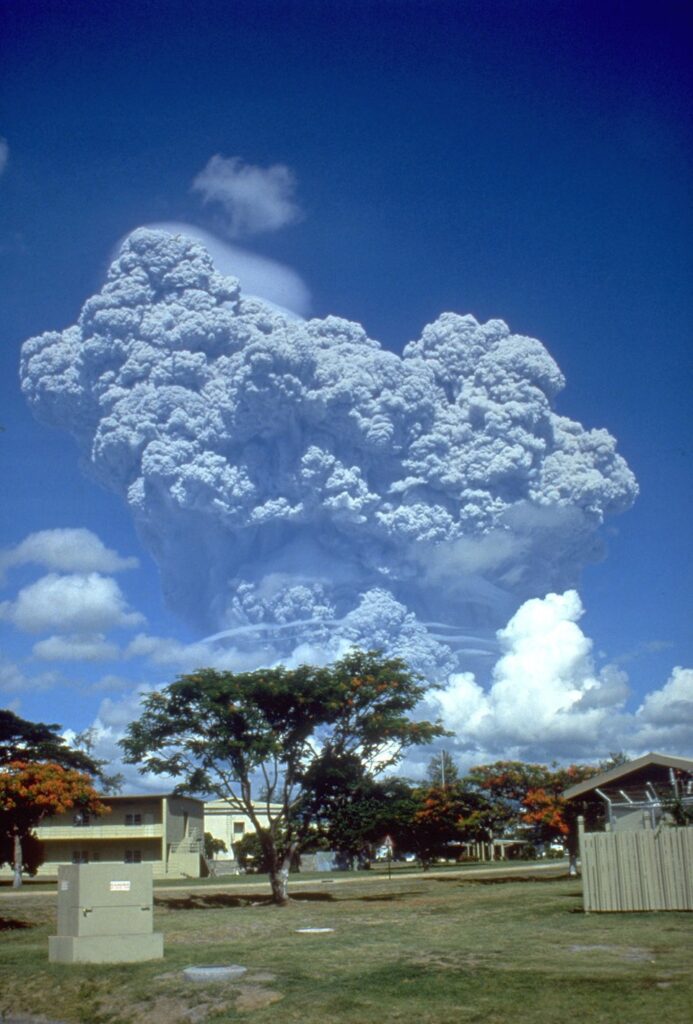
Mount Pinatubo 1991: When the Sky Turned Grey
Table of Contents
- Introduction
- The Quiet Before the Blast
- Awakening of a Sleeping Giant
- June 15, 1991: The Day the Mountain Roared
- The Ash Cloud That Circled the Globe
- Devastation and Displacement
- Environmental and Global Climate Effects
- Scientific Discoveries
- Recovery and Resilience
- Pinatubo in Memory and Culture
- Conclusion
- External Resource
- Internal Link
1. Introduction
On June 15, 1991, Mount Pinatubo, located on the island of Luzon in the Philippines, exploded with staggering intensity. The eruption was one of the largest volcanic events of the 20th century, releasing an ash cloud so vast that it lowered global temperatures.
This catastrophic event brought the region to a standstill, displaced over 200,000 people, and forever altered how we understand volcanic risks.
2. The Quiet Before the Blast
For 600 years, Mount Pinatubo had remained largely silent.
✔️ Considered dormant by most scientists
✔️ Inhabited by the Aeta people, indigenous communities living around the mountain
✔️ No significant eruption in written history
Few expected the mountain to awaken in modern times.
3. Awakening of a Sleeping Giant
In early 1991, seismic tremors and gas emissions began to worry volcanologists.
✔️ Small explosions and steam vents emerged in April
✔️ PHIVOLCS (Philippine Institute of Volcanology and Seismology) began close monitoring
✔️ U.S. Geological Survey joined to assess the risk
Authorities started preparing for the worst.
4. June 15, 1991: The Day the Mountain Roared
Mount Pinatubo erupted with cataclysmic force, ejecting 10 billion tons of magma and 20 million tons of sulfur dioxide into the atmosphere.
✔️ Ash column reached 35 km into the stratosphere
✔️ The eruption coincided with Typhoon Yunya, intensifying damage
✔️ Lava and pyroclastic flows buried entire villages
Nearby Clark Air Base, a major U.S. military installation, was abandoned.
5. The Ash Cloud That Circled the Globe
The ash didn’t stop at Luzon.
✔️ Winds carried ash across Southeast Asia
✔️ The sulfur dioxide led to aerosol formation, which reflected sunlight
✔️ Global temperatures dropped by 0.5°C over the following year
This was a rare case where a local eruption had global climatic impact.
6. Devastation and Displacement
The effects on local communities were heartbreaking:
✔️ Over 840 people killed, many by roof collapses from wet ash
✔️ 200,000+ people displaced, many permanently
✔️ Crops, livestock, and infrastructure destroyed
Many survivors lived in evacuation centers for years.
7. Environmental and Global Climate Effects
✔️ The eruption created a caldera roughly 2.5 km wide
✔️ Rain mixed with ash caused massive lahars (volcanic mudflows)
✔️ Some rivers permanently rerouted
✔️ Global ozone levels were temporarily reduced due to sulfate aerosols
8. Scientific Discoveries
The eruption of Mount Pinatubo became a case study in modern volcanology:
✔️ Validated models of stratospheric aerosol impacts
✔️ Advanced understanding of climate-volcano interactions
✔️ Boosted disaster preparedness systems across Southeast Asia
Scientists praised the rapid response and collaboration between PHIVOLCS and the USGS.
9. Recovery and Resilience
Years of rebuilding followed the eruption:
✔️ New housing and infrastructure projects were developed
✔️ Lahar-prone zones were mapped and monitored
✔️ Indigenous communities received relocation and aid
Despite trauma and loss, the Filipino people showed incredible resilience.
10. Pinatubo in Memory and Culture
Today, Mount Pinatubo stands as a reminder of nature’s power and humanity’s adaptability.
✔️ Became a popular trekking and tourist site
✔️ Inspires documentaries, books, and survivor stories
✔️ Symbol of strength and recovery in Filipino culture
11. Conclusion
The Mount Pinatubo eruption of 1991 was a wake-up call to the world. Its explosive nature and far-reaching consequences taught us the value of scientific monitoring, preparedness, and international cooperation.
More than a natural disaster, it was a moment that redefined our relationship with Earth’s geologic forces.
12. External Resource
🌐 Wikipedia: 1991 Mount Pinatubo eruption

