Mount Tambora’s 1815 Eruption: The Explosion That Changed the World
Table of Contents
- Introduction
- Geography and Background of Tambora
- Lead-Up to the Eruption
- The Eruption Unleashed
- Immediate Devastation
- The Global Climate Aftershock
- Humanitarian Crisis and Famine
- Long-Term Scientific Impact
- Legacy in Literature and History
- Conclusion
- External Resource
- Internal Link
1. Introduction
On April 10, 1815, Mount Tambora, a massive stratovolcano on Sumbawa Island, Indonesia, erupted with a force never before recorded in human history. This catastrophic event killed tens of thousands of people directly and indirectly, triggered a planetary climate anomaly known as the “Year Without a Summer,” and left a lasting mark on science, society, and the environment. Often overshadowed by the fame of Vesuvius or Krakatoa, Tambora was arguably far more powerful and influential.
2. Geography and Background of Tambora
Mount Tambora lies on Sumbawa, part of the Lesser Sunda Islands. Before the eruption, the mountain stood at approximately 4,300 meters, one of the tallest peaks in the Indonesian archipelago. It had been dormant for centuries, showing little seismic activity.
The volcano is located within the Pacific Ring of Fire, a tectonic region notorious for its seismic volatility. Indonesia’s volcanic activity is due to the subduction of the Indo-Australian Plate beneath the Eurasian Plate.
3. Lead-Up to the Eruption
As early as 1812, locals noticed rumblings and minor eruptions. By April 1815, activity escalated dramatically. Witnesses reported loud thunder-like sounds as far away as Sumatra, over 2,000 km distant.
The first major explosion occurred on April 5, but it was on April 10 that Tambora unleashed its full fury in an eruption rated VEI-7 (Volcanic Explosivity Index)—the highest observed in recorded history. The sound was heard over 2,600 kilometers away, and darkness blanketed the skies for days.
4. The Eruption Unleashed
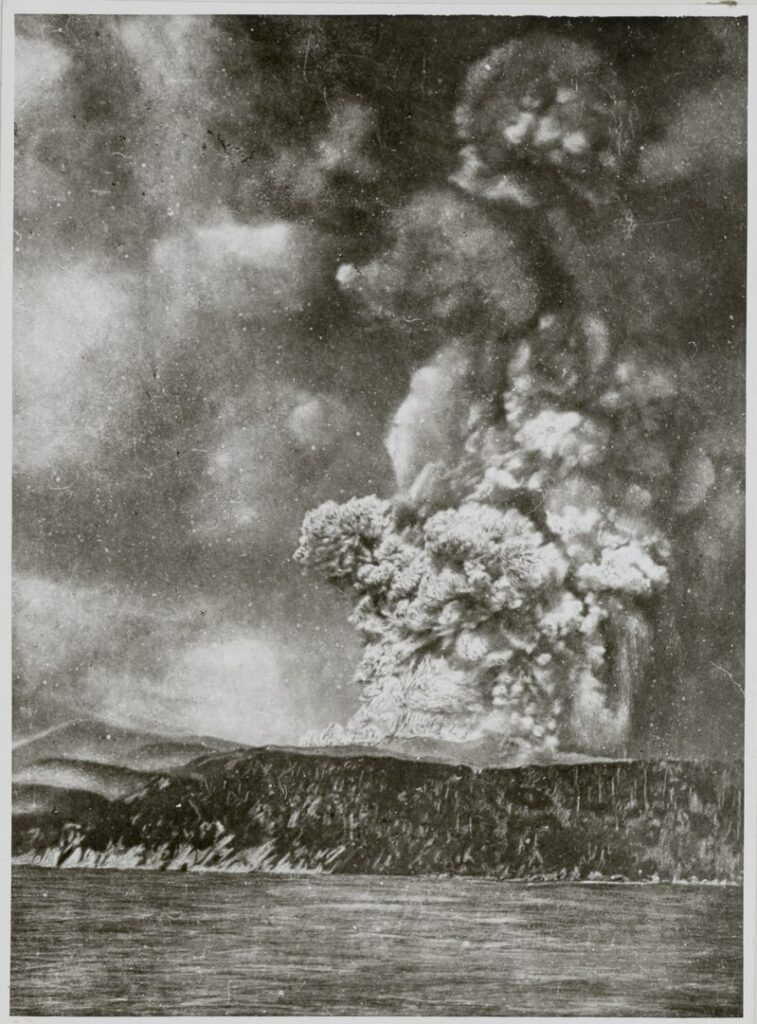
At its peak, the eruption ejected more than 160 cubic kilometers of material into the atmosphere. The top of the mountain collapsed into itself, forming a vast caldera 6 kilometers wide and over 1,100 meters deep.
🔥 The explosion created pyroclastic flows that destroyed everything in their path.
🌋 Ash clouds reached the stratosphere, circling the globe and blocking sunlight.
💨 Volcanic gases, especially sulfur dioxide, combined with atmospheric moisture to form aerosols that drastically cooled global temperatures.
5. Immediate Devastation
✔️ The eruption killed an estimated 10,000 people instantly in nearby villages, including Tambora, Pekat, and Sanggar.
✔️ Fires and tsunamis caused by the eruption contributed to further casualties.
✔️ The island was buried in up to 3 meters of ash, destroying crops, water sources, and homes.
Reports tell of entire settlements wiped from existence, landscapes reshaped, and survivors left with nothing but volcanic mud and silence.
6. The Global Climate Aftershock
What made the Tambora eruption uniquely historic was its global reach. The massive volume of sulfur aerosols it emitted reduced sunlight worldwide.
✔️ 1816 became known as the “Year Without a Summer”—snow fell in June in New England, and crops failed across Europe.
✔️ Average temperatures in the Northern Hemisphere dropped by 0.4 to 0.7°C.
✔️ Famines erupted in multiple continents due to failed harvests and food shortages.
It was one of the first recorded instances where a single volcanic event altered the global climate system so dramatically.
7. Humanitarian Crisis and Famine
In Indonesia, over 80,000 additional deaths occurred due to famine, disease, and starvation in the eruption’s aftermath.
In India, monsoon disruptions led to cholera outbreaks.
In Europe, food prices soared, and riots erupted in cities like London and Paris.
The eruption’s indirect consequences arguably killed more people than the explosion itself, affecting millions globally.
8. Long-Term Scientific Impact
The Tambora eruption helped inspire future generations of scientists to explore the link between volcanic activity and climate change.
Modern volcanology often uses Tambora as a benchmark for explosive events.
Pioneering work on the global distribution of aerosols began with Tambora’s aftermath.
It also contributed to the understanding of climate forcing, the impact of airborne particles on weather systems.
9. Legacy in Literature and History
✔️ During the dark, cold summer of 1816, a group of writers staying near Lake Geneva, including Mary Shelley, Lord Byron, and Percy Shelley, found inspiration in the gloomy atmosphere.
✔️ Mary Shelley began writing Frankenstein, a novel born in the shadows of Tambora’s climatic effects.
✔️ Tambora’s legacy lives on in both scientific discourse and cultural imagination.
10. Conclusion
The Mount Tambora eruption of 1815 was not just a volcanic explosion—it was a world-changing cataclysm. Its legacy is not just in ash and stone, but in the altered course of climate, history, and culture. It serves as a vivid reminder that Earth’s natural forces are powerful enough to shape civilizations.
11. External Resource
🌐 Wikipedia: 1815 eruption of Mount Tambora