Table of Contents
- The Fateful Night at Mukden: When Shadows Ignited a Crisis
- Manchuria on the Brink: A Land of Riches and Rivalries
- Japan’s Imperial Ambitions: The Path to Conquest
- The Political Cauldron in China: Warlords, Nationalists, and Chaos
- September 18, 1931: The Explosive Prelude to Invasion
- The Mukden Incident Unfolds: A False Flag with Real Consequences
- The Immediate Aftermath: Military Mobilization and Propaganda Blitz
- The League of Nations Steps In: Diplomacy vs. Aggression
- China’s Plight: Fragmentation and Resistance
- Manchukuo Emerges: Puppet State Under Japanese Control
- International Repercussions: Power Plays and Silent Endorsements
- The Crisis Deepens: Economic Exploitation and Militarization
- Daily Life Under Occupation: Voices from Manchuria
- The Seeds of Global Conflict: From Mukden to the Pacific War
- Historical Debates: Was the Mukden Incident Inevitable?
- Legacy and Memory: How the Manchurian Crisis Shapes Today’s Asia
- The Mukden Incident in Literature and Film: Echoes through Culture
- Modern Reflections: Lessons from a Century-Old Flashpoint
- Conclusion: The Relentless Surge of Empire and the Cost of Silence
- FAQs: Understanding the Mukden Incident and Its Impact
- External Resource: Wikipedia Link
- Internal Link: Visit History Sphere
The Fateful Night at Mukden: When Shadows Ignited a Crisis
The night of September 18, 1931, was one of quiet uncertainty under the cold Manchurian sky. The railway tracks near Shenyang—then known as Mukden—lay dark and still, except for the faint glow of lamps and the occasional whistle of a distant train. It was here, in the bleak hours before dawn, that a small explosion shattered the fragile calm of the region. Unknown to most, this seemingly minor act of sabotage was to become the spark that ignited one of the 20th century’s most significant crises—a crisis that would reshape East Asia and set the stage for a devastating war.
But this explosion was no ordinary act of rebellion or patriotic resistance. It was a carefully orchestrated false flag operation, engineered by officers of the Japanese Kwantung Army. Their aim was clear: to provide a pretext for a full-scale invasion and occupation of Manchuria—a land of immense strategic value and untapped natural riches. This moment was the fulcrum upon which history would pivot dramatically, exposing the fragility of international order and the limitations of diplomacy in an age of rising militarism. The Mukden Incident was not merely a localized skirmish: it was a wake-up call to the world about the dangers lurking within imperial ambitions and fractured politics.
Manchuria on the Brink: A Land of Riches and Rivalries
To understand why the Mukden Incident held such profound significance, one must first peer into the rich, daunting landscape of Manchuria. Stretching across northeast China, this vast region was a treasure trove of natural resources—fertile soils, sprawling forests, coal mines, and precious metals. Its ports and railways offered gateways to both economic prosperity and military advantage. For centuries, imperial powers eyed Manchuria like a prize to be claimed, each weaving their influence through a complex tapestry of economic concessions, military presence, and political manipulation.
By the early 20th century, Japan had emerged as a formidable force in the region following victories over Russia and China. The Kwantung Army, stationed in the South Manchurian Railway Zone, acted not only as a protector of interests but increasingly as an autonomous actor with ambitions that extended beyond mere defense. The economic ambitions dovetailed with political tensions—Japan’s burgeoning industrial economy thirsted for raw materials and markets, while strategic thinkers longed to solidify Japan’s dominance in Asia.
Yet, Manchuria was not a blank canvas; its population consisted of Han Chinese, Manchu, Mongols, Koreans, and Russians—diverse peoples caught in the swirl of competing interests. The region’s fragile political order made it a powder keg, vulnerable to any spark that might set off a chain reaction.
Japan’s Imperial Ambitions: The Path to Conquest
The 1930s dawned under the heavy shadow of Japan’s continental ambitions. The Meiji Restoration had transformed Japan from a feudal archipelago into a modern empire aspiring for global status. The conquest of Taiwan, Korea, and parts of China were steps along this path. Control over Manchuria promised not only economic benefits but also a strategic buffer against formidable rivals.
The Kwantung Army, however, often operated with remarkable impunity, occasionally diverging from Tokyo’s official directives. Within its ranks simmered extreme nationalistic fervor, doctrines of racial supremacy, and a deep-seated belief in Japan’s divine right to rule Asia. At the core was the concept of a “Greater East Asia Co-Prosperity Sphere” — a vision of Japanese hegemony cloaked in the rhetoric of liberation but fueled by colonial domination.
Thus, by 1931, Japan had both the motive and the military muscle to press its stake in Manchuria. Yet, the intricate web of international agreements, including the Washington Naval Treaty and other diplomatic efforts, still circumscribed overt aggression. The Japanese military leadership sought a pretext to override these constraints — an event that would justify decisive action and silence opposition.
The Political Cauldron in China: Warlords, Nationalists, and Chaos
Meanwhile, China was mired in internal turmoil. The Republic of China, under the nominal leadership of Chiang Kai-shek’s Nationalist government, struggled to assert authority over a vast and fractured land. Warlord factions controlled large swathes of territory, while Communists fomented rebellion in the countryside. Economic underdevelopment, political corruption, and foreign interference compounded the nation’s vulnerabilities.
Manchuria itself was ruled by provincial governors whose allegiance fluctuated between the central government and their own ambitions. With limited military capacity and distracted leadership, China was ill-prepared to resist a disciplined invasion. Internationally, the League of Nations pledged collective security but had no enforceable means to stop acts of aggression by military powers.
It was into this vortex of fragmentation and weakness that the Mukden Incident exploded, exposing the precariousness of China’s sovereignty and the limitations of Western diplomacy.
September 18, 1931: The Explosive Prelude to Invasion
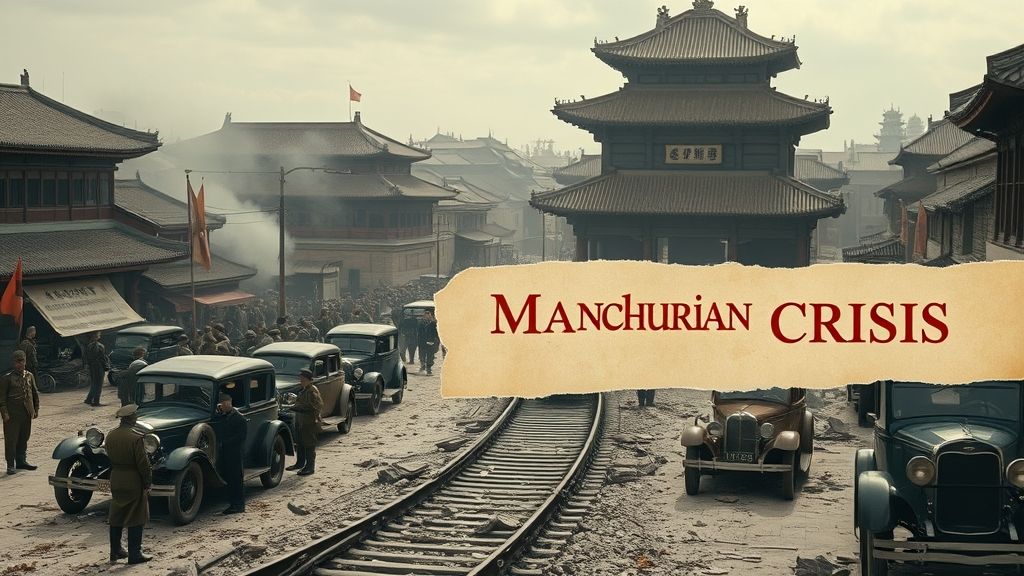
At approximately 10:20 pm on September 18, a small bomb detonated near a section of the Japanese-owned South Manchurian Railway, close to the city of Mukden. The blast was deliberately minor, causing only slight damage and no casualties, yet its implications were seismic.
The Japanese Kwantung Army immediately accused Chinese dissidents of sabotage, casting the act as a hostile attack and justification for retaliation. But investigations later revealed that the explosion was orchestrated by Japanese officers themselves, designed as a pretext to justify aggressive military response.
Within hours, Japanese troops mobilized, launching coordinated assaults on Chinese forces in the region. The assault was swift and brutal—railways seized, communications cut, and key towns occupied. The event, while ostensibly isolated, rapidly spiraled into a full-scale invasion.
The Mukden Incident Unfolds: A False Flag with Real Consequences
The Mukden Incident was textbook deception: a carefully staged event designed to manipulate public opinion and international scrutiny alike. It was a stark demonstration of how modern warfare and conquest could be initiated under a veneer of legality and outrage.
Major General Seishirō Itagaki and Colonel Kanji Ishiwara played crucial roles in orchestrating the operation, acting without explicit authorization from Tokyo’s civilian government. Their strategy was to create a fait accompli—a swift conquest that would be presented as a defensive necessity.
The Chinese military, taken by surprise and demoralized, struggled to mount an effective defense. Meanwhile, the Japanese press amplified the narrative of victimization and justification, rallying public support. This incident shone a harsh light on the frailty of international security mechanisms and the tenuous grasp China held over Manchuria.
The Immediate Aftermath: Military Mobilization and Propaganda Blitz
Following the attack, Japanese forces quickly moved to consolidate control over Manchuria. The initial clashes led to casualties and civilian displacement, as towns were caught in the crossfire. Japanese military governance replaced local Chinese authorities, rapidly transforming political and economic life.
In Tokyo, nationalist elements hailed the military as heroes, portraying the campaign as a noble mission to stabilize a region plagued by disorder. Propaganda campaigns inundated the Japanese public, embedding the idea that the operation was an act of righteousness and national destiny.
Internationally, Japanese diplomats sought to justify their actions, delaying direct confrontation with other powers and buying time to extend their dominion.
The League of Nations Steps In: Diplomacy vs. Aggression
The international community quickly took notice. China appealed to the League of Nations, invoking the principles of collective security enshrined after World War I. The League commissioned the Lytton Commission, a delegation tasked with investigating the events and delivering recommendations.
After months of inquiry, the Commission’s report condemned Japan’s actions as aggression and refused to recognize the newly established puppet state of Manchukuo. The report underscored the dangers of unrestrained militarism and advocated for the withdrawal of Japanese forces.
Yet, faced with Japan’s defiance and the impotence of military enforcement, the League faltered. Japan withdrew from the League in 1933, signaling a profound fracture in the international order and emboldening other expansionist powers.
China’s Plight: Fragmentation and Resistance
Within China, the occupation exacerbated existing divisions. While Chiang Kai-shek’s government condemned the invasion, its ability to launch a unified counterattack was limited by internal challenges. Communist factions sowed guerrilla resistance in rural areas, while regional warlords oscillated between collaboration and defiance.
The loss of Manchuria to Japanese control was a bitter blow to Chinese nationalism and galvanized calls for modernization and unity. Yet, it also marked a painful chapter of dismemberment, humiliation, and sustained conflict—a prelude to the brutal Sino-Japanese War that would engulf the nation a few years later.
Manchukuo Emerges: Puppet State Under Japanese Control
In 1932, Japan declared the establishment of Manchukuo, a nominally independent state fashioned to legitimize its control over Manchuria. Puyi, the last emperor of the Qing Dynasty, was installed as its figurehead ruler—a symbolic gesture aimed to cloak imperial conquest in dynastic nostalgia.
Manchukuo was, in reality, a puppet state governed by Japanese military interests and economic conglomerates. Its creation was a masterstroke of imperial theater, combining soft power tactics with ruthless exploitation.
The regime orchestrated land reforms, industrial expansion, and cultural policies designed to integrate Manchuria into Japan’s broader imperial framework, but underneath lay widespread repression, forced labor, and displacement of local populations.
International Repercussions: Power Plays and Silent Endorsements
Globally, the Manchurian Crisis sent shockwaves through geopolitical calculations. Western powers, preoccupied by the Great Depression and wary of conflict, largely responded with condemnations but little action. The United States, opting for the Stimson Doctrine, refused to recognize territorial acquisitions gained by force, yet refrained from confronting Japan militarily.
Soviet Russia, sharing a border with Manchuria, watched anxiously while boosting its own military presence. The crisis underscored the weaknesses of the post-World War I peace system and accelerated the breakdown of collective security.
The failure to check Japanese aggression sent a dangerous signal to powers like Nazi Germany and Fascist Italy that expansionist policies might escape consequence, setting in motion the unraveling toward global conflict.
The Crisis Deepens: Economic Exploitation and Militarization
With military control secured, Japan intensified its economic extraction from Manchuria. Resources such as coal, iron, and soy became pillars of Japan’s war industrial complex. Infrastructure developed rapidly to support both military and commercial goals.
At the same time, Manchuria became a laboratory for Japan’s militarized state, experimenting with new weapons, tactics, and intelligence operations. Civilian populations endured increased surveillance, cultural suppression, and forced assimilation.
The militarization of Manchuria not only fueled Japan’s empire but also tethered the region’s fate to the violent forces reshaping Asia.
Daily Life Under Occupation: Voices from Manchuria
Beyond the writ of generals and diplomats, the occupation altered the rhythms of daily life. Rural farmers faced land seizures, ethnic minorities confronted discrimination, and urban dwellers witnessed shifts in governance and social order.
Local testimonies recount a landscape of fear, survival, and adaptation. Women and children suffered particular hardships; schools and religious institutions were repurposed to serve imperial narratives.
Yet, stories of subtle resistance and resilience emerge, revealing the human spirit’s tenacity amid displacement and oppression.
The Seeds of Global Conflict: From Mukden to the Pacific War
The Manchurian Crisis was more than a regional episode—it was the opening salvo in a chain of events leading to the cataclysm of World War II in Asia. Japan’s occupation destabilized the region, provoking prolonged hostilities with China, antagonizing Western powers, and transforming military doctrines.
By challenging international norms and shattering the League of Nations’ credibility, the crisis emboldened militarists worldwide. It accelerated Japan’s trajectory toward further invasions, culminating in the devastating Pacific War.
Historical Debates: Was the Mukden Incident Inevitable?
Scholars have long debated the inevitability of the Mukden Incident. Was it a calculated gamble born of genuine security concerns or a cynical ploy to expand empire? Could diplomacy or internal reform in Japan or China have averted the crisis?
Some argue the harsh terms of prior treaties and nationalism made confrontation unavoidable. Others highlight the rogue nature of the Kwantung Army and missed diplomatic opportunities. This ongoing discourse reflects the complexity of imperialism, nationalism, and international relations in the interwar period.
Legacy and Memory: How the Manchurian Crisis Shapes Today’s Asia
Nearly a century later, the Manchurian Crisis continues to echo in the geopolitics and memories of East Asia. The occupation sowed decades of distrust between Japan, China, and the broader region.
Themes of historical injustice, reparations, and reconciliation remain sensitive, influencing diplomatic relations today. The crisis also serves as a powerful reminder of the costs of unchecked militarism and the fragile nature of sovereignty.
The Mukden Incident in Literature and Film: Echoes through Culture
The event has inspired numerous works of literature, film, and art. Japanese and Chinese artists explore the trauma, complexities, and consequences of occupation—sometimes sparking contentious debates about memory and responsibility.
Films like “City of Life and Death” and novels chronicling the era humanize the historical events, transforming raw facts into emotional narratives that resonate across generations.
Modern Reflections: Lessons from a Century-Old Flashpoint
The Mukden Incident offers enduring lessons on the dangers of propaganda, the importance of international law, and the need for vigilance against militarism. In a world still marked by territorial disputes and power rivalries, the crisis warns of how small sparks can ignite global conflagrations.
Conclusion: The Relentless Surge of Empire and the Cost of Silence
The night at Mukden was but a shadowed moment, a single explosion that rewrote the fate of millions and realigned global power. It revealed the dangers of ambition unchecked by morality or diplomacy, and the tragic price paid by ordinary people caught in the gears of empire.
The Mukden Incident reminds us that history is not simply the story of battles and treaties but a tapestry woven from choices, courage, and often silence. It challenges us to confront the past honestly and to seek a future where sovereignty and peace can be preserved.
FAQs: Understanding the Mukden Incident and Its Impact
1. What triggered the Mukden Incident?
The Mukden Incident was intentionally engineered by Japanese military officers as a false flag operation—a staged explosion on the South Manchurian Railway aimed at providing Japan a pretext to invade Manchuria.
2. Why was Manchuria important to Japan?
Manchuria was rich in natural resources and strategically critical as a buffer zone. Control over the region promised economic benefits and a stronger military foothold in East Asia.
3. How did China respond to the invasion?
China condemned the invasion but was politically fragmented and militarily weak, limiting its ability to resist effectively. Guerrilla resistance and nationalist sentiment increased, but China suffered the loss of its northeastern provinces.
4. What role did the League of Nations play?
The League investigated the invasion and condemned Japan’s actions. However, lacking enforcement mechanisms and unity among powers, it failed to stop Japan, highlighting the limitations of interwar international diplomacy.
5. How did the Mukden Incident contribute to wider conflicts?
The crisis marked the start of Japan’s aggressive expansion in Asia, leading directly to the Second Sino-Japanese War and contributing to the outbreak of the Pacific Theater in World War II.
6. Was the Japanese government unanimous in supporting the invasion?
Not entirely. The Kwantung Army acted somewhat autonomously, and while nationalist factions supported the action, some government officials were hesitant or opposed but powerless to counter the military’s momentum.
7. How is the Mukden Incident remembered today?
It remains a symbol of imperial aggression and national trauma in China, a contentious chapter in Japanese history, and a case study in the failure of international peacekeeping efforts.
8. What lessons can be drawn from the Manchurian Crisis?
The crisis underscores the risks of militarism, propaganda, and failed diplomacy, reminding the international community of the need for vigilance, collective security, and respect for sovereignty.