Table of Contents
- A Night in Burhanpur: The Day the World of an Emperor Shattered
- From Arjumand Banu Begum to Mumtaz Mahal: A Princess Becomes a Legend
- The Mughal Empire at its Zenith: Power, Opulence, and Fragile Hearts
- The Journey to the Deccan: War, Pregnancy, and Ominous Signs
- Inside the Royal Tent: The Final Hours Before Mumtaz Mahal’s Death
- The Morning After: Shock, Silence, and an Emperor Broken
- Funeral in Burhanpur: Prayers, Perfume, and the First Resting Place
- Promises at a Deathbed: Shah Jahan’s Vows of Eternal Memory
- Widower on the Peacock Throne: Grief in the Heart of an Empire
- From Burhanpur to Agra: The Long Journey of a Queen’s Body
- Imagining Eternity in Marble: The Conception of the Taj Mahal
- Architects, Artisans, and Empire: Building a Monument to Sorrow
- Court, Harem, and Heirs: Political Tremors After Mumtaz Mahal’s Death
- Aurangzeb, Dara, and the Shadow of a Lost Mother
- Burhanpur’s Forgotten Connection: The First Tomb That Never Was
- Love, Myth, and Memory: How History Retold Mumtaz Mahal’s Story
- The Taj Through the Centuries: Plunder, Preservation, and Pilgrimage
- Mumtaz Mahal in the Modern Imagination: Cinema, Tourism, and Global Romance
- Conclusion
- FAQs
- External Resource
- Internal Link
Article Summary: On 17 June 1631, in the Mughal military encampment near Burhanpur, the life of Empress Mumtaz Mahal slipped away during childbirth, and with it, much of Emperor Shah Jahan’s joy in ruling one of the richest empires on earth. This article traces the world surrounding mumtaz mahal death: the glittering Mughal court, the personal love story, the physical dangers of repeated pregnancies, and the brutal reality of war. It follows the final journey of her body from Burhanpur to Agra, the solemn promises made by a shattered emperor, and the decades-long construction of the Taj Mahal as an answer to grief. Along the way, we explore the political and emotional aftermath at court and in the imperial family, especially for the children who grew up in the long shadow of that loss. We examine how mumtaz mahal death reshaped imperial priorities, influenced architecture, and quietly altered the succession struggles that would tear the Mughal dynasty apart. From period chroniclers to modern historians, from forgotten riverside gardens in Burhanpur to the world-famous silhouette of the Taj Mahal, this narrative follows how a single death became a global symbol of love and mourning. In doing so, it reveals both the tenderness and the brutality of 17th‑century empire, and how memory can transform private sorrow into public monument.
A Night in Burhanpur: The Day the World of an Emperor Shattered
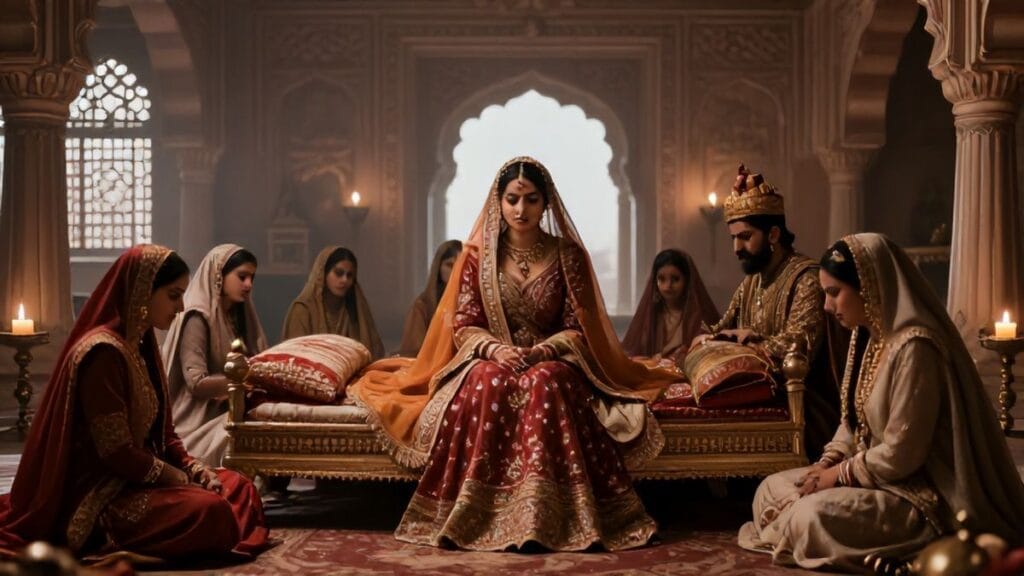
The monsoon clouds hung low over Burhanpur on the night of 17 June 1631, obscuring the stars that had so often watched over the Mughal encampments. In the sprawling field of silk tents on the banks of the Tapti River, torches flickered along narrow pathways where soldiers shuffled quietly, trying not to disturb the deep hush that had descended over the imperial camp. Inside the largest tent, its walls embroidered with gold and its carpets a sea of crimson and indigo, the empress of the Mughal world lay exhausted, her breathing shallow, the murmurs of midwives and physicians like distant waves. This was the setting of mumtaz mahal death, not a marble palace, not a scented garden in Agra, but a canvas pavilion pitched on the rough soil of a war front.
Shah Jahan, emperor of Hindustan, who commanded armies, mountains of silver, and the loyalty of millions, moved back and forth in a smaller adjoining chamber, fingers knotted behind his back. He had faced rebel princes and conquered distant forts, but the sounds from the birthing chamber—muffled cries, anxious instructions in Persian and Hindavi, hushed invocations of God—reduced him to a frightened husband and father. Mumtaz had borne him thirteen children already; this fourteenth was not expected to be different. And yet something in the air felt wrong, heavy, like the sky itself was bending. Outside, the clink of armor and the murmured guards’ commands were a faint reminder that they were far from the red sandstone palaces of Agra, deep in the Deccan, entangled in a campaign against local powers.
In a sudden moment, the sound inside the tent shifted: no longer active, urgent, purposeful, but scattered, strained, and then quiet. A court physician, his turban damp with sweat, emerged to face an emperor who could order the fate of enemies but could not command the course of a single birth. The words that followed have been recorded in different forms by various chroniclers, but the essence is the same: the child lived, but the empress was dying. Mumtaz’s life, fragile after hours of labor and potential complications like postpartum hemorrhage, slipped away in that canvas womb. It is here that mumtaz mahal death ceased to be a private tragedy and began its transformation into the seed of one of history’s most famous monuments.
In that instant, the royal encampment turned from a theatre of war into a house of mourning. Drums that had announced victories fell silent, banners hung limp, and the air thickened with whispers—how could it be that Arjumand Banu Begum, the beloved “Chosen One of the Palace,” whose laughter had filled courts from Agra to Burhanpur, was gone? Shah Jahan did not emerge to address his generals. He collapsed by her side, his tears falling onto hands already beginning to cool. It is astonishing, isn’t it, that the might of empire could do nothing here, that a woman who had survived the intrigues of court, the perils of childbirth thirteen times, and long journeys across the subcontinent should finally be claimed in a tent pitched on contested soil?
From Arjumand Banu Begum to Mumtaz Mahal: A Princess Becomes a Legend
Long before that fateful night in Burhanpur, she had been simply Arjumand Banu Begum, born in April 1593 into a family already woven into the highest strands of Mughal politics. Her father, Asaf Khan, was a powerful nobleman at the court of the emperor Jahangir; her aunt, Nur Jahan, would become Jahangir’s formidable wife and one of the most influential women in Mughal history. In such a world, daughters were not only cherished but also carefully placed, their marriages serving as bridges between factions, their charm and intelligence turned into instruments of power. Yet by all surviving accounts, Arjumand Banu was more than a political asset. Chroniclers describe her as remarkably beautiful and unusually educated, with a talent for poetry, a keen mind for administration, and a quiet but steady presence at court.
She first met Prince Khurram—later known to the world as Shah Jahan—in 1607. The image has been so often romanticized that it risks becoming cliché: the young prince catching sight of a noble girl at a bazaar, their eyes meeting over trinkets and jewels. But however embellished later accounts may be, what matters is that their match was far from ordinary. The Mughals had long embraced polygamy; emperors and princes took multiple wives for political alliance, companionship, and pleasure. Yet when Arjumand Banu married Khurram in 1612, the bond that grew between them proved unusually intense. He had other wives, yes, but she became his acknowledged favorite, his confidante, his political advisor, and the mother of the majority of his children.
It was Jahangir who gave her the title by which history remembers her: Mumtaz Mahal, “The Chosen One of the Palace,” or more poetically, “The Exalted One of the Palace.” Titles in the Mughal world were never mere ornaments; they were statements of status and function. In conferring this name, the emperor recognized that she was no ordinary consort. Soon, she became central to Khurram’s household. She kept his accounts, advised him on patronage and charity, and intervened in petitions on behalf of widows, orphans, and the poor. Contemporary chroniclers such as Inayat Khan, in his “Shah Jahan Nama,” portrayed her as both compassionate and politically astute, a woman who could read the currents of court with as much clarity as the emperor himself.
The love story that later generations would celebrate in poetry, film, and song was deeply rooted in this everyday partnership. She accompanied him frequently on campaigns; she shared the discomforts of travel and the strains of imperial responsibility. A union that produced fourteen children inevitably involved long stretches of pregnancy and postpartum recovery, yet within the constraints of her role, she exercised a quiet form of power. Mumtaz controlled her own substantial allowance, sponsored religious scholars and artists, endowed charitable works, and served as an informal channel between the emperor and subjects who might otherwise never be heard. To understand the impact of mumtaz mahal death, we must first recognize how central she was not only to Shah Jahan’s heart, but also to the intricate machinery of the Mughal court.
The Mughal Empire at its Zenith: Power, Opulence, and Fragile Hearts
By the 1620s and 1630s, the Mughal Empire stretched from the snow-laden valleys of Kashmir to the hot coasts of Gujarat, from the plains of Bengal to the rugged Deccan plateau. It was one of the wealthiest and most populous empires on earth, a magnet for merchants and envoys from Persia, Central Asia, the Ottoman lands, and newly aggressive European trading companies. Agra and later Shahjahanabad (Old Delhi) dazzled visitors with colossal forts, orchards heavy with fruit, intricate water channels, and bazaars choked with textiles, spices, and gemstones. The Peacock Throne itself, encrusted with diamonds, rubies, and emeralds, seemed to symbolize the Mughal vision of kingship: overwhelming, theatrical, almost otherworldly.
Yet behind this spectacle lay a more vulnerable reality. The empire relied on constant military campaigns to expand and defend its borders, intricate networks of loyalty among nobles, and the personal charisma of the emperor. Shah Jahan’s rule, often regarded by historians as the high-water mark of Mughal architecture and courtly culture, was at the same time marked by frequent wars, heavy taxation in some regions, and simmering discontent among local rulers in the Deccan. It was into this world—glittering at the center, turbulent at the edges—that Mumtaz Mahal entered as empress and partner.
Within the palace, the harem was not merely a space of seclusion but a parallel court. Royal women commanded staff, supervised workshops, collected revenues from their jagirs (landed estates), and served as crucial political mediators. Mumtaz’s apartments were said to be richly decorated but not ostentatious, emphasizing comfort and harmony. She focused on charity, patronage, and the well-being of the women and children in her care. Her presence provided continuity in a world where princes were forever moving between battlefronts and palaces. When she travelled with Shah Jahan, an entire micro-city moved with her—maids, eunuchs, physicians, wet nurses, tutors, scribes—all the layers of support that made imperial life possible.
This was the delicate architecture of power and intimacy that mumtaz mahal death would destabilize. The Mughal court functioned like a finely tuned instrument, attuned not just to battles and revenues but also to softer currents: the alliances woven by marriage, the influence of a favored wife’s family, the guidance of a trusted confidante in the emperor’s ear. When that confidante vanished suddenly, the consequences reverberated far beyond the walls of a single tent in Burhanpur.
The Journey to the Deccan: War, Pregnancy, and Ominous Signs
The years leading up to 1631 had been heavy with strain. After the tumultuous succession struggles that brought Shah Jahan to the throne in 1628, he turned his attention southward to solidify Mughal authority in the Deccan. The sultanates of Ahmadnagar, Bijapur, and Golconda had long been both rivals and reluctant allies; controlling them was central to the Mughal dream of dominion over the entire subcontinent. Campaigns against local powers were grueling, involving long marches through rough terrain, supply lines stretched across hundreds of kilometers, and garrisons constantly on alert against revolt.
Mumtaz, as she had often done, chose to accompany her husband on this Deccan expedition. She was once again pregnant, this time with their fourteenth child. To modern eyes, the decision to travel while heavily pregnant might seem reckless, but within the Mughal world it reflected both duty and preference. Separation from Shah Jahan was painful to her, according to contemporary accounts, and he in turn relied on her presence for emotional balance. The imperial encampment, enormous and carefully organized, offered luxuries that even many permanent palaces could not match: elaborate tents, refined cuisine, traveling gardens, and an army of attendants.
Yet the risks were real. Disease lurked in crowded encampments; the strain of travel and the stress of war weighed heavily on bodies already taxed by repeated childbirth. Some chroniclers suggest that omens were read in the skies, in dreams, in the behavior of animals—subtle warnings that something was awry. Whether or not these stories were embellished later, they capture the sense of unease that clung to that last journey. Behind the careful routines of the imperial day—audiences, consultations with generals, the drafting of orders—lay a growing anxiety about Mumtaz’s health.
The emperor, however, had obligations he could not abandon. Campaign reports demanded his attention; local governors needed instructions; envoys from neighboring powers sought favor. It was the fate of that world to be pulled between the intimate and the imperial, between the fragility of one woman’s body and the sprawling machinery of conquest. That tension would come to a cruel climax on the night of mumtaz mahal death, when the needs of empire and the needs of the heart collided in the canvas chambers of Burhanpur.
Inside the Royal Tent: The Final Hours Before Mumtaz Mahal’s Death
The royal birthing tent stood near the center of the encampment, guarded yet oddly vulnerable, its fabric walls fluttering in the monsoon-laden air. Inside, carpets cushioned the ground, and perfumed lamps fought the damp scent of the season. Midwives and ladies-in-waiting moved with practiced efficiency. This was, after all, not the first royal birth they had attended; it was, however, the most feared. Fourteen pregnancies would have taken a severe toll on Mumtaz’s body. Modern medical understanding suggests that postpartum hemorrhage, infection, or complications from prolonged labor may have been the immediate cause of her death, though sources are understandably vague.
The scene evoked all the contradictions of royal life. The emperor’s physicians were among the finest in the region, skilled in Unani and Ayurvedic practices, versed in herbs, surgery, and the complex system of humors that shaped premodern medicine. Yet for all their learning, they could do little when the labor dragged on, when the blood loss became dangerous, when Mumtaz’s strength began to fail. Prayers were recited in Persian and Arabic; Qur’anic verses echoed softly through the chamber. The women who attended her must have known they were fighting not just for an empress, but for the axis around which the emperor’s emotional universe turned.
Some later narratives, eager to deepen the romance, claim that Mumtaz made Shah Jahan promise to build a monument to their love, to treat their children fairly, and to remarry no other woman as dearly as he had loved her. Whether these specific words were spoken is impossible to verify. Yet the promises that Shah Jahan did make—at her bedside and before God—were real enough. In the stillness between her faltering breaths, he vowed that her memory would be preserved in a manner befitting her status in his life and in his empire. He likely had no concrete vision yet of the white marble marvel that would rise on the banks of the Yamuna, but the emotional seed was planted in that suffocating tent, amidst the echoes of grief and whispered supplication.
When the end came in the early hours, it was perhaps not dramatic but deeply quiet—a slowing of breath, a slackening of grip, a final exhale that left the air heavy with the realization that she was gone. Mumtaz Mahal, “The Chosen One of the Palace,” was no more, and mumtaz mahal death turned the richly adorned pavilion into a chamber of unadorned loss. Outside, the guards stiffened as the news filtered through: first to senior women of the harem, then to trusted courtiers, and finally to the wider ranks of officers and soldiers. An encampment that had expected another birth to the imperial house instead found itself folding into ritual mourning.
The Morning After: Shock, Silence, and an Emperor Broken
Dawn over Burhanpur that day was said to be unusually muted, the monsoon clouds thick enough to soften the sunrise into a gray wash. Within the imperial quarters, silence deepened rather than dissipated with the light. In the hours following mumtaz mahal death, Shah Jahan withdrew from the world. Chroniclers describe him sitting by her body, weeping, refusing food, and remaining unreachable even to his closest advisors. The man who had commanded the construction of grand forts and directed complex campaigns seemed suddenly shrunken, his royal robes a poor armor against the rawness of his grief.
The practical demands of state, however, could not be halted indefinitely. A royal death—especially that of an empress—triggered a set of well-defined rituals. The body had to be washed, shrouded according to Islamic rites, and buried as swiftly as possible, typically within 24 hours. This urgency carried a strange clash with the slow pace of Shah Jahan’s mourning. Ladies of the harem, including older female relatives and senior attendants, took charge of preparing the empress’s body, while the emperor’s son, Prince Dara Shikoh, and other male members of the family were likely summoned for the funeral prayers.
Yet nothing about the day felt ordinary. According to one account, Shah Jahan was so overwhelmed that he could hardly stand during the janaza prayer. It is said he spent days afterward in seclusion, his hair turning noticeably whiter, his once-carefully cultivated appearance slipping into neglect. Inayat Khan writes that “since the time of her death, he was never known to show a smile,” an exaggeration perhaps, but one that captures the intensity of his mourning. The imperial household entered a formal period of grief: music was stilled, festivities canceled, palace women discarded their bright colors for plain white or subdued tones, and the rhythms of court life were temporarily suspended.
This personal devastation coincided with a moment of vulnerability for the empire itself. The Deccan campaign still required attention; rival nobles watched closely for any sign that the emperor’s grief might weaken his grip on power. Yet the machinery of administration lumbered on, guided by senior ministers who understood that they now ruled in a world subtly but irrevocably changed. At the center of that change stood a widowed emperor, tasting in full the bitter truth that all his power could not shield the woman he loved from the ancient risks of childbirth.
Funeral in Burhanpur: Prayers, Perfume, and the First Resting Place
Burhanpur, a bustling town in the Deccan, suddenly became the stage for one of the most consequential funerals in Mughal history. The city, already dotted with mosques, caravanserais, and the mansions of nobles, now had to accommodate the funeral rites of the empire’s first lady. The choice of burial site was both spiritual and practical. Just outside the town lay the Zainabad garden, a riverside tract associated with earlier noble burials. It was here that Mumtaz Mahal’s body was laid to rest for the first time, in a temporary grave that would one day be overshadowed by the more famous tomb in Agra.
The funeral ceremony, as prescribed by Islamic law, was somber but not ostentatious. The empress’s body, washed with scented water and wrapped in simple white shrouds, was carried out in a bier. Perfumed smoke from incense burners mingled with the humid air. Imams recited verses from the Qur’an; men bowed in rows behind the prayer leader, while the women of the harem mourned in seclusion, their wails and sobs muted behind veils and screens. For all the elaborate decorum of the Mughal court, the graveside moment would have been starkly simple: earth opened, a body lowered, prayers whispered, soil returning to cover what had once been the most beloved woman in the empire.
Yet even this “temporary” resting place carried significance. Shah Jahan ordered that a suitable enclosure be built, a dignified setting for the queen who had died so far from the imperial capitals. For some time, Burhanpur would remain a site of pilgrimage for those who had known her. Regular Qur’an readings were arranged for the soul of the departed, and funds were likely endowed for charity in her name. The emperor, though unable to linger long away from the demands of war and governance, ensured that her presence would not be forgotten in this Deccan city.
Still, for Shah Jahan, Burhanpur could never be the final answer to his longing to honor Mumtaz. The idea that would eventually crystallize into the Taj Mahal was only beginning to take shape in his mind. But even in those early days, as he ordered that her body be treated with the greatest reverence, he must have sensed that a greater project awaited—a project that would bind her memory to the very stones of the empire’s heartland. For now, however, she slept by the Tapti River, and the emperor retreated into mourning that blurred the line between personal pain and public ritual.
Promises at a Deathbed: Shah Jahan’s Vows of Eternal Memory
Legends about the promises Shah Jahan made at Mumtaz’s deathbed have multiplied over the centuries, drifting between fact and myth. Still, they are rooted in a core truth: mumtaz mahal death became the pivot of an emperor’s vow to immortalize his grief. Some accounts insist that she extracted three pledges from him—to care devotedly for their children, to remarry no other woman with equal status, and to build for her a tomb unlike any the world had seen. Whether or not these precise words were spoken, there is no doubt that Shah Jahan bound himself, emotionally and spiritually, to the task of preserving her memory.
The first of these commitments, to their children, had immediate practical implications. Mumtaz had borne him several princes and princesses, including Dara Shikoh and Aurangzeb, who would later become central figures in the violent succession struggles of the next generation. Without their mother’s balancing presence, these children stood to become pawns in an increasingly tense political game. By all accounts, Shah Jahan did strive to protect and educate them with meticulous care, appointing tutors, spiritual guides, and guardians who reflected both intellectual refinement and military prowess. Yet the vacuum left by Mumtaz in the domestic sphere could never be fully filled.
The second promise—never to elevate another wife in the same way—did more than honor Mumtaz’s uniqueness. It subtly altered the dynamics of the harem and the broader court. While Shah Jahan did not renounce his existing wives, none rose to the preeminent position Mumtaz had held. This froze certain alliances and prevented new ones from forming at the same level of intimacy. It is one of the quiet but real political effects of mumtaz mahal death: without a new “chosen one” of the palace, the delicate webs of influence that typically surrounded an empress remained largely anchored in the legacy of a woman no longer alive.
The third vow, to build an unprecedented mausoleum, would take years to crystallize and even longer to realize. But it began to haunt his imagination almost immediately. The Mughals had a strong tradition of garden-tombs: Humayun’s tomb in Delhi, built by his widow Hamida Banu Begum, was already a masterpiece of Persianate garden architecture on Indian soil. Shah Jahan knew this lineage well. He had only to close his eyes to see lush charbagh gardens divided by water channels, red sandstone domes rising over graves of princes and emperors. Yet for Mumtaz, he resolved to go beyond imitation and to create something both rooted in that tradition and surpassing it in radiance. The vow he made in those raw days after her death would drive the design and construction of what the world now calls the Taj Mahal.
Widower on the Peacock Throne: Grief in the Heart of an Empire
Returning from Burhanpur toward the imperial heartlands, Shah Jahan carried with him not just the memory of his wife but a visible transformation in his demeanor. Court observers noted his withdrawal from many pleasures of kingship: music, poetry recitals, and festive gatherings lost their charm. He appeared in public when duty demanded it, but even in the splendor of formal audiences, his eyes were said to be shadowed by a persistent melancholy. One chronicler, echoing the sentiment of many, wrote that after mumtaz mahal death, the emperor’s heart “fled from the world and its vanities.”
For months, he reportedly wore plain white garments, the color of mourning in much of South Asia. Jewels were set aside, or at least toned down. The festivals of Eid and Nowruz were observed more modestly, with fewer fireworks, less music, and a gravity that reminded everyone of the loss the imperial family had suffered. This was not merely theatrical grief; it seeped into the smallest gestures. Envoys from other courts, who had expected to find a radiant monarch at the pinnacle of his power, instead encountered a man weighed down by bereavement, even as he retained his keen intelligence and political instincts.
Yet grief did not free him from responsibility. Petitions still had to be heard, revenue systems overseen, military campaigns supervised. Perhaps, in a way, this relentless flow of duty kept him from being entirely consumed by sorrow. He channeled his emotional energies into architectural and urban projects—new mosques, forts, and palaces—seeking in stone a kind of permanence that mortal flesh could not offer. Chief among these was the planned tomb for Mumtaz, which began as a set of ideas and quickly expanded into a project that would mobilize thousands of artisans across decades.
Still, there were nights, no doubt, when the emperor sat alone in the quiet of his chambers, the noise of court muted by thick walls and heavy curtains, remembering the woman who had shared his life from youth. The horses and elephants in the royal stables, the jewels in the treasuries, the armies that marched under his flags—all seemed poor compensation for the absence of the companion whose counsel and presence had once made the burdens of rule more bearable. It is here, in this tension between public authority and private desolation, that the story of mumtaz mahal death intersects most vividly with the inner life of an emperor.
From Burhanpur to Agra: The Long Journey of a Queen’s Body
For several months after her burial in Burhanpur’s Zainabad garden, Mumtaz Mahal lay far from the cities that had witnessed the happiest years of her marriage. But Shah Jahan had never intended Burhanpur to be her final resting place. The Deccan, with its tense politics and relative distance from the Mughal capitals, lacked the sacred and symbolic gravitas he wanted for her tomb. He envisioned a mausoleum closer to the Yamuna River, near Agra, where the empire’s heart beat strongest in the early years of his reign.
Historical sources suggest that around 1632, perhaps slightly later, he ordered the exhumation and transfer of her remains to Agra. Imagining this journey is to imagine a slow, mournful procession moving northward across the subcontinent. Her coffin, carefully sealed and wrapped in rich cloth, would have been carried in a special carriage, accompanied by a select guard of soldiers and attendants, their banners lowered, their movements deliberate. At each major halting point, prayers would have been recited, and perhaps alms distributed to the poor in her name. The journey was not merely logistical; it was a moving ritual, a final escort from the periphery of empire to its luminous center.
Agra, when the procession arrived, was ready to receive its lost empress. By then, Shah Jahan had already identified the land where her final tomb would rise: a riverside site, its gardens sloping down toward the Yamuna’s slow waters. This land either belonged to or was exchanged with local nobles; one story mentions that Shah Jahan traded with a Rajput noble, using nearby land to secure the ideal location. In any case, by the time Mumtaz’s remains reached Agra, the blueprint of her final resting place existed at least in outline, if not yet in the full, breathtaking detail we recognize today.
Her reburial in Agra, in a temporary structure while the main mausoleum was under design, marked the second and final major movement of her body. From that point onward, mumtaz mahal death would be permanently anchored in the soil of Agra, and the story of her loss would merge with the story of a building that was slowly, meticulously taking shape around her grave. While she rested underground in a modest chamber, above her, plans were being drawn that would elevate her memory to the level of myth.
Imagining Eternity in Marble: The Conception of the Taj Mahal
Designing a tomb for Mumtaz Mahal was never just about creating a place to house her remains; it was about giving architectural form to love, loss, and imperial grandeur. The Mughal tradition of monumental tombs provided Shah Jahan with precedents, but none entirely satisfied his desire. Humayun’s tomb in Delhi, commissioned by a grieving widow, offered a model of a garden-tomb surrounded by symmetrical pathways and water channels. The tomb of Itimad-ud-Daulah in Agra, built for Nur Jahan’s father, introduced white marble and intricate inlay work with semi-precious stones. Yet Shah Jahan envisaged something that would surpass both.
He assembled a team of architects, calligraphers, engineers, and craftsmen from across the empire and beyond: Persians, Central Asians, Indians, and perhaps even Ottoman influences, though the extent of the latter is debated. Among the chief architects, tradition frequently names Ustad Ahmad Lahori as a principal designer, though historical documentation is sparse enough to leave room for debate. Regardless of individual names, what emerged from their collective imagination was a plan that fused Persian garden principles, Indian craftsmanship, and Shah Jahan’s own aesthetic vision into a coherent whole.
The core concept was deceptively simple: a white marble mausoleum set upon a raised plinth, mirrored on either side by red sandstone buildings, all framed within a perfect charbagh garden divided by water channels. But every element was layered with symbolism. The central dome—onion-shaped, soaring, crowned with a lotus and finial—would seem to float above the structure, suggesting the dome of heaven. The four surrounding minarets, slightly tilted outward to avoid collapsing on the tomb in an earthquake, balanced the composition and reinforced its celestial aura. Verses from the Qur’an would be carved in black marble inlay around the main gateway and on the façade, speaking of divine mercy, paradise, and the transience of worldly life.
Shah Jahan, whose architectural tastes were already evident in projects like the Pearl Mosque and the palaces of Agra Fort, was not a passive patron. He reviewed models, adjusted details, and insisted on materials of the finest quality: Makrana marble from Rajasthan, jasper from Punjab, turquoise from Tibet, lapis lazuli from Afghanistan, and other stones from regions as far as Central Asia. The tomb was to be not only a monument to Mumtaz but also a material catalog of the empire’s reach. In imagining this structure, he effectively rewrote the script of imperial mourning: mumtaz mahal death would no longer be only a past event; it would be eternally reenacted in stone, water, and light.
Architects, Artisans, and Empire: Building a Monument to Sorrow
Construction of the Taj Mahal began around 1632 and would continue for roughly two decades, engaging an estimated 20,000 workers at its peak, according to later accounts. Whether or not that number is precise, the scale was unquestionably vast. The building site along the Yamuna became a city within a city: workshops for stonecutting and inlay, kitchens feeding thousands of laborers, storage depots for marble blocks and bricks, and lodging for artisans who had journeyed from far-flung provinces. Elephant caravans trudged in and out, laden with stone; scaffolding rose in intricate lattices around the emerging structure.
The process was as much about engineering as it was about aesthetics. Massive foundations had to be sunk deep into the riverbank, stabilized with timber and masonry to withstand the shifting soil and the river’s seasonal moods. The central platform on which the mausoleum would stand required careful leveling and drainage systems. Lifting heavy marble blocks into place demanded ingenious mechanical devices—ramps, pulleys, and possibly even proto-cranes powered by teams of laborers and animals. The grandeur of the finished Taj often obscures the sweat, injuries, and relentless toil that went into its making.
Artisans specialized in pietra dura—inlay work—sat cross-legged in workshops, shaping tiny bits of onyx, carnelian, jade, and malachite into delicate petals, leaves, and vine patterns. These were then set into carved grooves in the marble, polished until stone and marble fused into a seamless surface. Calligraphers, following master scripts, laid out Qur’anic verses in elongated Thuluth script, carefully adjusting letter sizes so that from the viewer’s perspective, they appeared uniformly elegant despite the varying distances from the eye. Each façade, each panel, each archway was a collaboration between multiple skills, all orchestrated under the emperor’s watchful gaze.
As the mausoleum rose, it became a magnet for observers and storytellers. Travelers attempted to capture its scale and beauty in words; later, European visitors would struggle to describe what they saw without slipping into hyperbole. But even in the early years, those who approached the site would have felt they were stepping into a space where time slowed. The hum of chisels and hammers, the chanting of laborers, the calls of overseers—all were framed by the steady, upward thrust of marble walls that seemed to defy material weight.
Throughout this long process, mumtaz mahal death was not an abstract idea but a constant, quiet presence. Somewhere within the construction zone lay her temporary grave, a reminder that all this labor was ultimately about a body once broken by childbirth. As decades passed, new courtiers and younger artisans who had never known Mumtaz in life came to know her only through this labor of memorialization. Her individual laughter, her scent, her voice—these were gone. What remained was the collective determination to fix her name forever in the geography of empire.
Court, Harem, and Heirs: Political Tremors After Mumtaz Mahal’s Death
Even as stone and marble rose in Agra, the political consequences of mumtaz mahal death played out more quietly but no less profoundly in the corridors of the court and the secluded apartments of the harem. Mumtaz had served as a stabilizing force in the imperial household. Her closeness to Shah Jahan allowed her to mediate disputes, temper his harsher impulses, and maintain relatively harmonious relations among his many children. With her gone, small rivalries grew sharper, and the court lost a powerful voice of conciliation.
Among her sons, Dara Shikoh and Aurangzeb would eventually become the best known, locked in a bitter struggle for succession decades later. Their personalities were strikingly different: Dara was mystical, philosophical, drawn to Sufi ideas and interfaith dialogues; Aurangzeb was austere, devout in a more conservative sense, and intensely ambitious. Under Mumtaz’s eye, these differences had been balanced by the shared affection of a mother and the unifying force of her role in the harem. Without her, their separate paths hardened, nourished by different advisors and factions at court.
Other women stepped in to fill roles that had once been Mumtaz’s domain. Her eldest daughter, Jahanara Begum, became especially important. Appointed Padshah Begum—the first lady of the empire—she oversaw many harem affairs, engaged in charitable works, and even sponsored architectural projects of her own, including gardens and caravanserais. Jahanara’s close relationship with Shah Jahan echoed, in some respects, the bond he had shared with Mumtaz, but it could never fully displace the memory of his lost wife. Still, her emergence as a political actor underscores a crucial point: while mumtaz mahal death created a void, it also opened space for other women to step forward.
Beneath these personal dynamics lay the broader structure of Mughal politics. Factionalism among nobles, always a latent feature of the court, became more pronounced as key figures attempted to align themselves with particular princes. A powerful empress might once have brokered compromises, softened insults, or nudged the emperor toward policies of reconciliation. In her absence, sharper voices sometimes prevailed. The seeds of future conflict—particularly the devastating war of succession that would erupt in the 1650s—found more fertile soil in this post-Mumtaz court, where memories of her balancing influence grew more distant with each passing year.
Aurangzeb, Dara, and the Shadow of a Lost Mother
When Mumtaz Mahal died in 1631, her older sons were already on the path to adulthood, while the younger ones were still children navigating a world suddenly deprived of maternal guidance. Dara Shikoh, born in 1615, would have been around sixteen, old enough to understand the full gravity of the loss. Aurangzeb, born in 1618, was a boy of twelve or thirteen, at a delicate age where the disappearance of a nurturing figure can leave marks that heal only imperfectly. Their sisters, including Jahanara and Roshanara, also confronted an altered family landscape in which they would assume new responsibilities even as they mourned.
Historians have often wondered how mumtaz mahal death shaped the psychological trajectories of these children, especially the rivalry between Dara and Aurangzeb. While it is impossible to draw direct causal lines from childhood grief to adult decisions, it is reasonable to speculate that the absence of a trusted, affectionate mother figure contributed to the hardening of positions in later years. Dara’s spiritual quest, his interest in Sufism and the Upanishads, may partly reflect a response to the impermanence he witnessed early in life—the search for meaning beyond the fragility of the body. Aurangzeb’s stern piety and suspicion of worldly pleasures might similarly be read, in part, as reactions to a court in which love, loss, and luxury were inextricably intertwined.
Within the harem, the memory of Mumtaz would have been preserved in stories, objects, and rituals. Younger siblings and later-born grandchildren would hear tales of her kindness, her beauty, her closeness to the emperor. Her jewelry, clothing, or personal Qur’ans may have been carefully passed down or preserved, tangible reminders of a woman who had once embodied the ideal of imperial womanhood. For Dara and Aurangzeb, such memories likely functioned as both comfort and burden, a standard against which other women in their lives would be inevitably measured.
When the brothers finally clashed for the throne in the 1650s, the empire descended into civil war. Shah Jahan, by then aging and ill, watched his sons destroy one another in a struggle he had hoped to avoid. One wonders whether, had Mumtaz survived into those years, she might have found ways to mediate between them, to cool Aurangzeb’s fears or soften Dara’s arrogance. It is a counterfactual, of course, but a telling one: the absence created by mumtaz mahal death is not only a matter of personal sorrow; it is woven into the structural failures that led to the Mughal Empire’s eventual fracturing.
Burhanpur’s Forgotten Connection: The First Tomb That Never Was
While the Taj Mahal in Agra has become synonymous with Mumtaz’s resting place, Burhanpur quietly guards the memory of her earlier grave. Local traditions in the city speak of an abandoned plan to build her permanent tomb there, on the banks of the Tapti River, before Shah Jahan decided to relocate the project to Agra. Some sources point to a site known as the Shahi Qila (royal fort) and nearby gardens where preliminary works may have been considered. Others mention an area called Khirki Ghat, where the emperor is said to have dreamed of a riverside mausoleum, only to find the soil unsuitable.
Whether or not such specific stories are accurate, they reveal a truth about how space and memory interacted after mumtaz mahal death. For a time, the Deccan city was at the center of the empire’s mourning rituals. Artisans may have begun sketching designs there; local workers might have prepared foundations. But the shifting tides of imperial strategy eventually pulled the focal point of her commemoration northward. Burhanpur, once poised to host one of the world’s greatest mausoleums, instead became a footnote, a chapter overshadowed by the marble splendor of Agra.
Today, visitors to Burhanpur can still find sites associated, however tenuously, with Mumtaz’s story: the Zainabad garden where she was first buried, crumbling structures that might once have housed imperial guests, fragments of walls that whisper of grander intentions. These ruins underscore a poignant irony. The most famous love-tomb in the world was born out of a death that first unfolded not in a radiant city of marble but in a relatively modest provincial town, on a damp monsoon night, under tented roofs that left no lasting trace. Burhanpur’s quiet, almost forgotten link to the Taj Mahal is a reminder that even the most iconic monuments emerge from histories far more scattered and fragile than their finished forms suggest.
Love, Myth, and Memory: How History Retold Mumtaz Mahal’s Story
Over the centuries, the story of mumtaz mahal death and Shah Jahan’s grief has drifted between history and legend, reshaped by each era’s desires. Early Persian chronicles such as Inayat Khan’s “Shah Jahan Nama” and Abdul Hamid Lahori’s “Padshahnama” provide relatively sober accounts: they record her virtues, the circumstances of her death, and the emperor’s mourning, but do not indulge heavily in romantic embellishment. They present her as a devoted wife and empress, pious and generous, whose loss deeply wounded the emperor. In this early layer of memory, the story is poignant but restrained.
Later retellings, especially during the colonial period and into the 19th and 20th centuries, increasingly romanticized the narrative. British travelers and writers, encountering the Taj Mahal through their own cultural lens, cast it as “a monument to eternal love,” often glossing over the broader context of Mughal politics and Islamic funerary traditions. Poets described Shah Jahan as a “Romeo of the East,” and Mumtaz as an almost ethereal figure whose only role was to inspire the monument. In this version, her complex life—her political influence, her administrative savvy, her role as mother to many heirs—was overshadowed by a simplified trope of idealized romantic love.
Modern historians have attempted to restore balance, anchoring the story once more in its specific historical context. They point out that Mughal rulers commonly built monumental tombs for themselves and their relatives, that such projects were as much about asserting dynastic legitimacy as about expressing personal feeling. At the same time, they acknowledge that the intensity of Shah Jahan’s grief, as attested in contemporary sources, does distinguish this mausoleum from others. As the historian Ebba Koch has argued in her detailed studies of the Taj Mahal, the building is both a political symbol and an intimate expression of mourning—a fusion that helps explain its enduring fascination.
In popular imagination today, Mumtaz Mahal occupies a liminal space between documented person and created myth. Films and television serials render her as exquisitely adorned, unfailingly gentle, almost saintly, glossing over the harsher realities of childbirth, court intrigue, and the occasional harshness that any powerful figure might exercise. And yet, beneath these layers of embellishment, the core story remains deeply human: a woman dies in childbirth; her husband grieves; he seeks through architecture a way to hold onto what time has taken away. That essential outline, repeated in countless retellings, ensures that mumtaz mahal death continues to resonate across cultures and centuries.
The Taj Through the Centuries: Plunder, Preservation, and Pilgrimage
When Shah Jahan was deposed by his son Aurangzeb in 1658 and confined in Agra Fort, legend says he spent his final years gazing across the Yamuna at the Taj Mahal, the tomb of the wife he had lost so long ago. Whether he actually had a clear view from his quarters or whether this is a later romantic embellishment, the image is powerful: an aging emperor, imprisoned by his own son, looking daily upon the monument that defines his legacy. In 1666, he was buried beside Mumtaz, his grave slightly disrupting the perfect symmetry of the inner chamber—another subtle reminder that human lives rarely conform to perfect plans.
In the centuries that followed, the Taj Mahal weathered the upheavals of Indian history. During periods of Mughal decline, the complex suffered neglect and occasional plunder. Under the 18th-century Maratha incursions and in the chaos that followed, precious items from the complex—silver doors, ornate carpets, candelabra—were reportedly looted. In the early colonial period, some British officials used the gardens for social gatherings, even parties, treating the site with a casualness that later generations would find shocking. Lord William Bentinck was accused—likely falsely, according to most historians—of contemplating the dismantling of the Taj to sell its marble, a story that, even if apocryphal, underscores how precarious the monument’s survival once seemed.
By the late 19th century, however, attitudes began to shift. British administrators, influenced by Romanticism and an emerging interest in “Oriental” art and architecture, started to see the Taj Mahal as a treasure worth preserving. Lord Curzon, Viceroy of India at the turn of the 20th century, initiated significant restoration efforts: cleaning the marble, replanting the gardens in more formal symmetry, and protecting the complex from further decay. While his interventions also imposed a particular aesthetic vision that may not fully match the original Mughal layout, they helped secure the Taj’s continued existence into the modern era.
In the 20th and 21st centuries, the Taj Mahal has become both an international icon and a focal point for debates about heritage, conservation, and environmental damage. Air pollution from nearby industries and the burning of fuels in Agra has caused the marble to yellow, prompting legal battles and protective measures, including restrictions on traffic and industrial emissions. Conservationists struggle to preserve delicate inlay work and structural integrity while accommodating millions of visitors each year. The Taj is now a UNESCO World Heritage Site, a magnet for tourism, and a subject of constant scrutiny from historians, architects, and environmental scientists alike.
Through all these changes, one thing has remained constant: visitors, whether emperors or backpackers, continue to stand before the white marble façade at sunrise or sunset, feeling a mixture of awe and introspection. They come for many reasons—for romance, for art, for history—but they all stand, knowingly or not, in the long shadow cast by mumtaz mahal death. Every photo taken, every gasp of wonder, every quiet moment of reflection in that garden is part of the afterlife of a story that began in a birthing tent in Burhanpur almost four centuries ago.
Mumtaz Mahal in the Modern Imagination: Cinema, Tourism, and Global Romance
In the modern world, Mumtaz Mahal has escaped the confines of history books to become a global cultural figure. Her name appears in films, novels, songs, and advertising campaigns. Bollywood has returned repeatedly to her story, sometimes focusing on her love with Shah Jahan, sometimes on the drama of court politics, but almost always framing her as an emblem of pure, selfless devotion. Western films and documentaries often use her as a narrative anchor when introducing audiences to the Taj Mahal, emphasizing the universal themes of love and loss that transcend specific cultural contexts.
Tourists today arrive in Agra armed with cameras and expectations. Many know only a simplified version of the story: a king, a queen, a tragic death, a majestic tomb. Standing in the long line at the Taj’s entrance, they may not know the details of Mughal genealogy, the intricacies of 17th-century obstetrics, or the fiscal policies that funded such massive constructions. Yet when they step through the great red sandstone gateway and see the white dome framed at the end of the garden, most feel an undeniable shift—the sense that they are entering not just a historical site, but a carefully crafted emotional theatre.
Guides tell stories that blend verified facts and popular legends. Some speak of Shah Jahan’s supposed plan to build a black marble twin across the river as his own tomb—a story now largely dismissed by scholars but still potent in imagination. Others recount often-embellished tales of laborers having their hands cut off to prevent them from replicating the design elsewhere, a gruesome legend unsupported by evidence but stubbornly persistent in folklore. These stories, while not always accurate, attest to the monument’s power to generate myth. In a way, the embellishments are themselves a form of homage, attempts to match the building’s visual intensity with narratives just as dramatic.
Amid this swirl of tourism and storytelling, scholars continue to refine our understanding of Mumtaz as a person. Archival research, reexaminations of Persian chronicles, and comparative studies of Mughal women’s lives help flesh out details that popular culture often omits: her management of finances, her involvement in charitable endowments, her interactions with scholars and Sufis. By reconstructing these aspects of her life, historians subtly shift the focus from mumtaz mahal death alone to Mumtaz as a living, thinking participant in her world.
And yet, the enduring magnet of her story lies precisely in its tragic arc. No matter how many visitors check “Taj Mahal” off their bucket lists, the image of a beloved wife dying in childbirth, of an emperor devastated and determined to defy forgetting, continues to resonate. In an age of medical advances, 24/7 news cycles, and digital ephemera, the simple fact that this woman’s death could inspire a monument that still stops people in their tracks suggests that, even now, we crave places where love and loss are inscribed in something more lasting than memory alone.
Conclusion
On that monsoon-soaked night in June 1631, when Mumtaz Mahal labored and died in a tent near Burhanpur, no one present could have fully imagined the centuries of storytelling and pilgrimage that would follow. Her death was, first and foremost, a personal catastrophe—a mother lost to her children, a beloved companion torn from an emperor, a woman exhausted by the physical demands of repeated childbirth in a world with limited means to save her. Yet mumtaz mahal death quickly became more than a private sorrow; it set in motion a chain of architectural, political, and cultural consequences that would transform a human life into a symbol recognized around the globe.
The Taj Mahal, rising slowly from the banks of the Yamuna, transformed grief into geometry, love into limestone and marble, memory into garden and water. It did not erase the pain of that loss, nor did it prevent the empire from stumbling into internal conflict and eventual decline. But it did offer a way for Shah Jahan—and for all who came after—to confront mortality and attachment in a space that seemed, paradoxically, to transcend both. Through changing rulers, colonial incursions, pollution, and mass tourism, the monument has held fast as a touchstone of beauty and melancholy.
Behind its gleaming surfaces, however, lies the rough canvas of the Burhanpur camp, the hurried funeral in Zainabad, the slow procession northward, the quiet political shifts in a court suddenly deprived of one of its most influential women. To remember Mumtaz fully is to see her not only as the inspiration for the Taj Mahal but as an active participant in the Mughal world—an empress who counseled, mediated, patronized, and mothered in an empire at its zenith. Only against that backdrop does the full weight of her loss, and the monument it inspired, truly come into view.
Today, when visitors stand before the Taj at dawn and watch the first light turn white marble rose-gold, they participate, however briefly, in the long afterlife of that night in 1631. They may not know every detail of the Deccan campaigns, of Shah Jahan’s vows, or of the artisans who chiseled stone until their fingers bled. But they feel, often without words, the collision of power and vulnerability, of imperial ambition and human frailty, that defines the story of mumtaz mahal death. In that moment of silent recognition, across time and culture, the empress of a vanished empire lives again, her memory renewed in each gaze that falls upon the monument built in her name.
FAQs
- When and where did Mumtaz Mahal die?
Mumtaz Mahal died on 17 June 1631 in the Mughal military encampment near Burhanpur, in the Deccan region of the Mughal Empire. She passed away in a royal tent during childbirth, far from the more famous courts of Agra and Delhi. - What caused Mumtaz Mahal’s death?
Contemporary sources are not medically precise, but most historians believe she died from complications related to childbirth, such as postpartum hemorrhage or infection, during the delivery of her fourteenth child. Repeated pregnancies had significantly weakened her health by that time. - How did Shah Jahan react to Mumtaz Mahal’s death?
Shah Jahan was reportedly devastated. Chroniclers describe him weeping inconsolably, withdrawing from public life for a period, and adopting plain white garments as a sign of mourning. His intense grief fueled his determination to build an extraordinary mausoleum to honor her memory. - Was Mumtaz Mahal first buried in Burhanpur?
Yes. Immediately after her death, Mumtaz Mahal was buried in the Zainabad garden just outside Burhanpur, in a temporary grave designed to respect Islamic funerary customs. Only later were her remains exhumed and transported to Agra for reburial in the Taj Mahal complex. - Did Mumtaz Mahal really ask Shah Jahan to build the Taj Mahal?
Popular legends say she extracted a promise from Shah Jahan to build a unique tomb for her, but contemporary chronicles do not record such specific words. What is clear is that her death profoundly affected him and led directly to his decision to construct an unprecedented mausoleum in her honor. - How long did it take to build the Taj Mahal?
Construction of the Taj Mahal began around 1632 and continued for roughly 20 years. The main mausoleum was largely completed within about a decade, but finishing work on the surrounding structures, gardens, and decorative details extended into the 1650s. - How many children did Mumtaz Mahal have, and did any become rulers?
Mumtaz Mahal bore fourteen children, of whom seven survived into adulthood. Her sons included Dara Shikoh and Aurangzeb. Aurangzeb eventually defeated his brothers in a brutal war of succession and became emperor, ruling as Alamgir from 1658 to 1707. - Is it true that the workers’ hands were cut off after building the Taj Mahal?
This is a popular legend but not supported by reliable historical evidence. Mughal records, which are quite detailed on many aspects of court life and construction, do not mention such a punishment. It is more likely a later myth meant to dramatize the uniqueness of the monument. - Did Shah Jahan plan a black marble Taj Mahal for himself?
The idea of a black marble twin to the Taj Mahal across the Yamuna River appears in some later European accounts, but most modern scholars consider it a myth. Archaeological evidence suggests Shah Jahan intended the garden across the river as part of the Taj’s larger landscape design, not as the foundation of a second, black mausoleum. - Where can I read more about Mumtaz Mahal and the Taj Mahal?
For detailed historical analysis, modern historians like Ebba Koch have written extensively about the Taj Mahal’s architecture and context. Primary Mughal chronicles such as the “Padshahnama” also offer contemporary perspectives on Mumtaz and Shah Jahan’s reign.
External Resource
Internal Link
Other Resources
- Encyclopaedia Britannica – general search for the exact subject
- Google Scholar – academic search for the exact subject
- Internet Archive – digital library search for the exact subject